Cryo-EM 3D reconstruction

Fan Zhitao
NUS Graduate School

February 20, 2014
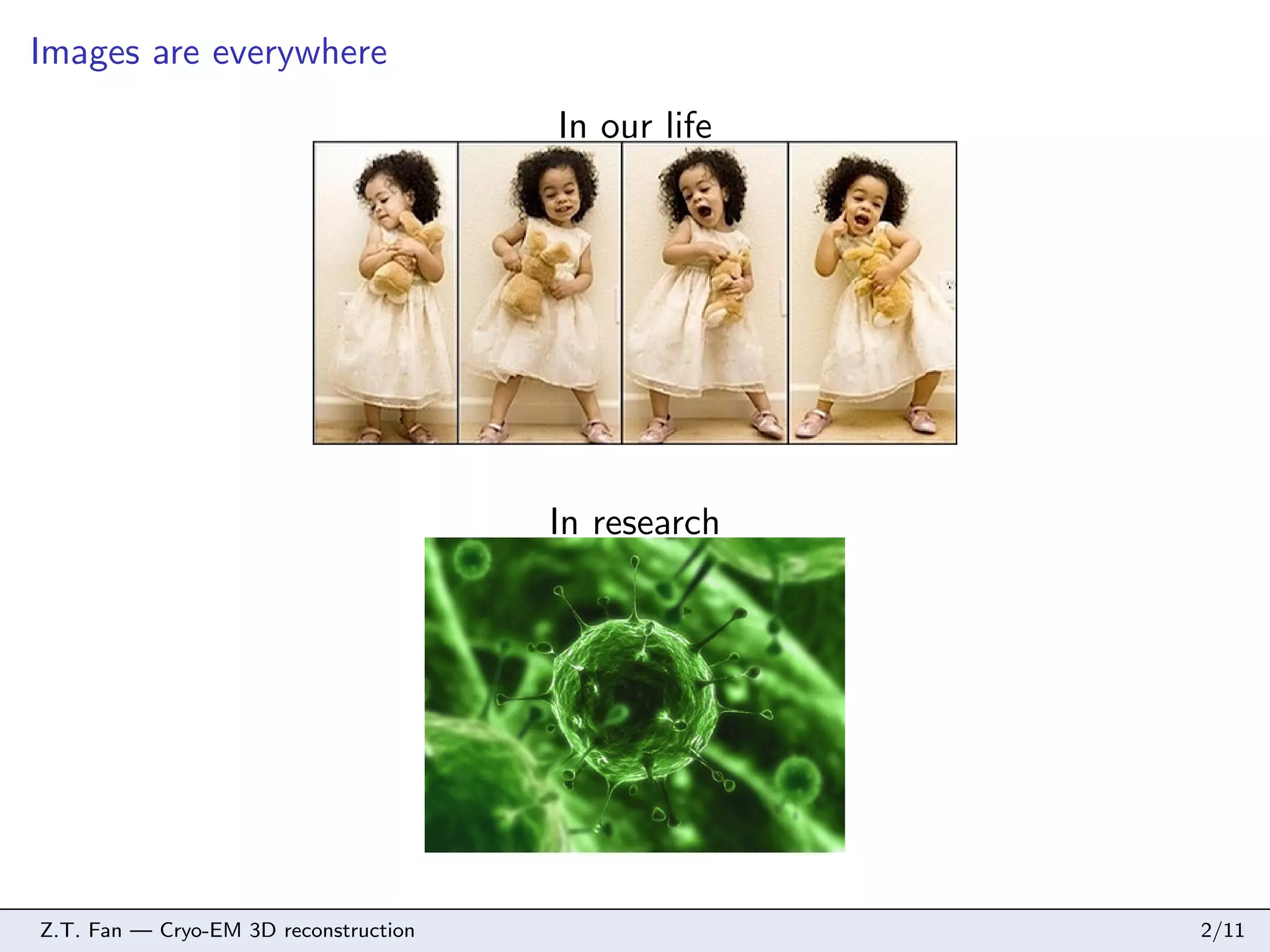
Images are everywhere
In our life

In research

Z.T. Fan — Cryo-EM 3D reconstruction

2/11
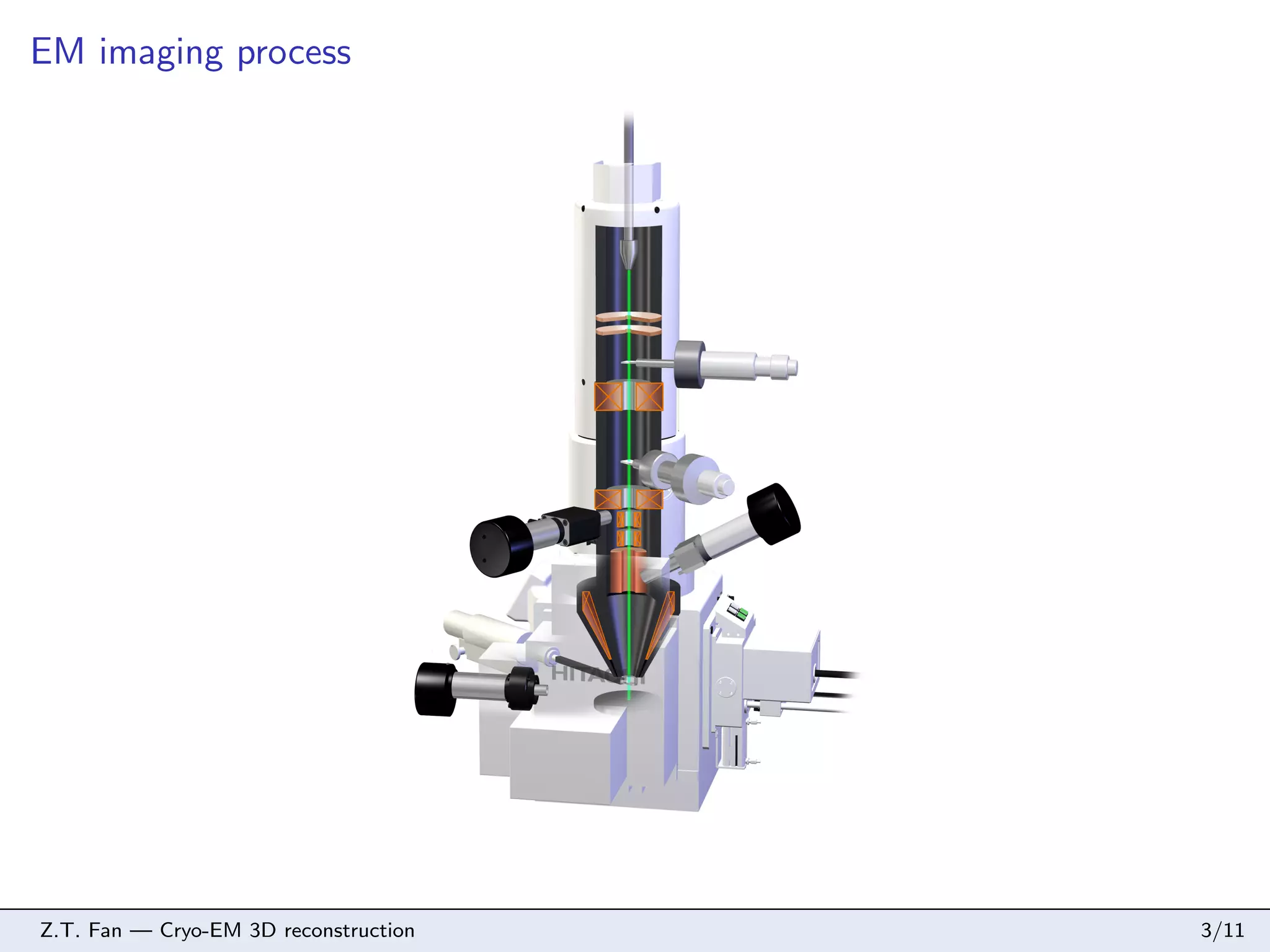
EM imaging process

Z.T. Fan — Cryo-EM 3D reconstruction

3/11
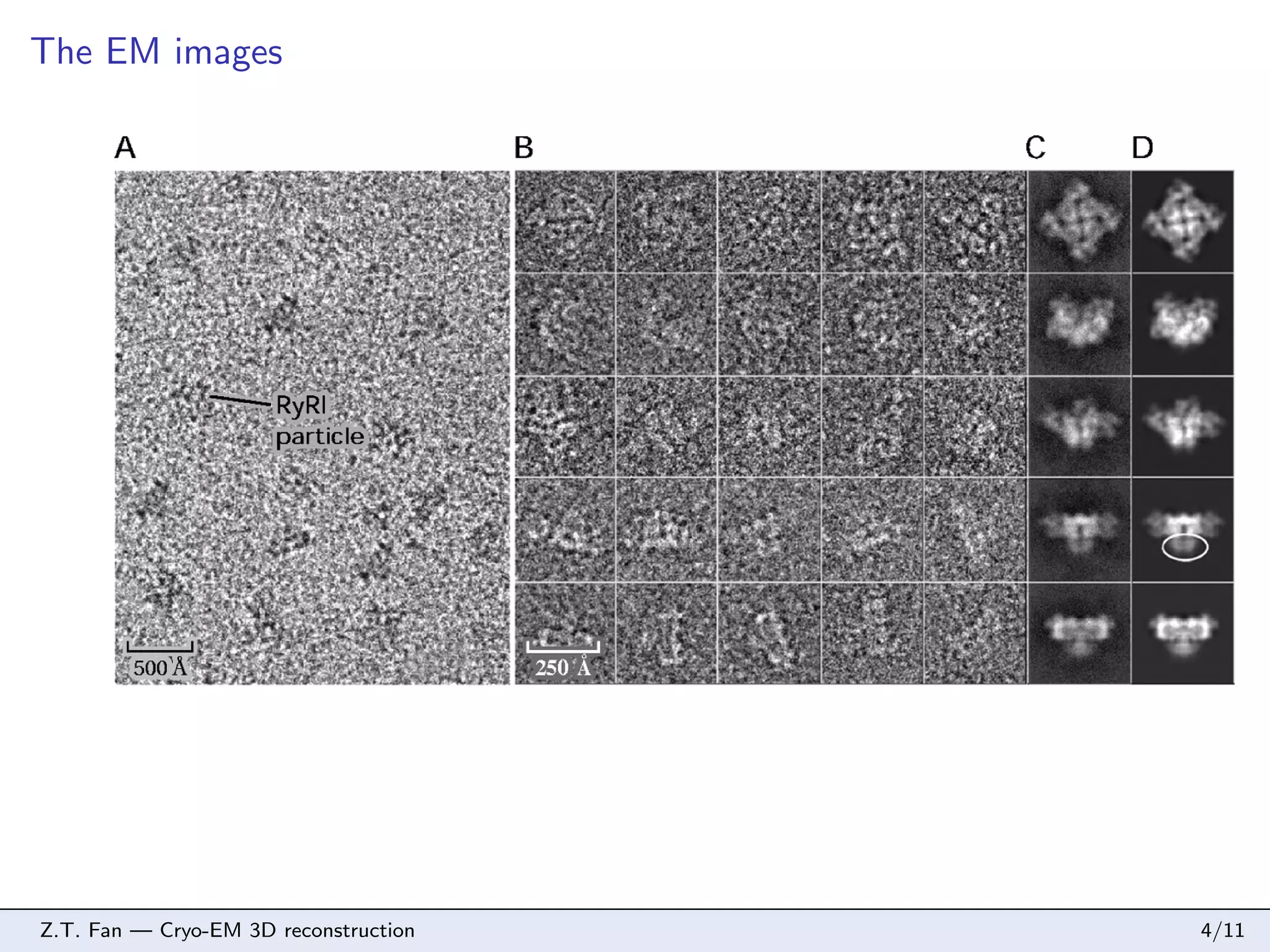
The EM images

Z.T. Fan — Cryo-EM 3D reconstruction

4/11
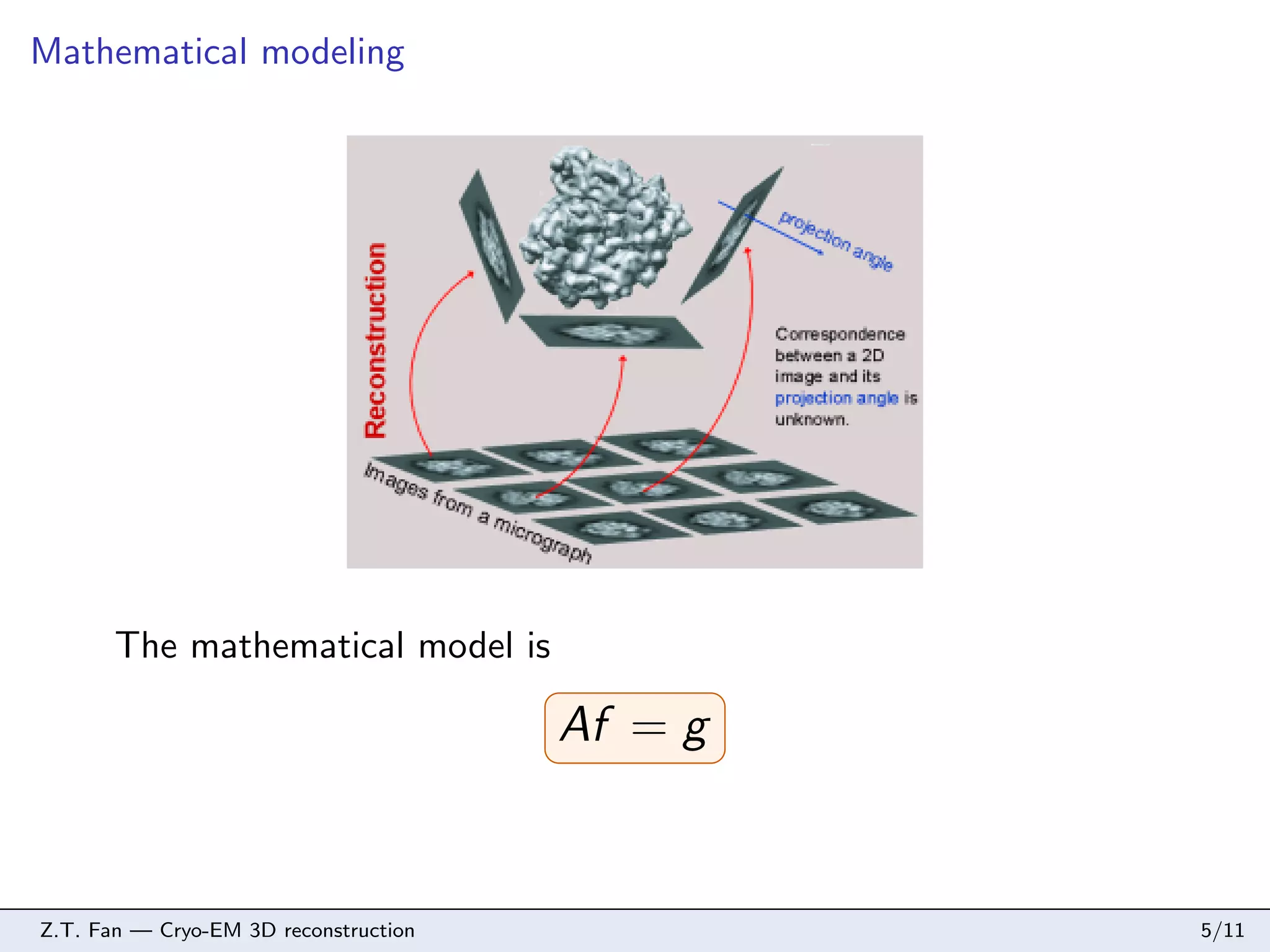
Mathematical modeling

The mathematical model is

Af = g

Z.T. Fan — Cryo-EM 3D reconstruction

5/11
Challenges

Challenges:
large noise
large data: 100, 000 projections with size 512
A is hard to write out
Contribution
Proposed a memory-saving tight wavelet frame based
algorithm
Done the convergence analysis of this algorithm

Z.T. Fan — Cryo-EM 3D reconstruction

6/11
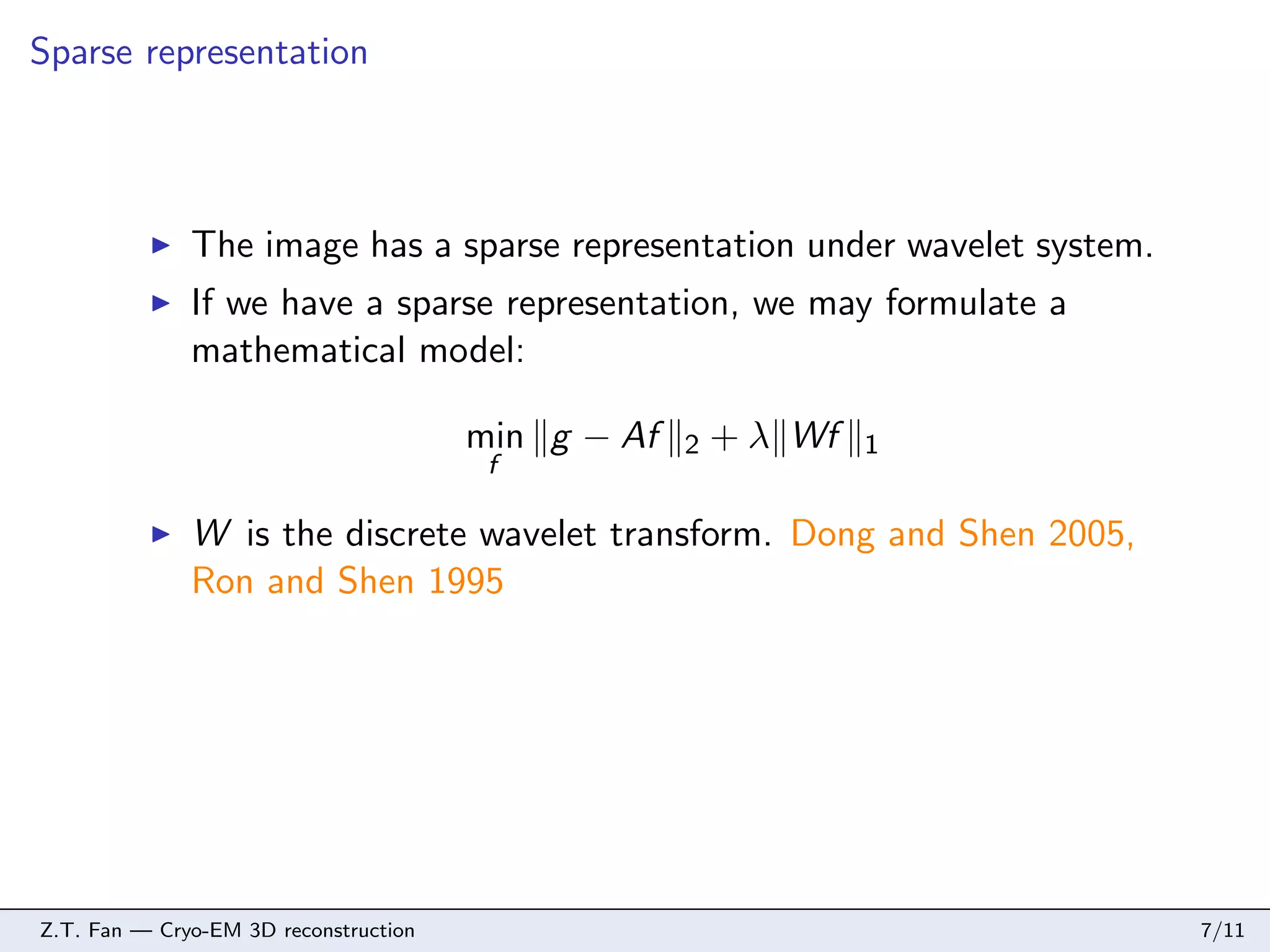
Sparse representation

The image has a sparse representation under wavelet system.
If we have a sparse representation, we may formulate a
mathematical model:
min g − Af
f

2

+ λ Wf

1

W is the discrete wavelet transform. Dong and Shen 2005,
Ron and Shen 1995

Z.T. Fan — Cryo-EM 3D reconstruction

7/11
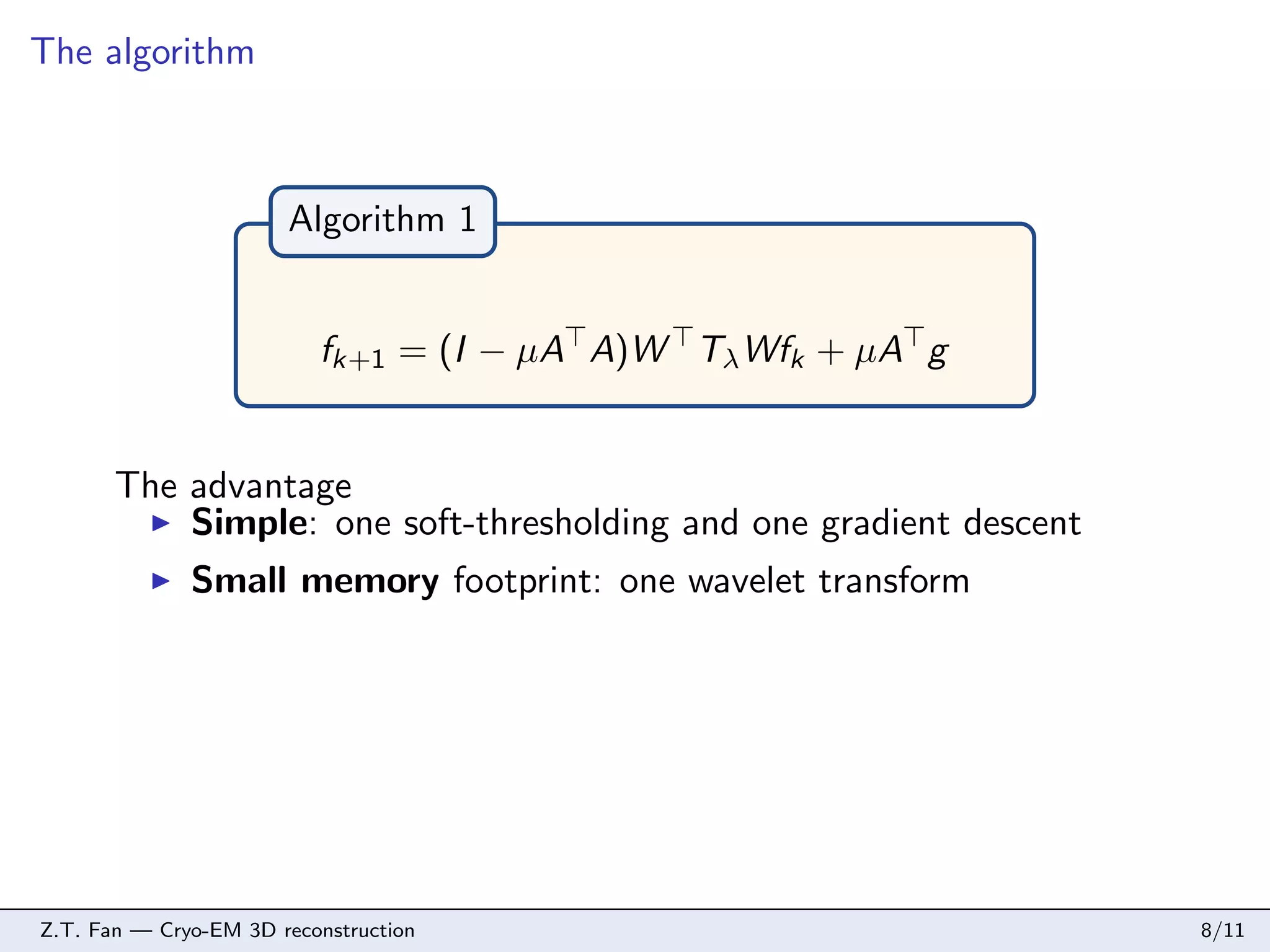
The algorithm

Algorithm 1
fk+1 = (I − µA A)W Tλ Wfk + µA g

The advantage
Simple: one soft-thresholding and one gradient descent
Small memory footprint: one wavelet transform

Z.T. Fan — Cryo-EM 3D reconstruction

8/11
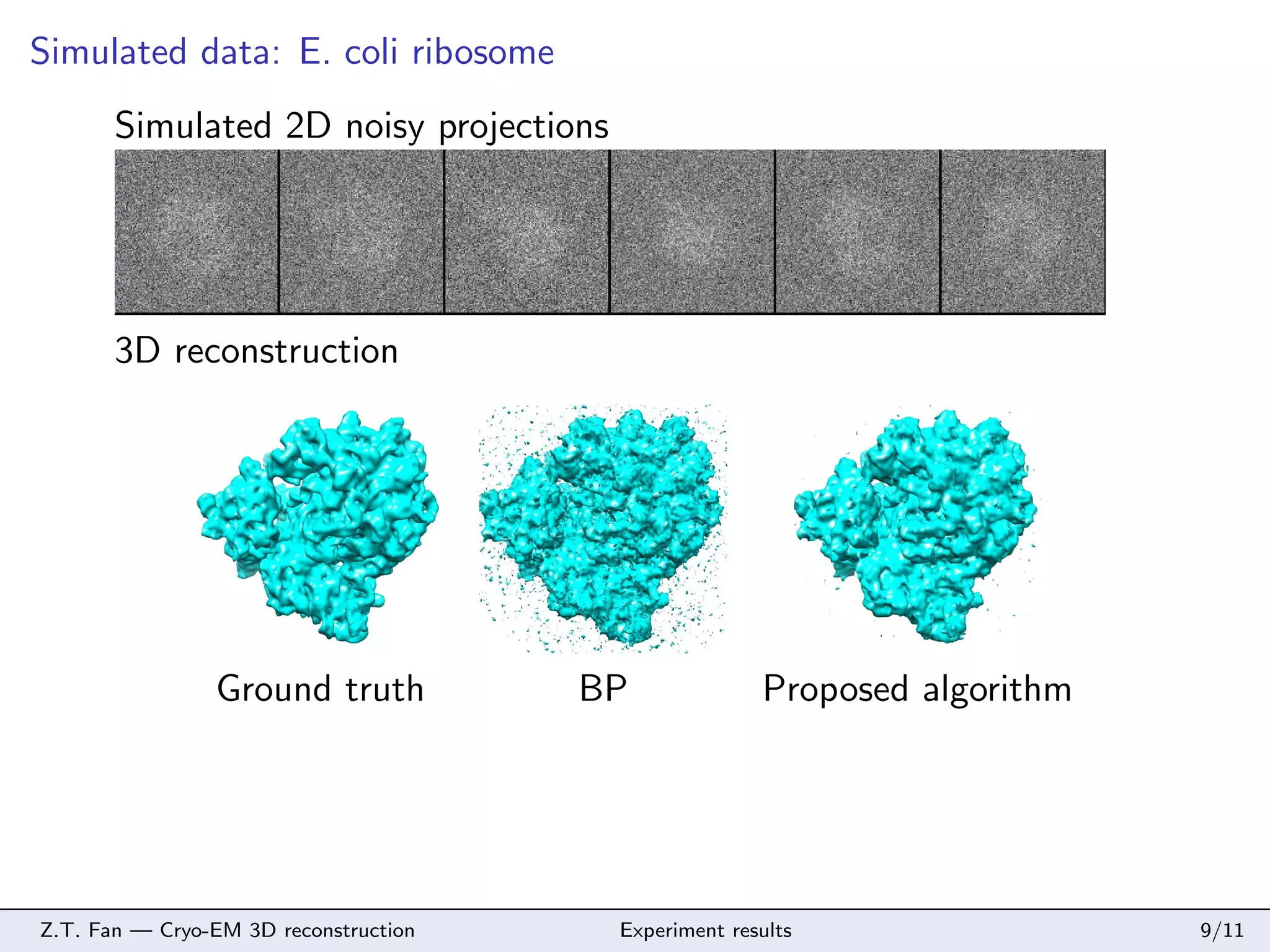
Simulated data: E. coli ribosome
Simulated 2D noisy projections

3D reconstruction

Ground truth

Z.T. Fan — Cryo-EM 3D reconstruction

BP

Proposed algorithm

Experiment results

9/11
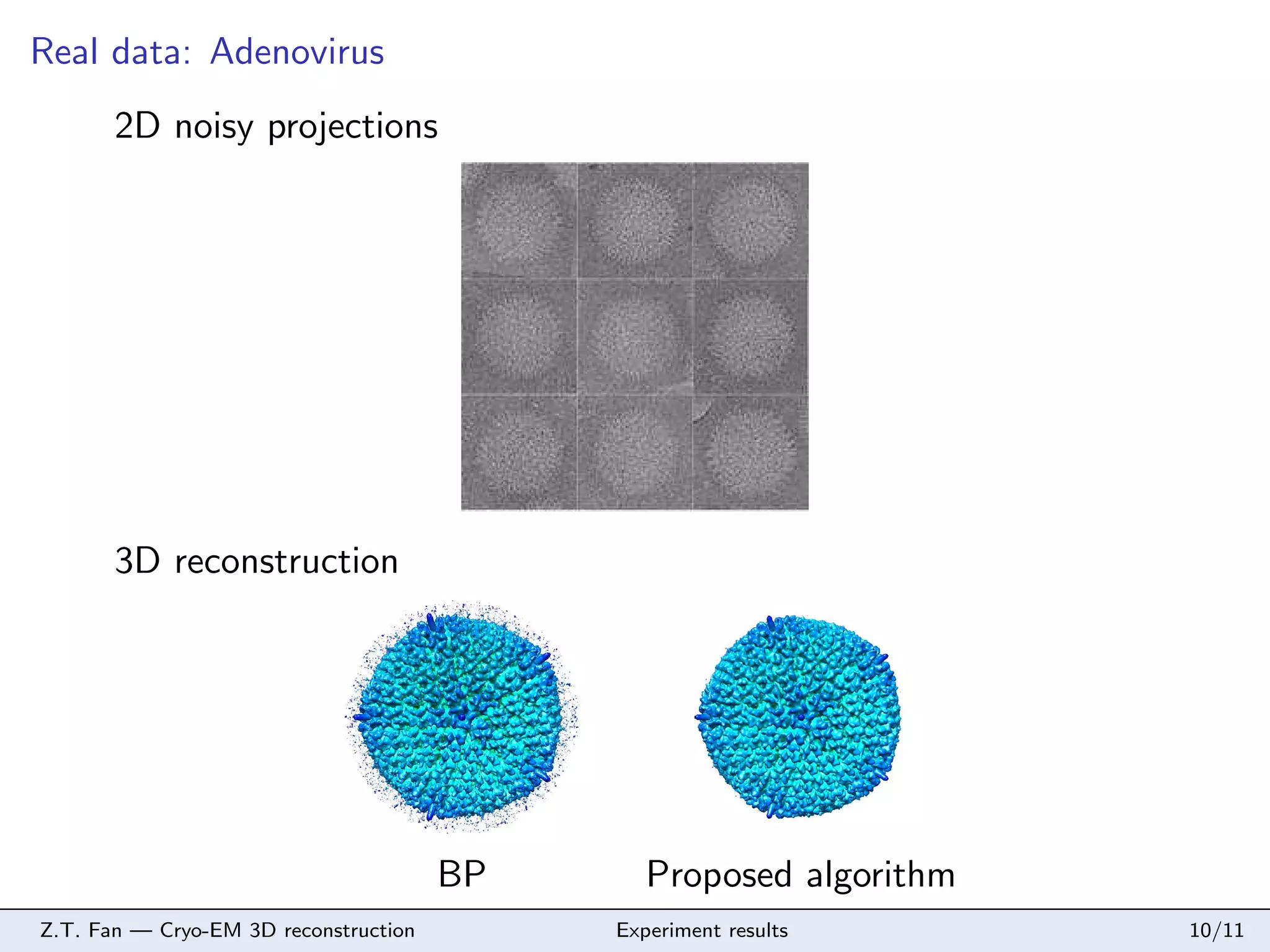
Real data: Adenovirus
2D noisy projections

3D reconstruction

BP
Z.T. Fan — Cryo-EM 3D reconstruction

Proposed algorithm
Experiment results

10/11
Thank you!

Special thanks to
DR Li Ming, Chinese Academy of Science
Prof Ji Hui, NUS mathematics
Prof Shen Zuowei, NUS mathematics

Z.T. Fan — Cryo-EM 3D reconstruction

Acknowledgement

11/11

EM 3D reconstruction

  • 1.
    Cryo-EM 3D reconstruction FanZhitao NUS Graduate School February 20, 2014
  • 2.
    Images are everywhere Inour life In research Z.T. Fan — Cryo-EM 3D reconstruction 2/11
  • 3.
    EM imaging process Z.T.Fan — Cryo-EM 3D reconstruction 3/11
  • 4.
    The EM images Z.T.Fan — Cryo-EM 3D reconstruction 4/11
  • 5.
    Mathematical modeling The mathematicalmodel is Af = g Z.T. Fan — Cryo-EM 3D reconstruction 5/11
  • 6.
    Challenges Challenges: large noise large data:100, 000 projections with size 512 A is hard to write out Contribution Proposed a memory-saving tight wavelet frame based algorithm Done the convergence analysis of this algorithm Z.T. Fan — Cryo-EM 3D reconstruction 6/11
  • 7.
    Sparse representation The imagehas a sparse representation under wavelet system. If we have a sparse representation, we may formulate a mathematical model: min g − Af f 2 + λ Wf 1 W is the discrete wavelet transform. Dong and Shen 2005, Ron and Shen 1995 Z.T. Fan — Cryo-EM 3D reconstruction 7/11
  • 8.
    The algorithm Algorithm 1 fk+1= (I − µA A)W Tλ Wfk + µA g The advantage Simple: one soft-thresholding and one gradient descent Small memory footprint: one wavelet transform Z.T. Fan — Cryo-EM 3D reconstruction 8/11
  • 9.
    Simulated data: E.coli ribosome Simulated 2D noisy projections 3D reconstruction Ground truth Z.T. Fan — Cryo-EM 3D reconstruction BP Proposed algorithm Experiment results 9/11
  • 10.
    Real data: Adenovirus 2Dnoisy projections 3D reconstruction BP Z.T. Fan — Cryo-EM 3D reconstruction Proposed algorithm Experiment results 10/11
  • 11.
    Thank you! Special thanksto DR Li Ming, Chinese Academy of Science Prof Ji Hui, NUS mathematics Prof Shen Zuowei, NUS mathematics Z.T. Fan — Cryo-EM 3D reconstruction Acknowledgement 11/11