SI SESSION
1-2
1.0 Soils and their
classifications
DIFFERENT CLASSIFICATION SYSTEMS
Classification is based on the following physical properties-
• Particle size distribution
• Liquid Limit (LL)
• Plasticity Index (PI)
3 Commonly used systems –
1. Unified Soil Classification system (USCS)
2. American Association of State Highways and Transportation Officials
(AASHTO)
3. British Standard/ MIT system
1.USCS
- ONLY NEED SIEVE ANALYSIS AND ATTERBERG LIMITS TO CLASSIFY SOIL.
- The coarse grained soils are those having more than 50% of soil being retained on the
No.200 sieve [0.075mm].
- Fine-grained soils are those that allow more than 50% to pass through the No.200
sieve.
% Gravel = % retained on No.4 sieve (4.75mm opening)
% Sand= % retained between No.200 sieve on No.4 sieve
% Fines= % passing No.200 sieve
G- Gravel
S- Sand
M-Inorganic Silt
C-Inorganic clay
O- Organic
silts/clays
W- Well-graded
P- poorly graded
L- low plasticity (LL
<50)
H- High plasticity
(LL>50)
PARTICLE DISTRIBUTION CURVE
SIEVE SIZE (MM)
%
FINER
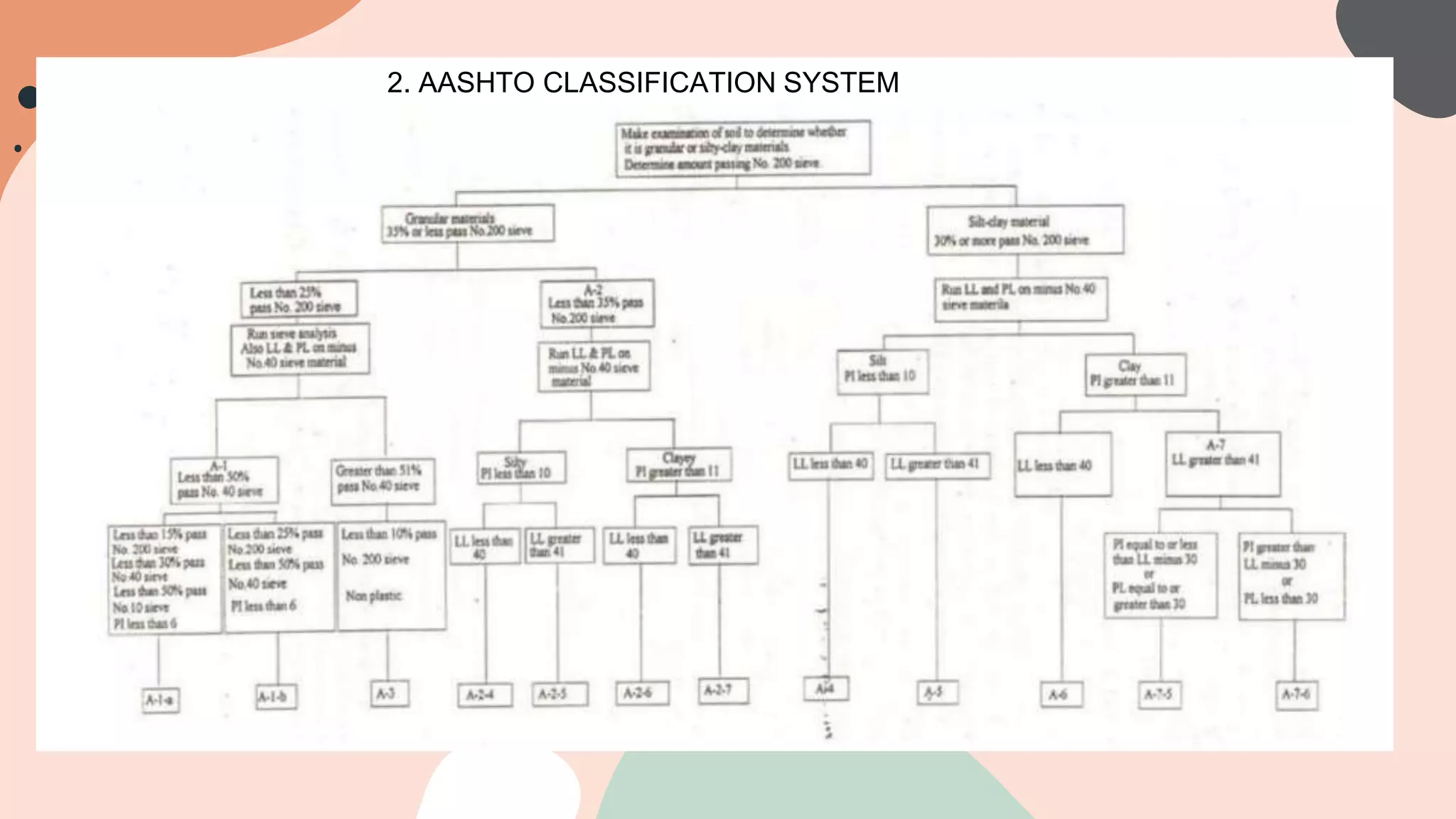
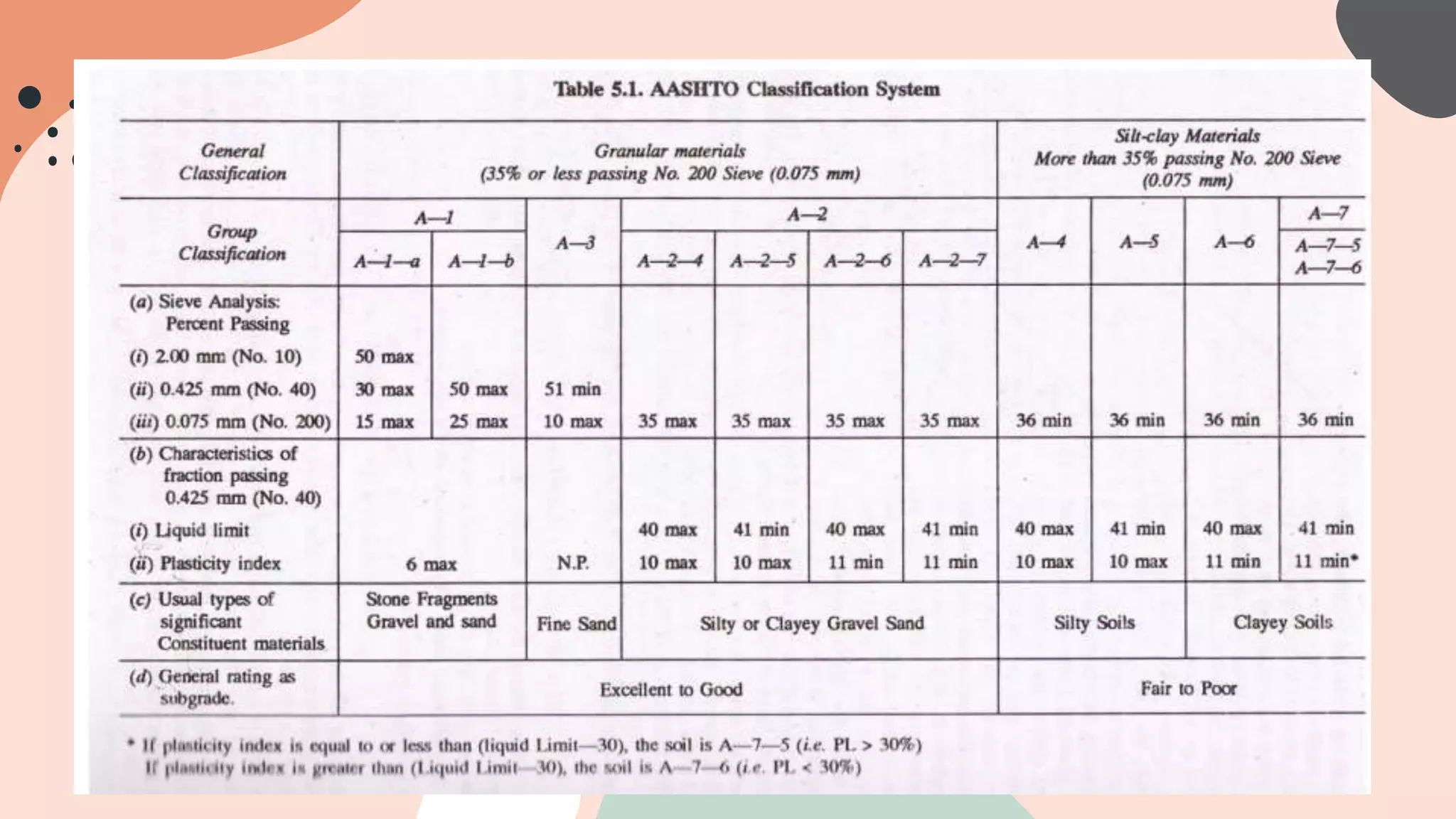
2. AASHTO CLASSIFICATION SYSTEM
SI SESSION
1-2
2.0 Soil Phase
Relations
Definitions
Soils generally contain soil grains, water and air,
which are known as the three phases. Dry soils do
not have water, and all the voids are filled by air.
Saturated soils do not have air, and the voids are
filled by water only.
W = M × 𝑔
𝜌 =
𝑚
𝑉
(SI unit kg/m3)
𝛾 = 𝜌 × 𝑔 ( SI Unit KN/m3)
Unit weight of water (𝛾𝑤 = 9.81 𝐾𝑁/𝑚3)
Volumetric ratios-
𝑉𝑊 =
𝑊𝑊
𝛾𝑊
Gs for most soils
=2.65
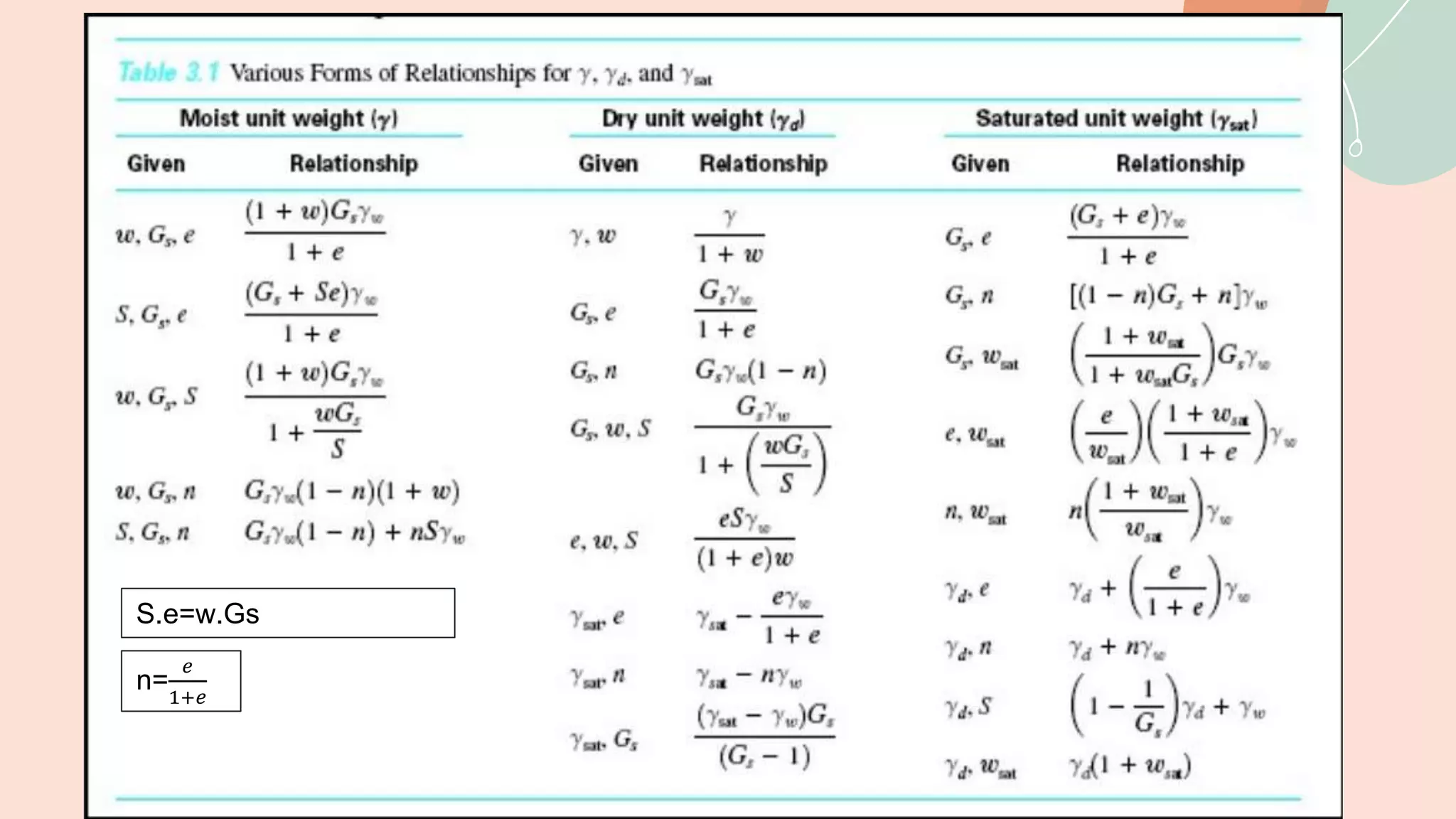
S.e=w.Gs
n=
𝑒
1+𝑒

PPT- SOIL CLASSIFICATION

  • 1.
    SI SESSION 1-2 1.0 Soilsand their classifications
  • 2.
    DIFFERENT CLASSIFICATION SYSTEMS Classificationis based on the following physical properties- • Particle size distribution • Liquid Limit (LL) • Plasticity Index (PI) 3 Commonly used systems – 1. Unified Soil Classification system (USCS) 2. American Association of State Highways and Transportation Officials (AASHTO) 3. British Standard/ MIT system
  • 3.
    1.USCS - ONLY NEEDSIEVE ANALYSIS AND ATTERBERG LIMITS TO CLASSIFY SOIL. - The coarse grained soils are those having more than 50% of soil being retained on the No.200 sieve [0.075mm]. - Fine-grained soils are those that allow more than 50% to pass through the No.200 sieve. % Gravel = % retained on No.4 sieve (4.75mm opening) % Sand= % retained between No.200 sieve on No.4 sieve % Fines= % passing No.200 sieve
  • 5.
    G- Gravel S- Sand M-InorganicSilt C-Inorganic clay O- Organic silts/clays W- Well-graded P- poorly graded L- low plasticity (LL <50) H- High plasticity (LL>50)
  • 7.
  • 8.
  • 10.
    SI SESSION 1-2 2.0 SoilPhase Relations
  • 11.
    Definitions Soils generally containsoil grains, water and air, which are known as the three phases. Dry soils do not have water, and all the voids are filled by air. Saturated soils do not have air, and the voids are filled by water only. W = M × 𝑔 𝜌 = 𝑚 𝑉 (SI unit kg/m3) 𝛾 = 𝜌 × 𝑔 ( SI Unit KN/m3) Unit weight of water (𝛾𝑤 = 9.81 𝐾𝑁/𝑚3)
  • 12.
  • 13.
    Gs for mostsoils =2.65
  • 14.