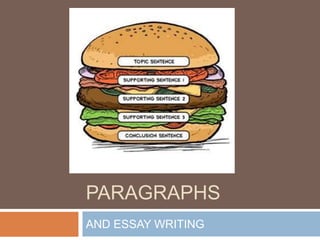
PARAGRAPHS
AND ESSAY WRITING
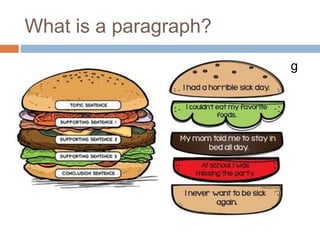
What is a paragraph?
 Group of sentences arranged to give meaning
to thought, idea, or opinion.
 Made of three basic parts:
 Introduction: introduces the topic
 Body: presents ideas that support the topic
 Conclusion: ties it all together
Basic features of a paragraph:
 Unity
 The sentences within the paragraph present and
support one main idea.
 i.e. main idea is about eating Italian cuisine,
sentences should not be talking about aliens on mars.
 Completeness
 Paragraph says everything it needs to say.
 i.e. your thought does not fall short (you fully tell your
story of how you lost your diary), but there is not extra
information the reader does not need (how your best
friend’s cousin’s grandfather lost his diary once)
Basic features of a paragraph
 Coherence
 The same way the body sentences should relate
back to the topic sentence, they should make
sense with each other in terms of timeline, and
smooth progression from one idea to the next.
 i.e. should not feel like jumping around, it follows order
of events
 Emphasis/Order
 The sentence patterns/meaning can easily be
followed by the reader, i.e. general to specific,
cause to effect, abstract to concrete, etc.
Basic features of a paragraph:
Topic Sentence
 Introduces topic of paragraph without announcing
it
 Hooks the reader and makes them want to read
 Usually first sentence, but can be anywhere
 Provides transition from previous sentence
No: The topic of this paragraph is electing me as
your class officer.
Yes: As class officer I can make your wildest dreams
of what our class can be a reality.
The Good, The Bad, and The
Confusing
Mornings are hard and I don’t like waking up.
There’s a lot to do in the morning, like brush my
teeth, comb my hair, and remember to pack my
bag for school. I can see why people sleep in
until noon. If I could I would sleep in all the time,
too! Sometimes I prefer bacon and eggs for
breakfast and sometimes I would rather have
plain old cereal. I’m always getting in fights with
my family, too! I guess we don’t have a choice
though, we have to wake up as human beings!
The Good, The Bad, and The
Confusing
They say that the early bird catches the worm, but I am no
good at waking up early in the mornings. I am always grumpy and
tired, as if a thousand lifetimes of sleep would never be enough to
satisfy me. I drag my heavy limbs to the bathroom, argue with my
siblings over the sink while brushing our teeth and washing our
faces. Hardly a great way to start off my mornings. Then I will sit on
my bed in front of the fan for a while to slowly clear my mind of the
remnants of sleep. The rest of my morning is spent making
breakfast and making sure everyone is ready for the school day
ahead. As hard as it is, waking up early is necessary to make sure
we get to where we need to be on time, to beat traffic, and
complete our tasks. And most importantly, so that I can have the
precious moment, when we have 10 extra minutes, of sitting in the
living room with my siblings, bowls of cereal in our hands, watching
early morning cartoons, and spending time together.
Big Four: Kinds of Paragraphs
 Expository: an informative paragraph that
may compare, contrast, list, summarize or
discuss different types of information.
 i.e. write about the meaning of friendship, movie
or book review, how to cook, fish, be a good
friend, etc.
 Topic sentence should contain main idea, and
following sentences support or further explain the
main idea.
Expository Paragraph Example
Body language is a very important form of communication that is
not often discussed or thought about. Body language is the unconscious
way we communicate our inner feelings, even when we are trying to hide
it. Having good body language will help when having interviews, when
presenting projects or public speaking, when trying to sell a product, or
simply when you are trying to make new friends. When you show you
are open, honest, and paying attention to the other person with what you
do with your body, it will make you appear more trustworthy and like
someone people want to be around. Positive body language can look
like eye contact, using open hands instead of fists when talking, turning
your body to the person you are speaking to, and even simply nodding
your head to let them know you are listening. Negative body language,
in contrast, can look like little to no eye contact, body is turned away
from the speaker, and you have your arms crossed or hands in your
pockets. Therefore, it is important to always be mindful about what your
body language is communicating.
Big Four: Kinds of Paragraphs
 Descriptive: Paragraph that uses the five
senses (sight, smell, touch, taste, and
auditory). Should paint a mental picture of
what it is you are trying to say.
 i.e. Your best friend and describe what they look
like and what they are like, describe a day at the
beach, describe the local bakery.
 Topic sentence should include the focus of your
paragraph, and the following sentences will
describe the focus.
Descriptive Paragraph Example
My favorite place in the world is my living room on a particularly
cold, winter day. I am surrounded by my mother’s softest and thickest
blanket that feels heavy and warm around my shoulders, my fingers
gliding over the fabric that is as smooth as water. I do not tend to wear
socks, so the cold wood floor licks at my bare feet causing a shiver to
go up my spine and goosebumps to run up my arms and legs. I clutch
the warm cup of hot cocoa my sister made closer to my dry lips, the
liquid sweet on my tongue and the steam rising up in soft gray clouds
that warm my face as if the sun were directly shining on me. I tuck my
feet under me, making sure to warm them up, as I burn my tongue
again, my face scrunching up at the sharp pain. This is what I love the
most, being relaxed and warm, a delicious drink in my hand, and the
beautiful view of the white fluffy snow that looks like little white cotton
balls, fluttering softly against the backdrop of the gray sky and bare
trees.
Big Four: Kinds of Paragraphs
 Narrative: Tells a story. Expresses chronology
of event, and give information to describe what
the event is.
 i.e. the day you learned to ride a bike, when you
became friends with your classmate, a fun day, a
sad day, etc.
Narrative Paragraph Example
Today has to officially be the most embarrassing day in all of my
13 ears of living. My face burned as the blush became apparent on my
cheeks as I remembered that terrible event, my mother by my side telling
me that I was “just exaggerating” and “it wasn’t that bad”, while trying and
failing to hide her laughter. If the same woman who gave birth to me was
laughing at me, then strangers would definitely be making fun of me, too.
I mean, it’s not like I meant to eat the extra large supreme chili cheese
hot dog right before getting on the Mind Eraser ride at my town’s carnival
that everyone I knew came to. And I definitely did not mean to projectile
vomit all of the cutest girl at school, who I just so happen to have the
biggest crush on, while she was waiting with her friends to get on the
same ride, not only ruining her very pretty, and probably expensive, baby
blue dress, but making her cry, too. I could just disappear, I thought to
myself as I stared in horror at what I had done, like how great would it be
for the ground to just open up and swallow me whole. At least my mom
found this, the worst moment of my life, absolutely hilarious.
Big Four: Kinds of Paragraphs
 Persuasive: Intended to gain reader’s support
on the topic of your choice or an opinion.
 i.e. why you are the best candidate running for
student council president, the canteen should
always be stocked with turon and yakult, why we
should have free donuts on international donut
day
 Topic sentence should contain your
argument/topic you are trying to convince the
reader to support you on, and following sentences
will include the reasons why they should take
your side
Persuasive Paragraph Example
Imagine a school that was clean and spotless, with beautiful
flowers, as well as delicious and nutritious fruits growing in the gardens we
build. With proper waste segregation and imagination, we could recycle and
reuse the materials we do not think twice about throwing away in landfills
that will destroy our environment for hundreds of years after we have used
it. Imagine the amazing and mighty animals we share this world with, who
can do nothing as they watch their homes and habitats cut down, taken over
by towers and towers of garbage and toxic waste. Imagine our homes as we
know it becoming an Atlantis in only a decade or two, most of our world as
know it submerged under water. Forest fires, dying coral reeds, endangered
animals, stronger and more destructive storms destroying our homes. Now
think, what can you do as one young person? You can start off small like
replacing disposable, single-use plastics with alternatives such as shampoo
bars, eco bags and reusable straws and utensils. It can look like shopping
for vegetables and meat at the palengke where it is fresh and plastic free,
and refusing plastic pouches of water and juice and ask if they can put it in
your reusable water bottle. Slowly, but surely, one person and one change
Common Mistakes
 Too short
 1-3 sentence paragraphs is way too short! Shoot to have 5-7
sentences in a paragraph.
 Too long
 After 8-9 sentences, it gets a little boring/too much.
 No structure
 Need introductory sentence, several body sentences, and then
the conclusion – in that order!
 Absence of a topic sentence
 Make sure you let the reader know what it is they are
reading/what the main topic is of your paragraph
 No focus
 Make sure the paragraph is not a mess of random ideas, but
that it all flows and makes sense together.
Now You Try
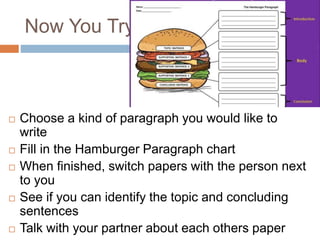
 Choose a kind of paragraph you would like to
write
 Fill in the Hamburger Paragraph chart
 When finished, switch papers with the person next
to you
 See if you can identify the topic and concluding
sentences
 Talk with your partner about each others paper

PPT Paragraphs.pptx

  • 1.
  • 2.
    What is aparagraph?  Group of sentences arranged to give meaning to thought, idea, or opinion.  Made of three basic parts:  Introduction: introduces the topic  Body: presents ideas that support the topic  Conclusion: ties it all together
  • 3.
    Basic features ofa paragraph:  Unity  The sentences within the paragraph present and support one main idea.  i.e. main idea is about eating Italian cuisine, sentences should not be talking about aliens on mars.  Completeness  Paragraph says everything it needs to say.  i.e. your thought does not fall short (you fully tell your story of how you lost your diary), but there is not extra information the reader does not need (how your best friend’s cousin’s grandfather lost his diary once)
  • 4.
    Basic features ofa paragraph  Coherence  The same way the body sentences should relate back to the topic sentence, they should make sense with each other in terms of timeline, and smooth progression from one idea to the next.  i.e. should not feel like jumping around, it follows order of events  Emphasis/Order  The sentence patterns/meaning can easily be followed by the reader, i.e. general to specific, cause to effect, abstract to concrete, etc.
  • 5.
    Basic features ofa paragraph: Topic Sentence  Introduces topic of paragraph without announcing it  Hooks the reader and makes them want to read  Usually first sentence, but can be anywhere  Provides transition from previous sentence No: The topic of this paragraph is electing me as your class officer. Yes: As class officer I can make your wildest dreams of what our class can be a reality.
  • 6.
    The Good, TheBad, and The Confusing Mornings are hard and I don’t like waking up. There’s a lot to do in the morning, like brush my teeth, comb my hair, and remember to pack my bag for school. I can see why people sleep in until noon. If I could I would sleep in all the time, too! Sometimes I prefer bacon and eggs for breakfast and sometimes I would rather have plain old cereal. I’m always getting in fights with my family, too! I guess we don’t have a choice though, we have to wake up as human beings!
  • 7.
    The Good, TheBad, and The Confusing They say that the early bird catches the worm, but I am no good at waking up early in the mornings. I am always grumpy and tired, as if a thousand lifetimes of sleep would never be enough to satisfy me. I drag my heavy limbs to the bathroom, argue with my siblings over the sink while brushing our teeth and washing our faces. Hardly a great way to start off my mornings. Then I will sit on my bed in front of the fan for a while to slowly clear my mind of the remnants of sleep. The rest of my morning is spent making breakfast and making sure everyone is ready for the school day ahead. As hard as it is, waking up early is necessary to make sure we get to where we need to be on time, to beat traffic, and complete our tasks. And most importantly, so that I can have the precious moment, when we have 10 extra minutes, of sitting in the living room with my siblings, bowls of cereal in our hands, watching early morning cartoons, and spending time together.
  • 8.
    Big Four: Kindsof Paragraphs  Expository: an informative paragraph that may compare, contrast, list, summarize or discuss different types of information.  i.e. write about the meaning of friendship, movie or book review, how to cook, fish, be a good friend, etc.  Topic sentence should contain main idea, and following sentences support or further explain the main idea.
  • 9.
    Expository Paragraph Example Bodylanguage is a very important form of communication that is not often discussed or thought about. Body language is the unconscious way we communicate our inner feelings, even when we are trying to hide it. Having good body language will help when having interviews, when presenting projects or public speaking, when trying to sell a product, or simply when you are trying to make new friends. When you show you are open, honest, and paying attention to the other person with what you do with your body, it will make you appear more trustworthy and like someone people want to be around. Positive body language can look like eye contact, using open hands instead of fists when talking, turning your body to the person you are speaking to, and even simply nodding your head to let them know you are listening. Negative body language, in contrast, can look like little to no eye contact, body is turned away from the speaker, and you have your arms crossed or hands in your pockets. Therefore, it is important to always be mindful about what your body language is communicating.
  • 10.
    Big Four: Kindsof Paragraphs  Descriptive: Paragraph that uses the five senses (sight, smell, touch, taste, and auditory). Should paint a mental picture of what it is you are trying to say.  i.e. Your best friend and describe what they look like and what they are like, describe a day at the beach, describe the local bakery.  Topic sentence should include the focus of your paragraph, and the following sentences will describe the focus.
  • 11.
    Descriptive Paragraph Example Myfavorite place in the world is my living room on a particularly cold, winter day. I am surrounded by my mother’s softest and thickest blanket that feels heavy and warm around my shoulders, my fingers gliding over the fabric that is as smooth as water. I do not tend to wear socks, so the cold wood floor licks at my bare feet causing a shiver to go up my spine and goosebumps to run up my arms and legs. I clutch the warm cup of hot cocoa my sister made closer to my dry lips, the liquid sweet on my tongue and the steam rising up in soft gray clouds that warm my face as if the sun were directly shining on me. I tuck my feet under me, making sure to warm them up, as I burn my tongue again, my face scrunching up at the sharp pain. This is what I love the most, being relaxed and warm, a delicious drink in my hand, and the beautiful view of the white fluffy snow that looks like little white cotton balls, fluttering softly against the backdrop of the gray sky and bare trees.
  • 12.
    Big Four: Kindsof Paragraphs  Narrative: Tells a story. Expresses chronology of event, and give information to describe what the event is.  i.e. the day you learned to ride a bike, when you became friends with your classmate, a fun day, a sad day, etc.
  • 13.
    Narrative Paragraph Example Todayhas to officially be the most embarrassing day in all of my 13 ears of living. My face burned as the blush became apparent on my cheeks as I remembered that terrible event, my mother by my side telling me that I was “just exaggerating” and “it wasn’t that bad”, while trying and failing to hide her laughter. If the same woman who gave birth to me was laughing at me, then strangers would definitely be making fun of me, too. I mean, it’s not like I meant to eat the extra large supreme chili cheese hot dog right before getting on the Mind Eraser ride at my town’s carnival that everyone I knew came to. And I definitely did not mean to projectile vomit all of the cutest girl at school, who I just so happen to have the biggest crush on, while she was waiting with her friends to get on the same ride, not only ruining her very pretty, and probably expensive, baby blue dress, but making her cry, too. I could just disappear, I thought to myself as I stared in horror at what I had done, like how great would it be for the ground to just open up and swallow me whole. At least my mom found this, the worst moment of my life, absolutely hilarious.
  • 14.
    Big Four: Kindsof Paragraphs  Persuasive: Intended to gain reader’s support on the topic of your choice or an opinion.  i.e. why you are the best candidate running for student council president, the canteen should always be stocked with turon and yakult, why we should have free donuts on international donut day  Topic sentence should contain your argument/topic you are trying to convince the reader to support you on, and following sentences will include the reasons why they should take your side
  • 15.
    Persuasive Paragraph Example Imaginea school that was clean and spotless, with beautiful flowers, as well as delicious and nutritious fruits growing in the gardens we build. With proper waste segregation and imagination, we could recycle and reuse the materials we do not think twice about throwing away in landfills that will destroy our environment for hundreds of years after we have used it. Imagine the amazing and mighty animals we share this world with, who can do nothing as they watch their homes and habitats cut down, taken over by towers and towers of garbage and toxic waste. Imagine our homes as we know it becoming an Atlantis in only a decade or two, most of our world as know it submerged under water. Forest fires, dying coral reeds, endangered animals, stronger and more destructive storms destroying our homes. Now think, what can you do as one young person? You can start off small like replacing disposable, single-use plastics with alternatives such as shampoo bars, eco bags and reusable straws and utensils. It can look like shopping for vegetables and meat at the palengke where it is fresh and plastic free, and refusing plastic pouches of water and juice and ask if they can put it in your reusable water bottle. Slowly, but surely, one person and one change
  • 16.
    Common Mistakes  Tooshort  1-3 sentence paragraphs is way too short! Shoot to have 5-7 sentences in a paragraph.  Too long  After 8-9 sentences, it gets a little boring/too much.  No structure  Need introductory sentence, several body sentences, and then the conclusion – in that order!  Absence of a topic sentence  Make sure you let the reader know what it is they are reading/what the main topic is of your paragraph  No focus  Make sure the paragraph is not a mess of random ideas, but that it all flows and makes sense together.
  • 17.
    Now You Try Choose a kind of paragraph you would like to write  Fill in the Hamburger Paragraph chart  When finished, switch papers with the person next to you  See if you can identify the topic and concluding sentences  Talk with your partner about each others paper