UNESCO Policy Guidelines on Digital Learning
and
Digital Open Schools
Fengchun Miao
Chief, Unit for Technology and AI in Education
UNESCO
Outline
• SEPTEMBER
1. UNESCO work to steer digital learning policies
2. Digital transformation: Call to Action of TES and a framework
3. Integrating digital content, capacities, and connectivity
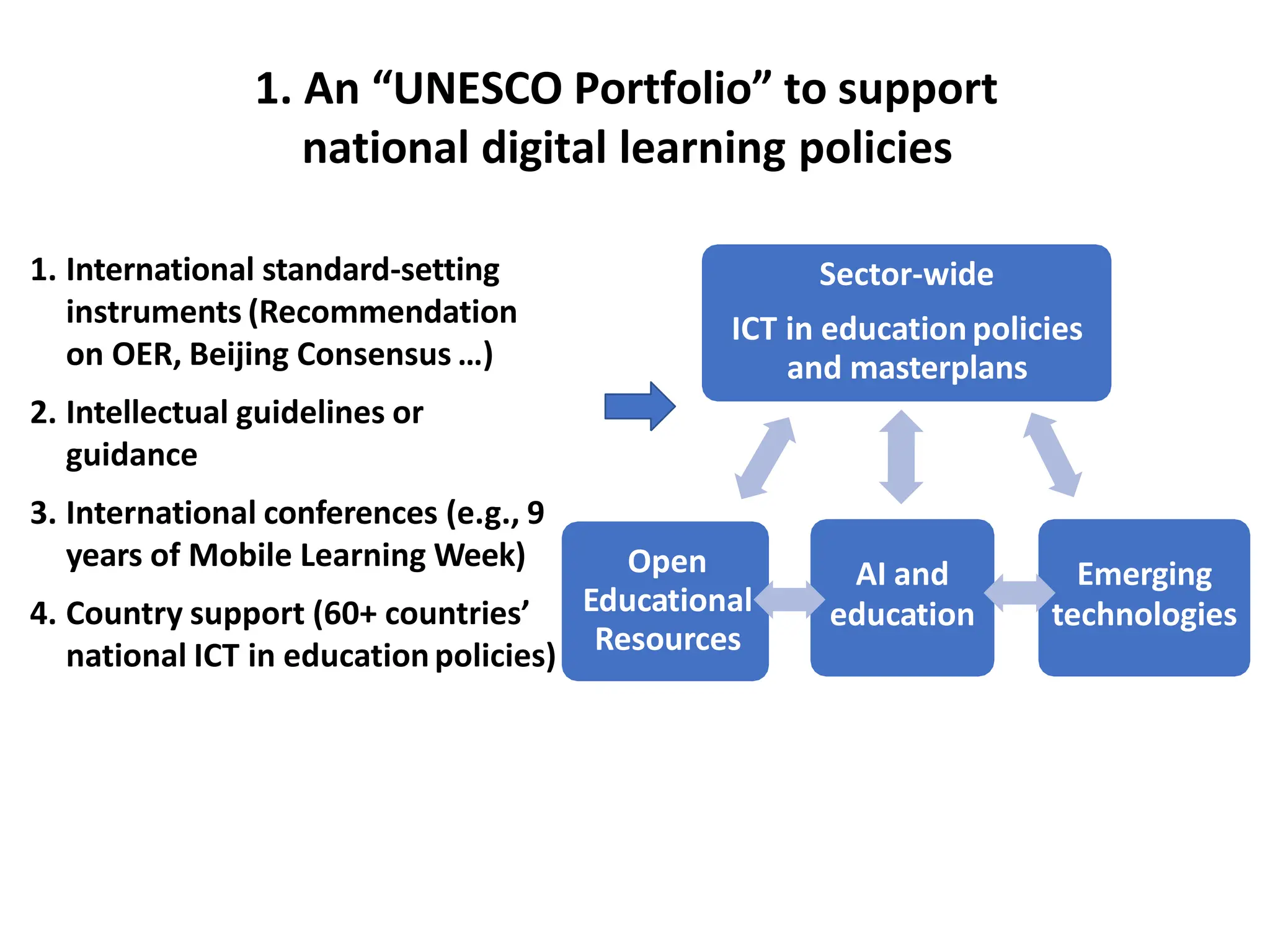
1. An “UNESCO Portfolio” to support
national digital learning policies
Open
Educational
Resources
Sector-wide
ICT in educationpolicies
and masterplans
Emerging
technologies
AI and
education
1. International standard-setting
instruments (Recommendation
on OER, Beijing Consensus …)
2. Intellectual guidelines or
guidance
3. International conferences (e.g., 9
years of Mobile Learning Week)
4. Country support (60+ countries’
national ICT in educationpolicies)
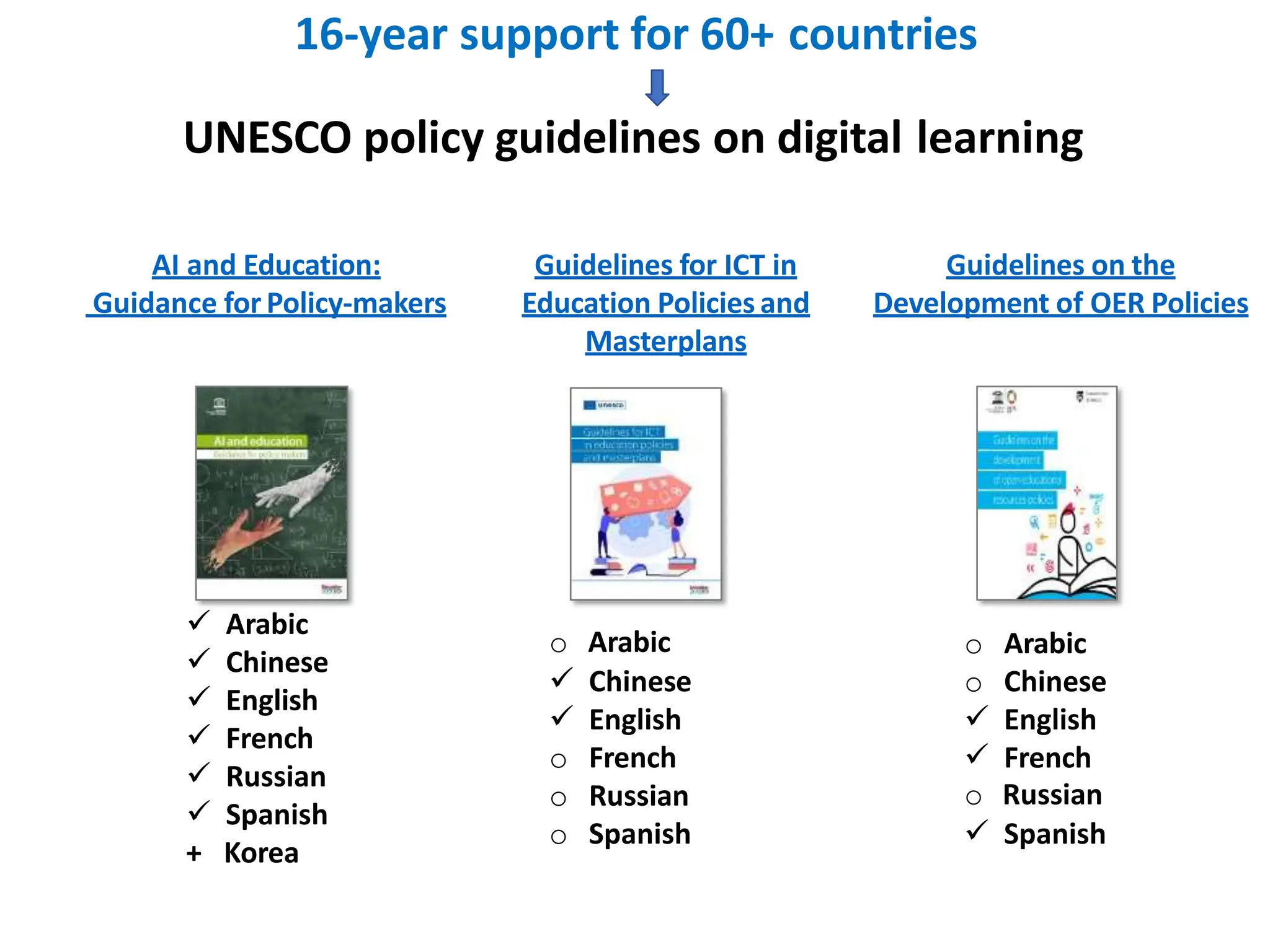
UNESCO policy guidelines on digital learning
Guidelines on the
Development of OER Policies
AI and Education:
Guidance for Policy-makers
Guidelines for ICT in
Education Policies and
Masterplans
 Arabic
 Chinese
 English
 French
 Russian
 Spanish
+ Korea
o Arabic
 Chinese
 English
o French
o Russian
o Spanish
o Arabic
o Chinese
 English
 French
o Russian
 Spanish
16-year support for 60+ countries
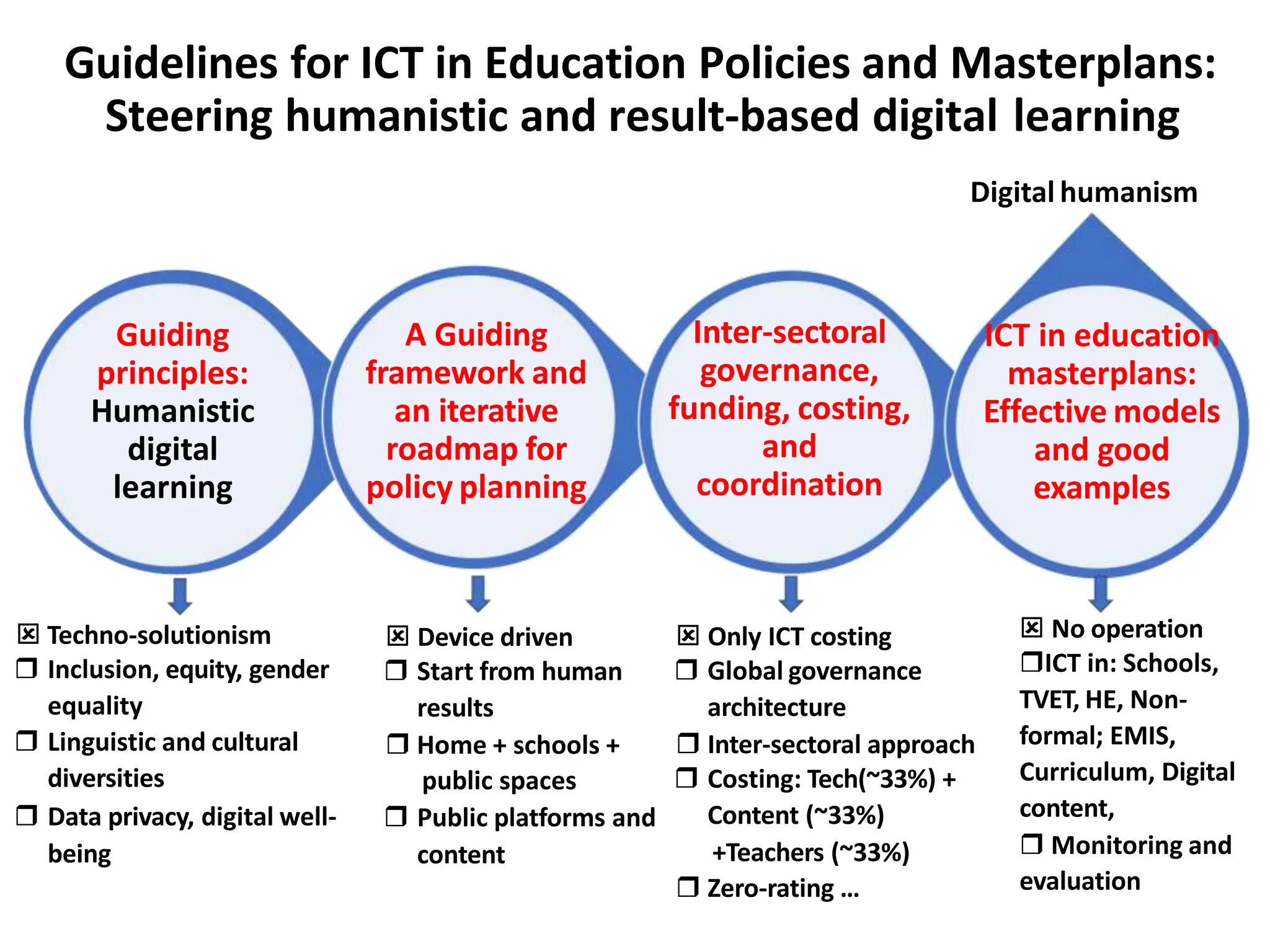
Guidelines for ICT in Education Policies and Masterplans:
Steering humanistic and result-based digital learning
Guiding
principles:
Humanistic
digital
learning
A Guiding
framework and
an iterative
roadmap for
policy planning
Inter-sectoral
governance,
funding, costing,
and
coordination
ICT in education
masterplans:
Effective models
and good
examples
 Device driven
 Start from human
results
 Home + schools +
public spaces
 Public platforms and
content
 Only ICT costing
 Global governance
architecture
 Inter-sectoral approach
 Costing: Tech(~33%) +
Content (~33%)
+Teachers (~33%)
 Zero-rating …
 Techno-solutionism
 Inclusion, equity, gender
equality
 Linguistic and cultural
diversities
 Data privacy, digital well-
being
Digital humanism
 No operation
ICT in: Schools,
TVET, HE, Non-
formal; EMIS,
Curriculum, Digital
content,
 Monitoring and
evaluation
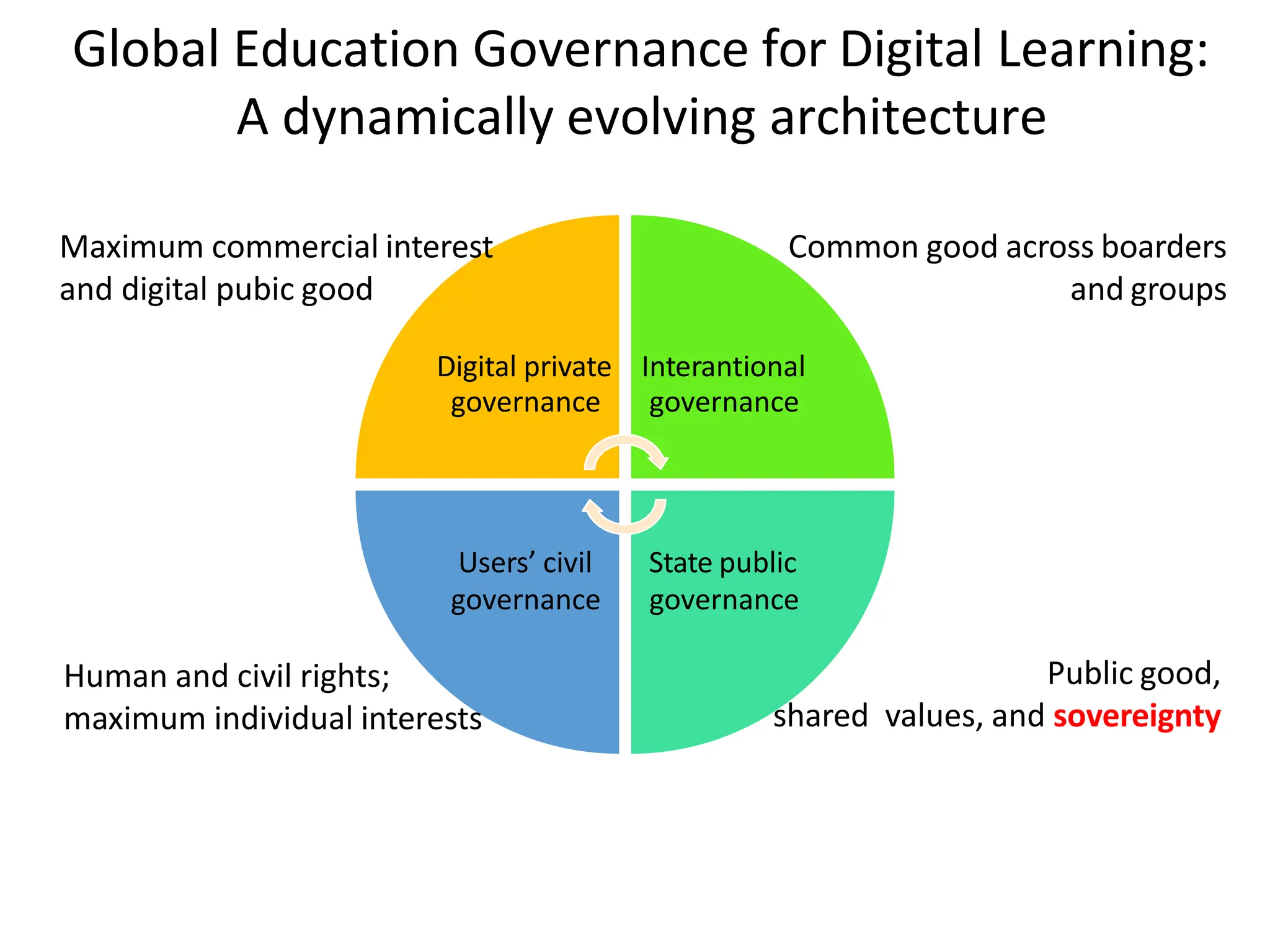
Global Education Governance for Digital Learning:
A dynamically evolving architecture
Digital private
governance
Interantional
governance
State public
governance
Users’ civil
governance
Maximum commercial interest
and digital pubic good
Common good across boarders
and groups
Public good,
shared values, and sovereignty
Human and civil rights;
maximum individual interests
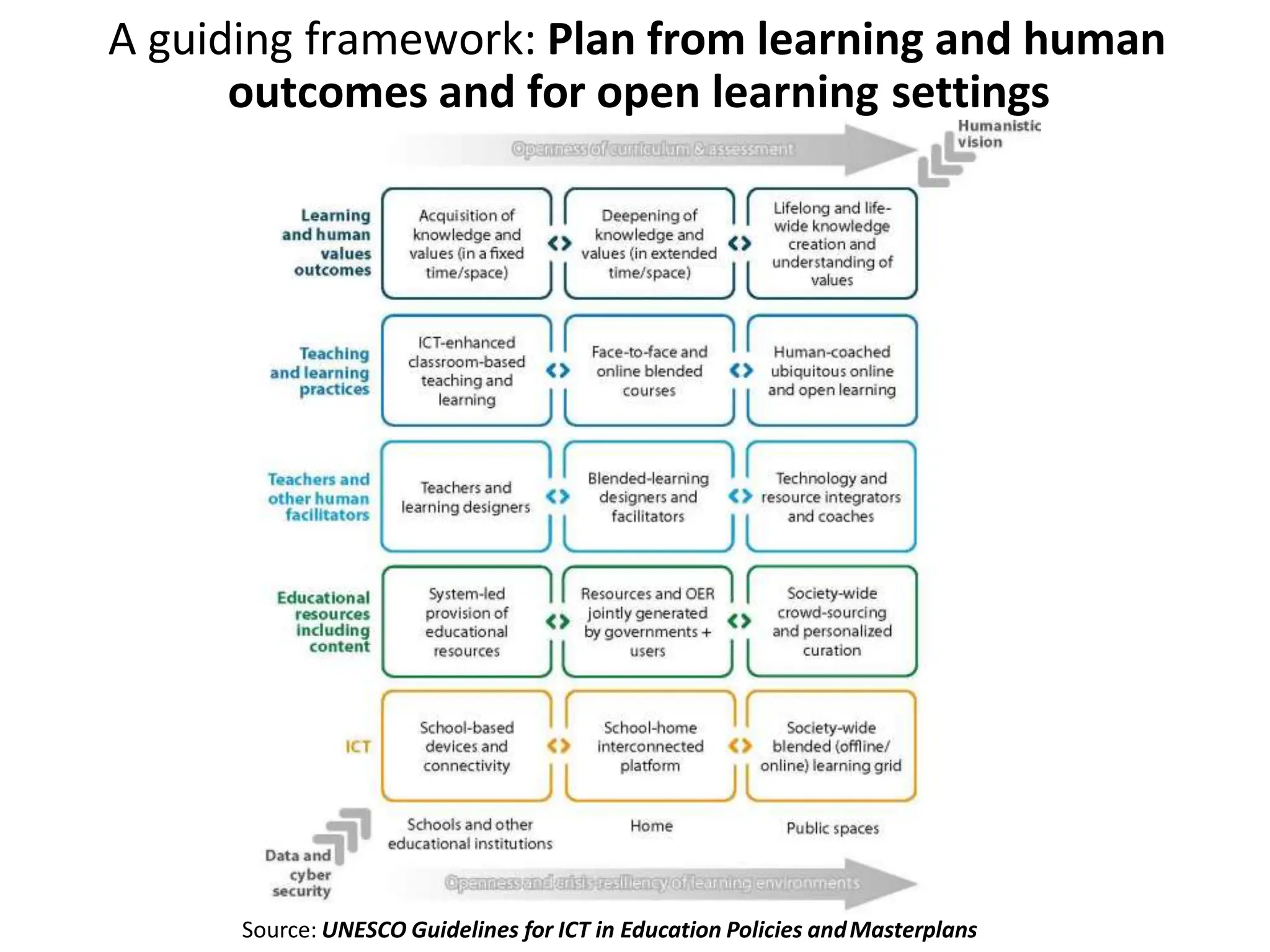
Source: UNESCO Guidelines for ICT in Education Policies andMasterplans
A guiding framework: Plan from learning and human
outcomes and for open learning settings
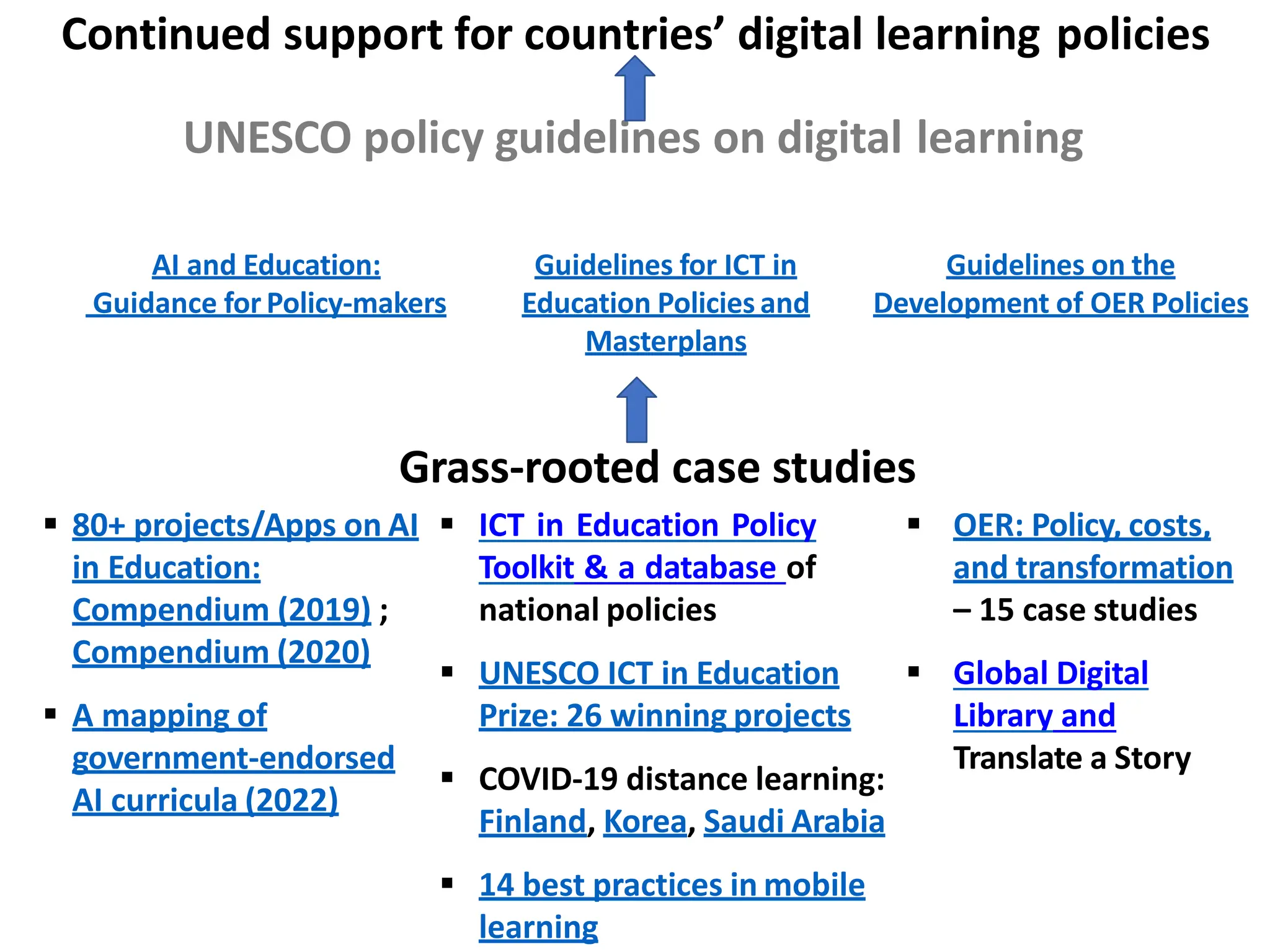
UNESCO policy guidelines on digital learning
Guidelines on the
Development of OER Policies
AI and Education:
Guidance for Policy-makers
Guidelines for ICT in
Education Policies and
Masterplans
Continued support for countries’ digital learning policies
 80+ projects/Apps on AI
in Education:
Compendium (2019) ;
Compendium (2020)
 A mapping of
government-endorsed
AI curricula (2022)
Grass-rooted case studies
 ICT in Education Policy
Toolkit & a database of
national policies
 UNESCO ICT in Education
Prize: 26 winning projects
 COVID-19 distance learning:
Finland, Korea, Saudi Arabia
 14 best practices in mobile
learning
 OER: Policy, costs,
and transformation
– 15 case studies
 Global Digital
Library and
Translate a Story
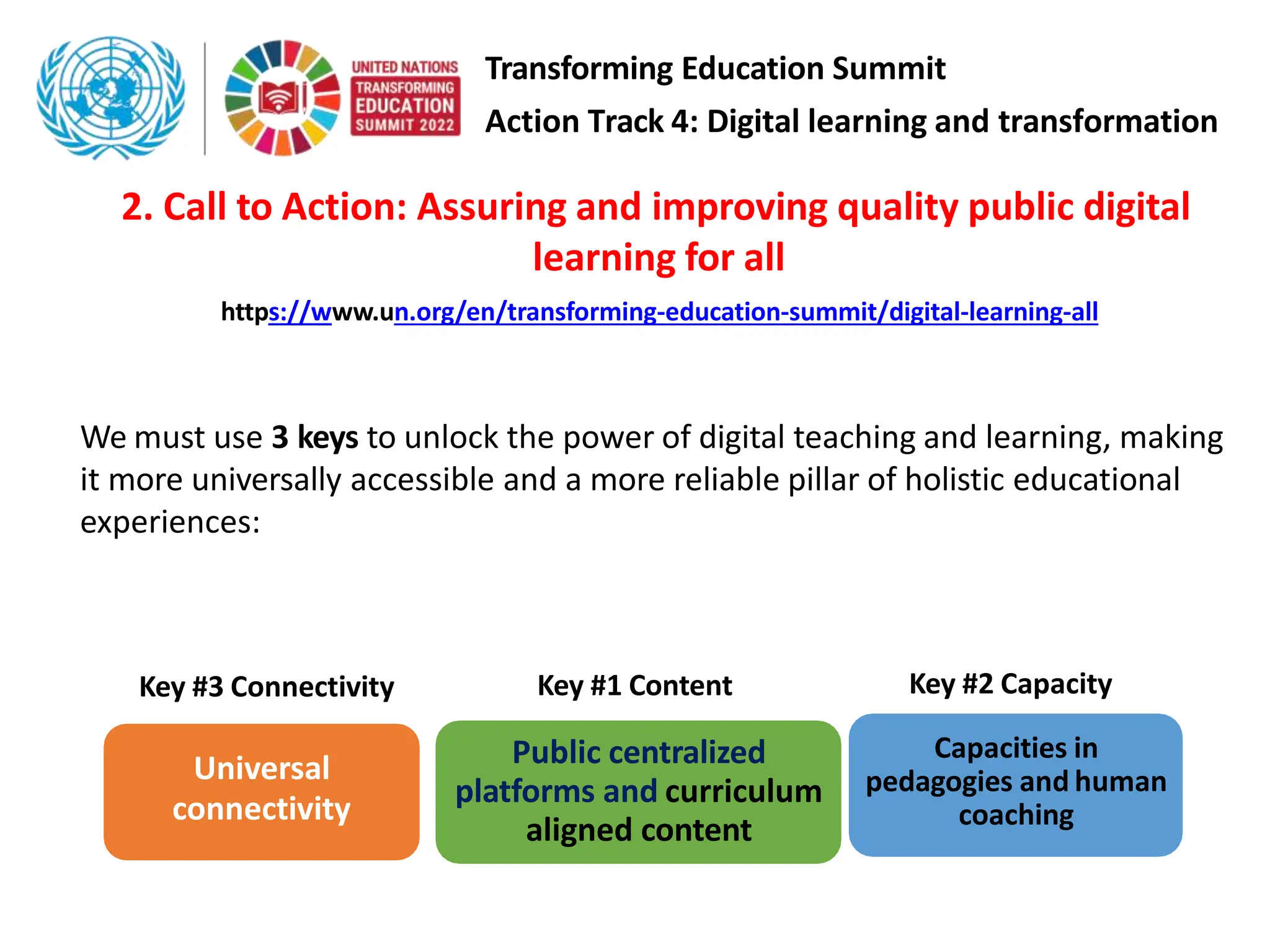
2. Call to Action: Assuring and improving quality public digital
learning for all
https://www.un.org/en/transforming-education-summit/digital-learning-all
We must use 3 keys to unlock the power of digital teaching and learning, making
it more universally accessible and a more reliable pillar of holistic educational
experiences:
Capacities in
pedagogies and human
coaching
Public centralized
platforms and curriculum
aligned content
Universal
connectivity
Key #1 Content Key #2 Capacity
Key #3 Connectivity
Transforming Education Summit
Action Track 4: Digital learning and transformation
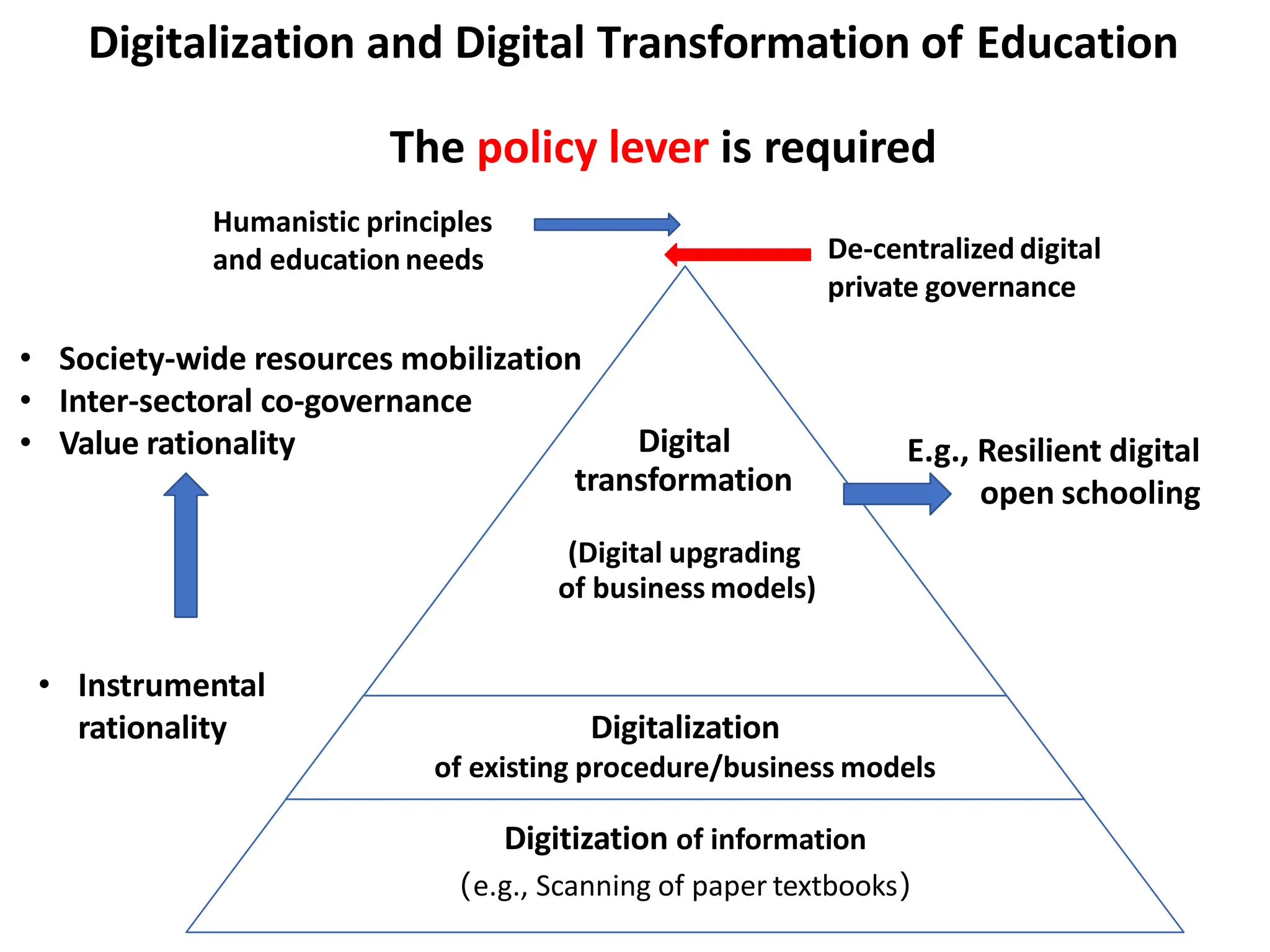
Digitalization and Digital Transformation of Education
Digital
transformation
(Digital upgrading
of business models)
Digitalization
of existing procedure/business models
Digitization of information
(e.g., Scanning of paper textbooks)
• Society-wide resources mobilization
• Inter-sectoral co-governance
• Value rationality
• Instrumental
rationality
and education needs De-centralized digital
private governance
E.g., Resilient digital
open schooling
The policy lever is required
Humanistic principles
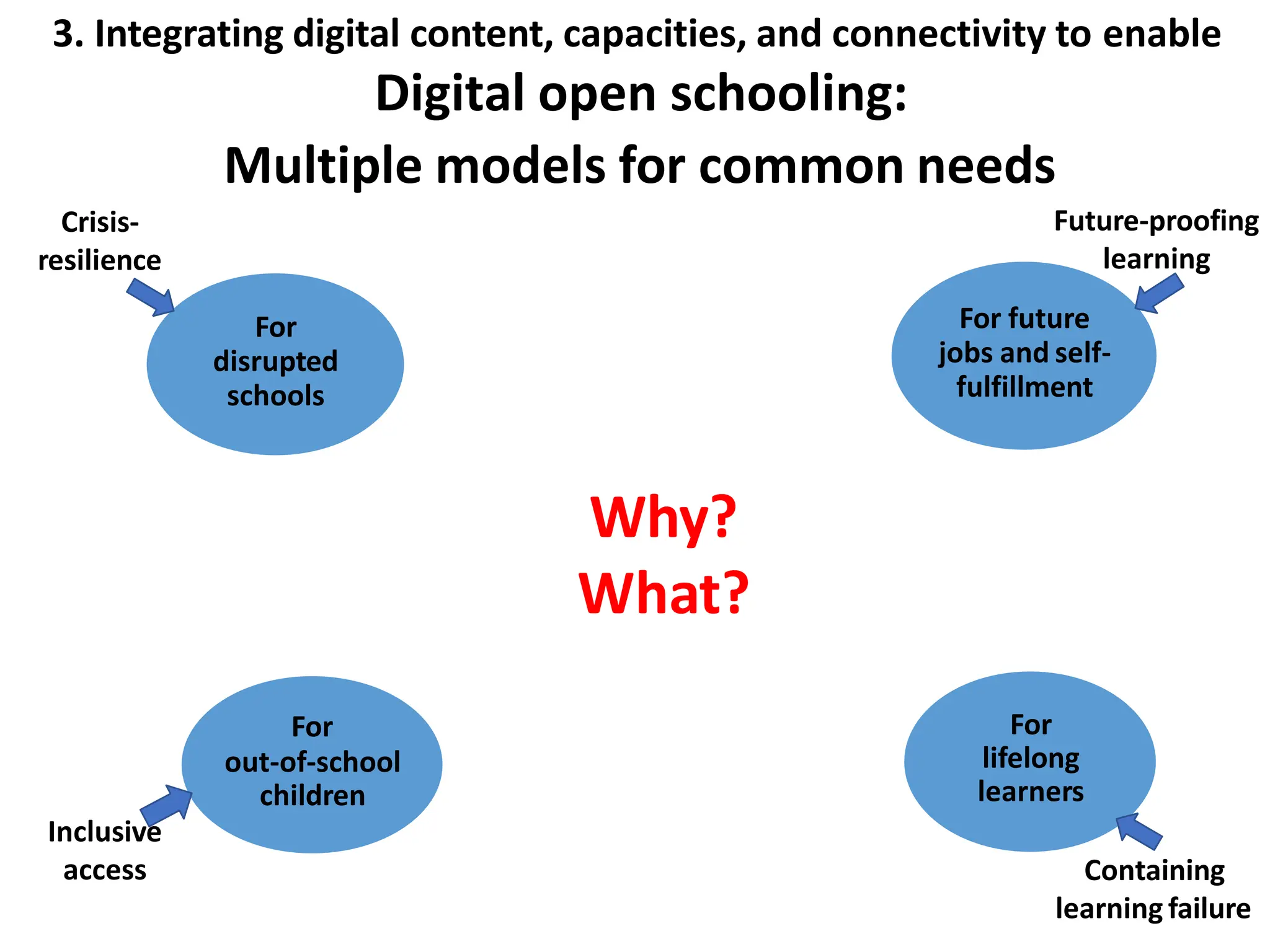
3. Integrating digital content, capacities, and connectivity to enable
Digital open schooling:
Multiple models for common needs
Why?
What?
For
out-of-school
children
Inclusive
access
For
disrupted
schools
Crisis-
resilience
For future
jobs and self-
fulfillment
Future-proofing
learning
For
lifelong
learners
Containing
learning failure
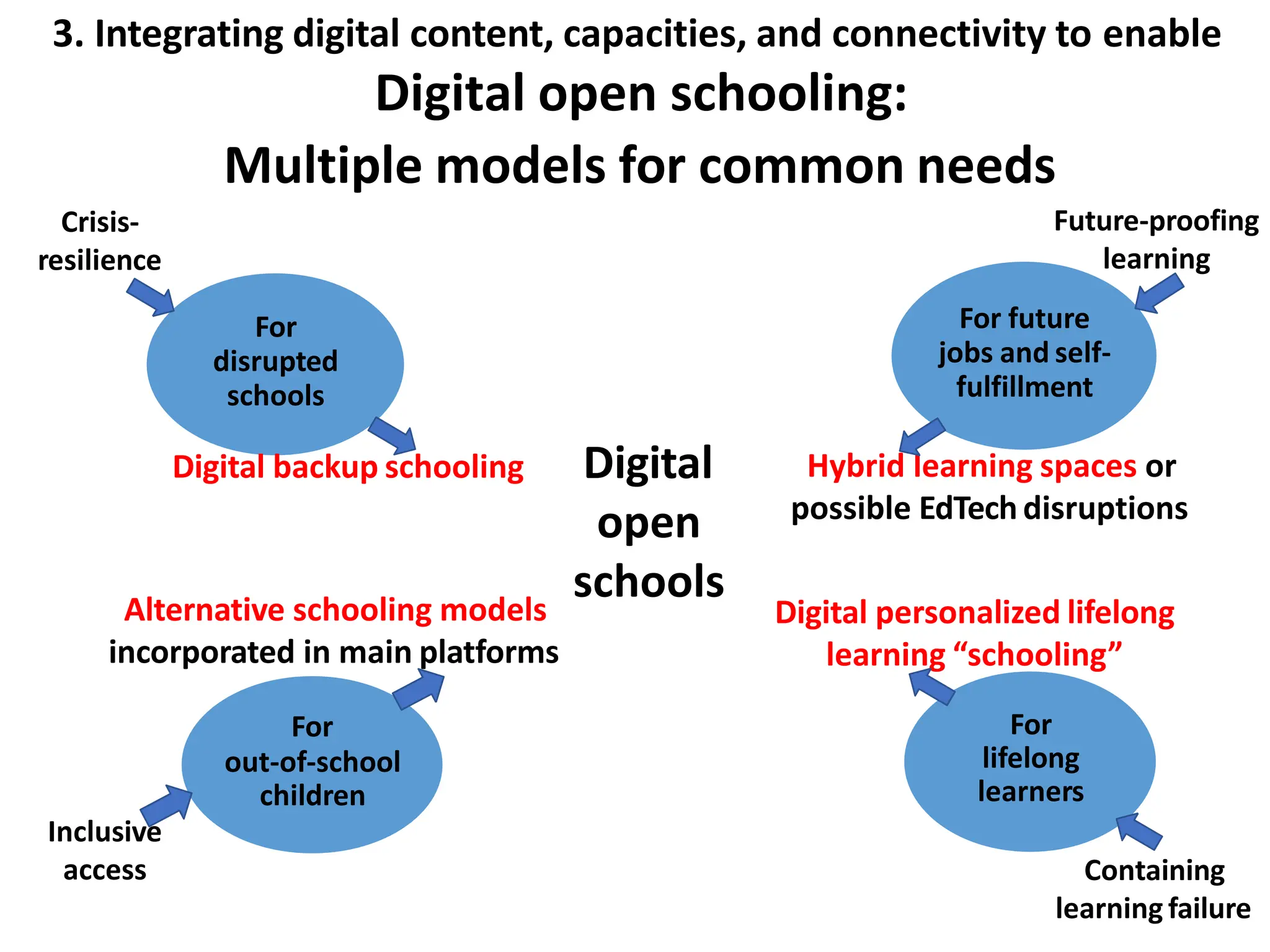
Digital
open
schools
For
out-of-school
children
Alternative schooling models
incorporated in main platforms
Inclusive
access
For
disrupted
schools
Digital backup schooling
Crisis-
resilience
For future
jobs and self-
fulfillment
Hybrid learning spaces or
possible EdTech disruptions
Future-proofing
learning
For
lifelong
learners
Digital personalized lifelong
learning “schooling”
Containing
learning failure
3. Integrating digital content, capacities, and connectivity to enable
Digital open schooling:
Multiple models for common needs
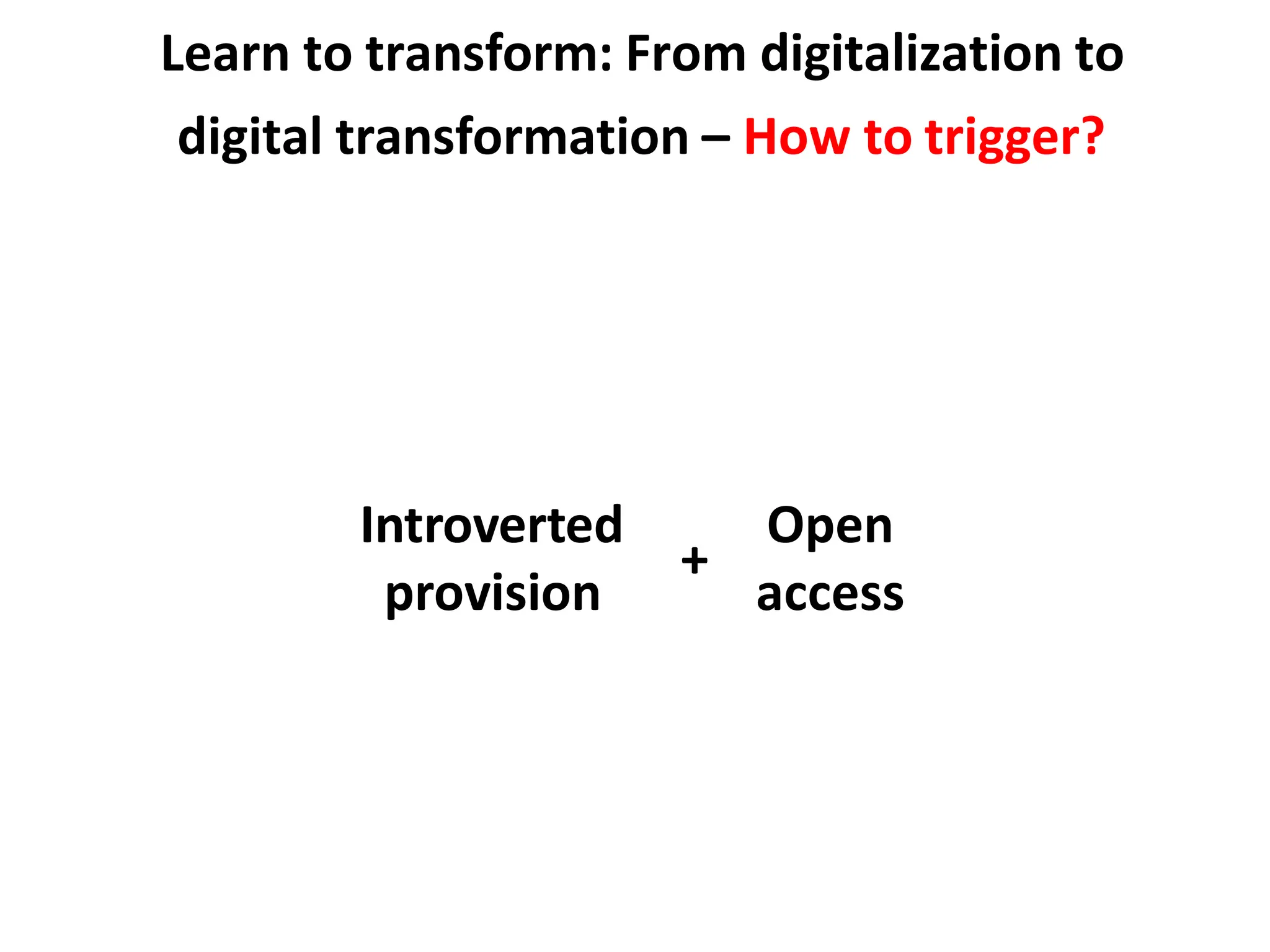
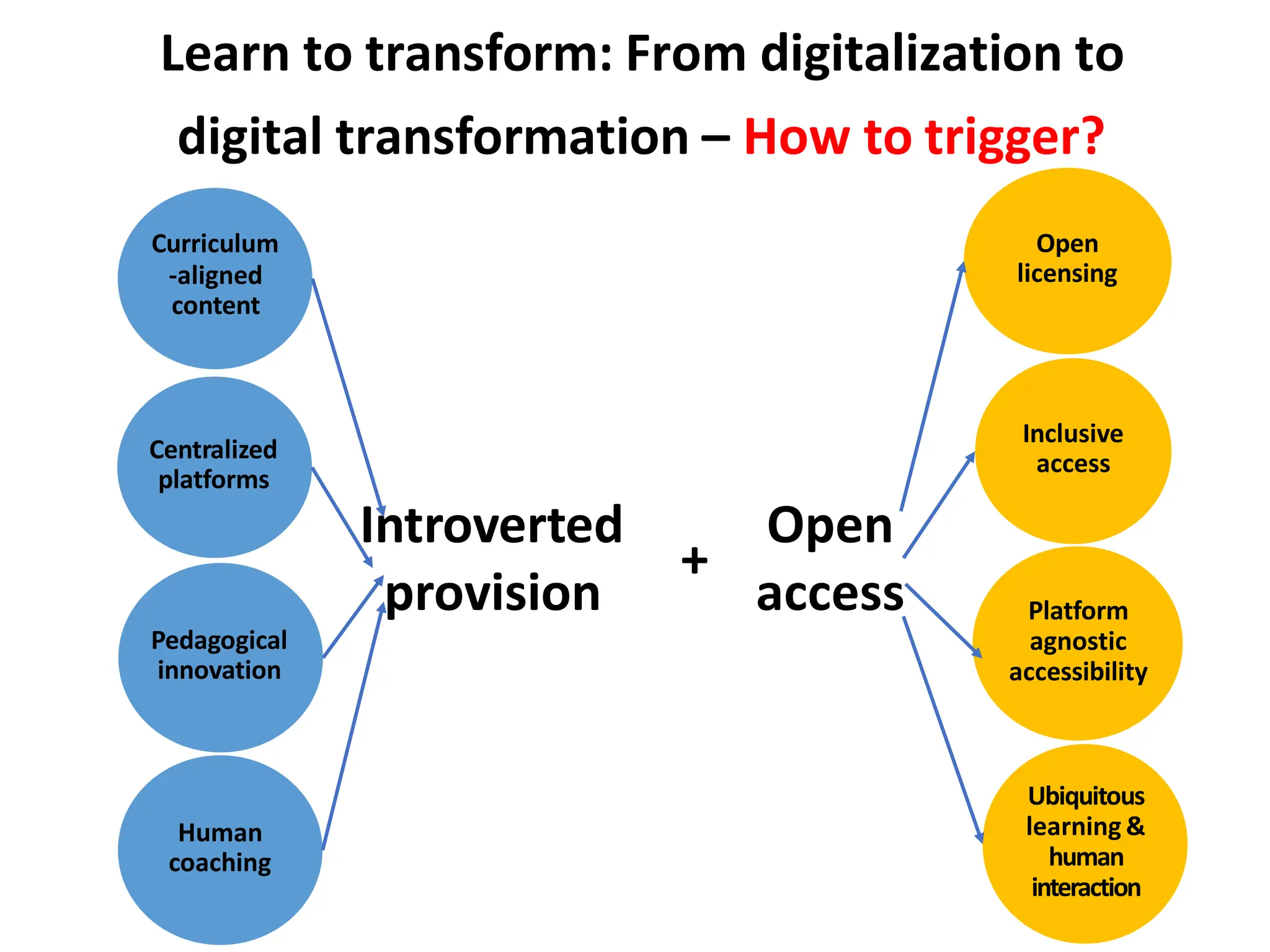
Learn to transform: From digitalization to
digital transformation – How to trigger?
Introverted
provision
Open
access
+
Curriculum
-aligned
content
Open
licensing
Centralized
platforms
Pedagogical
innovation
Human
coaching
Inclusive
access
Platform
agnostic
accessibility
Ubiquitous
learning &
human
interaction
Introverted
provision
+
Learn to transform: From digitalization to
digital transformation – How to trigger?
Open
access
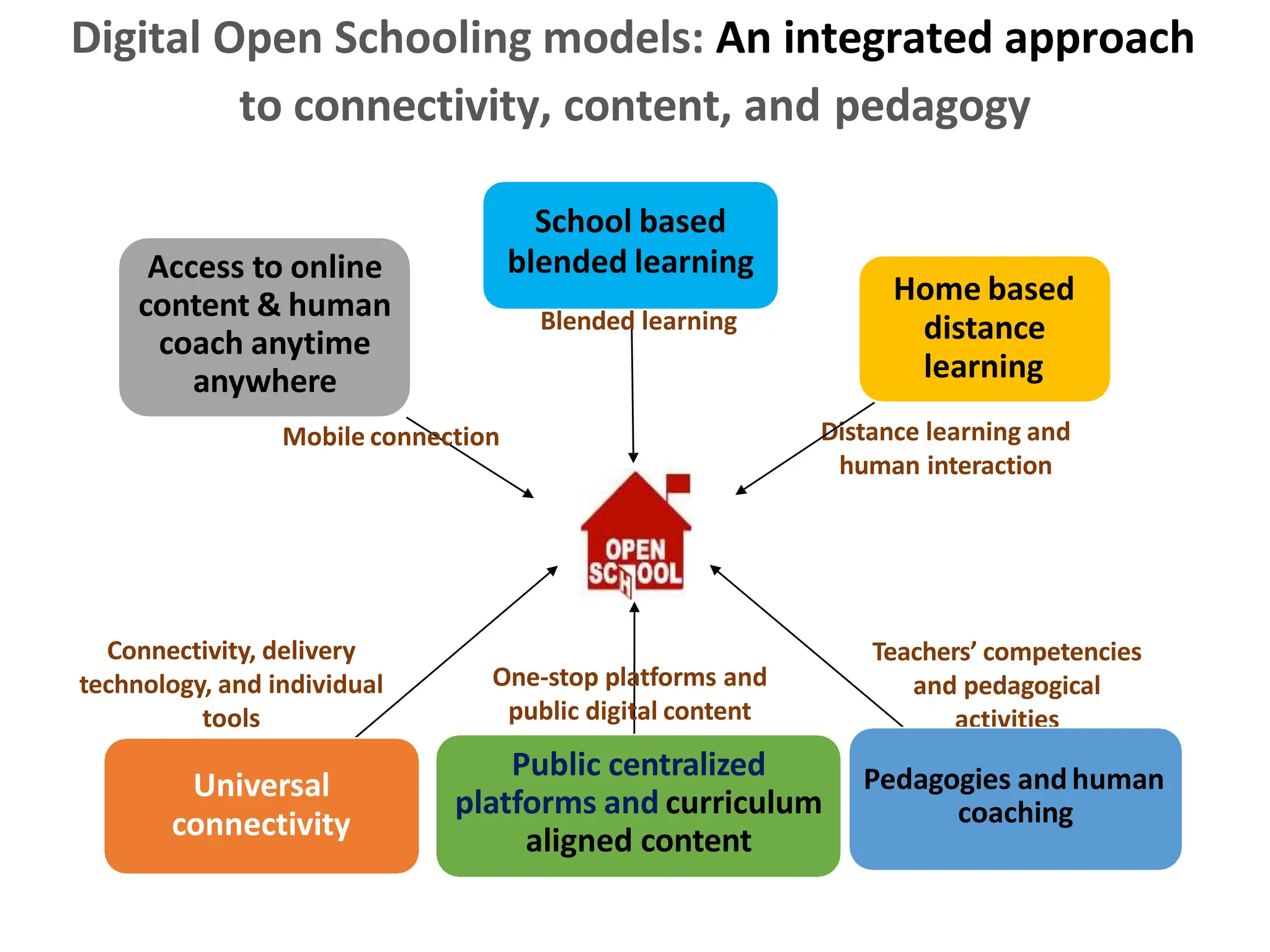
Digital Open Schooling models: An integrated approach
to connectivity, content, and pedagogy
Distance learning and
human interaction
Connectivity, delivery
technology, and individual
tools
Teachers’ competencies
and pedagogical
activities
School based
blended learning
Blended learning
Home based
distance
learning
Access to online
content & human
coach anytime
anywhere
Mobile connection
Pedagogies andhuman
coaching
One-stop platforms and
public digital content
Public centralized
platforms and curriculum
aligned content
Universal
connectivity
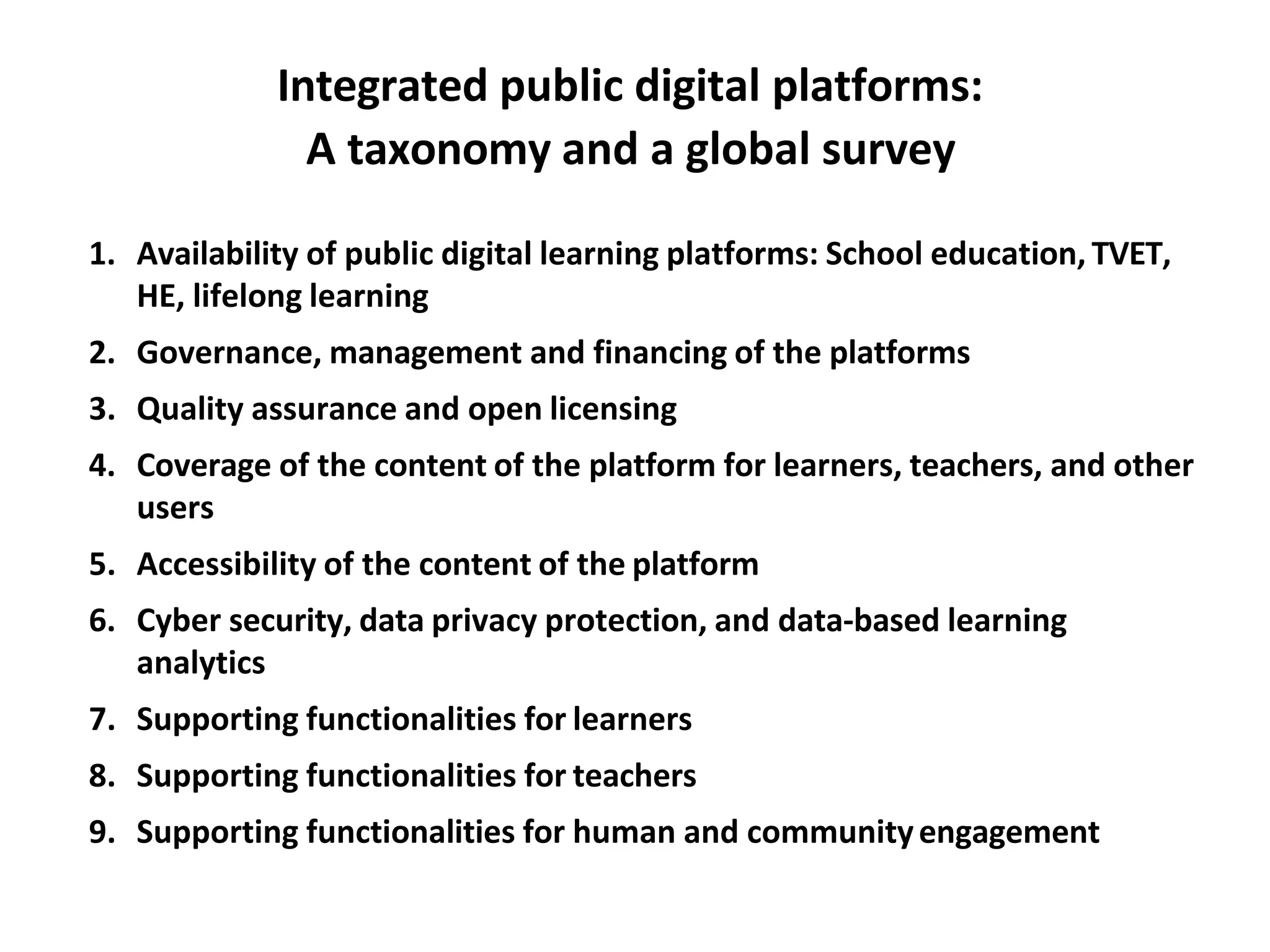
Integrated public digital platforms:
A taxonomy and a global survey
1. Availability of public digital learning platforms: School education, TVET,
HE, lifelong learning
2. Governance, management and financing of the platforms
3. Quality assurance and open licensing
4. Coverage of the content of the platform for learners, teachers, and other
users
5. Accessibility of the content of the platform
6. Cyber security, data privacy protection, and data-based learning
analytics
7. Supporting functionalities for learners
8. Supporting functionalities for teachers
9. Supporting functionalities for human and communityengagement
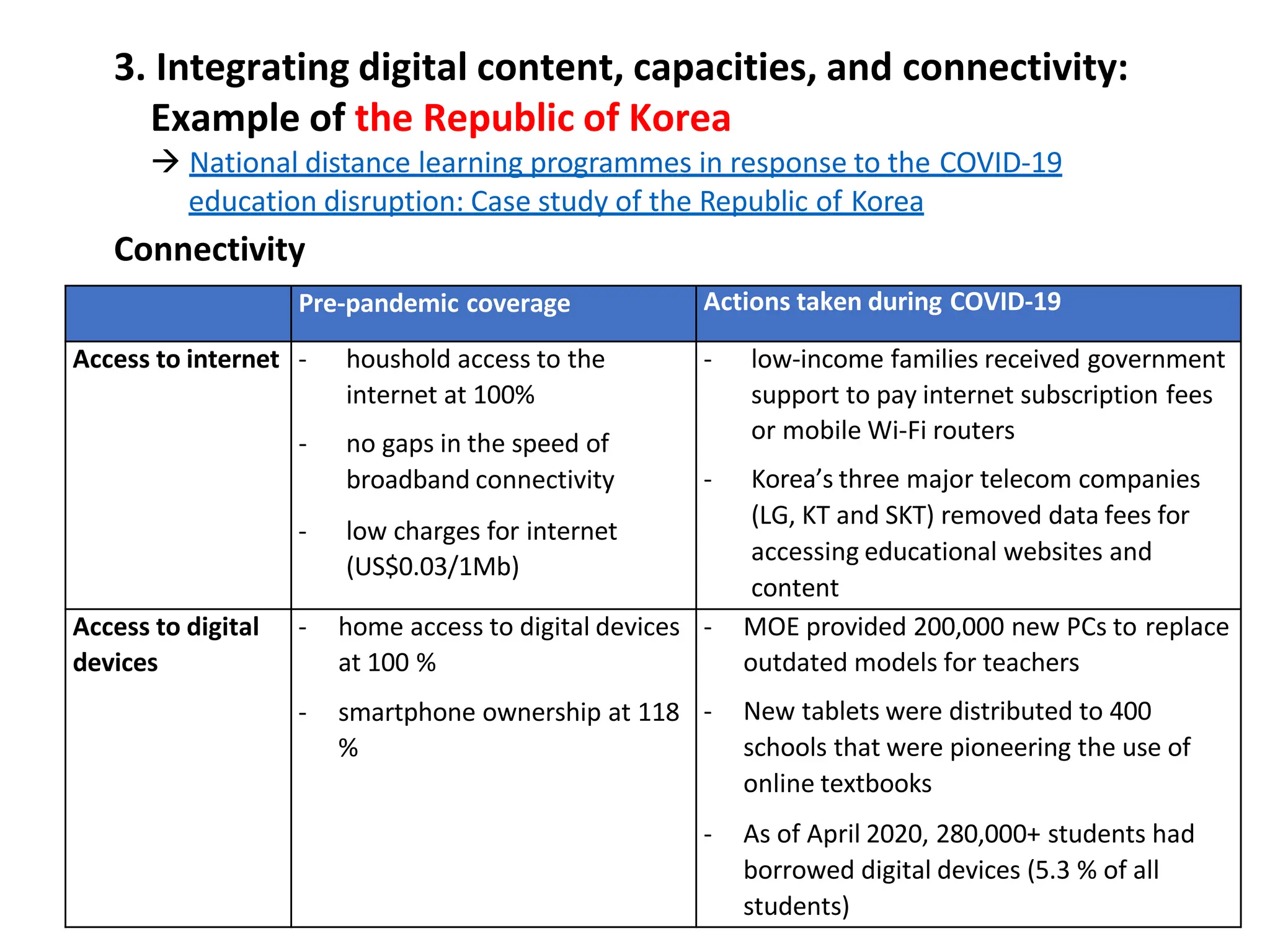
Pre-pandemic coverage Actions taken during COVID-19
Access to internet - houshold access to the
internet at 100%
- no gaps in the speed of
broadband connectivity
- low charges for internet
(US$0.03/1Mb)
- low-income families received government
support to pay internet subscription fees
or mobile Wi-Fi routers
- Korea’s three major telecom companies
(LG, KT and SKT) removed data fees for
accessing educational websites and
content
Access to digital
devices
- home access to digital devices
at 100 %
- smartphone ownership at 118
%
- MOE provided 200,000 new PCs to replace
outdated models for teachers
- New tablets were distributed to 400
schools that were pioneering the use of
online textbooks
- As of April 2020, 280,000+ students had
borrowed digital devices (5.3 % of all
students)
3. Integrating digital content, capacities, and connectivity:
Example of the Republic of Korea
 National distance learning programmes in response to the COVID-19
education disruption: Case study of the Republic of Korea
Connectivity
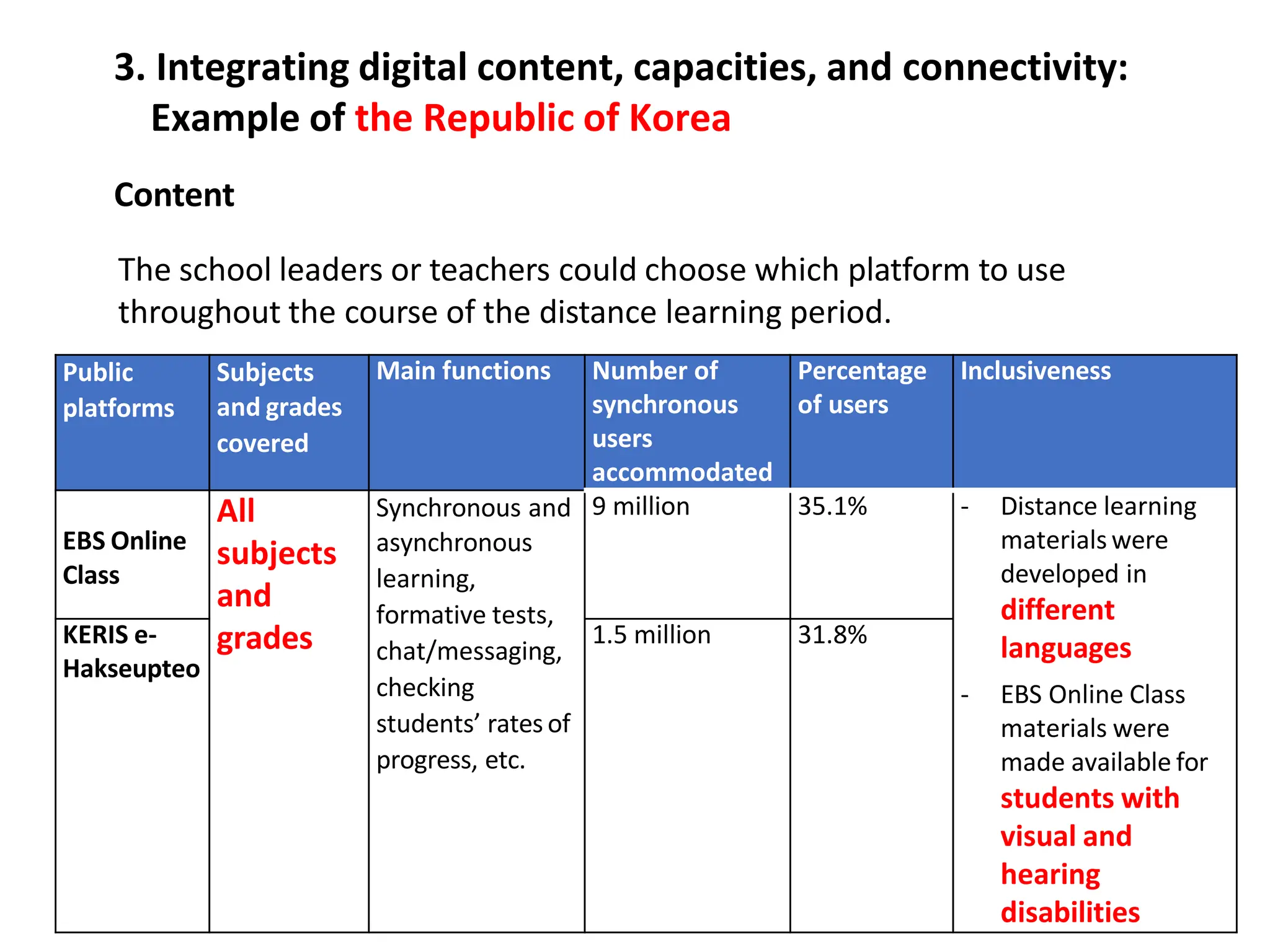
Public
platforms
Subjects
and grades
covered
Main functions Number of
synchronous
users
accommodated
Percentage
of users
Inclusiveness
EBS Online
Class
All
subjects
and
grades
Synchronous and
asynchronous
learning,
formative tests,
chat/messaging,
checking
students’ rates of
progress, etc.
9 million 35.1% - Distance learning
materials were
developed in
different
languages
- EBS Online Class
materials were
made available for
students with
visual and
hearing
disabilities
KERIS e-
Hakseupteo
1.5 million 31.8%
Content
The school leaders or teachers could choose which platform to use
throughout the course of the distance learning period.
3. Integrating digital content, capacities, and connectivity:
Example of the Republic of Korea
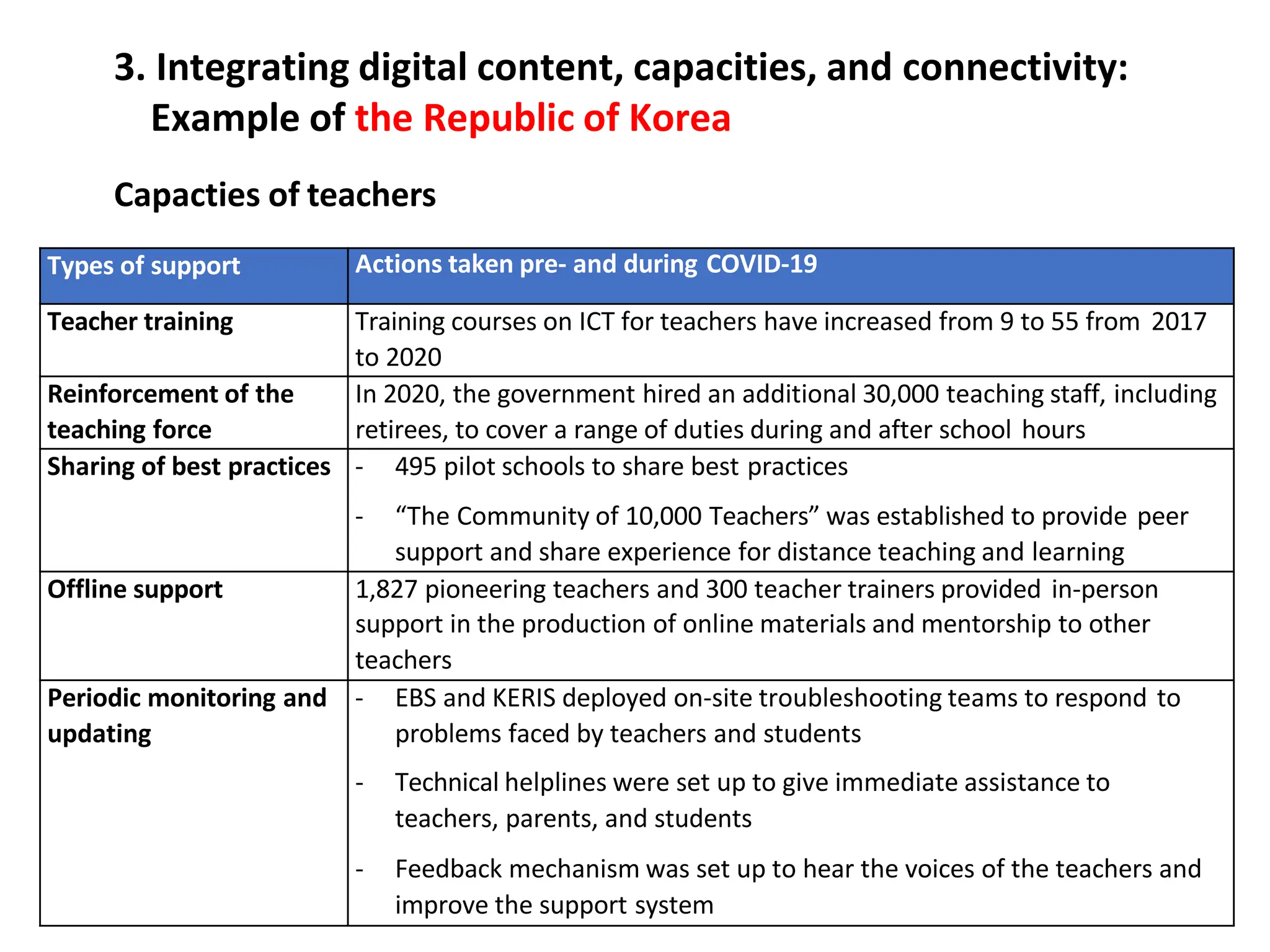
Types of support Actions taken pre- and during COVID-19
Teacher training Training courses on ICT for teachers have increased from 9 to 55 from 2017
to 2020
Reinforcement of the
teaching force
In 2020, the government hired an additional 30,000 teaching staff, including
retirees, to cover a range of duties during and after school hours
Sharing of best practices - 495 pilot schools to share best practices
- “The Community of 10,000 Teachers” was established to provide peer
support and share experience for distance teaching and learning
Offline support 1,827 pioneering teachers and 300 teacher trainers provided in-person
support in the production of online materials and mentorship to other
teachers
Periodic monitoring and
updating
- EBS and KERIS deployed on-site troubleshooting teams to respond to
problems faced by teachers and students
- Technical helplines were set up to give immediate assistance to
teachers, parents, and students
- Feedback mechanism was set up to hear the voices of the teachers and
improve the support system
Capacties of teachers
3. Integrating digital content, capacities, and connectivity:
Example of the Republic of Korea
Thanks!
f.miao@unesco.org
https://www.unesco.org/en/education/digital
https://www.researchgate.net/profile/Fengchun-Miao
https://www.linkedin.com/in/fengchun-miao-5b999077

PPT Of 2022.09 Digital Learning Policies and Digital Open Schooling (2).pptx

  • 1.
    UNESCO Policy Guidelineson Digital Learning and Digital Open Schools Fengchun Miao Chief, Unit for Technology and AI in Education UNESCO
  • 2.
    Outline • SEPTEMBER 1. UNESCOwork to steer digital learning policies 2. Digital transformation: Call to Action of TES and a framework 3. Integrating digital content, capacities, and connectivity
  • 3.
    1. An “UNESCOPortfolio” to support national digital learning policies Open Educational Resources Sector-wide ICT in educationpolicies and masterplans Emerging technologies AI and education 1. International standard-setting instruments (Recommendation on OER, Beijing Consensus …) 2. Intellectual guidelines or guidance 3. International conferences (e.g., 9 years of Mobile Learning Week) 4. Country support (60+ countries’ national ICT in educationpolicies)
  • 4.
    UNESCO policy guidelineson digital learning Guidelines on the Development of OER Policies AI and Education: Guidance for Policy-makers Guidelines for ICT in Education Policies and Masterplans  Arabic  Chinese  English  French  Russian  Spanish + Korea o Arabic  Chinese  English o French o Russian o Spanish o Arabic o Chinese  English  French o Russian  Spanish 16-year support for 60+ countries
  • 5.
    Guidelines for ICTin Education Policies and Masterplans: Steering humanistic and result-based digital learning Guiding principles: Humanistic digital learning A Guiding framework and an iterative roadmap for policy planning Inter-sectoral governance, funding, costing, and coordination ICT in education masterplans: Effective models and good examples  Device driven  Start from human results  Home + schools + public spaces  Public platforms and content  Only ICT costing  Global governance architecture  Inter-sectoral approach  Costing: Tech(~33%) + Content (~33%) +Teachers (~33%)  Zero-rating …  Techno-solutionism  Inclusion, equity, gender equality  Linguistic and cultural diversities  Data privacy, digital well- being Digital humanism  No operation ICT in: Schools, TVET, HE, Non- formal; EMIS, Curriculum, Digital content,  Monitoring and evaluation
  • 6.
    Global Education Governancefor Digital Learning: A dynamically evolving architecture Digital private governance Interantional governance State public governance Users’ civil governance Maximum commercial interest and digital pubic good Common good across boarders and groups Public good, shared values, and sovereignty Human and civil rights; maximum individual interests
  • 7.
    Source: UNESCO Guidelinesfor ICT in Education Policies andMasterplans A guiding framework: Plan from learning and human outcomes and for open learning settings
  • 8.
    UNESCO policy guidelineson digital learning Guidelines on the Development of OER Policies AI and Education: Guidance for Policy-makers Guidelines for ICT in Education Policies and Masterplans Continued support for countries’ digital learning policies  80+ projects/Apps on AI in Education: Compendium (2019) ; Compendium (2020)  A mapping of government-endorsed AI curricula (2022) Grass-rooted case studies  ICT in Education Policy Toolkit & a database of national policies  UNESCO ICT in Education Prize: 26 winning projects  COVID-19 distance learning: Finland, Korea, Saudi Arabia  14 best practices in mobile learning  OER: Policy, costs, and transformation – 15 case studies  Global Digital Library and Translate a Story
  • 9.
    2. Call toAction: Assuring and improving quality public digital learning for all https://www.un.org/en/transforming-education-summit/digital-learning-all We must use 3 keys to unlock the power of digital teaching and learning, making it more universally accessible and a more reliable pillar of holistic educational experiences: Capacities in pedagogies and human coaching Public centralized platforms and curriculum aligned content Universal connectivity Key #1 Content Key #2 Capacity Key #3 Connectivity Transforming Education Summit Action Track 4: Digital learning and transformation
  • 10.
    Digitalization and DigitalTransformation of Education Digital transformation (Digital upgrading of business models) Digitalization of existing procedure/business models Digitization of information (e.g., Scanning of paper textbooks) • Society-wide resources mobilization • Inter-sectoral co-governance • Value rationality • Instrumental rationality and education needs De-centralized digital private governance E.g., Resilient digital open schooling The policy lever is required Humanistic principles
  • 11.
    3. Integrating digitalcontent, capacities, and connectivity to enable Digital open schooling: Multiple models for common needs Why? What? For out-of-school children Inclusive access For disrupted schools Crisis- resilience For future jobs and self- fulfillment Future-proofing learning For lifelong learners Containing learning failure
  • 12.
    Digital open schools For out-of-school children Alternative schooling models incorporatedin main platforms Inclusive access For disrupted schools Digital backup schooling Crisis- resilience For future jobs and self- fulfillment Hybrid learning spaces or possible EdTech disruptions Future-proofing learning For lifelong learners Digital personalized lifelong learning “schooling” Containing learning failure 3. Integrating digital content, capacities, and connectivity to enable Digital open schooling: Multiple models for common needs
  • 13.
    Learn to transform:From digitalization to digital transformation – How to trigger? Introverted provision Open access +
  • 14.
  • 15.
    Digital Open Schoolingmodels: An integrated approach to connectivity, content, and pedagogy Distance learning and human interaction Connectivity, delivery technology, and individual tools Teachers’ competencies and pedagogical activities School based blended learning Blended learning Home based distance learning Access to online content & human coach anytime anywhere Mobile connection Pedagogies andhuman coaching One-stop platforms and public digital content Public centralized platforms and curriculum aligned content Universal connectivity
  • 16.
    Integrated public digitalplatforms: A taxonomy and a global survey 1. Availability of public digital learning platforms: School education, TVET, HE, lifelong learning 2. Governance, management and financing of the platforms 3. Quality assurance and open licensing 4. Coverage of the content of the platform for learners, teachers, and other users 5. Accessibility of the content of the platform 6. Cyber security, data privacy protection, and data-based learning analytics 7. Supporting functionalities for learners 8. Supporting functionalities for teachers 9. Supporting functionalities for human and communityengagement
  • 17.
    Pre-pandemic coverage Actionstaken during COVID-19 Access to internet - houshold access to the internet at 100% - no gaps in the speed of broadband connectivity - low charges for internet (US$0.03/1Mb) - low-income families received government support to pay internet subscription fees or mobile Wi-Fi routers - Korea’s three major telecom companies (LG, KT and SKT) removed data fees for accessing educational websites and content Access to digital devices - home access to digital devices at 100 % - smartphone ownership at 118 % - MOE provided 200,000 new PCs to replace outdated models for teachers - New tablets were distributed to 400 schools that were pioneering the use of online textbooks - As of April 2020, 280,000+ students had borrowed digital devices (5.3 % of all students) 3. Integrating digital content, capacities, and connectivity: Example of the Republic of Korea  National distance learning programmes in response to the COVID-19 education disruption: Case study of the Republic of Korea Connectivity
  • 18.
    Public platforms Subjects and grades covered Main functionsNumber of synchronous users accommodated Percentage of users Inclusiveness EBS Online Class All subjects and grades Synchronous and asynchronous learning, formative tests, chat/messaging, checking students’ rates of progress, etc. 9 million 35.1% - Distance learning materials were developed in different languages - EBS Online Class materials were made available for students with visual and hearing disabilities KERIS e- Hakseupteo 1.5 million 31.8% Content The school leaders or teachers could choose which platform to use throughout the course of the distance learning period. 3. Integrating digital content, capacities, and connectivity: Example of the Republic of Korea
  • 19.
    Types of supportActions taken pre- and during COVID-19 Teacher training Training courses on ICT for teachers have increased from 9 to 55 from 2017 to 2020 Reinforcement of the teaching force In 2020, the government hired an additional 30,000 teaching staff, including retirees, to cover a range of duties during and after school hours Sharing of best practices - 495 pilot schools to share best practices - “The Community of 10,000 Teachers” was established to provide peer support and share experience for distance teaching and learning Offline support 1,827 pioneering teachers and 300 teacher trainers provided in-person support in the production of online materials and mentorship to other teachers Periodic monitoring and updating - EBS and KERIS deployed on-site troubleshooting teams to respond to problems faced by teachers and students - Technical helplines were set up to give immediate assistance to teachers, parents, and students - Feedback mechanism was set up to hear the voices of the teachers and improve the support system Capacties of teachers 3. Integrating digital content, capacities, and connectivity: Example of the Republic of Korea
  • 20.