• What things do you need to do to
be prepared before an interview?
• What skills do you want to
demonstrate to your employer?
• What vocabulary can you use that
can describe your dynamic
personality?
1. The average length of an interview will be around 40 minutes.
2. But 33% of 2000 surveyed employers mentioned that they
know within the very first 90 seconds of the interview if they
will recruit the candidate.
• Have you ever been interviewed for a job in English?
• Was it successful?
• How did you feel? Were you nervous?
• How long was it?
• Why do you think it takes employers so little time to make the recruitment
decision?
• What does it depend on? What do hiring managers look at during these 90
seconds?
• What should each candidate do before going to an interview?
Useful tips for interview preparation
• Why do you think people should go to an interview prepared?
• What would you do to be prepared before the interview?
Ensuring you are well-prepared will help
you to reduce stress, increase your
confidence and improve your chances of
being offered the job
ensure reduce increase improve confidence
Choose the tips which you find useful while preparing for an
interview
Do some research into the company you are applying for a job with
Find out exactly what the job involves
Spray yourself with scent so there is a pleasant trail
Analyze your skills and experience and identify areas where they match
the job requirements and the company's needs
Sleep well to look fresh and presentable
Rehearse the interview
Decide what you're going to wear
Make an eye-catching hairstyle
Prepare a list of questions to ask at the end of the interview
Pray
improve = comprise scent rehearse pray trail
The interview, like every other meeting, has its own strategy
1. What are the interview stages you will have to pass?
2. Why is it obligatory to keep the plan?
b) Talking about yourself
a) Experience questions
c) Unusual questions
d) Asking about conditions
e) First impression. Meeting
1
2
3
4
5
3. What can you do to create a
positive first impression with
an interviewer?
4. Do you think these points are
useful in making a positive first
impression?
• your appearance;
• body language;
• "break the ice" with the
interviewer.
1. What problems do you think a candidate can face during an interview?
2. How could your body language let you down in an interview?
3. How can you avoid these problems?
No eye contact
Trembling voice
Sweating
Trembling hands
Bad posture
bring a handkerchief
make eye contact, but
remember not to stare
beathe slowly and deeply
Sit up straight and lean
forward when speaking
politely decline tea or coffee
1. Why do you think these problems occur in candidate's behaviour? Can you give any
advice on how to solve them?
2. What is a common action people do in an interview when they meet for the first time?
3. The handshake will be your only moment of physical contact with the interviewer.
4. Studies say that handshakes play a significant role in first impressions, so make it count.
5. Are there any strict rules about handshaking? Should it be strong orweak?
6. Do you have any ideas why managers can reject your interview? How many percent of
candidates do you think were rejected because of failing simple eye contact? Look at the
numbers below. Do you think they are real ? Why do you think so?
• 70% were too fashionable or trendy
• 67% failed an eye contact
• 55% failed dressing, acting and walking
through the door
• 47% presented little knowledge of a
company
• 38% had a lack of smile
• 26% the handshake was too weak
Crossed arms: Put your hands on your lap or on the table, lean over to your conversation
partners. This way you emphasize that you are listening attentively.
Nodding: Some people are nodding their heads constantly to show that they understand what
the interviewer is saying. This can be perceived as too obedient or not
sincere. Therefore, only nod your head if you agree, when you understand
an important point and when you want to invite your conversation
partner to continue talking.
Many gestures: Someone who is using their hands and arms too much can be perceived as
disturbing. The same applies to someone who is not moving at all. Sit up
straight and keep your back against the backrest.
Playing with your hair: It is a common way to soothe yourself. If you touch your face too much or
if you play with your hands, fingers or jewellery, you may be perceived as
insecure and/or unreliable.
Grinning: Excessive smiling in a job interview is seen for what it is — nervousness and a lack of
confidence. Smile when there's something to smile about. Do a practice run in
front of a mirror or a friend.
What is a small talk?
The outcome of an interview can be decided in the first five minutes. Small talks
usually happen between people who don't know each other well.
• How do you think small talk can influence the employer's impression about you?
• Have you ever experienced small talk conversations? (Not only in an interview)
• Are there any things you would avoid talking about?
• Why do you think employers ask the "How did you find out about us" question?
• Ok, you broke the ice between you and your hiring manager. What is the first question
employerwill ask you after a small talk?
A small conversation without much
importance in order to 'break the ice'
between people
!!!Tell me a little about yourself!!!
K
A
Good morning. My name is Karl
Osborne. I'm Head of Production
here at the theatre. It's nice to meet
you at last.
K How are you?
A
K I'm fine, thank you, Alex. Did you
have any trouble finding us?
A
K How did you get here?
A
K So you managed to avoid the
rain then? I can't believe the
weather at the moment!
A
K Would you like some tea or
coffee before we start?
A
K Ok. So Alex, how did you find out
about us? We didn't advertise the
position in a lot of places.
A
Thank you. Me too, Mr Osborne.
It's OK. And you?
Oh, it was challenging.
I had to take a taxi to be on time.
I know. It's awful.
I would like coffee, please.
It's rather cold outside
I heard somebody was talking at a
bus stop. You fired a person on this
position. So I decided to apply.
K Oh really...
I heard somebody was
talking at a bus stop
It's OK, I had enough sleep
this night, so I'm rather
happy
I would like coffee, please
Thank you. Me too
I know. It's awful
Oh, it was challenging
I'm doing great, thanks! I started the
day with a training run, so I can't really
complain
You were highly recommended to me by
a friend who works here
Thank you. It's nice to meet you too,
Mr Osborne
Oh, no, thank you
It's awful, isn't it? Still, it's supposed to
get better by the weekend
Match the improved answers with poor ones and explain the changes
No, no trouble at all. Your directions
were excellent
Explaining the
I started the day with a training run. — To emphasise keeping fit, it may say that he's an active
person.
Your directions were excellent. — It is a polite way to answer, nobody wants to hear moaning
about their company, even if it is connected with location.
It's awful, isn't it? Still, it's supposed to get better by the weekend. — It is typical to maintain a
small talk conversation. It is not enough just to say "yes" or "no".
K: Would you like some tea or coffee before we start?
A: Oh, no thank you. — It is a polite way to answer. Experts advise to always deny offers like that
in an interview.
You were highly recommended to me by a friend who works here. — It is one of the common ways
to answer. Experts also suggest to emphasise that you did some research and became very
interested in their company.
Let's imagine that you are passing a job interview. Answer my small talk
questions as you would answer them in an interview with your employer:
• How are you?
• Did you have any trouble finding us?
• The weather is awful, isn't it?
• How did you know about this position?
• Would you like some tea or coffee?
Education
Current position
Professional achievements
Previous job
Reason for applying
Skills you want to improve
University achievements
I have a really strong background in ...
I'm hoping in the future I'll be able to ...
I've been working at my current
position for ...
I've always had a passion for ...
It's been a really interesting new
challenge for me ...
I have a really great skill set of ...
I did the whole program with special
focus on ...
Watch the video again and match phrases with the topics from
the video
In all interviews you will be required to talk about yourse
lf. What do you think they want to find out?
The interviewers want to find out whether
you're the type of person who would be able to
do the job and also whether your personality
would fit in with the rest of the company.
• Do you think the phrases are useful in your speech?
• Can they make your answer impressive?
• Are you going to use them in your interview?
• How would you avoid a boring answer to the question
'tell me a little bit about yourself'?
I've always had a passion for computers. My friends and I even tried to create our own software
program, but we didn't have enough knowledge at the time. I did the whole program with a
special focus on computer technologies. I graduated from university in 2010. I have a really
strong background in software and IT. I have a really great skill set of being able to
communicate with people. I worked on different projects for several companies. It was an
interesting challenge for me that helped me advance and become a project manager. I've been
working at my current position for 5 years. I'm hoping in the future I will be able to improve my
skills, accept bigger responsibilities and apply my new knowledge to help your company create
better programs.
 sounds impressive
 shares their hobbies and
interests to show they are
creative
 demonstrates relevant passions
 boasts of gained skills for a long time
 shows future plans in relation to the
company
 highlights relevant experience in a
smart and concise way
The speaker
!concise! = short, brief
Think of your answer as your elevator pitch. An elevator pitch is a short summary used to quickly and
simply define value proposition. It answers the question: "Why should I hire?" It should be concise
enough to be delivered during a short elevator ride (to the 5th floor, not to the 105th floor).
• What are your primary selling points for this job?
• Why are you interested in this position right now?
• What do you think 'Practice makes perfect' means?
Now create your own impressive story
•I've always had a passion for ...
•I did the whole program with a special focus on ...
•I graduated from ...
•I've been working at my current position for ...
•I have a really strong background in ...
•I have a really great skill set of ...
•It's been a really interesting new challenge for me .
..
Cover the points:
• assess what is
important to the
company;
• make a list of things
you want to include;
• plan your answer to the
following questions
using impressive
beginnings.
T
S
How are you?
I'm doing great, thank you. Today
I have finished my picture, so I'm
in high spirits. What about you?
T Did you have any
trouble finding us?
S
Nope, the directions on your
website were excellent.
T The weather is
awful, isn't it?
S
Yes,
I'm looking forward to enjoying
the sun outside. Let's hope the
weather forecast doesn't lie
because at the weekend I'm going
on a picnic with my family.
T Would you like some tea or coffee?
T How did you know about this position?
Tell me a little bit about yourself.
S
Well. I've been working for the past six years as
an English teacher. During that time I've been
trained and certified on a number of different
systems. I'd really describe myself as an
enthusiastic person with a versatile skill-set.
Now I'm looking to take my career to the next
level and move out of contract work into a full-
time employee for a company where I can be a
part of a team. I'd like to build a long-term career
that lets me focus on professional growth.
Oh, no, thank you so much. I had
enough time this morning and I
managed to have a cup.
T
S
You were highly recommended to me by a friend
who works here. He heard about the job and
suggested I apply.
S
Put the words into appropriate sentences
1.Jesse is an____________ He doesn't mind staying home on a Friday
night
2.Graham's always very ______________ why don't you talk the
─
problem over with him?
3.His voice started to ______________, and I thought he was going to cry.
4.Don't ______________ at people like that, it's rude.
5.The baby turned and gave me a toothy ______
6.Teachers have to be _________ to cope with different ability levels
7.Anton has a big ______________ for science fiction.
8.It could be a ______________ getting a piano through the doorway
passion introvert tremble challenge grin
stare approachable versatile
Competencies are a combination of knowledge, skills and behaviour required to do
a specific job. Do you know any specific competencies employers usually look for?
What competency-based questions do they ask?
Competencies
• Have you ever been asked competency-based questions in your previous
interview?
• Should candidates know any tips to make their responses effective?
• Are there any useful approaches to handle interview questions?
• Can you give any advice to candidates on how to prepare for a competency
based interview part?
Preparation is key if you want to be able to
answer all questions thrown at you without
having to think too much on the spot on the
day of the interview
Match the competencies with their questions
1._______________Tell me about a time you had to adjust your
communication approach to suit a particular audience.
2.________________ Tell me about a time when you had to make a
difficult decision.
3.______________ Tell me about a time when you assumed the role of
leader. Were there any challenges, and how did you address them?
4.___________________ Tell me about a time when you were particularly
successful.
5.______________ Tell me about a time you were working
as part of a team. How did you make a contribution?
6.______________ Tell me about a time you were deceptive.
communicatio
n
leadership teamwork
results orientation
Decision
making
reliability
• Make sure that you understand which skills and competencies will be tested.
It sounds obvious, but some person specifications can be a little vague and
you will need to do some thinking in order to ensure that the examples that
you will be using hit the spot. Understanding the requirements for the post,
whether they are stated clear or not in the person specification, is therefore
crucial.
• Identify examples from your past experience which you can use to
demonstrate that you possess the skills and competencies that you are being
asked to demonstrate. You do not have to find hyper-complicated examples;
in particular the outcome of the story does not have to be extraordinary; what
matters most is that the role you played in reaching the outcome was
substantial.
• Learn to narrate the story using the STAR method.
Read the tips
Look at the picture and read the definitions under each letter.
What do you think the initials S, T, A and R stand for?
situation task action result
The STAR Method is a way of answering competency-based interview
questions that provides interviewers with clear, concrete and concise answers.
Interview questions that are answered in the STAR method format get to the
heart of what a candidate actually did in a previous work experience.
STAR stands for:
* Situation — What was the situation you faced?
* Task — What tasks were you involved in?
* Action — What actions did you take?
* Results — What were the results of those actions?
So, it all worked out in the end. As a result of my initiative, we not only
landed the client, but I was also recommended for a promotion.
I had been looking for ways to take on more responsibility, so I
volunteered to finish up the presentation.
I worked with my supervisor via the phone and between the two
of us, we ended up going ahead with the scheduled meeting.
I was a part of a team working on a presentation meant to help us
secure a major new client for our company. The weather was bad,
and it turned out that my supervisor got caught in a snowstorm and
was unable to make it back in time. It looked like we were going to
have to cancel the meeting and potentially lose the client.
Match the answers with the STAR parts
Result:
Task:
Situation:
Action:
• Do you think STAR approach is logically
constructed?
• Why is it a useful method to describe your
experience?
Find out which one followed the STAR approach.
How did you understand it?
Who is following the STAR approach?
 Speaker A
 Speaker B
 Both
Put the phrases from the answers into appropriate place
Situation: Task: Action: Result:
I actually ended up It turned out I decided to
The problem was I wanted to be more I had to
Therefore I So it all worked
out in the end
Probably, the
best example is
• Which answer is more impressive? Was it easy to guess who of the speakers
followed the STAR approach?
• Would you recommend somebody to use the STAR method? Why?
 Tell me about a time when you had to make a difficult decision.
 Tell me about a time when you demonstrated good customer service.
 Tell me about a time when you showed strong leadership skills.
 Tell me about a time when you played an important role in a team.
 Tell me about a time when you experienced pressure at university or at work.
Useful language
 turn out
 therefore
 end up
 work out
Which phrasal verb is used to describe the unexpected success?
worked out
turned out
ended up
Which phrasal verb is used to introduce the unexpected cause?
worked out
turned out
ended up
Which phrasal verb is used to introduce the unexpected result?
worked out
turned out
ended up
Choose one situation and respond using three phrasal verbs:
 Tell me about a time of difficult work relationship that you've experienced.
 Tell me about a time when you felt that you hadn't achieved your goal.
 Tell me about a time when you convinced a co-worker to accept a new task.
• Why is it a good idea to
use phrasal verbs in your
speech? Let's practise
your own answers.
They help to make your
speech more
professional and sound
impressive. You show
high knowledge in your
language skills.
Complete the following interview extracts using the correct verb:
1. I was planning to study Economics at Bristol University but I ____________
going to Manchester University instead.
2. Things _____________so well that they offered me a promotion.
3. Although I wasn't entirely sure I had made the right decision, I ________
really enjoying the course.
4. Unfortunately it _______________ that they couldn't offer me the job
because my qualifications didn't meet the visa requirements for working in
the country.
5. Larissa was working as a PA when I joined the company. However, after she
got married, she moved to New Zealand and she ___________ retraining as a
nurse.
6. We had a lot of technical problems in the beginning, but we managed to sort
them out and it all ______________in the end.
ended up turned out worked out
Communication
• Tell me about a time when a co-worker criticized
your work in front of others. How did you
respond? How has that event shaped the way you
communicate with others?
• How do you ensure that someone understands
what you are saying?
• Tell me about a time when you had to present
complex information.
• Tell me about a time when you had to use your
written communication skills in order to get
across an important point.
• Give me an example of a time you had to make a
difficult decision.
• Describe a specific problem you solved for your
employer. How did you approach the problem?
What role did others play? What was the
outcome?
• Give me an example of when taking your time to
make a decision paid off.
Decision making
• Describe a situation when you had many projects
due at the same time.What steps did you take to
get them all done?
• How do you determine priorities in scheduling
your time? Give me an example.
Planning and organizing
• Tell me about a time when you influenced the outcome
of a project by taking a leadership role.
• Give me an example of when you involved others in
making a decision.
Leadership
Time management
• Tell me about a time when you failed to
meet a deadline.What things did you fail to
do?What were the repercussions?What
did you learn?
• Tell me about a time when you were
particularly effective in prioritizing tasks and
completing a project on schedule.
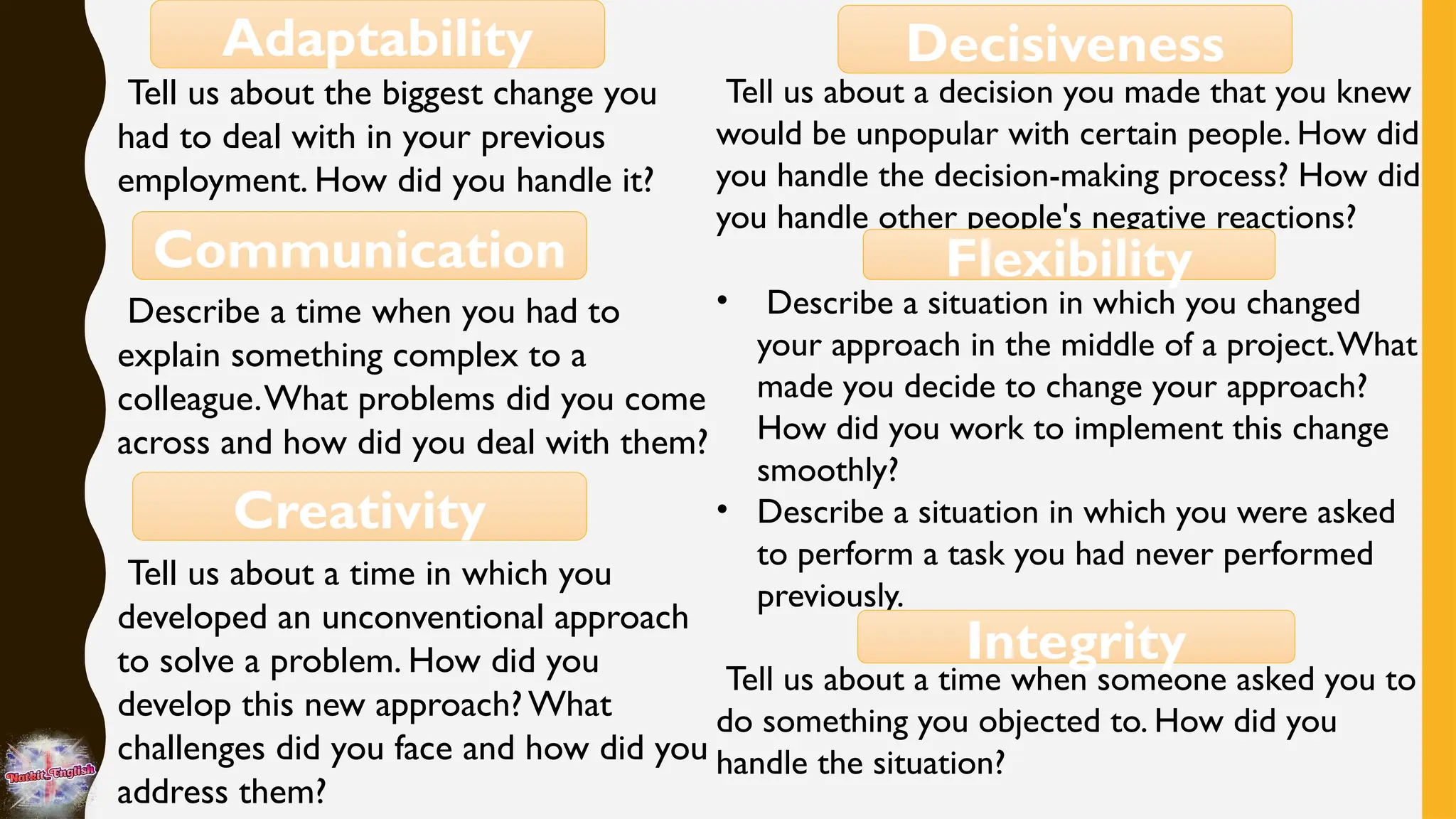
Tell us about the biggest change you
had to deal with in your previous
employment. How did you handle it?
Describe a time when you had to
explain something complex to a
colleague.What problems did you come
across and how did you deal with them?
Tell us about a time in which you
developed an unconventional approach
to solve a problem. How did you
develop this new approach? What
challenges did you face and how did you
address them?
Tell us about a decision you made that you knew
would be unpopular with certain people. How did
you handle the decision-making process? How did
you handle other people's negative reactions?
• Describe a situation in which you changed
your approach in the middle of a project.What
made you decide to change your approach?
How did you work to implement this change
smoothly?
• Describe a situation in which you were asked
to perform a task you had never performed
previously.
Tell us about a time when someone asked you to
do something you objected to. How did you
handle the situation?
Communication
Creativity
Flexibility
Integrity
Decisiveness
Adaptability
Describe a time when you had to improve
team's performance.What challenges did you
meet and how did you address them?
Describe a time when you received negative
feedback from an employer, colleague, or client.
How did you manage this feedback? What was
the outcome?
Describe a time when you were a member of
a team. How did you positively contribute to
the team?
Leadership
Resilience
Teamwork
Read the comment of hiring manager Thomas Turner and choose
the tip he mentions
As a hiring manager, I can say that preparing for interviews is serious business. But even if you
practice, and practice, and practice, you could still get a question you just don't know how to
answer. Try one of these pain-free approaches.
1. Take Your Time
First things first: Acknowledge that the question was asked and that you're thinking about it.
Take some time to work through your first thoughts on how to approach the question to fill up any
empty airspace with words to avoid awkward silences. Something like: "Hmm ... that's a great
question. Let me think about that."
2. Redirect
If you're asked a question that you really can't work through, own up and try redirecting to an
area you are familiar with. You may not be able to speak to a certain skill directly, but if you're able
to connect it to similar skills, you're much better off than just saying you don't have the skill
they're looking for.
Choose the tip he mentions:
 Tell a story that is anything but a success
 Tell a story that has nothing to do with the
question asked but don't keep silence
 Be honest. Say you don't know the answer and
don't waste the time
 Take some time to work through your thoughts
and redirect the question into possibility to
answer
For example, you applied for a position that requires social media marketing
experience and are asked about your experience in this type of marketing. If you
simply don't have it, take some time to work through your first thoughts on how
to approach the question and try redirecting the answer to something you do
have experience with.
In this instance, you could move toward your experience in social media
community management or print marketing and say, "That's one of the reasons
I'm so excited about this position. I have extensive experience in social media
community management from blogging in my previous position, as well as
experience with print marketing for my professional organization. I think I'm
very well equipped to combine these two skills into the necessary social media
marketing for your product, especially since your company has been focusing its
efforts in building up a community."

PPT - meeting 15 job interview presentation.pptx

  • 2.
    • What thingsdo you need to do to be prepared before an interview? • What skills do you want to demonstrate to your employer? • What vocabulary can you use that can describe your dynamic personality?
  • 3.
    1. The averagelength of an interview will be around 40 minutes. 2. But 33% of 2000 surveyed employers mentioned that they know within the very first 90 seconds of the interview if they will recruit the candidate.
  • 4.
    • Have youever been interviewed for a job in English? • Was it successful? • How did you feel? Were you nervous? • How long was it? • Why do you think it takes employers so little time to make the recruitment decision? • What does it depend on? What do hiring managers look at during these 90 seconds? • What should each candidate do before going to an interview?
  • 5.
    Useful tips forinterview preparation • Why do you think people should go to an interview prepared? • What would you do to be prepared before the interview? Ensuring you are well-prepared will help you to reduce stress, increase your confidence and improve your chances of being offered the job ensure reduce increase improve confidence
  • 6.
    Choose the tipswhich you find useful while preparing for an interview Do some research into the company you are applying for a job with Find out exactly what the job involves Spray yourself with scent so there is a pleasant trail Analyze your skills and experience and identify areas where they match the job requirements and the company's needs Sleep well to look fresh and presentable Rehearse the interview Decide what you're going to wear Make an eye-catching hairstyle Prepare a list of questions to ask at the end of the interview Pray improve = comprise scent rehearse pray trail
  • 7.
    The interview, likeevery other meeting, has its own strategy 1. What are the interview stages you will have to pass? 2. Why is it obligatory to keep the plan? b) Talking about yourself a) Experience questions c) Unusual questions d) Asking about conditions e) First impression. Meeting 1 2 3 4 5 3. What can you do to create a positive first impression with an interviewer? 4. Do you think these points are useful in making a positive first impression? • your appearance; • body language; • "break the ice" with the interviewer.
  • 8.
    1. What problemsdo you think a candidate can face during an interview? 2. How could your body language let you down in an interview? 3. How can you avoid these problems? No eye contact Trembling voice Sweating Trembling hands Bad posture bring a handkerchief make eye contact, but remember not to stare beathe slowly and deeply Sit up straight and lean forward when speaking politely decline tea or coffee
  • 9.
    1. Why doyou think these problems occur in candidate's behaviour? Can you give any advice on how to solve them? 2. What is a common action people do in an interview when they meet for the first time? 3. The handshake will be your only moment of physical contact with the interviewer. 4. Studies say that handshakes play a significant role in first impressions, so make it count. 5. Are there any strict rules about handshaking? Should it be strong orweak? 6. Do you have any ideas why managers can reject your interview? How many percent of candidates do you think were rejected because of failing simple eye contact? Look at the numbers below. Do you think they are real ? Why do you think so? • 70% were too fashionable or trendy • 67% failed an eye contact • 55% failed dressing, acting and walking through the door • 47% presented little knowledge of a company • 38% had a lack of smile • 26% the handshake was too weak
  • 10.
    Crossed arms: Putyour hands on your lap or on the table, lean over to your conversation partners. This way you emphasize that you are listening attentively. Nodding: Some people are nodding their heads constantly to show that they understand what the interviewer is saying. This can be perceived as too obedient or not sincere. Therefore, only nod your head if you agree, when you understand an important point and when you want to invite your conversation partner to continue talking. Many gestures: Someone who is using their hands and arms too much can be perceived as disturbing. The same applies to someone who is not moving at all. Sit up straight and keep your back against the backrest.
  • 11.
    Playing with yourhair: It is a common way to soothe yourself. If you touch your face too much or if you play with your hands, fingers or jewellery, you may be perceived as insecure and/or unreliable. Grinning: Excessive smiling in a job interview is seen for what it is — nervousness and a lack of confidence. Smile when there's something to smile about. Do a practice run in front of a mirror or a friend.
  • 12.
    What is asmall talk? The outcome of an interview can be decided in the first five minutes. Small talks usually happen between people who don't know each other well. • How do you think small talk can influence the employer's impression about you? • Have you ever experienced small talk conversations? (Not only in an interview) • Are there any things you would avoid talking about? • Why do you think employers ask the "How did you find out about us" question? • Ok, you broke the ice between you and your hiring manager. What is the first question employerwill ask you after a small talk? A small conversation without much importance in order to 'break the ice' between people !!!Tell me a little about yourself!!!
  • 13.
    K A Good morning. Myname is Karl Osborne. I'm Head of Production here at the theatre. It's nice to meet you at last. K How are you? A K I'm fine, thank you, Alex. Did you have any trouble finding us? A K How did you get here? A K So you managed to avoid the rain then? I can't believe the weather at the moment! A K Would you like some tea or coffee before we start? A K Ok. So Alex, how did you find out about us? We didn't advertise the position in a lot of places. A Thank you. Me too, Mr Osborne. It's OK. And you? Oh, it was challenging. I had to take a taxi to be on time. I know. It's awful. I would like coffee, please. It's rather cold outside I heard somebody was talking at a bus stop. You fired a person on this position. So I decided to apply. K Oh really...
  • 14.
    I heard somebodywas talking at a bus stop It's OK, I had enough sleep this night, so I'm rather happy I would like coffee, please Thank you. Me too I know. It's awful Oh, it was challenging I'm doing great, thanks! I started the day with a training run, so I can't really complain You were highly recommended to me by a friend who works here Thank you. It's nice to meet you too, Mr Osborne Oh, no, thank you It's awful, isn't it? Still, it's supposed to get better by the weekend Match the improved answers with poor ones and explain the changes No, no trouble at all. Your directions were excellent
  • 15.
    Explaining the I startedthe day with a training run. — To emphasise keeping fit, it may say that he's an active person. Your directions were excellent. — It is a polite way to answer, nobody wants to hear moaning about their company, even if it is connected with location. It's awful, isn't it? Still, it's supposed to get better by the weekend. — It is typical to maintain a small talk conversation. It is not enough just to say "yes" or "no". K: Would you like some tea or coffee before we start? A: Oh, no thank you. — It is a polite way to answer. Experts advise to always deny offers like that in an interview. You were highly recommended to me by a friend who works here. — It is one of the common ways to answer. Experts also suggest to emphasise that you did some research and became very interested in their company.
  • 16.
    Let's imagine thatyou are passing a job interview. Answer my small talk questions as you would answer them in an interview with your employer: • How are you? • Did you have any trouble finding us? • The weather is awful, isn't it? • How did you know about this position? • Would you like some tea or coffee?
  • 17.
    Education Current position Professional achievements Previousjob Reason for applying Skills you want to improve University achievements I have a really strong background in ... I'm hoping in the future I'll be able to ... I've been working at my current position for ... I've always had a passion for ... It's been a really interesting new challenge for me ... I have a really great skill set of ... I did the whole program with special focus on ... Watch the video again and match phrases with the topics from the video
  • 18.
    In all interviewsyou will be required to talk about yourse lf. What do you think they want to find out? The interviewers want to find out whether you're the type of person who would be able to do the job and also whether your personality would fit in with the rest of the company. • Do you think the phrases are useful in your speech? • Can they make your answer impressive? • Are you going to use them in your interview? • How would you avoid a boring answer to the question 'tell me a little bit about yourself'?
  • 19.
    I've always hada passion for computers. My friends and I even tried to create our own software program, but we didn't have enough knowledge at the time. I did the whole program with a special focus on computer technologies. I graduated from university in 2010. I have a really strong background in software and IT. I have a really great skill set of being able to communicate with people. I worked on different projects for several companies. It was an interesting challenge for me that helped me advance and become a project manager. I've been working at my current position for 5 years. I'm hoping in the future I will be able to improve my skills, accept bigger responsibilities and apply my new knowledge to help your company create better programs.  sounds impressive  shares their hobbies and interests to show they are creative  demonstrates relevant passions  boasts of gained skills for a long time  shows future plans in relation to the company  highlights relevant experience in a smart and concise way The speaker !concise! = short, brief
  • 20.
    Think of youranswer as your elevator pitch. An elevator pitch is a short summary used to quickly and simply define value proposition. It answers the question: "Why should I hire?" It should be concise enough to be delivered during a short elevator ride (to the 5th floor, not to the 105th floor). • What are your primary selling points for this job? • Why are you interested in this position right now? • What do you think 'Practice makes perfect' means? Now create your own impressive story •I've always had a passion for ... •I did the whole program with a special focus on ... •I graduated from ... •I've been working at my current position for ... •I have a really strong background in ... •I have a really great skill set of ... •It's been a really interesting new challenge for me . .. Cover the points: • assess what is important to the company; • make a list of things you want to include; • plan your answer to the following questions using impressive beginnings.
  • 21.
    T S How are you? I'mdoing great, thank you. Today I have finished my picture, so I'm in high spirits. What about you? T Did you have any trouble finding us? S Nope, the directions on your website were excellent. T The weather is awful, isn't it? S Yes, I'm looking forward to enjoying the sun outside. Let's hope the weather forecast doesn't lie because at the weekend I'm going on a picnic with my family. T Would you like some tea or coffee? T How did you know about this position? Tell me a little bit about yourself. S Well. I've been working for the past six years as an English teacher. During that time I've been trained and certified on a number of different systems. I'd really describe myself as an enthusiastic person with a versatile skill-set. Now I'm looking to take my career to the next level and move out of contract work into a full- time employee for a company where I can be a part of a team. I'd like to build a long-term career that lets me focus on professional growth. Oh, no, thank you so much. I had enough time this morning and I managed to have a cup. T S You were highly recommended to me by a friend who works here. He heard about the job and suggested I apply. S
  • 22.
    Put the wordsinto appropriate sentences 1.Jesse is an____________ He doesn't mind staying home on a Friday night 2.Graham's always very ______________ why don't you talk the ─ problem over with him? 3.His voice started to ______________, and I thought he was going to cry. 4.Don't ______________ at people like that, it's rude. 5.The baby turned and gave me a toothy ______ 6.Teachers have to be _________ to cope with different ability levels 7.Anton has a big ______________ for science fiction. 8.It could be a ______________ getting a piano through the doorway passion introvert tremble challenge grin stare approachable versatile
  • 23.
    Competencies are acombination of knowledge, skills and behaviour required to do a specific job. Do you know any specific competencies employers usually look for? What competency-based questions do they ask? Competencies • Have you ever been asked competency-based questions in your previous interview? • Should candidates know any tips to make their responses effective? • Are there any useful approaches to handle interview questions? • Can you give any advice to candidates on how to prepare for a competency based interview part? Preparation is key if you want to be able to answer all questions thrown at you without having to think too much on the spot on the day of the interview
  • 24.
    Match the competencieswith their questions 1._______________Tell me about a time you had to adjust your communication approach to suit a particular audience. 2.________________ Tell me about a time when you had to make a difficult decision. 3.______________ Tell me about a time when you assumed the role of leader. Were there any challenges, and how did you address them? 4.___________________ Tell me about a time when you were particularly successful. 5.______________ Tell me about a time you were working as part of a team. How did you make a contribution? 6.______________ Tell me about a time you were deceptive. communicatio n leadership teamwork results orientation Decision making reliability
  • 25.
    • Make surethat you understand which skills and competencies will be tested. It sounds obvious, but some person specifications can be a little vague and you will need to do some thinking in order to ensure that the examples that you will be using hit the spot. Understanding the requirements for the post, whether they are stated clear or not in the person specification, is therefore crucial. • Identify examples from your past experience which you can use to demonstrate that you possess the skills and competencies that you are being asked to demonstrate. You do not have to find hyper-complicated examples; in particular the outcome of the story does not have to be extraordinary; what matters most is that the role you played in reaching the outcome was substantial. • Learn to narrate the story using the STAR method. Read the tips
  • 26.
    Look at thepicture and read the definitions under each letter. What do you think the initials S, T, A and R stand for? situation task action result The STAR Method is a way of answering competency-based interview questions that provides interviewers with clear, concrete and concise answers. Interview questions that are answered in the STAR method format get to the heart of what a candidate actually did in a previous work experience.
  • 27.
    STAR stands for: *Situation — What was the situation you faced? * Task — What tasks were you involved in? * Action — What actions did you take? * Results — What were the results of those actions? So, it all worked out in the end. As a result of my initiative, we not only landed the client, but I was also recommended for a promotion. I had been looking for ways to take on more responsibility, so I volunteered to finish up the presentation. I worked with my supervisor via the phone and between the two of us, we ended up going ahead with the scheduled meeting. I was a part of a team working on a presentation meant to help us secure a major new client for our company. The weather was bad, and it turned out that my supervisor got caught in a snowstorm and was unable to make it back in time. It looked like we were going to have to cancel the meeting and potentially lose the client. Match the answers with the STAR parts Result: Task: Situation: Action: • Do you think STAR approach is logically constructed? • Why is it a useful method to describe your experience?
  • 28.
    Find out whichone followed the STAR approach. How did you understand it? Who is following the STAR approach?  Speaker A  Speaker B  Both Put the phrases from the answers into appropriate place Situation: Task: Action: Result: I actually ended up It turned out I decided to The problem was I wanted to be more I had to Therefore I So it all worked out in the end Probably, the best example is
  • 29.
    • Which answeris more impressive? Was it easy to guess who of the speakers followed the STAR approach? • Would you recommend somebody to use the STAR method? Why?  Tell me about a time when you had to make a difficult decision.  Tell me about a time when you demonstrated good customer service.  Tell me about a time when you showed strong leadership skills.  Tell me about a time when you played an important role in a team.  Tell me about a time when you experienced pressure at university or at work. Useful language  turn out  therefore  end up  work out
  • 30.
    Which phrasal verbis used to describe the unexpected success? worked out turned out ended up Which phrasal verb is used to introduce the unexpected cause? worked out turned out ended up Which phrasal verb is used to introduce the unexpected result? worked out turned out ended up Choose one situation and respond using three phrasal verbs:  Tell me about a time of difficult work relationship that you've experienced.  Tell me about a time when you felt that you hadn't achieved your goal.  Tell me about a time when you convinced a co-worker to accept a new task. • Why is it a good idea to use phrasal verbs in your speech? Let's practise your own answers. They help to make your speech more professional and sound impressive. You show high knowledge in your language skills.
  • 31.
    Complete the followinginterview extracts using the correct verb: 1. I was planning to study Economics at Bristol University but I ____________ going to Manchester University instead. 2. Things _____________so well that they offered me a promotion. 3. Although I wasn't entirely sure I had made the right decision, I ________ really enjoying the course. 4. Unfortunately it _______________ that they couldn't offer me the job because my qualifications didn't meet the visa requirements for working in the country. 5. Larissa was working as a PA when I joined the company. However, after she got married, she moved to New Zealand and she ___________ retraining as a nurse. 6. We had a lot of technical problems in the beginning, but we managed to sort them out and it all ______________in the end. ended up turned out worked out
  • 32.
    Communication • Tell meabout a time when a co-worker criticized your work in front of others. How did you respond? How has that event shaped the way you communicate with others? • How do you ensure that someone understands what you are saying? • Tell me about a time when you had to present complex information. • Tell me about a time when you had to use your written communication skills in order to get across an important point. • Give me an example of a time you had to make a difficult decision. • Describe a specific problem you solved for your employer. How did you approach the problem? What role did others play? What was the outcome? • Give me an example of when taking your time to make a decision paid off. Decision making • Describe a situation when you had many projects due at the same time.What steps did you take to get them all done? • How do you determine priorities in scheduling your time? Give me an example. Planning and organizing • Tell me about a time when you influenced the outcome of a project by taking a leadership role. • Give me an example of when you involved others in making a decision. Leadership Time management • Tell me about a time when you failed to meet a deadline.What things did you fail to do?What were the repercussions?What did you learn? • Tell me about a time when you were particularly effective in prioritizing tasks and completing a project on schedule.
  • 33.
    Tell us aboutthe biggest change you had to deal with in your previous employment. How did you handle it? Describe a time when you had to explain something complex to a colleague.What problems did you come across and how did you deal with them? Tell us about a time in which you developed an unconventional approach to solve a problem. How did you develop this new approach? What challenges did you face and how did you address them? Tell us about a decision you made that you knew would be unpopular with certain people. How did you handle the decision-making process? How did you handle other people's negative reactions? • Describe a situation in which you changed your approach in the middle of a project.What made you decide to change your approach? How did you work to implement this change smoothly? • Describe a situation in which you were asked to perform a task you had never performed previously. Tell us about a time when someone asked you to do something you objected to. How did you handle the situation? Communication Creativity Flexibility Integrity Decisiveness Adaptability
  • 34.
    Describe a timewhen you had to improve team's performance.What challenges did you meet and how did you address them? Describe a time when you received negative feedback from an employer, colleague, or client. How did you manage this feedback? What was the outcome? Describe a time when you were a member of a team. How did you positively contribute to the team? Leadership Resilience Teamwork
  • 35.
    Read the commentof hiring manager Thomas Turner and choose the tip he mentions As a hiring manager, I can say that preparing for interviews is serious business. But even if you practice, and practice, and practice, you could still get a question you just don't know how to answer. Try one of these pain-free approaches. 1. Take Your Time First things first: Acknowledge that the question was asked and that you're thinking about it. Take some time to work through your first thoughts on how to approach the question to fill up any empty airspace with words to avoid awkward silences. Something like: "Hmm ... that's a great question. Let me think about that." 2. Redirect If you're asked a question that you really can't work through, own up and try redirecting to an area you are familiar with. You may not be able to speak to a certain skill directly, but if you're able to connect it to similar skills, you're much better off than just saying you don't have the skill they're looking for. Choose the tip he mentions:  Tell a story that is anything but a success  Tell a story that has nothing to do with the question asked but don't keep silence  Be honest. Say you don't know the answer and don't waste the time  Take some time to work through your thoughts and redirect the question into possibility to answer
  • 36.
    For example, youapplied for a position that requires social media marketing experience and are asked about your experience in this type of marketing. If you simply don't have it, take some time to work through your first thoughts on how to approach the question and try redirecting the answer to something you do have experience with. In this instance, you could move toward your experience in social media community management or print marketing and say, "That's one of the reasons I'm so excited about this position. I have extensive experience in social media community management from blogging in my previous position, as well as experience with print marketing for my professional organization. I think I'm very well equipped to combine these two skills into the necessary social media marketing for your product, especially since your company has been focusing its efforts in building up a community."