PPT GRAND PRESENTATION cbdc (central based digital currency)
1.
CURRENT SCENARIO ANDFUTURE
OF CENTRAL BANK DIGITAL
CURRENCIES
(GRAND PRESENTATION)
BY : AKSHITA JAIN
YASHIKA ARORA
ANURAG NAGI
SUMIT MATHUR
ISHIKA DHAMA
SHREYA SHAMBHAVI
2.
WHAT IS CENTRALBANK DIGITAL CURRENCY (CBDC)?
1. A Central Bank Digital Currency (CBDC) is the legal tender issued by a central
bank in a digital form. It is the same as a fiat currency and is exchangeable one-to-
one with the fiat currency. Only its form is different.
2.It is basically the virtual form of a fiat currency created and regulated by the
nation’s monetary authority or central bank (Reserve Bank of India).
3.It is a digital token or electronic record of a country’s official money.
4.It is sovereign currency in an electronic form and it would appear as liability
(currency in circulation) on a central bank’s balance sheet.
5. RBI started the process of designing CBDC framework in 2022. Finance Bill 2022
enacted with amendments in Reserve Bank of India Act, 1934 for CBDC.
3.
CURRENT SCENARIO OFOTHER CURRENCY
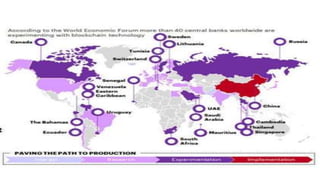
• 81 countries , representing over 90 percent of Global GDP, are
exploring CBDCs.
• Fourteen countries have tested pilots.
• China(e-Yuan) and south Korea, England , Sweden(e-Krona).
• 16 countries such currencies are in the development phase.
• 32 countries in the research phase-USA , UK , Mexico etc.
• The Bahamas , Nigeria and 7 countries in Eastern Caribbean
Union- have already launched a centrally governed digital.
4.
AIM OF CBDC’S
1.Theaim of study of CBDC’s is to study how
mitigate the risks and trim costs in handling
physical currency, costs of phasing out
soiled notes, transportation, insurance and
logistics.
2.t will also wean people away from
cryptocurrencies as a means for money
transfer.
5.
OBJECTIVES OF CBDCs
1.Exchangingenhancing financial inclusion control.
2. Ensuring the stability of the financial system.
3. Improving the efficiency of payment system.
4. Providing a safe , and efficient means of payment ,accessible to all citizens ,
reducing reliance on physical cash and potentially lowering transaction costs.
5. Seen as a way to fortify the economy against the challenges posed by private
digital currencies and to maintain control over monetary policy.
6. The main objective is to mitigate the risks and trim costs in handling physical
currency, costs of phasing out soiled notes, transportation, insurance and
logistics.
7.It will also wean people away from cryptocurrencies as a means for money
transfer.
6.
FIAT MONEY
• Itis a government-issued currency that is not backed by a
commodity such as gold.
• It gives central banks greater control over the economy
because they can control how much money is printed.
• Most modern paper currencies such as the US dollar are fiat
currencies.
• One danger of fiat money is that governments will print too
much of it, resulting in hyperinflation.
INTERNATIONAL MONETARY FUND(IMF)STATEMENT
1.The IMF’s Digital Money Strategy , endorsed by its Executive Board in July 2021, gives
the institution a mandate to help that digital money fosters domestic and international
economic and financial stability.
2.CBDC’s , in particular , will likely have important implications for monetary policy, financial
stability, and the international monetary system (IMS).
3.The IMF must monitor ,and advise on , digital money developments for members.
4.Given its mandate and global membership , the IMF is uniquely well-placed to offer advice
to countries across different regions and income groups.
5.Over 40 countries have approached the IMF to request assistance through CBDC capacity
development(CD).
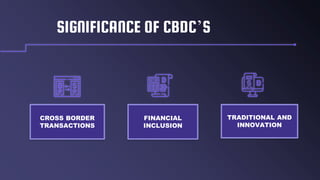
CROSS BORDER TRANSACTION
•CBDCs possess unique attributes that can revolutionize
cross-border transactions.
• Instant settlement feature of CBDCs as a significant
advantage, making cross-border payments cheaper,
faster, and more secure.
• Faster, cheaper, transparent, and inclusive cross-border
payment services can yield substantial benefits for
individuals and economies worldwide.
• These improvements can support economic growth,
international trade, and financial inclusion on a global
scale.
11.
FINANCIAL INCLUSION
• Theincreased use of CBDC could be explored for many other
financial activities to push the informal economy into the formal
zone to ensure better tax and regulatory compliance.
• It can also pave the way for furthering financial inclusion.
TRADITIONAL AND INNOVATION
• CBDC can gradually bring a cultural shift towards virtual
currency by reducing currency handling costs.
• CBDC is envisaged to bring in the best of both worlds:
• The convenience and security of digital forms like
cryptocurrencies.
• The regulated, reserved-backed money circulation of the
traditional banking system.
12.
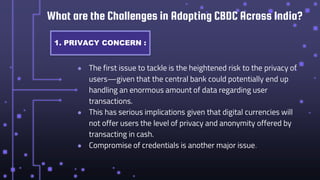
What are theChallenges in Adopting CBDC Across India?
● The first issue to tackle is the heightened risk to the privacy of
users—given that the central bank could potentially end up
handling an enormous amount of data regarding user
transactions.
● This has serious implications given that digital currencies will
not offer users the level of privacy and anonymity offered by
transacting in cash.
● Compromise of credentials is another major issue.
1. PRIVACY CONCERN :
13.
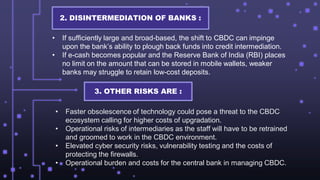
2. DISINTERMEDIATION OFBANKS :
• If sufficiently large and broad-based, the shift to CBDC can impinge
upon the bank’s ability to plough back funds into credit intermediation.
• If e-cash becomes popular and the Reserve Bank of India (RBI) places
no limit on the amount that can be stored in mobile wallets, weaker
banks may struggle to retain low-cost deposits.
3. OTHER RISKS ARE :
• Faster obsolescence of technology could pose a threat to the CBDC
ecosystem calling for higher costs of upgradation.
• Operational risks of intermediaries as the staff will have to be retrained
and groomed to work in the CBDC environment.
• Elevated cyber security risks, vulnerability testing and the costs of
protecting the firewalls.
• Operational burden and costs for the central bank in managing CBDC.
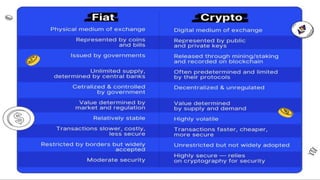
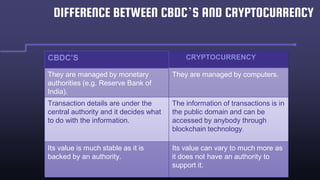
CBDC’S CRYPTOCURRENCY
They aremanaged by monetary
authorities (e.g. Reserve Bank of
India).
They are managed by computers.
Transaction details are under the
central authority and it decides what
to do with the information.
The information of transactions is in
the public domain and can be
accessed by anybody through
blockchain technology.
Its value is much stable as it is
backed by an authority.
Its value can vary to much more as
it does not have an authority to
support it.
DIFFERENCE BETWEEN CBDC’S AND CRYPTOCURRENCY
16.
ADVANTAGES OF CBDC’S
•It aims at reduction in operational costs involved in physical cash
management, fostering financial inclusion, bringing resilience,
efficiency and innovation in the payments system.
• It will add efficiency to the settlement system and boost innovation in
cross-border payments space.
• It will provide the public with the uses that any private virtual
currencies can provide without any associated risks.
• It will curb issues such as money laundering, terror financing,
• tax evasion , etc.
17.
BRICS Will CreatePayment System Based on Digital
Currencies and Blockchain
• The BRICS grouping will create a payment system based on blockchain.
• The effort is part of a specific task for this year to increase the role of BRICS in the international
monetary system.
• The five-nation BRICS group comprising Brazil, Russia, India, China and South Africa will work
on creating a payment system based on blockchain and digital technologies, a report by Russian
news agency TASS said.
• “We believe that creating an independent BRICS payment system is an important goal for the
future, which would be based on state-of-the-art tools such as digital technologies and
blockchain.
• The main thing is to make sure it is convenient for governments, common people and
businesses, as well as cost-effective and free of politics,” Kremlin aide Yury Ushakov said in an
interview with TASS.
• The effort is part of a specific task for this year to increase the role of BRICS in the international
monetary system.
• For some time now, the BRICS grouping has been making efforts to reduce its reliance on U.S.
dollars in settlement, also known as de-dollarization..
18.
BRICS Will CreatePayment System Based on Digital
Currencies and Blockchain
• Work will continue to develop the Contingent Reserve Arrangement,
primarily regarding the use of currencies different from the US dollar,"
Ushakov said.
• Last week, another TASS report said Russia’s Finance Ministry, the Bank
of Russia and BRICS partners will create the BRICS Bridge multisided
payment platform in an effort to improve the global monetary system.
• Also in February, Klaas Knot, the Chair of the Financial Stability Board,
which keeps an eye on the global financial system, wrote to finance
ministers from the Group of 20 (G20) countries that crypto assets,
tokenization and artificial intelligence (AI) remain priorities.
19.
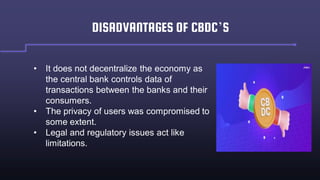
DISADVANTAGES OF CBDC’S
•It does not decentralize the economy as
the central bank controls data of
transactions between the banks and their
consumers.
• The privacy of users was compromised to
some extent.
• Legal and regulatory issues act like
limitations.
CBDCs represent adigital form of a country's national currency, in the case of India, it is Digital Rupee
(e₹), issued and regulated by the central bank. It is fundamentally different from cryptocurrencies like
Bitcoin, which are decentralized and operate outside the traditional financial system. CBDCs, on the other
hand, are fully integrated into the central bank's monetary policy and payment infrastructure . Digital
currency refers to any currency that is available in electronic form. The Digital Rupee is virtual money,
serving the same purpose as physical money. It is a form of digital currency issued by the Reserve Bank
of India (RBI), the country's central bank. The Digital Rupee is a centralized digital currency directly
regulated by the RBI, maintaining the stability and trust associated with traditional currencies . The Digital
Rupee is introduced in India to enhance financial inclusion, providing greater access to formal financial
services. It aims to promote efficiency in transactions through faster and more secure digital payment
methods, align with the country's technological advancements, foster a digital-first economy, reduce
dependence on physical currency, and enable better regulatory control over monetary transactions while
countering potential illicit activities . Digital Rupee, also known as e Rupee , is electronic money. It
operates as a form of digital currency issued and controlled by the Reserve Bank of India (RBI), using
blockchain or distributed ledger technology for secure and transparent transactions .Types of CBDC’s.
CBDCs can be broadly categorized into two main types : Retail CBDCs: Designed for use by the general
public for everyday transactions, similar to how cash is used today . Wholesale CBDCs: Intended for use
by financial institutions for interbank settlements and other wholesale transactions . Issuing Digital Rupee.
CASE STUDY
22.
The Reserve Bankof India (RBI) issues electronic tokens that can be exchanged on a one-to-one basis, with
denominations similar to physical currency. The RBI controls the distribution of the Digital Rupee, distributing
it to commercial banks or authorized financial institutions for circulation. Transactions made with Digital
Rupee are recorded and verified on a secure ledger system for transparency and security . Acquiring Digital
Rupee Users can acquire Digital Rupee through digital wallets provided by authorized financial institutions or
other approved platforms. These wallets function as secure digital storage for the currency. Digital tokens
can also be withdrawn, similar to withdrawing cash, and cash can be converted to e Rupee using a UPI
gateway . Users can load the required token amount or select different denominations of Digital Rupee
through their linked Banked Account (Bank of Baroda Account) or Other UPI Account. If users have chosen
"Other UPI Account," a list of all UPI apps available on their phone will appear. Users can select their
preferred UPI app, enter their UPI PIN, and complete the transaction. The amount is debited from the Bank
Account directly, and Digital Rupee is loaded in the wallet successfully . Users can redeem/unload wallet
tokens to their linked bank account. Digital Rupee Tokens will be unloaded from their wallet, and the
equivalent amount will be credited to their linked bank account . Using Digital Rupee . Person-to-Person:
Transfer money to another person’s wallet with a QR code or their mobile number. Person-to-Merchant:
Scan the QR code displayed at a merchant’s establishments (shops) to make a payment . Features of Digital
Rupee .The Digital Rupee is issued by the Reserve Bank of India and is legally recognized as a secure form
of payment accepted by individuals, businesses, and governmental bodies . Issuance follows the central
bank's financial policies . Holders have the freedom to convert Digital Rupee into physical cash through
commercial banks . Legal Tender: CBDCs are considered legal tender, usable for all types of transactions .
Central Bank Control: CBDCs are controlled and regulated by the central bank, ensuring stability and
trustworthiness . Programmable Money: CBDCs can have programmable features, such as smart contracts,
enabling automated, self-executing financial agreements .
23.
Advantages of DigitalRupee . Financia l Inclusion: Provides opportunities for those without access to traditional banking
services, allowing participation in the formal economy . Reduced Transaction Costs: Eliminates intermediaries, leading
to lower transaction costs compared to traditional banking systems . Efficiency and Speed: Transactions are processed
faster, often within seconds, regardless of geographical locations . Transparency and Security: Blockchain ledger
ensures transaction transparency while maintaining security through cryptographic protocols . Government Control and
Regulation: Being centrally regulated, the RBI can control the supply, circulation, and monetary policies associated with
Digital Rupee . Challenges and Concerns of CBDC Privacy Concerns: The use of CBDCs raises questions about privacy, as
transactions can be easily monitored and traced, potentially compromising individual financial privacy . Cybersecurity
Risks: CBDCs are susceptible to cyber-attacks, requiring robust security measures to protect the digital currency's
integrity . Disruption of Traditional Banking: Widespread adoption of CBDCs could disrupt traditional banking systems,
potentially leading to bank runs and other systemic challenges . International Implications: Global adoption of CBDCs
may influence the international monetary system, raising concerns about the role of the U.S. dollar as the world's
primary reserve currency . CBDC in Bank of Baroda Milestones . Bank of Baroda Launched CBDC application called
“Bank of Baroda Digital Rupee” on 17th January 2023.Bank of Baroda enabled CBDC UPI QR Interoperability
functionality for pilot users on the Bank of Baroda Digital Rupee app on September 2, 2023. Conclusion . The Digital
Rupee holds the potential to revolutionize India's financial landscape, promoting financial inclusion, reducing
transaction costs, and streamlining financial operations. As the digital currency ecosystem evolves, the Digital Rupee is
positioned to play a pivotal role in shaping the future of transactions and financial services in India . The Digital Rupee is
a landmark development in India's financial history, leveraging technology to create a more inclusive and efficient
financial system.
24.
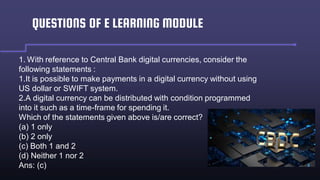
QUESTIONS OF ELEARNING MODULE
1. With reference to Central Bank digital currencies, consider the
following statements :
1.It is possible to make payments in a digital currency without using
US dollar or SWIFT system.
2.A digital currency can be distributed with condition programmed
into it such as a time-frame for spending it.
Which of the statements given above is/are correct?
(a) 1 only
(b) 2 only
(c) Both 1 and 2
(d) Neither 1 nor 2
Ans: (c)
25.
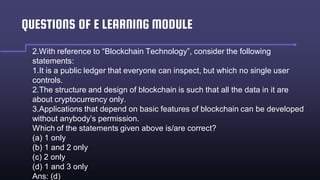
QUESTIONS OF ELEARNING MODULE
2.With reference to “Blockchain Technology”, consider the following
statements:
1.It is a public ledger that everyone can inspect, but which no single user
controls.
2.The structure and design of blockchain is such that all the data in it are
about cryptocurrency only.
3.Applications that depend on basic features of blockchain can be developed
without anybody’s permission.
Which of the statements given above is/are correct?
(a) 1 only
(b) 1 and 2 only
(c) 2 only
(d) 1 and 3 only
Ans: (d)
26.
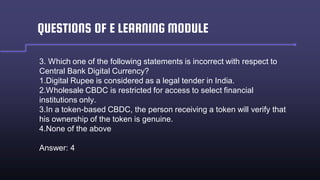
QUESTIONS OF ELEARNING MODULE
3. Which one of the following statements is incorrect with respect to
Central Bank Digital Currency?
1.Digital Rupee is considered as a legal tender in India.
2.Wholesale CBDC is restricted for access to select financial
institutions only.
3.In a token-based CBDC, the person receiving a token will verify that
his ownership of the token is genuine.
4.None of the above
Answer: 4
27.
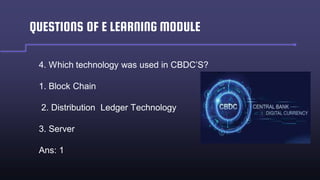
QUESTIONS OF ELEARNING MODULE
4. Which technology was used in CBDC’S?
1. Block Chain
2. Distribution Ledger Technology
3. Server
Ans: 1
28.
• The CBDChas many advantages to
offer like reduced cost, and better
central control over the paper
currency.
• The present banking system needs
to be part of the CBDC Pilot
projects in the Indian context.
• The acceptance and anonymity of
paper currency can be attained
with CBDC only with time and
gradual acceptance.
CONCLUSION