LX5619 PRACTICE OF
INTERNATIONALFINANCIAL
REGULATION
Dr Shabir Korotana (LSE) Module
Leader
Professor Arad Reisberg
Dr Francesco De Pascalis
2.
Brunel University London
4May 2025
Presentation Title 2
1 introduction
· Focus of the lecture: To explore the configuration of CBDC systems, the
involvement of commercial banks, and the role of various technologies in ensuring
consumer privacy, referencing policy papers from bodies like the BIS and IMF.
· CBDCs are viewed as a transformative force in digital money, representing a
significant move towards state-driven control over payments and money systems.
· Lecture Structure: The lecture is divided into sections covering 1. rationales for
CBDCs, 2. cross-border use and obstacles, 3. legal/economic aspects, and 4. CBDC
architectures and technologies, 5. with conclusions.
3.
Brunel University London
4May 2025
Presentation Title 3
1. Rationale for CBDC
1. Rationales
Response to the Digitisation of Money and Payments CBDCs are central banks'
answer to the increasing digital transformation of money and the dominance of
private payment systems (Facebook factor?). They aim to reclaim monetary
sovereignty and address the challenges posed by the privatisation of payment
systems.
· Key Rationales for CBDCs The Bank of International Settlements and the European
Central Bank outline the main reasons for developing CBDCs: securing payment
systems, countering private sector dominance, encouraging innovation for all citizens,
and safeguarding financial inclusion.
· Impact of Private Sector Dominance The dominance of private networks like Visa
and MasterCard, along with the volatility of cryptocurrencies, has highlighted the need
for stable, publicly controlled alternatives. CBDCs address these issues by reasserting
state control over monetary policy and payments.
4.
Brunel University London
4May 2025
Presentation Title 4
Rationale for CBDC
· Challenges for Public Policymakers The rise of private payment providers and cryptocurrency
scams has created issues for governments, including securing universal access to payment
networks. Instead of imposing stricter regulations (for market failures) on private operators, states
are introducing CBDCs as a competing system.
· Market Failures and State Intervention Market failures, such as high transaction costs and
limited access to private payment systems, have prompted central banks to step in with CBDCs.
These digital currencies are designed to ensure fair access and address gaps left by private
providers.
· Money as a Public Good The introduction of CBDCs has revived debates about whether money
should be treated as a public good. This perspective argues for state involvement in providing
essential financial services like payments and monetary stability in the public interest.
· Financial Inclusion Benefits CBDCs can enhance financial inclusion in places where access to
banking services is limited, like island states such as The Bahamas. By providing a state-controlled
digital payment solution, they can offer an alternative to expensive or inaccessible commercial
banking networks (Central bank account?).
5.
Brunel University London
4May 2025
Presentation Title 5
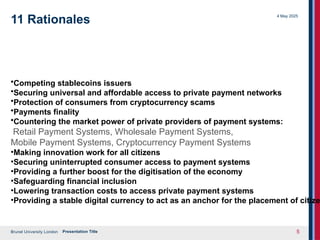
11 Rationales
•Competing stablecoins issuers
•Securing universal and affordable access to private payment networks
•Protection of consumers from cryptocurrency scams
•Payments finality
•Countering the market power of private providers of payment systems:
Retail Payment Systems, Wholesale Payment Systems,
Mobile Payment Systems, Cryptocurrency Payment Systems
•Making innovation work for all citizens
•Securing uninterrupted consumer access to payment systems
•Providing a further boost for the digitisation of the economy
•Safeguarding financial inclusion
•Lowering transaction costs to access private payment systems
•Providing a stable digital currency to act as an anchor for the placement of citize
6.
Brunel University London
4May 2025
Presentation Title 6
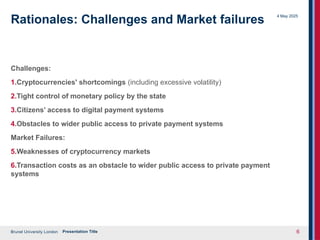
Rationales: Challenges and Market failures
Challenges:
1.Cryptocurrencies' shortcomings (including excessive volatility)
2.Tight control of monetary policy by the state
3.Citizens’ access to digital payment systems
4.Obstacles to wider public access to private payment systems
Market Failures:
5.Weaknesses of cryptocurrency markets
6.Transaction costs as an obstacle to wider public access to private payment
systems
7.
Brunel University London
4May 2025
Presentation Title 7
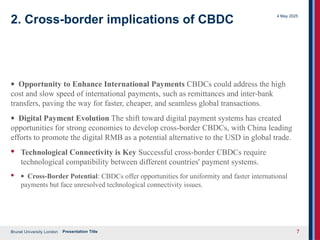
2. Cross-border implications of CBDC
· Opportunity to Enhance International Payments CBDCs could address the high
cost and slow speed of international payments, such as remittances and inter-bank
transfers, paving the way for faster, cheaper, and seamless global transactions.
· Digital Payment Evolution The shift toward digital payment systems has created
opportunities for strong economies to develop cross-border CBDCs, with China leading
efforts to promote the digital RMB as a potential alternative to the USD in global trade.
· Technological Connectivity is Key Successful cross-border CBDCs require
technological compatibility between different countries' payment systems.
· · Cross-Border Potential: CBDCs offer opportunities for uniformity and faster international
payments but face unresolved technological connectivity issues.
8.
Brunel University London
4May 2025
Presentation Title 8
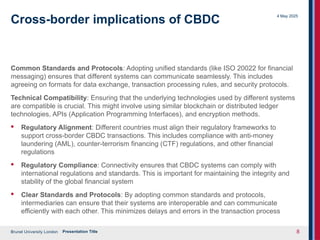
Cross-border implications of CBDC
Common Standards and Protocols: Adopting unified standards (like ISO 20022 for financial
messaging) ensures that different systems can communicate seamlessly. This includes
agreeing on formats for data exchange, transaction processing rules, and security protocols.
Technical Compatibility: Ensuring that the underlying technologies used by different systems
are compatible is crucial. This might involve using similar blockchain or distributed ledger
technologies, APIs (Application Programming Interfaces), and encryption methods.
· Regulatory Alignment: Different countries must align their regulatory frameworks to
support cross-border CBDC transactions. This includes compliance with anti-money
laundering (AML), counter-terrorism financing (CTF) regulations, and other financial
regulations
· Regulatory Compliance: Connectivity ensures that CBDC systems can comply with
international regulations and standards. This is important for maintaining the integrity and
stability of the global financial system
· Clear Standards and Protocols: By adopting common standards and protocols,
intermediaries can ensure that their systems are interoperable and can communicate
efficiently with each other. This minimizes delays and errors in the transaction process
9.
Brunel University London
4May 2025
Presentation Title 9
Cross-border Implications of CBDC
· CBDCs and Monetary Sovereignty: Central Banks worldwide are planning CBDCs as a way to reclaim monetary sovereignty
amidst rapid technological changes, but their development poses socio-economic challenges.
· Monetary Policy and Financial Stability: Challenges like potential disruptions to monetary policy and financial stability could
be mitigated through measures such as interest rates and caps on deposits/withdrawals.
· Economic Implications for Adopting Countries When a country adopts another country’s CBDC, it essentially imports the
issuing country’s monetary policies, such as interest and exchange rates. This may affect the adopting country's trade
competitiveness and require adjustments to its economic strategies.
· Advantages for Issuing Countries The internationalization of a CBDC could increase the liquidity of the issuing country's
currency and strengthen trade links with adopting countries, benefiting the issuing nation economically.
· Central Bank Cooperation is Essential Smooth cross-border payments depend on collaboration between central banks to
ensure system connectivity and operational feasibility, which will determine the effectiveness of CBDCs in international
transactions.
· Legal Challenges in Cross-Border Transactions Legal questions remain about how to address wrongful transfers of CBDCs
across borders, including which country’s property laws and tracing remedies would apply. These issues depend on the
location of the CBDC ledger and the central bank managing the accounts. An important legal question is whether the laws
of both the issuing and adopting countries will apply in cases of wrongful cross-border transfers of CBDCs. To
answer this, we need to look at the rules in private international law that deal with cross-border holdings of digital
assets. The applicable rules might depend on the location of the CBDC ledger or the central bank that manages the
accounts.
10.
Brunel University London
4May 2025
Presentation Title 10
Cross-border implications of CBDC
· Impact on Costs and Currency Substitution: CBDCs could reduce cross-border payment costs,
benefiting migrant remittances, but adopting another country's CBDC might equate to currency
substitution, with mixed economic outcomes based on previous cases like Zimbabwe and
Venezuela.
· China's Ambition: China aims to use its digital Renminbi (RMB) to challenge the dominance of
the USD in global trade, potentially altering global monetary arrangements despite its non-
convertibility hurdles.
11.
Brunel University London
4May 2025
Presentation Title 11
3. Legal and Economic aspects of CBDC
4
Could CBDCs Become a Form of Money?
Functions of Money: CBDCs can become money if they serve as a medium of exchange, a store of
value, and a unit of account—key roles traditionally associated with money.
Fiat Money and Legal Tender: As digital fiat money, CBDCs can be designated as legal tender by
issuing states, unlike cryptocurrencies, which do not satisfy the same sociological or Chartalist
definitions of money.
Global Debate: Governments and central banks view CBDCs as a response to the revolution in money
and payments, but there is no consensus on their architecture despite significant discussions globally,
including in the US, EU, China, and others.
CBDCs and Financial Stability
Risk of Bank Runs: CBDCs might cause mass withdrawals from banks if savers transfer funds to
CBDCs. However, measures like caps on CBDC holdings or withdrawal limits can mitigate this risk.
Interest Rates: Central banks could ensure CBDCs do not compete with bank deposits by setting
interest rates for CBDCs at levels lower than traditional savings accounts.
12.
Brunel University London
4May 2025
Presentation Title 12
Legal and Economic Aspects of CBDC
Monetary policy refers to the actions taken by a country's central bank or monetary authority to manage the
supply of money and interest rates in the economy. The primary goals of monetary policy are to control inflation,
stabilize the currency, achieve full employment, and promote economic growth. Here are some key tools and
actions used in monetary policy:
1.Interest Rates: Central banks can adjust the short-term interest rates to influence borrowing and spending.
Lowering interest rates makes borrowing cheaper, encouraging spending and investment. Raising interest rates
makes borrowing more expensive, which can help control inflation.
2.Open Market Operations: This involves buying or selling government securities in the open market to influence
the amount of money in the banking system. When the central bank buys securities, it increases the money
supply; when it sells securities, it decreases the money supply.
3.Reserve Requirements: Central banks can set the minimum amount of reserves that commercial banks must
hold against deposits. Lowering reserve requirements increases the amount of money banks can lend, while
raising reserve requirements reduces it.
4.Quantitative Easing: This is a more unconventional monetary policy tool where the central bank purchases
longer-term securities to increase the money supply and encourage lending and investment.
5.Forward Guidance: Central banks communicate their future policy intentions to influence expectations and
behavior of businesses and consumers.
By using these tools, central banks aim to influence economic activity, control inflation, and maintain financial
stability.
13.
Brunel University London
4May 2025
Presentation Title 13
Legal and Economic Aspects of CBDC
CBDCs and Monetary Policy
Impact on Money Supply: CBDCs, as replacements or complements to fiat money, are unlikely to cause
inflation or increase money circulation significantly.
Centralization and Role of Banks: CBDCs could centralise monetary policy but do not necessarily disrupt
interest rates. Their design as tokens or accounts depends on the central banks' mandates and priorities.
Token vs. Account-Based CBDCs
Design Choices: Token-based CBDCs offer decentralised options but require centralised systems for
settlement. Account-based CBDCs make payment reconciliation easier but may rely on centralised ledgers.
DLT Benefits and Challenges: Distributed Ledger Technology (DLT) ensures immutability and payment
irreversibility but comes with operational drawbacks.
Short-Term Utility of CBDCs
Limited Retail Use: In economies with well-developed payment systems, CBDCs’ short-term benefits for
retail payments may be minimal. However, they provide a means for governments and central banks to
regain control over money supply and monetary policy.
14.
Brunel University London
4May 2025
Presentation Title 14
4. Impact of CBDC
5 Impact
Possible CBDC Models
Wholesale vs. Retail CBDCs: Wholesale CBDCs involve commercial banks managing CBDC wallets and payments, while retail CBDCs are used by
individuals and small businesses. Retail models face challenges with Know Your Customer (KYC) processes if merchants are entry points to the system.
The choice of CBDC model affects regulatory compliance and system design. If commercial banks are involved, they handle
user registration, KYC checks, and regulatory compliance. If private merchants are the entry point, it's hard for them to
manage these controls. An account-based CBDC might let the public have accounts directly with the central bank, but this
could negatively impact commercial banks where people keep their savings. While CBDCs are seen as central bank liabilities,
this approach could make central banks a single point of failure and increase the risk of cyber-attacks.
Examples of CBDC Plans: The Bank of England and European Central Bank envision retail CBDCs like the digital Sterling and digital Euro, while
Canada and the US explore dual-use (wholesale and retail) CBDCs.
Privacy and Security Challenges
Interoperability with Private Networks: CBDCs must integrate seamlessly with private payment systems like commercial bank cards, requiring
interfaces between central bank ledgers and commercial bank balances.
Privacy Concerns: Using Distributed Ledger Technology (DLT) raises risks due to transparency but could incorporate privacy solutions like zero-
knowledge proofs. Central banks favor non-DLT systems to protect citizens’ payment data from excessive surveillance.
Digital Wallets: A potential solution involves user-managed digital wallets, allowing interaction with central ledgers while maintaining transaction privacy.
Environmental Impact
Energy Efficiency: CBDC systems must minimize energy consumption compared to cryptocurrencies like Bitcoin, aligning with global efforts to combat
climate change.
15.
Brunel University London
4May 2025
Presentation Title 15
Impact of CBDC
Open vs. Closed Systems
Closed Systems Preferred: Most central banks reject permissionless blockchain technology
for CBDCs, favoring closed systems to ensure control and security.
Potential Role in Open Finance: If CBDCs align with open finance principles, they could
boost currency liquidity and demand, enhancing national exchange rates.
Public Trust and Adoption
Public Trust is Critical: The success of CBDCs depends on scalability, security, and public
confidence. Smart contracts and programmable money could further enhance societal welfare.
Regulatory Benefits: CBDCs could help combat money laundering, tax evasion, and terrorist
financing by offering less anonymity than cryptocurrency wallets.
Impact on Commercial Banking
Risk to Banks: Central banks holding direct CBDC accounts could centralize liabilities but
may disrupt commercial banking and increase cyber-attack risks.
16.
Brunel University London
4May 2025
Presentation Title 16
5. Conclusion
Conclusion
· CBDCs as the Digital Frontier: CBDCs represent the final step in the digitization of money, potentially
leading to the gradual decline of physical cash while reinforcing the use of fiat money. They are seen as a way
for states to reclaim monetary sovereignty as sole suppliers of money.
· Retention of Physical Cash: Fully replacing physical currency with CBDCs is unwise due to the inclusivity
of cash for those who are digitally disadvantaged and its role as a critical backup during emergencies like
technology disruptions or disasters.
· Challenges and Open Questions: CBDCs face significant unresolved challenges, such as cross-border
connectivity and their impact on domestic banking systems. Technology choices and international guidance (e.g.,
from BIS) are crucial in addressing these issues.
· Uncertain Success Against Private Sector: The state's efforts to reclaim control over money and payments
via CBDCs may face difficulties given private sector competition and innovations in digital payments.
· Potential for Transformation: CBDCs could redefine how money and payments function in the global
economy, offering central banks a chance to reclaim their historic monopoly over money supply—but success is
not guaranteed.
· Acknowledgment: The article builds upon insights from experts in blockchain, finance, and central banking,
acknowledging their contributions while leaving room for future debate and exploration.
17.
Brunel University London
4May 2025
Presentation Title 17
Reading List
1. A Critical Evaluation of Central Bank Digital Currencies (CBDCs): Payments’
Final Frontier?" Authors: Emilios Avgouleas and William Blair Published in: Capital
Markets Law Journal (Volume 19, Issue 2, April 2024)
2. "Central Bank Digital Currencies and Law" Author: Steven L. Schwarcz
Published in: Duke Law School Public Law & Legal Theory Series
3. "CBDC: Concepts, Benefits, Risks, Design, and Implications" Authors: Yibin Mu
and Angela Mu Published in: SSRN