Objectives:
• After goingthrough this module, you are expected to:
1. Discuss developmental tasks and challenges being
experienced during adolescence (EsP-PD11/12DS-Ic-3.1)
2. Evaluate one’s development through the help of significant
people around him/her (peers, parents, siblings, friends,
teachers, community leaders) (EsP-PD11/12DS-Id-3.2)
3.
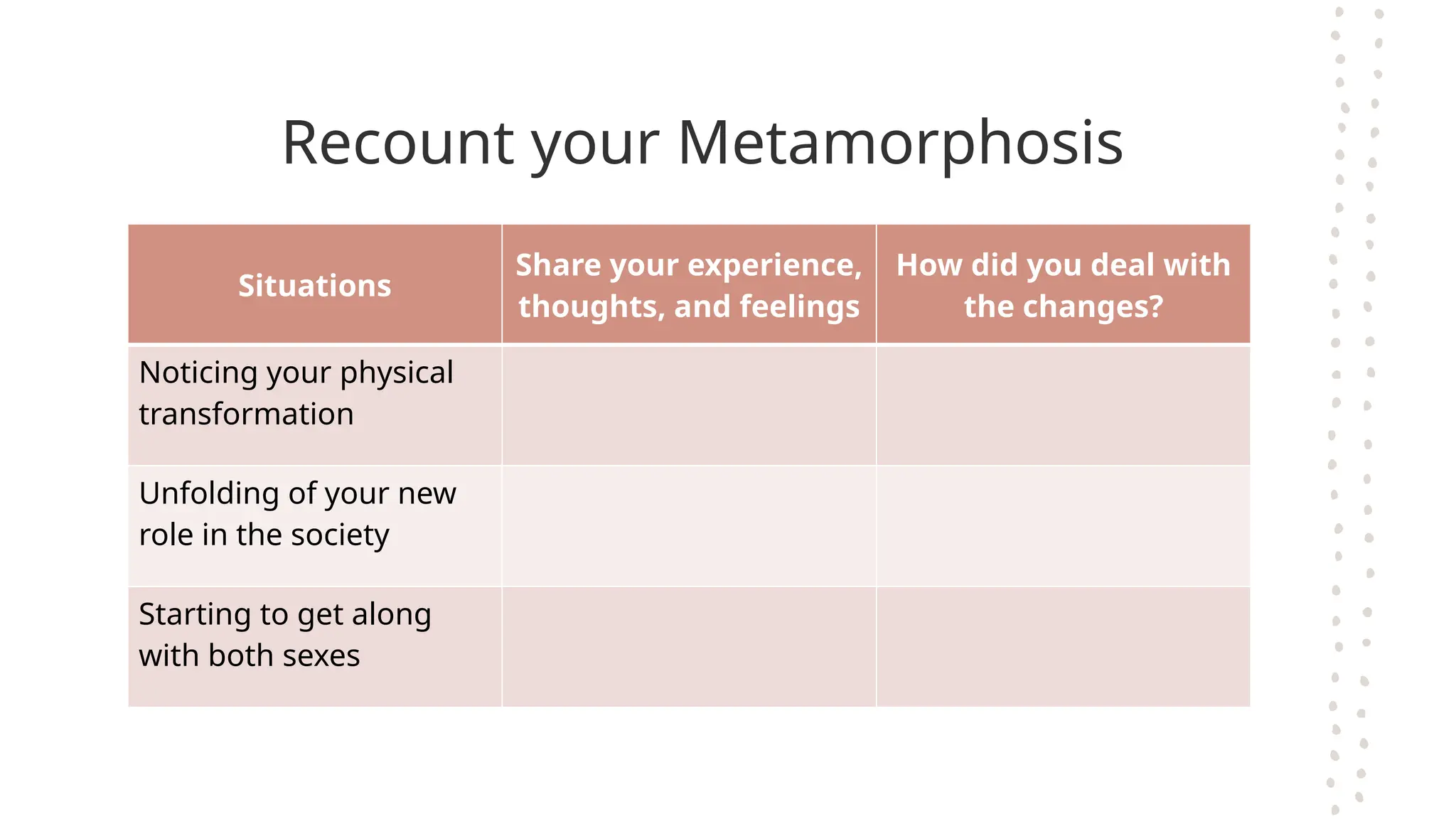
Recount your Metamorphosis
Situations
Shareyour experience,
thoughts, and feelings
How did you deal with
the changes?
Noticing your physical
transformation
Unfolding of your new
role in the society
Starting to get along
with both sexes
4.
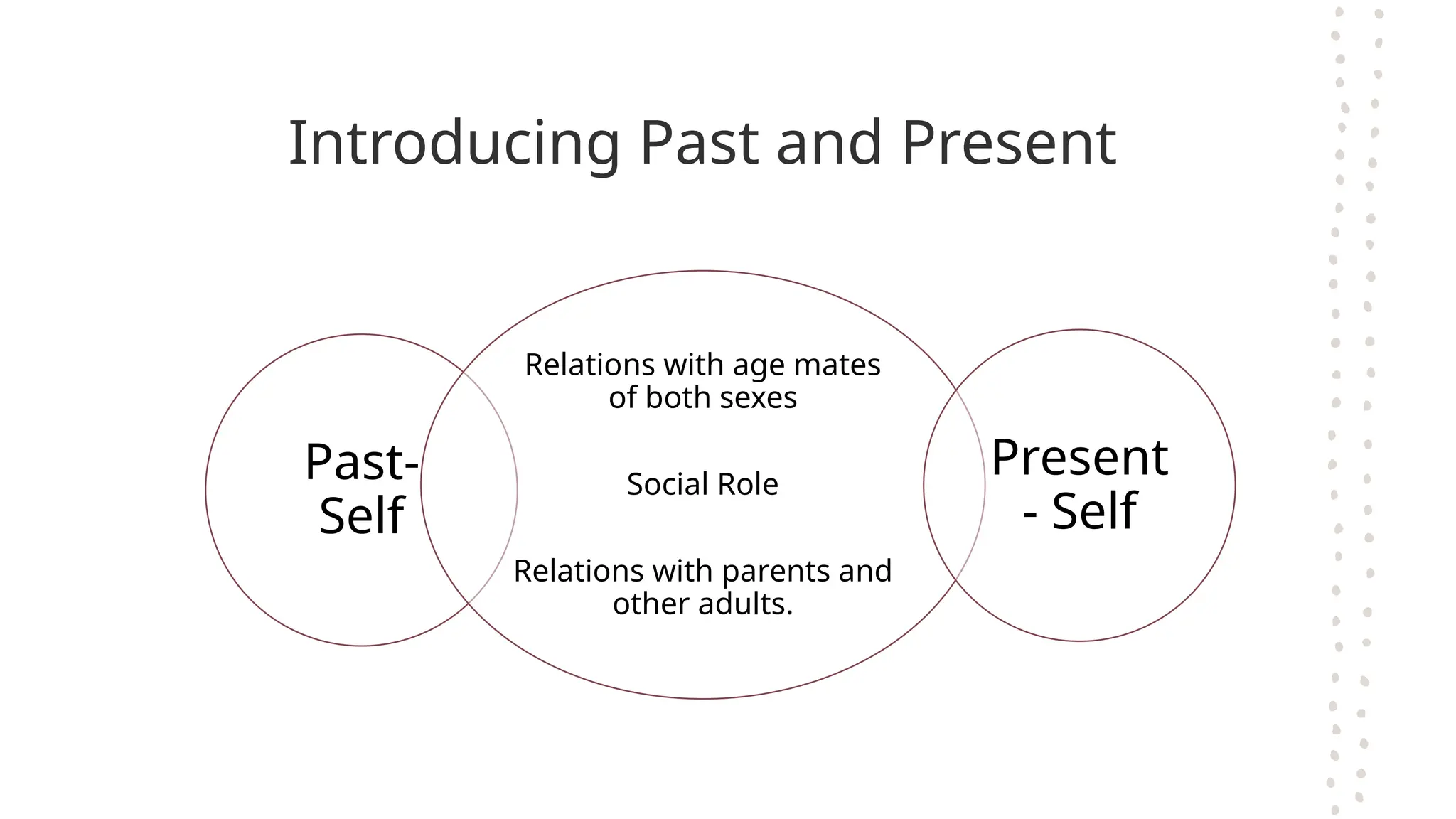
Introducing Past andPresent
Past-
Self
Relations with age mates
of both sexes
Social Role
Relations with parents and
other adults.
Present
- Self
Adolescence stage isa
milestone to all
individuals since it
serves as the
metamorphosis in
becoming an adult.
8.
Three Stages ofAdolescence
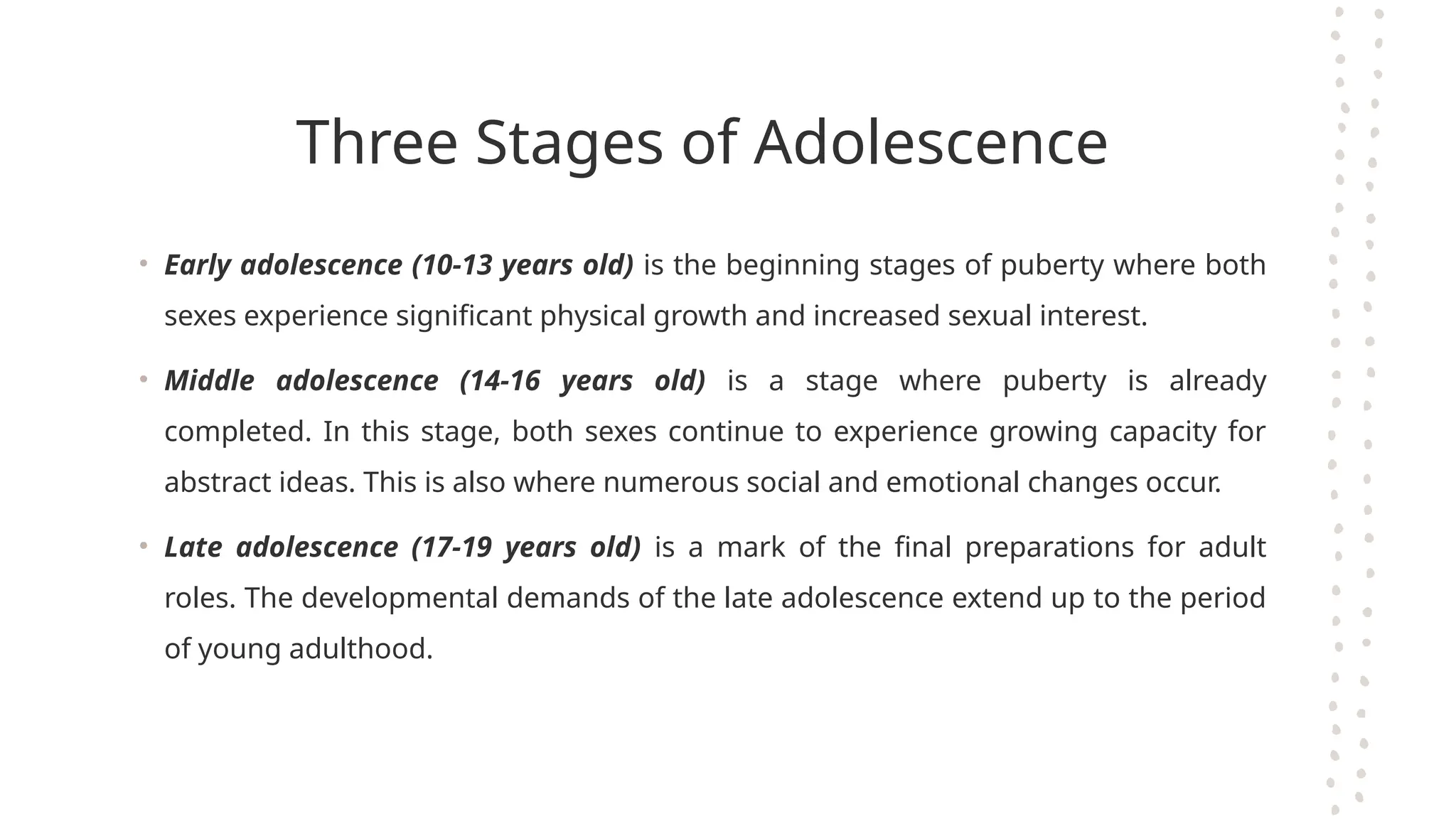
• Early adolescence (10-13 years old) is the beginning stages of puberty where both
sexes experience significant physical growth and increased sexual interest.
• Middle adolescence (14-16 years old) is a stage where puberty is already
completed. In this stage, both sexes continue to experience growing capacity for
abstract ideas. This is also where numerous social and emotional changes occur.
• Late adolescence (17-19 years old) is a mark of the final preparations for adult
roles. The developmental demands of the late adolescence extend up to the period
of young adulthood.
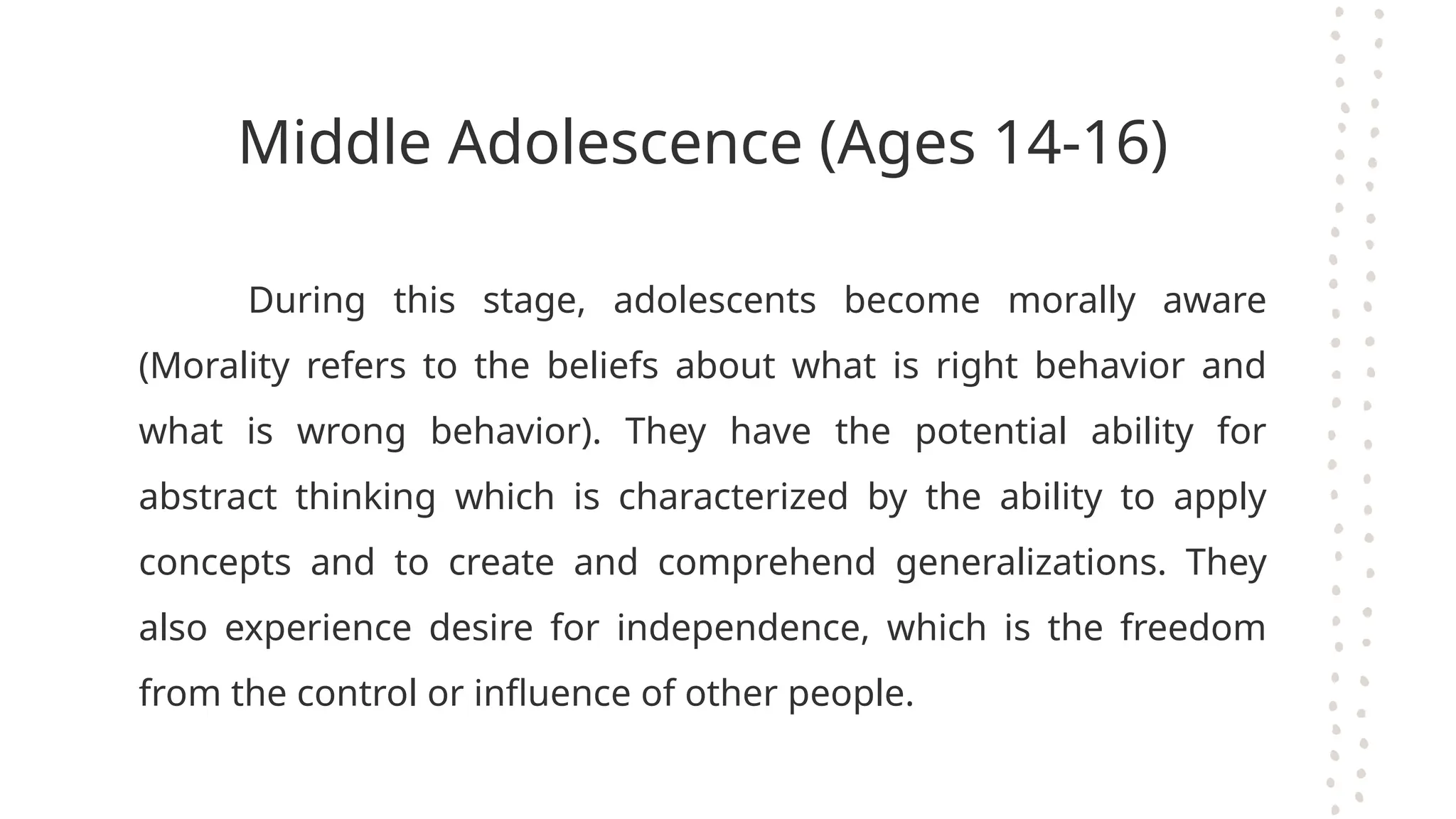
Middle Adolescence (Ages14-16)
During this stage, adolescents become morally aware
(Morality refers to the beliefs about what is right behavior and
what is wrong behavior). They have the potential ability for
abstract thinking which is characterized by the ability to apply
concepts and to create and comprehend generalizations. They
also experience desire for independence, which is the freedom
from the control or influence of other people.
11.
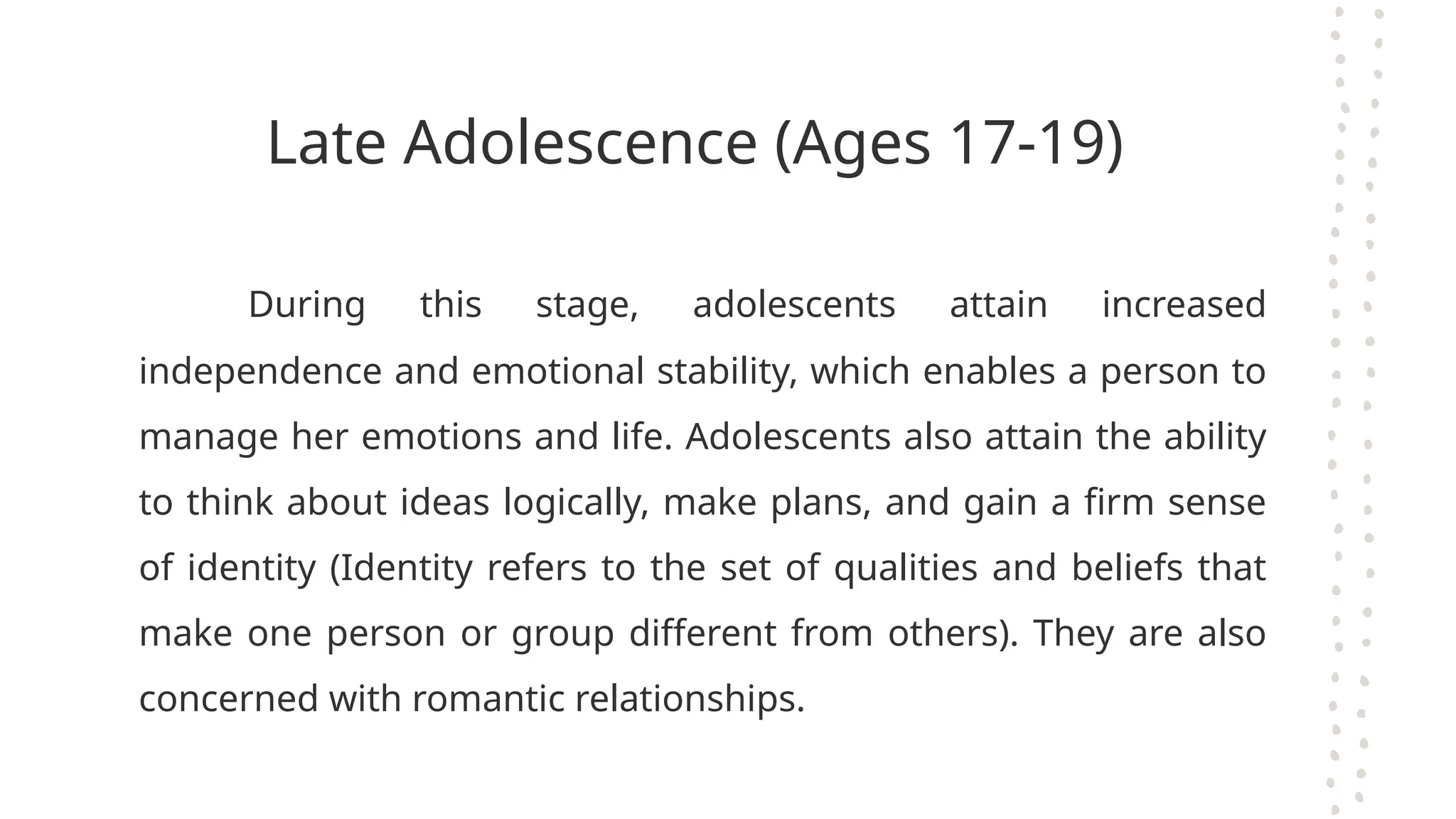
Late Adolescence (Ages17-19)
During this stage, adolescents attain increased
independence and emotional stability, which enables a person to
manage her emotions and life. Adolescents also attain the ability
to think about ideas logically, make plans, and gain a firm sense
of identity (Identity refers to the set of qualities and beliefs that
make one person or group different from others). They are also
concerned with romantic relationships.
12.
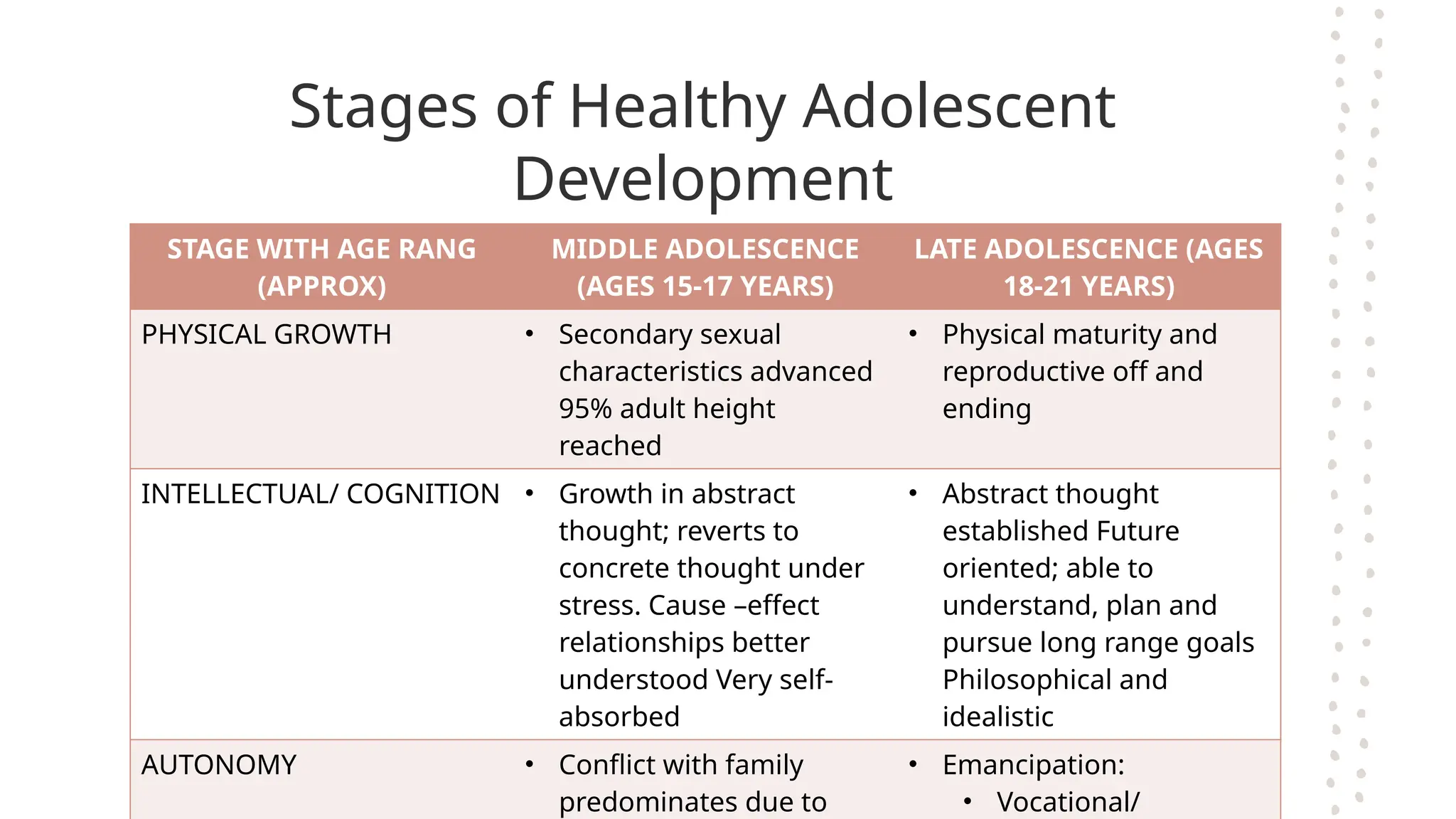
Stages of HealthyAdolescent
Development
STAGE WITH AGE RANG
(APPROX)
MIDDLE ADOLESCENCE
(AGES 15-17 YEARS)
LATE ADOLESCENCE (AGES
18-21 YEARS)
PHYSICAL GROWTH • Secondary sexual
characteristics advanced
95% adult height
reached
• Physical maturity and
reproductive off and
ending
INTELLECTUAL/ COGNITION • Growth in abstract
thought; reverts to
concrete thought under
stress. Cause –effect
relationships better
understood Very self-
absorbed
• Abstract thought
established Future
oriented; able to
understand, plan and
pursue long range goals
Philosophical and
idealistic
AUTONOMY • Conflict with family
predominates due to
• Emancipation:
• Vocational/
13.
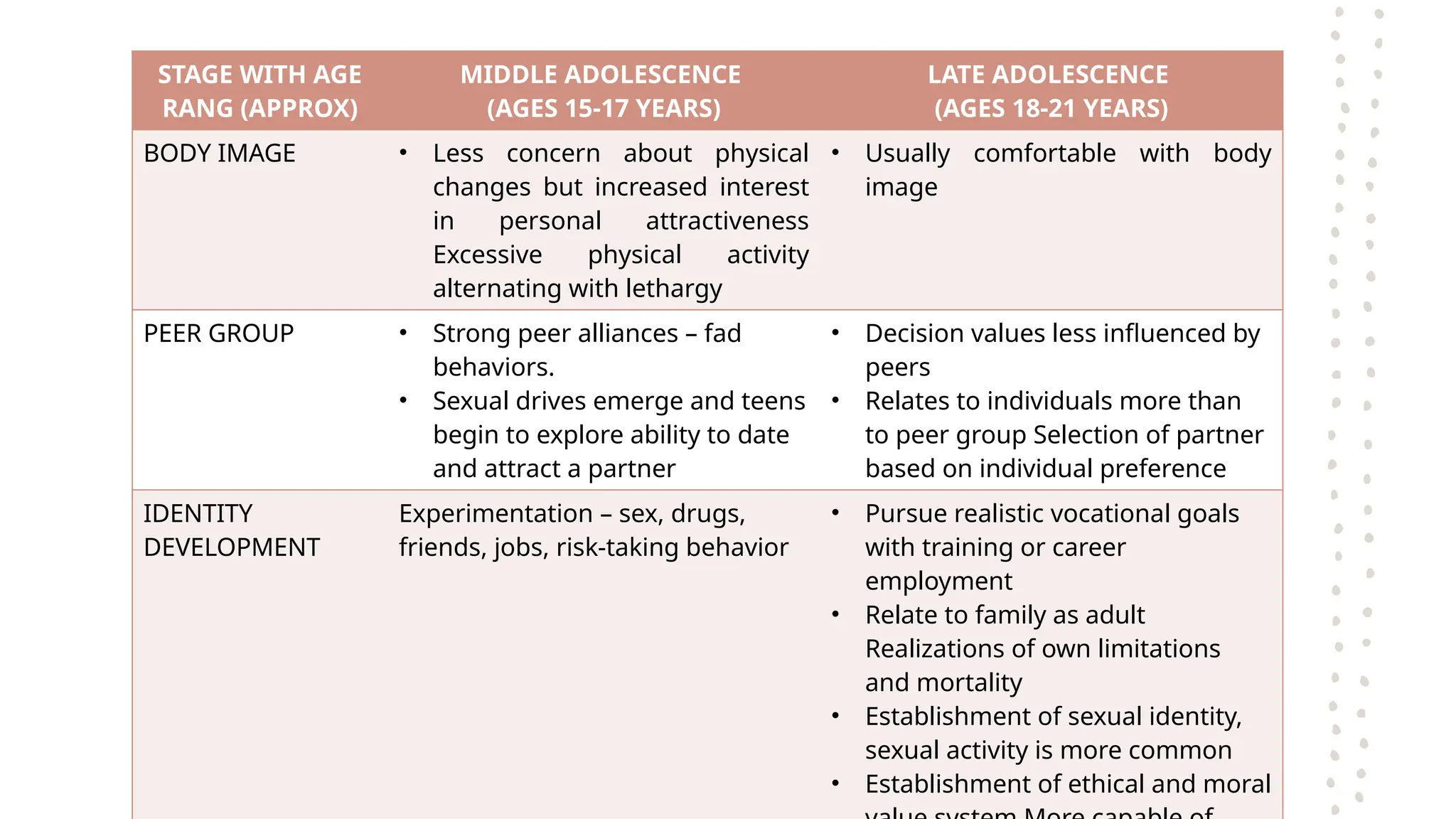
STAGE WITH AGE
RANG(APPROX)
MIDDLE ADOLESCENCE
(AGES 15-17 YEARS)
LATE ADOLESCENCE
(AGES 18-21 YEARS)
BODY IMAGE • Less concern about physical
changes but increased interest
in personal attractiveness
Excessive physical activity
alternating with lethargy
• Usually comfortable with body
image
PEER GROUP • Strong peer alliances – fad
behaviors.
• Sexual drives emerge and teens
begin to explore ability to date
and attract a partner
• Decision values less influenced by
peers
• Relates to individuals more than
to peer group Selection of partner
based on individual preference
IDENTITY
DEVELOPMENT
Experimentation – sex, drugs,
friends, jobs, risk-taking behavior
• Pursue realistic vocational goals
with training or career
employment
• Relate to family as adult
Realizations of own limitations
and mortality
• Establishment of sexual identity,
sexual activity is more common
• Establishment of ethical and moral
14.
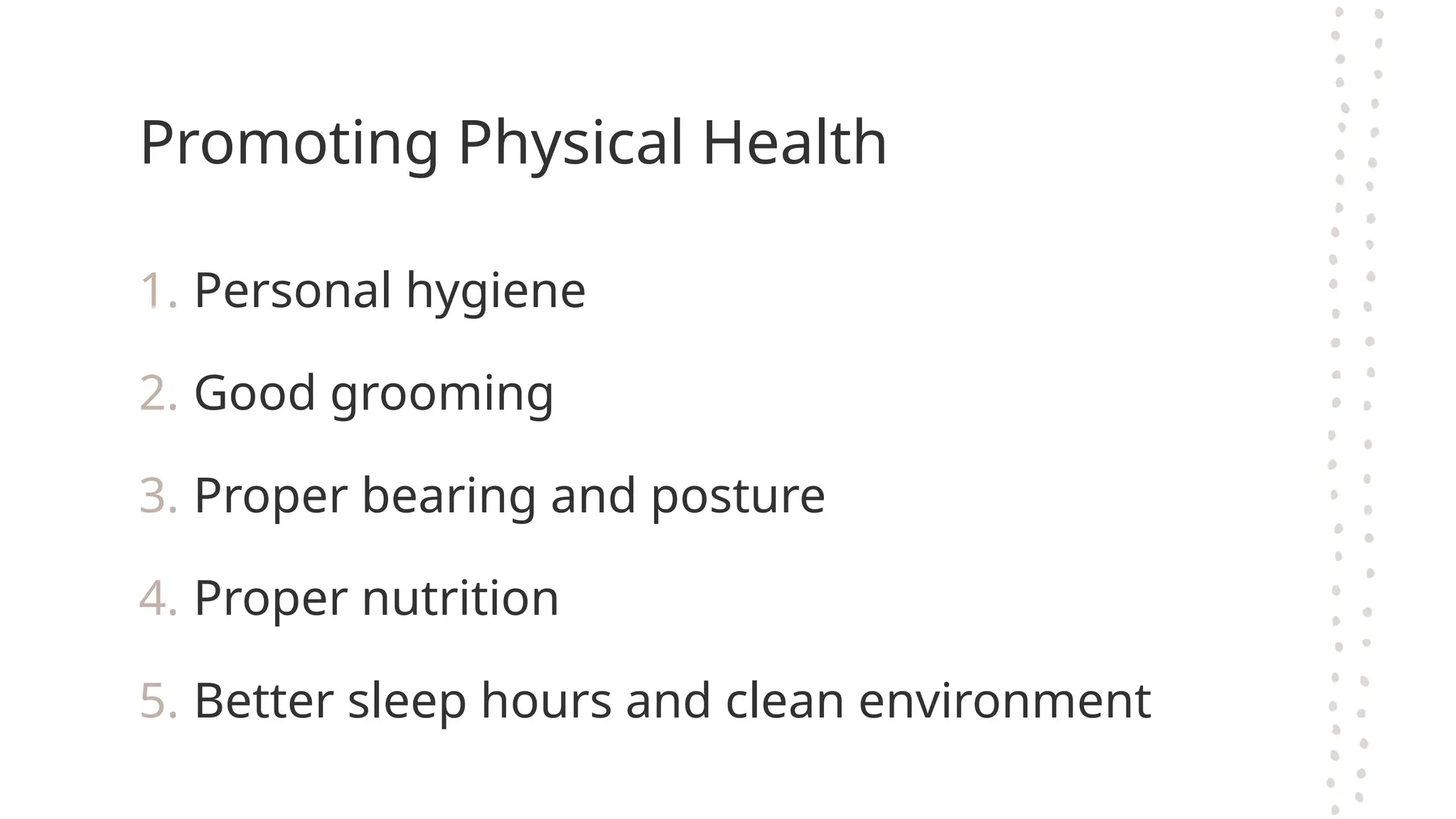
Promoting Physical Health
1.Personal hygiene
2. Good grooming
3. Proper bearing and posture
4. Proper nutrition
5. Better sleep hours and clean environment
15.
Social Development
• Personalityas reiterated by Eric Erickson is a result of an individual’s
relationship with the significant others as he goes along performing
his everyday tasks.
• Merki (2020) stated that social health directly connotes relatedness
with other people. These are the connections we establish with
other groups of people. These are based on how one relates and
acts which involves key skills of social health inclusive of
communication, compromise and cooperation.
16.
Mental Development
• Personalityis never measured by external factors alone. Mental ability
forms part and parcel of one’s persona.
• People differ in several ways. Intelligence is one element that
separates one from all others of same demographics.
• All other things equal, individuals have the ability and even the skills to
learn. These learning’s whether significant or not becomes a basis for
evaluating, analyzing and making decisions pertinent to their everyday
dilemmas.
Study Habits
Following areways to deal with the everyday physical, emotional, and
intellectual requirements in the school.
1. Have the right mindset
2. Practice Zero Navigation when preparing for the coursework
3. Choose the proper venue for studying
4. Make a reviewer
5. Bring only the things that you need
19.
Morality
• This isprinciple concerning how individuals distinguish what is
right from what is wrong. Morality comes from the Latin word
“moralitas” which denotes manner, character and proper
behavior.
• It is the differentiation of intentions, decisions and actions
between those that are distinguished as proper and those that
are improper the disjunction between right and wrong.
20.
Emotional Development
• PositiveEmotions
A classification of pleasant emotion which may include happiness, excitement, joy,
relief, triumph, jubilation. It connotes an expression where one finds himself smiling or
laughing with a feel of “elation”. These come from positive experiences especially when
one is able to attain or satisfy his expectations and desires.
• Negative Emotions
A classification of emotion involving sadness, disgust, annoyance, anxiety, anger,
jealousy, fear and the like. It is shown through facial expression that is manifested in an
unhappy face, tears, discomfort, pain and even psychosomatic illness.
21.
Emotional Symptoms
• Moodiness
•Irritability or short temper
• Agitation, inability to relax
• Feeling overwhelmed
• Sense of loneliness and isolation
• Anxiety
• Constant worrying
• Depression or general unhappiness
22.
Anxiety
• The AmericanPsychological Association (APA) defines Anxiety is an
emotion characterized by feelings of tension, worried thoughts and
physical changes like increased blood pressure.
• People with anxiety disorders usually have recurring intrusive
thoughts or concerns. They may avoid certain situations out of worry.
• They may also have physical symptoms such as sweating, trembling,
dizziness or a rapid heartbeat.
23.
Depression
• Depression otherwiseknown as major depressive disorder or clinical
depression is a common and serious mood disorder.
• Those who suffer from depression experience persistent feelings of
sadness and hopelessness and lose interest in activities they once
enjoyed.
• Aside from the emotional problems caused by depression, individuals
can also present with a physical symptom such as chronic pain or
digestive issues
24.
Men may experiencesymptoms related
to their:
• Mood, such as anger, aggressiveness, irritability, anxiousness, restlessness
• Emotional well-being, such as feeling empty, sad, hopeless
• Behavior, such as loss of interest, no longer finding pleasure in favorite activities, feeling tired
easily, thoughts of suicide, drinking excessively, using drugs, engaging in high-risk activities
• Sexual interest, such as reduced sexual desire, lack of sexual performance
• Cognitive abilities, such as inability to concentrate, difficulty completing tasks, delayed
responses during conversations
• Sleep patterns, such as insomnia, restless sleep, excessive sleepiness,
• Physical well-being, such as fatigue, pains, headache, digestive problems
25.
Women may experiencesymptoms
related to their:
• Mood, such as irritability
• Emotional well-being, such as feeling sad or empty, anxious or hopeless
• Behavior, such as loss of interest in activities, withdrawing from social engagements,
thoughts of suicide
• Cognitive abilities, such as thinking or talking more slowly
• Sleep patterns, such as difficulty sleeping through the night, waking early, sleeping
too much
• Physical well-being, such as decreased energy, greater fatigue, changes in appetite,
weight changes, aches, pain, headaches, increased cramps
26.
Bipolar
• The AmericanPsychological Association said that Bipolar
disorder is a brain disorder that causes changes in a person's
mood, energy, and ability to function.
• People with bipolar disorder experience intense emotional
states that typically occur during distinct periods of days to
weeks, called mood episodes.
27.
Eating Disorders
Eating disordersare a range of psychological conditions that cause
unhealthy eating habits to develop. They might start with an obsession with food,
body weight, or body shape.
• Anorexia Nervosa
An eating disorder that can result in severe weight loss. A person with anorexia is
preoccupied with calorie intake and weight.
• Bulimia Nervosa
An eating disorder, commonly referred to simply as bulimia. It’s a serious condition that
can be life-threatening. It’s generally characterized by binge eating followed by purging.
28.
What is MentalHealth?
According to World Health Organization “Mental
health is a state of well-being in which an individual
realizes his or her own abilities, can cope with the
normal stresses of life, can work productively, and is
able to make a contribution to his or her community.”
29.
Adolescents also experiencechallenges
in peer, family, and romantic relationship.
1. Peer relationship includes relationships with friends, neighbors,
teammates, and classmates; it enables an adolescent to have
independence from their parents and to develop his/her own personal
identity.
2. Family relationship involves relationship with immediate family members
including parents and siblings. An adolescent with a good family
relationship makes him/her feel secured and loved.
3. Romantic relationship is an interpersonal relationship that involves
emotional intimacy and passion with the opposite sex.
30.
Example of socialchallenges during
middle and late adolescence
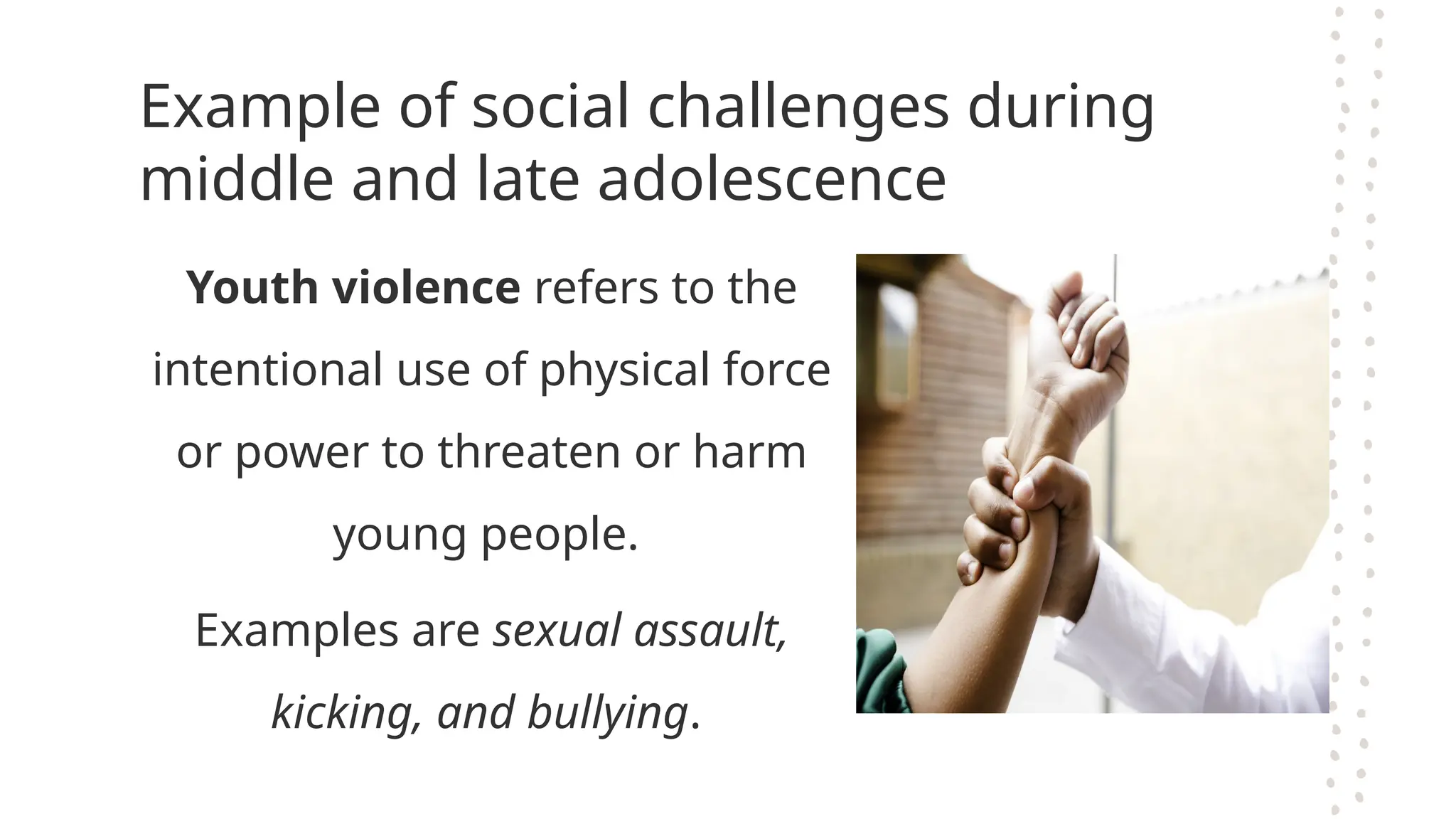
Youth violence refers to the
intentional use of physical force
or power to threaten or harm
young people.
Examples are sexual assault,
kicking, and bullying.
31.
Example of socialchallenges during
middle and late adolescence
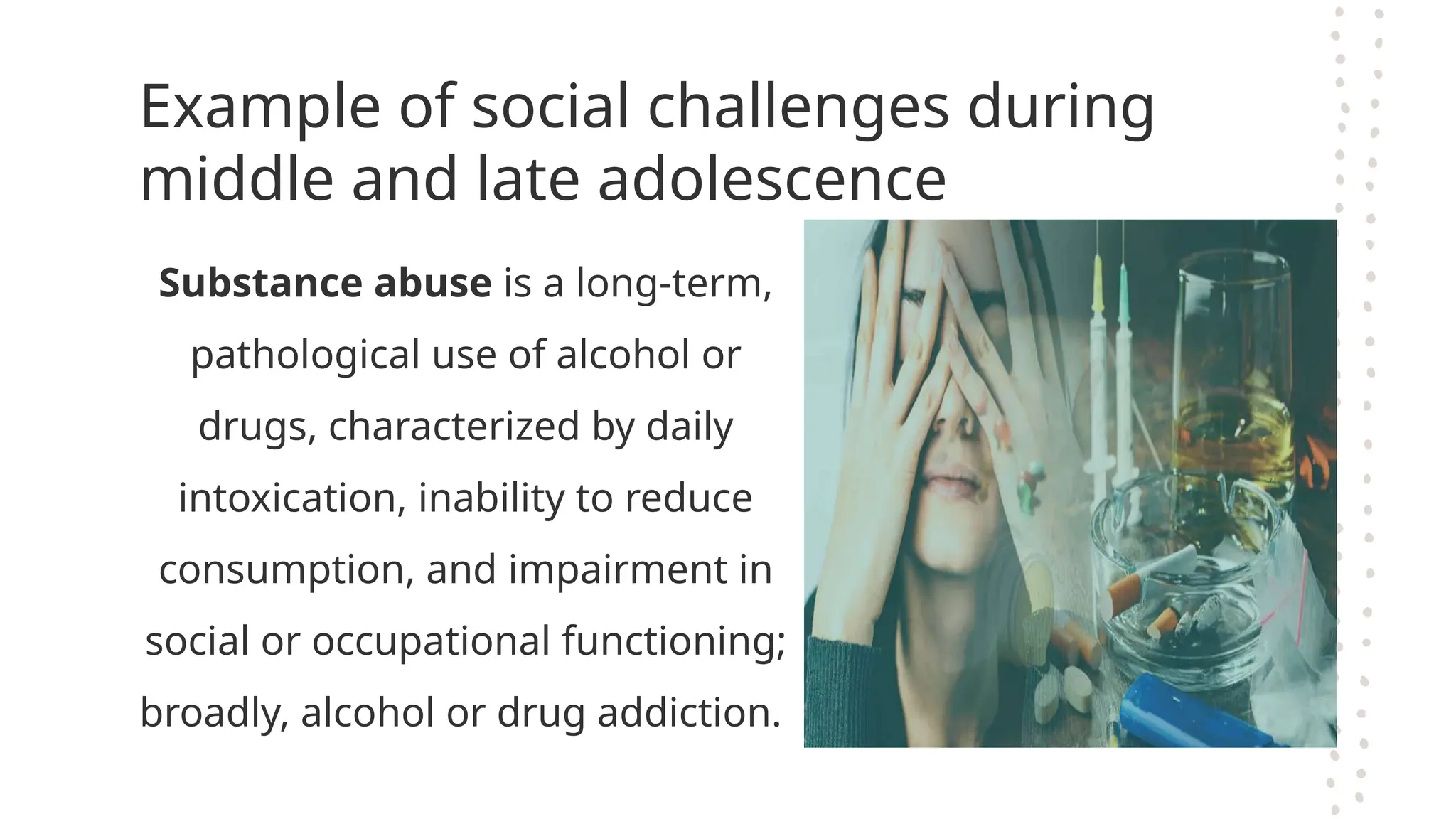
Substance abuse is a long-term,
pathological use of alcohol or
drugs, characterized by daily
intoxication, inability to reduce
consumption, and impairment in
social or occupational functioning;
broadly, alcohol or drug addiction.
32.
Example of socialchallenges during
middle and late adolescence
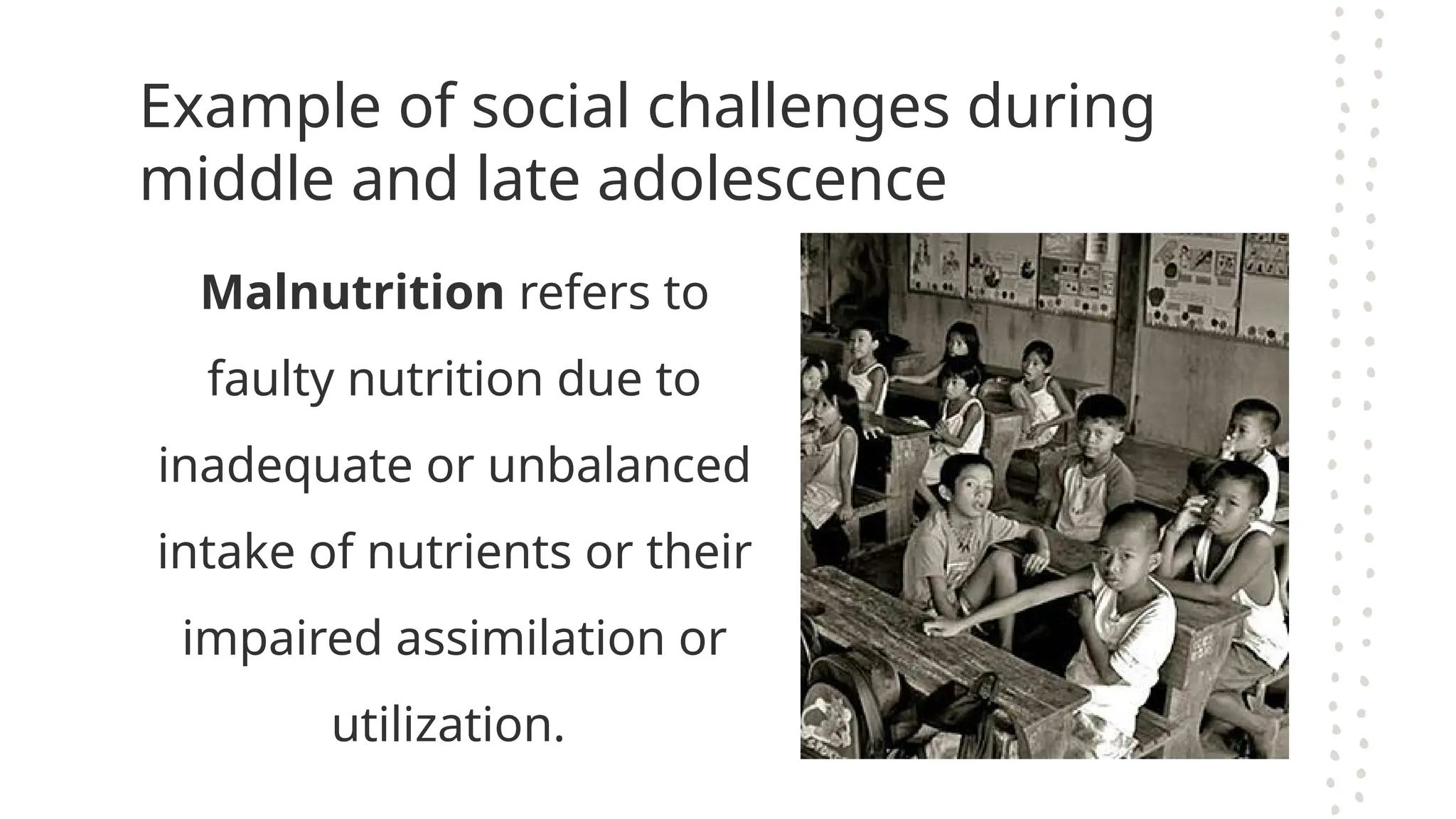
Malnutrition refers to
faulty nutrition due to
inadequate or unbalanced
intake of nutrients or their
impaired assimilation or
utilization.
33.
Example of socialchallenges during
middle and late adolescence
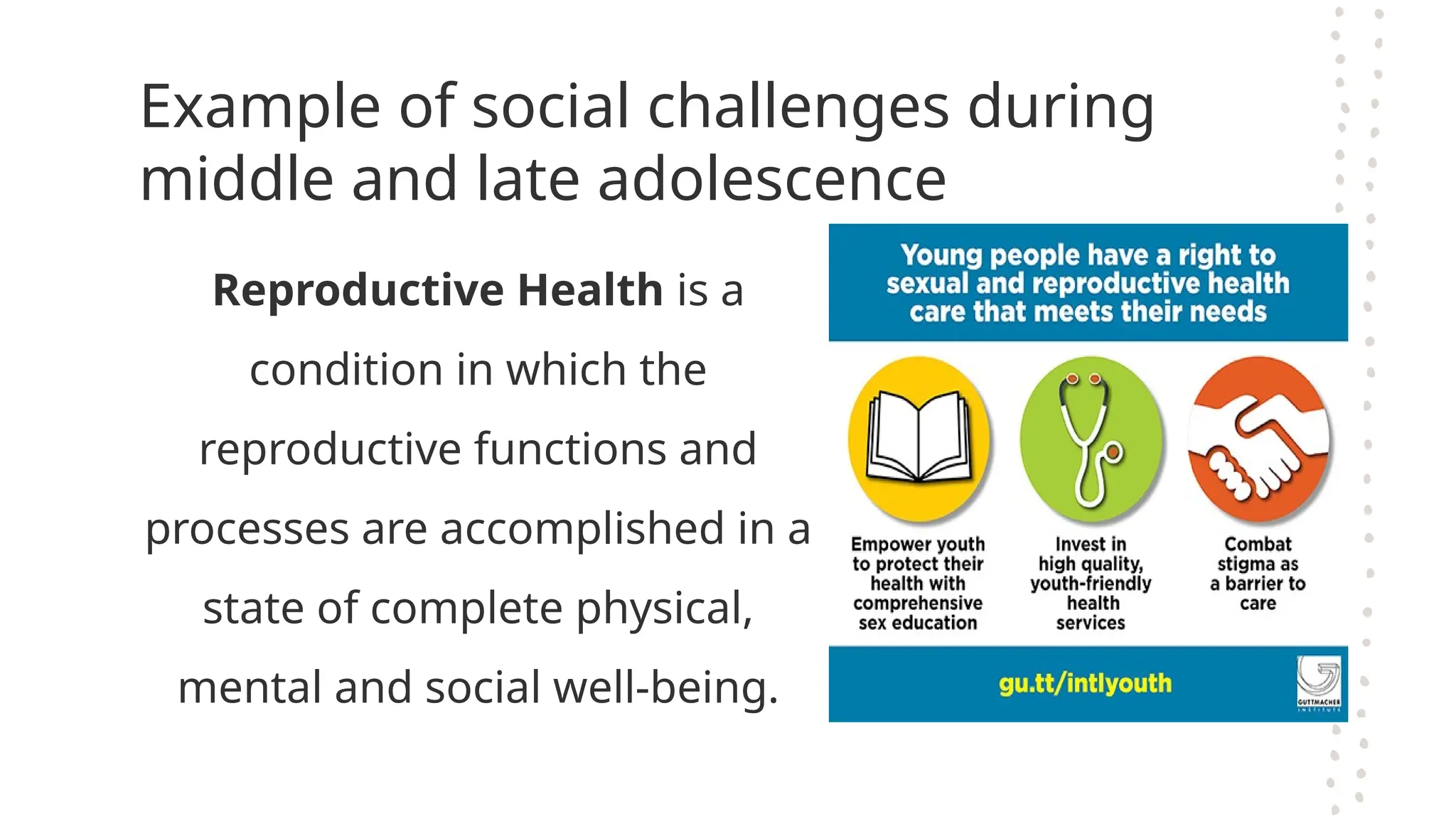
Reproductive Health is a
condition in which the
reproductive functions and
processes are accomplished in a
state of complete physical,
mental and social well-being.
34.
Example of socialchallenges during
middle and late adolescence
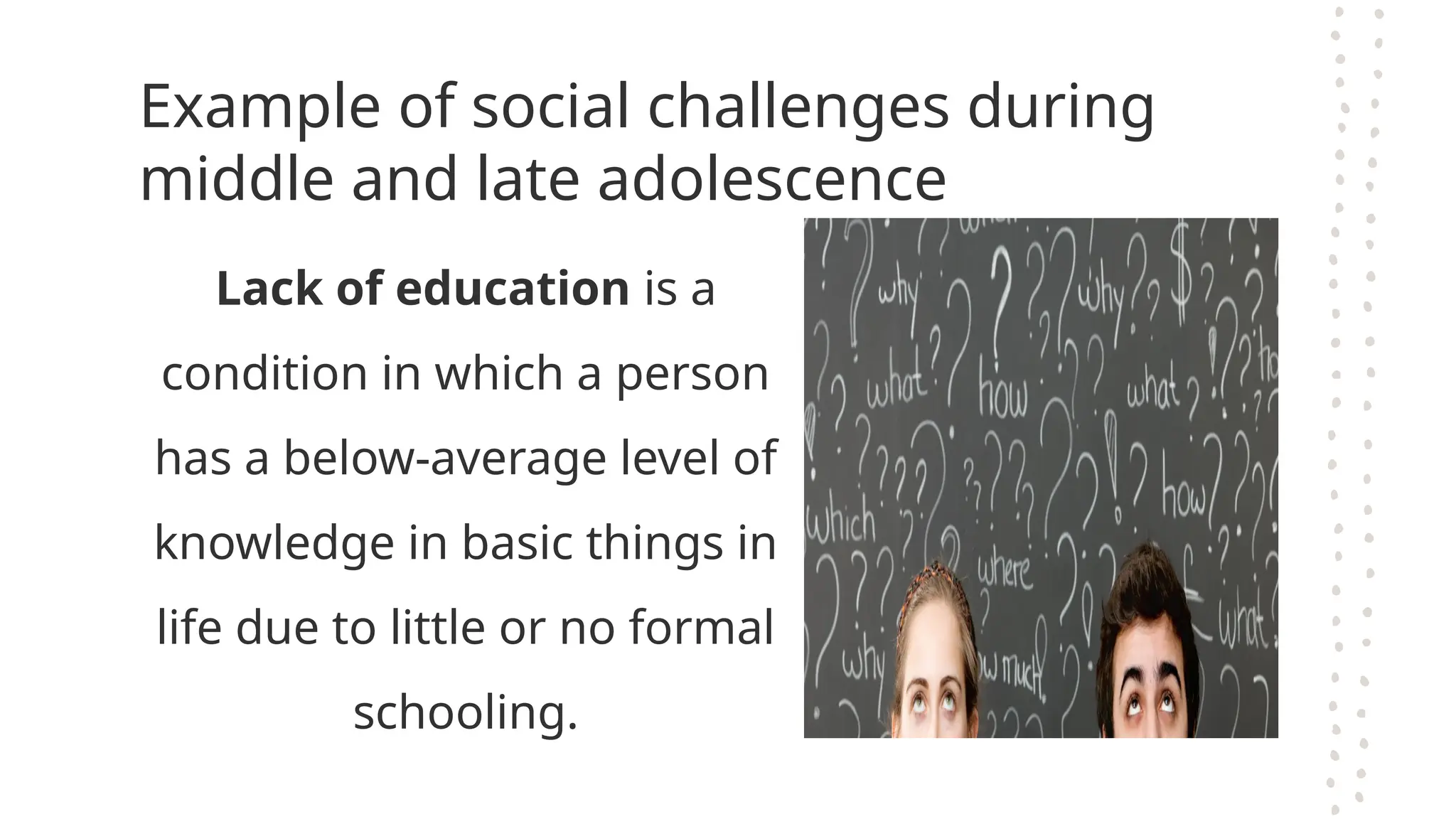
Lack of education is a
condition in which a person
has a below-average level of
knowledge in basic things in
life due to little or no formal
schooling.
35.
Example of socialchallenges during
middle and late adolescence
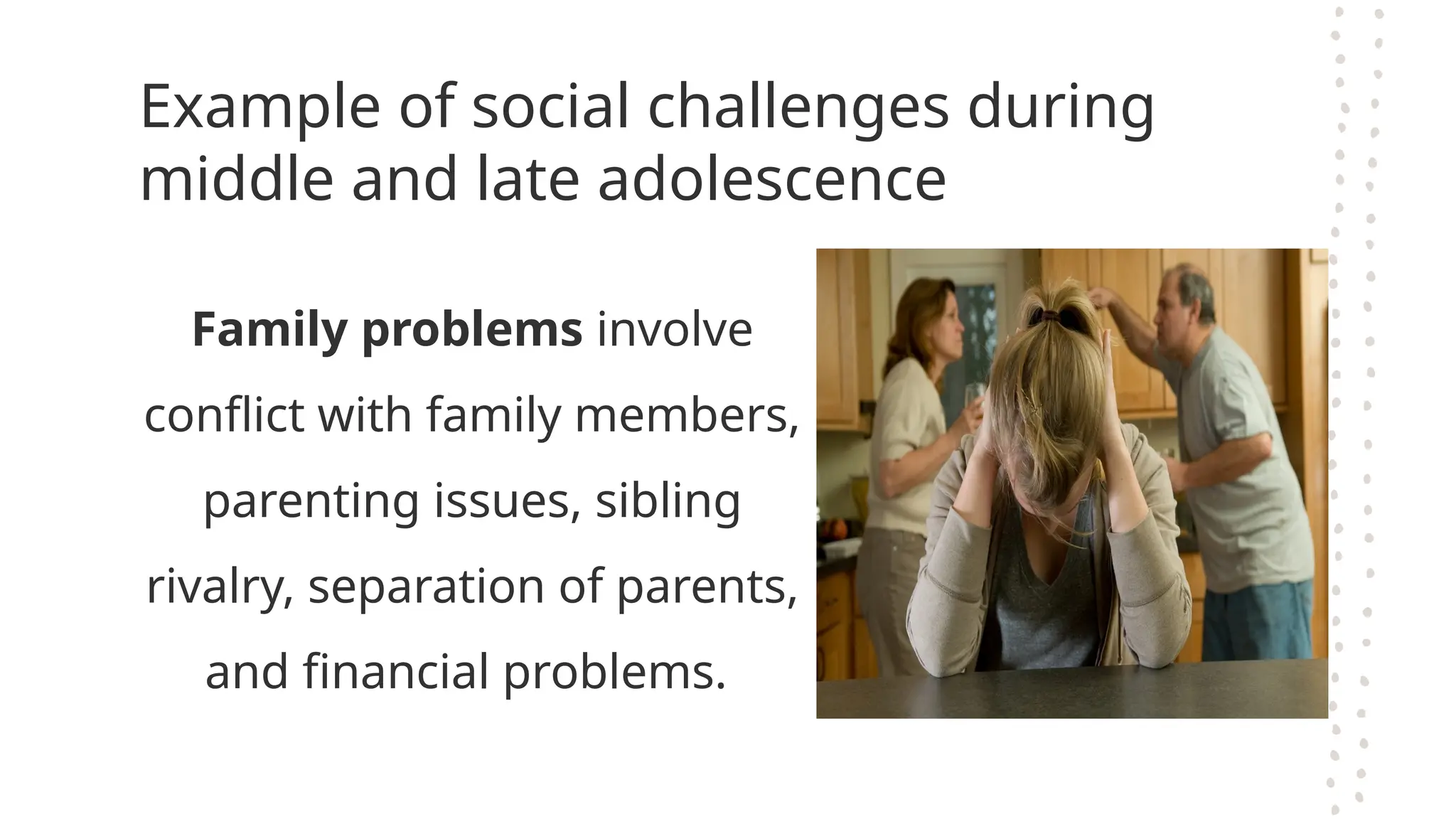
Family problems involve
conflict with family members,
parenting issues, sibling
rivalry, separation of parents,
and financial problems.
36.
Managing Extreme Emotionsand Live
Mentally Healthy
1. Seek Help
2. Explore
3. Be Positive
4. Practice proper breathing
technique
5. Use Mantra
6. Humor
7. Keep yourself busy
8. Protect yourself by improving your
self-esteem
9. Develop Hardiness
10. Take a Break
Editor's Notes
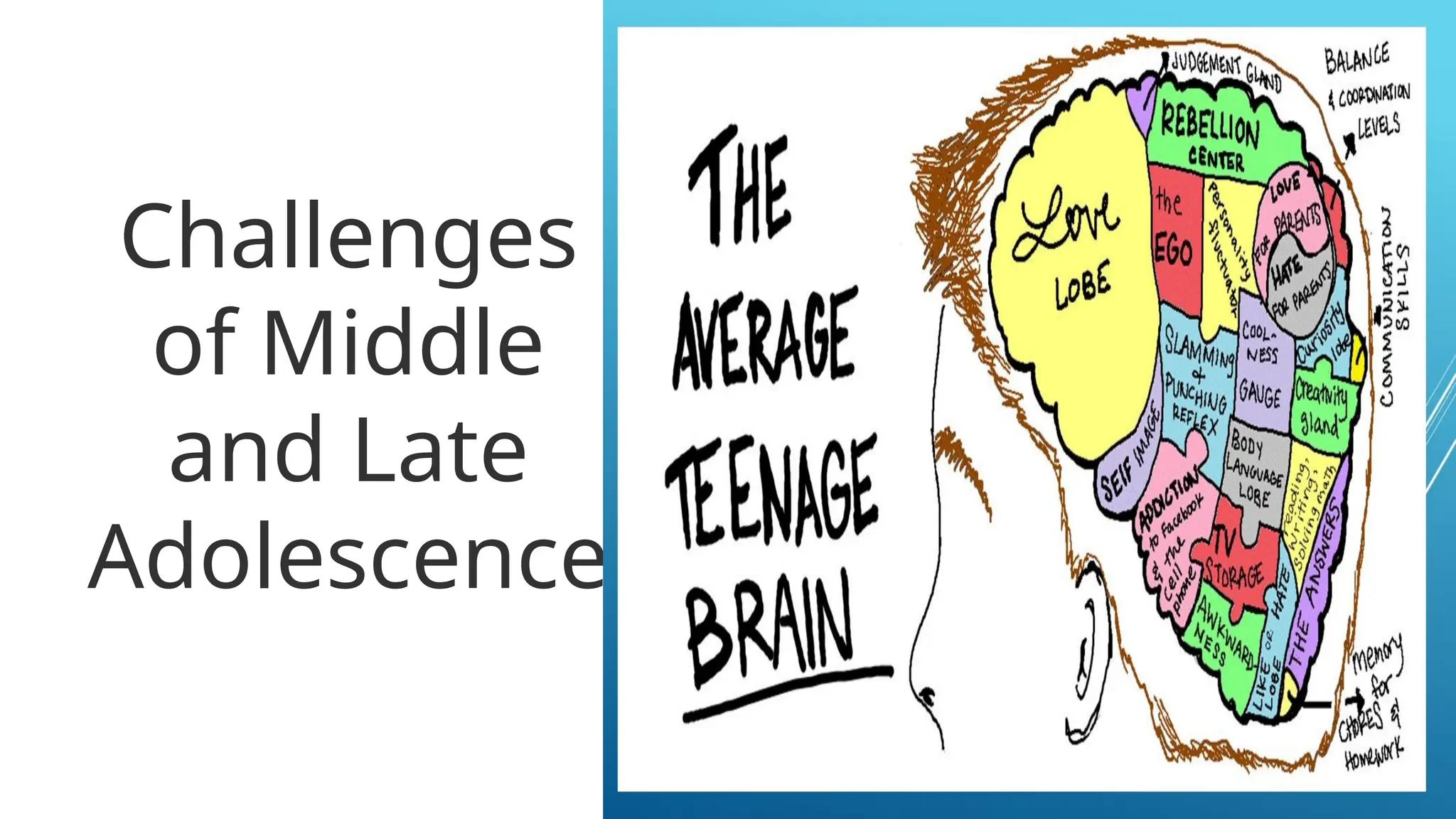
#2 This module will help you understand the challenges of middle and late adolescence.
It explains how adolescents can balance the expectations of other people in their lives and personal goals.
It helps you better understand the importance of facing and overcoming challenges during adolescence to clarify and manage the demand of teenage years.
In this lesson, you will learn to appreciate that making affirmations helps one become more lovable and capable as an adolescent.
#3 Briefly share your experience, thoughts, and feelings when you encountered the given situations below.
Write an explanation on how you dealt with these circumstances to become a sensible adolescent.
#4 State the changes you observed from your past-self to your present self.
You may use a separate sheet of paper for your answers.
Guide Questions:
What is the relevance of this activity in understanding the changes in yourself?
Why do you think that change is inevitable in one’s growth?
#5 Republic Act (RA) 10354, the Responsible Parenthood and Reproductive Health (RPRH) Act of 2012 uses the term adolescents for people aged 10-19 years.
This distinguishes the term from youth for those aged 15–24 years and young people, aged 10-24 years.
In the Philippines, adolescents comprise 21.5% of the country’s population (NSO, 2010).
The Department of Health (DOH) and the Philippine Pediatric Society (PPS) divides the adolescence period into:
Early adolescence (10-13 years old),
Middle adolescence (14-16 years old), and
Late adolescence (17-19 years old).
At each stage, adolescents have different concerns.
For example, girls in early adolescence may have just begun menstruating and are concerned with their menstrual hygiene.
In comparison, girls in late adolescence are concerned with romantic relationships.
Early adolescents who are attending school have unique concerns compared to late adolescents who are employed.
#6 Adolescence is rooted in the Latin verb adolescence which denotes “to grow” or “to grow to maturity.”
This stage signifies the period of growth: from childhood to adulthood.
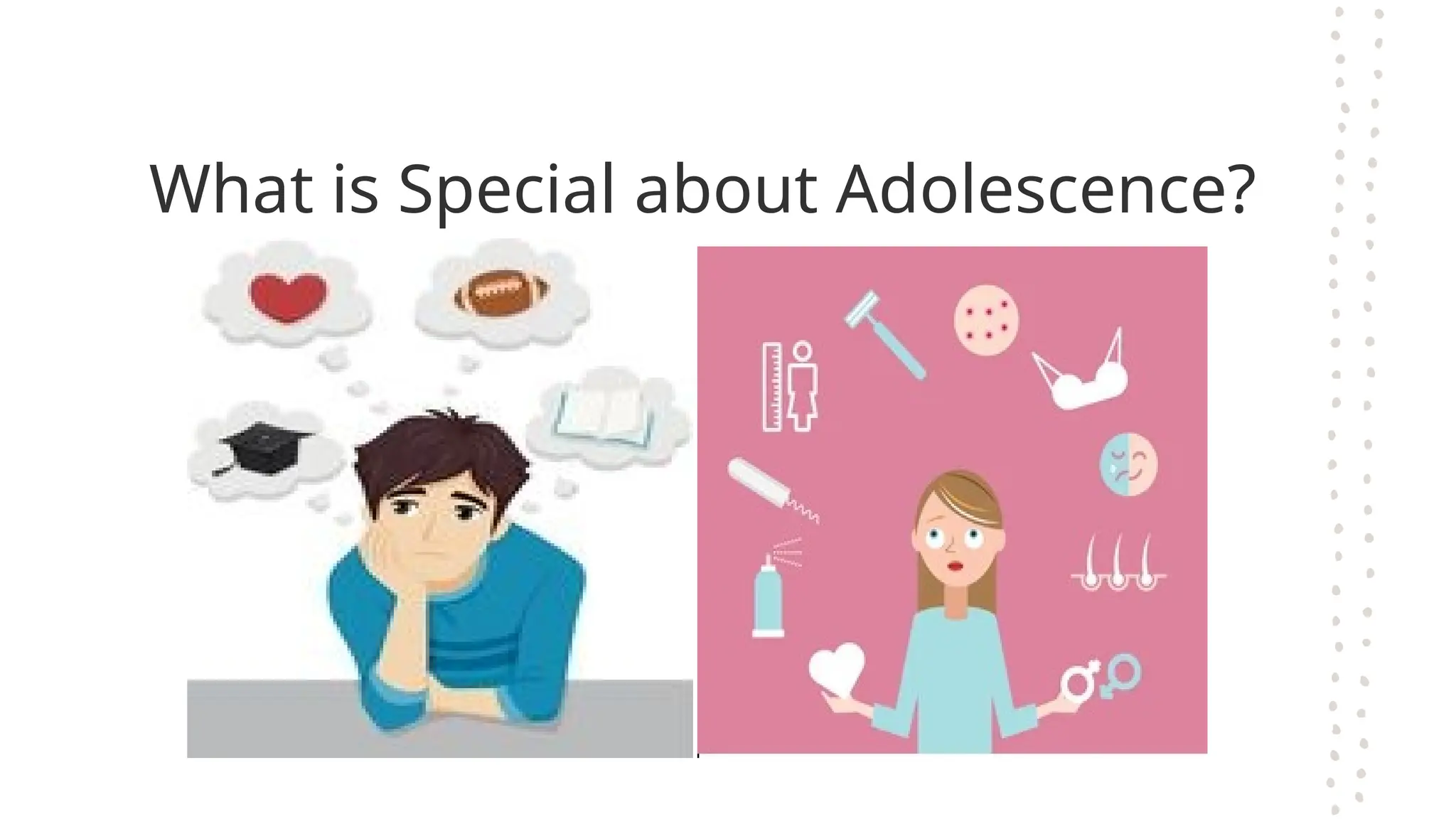
Apparently, there are distinctive physical, cognitive, social, emotional, and sexual developmental changes that take place during adolescence.
Adolescents experience hormonal changes and puberty, new and complex sensations and emotions, and burst of emotional and physiological brain development.
They also experience sexual awareness and gender identity.
Gender identity refers to a person’s internal sense of gender, which may or may not match with the sex assigned at birth.
They also experience evolving cognitive ability and context-influenced emotional impulse control.
Cognitive ability enables adolescents to perform mental activities such problem solving and learning. Adolescents are also concerned about their physical identity.
Physical identity refers to an individual’s awareness of his/her own appearance.
Based on Erikson’s Psychosocial Development Stages, adolescents face the challenge as identity versus role confusion. They work at enhancing a sense of self by testing roles, then combining them to create a single identity.
#7 In this stage, adolescents started to grasp various information, engage themselves to different groups and community, as well as explore the ways of life.
These haps, however, pose some challenges to every adolescent such as striving to find an answer to the question “Who am I?”
#14 Personal Hygiene The physical self is a significant element in one’s personality. Keeping it clean and hygienic creates a good image and allows one to feel good about him. It is not necessary to be updated as to what is currently the fashion statement but it is a requirement to be clean and presentable at all times
Good Grooming It is a common notion that “First impressions lasts”. It is necessary to take pride in our appearance and dress appropriately. Careful grooming therefore is a significant factor in building self-esteem. One should stick to the basics and appreciate the following tips:
For the Gentleman
1. Be clean. Take a shower, cut nails and pamper skin
2. Select the right wardrobe for the right event
3. Have sense of style. Clothing that feels comfortable but elegant.
4. Wear clean and shiny shoes that complement your attire.
5. Smell good by wearing mild perfume scent.
6. Check your bearing. Proper body posture adds confidence and appeal
For the Ladies
1. Bathe, be clean and fresh always as it exudes confidence
2. Polish nails to add feminity and art.
3. Apply light make-up using colors that match your skin tone.
4. Choose the appropriate attire that suits the event
5. Use a mild feminine perfume scent that fits your personality
6. Wear clean shoes or sandals
7. Choose the best bag or clutch that complements your clothing
8. Wear smart face, chin up and keep proper smart posture.
Proper Bearing and Posture Posture is the position in which you hold your body upright against gravity while standing, sitting or lying down. One’s composure and bearing affects not only his physical self but his level of confidence as well. People who are sure and who believes in themselves conducts themselves well in front of others. Standing or sitting upright in a snappy and smart manner creates an aura of confidence and strength.
Proper Nutrition Diet or what we regularly eat and drink provides us with the fuel that powers our body and brain. We should be guided by the Food Pyramid and to determine what should be consumed less and what should be the bulk of what we take in.
Better Sleep Hours and Clean Environment
Regular Sleep Time for 8 Hours/Night and Short Naps (20-30min) added in during week is very important. Here are the following routines for better sleep:
Cool my room down to 60-67 degrees (F)
Sounds: listen to relaxing music 30+ min before bedtime and/ or white noise for sleep
Turn off electronics 1 hr before bedtime
Use an app or setting on your computer/phone to decrease blue light
Read before bed
Warm Bath/Shower before bed
Use lavender or other oils to provide positive smells for nighttime
#17 How do middle and late adolescence develop Intellectually?
There are varied ways to enhance one’s intellectual ability. Everything begins with the motive to go forth and advance.
As this is basically in the mental facet hence it becomes a necessity that the individual should not only possess the ability but the drive to learn, re-learn and unlearn.
Learn about new things that may aid in the promotion of life skills, re-learn relevant elements that may continue to affect one’s behavior and persona and to unlearn those antiquated and obsolete ideas and ways of a life that are no longer true and appropriate.
#18 Education provides an individual a license that will equip him to achieve his future goals.
#20 Emotions comes the latin word “Emovere” which means to “move out”.
Emotions are spontaneous responses to certain stimuli. It is a natural and random response to situations that may cause anger, sadness, happiness and fear.
#21 Physiological reactions may result from certain emotional state that may even lead to mental illnesses such anxiety, depression, bipolar and eating disorder.
#22 Anxiety disorders form a category of mental health diagnoses that lead to excessive nervousness, fear, apprehension, and worry.
These disorders alter how a person processes emotions and behave, also causing physical symptoms.
In DSM V Anxiety Disorder is an excessive anxiety and worry (apprehensive expectation), occurring more days than not for at. least 6 months, about a number of events or activities (such as work or school performance)
#23 The five main warning signs of mental illness are as follows:
Excessive paranoia, worry, or anxiety.
Long-lasting sadness or irritability.
Extreme changes in moods.
Social withdrawal.
Dramatic changes in eating or sleeping pattern.
Depression can be more than a constant state of sadness or feeling “blue.”
Major depression can cause a variety of symptoms. Some affect your mood, and others affect your body.
Symptoms may also be ongoing, or come and go
#24 Depression can be more than a constant state of sadness or feeling “blue”.
Major depression can cause a variety of symptoms. Some affect your mood, and others affect your body. Symptoms may also be ongoing, or come and go.
#25 Depression can be more than a constant state of sadness or feeling “blue”.
Major depression can cause a variety of symptoms. Some affect your mood, and others affect your body. Symptoms may also be ongoing, or come and go.
#27 Purging can occur through forced vomiting, excessive exercise, or by taking laxatives or diuretics. People with bulimia often have an unrealistic body image. They are obsessed with their weight and are intensely self-critical.
#29 In the Philippines, many social challenges (problems that people are experiencing with their daily interaction with others) and issues such as poverty, lack of education, drug or substance abuse, sex crimes, and family problems continue to affect adolescents.
#36 Handling stress and emotions vary from one person to another. This basically is in accordance with how a person looks onto his current circumstances. A number of variables may either aggravate or simplify the issue or concern to how well people can his stress and extreme emotions.
Seek help from those who understand your concern particularly with your family and those mental health professionals.
Explore on those issues that gives you much stress and is subjecting you to extreme emotions. Knowing everything about your issues and worries will shed light and provide you enlightenment.
Be Positive “Positive thoughts attract positive people and positive events according to the “The Secret”. One should start from an attitude of gratitude so he may see the things that he possesses rather than his deficiencies.
Practice proper breathing technique to relax your muscles your body and your mind. During moments of stress and extreme emotions by breathing in four counts (“inhale 1,2,3,4”) and exhale 8 counts (:exhale 1,8,7,6,5,4,3,2,1). Repeat again and again and feel your system relaxing
Use Mantra look unto a mirror and do positive self-talk. Focus on your beauty, your strengths, your uniqueness and the things that you have. Practice deep breathing while doing this and start believing in you through positive self-talk.
An example of these statements are:
There’s no need to worry!
Everything will be fine!
I’ll cross the bridge when I get there
One step at a time my dear!
You’re the best, you can do it.
Humor is helpful in these circumstances. One should find comic relief by watching funny films and reading feel-good books.
Keep yourself busy. An idle person is subjected to more negativity as he is preoccupied more with these issues. Tendency is just to discuss more about his hurts and pains as there is nothing relevant pre-occupies him.
Protect yourself by improving your self-esteem. A person with high sense of self-esteem develops a shield that will secure him from greater pain. If one has a positive assessment of his over-all worth then he creates a positive outcome in his life.
Develop Hardiness- a syndrome that mitigates the impact of stress and extreme emotions. Hardiness may reduce the effects of stress by altering stress appraisals or fostering more active coping (Crowley et al 2019).
Take a break Go on a vacation and commune with nature. Go back to the basics of life and find a place that can relax and soothe the mind.