STUDY OF ACQUISITION AND IMPLEMENTATION OF ERP SOFTWARE
FOR INTEGRATED TEXTILE AND GARMENTS MANUFACTURING
BY
SHAH MD. REZAUL HAQUE
A thesis sllbmitted to the. department of Industrial & Production Engineering,
Bangladesh University of Engineering & Technology, Dhaka, in partial
fulfillment of the requirements for the degree of Master of Engineering in
Advanced Engineering Management ( AEM ) .
MAY 11,2003
111111111111111111111/111111111 "'- ~
#97635# ;
DEPARTMENT OF INDUSTRIAL & PRODUCTION ENGINEERING
BANGLADESH UNIVERSITY OF ENGINEERING AND TECHNOLOGY
DHAKA-toOO, BANGLADESH
:
STUDY OF ACQUISITION AND IMPLEMENTATION OF
ERP SOFTWARE FOR INTEGRATED TEXTILE AND
GARMENTS MANUFACTURING
BY
SHAH MD. REZAUL HAQUE
STUDENT NO. 040008125P
Approved as to the style and content by:
~JIfJ-~
', .

1. Dr. Mahiuddin Ahmed
Professor & Head
Dept. afIPE, BUET
2. Dr. M. Anwarul Azim
Professor,
Dept. ofIPE, BUET
3. Dr. Ah an Akhtar Hasin
Associate Professor
Dept. of IPE, BUET
MAY 11, 2003
Chairman
(Supervisor)
Member
Member
DEPARTMENT OF INDUSTRIAL & PRODUCTION ENGINEERING
.~
BANGLADESH UNIVERSITY OF ENGINEERING AND TECHtJ0LOGY
DHAKA-IOOO, BANGLADESH
11
DECLARATION
This is to certify that this work has been done by me and it was not
submitted elsewhere for the award of my degree or diploma except
for publication.
Shah Md. Rezaul Haque
III
ACKNOWLEDGEMENT
The author acknowledges his profound indebt ness and expresses his sincere
gratitude to Dr. Mahiuddin Ahmed, Professor & Head, department of Industrial
Production Engineering for his constant guidance, supervision and
suggestions at all stages in conduction of this research work. The author is
greatly indebted to him not only for the time and effort he put to provide the
author useful comments but also for his view and sincere advice and
encouragement that facilitated the completion of the project.
A special thanks to Dr. Anwarul Azim, Professor, Department of Industrial and
Production Engineering, for his valuable suggestions on this research work.
The author is also grateful to Dr. Ahsan Akhtar Hasin, Associate professor,
Department of Industrial & Production Engineering, for critical observations
and valuable suggestions on this research work.
The author is also grateful to IT professionals of Beximco Textile Limited for
their cooperation during this research work.
Finally, the author wishes to express his heartiest thanks to his respected
teachers of the department of Industrial & Production Engineering and to all
those who directly or indirectly helped him in his work.
Author
IV
ABSTRACT
Textile and apparel industries of Bangladesh have a maj or share of our export. This
sector is currently facing tremendous competition from industries of other countries.
Similarly industries of other sectors are also facing same competition in global economic
market. Enterprise Resource Planning (ERP) has brought a new revolution in present
business practice in improving responsiveness to market demands as well as III
lowering the cost and improving quality. Bangladeshi companies are implementing ERP
software to sustain in the competition. But they are experiencing a lot of problems in
acquisition and implementation of ERP software. This project undertake the study of the
difficulties faced by Beximco Textile Division in acquisition and implementation of
Textile Integrated Manufacturing, an ERP for integrated textile and apparel
manufacturing.
[n this study we observed that a lot mistakes were done by Beximco Textile Division. It
also revealed the difficulties in implementation of ERP software. In this work, the
acquisition and implementation processes are critically analyzed and lessons are
extracted for the companies who might take similar decision for implementing ERP
software.
Author
v
TABLE OF CONTENTS
CHAPTER 1
INTRODUCTION
Page
2.1 Introduction
1.6 Beximco Textile Division .
2.6 Garments manufacturing
2.2 Spinning
2.3 Weaving
2.4 Knitting
2.5 Denim
13
13
13
18
20
21
22
4
6
6
7
8
9
10
1 1
12
............... " ' " , .
1.2 ERP software .
1.3 Growth ofERP software .
1.4 Acquisition and implementation of ERP .
1.5 Bangladesh Aspect .
1.7 Textile Integrated manufacturing (TIM) . .
1.8 Objective . .
19 Methodology .
CHAPTER 2
TEXTILE AND APPAREL MANUFACTURING PROCESS
1.1 Introduction
CHAPTER 3
DESCRIPTION OF ERP SOFTWARE PACKAGE, TIM
3.1 Introduction
3.2 Details of TIM
CHAPTER 4
ACQUISITION PROCESS OF TIM
4.1 Prior to acquisition .
4.2 Acquisition
4.2.1 Selection
4.2.2 Cost benefit Analysis .
4.2.3 Feasibility .
CHAPTER 5
IMPLEMENTATION PROCESS OF TIM
5.1 Introduction .
5.2 Implementation strategy .
5.3 Implementation plan .
5.4 Implementation (First Phase) .
. 5.5 Implementation (Second Phase) .
5.6 Latest position of implementation
5.7 Scope offurther implementation
CHAPTER 6
BENEFITS
6.1 Expected benefits
6.2 Actual benefits
2
23
23
23
47
47
50
51
53
54
56
56 .
56
57
60
65
69
69
70
70
74
CHAPTER 7
CRITICAL ANALYSIS OF THE ERP SOFTWARE
7.1 Analysis of acquisition process .
7.2 Analysis of implementation .
CHAPTER 8
DISCUSSION
8.1 Discussion
8.2 Causes ofERP failure .
8.3 Lessons .
8.4 Future Scope of study .
8.5 Conclusion
REFERENCES
APPENDIX A
List of some ERP software package with short description
APPENDIX B
Glossary - Definition of some Textile Terms
APPENDIX C
Input screen for Finished Fabric Receive in BKL MASH
3
77
77
79
82
82
83
85
86
87
88
INTRODUCTION
CHAPTER 1
1.1 INTRODUCTION
Human being had clothed themselves with woven materials since the dawn of history.
It is one of the basic needs of human being. Textile is one of those industry that is as
old as civilization. Even today textile and apparel industry is one of the world's leading
industries: the third industry in the world after media/communication and travel. In
spite of being a mature sector it is growing in volumes and technologies ..
World textile export is about US$ 342 billion per annum [I] which is about 6% of total
world export. Asia produces about 60% of total textile production. Since it is a labor-
oriented industry, a big portion world labor depends on it. Bangladesh became one of
the leading exporters in this sector. Annual export of clothing was US$ 5.11 billion [I]
in 2001 which is about 1.49% of world export of textile.
As mentioned, textile and apparel industry is experiencing significant changes in the
foil-owing way:
I. Low cost, high volume production is moving outside developed countries
2. Quality level of developing countries production is increasing.
3. Top quality companies (high price, know-how, advanced equipment) are
concentrating, through acquisitions and mergers
4. Supply Chain pipeline is shortening: apparel producers are distributing, distributors
become producers.
The textile industry is facing big challenges these days. Competition in global market is
increasing day by day. Companies are realizing that responsiveness to market demands
and adaptability to changing conditions and competitive prices are the hallmarks of
successful enterprise. Therefore every company wants to lower the cost, improve
4
'i._ .
quality and become more responsIve to customers. To achieve anyone of these
objectives would not be difficult. To achieve two would be harder. To compete
effectively today every company must pursue all three at the same time, and this is
where the real challenges and the big rewards are today.
Present trend of global economy is driving towards a more competitive future through a
policy of continuous irreversible improvement of business planning and control.
Industries are now using different management tool specially information technology.
More and more companies are using Enterprise Resource Planning (ERP) for business
planning and control to dominate the competition.
The Textile and Apparel industries are among the most competitive in the world, driven
as they are by the pressures of global supply and demand, by frequent changes in the
fashion-tastes and by the impact of the relocation of part of the production facilities
from one geography to the other. The immediate availability of information IS an
essential resource for supporting top and middle management in their decision.
Companies in textile and apparel sector generate a huge amount of data- production
and design data, supply chain and inventory data, operational data, customer data, etc.
Management requires intelligence solutions to transform all this data into useful
knowledge. That knowledge can help textile and apparel manufacturers improve the
aliocation of their resources, locate raw materials at lower costs, streamline their
production and distribution processes, tum their supply chains into an asset and
compete more effectively in global markets.
Many types of tools have been developed to perfom1 above functions. Master
Production Schedule (MPS) was first introduced to make perfect production schedule
to enable realistic, achievable delivery promises to be made to customer. Material
Requirement Planning (MRP) was developed to produce detail material and capacity
requirements. Later came Manufacturing Resource planning (MRPII), to integrate
5
many other functions of business. Then came Enterprise Resource planning (ERP) to
integrate all business activities for manufacturing as well as non-manufacturing
enterprises.
1.2 ERP SOFTWARE
ERP software companies have grown tremendously in last few years with increasing
demand of ERP software. At present hundreds of ERP softwares are available in the
market. Some ERP such as SAP R/3 will cost £1 million where as some will cost £0.05
million or less. Some leading ERP softwares are SAP R/3, QAD Mfg/Pro, Sage
TetaCS3, SSA BPCS, BaaN4, Fourth Shift, Computer Associates MK8, Intentia by
Movex, MAPICS, J.D. Edward I World, Ross Renaissance, EFACS, GEAC JBA
System 21, Protean! Prism, Max, Oracle, Saderson PICS, TIM (datatex), Glovia.com.,
incom, Western Compass, IMAS, ESP by B.E.L. System Ltd. Macola ES,
Manage2000, Harris data, Syspro Enterprise Resouse Planning, e by Epicor, Made 2
Manage, IFS Manufacturing, infimacs II, Visual Manufacturing, e-city, Logix™ ,
Adonix X3, Skyva, Evolution, etc. List of some ERP softwares with short description
are given in Appendix A.
1.3 GROWTH OF ERP
In this information age, use of information has been given the greatest importance in
business. Companies are using computer based different management tools to harvest
the benefit from modem technology and global business environment. Out of these
tools, ERP software is the most used one. Growth of ERP software sale and their
revenue show its increasing use in global market.
Revenue of SAP, the largest ERP software company was£1,903 million in 1996, which
increased to £7,341 million in 2001 [5]. According to AMR research [15], total lORP
market will grow from $19.8 billion to $31.4 billion in 2006 at a compound annual
growth of 10%. Resource planning and control with ERP software may not bc cnough
for tomorrow's business. In near future all the enterprises may have to go for c-
6
business to survIve. No doubt, ERP with e-business will be an essential tool for
tomorrow's business.
1.4 ACQUISITIONS AND IMPLEMENTATION OF ERP SOFTWARE
ERP software is quite different from other off-the-shelf software. It is usually very
large software developed for medium and large business system in general. Therefore
right selection and proper implementation planning are very important for successful
acquisition and implementation of ERP software. ERP computer software has become
extremely complex both in terms of functionality and visual presentation. The normal
good purchasing practice of writing a detailed requirements specification is not
therefore practical. Two biggest problems with packages are software problems or
"bugs" and poor support from the software house. These problems cannot be avoided
by writing a long and complicated specification which creates an illusion of security
but in practice may do little except put off some otherwise good software suppliers.
Specialist computer software selection consultants have a role to play but do not come
cheap and tend to suggest top of the range packages.
A lot of ERP projects have failed due to wrong selection of ERP software. In those
cases selected software did not meet the requirement of business. Software packages
are so feature rich i.e. complex that the people running the company did not understand
them. It is better to see the appropriate software in a company of similar type (i.e. make
to stock, make to order or engineer to order) rather than looking for similar size.
However, before it is worth visiting a company using the software, one must have a
clear understanding and vision of what he or she wants the software to achieve, what he
or she is looking for and so what questions he or she need to ask.
Implementation of ERP software is a big task. It is a long-ternl project that can vary
from 6 months to 2/3 years according to size of the organization. Most of the
7
,
entrepreneurs and top managements think it just b~ying and installing like Ms office or
windows operating system. It is possible to just install the software in a few weeks
which too many companies do, contributing to the fact that only about 35% of ERP
implementations succeed in improving business performance and/or reduce operating
costs. Proper implementation planning and execution are needed for successful
implementation of ERP software. It requires customization of ERP software to fit
specific business functions. It is the longest part of the project. Every possible business
activities have to be fitted in the software. It also requires training for users, and get all
the people to do their daily works in new ways. Change is never easy and almost never
happens to the extent one need without some external stimulus because he or she have
to change all functions to some extent to make a new system work and this is hard to
achieve from within.
1.5 BANGLADESH ASPECT
Bangladesh has come a long way since its independence. It has improved the nation's
key social indicators and the well being of its people. A lot of enterprises had imported
modem technologies and started manufacturing goods for export. These enterprises are
facing big challenges from the competitors of other countries. To face this challenge
effectively, they need to be more responsive to market demands, lower prices by
choosing proper supply chain management and as well as improve quality of products.
A few leading enterprises are now looking for ERP software. Some had already started
implementation, while others are thinking of it. Some companies are already using ERP
software. Beximco, the leading enterprise is using MAPICS for many years in its
Corporate Head Office. Later Beximco Textile Ltd started implementing an ERP
(Textile Integrated Manufacturing) softwarc. Many other companies already bought
ERP software. RahimAfroz, British American Tobacco Company, Novartis etc are
implementing ERP. BATC, Novartis are implementing or thinking of implementing
costliest ERP software, SAP R/3. However ERP is a new aspect of business tool, still
unknown to most of the enterprises of Bangladesh. Most of companies do not know the
use, benefit, selection and implementation procedure of it. More over the companies
which are implementing ERP software are also facing lot of problems in
8
"
implementation and in use. Due to improper selection Rahimafroz now changing their
software from ERM to IMAS. Due to poor implementation planning Beximco Textile
Division could not complete implementation of their ERP software Textile Integrated
Manufacturing. Preliminary information on all these cases suggests unsuccessful
acquisition and implementation of ERP software. It is probably high time to review
some of these cases to extract lessons for the managers who might be taking similar
decisions.
1.6 BEXIMCO TEXTILE DIVISION
The Beximco Group of Companies has been an important part of industrial
development of Bangladesh. BEXIMCO has targeted those industries which the
country needs most in order to progress and to improve living standards. Beximco is
also focused on those industries, which make the most of Bangladesh's competitive
advantages in the international market. As a result of this philosophy, the Beximco
Group today is Bangladesh's largest private sector industrial conglomerate. In the
course of its growth, it has created industrial and management capabilities that will
serve the country for generations to come.
BEXIMCO's industrial businesses include jute, textiles, ceramics, basic chemicals and
phannaceuticals, and marine foods. BEXIMCO's non-industrial undertakings are
focused on real estate and construction, engineering, media, information 'technology,
trading and financial services. Out of these sectors, Beximco Textile Division is the
largest one. It has the capacity to produce 50 tons of yam, 100,000 yards of finished
fabric, 14 ton of knit fabric, 18,000 yards of denim fabric and 2013 dozens of ready
made garments per day. Tum over of this division is approximately Tk.
9,238,308,000.00 and total employee is more than 7000.
From fiber to garments, the Beximco Textiles Division is a truly integrated
undertaking. This division includes Padma Textiles Mills Ltd. - one of the largest
spinning mills of the country with 122,000 spindles, Beximco Synthetics Ltd. - a
polyester filament yam and drawn textured yam production unit, Beximco Textiles
9
Ltd. - a composite woven fabric production unit, Beximco Denims Ltd. - a high
quality denim fabric manufacturing unit, Beximco Knitting Ltd. - a state of the art
circular knitting mill, and two garment production units, Beximco Fashions Ltd. and
Beximco .Apparels Ltd., to support a wide range of top and bottom stitching
requirements for 100% export oriented market. The Textiles Division has the capability
to offer a complete product range for the export and domestic textile market. The goal
of the Textiles Division is to become the preferred partner for supplying high quality
fabrics and clothing from Bangladesh. With highly advanced technology and an
emphasis on developing local human resources, the Textiles Division has the potential
to make an important contribution to the nation's growing readymade garments export
sector.
Beximco Textile Division faces global challenges from other developing countries like
China, India, Pakistan, Thailand, Vietnam, Hong Kong etc. To meet this challenge,
BTD uses Enterprise Resource Planning tool to support their fiber to garment industry.
BDT uses Textile Integrated Manufacturing (TIM) for its Enterprise Resource Planning
and control. Material planning to production status to customer delivery status, it
opened the doors of information that are vital in an integrated manufacturing plant.
TIM is expected to provide them the strength and flexibility to outperform their
competitors and sustain their growth in this highly competitive industry.
1.7 Textile Integrated Manufacturing (TIM)
Textile Integrated Mallufacturing (TIM) is a specialized ERP software developed by
Datatex Corporation designed for textile and apparel industry of all sizes, whether
vertically integrated or specialized in just one stage of manufacturing chain. Textile
Integrated Manufacturing is network orientcd application in AS400 environment
including e-business functions. There are 250 implementations of Textile Integrated
Manufacturing in more than 30 countries.
10
TIM is modular designed ERP software. It has several modules such as COPS, MASH,
SOS, DISPO, CIS, MAIS, MACO, COBRAlTRP, VIP, E@CO, SRS, BASE, CATS
etc. Any number of module can be implemented. Complete TIM serves the followings:
1. Sales, for order acceptance, shipping and invoicing, including electronic trading
facilities.
2. Planning, for optimizing and scheduling of production orders.
3. Manufacturing, for production cycle management, including dye-house
management and quality control.
4. Inventory & Purchasing, for reorder optimization, stock control and valuation
policies.
5. Costing, for monitoring and control of standard and actual costs.
6. Database, for the use and storage of corporate information and operating
standards.
Datatex solutions are created to meet the real needs of each company function, using
the most appropriate technology.
1.8 OBJECTIVE
Since ERP will be an essential tool for tomorrow's business, Bangladeshi entrepreneurs
must have knowledge about selection, planning, implementation and maintaining of
ERP software. Textile and garments sector is the most leading export oriented sector of
Bangladesh. After year 2004, Bangladeshi garments will have to compete globally.
Bangladeshi enterprises must implement ERP with e-business to outperform their
competitors. It is reported that BTD faces a lot of difficulties to implement ERP
sotiware. They bought TIM in 1996 but could not finish its successful implementation
yet. Success rate of ERP in improving business is merely 35% [3]. So every enterprise
have to bc very careful about planning, implementation and post implementation
Cactors.The objective of this study to gather the experience of Beximco Textile Ltd in
selection, acquisition and implementation of ERP software Textile Integrated
11
Manufacturing. This will give us information about barriers to implement ERP as well
as the benefits of it.
Specific objectives of this study will be as below:
I. To study the acquisition process of the ERP software, TIM
11. To study the implementation process of the software
111. To identify implementation difficulties faced by BDT
IV. To assess the benefits from the acquisition and implementation of the
software.
"';',
1.9 METHODOLOGY
Methodologies used in this study are follows:
I. Gather and analyze company data / information .related to the software
acquisition and implementation.
11. Study the Iiterature related to the software.
111. Study relevant secondary literature.
IV. Interviewing people related to acquisition and implementation of the software.
v. Use of web sites related to ERP software.
12
CHAPTER TWO
TEXTILE AND APPAREL MANUFACTURING PROCESS
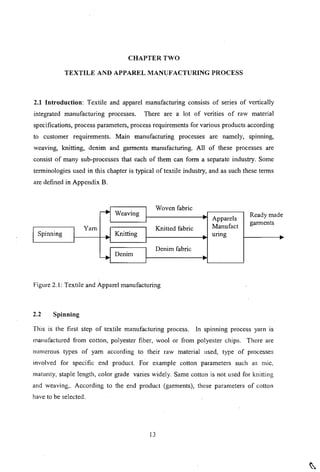
2.1 Introduction: Textile and apparel manufacturing consists of series of vertically
integrated manufacturing processes. There are a lot of verities of raw material
specifications, process parameters, process requirements for various products according
to customer requirements. Main manufacturing processes are namely, spinning,
weaving, knitting, denim and garments manufacturing. All of these processes are
consist of many sub-processes that each of them can form a separate industry. Some
terminologies used in this chapter is typical of textile industry, and as such these terms
are defined in Appendix B.
Spinning
Yam
Weaving
Knitting
Denim
Woven fabric
Knitted fabric
Denim fabric
Apparels
Manufact
unng
Ready made
garments
Figure 2. I: Textile and Apparel manufacturing
2.2 Spinning
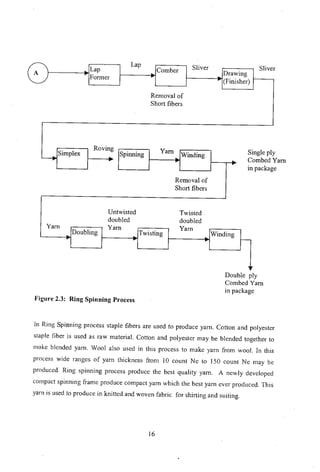
This is the first step of textile manufacturing process. In spmnmg process yarn IS
manufactured from cotton, polyester fiber, wool or from polyester chips. There are
numcrous types of yam according to their raw material used, type of processes
involved for specific end product. For example cotton parameters such as mic,
maturity, staple length, color grade varies widely. Same cotton is not used for knitting
and weaving,. According to the end product (garments), these parameters of cotton
have to be selected.
13
However, there are three types of spinning process namely, Open End Spinning, Ring
Spinning and Synthetic spinning. Staple fibers cotton and polyester are used in Open
end and Ring Spinning and polyester chips is used in Synthetic spinning for producing
filament yam.
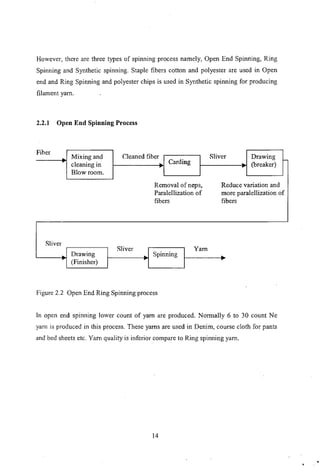
2.2.1 Open End Spinning Process
Fiber
Mixing and Cleaned fiber Sliver Drawing
cleaning in Carding .
(breaker)
Blow room.
Removal of neps, Reduce variation and
Paralellization of more paralellization of
fibers fibers
Sliver
Sliver Yam
Drawing ~ Spinning ~
(Finisher)
Figure 2.2 Open End Ring Spinning process
In open end spinning lower count of yam are produced. Normally 6 to 30 count Ne
yam is produced in this process. These yams are used in Denim, course cloth for pants
and bed sheets etc. Yarn quality is inferior compare to Ring spinning yarn.
14
•
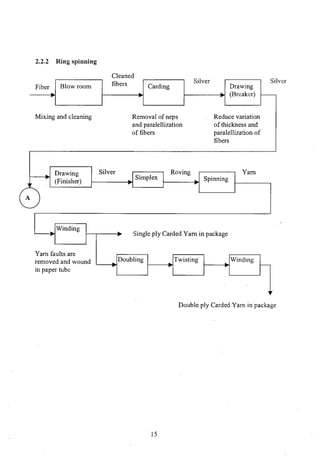
2.2.2 Ring spinning
S'lver
Cleaned
fibers SIlver I
Fiber Blow room Carding Drawing
. (Breaker) -
Mixing and cleaning Removal of neps Reduce variation
and paralellization of thickness and
of fibers paralellization of
fibers
Drawing Silver
ISimplex I Roving Yarn
(Finisher) Spinning
.
Winding
Single ply Carded Yarn in package
.
Yarn faults are
removed and wound ~Doubling Twisting Winding
. -
in paper tube
Double ply Carded Yarn in package
15
Lap
Former
Lap
Comber Sliver Sliver
Drawing
(Finisher)
Removal of
Short fibers
ngle ply
ombed Yam
package
R
Simplex
ovmg
Spinning
Yarn
Winding Si
. ~
C
m
Removal of
Short fibers
Untwisted Twisted
doubled doubled
Yam Yam Yam
Doubling Twisting Winding
-
Figure 2.3: Ring Spinning Process
Double ply
Combed Yarn
in package
In Ring Spinning process staple fibers are used to produce yam. Cotton and polyester
staple fiber is used as raw material. Cotton and polyester may be blended together to
make blended yam. Wool also used in this process to make yarn from wool. In this
process wide ranges of yam thickness from 10 count Ne to 150 count Ne may be
produced. Ring spinning process produce the best quality yam. A newly developed
compact spinning frame produce compact yam which the best yam ever produced. This
yarn is used to produce in knitted and woven fabric for shirting and suiting.
16
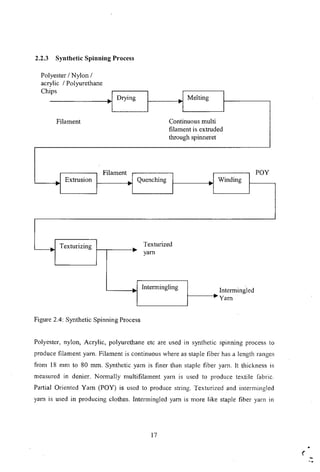
2.2.3 Synthetic Spinning Process
Polyester / Nylon /
acrylic / Polyurethane
Chips
. Drying . Melting
Filament Continuous multi
filament is extruded
through spinneret
Filament POY
Extrusion Quenching Winding
Texturizing . Texturized
yam
Intermingling Intermingled
Yam
Figure 2.4: Synthetic Spinning Process
Polyester, nylon, Acrylic, polyurethane etc are used in synthetic spinning process to
produce filament yam. Filament is continuous where as staple fiber has a length ranges
from 18 mm to 80 mm. Synthetic yam is finer than staple fiber yam. It thickness is
measured in denier. Normally multifilament yam is used to produce textile fabric.
Partial Oriented Yam (POY) is used to produce string. Texturized and intermingled
yarn is used in producing clothes. Intermingled yam is more like staple fiber yarn in
17
(
•
appearance. Spandex (Lycra) is produced from polyurethane in this process which is
used to produced fancy yam and hosiery.
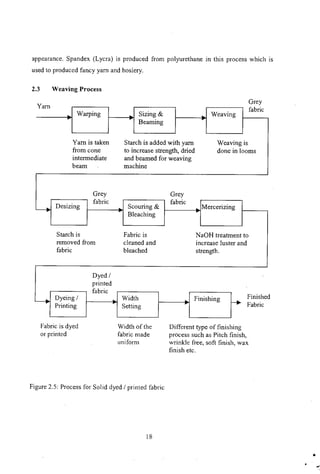
2.3 Weaving Process
d
Grey
Yam
fabric
. Warping Sizing & Weaving
~
Beaming
Yam is taken Starch is added with yam Weaving is
from cone to increase strength, dried done in looms
intermediate and beamed for weaving
beam machine
Grey Grey
Desizing
fabric
Scouring &
fabric
Mercerizing
L--.
Bleaching
Starch is Fabric is NaOH treatment to
removed from cleaned and increase luster and
fabric bleached strength.
Dyed /
printed
fabric
L--. Dyeing / Width ~ Finishing
~
Finishe
Printing
~
Setting Fabric
Fabric is dyed
or printed
Width of the
fabric made
uniform
Different type of finishing
process such as Pitch finish,
wrinkle free, soft finish, wax
finish etc.
Figure 2.5: Process for Solid dyed / printed fabric
18
•
Yam Soft ~Souring & ~ Mercerizing
winding Bleaching
Soft winding is To increase luster
required for penetration and strength.
of dye
Dyeing Hard Warping
Winding
Yam is wound in an
intermediate beam
Sizing & Weaving Desizing
. Beaming
Starch is added and yam is
wound in final beam from
10-12 intermediate beam
.
Width Finishing Yam dyed
setting
. Finished Fabric
Width of the
fabric made
uniform
Pitch finish, wrinkle
free, soft finish, wax
finish etc.
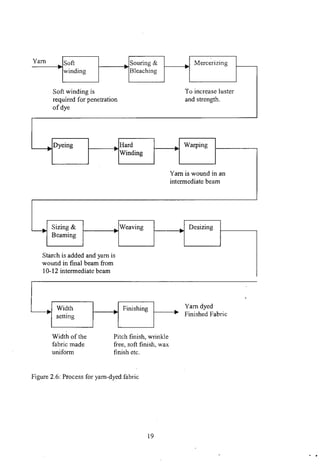
Figure 2.6: Process for yam-dyed fabric
19
. .
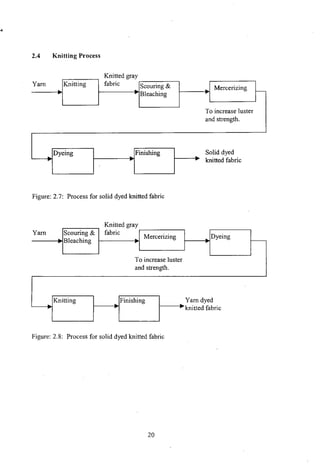
2.4 Knitting Process
Knitted gray
Yam Knitting fabric Scouring & Mercerizing
Bleaching
-
To increase luster
and strength.
Dyeing Finishing Solid dyed
knitted fabric
Figure: 2.7: Process for solid dyed knitted fabric
Knitted gray
Yam Scouring & fabric
Mercerizing Dyeing
Bleaching -
To increase luster
and strength.
Knitting Finishing Yam dyed
knitted fabric
Figure: 2.8: Process for solid dyed knitted fabric
20
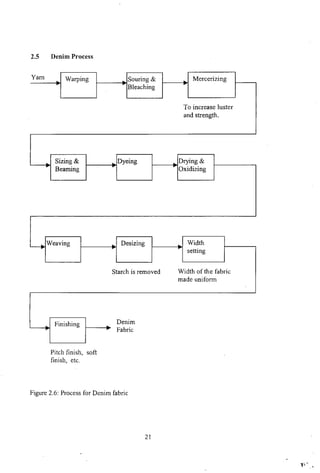
2.5 Denim Process
Yarn Warping Souring & Mercerizing
~
Bleaching
To increase luster
and strength.
Sizing & Dyeing Drying &
Beaming
~
Oxidizing
Weaving Desizing Width
setting
Starch is removed Width of the fabric
made uniform
Finishing Denim
~ Fabric
Pitch finish, soft
finish, etc.
Figure 2.6: Process for Denim fabric
21
1".
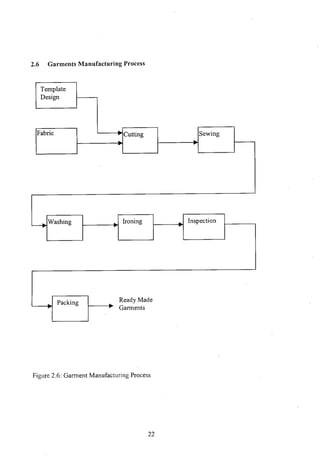
2.6 Garments Manufacturing Process
Template
Design
Fabric Cutting Sewing
.Washing Ironing Inspection
Packing . Ready Made
Garments
Figure 2.6: Garment Manufacturing Process
22
CHAPTER THREE
TEXTILE INTEGRATED MANUFACTURING
3.1 Introduction: Textile Integrated Manufacturing (TIM) has been developed by
Datatex group. Datatex is an international company with its head office in Switzerland
and sister concerns in Italy, Germany, Israel, South Africa, Belgium and USA. It is
specialized in the design, development and implementation of IT solutions for the
textile and apparel industry. Founded in 1987, datatex brought together the expertise of
a leading group of textile management consultants and an established software house
with extensive experience in developing solutions for the IBM AS/400 environment.
The resulting mix of strategic skills, industry knowledge and technological know-how
has led to the company's current success in world markets. Datatex provides solutions
for textile industries of all kinds, from vertically integrated companies requiring
systems to cover the entire production cycle to those specializing in a single stage of
the production process. Constant product innovation, excellence in working practice,
wide availability of resources and services, together with careful attention to the
methods and management style of each customer, are the foundations on which datatex
has built its success.
3.2 Details of TIM.
TIM is modular designed ERP software. It has several modules such as COPS, MASH,
SOS, DISPO, CIS, MAIS, MACO, COBRA/TRP, VIP, E@CO, SRS, BASE, CATS
etc. Any number of modules can be implemented. Complete TIM serves the following
business functions as shown in Table 3.1.
23
Table 3:I: Business functions and corresponding Modules of TIM
Business Functions Module Used
Sales and Marketing COBRAlTRP, VIP, COPS, TPM, E@CHO
Planning COBRAlTRP, VIP, DISPO
Manufacturing DISPO, CATS, K2DYE
Inventory and Purchasing MASH, MRS, SRS, SOS, FAIRWAY
Costing MAIS,MACO
Database BASE, MAIS, SAM
It may be seen from above table that certain modules cover more than one business
function. At the same time it is also evident that for one business function a company
needs more than one TIM module.
3.2.1 COPS MODULE
Function: Sales Order Handling
The COPS module of TIM system handles all the inforrnation processing required by
the Sales Order Office and by the Commercial Management and Directors.
Functions of this module are:
• Processing of Samples Production and Samples Sales, along with the
distribution of Shade Cards, Samples Cards, Swatches and Sample lengths.
Control of cutting lists in the samples room.
24
• Planning of the loading of the production machinery, in particular the loading of
the scarce resources at close to 100% for example the spinning frames, the
weave room, the dye machines.
• Decisions to launch production orders "at risk" ahead of the actual arrival of
customer orders for a given collection. This will apply usually to classical
articles which repeat season after season. This risk production is made to cover
the low production periods between one collection and the next
• Processing of Open Orders from major customers in order to book production
capacity in advance. Control of these Open orders and of the quantities and
values actually converted into detailed Sales Orders.
• Immediate computer processing of definitive Sales Orders from Customers and
immediate analysis of the demand on a daily and periodic basis, by article,
zone, customer, and delivery date. This includes handling of Provisional orders.
• Dealing with all Amendments to Sales Orders, whether at the request of the
customer or arising from internal decisions. Statistics regarding the reasons for
amendment.
• Launch of Requested Production Orders to the mill to cover the Sales Orders,
and liaison with the mill planning office to ensure the meeting of the deliveries
requested by the customer, but at the same time allowing optimization of the.
use of production resources.
• Communication with the customer to confirm the original sales order in writing,
and also to inform the customer of any changes made to the sales orders
(quantity, price, delivery date, packaging, transport).
• Cancellation of sales quantities, if minimum production quantities are not
reached.
• Communication with the customer regarding the availability of goods for his
order, and possible partial shipments. Also to inform him of probable delivery
dates ofa1l item lines of his order.
25
• Control of all goods, which become available from the production facilities and
collection of information regarding the quality and applicability of the goods.
Agreement with the Inspection department as regards the specific acceptable
quality levels for each customer and article.
• Decisions as regards the mode of packaging of the goods before they are passed
to finished goods warehouse.
• Decisions as regards the use of particular qualities of finished goods for each
customer order. Normally, the sales office assigns the specific pieces of cloth,
or the specific boxes of yam to customer orders. Sometimes this allocation
operation is done automatically.
• Delivery and dispatch rules, and the preparation of instructions (sometimes in
several languages) for the warehouse manager regarding delivery, special
ticketing requirements, and the transport facilities to be used.
• Control of customer credit worthiness and close liaison with the Sales
Accounting Office to ensure that the customer is still within control limits,
before giving final instructions to deliver.
• Preparation of delivery documents and of the eventual invoice, and introduction
of any special terms of payment, including cash-on-delivery orders.
• Processing of agreements with Sales Agents regarding % commission and
customer accounts. Eventual agreement on payment of commission, with the
accounting office.
• Customer complaints processing, recording of claims regarding product quality,
the physical return of defective articles, their inspection and approval, and the
raising of Credit Notes.
• Provision of timely information to the Sales force during the mam selling
period, regarding those articles which the Commercial Office would especially
like to sell ( for example: fabric over manufactured).
26
• Preparation of Sales statistics m a variety of forms in order to guide the
Commercial directors in decision taking. The package offers extensive on-line
inquiry of sales, dispatches, invoicing, with totals by period.
• There are many links to other modules from here. MASH for stock allocation
and shipping, D!SPO for creating Dispos from sales orders, COBRA within
VIP to allow order verification during order processing, EDI to allow the
creation of sales orders from remote data entry through PC, as well as
restrictions.
The COPS module manages the entire sales order cycle, from acceptance and entry
through shipping and invoicing. Orders are easily entered into TIM, either manually or
via ED!, tracked through all changes, allocated, released, shipped and invoiced with
full human control, but minimal effort. Processing is quick, efficient and customized to
each company's needs and objectives.
3.2.2 COBRAfTRP MODULE
Function: Sales Order Acceptance And Simulation
Functions ofCOBRAffRP:
-/ Capacity and/or materials feasibility checking.
-/ on-line sales order acceptance and availability checking.
-/ Multi-level product views.
-/ Purchase commitments and comparison to needs .
./" Suggested dates or availability if original request is not feasible .
./" Manual overrides of blocking as required .
./" Focusing on scarce (critical) resources.
27
Function: Planning
Make-to-stock companies, and those that plan in a semi-finished state, need a tool to
create a production plan, derived from a sales forecast, and manage both production
and inventory from that plan. Textile Requirements Planning (TRP) incorporates the
techniques to provide that functionality.
TRP functions include:
,( The ability to create a feasible production plan based on a sales forecast, by
product or product family.
,( The facility to connect the production plan to the analytical tools encompassed
in the Board executive information system (if used).
,( Analyses of the impact of the tested production plan on revenues, profit,
inventory and cash.
,( Update of the COBRA files to maintain stables planning and dependable
promlsmg.
,( Recommended replenishment orders, both purchased and internal, based on the
explosion of the production plan.
,( Identification of shortages and at risk orders to enhance customer
communications and promising when delays are unavoidable.
,( Provide detail of the load on bottleneck orders to facilitate schedule revisions
and modifications.
3.2.3 TPM MODULE
Function: Sales (Conversion Processing / External Operations)
The TPM (Third Party Manufacturing) module was design~d for companies with a
significant amount of business being generated from commission operations. The
software focuses on the tracking of inventory and processing, job costing and invoicing.
28
TPM's main features include:
a Invoicing directly from job lots.
a Inventory management of customers stock.
a Full price list capabilities based on processes.
a Quantity break pricing.
a Handling of price discounts.
a Interactive or batch invoicing.
a Provisional invoices.
a Printed reports and statistics.
3.2.4 E@CHO MODULE
Function: Electronic Commerce
The Web is no longer simply a better way to publish and distribute information. It has
become the conduit for billions of informational exchanges that help make up daily life.
Forward thinking companies are migrating their entire supply chains to the Web.
E@CHO provides a way to connect the system to the Internet, enabling company to
reach out to customers and provide access to it in ways never before imaginable. It
allows the company to make information available to prospective, as well as existing
clients, helping them to leverage their investment in TIM and maximize revenue
stream.
Key uses ofE@CHO include:
a Corporate image promotion.
a Product catalogue.
a Product technical specifications.
a Price lists and promotions.
a Available to sell inventories.
29
o Customer identification and registration.
o Customer order entry and inquiry.
3.2.5 VIP MODULE (Visual Interactive Plan)
Functions: Sales (Customer Order Demand Promising)
Visual Interactive Plan (VIP) has been designed and written to provide true make-to-
order companies with such a tool and allows the user to do real-time resource review
and allocation for the creation of an accurate customer order backlog.
The features of VIP include:
o Real-time or batch order confirmation (user defined) with "first possible date" if
requested date not available.
o Graphical representation of the load on critical resources providing an easily
digested view of resource status including gaps between orders. The screens are
color coded for ease of interpretation.
o Full explosion and netting across all levels of the bill of Material (BOM).
o Analysis of machine downtime and set-up/clean-up.
o Analysis of all promised orders, along with any manually scheduled production
orders (dispos) either unlinked or partially linked to a specific customer order
Non-run time constraints (i.e. allowable bailouts, tooling availability) can be
defined and measured. Warning signals will occur when violation occurs.
o User control maintained in telms of order splitting and the modifying of
existing orders to free-up resources
o Automatic dispo revisions or calculations based on the modification of existing
infOlmation, including quantity, run dates and actual production data.
30
Function: Planning
Planning: Every textile and apparel company has to plan at several levels, essential
way to the efficient use of its resources.
Planning objectives and methodology change according to the considered time frame
and events. However some requirements come out strongly dealing with planning and
scheduling in the textile and apparel industry:
Following planning functions done by VIP:
1. Quick and reliable on-line verification for Make-to- Order Scheduling.
2. VIP gives a graphical representation (Gantt chart) of the workload on critical
resources providing an easily digested view of resource status including gaps
between orders.
3. It allows the planner to analyze the situation and to manually correct the plan
and automatically handles the plan impacts, when an order is cancelled or
changed, by creating and recalculating the production orders.
4. It represents always the current status of any order, considering also the
automatic or manual plant data collection .delays are displayed on-line reacting
to any change of conditions automatically creates production orders for all
manufacturing levels.
5. It checks the feasibility of each customer order in a very short time in order to
confirm the delivery date in an interactive way, especially when the ordered
item is not in stock.
6. It can define when to use the resources with two different approaches: if the
"earliest" scheduling is required, the first available resource is searched; if the
"latest" scheduling is required, the first available resource is searched starting
from the process end date. If no resource is available, the planner can accept the
suggested date or force a new one; the necessary resources are reserved when
the order is confirmed.
31
7. It shows in a graphical form the real and complete situation of the plan and
highlights the possible periods of overlapping "use" of elements connected to
the production, the delay in order delivery and the unused resources.
8. It also allows the planner to exactly evaluate the situation and manually change
the reserved resources for orders already confirmed or not. The planner can also
create directly on the plan new production orders, modifY existing ones or link
new customer orders to a production order.
9. VIP provides the planner with a Gantt chart to display the complete and up-to-
date situation. He evaluates the plan and, when appropriate, manually change it
or enter new production orders.
3.2.6 DISPO MODULE
Functions: Manufacturing
All production orders are launched tracked and controlled with the help of the DISPO
module. This module calculates all reservations of materials and capacities based on
expected quantities. It also allows a good deal of flexibility in terms of methods used
such as forward or backward scheduling, of produced quantities (fixed or rate based),
overlapping or parallel operations, and shop floor updating when required.
DISPO provides solution to common production tracking problems.
• Launching of production orders.
• User-definition of multiple production order structures according to processing
type (spinning, weaving, etc.) Pre-defined production orders by period (day,
week or month).
• Waste reprocessing (spinning waste)
• Handling of production orders with vanous units of measurement (meters,
picks, kilo, etc.)
• User-defined technical data applied to production order steps (standard
procedures etc.)
32
• Multi-article production orders
• Multi-batch production orders that go through an entire cycle or branch off from
a specific step.
Calculation of material requirements
• Calculation of material requirements, accounting for extension/contraction and
in-process losses
• Material requirements by size
• Material requirements calculated by quantity and date
• Yam requirements calculated according to weaving design
Production progress management
• Estimates of processing step duration taking into consideration: job order
quantity, setup time, machine efficiency, average run lengths, waste,
extension/contraction and reprocessing
• External production order launching
• Production orders closed early or on-going
• User-definition of production progress data (lot tracking)
• Production tracking by batch, piece and location.
Service and information functions
• Updating of material and in progress standard production values
• Allocation of materials by quantity, batch and element, such as pieces, rolls,
yam boxes, etc.
• Allocation of completed jobs to other production orders (e.g. from unbleached
to finished) or to customer orders ,Preparation of pieces, beams, warps, and
boxes of yam for production orders
• On-line inquiry of a customer order and its production status
• Use of bar code
33
• Creation and handling of all production cycle documentation, such as: picking
list, piece tags, processing instructions, etc.
Function: Planning
Another planning session IS required when an acceptance order is turned into a
production order. DrSPO module is designed to assist the planning personnel and avoid
overloading the production offices. Making schedules on a weekly basis helps plan
balanced job loads on the major work centers.
DISPO relays product and material availability over time and analyze work center
availability. It probes for sales order, stock balance, launched orders and purchase
orders in progress and compares them to the production plan. It also singles out
material requirement on all levels production.
Planning functions done by DISPO are:
,/ Negative availability analysis on each production level per period.
,/ Work center load analysis.
,/ Material availability analysis by articles, color, variant or size.
,/ Producing printed reports and planning statistics.
3.2.7 K2DYE MODULE
Functions: Dye House Management
The K2DYE module provides the users with the ability to define batch-grouping
criteria either by color, article, work center, etc. These batches are connected to the
recipe archive for accurate calculations of drug room formulae. Once the dispos have
been dyed, K2DYE can automatically update dye and chemical balances and will
provide a comparison of standard versus actual dye house perfornlance.
34
The main functions of K2DYE include:
./ Dye-house batch definition based on user-based parameters .
./ Formula calculations for batch, continuous, printing and coating processes .
./ Production lot -formula connections .
./ Calculation of material reservations by dye-house and subsequent issuance of it.
./ Add or recipe recalculations .
./ Process instruction files.
./ Print shop paper.
./ Automatic relief of actual quantities (connected to electronic scales) .
./ Creation and maintenance of reprocess lots.
./ Highlight unplanned or non-standard quantities.
3.2.8 CATS (Computer Aided Textile Supervision) MODULE
CATS -Computer Aided Textile Supervision is a computer-based tool supporting the
cloth inspection phase with three main objectives:
~ Improve inspectors' productivity and efficiency.
~ Optimize the value of the produced fabric.
~ Report timely information on faults in production.
CATS will increase inspector's productivity by:
I. Minimizing data input at terminals.
2. Avoiding input errors by using bar coding.
3. Speeding up the correction of roll I piece data.
4. Simplifying data exchange with host computer.
35
CATS is able to :
o Provide a graphical user interface for inspection and cutting operators'
workstations including connection to length counter. Previous inspection
performed for this roll or pIece IS constantly displayed on a graphical bar,
simultaneously displaying underneath a graphic bar of the actual inspection.
o CATS optimizes the cutting of the roll, with the goal of providing maximum
first quality production, according to the chosen policy. Optimization IS a
dynamic function while cutting the roll, taking into consideration and
synchronizing both defects and length specifications
o Handle events recording such as: Change weaver, change dispo, change
operator etc. on the same roll.
o Alert at end of batch.
• Monitor the inspection process with the possibility to enter stop reason codes.
o Manage a messaging system from main system or system operator to inspectors,
triggered by Dispo, article or roll.
o Handle defect map of each product including length defects, keeping both
length and width co-ordinates.
o Manage output of more than one roll created by lengthwise cutting after the
inspection process (splitting), calculating quality level of each cut roll.
o Manage more than one point-table allowing for later evaluation of each roll
with a different point-table including multi article situations.
o Handling of cut waste including possibility of creating a waste roll while still
inspecting or rolling the main roll.
o Handling intermediate inspection without input into stock.
o Handling ofre-inspection.
o Entry into the inspection station can be by Batch, Predefined roll, or a Purchase
order. Output rolls can be newly created or retain the number as entered.
• Automatic roll numbering by user defined logic.
36
o Allow for joining inspected rolls put aside while inspecting.
o Manage multiple inspection models.
o It can also integrate with other devices such as:
:» Weighing stations.
:» Thermo transfer printers for ticket printing, with unlimited no. of label
types.
:» Digital outputs, I.e. for "machine stop", automatic fault labeling.
:» Digital inputs, I.e. for recording any machine events.
:» Packing and pall etizing system.
:» Laboratory station (I.e. to add additional laboratory data to the inspected
rolls)
o Moreover it is also possible to connect an inspection table-pointing device to
directly coli ect the fault position through two sensors and a pointing pen, the
latter being slightly bigger than a normal ball pen.
o Provide the possibility to connect packing, palletizing, weighing or transport
systems to controllers.
3.2.9 MASH (MANAGEMENT ACCOUNT STORE HANDLER) MODULE
Function: Inventory And Purchasing
The MASH module has been designed to he both easily used and understood and to
support activities related to the exacting world of textile, such as:
,/ The ability to recognize multiple put-ups and the quantity per put-up for all
inventory.
,/ The ability to have elements (roll/pieces) within a container (case/trailer)
,/ Multiple quality levels with related discount percentages.
37
.,/ Logical or physical warehouse definitions. with a separate 8-character location
field.
.,/ Cycle-counting or physical inventory reports, with or without quantities .
.,/ The ability to split or join elements with full trace ability .
.,/ Product allocations to customer orders, production orders or to other
warehouses .
.,/ Automatic unit of measure conversions either through alternates listed for the
item or via standard conversion tables .
.,/ The tracking of articles that have been received oul not approved for use.
.,/ Partial release and allocation of elements when necessary .
.,/ On-line and batch warehouse transactions .
.,/ Altering the quality of inventory on-line .
.,/ Multiple entries of technical data per element and batch .
.,/ Yam moisture content management.
.,/ Narrative comments .
.,/ Printed labels (bar-coded), documents and reports .
.,/ Restricted access of goods by warehouse .
.,/ "Wild card" searches by article codes .
.,/ Searches by element, container, location or movement status .
.,/ Inventory valuation reports by standard cost, average estimated cost or average
period cost Calculation of ABC consumption .
.,/ LIFO inventory evaluation .
.,/ Tracking of quality codes and mapping.
38
to
..
3.2.10 MArS MODULE
Function: Ware house management
The process flows, stored in MArS, are the most seamless representation of a combined
bill of material and routing available today. These flows enable real-time material and
capacity checking.
MArs provides the following functions:
v' Control of the calculation of standard costs and the production process.
v' Files for cost centers, work centers, process flows, work center processes and
consumption.
v' Management of recipes for printing, coating, batch or continuous dyeing and
finishing.
v' Print screen management.
v' Loading of each step including processing times, setup times, resource yields,
losses, extension/shrinkage and/or waste due to process, standard batch size,
operation typology, utilities and auxiliary materials defined and managed by
process flow.
v' Operation types handled: continuous, batch, printing, external.
v' Multiple process flows per item, including frozen, master and alternative.
v' Thermal process charting.
v' Configurable bill of material minimizing the handling and maintenance
requirements based on the secondary key concept and regroupings of technical
inforn1ation.
Standard costing functions:
The information stored in this module helps to define and managc standard product
costs on the basis of raw material requirements, labor and overhead consumptions and
production capacity needs.
39
MArs provides the following functions:
.,/ Cost elements are user-defined through tables based on parameter settings.
They can be set for cost (e.g. interest) or consumption (e.g. labor) .
.,/ Each cost element and product can use up to 3 different, user-defined values
simultaneously .
.,/ Cost elements can be applied to various levels, such as process flow steps,
process flows, work centers and external operations. Moreover, cost elements
can be linked to complete or partial article codes managed as ordinary
secondary keys (for example, product costs detailed by color, or by color groups
which are often defined on an article code's secondary key) .
.,/ Cost elements can be dynamically divided as direct or indirect costs without a
rigid distinction and grouped by type.
.,/ Standard costs can be calculated by product or by article flow .
.,/ Calculate the contribution margin of a unit of measurement and/or machine
hour by product (average alternative flows) or by single process flow.
.,/ Calculate product costs using the complete or partial article key.
.,/ Explode cost calculation to lower levels of the bill of material.
.,/ Query standard costs using 3 different values with a maximum of 5 decimal
digits.
.,/ Query costs bycost center, work center and cost element type .
.,/ Query costs of: materials, internal production, external production, interest and
below standard quality .
.,/ Query direct and indirect costs dynamically defining the distinction each time .
.,/ Costs by user defined unit of measurement and user defined currency .
.,/ Make production plans for a period to detem1ine contribution margins .
.,/ Simulate optimum production mixes that maximize company profits.
40
3.2.11 FAIRWAY MODULE
FAIRWAY is a module designed to assist In the management of warehouses,
optimizing both the logical and the physical handling of the inventory.
FAIRWAY not only handles the physical location of a single item, but can also
determine automatically where an item can be placed. To do so FAIRWAY considers
user-definable characteristics such as dimension and weight of both the item and the
numerous locations to be considered.
FAIRWAY supports the following warehouse functions:
,/ Physical Warehouse: The physical warehouse defines the actual physical
location and dimensions of the storage facility and also defines the use of zones,
locations and containers. It may contain multiple logical warehouses and
supports the segmentation of locations, handling all the element/container
characteristics.
,/ Logical Warehouse(s): Logical warehouses are related to zones within the
physical warehouse and allow for further definition of container handling.
,/ Zone Master File: The Zone Master file sub-divides the physical warehouse and
contains the segmentation criteria and attributes of the locations assigned.
Zones may also be used to redefine container handling.
,/ Location: Composed of a ten-character code, FAIRWAY supports the division
of this field in up to six different customizable sub-codes to which attributes can
be linked. Sub-codes can include, but are not limited to area, row, rack and tier.
Examples of attributes that can be defined are:
o Size: Size, volume, weight and three additional user-defined constraints.
Also defines the number of containers allowed.
o Type: Single versus multiple article storage and complete or pa!1ial
containers.
o Status: Transitional versus permanent location and usable versus non-
usable inventory (i.e. awaiting inspection/test results).
o Turns/Rotation: Denotes quick turning or high rotational inventories.
41
3.2.12 SOS MODULE
SOS handles the creation of purchase orders from the requisition module or from
manually keyed input. It will also aid in supplier selection, finding the best source
based on price, delivery, quality and past performance. It will track status and keep
details on all receipts, including those pending quality review. Finally, it will pass the
necessary information to accounting for vouchering and payment of invoices.
SOS's basic functions include:
,/' The ability to handle single and blanket orders.
,/' The creation of forecast orders.
,/' Options for color variants and size.
,/' Split receipts to different locations.
,/' The handling of discounts, payment methods, etc. (can be taken directly from
supplier master files).
,/' Dynamic price list functions.
,/' Allocating pending receipts to production orders or customer orders.
,/' The use of vendor article codes.
,/' Methods for on-line matching.
,/' Reports and queries.
,/' Interfaces with accounting packages.
3.2.13 MACO MODULE
TIM uses a combination of the MAIS module and MACa to enable the use of standard
costing .and the gathering of manufacturing variances at all levels. Each product is
linked to one or more process flows that contains all the infonnation necessary to both
roll-up a standard product cost and freeze a product cost, as the user requires. to enable
the ongoing calculation and application of variances.
42
MACa key features include:
• Show the differences between standard and actual costs.
• Evaluate entry movements coming from internal operations.
• Make links with the general ledger.
• The ability to have frozen flows, that archive a product's standard cost, current
(industrial engineering) flows for the most recent methods and a third version to
be used for future rewrites or archiving of previous costs.
• The ability to close orders and rationalize earnings based on goods actually
produced from a production order.
The use of MACa will allow TIM users not only to capture and reflect periodic costs,
but much more. MACa has provisions for linking the results of the calculations with
the general ledger for budget to actual calculations along with variance costing. MACa
will allow the user to analyze data by product, production order, cost center/work
center or period.
3.2.14 MRS (Material Replenishment System) MODULE
Function: Inventory Replenishment Methods
TIM contains replenishment methodologies that handle either raw or manufacturing
materials (i.e. order point with automatic calculations of minimums and maxiinums). It
uses either the DISPO module, combined with MASH, to identify future replenishment
needs or uses MRS (Material Replenishment System) to identify items suitable to order
point handling and calculates the trigger amount, order quantities and safety stocks,
when and where necessary.
MRS also provides for:
./' User defined ordering parameters .
./' Monthly analysis of usage.
./' Reports of articles needing review .
./' Valuations of on-hand inventories.
43
v" Option of interfacing directly into the purchase requisition programs.
3.2.15 SAM (SECURITY ACCESS MANAGEMENT) MODULE
Functions: Security of Database
The routine problems ofregulating user access to specific functions or specific entities
(i.e. products, plants, warehouses, etc.). To provide a solution for these issues, datatex
has introduced Security Access Management (SAM), an easy-to-use security
management tool that allows system administers to limit the authority of users to the
data they need while filtering out the data they should not be able to access. Through
SAM one can customize one's access to actually block certain users from inputting
sales orders for a specific customer beyond a specific date or allow access to data
pertaining only to certain products in specific warehouses.
Some of the main features of SAM are:
v" Users can be classified by category (User classes) coded by group.
v" Each user has an authority level. The level establishes the user's authority to
access and manipulate data.
v" Security is available to the specific "field" and "field value" level per user.
v" A "firewall" is created that allows external users to access certain functions and
specific data, without being able to view sensitive information.
3.2.16 SRS MODULE
Function: Purchase Requisitions
TIM tracks purchase requisitions in a special module, ensuring that persons utilizing
this function have correct authority to create requisitions and that proper oversight
levels are maintained.
SRS makes it possible to:
o Deal with requisitions for both coded and non-coded itcms
44
a Define parameters by users that modify screen formats to meet individual needs
a Manage authority levels allowing segregation of requesters, approvers, and
purchasers also by ordered value.
a Track requisition status to create various reports.
3.2.17 BOARD MODULE
Management Intelligence Toolkit
BOARD: is a company-wide module that integrates EIS (Executive Information
System) and DSS ( Decision Support System) functions to allow management to make
informed decisions based on rapid simulations through precise, graphically-illustrated
responses. It is capable of carrying out any kind of budgeting operation. Textile
Companies can today achieve these challenging goals thanks to the integration of TIM
with BOARD-Management Intelligence.
The innovative design and the advanced technology of BOARD make it a unique and
outstanding product on the market place.
BOARD is:
an integrated tool providing EIS (Executive Information System) and DSS
(Decision Support System) features
an application generator system that requires no programming and guarantees
reduced implcmentation times and costs
full indepcndcnce from the supplier
minil113lmaintenance
So fast and efiicient multidimensional database with:
a powerful Rcport Generator with charts
a model builder to support simulations
45
embedded forecasting models to analyze trend and seasonal components
multi-user Read &Writc access (essential for budgeting support)
advanced security management.
46
CHAPTER 4
ACQUISITION OF TEXTILE INTEGRATED MANUFACTURING
4.1 PRIOR TO ACQUISITION
Any acquisition must precede some homework to establish the need precisely. This is
also true for a software acquisition process. The necessity of ERP software should be
justified. Entrepreneurs or top management must decide whether they need ERP
software for planning and manufacturing control or not. To answer to the question of
when to use a computerized planning and control are right step for a company, the size
of the company play the vital role to the answer. In small companies it is not difficult
for informal communication to work well along with spreadsheets or planning boards.
As companies grow, such informal communication systems become less efficient and
mistakes become common. Spreadsheets are generally "owned" by just one or two
people. Much of the information they contain has to be entered from and re-entered by
other department leading to errors and reducing the speed of reaction to change. An
integrated MRPII or ERP system enables accounts, sales, production, planning and
purchasing to use the same basic data to keep the business synchronized tb minimize
confusion and delays.
The other big driver for the increased used of computerization is time scale. In the 70's
it was common to plan in monthly time periods so materials were brought in the month
before they were needed and shipments were any time in the month. In the 80's best
practice was 10 plan in weekly time periods. These days, many companies have to ship
to mcet a timc slot of minutes on a specific day, therefore must plan in daily basis.
Manual planning and re-planning every day, to the day is impractical due to the number
47
,...
of calculations needed to be done every day. For a computer daily planning is as easy
as monthly planning once set up.
Best practice and the most efficient way to plan manufacturing for any company over
about 50 people is a fully integrated, properly implemented and understood MRPII or
ERP planning system.
Beximco Textile Division is large manufacturing company which compnses of all
processes to produce garments from fiber, namely yam manufacturing (spinning),
weaving, knitting, dyeing, finishing, manufacturing of denim fabric, and manufacturing
of ready made garments from knitted, weaved and denim fabric. Total number of
employees is about 7000. Moreover it is a discrete manufacturing plant, which require
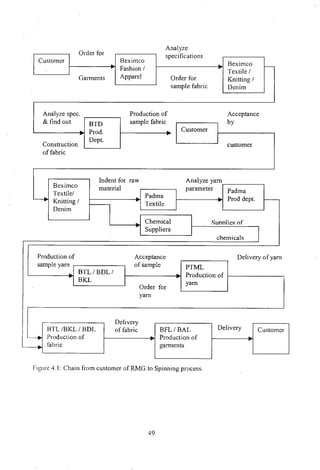
a very long supply chain management. An example of this chain is shown in the
diagram I below.
48
Order for
Customer
Garments
Beximco
Fashion I
Apparel
Analyze
specifications
Order for
sample fabric
Beximco
Textile I
Knitting I
Denim
Acceptance
by
Production of
I f: b .
Analyze spec.
&fi d t
In ou BTD samp e a flC
Prod. Customer
~
Construction
Dept.
customer
of fabric
.
Indent for raw Analyze yam
Beximco material parameter Padma
Textilel
. Padma ~
-. Knitting I Textile
Prod dept.
Denim
Chemical Sunnlie. of
Suppliers
1
chemical.
Production of Acceptance Delivery of yam
sample yam of sample PTML
. BTL/BDLI
Production of
BKL
yam
Order for
yam
Delivery
Delivery
BTL IBKL I BDL of fabric BFLI BAL Customer
------. Production of Production of
fabric garments
--,.
Figure 4.1: Chain from customer ofRMG to Spinning process.
49
When Beximco Fashions or Beximco Apparels takes an order for a ready made
garments manufacturing, it passes the sample fabric to Beximco Textile / Denim /
Knitting for the required fabric. They analyze the sample and find out all required
materials like yam (type and quality), dyes-chemicals etc. Procurement department
order Padma Textile for required yam and make arrangement to import dyes and
chemicals. Padma Textile import fiber as required to produce the required yam.
Therefore from fiber to garment is a long chain of supply and manufacturing.
For good planning and control of all manufacturing processes, Beximco Textile
Division decided to use ERP software with following objectives:
~ Improve on-time delivery
~ Reduce works-in-progress
~ Control over manufacturing cost.
No doubt about this decision, for above objective an ERP software is the right choice.
4.2 ACQUISITION
An ERP software life cycle consists of three stages namely, acquisition,
implementation and maintenance. Acquisition is the first step of ERP life cycle. In
acquisition process selection of ERP software, cost benefit analysis and feasibility
study have to be done. It is very important that acquisition process should be properly
followed. A lot ERP project failed due to improper acquisition. According to Phil
Robinson [II], author of "Business Excellence - The Integrated Solution to Planning
and Control" only 35% ERP project succeeded in improving business performance and
rcduce operating costs. There must be team for acquisition of ERP. Team members
must have knowledge about ERP software. Team must be headed by top level manager
who have sufficient knowledge about ERP. Beximco Textile Division fomled a team
with following person for acquisition of ERP:
• Manager (lnfomlation Technology)
• Manager (Finance)
• Sr Executive (lnfomlation Technology)
50
4.2.1 SELECTION
Selection of ERP software is very difficult since ERP software has become extremely
complex both in terms of functionality and visual presentation. The normal good
purchasing practice of writing a detailed requirement specification of ITT (invitation to
tender) is not therefore practical. Two biggest problems from software packages are
problems or bugs and poor support from software house. These problems cannot be
avoided by writing a long and complicated specification.
At present a lot of ERP softwares are available in the market with variety of tags such
as MRPII, ERP, APS etc but under the surface all appear to have the same
functionality. It is impossible to study all these softwares. Therefore instead of
studying a lot softwares, the team visited few renowned textile and apparels
manufacturers of similar type in India, Turkey, Australia, Canada. After the visit they
found Textile Integrated Manufacturing (TIM) is the most used one. Instead of making
a comparison between a lot of softwares, they studied Textile Integrated Manufacturing
(TIM) thoroughly .
./ They studied brochures, manuals and other literatures. It gave them first
impression about the software. They became well aware of the functions,
reports produced by Textile Integrated Manufacturing (TIM). It also gave
advantages of its use, and the objectives that will be met by it.
./ They studied demo version of Textile Integrated Manufacturing (TIM). It made
them familiar with the software on practical basis. They came to know about
what are the input data, how the screen look like, how customer order can be
tracked, how manufacturing planning is done and what other functions can be
done by TIM. They became familiar with handling of TIM .
./ After having theoretical knowledge about TIM, they visited different textile
mills those are using Textile Integrated Manufacturing (TIM) to gather practical
knowledge. They tried to get their hands on the keys. They tried to gather the
knowledge about the following:
• Why they chose the software
51
• Hardware & software configuration specified at implementation
• System's actual performance vs. expectations and any more hardware or
software required
• Quality of training, preferably the names of any good trainers who are
still available
• Availability and performance of implementation team
• Ability of vendor to meet schedules and deadlines
• Attitude and responsiveness of vendor staff (friendly, adversarial, etc.)
• Problems during implementation, how they were resolved and any
outstanding issues I bugs now
• How new releases I upgrades are handled
• Unexpected surprises (good and bad)
• Challenge of finding and retaining IT talent to support the system
• Major benefits of the system
• Major limitations of the system
• Hidden costs
• Customization issues
From above study they found the following points In favor Textile Integrated
Manufacturing (TIM):
• It is a specially designed ERP software to integrated all processes from fiber to
gam1ents namely spinning, weaving, knitting, dyeing, finishing, denim processing
and apparel industries.
• Datatex, manufacturer of Textile Integrated Manufacturiilg (TIM), has an
experience of 15 years and had a history of 200 successful implementations in
more than 30 countries in 14 languages all over the world.
52
• Many other ERP software support textile manufacturing, but jargons do not
directly fit textile process. Since Textile Integrated Manufacturing (TIM) is
textile oriented package, the vocabulary used in it is familiar to software persons
and other top management personnel of Beximco Textile Division. Therefore
textile business functions done by TIM were easy to understand.
• Since TIM is textile oriented package, they thought that customization would be
easy comparative to other ERP softwares.
• During customization of ERP software many implementers find that the software
does not support all business functions. Then either they have to change the
software or change the business style. Change of business style some time no
possible and change of software is costly. Rahimafroz of Bangladesh changed
their software when they found that the software ERM does not meet their
requirement[12]. Since TIM is an established ERP software for textile and
apparels, Beximco textile division management assumed that risk of non-
compliance with business activities will be much less.
• Cost of TIM is much cheaper than renowned ERP software like SAP R!3, QAD
MfglPro, Intentia Movex, MAPICS, J.D. Edward I World.
• Most of the renowned textile and apparel manufacturers those have implemented
ERP, use Textile Integrated Manufacturing (TIM).
• Textile Integrated Manufacturing (TIM) is a complete ERP software that support
supply chain management, customer order processing and tracking, sales,
planning, inventory and purchasing, marketing, manufacturing, costing, e-
business for spinning, weaving, knitting, dyeing, denim and garments
manufacturing.
4.2.2 COST BENEFIT ANALYSIS
Manager, Information Technology, of Beximco Textile Division made cost benefit
analysis of the ERP software project. In the analysis, rate ofretum was found high and
pay back period was found short. Due to departure of IT head, there was a gap in that
53
position for more than one year. Due to this gap in previous and present managers, the
present manager could not give any detail of this cost benefit analysis.
4.2.3 FEASIBILITY STUDY
In selection process Textile Integrated Manufacturing (TIM) was selected as ERP
software. Cost benefit analysis showed a good rate of return. Then Beximco Textile
management studied the feasibility of the software. In this study they checked technical
aspects of software implementation and use. Following things were revealed in the
study:
o TIM had all functionality that Beximco Textile Division required.
o Since ERP software experts are not available in Bangladesh, they checked
whether it would be possible to implement TIM by local IT professionals. They
found it possible in phased approach method.
o They checked the requirement of computer skill, educational background, and
aptitude etc of operator for operation of TIM. It was very important that existing
manpower should be able to operate TIM. They found that exiting manpower
would be able to operate if they get appropriate training.
o Hardware requirement- They checked hardware and network requirement and
its availability. Because units are at a distance of few hundred meters and the
head office is at 50 kilometer away from the factories. A radio link connection
of 256 kbps would connect head office with the factory and factories would be
connected by fiber optic cable. Data would be entered by ordinary personal
computer.
o Requirement of cultural change- Cultural change in any business and
manufacturing organization is not easy. Many projects were abandoned due to
failure to change the culture. Revenue Board of Bangladesh implemented
computerized system but could use it due to resistance from its employees. So
54
before taking any project that changes culture, acceptance of the change must
be studied. Normally fear of uncertainty, loss of job, etc make employees to
resist the change. Beximco Textile management thought the cultural change
would be possible. Because, the existing employees would be trained and
operate new software system. So resistance to this change would not very hard.
Therefore management opined that the ERP software (TIM) would be feasible.
55
CHAPTERS
IMPLEMENTA nON
5.1 INTRODUCTION
Implementation of ERP software is the second part of ERP life cycle. It is the biggest
and challenging part of the job and it requires a lot of manpower involvement. In broad
sense it involves almost every body of the organization. A lot of ERP project had been
abandoned during this phase. Most of the entrepreneurs think it as installation and
commissioning of other software like windows, MS Office etc. They do not understand
the importance of good planning and proper implementation. It is possible to just install
the software in a few weeks which too many companies do which contributes to the
fact that only about 35% of ERP implementations succeed in improving business
performance and/or reduce operating costs. Therefore, every stage of ERP
implementation have to be planned and executed carefully. All ERP software
manufacturers give guidelines for implementation. More over there are standard
procedure and guidelines for ERP software implementation[14). Two approaches are
most common in implementation of ERP software as discussed below.
5.2 IMPLEMENTATION STRATEGY
Big Bang Approach - It is an implementation strategy that cuts over all parts of a
planning system at the same time in a company or division as opposed to phased
approach implementation. It is an aggressive implementation strategy of short time
scale. It requires a project team with sufficient skilled IT professional and clear
understanding of ERP software and business functions as well. Planning must be done
by experienced consultant and implementers are to professional in that field with
implet'nenting experience of that particular ERP software. Accurate planning and
proper execution must be done in big bang approach.
56
Phased approach- Normally ERP software consists of lot of modules for different
business functions like planning, sales, manufacturing, inventory, purchasing and
costing. In phased approach strategy ERP implementation is done by module by
module. Therefore it takes much more time to implement than that of big bang
approach. It has the advantages that it requires less manpower in the project team, and
can be implemented by own IT professional with proper training. Implementation
experience is not mandatory in this case. Training by experienced personnel can serve
the purpose. Many organizations want to implement with their own IT personnel for
better maintenance and less cost involvement. Main draw back of phased approach is
that interdependent module cannot be implemented module by module. More over it
takes much more time than predicted. Textile Integrated Manufacturing (TIM), can be
implemented module by module.
Beximco Textile Division planned to implement TIM in phased approach method.
Professional implementers of ERP software were not available in our country. To hire
experts from abroad is very costly. Therefore, Beximco Textile Division decided to
implement TIM by its own IT professionals in phased approach method. They planned
to COPS and MASH modules at first. They also reduced the area of implementation
only to Beximco Textile, Beximco Knitting and Beximco Denim instead of whole
textile division.
5.3 IMPLEMENT AION PLAN
Management of Beximco Textile Division chalked out a plan for TIM implementation.
They followed the guidelines of datatex, manufacturer of TIM and the knowledge
gathered from visiting other organizations who have implemented TIM before to make
the plan. During planning they out lined hard ware, software and training requirements,
requirement of IT professionals. They chalked a planning steps and time fence. All
these plans were done by project team. No experts were hired for planning. They
planned to implement two modules COPS & MASH first in BTL.
57
5.3.1 HARDWARE REQUIREMENTS
Project team studied the papers of datatex to find out the required server and other
hardware requirement for Textile Integrated Manufacturing (TIM). They estimated
number of users in the floor, location of switches, distances between user location,
distance between production floors and offices etc. According to their estimation
required hard wares were:
o Server- IBM AS400 server.
o NT server (IBM)
o 100 nos. personal computers.
o Fiber optic network - Fiber optic cables, switches, UTP cables, power supplies
etc. for Local Area Network (LAN) in Beximco Textile Limited, Beximco
Knitting Limited and Beximco Denim Limited.
o Radio link between Factory and Head office- Since distance between factory
and head office is about 50 kilometers, Radio link has 10 be established to
connect local area network of head office and factory. All required hard ware
for this communication.
o Printers, furniture etc. for servers and PCs.
o Room for IT officers and servers.
5.3.2 SOFTWARE REQUIREMENT
Project team consulted datatex for required software for implementation of TIM.
They found following software necessary for implementation of TIM:
o OS-400 operating system to run TIM.
o RPG operating system for programming.
o Windows 98 operating system for PCs on the floor.
o Networking software, Windows NT-4
58
o Linux for email server
o OB2/400 database
o Client Access, Rumba etc for emulation i.e connecting PC with TIM
5.3.3 MANPOWER REQUIREMENT
Since they planned to implement TIM in phased approach, they estimated that 10-12 IT
professionals will be sufficient for implementation. They thought they will not need
any expert continuously for the project. No extra person for data entry will be required.
Present employees working in different sections will be trained and they will enter data
by themselves for their own section. Existing IT persons who looks after network will
be sufficient to administer the new (expanded) network.
5.3.4 TRAINING OF IT PROFESSIONAL
They employed fresh IT professionals for the job. Therefore they required training on
many aspects. Following training programs were planned:
o Training on OS-400 operating system.
o Training on RPG software
o Training on TIM implementation.
All training programs were planned in Beximco Textile Division premise to be given
by hired IT experts.
5.3.5 TRAINING OF USERS
It was planned that exiting employees would run the TIM. Therefore they needed
training to run it. Two weeks training was planned for the users at the floor and it was
planned to be given by own users. Users at different level needed different type of
training, so that all level of users can enter data and can generate reports as necessary.
59
5.3.6 PLANNED TIME FRAME
Implementation time fence is very vital thing in planning. To complete the whole
project in planned time, the project needed to be broken down to smallest division of
work and link between the works must be apprehended. Time for each work must be
estimated and monitored. To make a good plan, time scale for each part of work
requires adequate knowledge about it. Beximco Textile Division was relaxed in
planning time scale for implementation. They did not break down the complete work in
smallest division. Rather in first phase they planned to implement only two modules in
Beximco Textile only. After success of it, they would take decision for other modules.
5.4 IMPLEMENTATION (FIRST PHASE)
After acquisition of TIM, implementation started in 1997. They had to do a series of
works. Installation steps are installation of all required hardware and software,
customization of ERP software, testing and debugging of customized modules, report
generation, real data entry and use, training and implementation. One of the most
important parts of implementation of ERP is the change of culture of manager and
users. The following works were started sequentially:
5.4.1 PROCUREMENT OF HARDWARE
According to plan they started procuring hardware items. At the beginning they
procured the following hard ware:
o One IBM AS-400 server.
o 100 hundred Personal Computers.
o Fiber optic cable, switches, hubs, UTP cables, data switches, LAN cards etc for
Local Area Network.
o Router, Antenna, transmitter, receiver, line driver, radio modem for Radio link
between head office and factory.
o Printers
o Furniture for new personal computers and servers.
60
5.4.2 EMPLOYMENT OF IT PROFESSIONAL
Top management of Beximco Textile Division decided to employ fresh IT personnel
with computer science background. They employed ten (10) .fresh IT professionals
graduated in computer science. They put two more IT persons from existing IT
department. These twelve persons headed by Manager, Information Technology,
formed a team for implementation of Textile Integrated Manufacturing.
5.4.3 TRAINING OF IT PROFESSIONALS
After employment, IT personnel were given training In different software. Textile
Integrated Manufacturing (TIM) was a complete new ERP software that run in OS/400
environment. So they needed training on TIM, OS/400 operating system and other
software for implementation. Following training was given to the implementation team
member:
o Training on OS/400 operating system: OS/400 is the operating system for
AS/400 server. IT personnel were given one week training on OS/400 operating
system by IBM experts of Bangladesh at factory premises.
o Training on NT -4 operating system: There was a small local area network
(LAN) in Beximco Textile Limited before implementation of TIM. New
members of team were trained by existing IT personnel on NT-40perating
system.
o Training on RPG software: RPG is the programming software for OS/400
operating system. Two weeks training on RPG was given by IBM personnel at
factory premises.
o Training on TIM: Datatex experts trained IT personnel of implementation
team about TIM. They gave them the overall idea about the whole ERP
software. Then they trained them on implementation issues. They made them
understand all data structures, fields and creation of their relation. They gave
them the idea of designing different input screen, coding for fiber, fabric,
customer, code for inventory of raw materials and spares etc. They also trained
them how to generate reports from different modules for different sections.
61
They gave the idea of customization to fit the TIM to Beximco's business
activities. Training was given at factory premises and duration was 3 weeks.
o Training on Emulation software: Client access and Rumba are the two software
used to connect the users of NT -4 operating system to TIM software. Datatex
expert gave training on it.
5.4.4 INSTALLATION OF TIM
First AS/400 server was installed at Beximco Textile factory premises. They
commissioned all software e.g. OS/400, RPG, Client Access etc. Then they installed
different modules of Textile integrated manufacturing (TIM). After installation, they
started customization of different modules of TIM. They started with COPS and
MASH modules. First COPS and MASH were implemented in Beximco Textile
Limited. Later they implemented DISPO, SOS, CIS, VIP etc.
5.4.5 CUSTOMIZATION OF COPS & MASH
In the first phase they started customization of COPS and MASH. The COPS module
manages the entire sales order cycle, from acceptance and entry through shipping and
invoicing. Orders are easily entered into TIM, either manually or via EDI, tracked
through all changes, allocated, released, shipped and invoiced with full human control,
but minimal effort. Processing is quick, efficient and customized to each company's
needs and objectives. The functions of COPS module are handling of normal orders,
assortments, and samples, order forecasting, User-defined order heading and line
definitions, multiple deliveries' to multiple delivery points on all orders, agent
identillcation, commissions, discounts and ship-to addresses from customer master,
full purpose, dynamic price lists, credit management and other user defined order
blocks, material availability from order line, on-line production order status inquiry
b-om the order line, a cross-reference utility for user styles, the handling of sets, the
ability to have articles exclusive to one customer, templates for sales documents, i.e.,
picking lists, packing Jist, bills of lading, invoices, multi-language comments
connected to headers or lines, bill and hold handling, customer "restrictions" on goods
62
shipped, i.e., piece cut, point count, shade, batch loading of orders through EDI, user
defined inquiries and reports, sales tax coding etc.
All the functions done by COPS indicate that the software need a lot data those varies
company to company. During customization these data e.g. name of customer,
country, port of entry, invoice structure, preference and priority, etc have to be entered
in database. To enter these data, input data screen with all specification and restriction
of each field, have to be designed. There are different levels of users for this module.
There are also different types of input screens for different users according -their
position and department.
Report generation IS another part of customization. Normally standard reports are
customized to company requirements. But unfortunately, none of the standard report
of TIM could be used for Beximco Textile. Therefore IT professionals wrote a lot of
program in RPG software to generate these reports.
MASH module is used for inventory control. It manages and evaluates raw materials
and finished products in terms of inventory levels, requisitions and allocations. It also
keeps records of spare and raw materials use such as consumption of raw materials for
a specific order. Store codes were designed for all spares, raw materials and finished
goods. Units of each code were defined. Maximum and minimum inventory of each
are entered. Access level of each user were declared. Code for store locations are
generated. Customization of input screen for requisition and issue of materials,
receiving of raw materials, spare, finished goods etc.
An example of customization input screen for Finished Fabric Receive in BKL MASH
is given in APPENDIX C
Report generation: Programs are written to generate reports for use of spareS, raw
materials, finished goods delivery, LIFO inventory evaluation, calculation of ABC of
consumption, on-line batch transactions, inventory valuation reports by standard cost
etc.
63
5.4.6 TRAINING OF USERS
Management decided that existing employees would use TIM by themselves; no other
operator would be used. These employees came from educational back ground. They
divided into different level of users. Each level of employees were divided into group
of 10-12 persons. Two weeks training for each group on their specific task (use of
TIM) were given by IT personnel. Managers had higher level of access to TIM data.
Therefore they trained separately by IT personnel. It took about few months to trained
all managers and employees. They trained with practical use of software with test data
entry.
5.4.7 REAL DATA ENTRY AND USE OF COPS & MASH
After completion of customization and test, real data entry and used of these the soft
were supposed to begin. To make this happen IT personnel faced some problems.
Employees were using spreadsheet for reporting for long time. The new system was
completely different from the old one. Especially they cannot see all report like spread
sheet. After entering data they were able see some reports but they cannot alter it any
more. There was fear among them that in new computerized system they will be
cornered or obsolete. None of the users had the experience of ERP software. So fear of
uncertainty and ignorance were the main causes of resistance to change.
There were also resistances from the managers also. Manager would report in
spreadsheet before. Where they make window dressing. But the new system is very
transparent. They could hide or delete any information. For example, in old system,
manager of Dyeing section gave a requisition slip to store for dyes-chemicals for a
particular order processing. If dyeing quality was poor and redyeing was necessary, he
would withdraw dyes from the store again for redyeing. He would mention redyeing in
the requisition. Top management could not know this failure of manager. But in TIM,
requisition would be generated from the software for a particular batch or order. Once
dyes have been issued, he could not generate a store requisition unless he mention
necessity of redyeing in the software. So manager could no hide any thing. Similarly all
64
data of processing, break down maintenance, efficiency of machine, true production
became very transparent in TIM. Managers were frightened about this transparency.
However, the problem of getting all managers to accept the need for change is not new.
Change is never easy and almost never happens to the extent it is required without
some external stimulus because all functions have to be changed to some extent to
make a planning system work and this is hard to achieve from within.
To overcome above problems, implementation team tried to convince all managers and
users about the necessity and objective of the new system. They explained advantages
of the ERP software. They made familiar with it. They showed them that ERP software
make their work more efficient and easy. Capacity planning and daily production
schedule became optimum and can get more production. They were made aware of the
benefits of it.
More over there was pressure from the top management to use the software. Manual
reports were not accepted to higher management.
With above endeavors, Beximco Textile succeeded in implementation of COPS and
MASH modules. Real data entry started and the software passed the second cycle of its
life i.e from implementation to maintenance.
5.5 IMPLEMENTATION (SECOND PHASE)
After successful implementation of first phase, management of Beximco Textile
Division decided to start next phase of implementation. In second phase they decided to
implement DISPO module. Area of TIM would be increased in functions as well as in
physical coverage area. They took two units Beximco Knitting Limited and Beximco
Denim Limited to take under TIM implementation. Top management reviewed the
overall performance of implementation. Actual performance did not make them happy.
They tried to find out the real problem in implementation and planned to take measure
to speed up the progress. In their investigation they found out some specific reasons for
bad performance. These are:
65
o Shortage of IT personnel- Implementation began with 12 IT persons. After two
and half years 50% of them left the organization. So present status of
manpower came to half of the planned manpower. Implementation was
severely suffering for shortage of manpower.
o Existing manpower had training on COPS and MASH modules only. They
needed training on other modules.
o They felt necessity of a manager, who had experience in TIM implementation,
to guide the IT team in better way.
o Due to increase in the number of users program became very slow in speed. To
increase speed they thought of buying another AS/400 server TIM.
o Low supervision- Implementation was going on in factory premises where as
IT Manager, worked in the head office. Moreover, IT Manager was doing his
regular duties along with implementation task. Therefore there was none to
consistently supervise the IT personnel.
They took measures to overcome these problems. These are:
o EMPLOYMENT OF IT PERSONNEL- They employed SIX more IT
personnel to join the team. The team regained its original size of manpower. As
before, they employed fresh, young & energetic graduates on computer science
background.
o TRAINING - Newcomers of project team needed training OS/400 operating,
RPG programming, network administration and TIM. Newcomers were trained
on above subjects. Datatex expert trained the whole team on DISPO. Training
was done twice and duration was of two weeks. Training was done at Beximco
Textile Limited factory premises. Later on further training was done on other
modules.
o PROCUREMENT OF HARDWARE - To Increase physical coverage area
under TIM (addition, Beximco Knitting Limited & Beximco Denim Limited) ,
they procured and installed fiber optic cables, switches, UTP cables, personal
computers Beximco Textile Limited, Beximco Knitting Limited & Beximco
66
Denim Limited came under the network and head office joined the via radio
link. To speed up performance of TIM they thought another AS 400 server.
o EMPLOYMENT OF MANAGER - Though they felt the necessity of an
experienced manager dedicated for TIM implementation yet no one was
appointed immediately for that post. After two years, one manager from India
experienced on TIM was appointed in January 2002.
5.5.1 CUSTOMIZATON OF DISPO MODULE
With enhanced support from top management they started to employ DISPO and other
modules. DISPO is main production module for production function. This module
calculates all reservation of materials and capacity based on expected quantities. All
production orders are launched tracked and controlled with the help of the DISPO
module. It also allows a good deal of flexibility in terms of methods used such as
forward or backward scheduling, of produced quantities (fixed or rate based),
overlapping or parallel operations, and shop floor updating when required.
Customization of DISPO is a vast job. All production machines data are entered in
TIM. Flow of production for different products line have to be defined. Production rate
of each individual machine for different type of products have be entered in the
program for capacity planning, daily, weekly & monthly production schedules,
calculation of efficiency of all machines.
Code for each process are designed and generated. There are hundreds of processes in
Beximco Textile Division. Data of each process have to be entered the database.
Different levels of users input & use these data. Input screen for each process for each
user have to be defined. There are links between COPS, MASH & DISPO modules.
These links are established.
Like COPS & MASH, reports of DISPO module are needed to be customized. Some
reports are generated by writing program. By entering real data, testing performances
67
and debugging errors, implementation has been completed. It is now in use in Beximco
Textile Limited.
5.5.2 CUSTOMIZATION OF OTHER MODULES
Similar to COPS, MASH & DISPO, all others modules also required customization to
fit the business functions of Beximco Textile Division. The team broke up in three
groups. Two groups started customizing DISPO for Beximco Knitting Limited &
Beximco Denim Limited and one group started customizing other modules of TIM e.g.
SOS, CIS, K2DYE, MAIS & PLANT VIEW, VIP. etc.
5.5.3 DIFFICULTIES IN IMPLEMENTAION
However, after working PLANT VIEW & VIP, Beximco textile management found
that these do not have the functionality required for their business process. It was not
known that how far functions of these modules differ from their existing business style.
They did not study yet whether these modules can be modified at a reasonable cost or
not. They took if for granted that these modules were not suitable for Beximco Textile
Division rather they developed some program with data in TIM database like OES,
RFD.
Another problem was that, designed TIM structure does not support costing. At the
beginning of customization, structure of database was designed (field of database
assigned to variable) under the guidance of datatex expert. On this designed structure
COPS, MASH, DISPO modules are running. Now, while implementing another
module called MAlS, it was found that with these data structure costing is not possible.
Another problem was observed in database structure. Field length for process code was
defined for 6 digits, in Beximco Knitting Limited, they faced difficulty as the cxisting
process code required 9 digits. Existing process code of dyeing in Beximco Knitting
Limited say 500/01102 which denotes order number & year & process number. But
68
since they cannot entry a 9-digit code like 500101102, they enter a 6-digit number say
kS0020. This number directly does not mean in which year, the process was done and
what was the lot number or order number. Now it is not possible change the data
structure. To change it they have to change almost all of other program &
customization.
5.6 CURRENT POSITION OF IMPLEMENTATION
Implementation of TIM started is 1997. In March 2003, not all modules are
implemented. COPS, MASH, DISPO, K2DYE, SIS, SOS have been implemented in
Beximco Textile Limited, COPS & MASH DISPO, KYDYE have been implemented
for Beximco Knitting and Beximco Denim limited.
At present IT personnel are implementing SOS, DISPO, CIS, MAIS, MACO,
COBRAlTRP, VIP, E@CO, SRS, CAT modules. Some modules are implemented in
Beximco Fashions Limited.
5.7 SCOPE OF FURTHER IMPLEMENTATION
TIM supports all textile business functions from fiber to garments. Therefore all
processes & functions involved with spinning, weaving, dying, knitting, warping,
denim fabric processes, cutting, sewing, packing etc could be done by TIM: Beximco
Textile Division is a complete textile manufacturer, which have all the above functions
and processes and to produce garments from fiber. Since almost all modules have been
procured, it could be easily implemented in all units from spinning to garments, namely
in Padma Textile Mills limited, Beximco Textile Limited, Beximco Knitting Limited,
Beximco Denim Limited, Beximco Fashions Limited, and Beximco Apparels Limited.
To do the work Beximco Textile Division need to connect local area networks of all of
these organizations together and customize and implement the modules. for rest of the
units. 'ERP software is equally important for all of these organizations. Turn over of
Beximco Textile Division is double of the tum over of Beximco Textile, Beximco
Knitting and Beximco Denim. Therefore utilization of the software would be much
more and return would be double.
69
CHAPTER 6
BENEFITS
6.1 EXPECTED BENEFITS
Like any other project, cost benefit analysis of ERP project must be done before
acquisition ..When the top team have a reasonable understanding of the ERP software in
an overall sense, they should carry out a cost and benefits analysis. It should also be
made clear that they will re-visit the analysis after the project is complete to ensure
they have cashed all the benefits. The benefits stage of the analysis looks at three main
areas of potential benefit, increasing sales, reducing costs and reducing inventory.
One of the main focuses of a ERP project is customer service. For make to order
company like Beximco Textile Division, the benefits from a ERP project typically
come in the form of reduced lead time, a 25% reduction in 6 months is common, and
on-time delivery close to 100%. The potential increasing sales if lead-time could be
reduced by half and on time delivery improved, should be estimated. Expected increase
in sales is about 5% [3]. It would not be realistic to believe that all the potential
increase in sales could be due to ERP implementation. In our calculation we have taken
half of the potential benefits for ERP.
The most basic improvement that ERP implemented companies achieve is a stable,
managed master schedule out to the cumulative lead-time. When a manufacturing
department has stable, reliable schedules so that supervision can spend their time
managing and improving their processes instead of chasing material and shuffling
priorities, there will be a saving in both direct and indirect costs. An estimate of the
potential direct saving is about 5% [3] and again we will add just 50% of it to the
project benefits for our benefit analysis.
Direct material is frequently a large proportion of the 'cost of sales. There are many
potential savings in this area that arise from improvements in master scheduling. If we
give our vendors stable schedules they can achieve the same manufacturing cost
savings as we. Single reliable sources of material, rather than multiple but unchecked
70
sources, opens up the possibility of point of use delivery which saves inventory and
administration time. We find that purchasing department can typically achieve a 10%
reduction in material costs with as little as 3 months [2] forward visibility of
requirements. We will again be as realistic as possible and use only half of this estimate
of potential savings on purchased material for our calculation.
Inventory is the last main category of quantifiable savings. If there are overdue items
on the schedules, all the other material which depends on the overdue items will be
rescheduled. Eliminating all overdue items on the schedules alone wiIl significantly
reduce raw material and work in progress. When a managed master production
schedule is driven by a sales and operations plan, agreed by the senior team, finished
unit inventory wi!! be much better controlled so that slow moving stock will be
gradually eliminated.
With above justifications, benefits analysis was done. The figures for benefits are
shown in Table 6.1. .
Table 6.1: Annual Sales, Raw material purchase, Direct labor cost and Work In
progress inventory in the year 200 I [4,6-1OJ.
Units Sales Raw Mat. Purchase Direct Labor WIP lnventorv
BTL 2,991,581 1,812,809 107,436 771,372
BKL 861,695 624,890 27,749 229,593
BOL 552,905 385,103 10,128 105,717
BFL 1,326,573 1,172,617 68,517 18,425
BAL 689,696 871,508 26,074 5,747
PTML 2,815,858 1,613,183 156,286 26,741
.
Total 9,238,308 6,480,110 396,190 ],357,595
All figures are in '000 Tk.
7]
Table 6.2: Expected Benefit ofERP project for BTD
TklBenefit
J~,238
1
All amounts in million
1 _u
ilSales
1
IPossible % increase with shorter lead times J.5%
,
I
. .
"
I~ncrease 11461.90 i
IIAnnualbenefit for ERP 50% of above
.
11230.95 1
I[Annualdirect labor cost 11396 I
[Possible saving oflabour cost (5%) 1[18.80
I
I
IIAnnUa!benefit from 50% of above .. . ...... .1[9.9.
I
---- -- .". j
IAnnual purchase material cost ]6,480. J
I[Possiblesaving in purchase of material (5%) ..J[324.0 ~
I __
..
IIAnnualbenefit fro 50% of above ![162. I
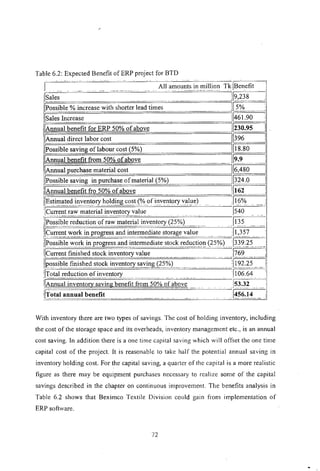
. J
I[Esti~ated inventory holding (;o~t(% of inv~n~~ryv.al~~) [ I(jo;"
..
'ICurrent raw material inventory value 1540 . ..
ilp~~~ibl~.~ed.u~;ion
.of raw ~at~;:;~l in;~ntory.(250;0)... .. .[135
![Currentwork in progress and intermediate storage value jl}52 ....
f .. .. .. .... ... . ... .. .... ... ..... . ...
i[Possible work in pr()gress andintermediatestoc~ re.du(;tic)fi
(25%) 133<).2~
....
!ICurrentfinished stock inventory value .1769 ...
,
.__._-- __ - I
i[p?~siblefinished stock invent?ry s.avifl~.(2~~) HUJ19~:.2.5.
I
!
.-----.-.-
!I-r:0tlll
reduction of inventory 1106.64.
ilAnnual inventory saving benefit f;om 50% .~i~bov.e .: .. .
153.32 .
.. . --- ..
ilTotal annual benefit ._----,- - _.__ . -_ .. .. _. .•[~.5~:l4....
---._- - --.- -
With inventory there are two types of savings. The cost of holding inventory, including
the cost of the storage space and its overheads, inventory management etc., is an annual
cost saving. In addition there is a one time capital saving which will offset the one time
capital cost of the project. It is reasonable to take half the potential annual saving in
inventory holding cost. For the capital saving, a quarter of the capital is a more realistic
figure as there may be equipment purchases necessary to realize some of the capital
savings described in the chapter on continuous improvement. The benefits analysis in
Table 6.2 shows that Beximco Textile Division could gain from implementation of
ERP software.
72
Unfortunately there is a cost associated with this benefit so it is now necessary to
estimate the cost of the project. First there will be hardware and software costs. There
will be a one time capital cost and an on-going annual cost for maintenance of the
software. There will also be an ongoing maintenance cost to install the upgrades along
with further customizing.
Table 6.3; ERP project (TIM) costs.
All amounts i; millio~ TkiiOne time
._--------
[ liOn going j
I I[ _~I :
]
IHardware 1[30 1[3 J
ISoftware 1115 1[0 1
I
1[5.6 JI.5 _ I
i[Customizing
IIDatacontrol II 'I
i
__.I _ _ ...•. ,
Ilnventory r~~ords 111.8 il1.0 ,
I[Education -
11
__
- ~--- II
'IExternal -- - ---
111.628 _. _. JO.IOS
illnternal --
119.6 -
.11;296
1---'" -
:[Direct!a~()r ._.__. --" .__ .•.... I I
:IFulltime project leader -_. - --
,10.72_ . .- .. - I
,_. - - _. --_._.- -
,[Fulltime project team (4) JI4 __ .. :1 _ ... . --
IIOutsideconsultanc; .__ ill_ :1:5
!IMiscellaneous JI?__ _
___
JI3
!1!ot~1Implementation cost ___
J20.548 _._ ..... i19:401 .. - ._..'
Many companies do not go any further than these costs to arrive at the cost of the
project. It would, indeed, be possible to change the current planning system for the new
planning system without any additional costs. Unfortunately, such implementations fail
to achieve any of the benefits itemized above. All of the benefits come ii'om the second
half of the investment.
All costs associated with getting the bill of material and inventory record accuracy
above the 98% that is vital to get meaningful data from the system. For inventory
records, the cost of cycle counting will be on-going but bills of material will generally
73
remain accurate, once the process for maintaining the bills of material has been
established, without any significant on-going cost.
An allowance should be made for external education and training in the initial phase.
As well as the initial cost of education and training, there will be an on-going cost of
training new recruits and for adjusting the process as the business changes.
Many companies start out with the intention of not having a full time project leader let
alone a full time project team. As a rule of thumb, a project team of three people is
necessary for companies with up to 300 employees. One more project team member is
needed for every 200 employees. Deciding who the team will be can be delayed until
later.
Table 6.4: Cost and Benefits Summary
il. . •. All-amounts are in millicmTkjl
I
[Total annual saving.. JI.
[On-going costs ... . il.
IINet annual benefit_ ... _ mil
i[Onetime cost .. __ _ . il
t.__
..
...
..... Net Profit :1
4s~.!~i
9.401i
• _.- j
456.141
- ---------_.,
90,55]
356.19!
From above figure it is obvious that ifBeximco can achieve the target of Table 6.2,
they can make a profit of Taka 356.19 million per annum.
Above calculations have been done on basis of Annual Report of 200 I all units of
Beximco Textile Division.
6.2 ACTUAL BENEFITS
Cost benefit analysis was done with figures of whole Beximco Textile Division. But in
fact TIM has been implemented partially in Beximco Textile, Beximco Knitting and
Beximco Denim Ltd. Since complete package has not been implemented in anyone
units of Beximco Textile Division, it is diftlcult to find out any benefits at this moment.
74
After implementing COPS, MASH, DISPO and K2DYE in Beximco Textile improve
on time delivery. Sales has been increased.
But the project is not complete yet. Implementation in other units has not been started.
Implementation of few module has been done only in Beximco Textile Limited. It is
difficult to asses the gain obtain by TIM as it was not implemented in one or two year.
First two modules were operational in the year 2000 in Beximco Textile Limited. Yet
from the business statistics of Beximco Textile we can summarize the gain as follows:
'" Increase in sales.
'" Reduction of manufacturing cost.
'" Reduction of raw material used.
'" Increase of machine efficiency.
'" Increase of profit.
Increase in Sales:
Sales in the year 2000
Sales in the year 200 I
Increase in Sales
Sales increase volume
Sales in the year 2000
Sales in the year 2001
Increase
=
2703 million Taka.
2991 million Taka.
288 million Taka.
24680000 meters
25228000 meters
548000 meters
75
Reduction of manufacturing cost
Manufacturing cost in the year 2000
Manufacturing cost in the year 200 I
Reduction of manufacturing cost
Reduction of raw material consumed
Raw material consumed in the year 2000
Raw material consumed in the year 2001
Reduction of raw material consumption
=
=
=
2319 million Taka.
2304 million Taka.
15 million Taka.
1859 million Taka.
1827 million Taka
32 miilion Taka.
The above figures were taken from annual report of Beximco Textile Limited. This
increase in sales, reduction of manufacturing cost and raw material consumed may not
be due to implementation of TIM alone.
76
CHAPTER 7
CRITICAL ANALYSIS
7.1 ANALYSIS OF ACQUISITION PROCESS OF TIM
It was found in the study that acquisition process of TIM did not follow standard
procedure of acquisition of ERP software. A lot of mistakes were made and a lot of
ideas of the implementers were proved wrong. These are presented below:
l' Top management of Beximco Textile Division formed a team with Manager
(Information Technology), Manager (Finance & Accounts), Senior Executive
(Information Technology) for acquisition process. In this study it was revealed
that none of them had good knowledge of Enterprise Resource Planning
software. Neither they had experience not they had training on it. Therefore the
team was likely to be unable to take correct decision. Any incorrect decision in
this stage may lead to failure. For example Rahimafoz, Banlgadesh
implemented an ERM software which did not fulfill their requirement. Later on
they change to another ERP software named IMAS. Failure of the first
software was certainly due to wrong selection of software.
l' The name Textile Integrated Manufacturing (TIM) made Bexim'co team
believed that this was the only ERP software suitable for textile and apparels
manufacturing. They did not questioned very minutely about the functionality
of TIM. They believed that it would support all business activities of Beximco
Textile Division. They did not study and compare TIM with other ERP
softwares. This idea is cel1ainly wrong. Because many other ERP softwares
support Textile and Apparel industries. For example, Bradgate Textiles
implemented EFACS, Graham Seagrave, use Movex by Intentia, Leisurewear
implemented BPCS, Whitley Willows implemented JBA etc.
77
~ Since Beximco personnel had no practical experience of ERP software, they
should have appointed a consultant. But Beximco did not appoint anyone as
consultant for acquisition process
~ During selection they visited industries those were using TIM. But they did not
visit to any textile or apparel industry that used other ERP software.
~ They checked the functionality of TIM modules in different industry industries.
But they failed to understand that the reports produce by TIM do not meet the
requirement of Beximco Textile Division. Even they failed to checked the
functionality of some modules like "Plant View", "VIP" which do not support
business practices of Beximco. If these modules do not support their
requirement, they should not buy these modules.
~ If top management of Beximco wanted to select the ERP software by
themselves without using a consultant, they should have attended at least a short
training program to have adequate about ERP software selection . Many
organizations such as MRP of England offer training program of I / 2 weeks for
executives. They should have clear understanding of what functionality they
needed and what questions they would ask, while they were looking for
software packages.
~ Top management visited different textile and apparels industries those are using
TIM. They had observed the functionality of it, but did not observed their
acquisition process. For example, Vardhaman Group is a US$ 320 million
textile manufacturing conglomerate of India. They implemented TIM. The
Group was using tools of information technology with full fledged IT
department headed by the Corporate General Manager and a team of qualified
computer professionals. On the initiative of Chairman the Group constituted a
task force for evolving an IT road map for the group. The task force concluded
that although the Group has reasonably good legacy system, yet integrated
package solution would. give the group long term competitive advantage. The
Chairman decided to scout for a good ERP solution. They had gone through a
rigorous selection process for selection of RP software. Following a thorough
survey of the ERP packages available in the market, Vardhaman decided to go
78
with IBM for its ERP implementation project. In selection phase, the force
evaluated alternative ERP solutions and decided in favor Textile Integrated
Manufacturing (TIM) software.
7.2 ANALYSIS OF IMPLEMENTATION OF TIM
Beximco Textile Division started implementation of TIM In 1997. Still today they
could not implement the whole software. After six years of acquisition, they could not
complete 50% of the task. In our study, we found the following observations in
implementation process.
,/ Normal practice of ERP software implementation is to take it as a separate
project. The project should have a full time project leader. Good qualifications,
wide credibility, determination and good knowledge of business are the
characteristics of project leader. If required, he should have trained on ERP
software implementation planning. But Beximco Textile did not take
implementation as project. Instead they took it as additional job to be done by
Information Technology department. It was one of the main reasons for delay in
implementation.
,/ Good implementation planning is essential. In the plan, job is subdivided into
smallest task and job responsibility and task should be defined to each people.
Beximco Textile did not have a well defined implementation plan. They had
planned that they would implement TIM module by module. When one module
would be completed, how it would be, who are responsible for the task, there
were no detai Is about it.
,/ Nonnally every organization uses a consultant for implementation. None of the
IT personnel of Beximco Textile Division had experience of implementation of
ERP software. No one had training of it. Still they did not appoint any
79
consultant for it. They should have used a consultant for the implementation
process as well as acquisition process .
.,/ Training if IT personnel: Fresh IT personnel were employed for implementation
of TIM. They were trained by datatex expert and other IT professionals at
factory premises for few days but training was insufficient to have a good
understanding of the implementation issues. None of them visited other
organizations who had implemented TIM.
.,/ Many organization hire implementation team. They are professional In
implementation of ERP software. Some of them had experience In
implementing TIM. They trained and skilled manpower. They could do it in
better way in much shorter time. Since Beximco Textile Division had no skilled
manpower for implementation, they should have appoint such organization .
.,/ Top management should have observed in the companies they visited, how they
had implemented TIM. They should have effective implementation planning
from them. For example, Vardhaman Group, a textile giant of India with
workforce over 20,000, had a strong information technology department headed
by a corporate General Manger and a team of qualified computer professionals.
Yet they decided to go with IBM for its ERP (TIM) implementation. IBM India
provided them business consultancy and ERP application implementation
consultancy services. IBM provided support for customizations of TIM
modules. The IBM's implementation methodology approach empowered their
team with implementation skills. They made a implementation record of seven
months to complete implementation of TIM in all its seven divisions .
.,/ Top management should have gIven more importance to implementation of
TIM. It seemed that top management was little bit reluctant about completion of
it.
80
,f Departure of IT Manager- Manager, Information Technology who was
leading the implementation process left the company before completing 40% of
the task. For some time there was nobody in that post. After more than one year
of his departure, a new General Manager was appointed. This absence and
change ofIT head causes more delay in implementation.
,f High turn over of IT personnel - Beximco Textile started implementation of
.TIM with Ii team of twelve IT professionals. At present only three out those
twelve are working in Beximco. Though new IT personnel have been
appointed, yet departure of trained people delayed implementation. Beximco
should have taken measure to reduce tum of trained people.
,f Wrong selection of implementing personnel- It is very common idea that
since ERP is a computer software planning process, so IT personnel should
implement it. But in fact, ERP software cannot make any improvement in the
business unless right scheduling, lot size, and other production and quality
control theories are applied. Therefore, personnel of production management
should be involved in implementing process along with IT personnel. Same
mistake has been done by BTD. They did not involve any people of production
enginner.
7.3 Financial Analysis
From above analysis it is evident that Beximco Textile Division incurred huge
opportunity losses due to incompletion of ERP project. They have invested about 90
million taka before 1998 but did not get any return until the year 2000. Since Beximco
Textile is not larger in size than Vardhaman Group of India, it could implement TIM in
six to twelve months. Still today the benefits they are getting, is negligible compare to
the investment because they have implemented only few modules in BTL, BDL and
13KL.They will get the return from the investment only when they will implement TIM
in whole Textile Division.
81
CHAPTER 8
DISCUSSION
8.1 DISCUSSION
Enterprise Resources Planning (ERP) has brought a new revolution to the traditional
business practices. The benefits reaped from successful deployment of ERP solution
are manifold. Needless to say, it automates and standardizes the entire business
processes and workflows of a company. Multitude, fragmented business applications in
the manufacturing, finance, distribution, logistics and human resources field could now
be integrated to share a common set of data in a central database. ERP also binds
together applications using different computer architecture through a common platform
with comprehensive functionality.
Not only does it help companies standardize the quality of the products delivered to the
customers, it also optimizes the operational resources and capacities of the companies,
resulting in better productivities. Companies could also leverages on the opportunity
derived from ERP system implementation to conduct a complete overhaul of the legacy
systems within the company.
With the help of ERP, companies could boost the level of customer satisfaction it
delivered, including prompt and accurate feedback to customers, better customer order
processing and quality pre-sales and after-sales service.
But the prerequisites to get these benefits from ERP software are; proper selection of
the software, proper implementation of it, and maintenance of the software. No doubt
about the success of ERP software, but failure of it to improve business performance
overshadowed it success. For example, Rahimafroz, Bangladesh, changes to [MAS
package from ERM, Rectella implemented Movex over GEAC. Many entrepreneurs
think its installation like other computer software. Many companies just installed the
software in a few weeks which contributes to the fact that only about 35% of ERP
implementations succeed in achieving objectives of ERP software. Some general
causes of ERP software failures discussed below.
82
8.2 CAUSES OF ERP FAILURE vis-a-vis BTD
The ERP software packages are being used for more than 20 years. In last twenty years
a lot of ERP software have been developed. Huge amount of implementations had
taken place. In these implementations failure and success remained side by side. The
main reasons for ERP failures:
:.- Top management of the company play the vital role in ERP project. Most of
them do not have good knowledge about selection, functionality,
implementation and objectives of ERP software. They think it similar to other
computer software. Seldom top management get training on ERP software
systems. Top management of BTD did not have good knowledge about ERP
software.
:.- In theory, ERP should have overcome the old MRP problems. Unfortunately it
seems that the majority of software implementers did not understand master
scheduling very well so encouraged companies to implement ERP packages in
the old, flawed MRP way i.e. without proper master scheduling and capacity
planning. BTD did not have MRP in place before the ERP software. Master
scheduling and capacity planning in BTD were not very strong prior to ERP
procurement.
:.- Inaccurate data - experience has shown that at least 98% of inventory records
and bills of material must be correct to make the system usable to control the
business. Other information must be similarly accurate. Accurate data some
time not available.
~ Software packages did not meet the needs of the business - packages were.
becoming so "feature rich" (i.e. complex) that people running the company did
not understand them. Professional implementers who did not truly understand
the business were therefore left to decide how the packages will be "mapped" to
the business. This often meant automating the current methods giving rise to
83
the phrase "digitizing the dinosaur", resulting in a lot of cost but no business
benefits. At the other end of the spectrum, there are some cheap packages that
miss some essential business requirements, e.g. lot tracking in the aerospace
industry or multi currency. Trying to modify the package leads to higher costs
and extended implementation times which repeat at each upgrade. One cannot
successfully purchase and implement a planning system unless the business
managers understand the planning principles by attending suitable education
courses at the outset.
~ Some people felt excluded - ERP offered the promise of helping everyone but
frequently degenerated into a software implementation exercise dominated by
IT. Anyone who felt left out would, intentionally or otherwise, undermine the
success of the project. A few general managers were not involved in the project.
They did not cooperate spontaneously with implementation.
~ The longer term financial objectives of the company were not addressed -
companies are judged by their financial success. If a planning system cannot be
seen to connect to the financial needs of the business, there will be two,
frequently competing agendas. Manufacturing, for instance, could be asked to
hit monthly financial targets whilst also being expected to meet the customer
requirements passed down through the planning process. In this environment it
is often the financial objectives that dominate so undermining the validity of the
plan.
~ Departure of the sponsor - the average tenure of a Managing Director appears
to be about 4 years. A lot implementations last more than 24 months on
average, there is a high risk of a change of management during the
implementation, seriously disrupting the implementation. IT manager of BTD
left the company before completion of implementation.
~ Insufficient education - time and again people who have implemented ERP
systems, even those that were successful, say they did not have a sufficient level
84
of understanding of either the software or the new business operating processes
and procedures needed to work in an integrated environment. IT professionals
of BTD had no past experience on ERP project and they got a very little
training on it. This was not sufficient to improve their knowledge.
J- Ineffective use of cousultants - most people will only implement planning
systems once or twice in their careers. Many companies try to implement
systems without the help of people who have proven experience in
implementing such systems. It is possible to get such help without losing
"ownership" of the project. Beximco Textile did not use any consultant for the
project.
8.3 LESSON
ERP software system is a vast subject. Good knowledge about it cannot be achieved
without training by ERP software experts. From the study of TIM implementation in
Beximco Textile Division and the study of relevant papers we learnt that entrepreneurs
and top management of many organizations either overestimate their knowledge about
ERP software or underestimate the complexity of ERP packages. Actually most of
them do not have good knowledge about benefits, functionality and implementation
complexity of the software. We have learned the following from the study:
• ERP software acquisition and implementation should be taken as a separate
project headed by a full time project manager.
• Consultant should be used in selection and implementation of ERP software.
• Entrepreneurs and top management should have training on basic knowledge on
functionality, implementation issues, and benefits of ERP software.
• Risk if big bang approach is very high. A little mistake in implementation Cail
do a lot of damage to the company. Therefore, ERP project should be
implemented in phased approach.
85
• Departure of Project leader and turn over of IP professionals engaged in
implementation is one of the main causes of delay. Therefore implementation
time should be shorter and there should be enough motivation to reduce turn
over.
• Some companies buy one or two modules of the package and do not think of
rest of the modules. Some times it happened that those one or two modules fit
their business but when they go to implement later on the rest of the modules,
the functionality of these modules do not match their business. Then they
changed the whole software which is very costly.
• For effective and quick implementation the following things are required:
o Total top level commitment and involvement.
o Strong internal IT team.
o Effective training on ERP package.
o Good support from vendor
o Selection of strong core team for implementation.
o Risk taking approach.
o Least customization.
8.4 FUTURE SCOPE OF STUDY
At present hundreds of ERP softwares are available in the market. For an organization
that wants to implement an ERP software, it will be difficult to select from these
hundreds of available packages to meet their criteria. In most cases comparison in
numeric figures become almost impossible. Use of multi criteria approach can be
studied for selection of ERP software.
At present some other organizations of Bangladesh are implementing ERP software.
Studying these cases, a guideline can be generated for Bangladeshi organizations for
ERP software implementation.
86
8.5 CONCLUSIONS
Enterprise Resonrces Planning (ERP) has brought a new revolution to the traditional
business practices. The benefits reaped from successful deployment of ERP solution
are manifold. Needless to say, it automates and standardizes the entire business
processes and workflows of a company. With the help of ERP, companies could boost
the level of customer satisfaction it delivered, including prompt and accurate feedback'
to customers, better customer order processing and quality pre-sales and after-sales
service. ERP softwares are costly. Proper selection, implementation and maintenance
of it will increase profits, on the other hand wrong implementation will incur huge
losses.
In this information age, flow of information is becoming faster everyday. Information
of demand or supply in one region of the world flows to the other corner within a
second. Therefore competition is becoming harder day by day. After globalization, this
competition will increase tremendously. To compete successfully in such environment
every company will have to use this tool (ERP) to reduce cost and improve
responsiveness to the customer. Asian countries are lagging behind US and Europe in
use of ERP software. Bangladesh is lagging far behind them. Even in India a lot of
organizations implemented ERP software. Participation of Bangladeshi organizations
in the world market is not significant. To improve participation Bangladeshi
organizations have to think about two things, first they have to implement ERP
software and second, they must be careful about selection and implementation of it.
This study revealed that Bangladeshi organizations such as BTD made a lot of mistakes
in implementing ERP software. Beximco Textile should involve industrial production
engineer to optimize production and quality in the ERP planning system. That is why
still today they could not harvest the total benefit of the software TIM.
Bangladeshi entrepreneurs those who will buy and implement ERP software should be
careful of the lessons we derived from this study.
87
REFERENCES
[1] WTO, World Trade Statistics - 2001, WTO, (web site- www.wto.org)
[2]Datatex, Manual of "Textile Integrated Manufacturing" , Datatex 2000.
[3] Phil Robinson, "Business Excellence (The Integrated Solution to Planning and
Control)", Second Edition, BPIC, UK, February 1998.
[4] Beximco Textile Limited, "Annual Report of200l, 2002.
[5] SAP, Annual Report 2001,2002
[6] Beximco Knitting Limited, "Annual Report of 200 1", 2002
(7] Beximco Denim Limited, "Annual Report of 200 1", 2002
[8] Beximco Fashions Limited, "Annual Report of200l", 2002
[9] Beximco Apparels Limited, "Annual Report of200l, 2002
[10] Padma Textile Mills Limited, "Annual Report of2001, 2002
(II] Personal Communication with Mr. Phil Robinson, Author of the book "Business
Excellence"
[12] Personal Communication with Mr. Anis, Manager (Marketing), Rahimafroz,
Bangladesh
[13] Datatex, "Annual Report of Datatex-200 1" 2002.
[14] Web site- www._bpic.co.uk
[15] Web site - www.amrresearch.com
[16] Web site - www.cio.com
[17] Web site - www.knowledgestorrn.com
[18] Web site - www.datatex-tim.com
[19] Web site - www.sap.com
[20] Web site - www.evolution.com
88
APPENDIX A
LIST OF SOME ERP SOFTWARE WITH SHORT DESCRIPTION
Hundreds of ERP softwares are now available in the market. Some of these are full
featured ERP for general use, some for service organizations, while some serve some
of business functions. Name of some ERP software, their manufacturer, and short
description of functionality are given below:
MANAGE 2000@ (Enterprise Resource Planning) by ROI Systems, Inc.
MANAGE 2000 is an extended Enterprise Resource Planning (ERP) manufacturing
software solution. It is an Internet-based ERP suite supporting today's manufacturing
value chain with applications for supply chain management, supplier relationship
management, customer relationship management, manufacturing, finance, human
resources and e-business.
Logix™ by Enterprise Logix, LLC
Logix™ is an Enterprise class solution for small to mid-market Manufacturers,
Distributors, and Service Providers, including: ERP CRM Supply Chain Business
Intelligence Finance Logix is a complete system built for a modem, SQL Server
platform at a low, fiat-rate price, without complicated "per seat" licensing
requirements.
CMiC's mPOWER Software -- ERP for Project Based Businesses by CMiC
CMiC's mPOWER Software is a robust, flexible, and scalable ERP solution that
embodies CMiC's 28-year track record in developing enterprise project and financial
accounting management solutions for project based businesses such as Construction,
Engingeering and Professional Services.
A-I
TRAX-ERP for the Distribution Industry by Sentai Software
Designed with Distributor's needs in mind, TRAX is one of the most robust and
flexible suites of inventory management and financial accounting solutions available.
Built to maximize. efficiency and flexibility on a task-by-task basis, TRAX deals with
all the complexities of your business, from automated replenishment to EDI and
proactive marketing.
Made2Manage by Made2Manage Systems, Inc.
The Made2Manage Enterprise Business System is a fully integrated software offering
which includes: Enterprise Resource Planning, Supply Chain Management, Customer
Relationship Management, Enterprise Portals, Business Intelligence and User Services.
CyberShift Server Workplace Management System by Cybershift, Inc.
CyberShift Server Workplace Management System is the best, fully integrated,
Intemet-enabled time and attendance system--without exception.
Cypo DC-400 Suite by Cyposoft Corporation
The Cypo DC-400 suite combines a Windows-based AS/400 screen mapping tool with
the power of the Cypo NetServer. You can quickly and easily map existing AS/400
transactions to any data collection terminal including JD Edward World, MAPICS,
BPCS, CMS, PRMS, KBM system.
Interwave Coordinator™ by Interwave Technology, Inc.
Interwave Coordinator™provides an affordable solution that works independently or
in concert with other leading Collaborative Manufacturing .Execution software
applications.
A-2
Enterprise Global Planning System by Adexa, Inc.
The Adexa Enterprise Global Planning System delivers a robust enterprise business
planning solution that encompasses supply chain planning, event management,
enterprise performance management, and intelligent collaboration that helps you
maximize asset utilization within and beyond the walls of your company.
VISUAL ManufacturingbyLilIy Software Associates,Inc.
We offer a complete line of integrated end-to-end products that includes Enterprise
Resource Planning (ERP), Advanced Planning and Scheduling (APS), Manufacturing
Execution Systems, Quality Management System, and Warehouse Management System
capabilities.
ILOG OPL Studio by ILOG, INC.
ILOG OPL Studio is a compr~hensive optimization modeling environment that enables
the rapid development and deployment of ILOG CPLEX and other ILOG optimization
engines, to create applications for rapid decision-making in managing resources and
processes.
Intuitive ERP by Intuitive Manufacturing Systems, Inc.
Intuitive Manufacturing Systems' enterprise software solution includes a solid ERP
software backbone along with intuitive CRM, decision support and e-business modules
and a powerful technology infrastructure -- all the tools you need to enhance the
productivity and profitability of your operations.
A-3
eRequester by Paperless Business Systems
eRequester is an elegant e-procurement application that streamlines business processes
throughout your supply chain. With eRequester, managing procurement has never been
easier. eRequester is a complete procurement solution that enables ultimate control of
the entire purchasing process, delivering rapid and quantifiable ROJ.
Microsoft Business Soluti()ns Supply Chain Management-Axapta by Microsoft
Business Solutions.
Microsoft Business Solutions Supply Chain Management-Axaptaempowers you to
maximize your partner and vendor relationships to generate sustainable company
growth and profitability
Microsoft Business Solutions Manufacturing-Great Plains by Microsoft Business
Solutions
Microsoft@ Business Solutions Manufacturing-Great Plains@ offers powerful, cost-
effective resource planning and management tools that enable you to collaborate with
trading partners, manage the entire financial life-cycle of the manufacturing business
process and build a sustainable advantage in your industry.
Microsoft Business Solutions Financial Management-Great Plains by Microsoft
Business Solutions
Microsoft@ Business Solutions Financial Management-Great Plains@ gives you the
integrated tools you need to master your financial data and processes, taking full
advantage of the information your financial system contains.
A-4
Microsoft Business Solutions Manufacturing-Axapta by Microsoft Business
Solutions
With Microsoft Business Solutions Manufacturing-Axapta, manufacturers are able to
manage the entire production process from availability of raw materials to the shipment
of finished goods to customers.
Microsoft Business. Solutions .. ManufacturingcNavisionby Microsoft Business
Solutions
Supply Chain Management-Navision delivers increased customer loyalty through
better responsiveness and improved partner collaboration.
Microsoft Business Solutions Financial Management-Navision by Microsoft
Business Solutions
Microsoft Business Solutions Financial Management-Navision offers you a business
solution that helps you identifY and respond quickly to new revenue opportunities.
Microsoft Business Solutions Manufacturing-Solomon by Microsoft Business
Solutions
Microsoft@ Business Solutions Manufacturing-Solomon@ is ideal for distributors with
some manufacturing, advanced kitting and/or production requirements. Covering
discrete, make to order, make to stock, and job shops, Manufactming is designed to
leverage integration across the entire business management solution.
Small/Medium Enterprise Hosted ERP Suite for Manufacturing by ERP
Technologies, Inc.
Hosted Small/Medium Enterprise ERP Suite is the ideal ERP solution to help
streamline any business. You have an integrated ERP system to manage your entire
A-5
access to latest up-to-the-minute business information, for complete multi-user, multi-
location flexibility.
Hosted Small/Medium Enterprise ERP Suite for General Business by ERP
Technologies, Inc.
Hosted Enterprise ERP Suite is the ideal ERP solution to help streamline any business.
You have an integrated ERP system to manage your entire business. It is Internet based
and Hosted forSmalJiMedium Businesses. You always have access to your latest up-
. .
to-the-minute business inforination, forconiplete multi;user,niulti-Iocation flexibility.
The Net Collection by Network Systems International, Inc.
Network Systems International, Inc. presents the net collection, an enterprise-wide
suite of software products developed specifically for complex process manufacturers
and distribution centers in the textile and apparel industry.
CLC-MRP Manufacturing Management System by Command Line Corp.
CLC-MRP is a complete manufacturing system with purchased items and
subassemblies inventory control, purchasing, recelvmg and manufacturing
management. MRP/ERP options: sales quotations, finished products control,
engineering change notices, routers and standard manufacturing procedures, work
orders, job costing, bar coding and lot traceability.
eCity Make - Manufacturing Execntion (MES) by SLINGSHOT
Slingshot's eBusiness Supply Chain suite includes the eCity-Make Manufacturing
Execution (MES) module. eCity-Make controls the assembly of components into
finished items. Work orders can be opened to satisfy an immediate requirement or as
part of the supply plan managed automatically by eCity-Plan.
A-6
HarrisData Manufacturing by HarrisData
HarrisData Manufacturing uniquely combines ERP and MES functionality in a
comprehensive software package for mid-sized manufacturers. Integrated customer and
supplier self-service functions bring business and e-business together.
Macola ES by Exact Software North America
Exact Software's Macola ES is the latest and most revolutionary version of its robust
ERP solution. With Macola ES, Exact has gone beyond traditional ERP solutions by
embedding the application with a rich set of business process management capabilities,
thus allowing organizations to fully integrate front- and back-office processes.
abas Business Software - Integrated ERP by ABAS-USA
abas is an award-winning ERP/supply chain package designed, developed, and priced
for the mid market used by nearly 1500 firms. It is intuitive, easy to use, and implement
and is flexible enough to fit most businesses. The package has a manufacturing and
distribution configuration, ensuring high fit with robust function. Rated highest value
Custom Manufacturing Software Solutions by Tallan
Our extensive project experience includes data warehousing, data marts, web systems,
and enterprise information managing, reporting and monitoring systems. Since 1985
we've helped manufacturers like EMC, The Shaw Group, Mead Johnson, Perkin Elmer
and Schick take advantage of the best technologies available and put more money on
the bottom-line.
A-7
Infimacs II@ - Comprehensive ERP by Relevant Business Systems, Inc.
INFlMACS II is a comprehensive Enterprise Resource Planning (ERP) system
designed not only to accommodate current requirements, but also to expand and grow
as you grow. INFIMACS II allows for the management of Inventory Control,
Purchasing, Sales Order Management, Shop Floor Control, and Manufacturing Cost
.' : ' '
Control, all by project andlorcustomer:'.
Oracle Application Hosting by Agilera
Agilera provides application management and managed services [hosting] for Oracle
and understands how to leverage its technology and functional capabilities. Agilera
excels at providing a range of services around Oracle including implementation,
integration, project management, training and help desk.
J.D. Edwards Application Hosting by Agilera
Agilera provides application management and managed services [hosting] for J.D.
Edwards and understands how to leverage its technology and functional capabilities.
Agilera excels at providing a range of services around J.D. Edwards including
implementation, integration, project management, training and help desk.
Plexus Online by Plexus Systems
Plexus Online includes all the modules required by a manufacturing company, from
quote tracking to job costing, inventory to accounting, and everything in between.
Some customers subscribe to small, specialized applications. Others use it to run their
whole company. It works equally well in small companies and large.
A-8
AccountMate 6.0 for SQL-Business Management for Meduim Sized
Companies by Softline Software
AccountMate is a real-time, customizable, scalable and affordable business
management and accounting solution designed to address the needs of medium-sized
businesses. With the ability to accommodate hundreds of users and no built in size
limitation of your database, AccountMate makes every aspect of your business easier to
manage.
WinMAGI - Manufacturing Solutions by Manufacturing Action Group, Inc.
(MAGI)
WinMAGI is a world class manufacturing MRPII - ERP system for small to mid-sized
manufacturers. It blends solid accounting and manufacturing practices in an easy to use
and implement package.
ERP - WinMAGI by Manufacturing Action Group, Inc. (MAGI)
WinMAGI is a world class manufacturing ERP. system for small to mid-sized
manufacturers. It blends solid accounting and manufacturing practices in an easy to use
and implement package.
PENTAGON 2000SQL Enterprise Systems by Pentagon 2000
PENTAGON 2000 Software, Inc. is a global leader in the development and marketing
of fully integrated aerospace, defense and electronics industry ERP software products.
Fourth Shift (ERP for Midrange Manufacturing) by Softbrands Manufacturing
A set of integrated applications that tie together and streamline' business processes
across your accounting, engineering, manufacturing, order entry, purchasing and
<:::1,inn;no-
nnpr~ti()nJ;:: Thi..: hPJn..: Vroll to '.Pilll(,P rn,pr~l1 lnvpntnr" 11":"1"1<::: U.fhilp imnrn"ino
A-9
cash collection and on-time order shipments.
J.D. Edwards Financial Management by JO Edwards
Having the right financial foundation for your organization is key when you need to
account for every penny that comes in or goes out, in every currency, and in every
country.
J~D.
Edwards Manufacturing Management by JD Edwards
. .. . . : .
. ,. .' .
Using our solution, you can interchange manufacturing modes on demand to meet
changing production requireriJ.ents~Because each mode existS within an enterprise-wide
system where all manufacturing processes share common iriventory, material, planning,
purchasing, and financials, you can depend upon the utmost efficiency and accuracy
across every mode.
SyteLine 7 (ERP) by Frontstep, Inc.
SyteLine 7 is the newest version of Frontstep's extended ERP solution that for more
than 20 years has helped discrete, to-order manufacturers integrate customer service
and order management, manufacturing planning and production, inventory and supplier
management, and financial controls.
Vantage by Epicor Software Corporation
Vantage by Epicor is an integrated solution for engineered-to-order and job shop
manufacturers. Vantage provides powerful tools for quoting, visual scheduling, job
tracking, and cost and shop floor data collection.
NetSuite by NetLedger Inc.
NetSuite is the first online business software solution to automate both front and back
A-1O
use of Oracle Small Business Suite, and adds the advanced accounting, ERP, CRM,
and customization functionality of traditional mid-market software solutions.
Oracle Small Business Suite by NetLedger Inc.
Ideal for smaller companies, Oracle Small Business Suite unites your front and back
office to give you aconplete picture of your business. In one application, the Suite
provides award winning accounting, payroll, time imd billing, sales force automation,
, ,'"
customer support managlJll1ent,:Webpresenc~and more.
ALCIE Manufacturing Suite by ALCIE Integrated Solutions Inc. (A.I.S.)
ALCIE Manufacturing Suite is designed to fulfill the requirements of a discrete
manufacturing facility with multiple products or jobs running concurrently. It allows
for the costing and estimation or jobs, shop floor control, production planning, and
management of resources.
BaanERP Manufacturing by Baan
Baan's unrivalled BaanERP delivers a comprehensive solution for a wide range of
production typologies and in addition, its extensive planning and scheduling
capabilities translate your company's business goals into manufacturing plans.
BaanERP Project by Baan
BaanERP Project provides benefits to organizations that deal with the management of
large projects and contracts, in the field of engineering, construction or hybrid
manufacturing.
BaanERP by Baan
BaanERP consists of a number of interdependent components used to meet your
hll~inp.I.::'" npp,-h:: ThP flp:ythl1ihr u.,tthin R~~nPRP ~11
•.•
u.,c (,lldnmPTC to rn~Ylm17P thp
A-II
benefits of both best in class solutions and a fully integrated, high-performance system.
BaanERP Tools by Baan
The BaanERP Tools can be described as a computing platform that provides an
independent, flexible, open and distributed computing and development environment.
e by Epicor by Epicor Software <:;orporation
Epicor's comprehensive suite of proven, web-enabled solutions, meets the needs of
customers, suppliers, partners andemployees- ..•you must enable your company to
exploit these relationships most effectively ..•
Enterprise Resource Planning (ERP) Solutions by CSB Systems
CSB Systems integrates the best software with superior technologies, professional
services and support structures to create Enterprise Resource Planning Solutions that
are as unique as our client's needs.
SYSPRO Enterprise Resource Planning - ERP by SYSPRO
SYSPRO 6.0 has built-in core functionality for an integrated, end-to-end supply chain
solution, including ERP, CRM, APS, E-Commerce and Warehouse Management.
IFS Manufacturing™ by IFS, Industrial & Financial Systems AB
IFS Manufacturing offers a total overview of a product's life cycle. The system
supports the entire manufacturing process, from design and development to
warehousing, deliveries, and after sales service.
IFS Applications 2002 by IFS, Industrial & Financial Systems AB
A-12
IFS Applications offers 60+ enterprise application components used in manufacturing,
supply chain management, customer relationship management, financials, engineering,
maintenance and human resource administration.
E-Business Suite by Oracle Corporation
Oracle E-Business Suite is a complete set of business applications that enables you to
efficiently manage customer interactions, manufacture products, ship orders, collect
payments and more - all from a business system that shares a single technology
foundation.
Endura iDistribute™ by Gillani, Inc.
A complete end-to-end Supply Chain Management solution with a unique combination
of planning, execution, collaboration and monitoring capabilities. Delivered via the
web, the system provides advanced Order Management capabilities, integrated with a
comprehensive Warehouse and Branch Inventory Management, Replenishment and
Accounting system.
MC/EMpower by MainControl, Inc.
MC/EMpower is MainControl's traditional product offering, which features an
integrated software suite that manages the entire life cycle of e-infrastructure assets -
from planning to procurement, deployment, maintenance and finally, retirement.
e-intelliprise™ by American Software, Inc.
lntemet-ready lntelliprise, the comerstone of our enterprise products, offers an
advanced, out-of-the-box business intelligence solution with fully integrated e-business
capabilities - and ready-to-use alerts!
A-13
MicroStation ERPScope/S by Bentley Systems, Inc.
This product, that uses the same certified technology as MicroStation ERPIntegrator/S,
provides SAP? users with direct access to MicroStation design data for viewing and
redlining.
MicroStation ERPIntegrator/SbyBentleySystems, Inc.
MicroStation ERPIntegratcir/S is a MicroStation application that enables engineering
users to create, search for, edit and retrieve SAP? enterprise business data.
EMS-Framework by Datasul Inc.
EMS-Framework is an enterprise-wide Manufacturing, Distribution, and Financial
management information system.
InterPlex SQL by McConnell & Associates, Inc.
InterPlex SQL is a Unisys mainframe software product that supplies an important
component in Enterprise Resource Planning (ERP) of any corporation or agency.
Flow Manufacturing by American Software, Inc.
American Software's Flow Manufacturing? product represents the industry's first
dedicated solution designed expressly for companies who view manufacturing as a
strategic weapon.
Hyperion Application Link by Hyperion Solutions Corporation
Hyperion Application Link dramatically reduces the time and expense to integrate
enterprise resource planning (ERP) systems, transaction-processing applications, and
other sources with packaged analytic applications.
A-14
Hyperion Activity Based Management by Hyperion Solutions Corporation
Hyperion Activity Based Management is a leading activity-based management solution
for optimizing the deployment of enterprise resources.
Movex Enterprise Resource Planning by Intentia International America's Group
Movex Enterprise Resource Planning (ERP) contai~s a number: of powerful tools for
managing your elteipnse resources such.as human skills and resources, machinery and
equipment, and financial status.
A-IS
APPENDIX B
A lot of textile terms are used in practice. Here is definition of some textile terms used in
this report.
Mic. : Abbreviation of Micronaire which expresses fibre fineness .It is the weight of 1
inch fibre in microgram. For cotton, mic ranges from 3 to 5.
Staple Length: A term used in cotton trading. It is the normal average length of cotton
fibre in a sample which is usually classed by Cotton Classer by their
personal judgment. Staple length of fiber normally ranges from 18 mm to 50 mm
for cotton and from 30 to 60 mm for polyester.
Count : It is a term which expresses yam fineness or coarseness. It can be measured
either by weight of yam per unit length, which is called direct method , or by
length per unit weight, which is called indirect method . It is Expressed in
English count Ne or in metric count Nm.
Ne: It is the Number ( Count) of yam in English System. It is indirect method.
It is the number of hanks (l hank = 840 yards) per pound of yam. For 30
Ne, length of 1 pound yam would be = 25200 (30x840) yards. The higher the
count the finer the thickness of yam.
Nm: It is the Number ( Count) of yam in Metric System. It is indirect method.
It is the number of Kilometer per Kg of yam. For 30Nm yam, length
of IKg yam would be = 30 Kilometer.
I Ne= 0.59 Nm.
Denier: It is the fineness or coarseness of yam or filament In direct method.
It is the weight in gm per 9000 metres of yam .
Color Grade : It is the grading of cotton fibre on the basis of its light reflection
and degree of yellowness. Higher reflection and lower yellowness
means better Color Grade.
g- 1
Neps: It IS entanglement of
entangle with each other or
fibres . Some dead fibres or immature
with any other substance and foml Neps .
fibers
Maturity Ratio: It is the measure of Degree of cell-wall thickening of cotton.
In simple way , it may be expressed as the ratio of cross-
sectional area of cell wall of fiber divided by the cross-sectional
area of cotton fiber.
Sliver : It is an intermediate product in cotton spinning process. It IS a rope-like
substance made of individualized and parallel cotton fibers .
Roving : It is an intermediate product pnor to final cotton splnnmg process.
It IS a thin rope-like substance made of individualized and partially
twisted cotton fibres. Sliver is drafted and attenuated to form Roving.
Sizing: It is a process in Textile manufacturing. In this process starch is added with yam
to reduce friction and increase strength.
Mercerizing: In this process yam / fabric is treated with 18% sodium hydroxide solution.
It reshapes fiber and increase surface reflection. Thus it increase luster.
B-2
APPENDIX C
Following is an example of customization of input screen. The following screen was
customized for MASH module for Beximo Knitting Limited.
1st Screen.
WRHS. ENTRY DISPO EXT/PROCESS SD Fin. Knit 3
PA
-----------------------------------------------------------
1) Insert
5) Search Dispos by type
6) Search Dispos by supplier
7) Search orders by supplier
8) Search suppliers by name
Option , II
Dispo type , 1-"
Dispo No :
Batch No :
Reprocess No : 0
Order No :
Supplier code :
Name :
----------------------------------------------------------
YP5201 /
CM06-Flow CM08-Decodify CMI1-Return
Copyright DATATEX A.G. BAAR ** Licensed to: BEXIMCO TEXTIL~S LIMITED
WRHS.ENTRY DISPO EXT/PROCESS SD Fin. Knit 3 ISRT YP5201/P1
----------------------------------------------------------
Movement date
Transact. type Entry fr PO
-------------------------------------------------------------------
CMOB-Decodify CMII-Return
2nd
Screen:
COl
3'd Screen
WRHS. ENTRY DISPO EXT/PROCESS SD Fin. Knit 3 SRCH YP5201/S1
Dispo Type
Dispo No
o
30 Body-(O) -DF
1K3002 Batch No 01 Reprocess No
Option Ln Fab Qlty Sz/GSM Yrn/Fn Color
Remain
I 1 SJOICCOI 8Dl150 301NOO BK5001
400.00
Wh UM Qty Ord.
KF KG 400.00
l-SLCT
Return
4th Screen
CM06-Additional data CM07-Settled+ann. CMll-
WRHS. ENTRY DISPO EXT/PROCESS SO Fin. Knit 3 ISRT YP5201/P3
Dispo No
Batch No
Fab Q1ty Sz/GSM
SJOICCOI 801150
1K3002
01
Yrn/Fn Color
301NOO BKSOOI
Line No 1
Repr.No 00
Article deser.
115 FGSM
UM
KG
Movem. trans type
11 Entry fr PO
Warehouse KF
UM mav. KG
Qty. in UM mav.
Qty in KG
Balanc(S)
•••
100.00
RFD W/H
kgs.
Ord.
Recv
400.00 Rem.
.00
400.00
CM07-Temparary may. CM02-Stack CMOS-Lots CM08-Decodify CMII-Return
C-2
•
f
5th
Screen
WRHS. ENTRY DISPO EXT/PROCESS SD Fin. Knit 3 SRCH YP5201/P4
------------------------------------------------------------------------------
Dispo No
Batch No
Fab Qlty Sz/GSM
SJ01CC01 801150
lK3002
01
Yrn/Fn
301NOO
Color
BK5001
Line No
Repr.No
1
00
Article deser.
115 FGSM
UM
KG
Movem.trans type
11 Entry fr PO
- --- -- - -- - - --- - - --- ---- --- --- -- - - - - -- -- - - -- - -- -- - - -- - -- - -- - - -- - -- - -- - -- -- - - - --
Warehouse KF
UM mov. KG
Qty. in liM mov.
Qty in KG
Balanc(S)
100.00
100.00
RFO W/H
kgs.
Ord.
Recv
400.00 Rem.
.00
400_00
Lot Qty in KG
.00
.00
Comment
- - -- -- --- -- - --- - -- - - - - - - - - --- - - - -- -- - -- -- -- - - - --- -- - -- - - - - - - - - - - - - - - - - - - - - ---
6th
Screen:
CM07 - Temporary mov. eMIl-Return
WRHS. ENTRY DISPO EXT/PROCESS SD Fin. Knit 3 SRCH YPS201/PS
Warehouse KF RFO W/H
Transaction 11 Entry fr PO Date 24/01/03
Fab Qlty Sz/GSM Yrn/Fn Color UM mov. Qty in KG UM hndl Qty in KG
SJ01CCOl 801150 30lNOO BK5001 KG 100.00 KG 100. 00
Line Bundle # UM elm NO.el Qty in KG Cause Qual. Location
optn:1 Line 0 Lot: 20001 (1=Isrt/2=Updt/3=Dlac/9=Upd.cont.blnc.)
Sequ N .00 of
CMOl-Enter CM04-Add.data CM06-Dup. OFF CM07-TempMov eMIl-Return
C-3
100.00
7th
Screen
WRHS. ENTRY DISPO EXT/PROCESS SD Fin. Knit 3 SRCH YP5201/P5
------------------------------------------------------------------------------
Warehouse KF RFD WfH
Transaction 11 Entry fr PO Date 24/01/03
Fab Qlty SzjGSM Yrn/Fn Color UMmov. Qty in KG liM hndl Qty in KG
SJ01CC01 801150 301NOO BK5001 KG 100.00 KG 100.00
Line Bundle # liM elm No. el Qty in KG Cause Qual. Location
Optn." 1 Line 0 Lot 20002
Bundle# UM elm No.el
_RL 1
(l=IBrt/2=Updt/3=01ac/9=Upd.cont.blnc.)
Qty in KG Cause Qual e Location
• m
Clr. Wt.
.00
Comment
Dispo
lI'IliIII
Sequ N .00 of 100.00
sth Screen
WRHS. ENTRY DISPO EXT/PROCESS SD Fin. Knit 3 SRCH
YPS201/ PS
Warehouse KF RFD W/H
Transaction 11 Entry fr PO
Fab Qlty SzlGSM YrnlFn Color
KG
SJOICC01 8D1150 30lNOO BK5001
Line Bundle # UM elm No.el
Date 24/01/03
UM mov. Qty in KG UM hndl Qty In
KG 100.00 KG 100.00
Qty in KG Cause Qual. Location
Optn. 1 Line 0 Lot 20002 (1=Isrt/2=Updt/3=Dlac/9=Upd.cont.blnc.)
Bundle # UM elm No.el Qty in KG Cause Qual. Location
RL I .00 I
C-4

PPC-5.pdf

  • 1.
    STUDY OF ACQUISITIONAND IMPLEMENTATION OF ERP SOFTWARE FOR INTEGRATED TEXTILE AND GARMENTS MANUFACTURING BY SHAH MD. REZAUL HAQUE A thesis sllbmitted to the. department of Industrial & Production Engineering, Bangladesh University of Engineering & Technology, Dhaka, in partial fulfillment of the requirements for the degree of Master of Engineering in Advanced Engineering Management ( AEM ) . MAY 11,2003 111111111111111111111/111111111 "'- ~ #97635# ; DEPARTMENT OF INDUSTRIAL & PRODUCTION ENGINEERING BANGLADESH UNIVERSITY OF ENGINEERING AND TECHNOLOGY DHAKA-toOO, BANGLADESH :
  • 2.
    STUDY OF ACQUISITIONAND IMPLEMENTATION OF ERP SOFTWARE FOR INTEGRATED TEXTILE AND GARMENTS MANUFACTURING BY SHAH MD. REZAUL HAQUE STUDENT NO. 040008125P Approved as to the style and content by: ~JIfJ-~ ', . 1. Dr. Mahiuddin Ahmed Professor & Head Dept. afIPE, BUET 2. Dr. M. Anwarul Azim Professor, Dept. ofIPE, BUET 3. Dr. Ah an Akhtar Hasin Associate Professor Dept. of IPE, BUET MAY 11, 2003 Chairman (Supervisor) Member Member DEPARTMENT OF INDUSTRIAL & PRODUCTION ENGINEERING .~ BANGLADESH UNIVERSITY OF ENGINEERING AND TECHtJ0LOGY DHAKA-IOOO, BANGLADESH 11
  • 3.
    DECLARATION This is tocertify that this work has been done by me and it was not submitted elsewhere for the award of my degree or diploma except for publication. Shah Md. Rezaul Haque III
  • 4.
    ACKNOWLEDGEMENT The author acknowledgeshis profound indebt ness and expresses his sincere gratitude to Dr. Mahiuddin Ahmed, Professor & Head, department of Industrial Production Engineering for his constant guidance, supervision and suggestions at all stages in conduction of this research work. The author is greatly indebted to him not only for the time and effort he put to provide the author useful comments but also for his view and sincere advice and encouragement that facilitated the completion of the project. A special thanks to Dr. Anwarul Azim, Professor, Department of Industrial and Production Engineering, for his valuable suggestions on this research work. The author is also grateful to Dr. Ahsan Akhtar Hasin, Associate professor, Department of Industrial & Production Engineering, for critical observations and valuable suggestions on this research work. The author is also grateful to IT professionals of Beximco Textile Limited for their cooperation during this research work. Finally, the author wishes to express his heartiest thanks to his respected teachers of the department of Industrial & Production Engineering and to all those who directly or indirectly helped him in his work. Author IV
  • 5.
    ABSTRACT Textile and apparelindustries of Bangladesh have a maj or share of our export. This sector is currently facing tremendous competition from industries of other countries. Similarly industries of other sectors are also facing same competition in global economic market. Enterprise Resource Planning (ERP) has brought a new revolution in present business practice in improving responsiveness to market demands as well as III lowering the cost and improving quality. Bangladeshi companies are implementing ERP software to sustain in the competition. But they are experiencing a lot of problems in acquisition and implementation of ERP software. This project undertake the study of the difficulties faced by Beximco Textile Division in acquisition and implementation of Textile Integrated Manufacturing, an ERP for integrated textile and apparel manufacturing. [n this study we observed that a lot mistakes were done by Beximco Textile Division. It also revealed the difficulties in implementation of ERP software. In this work, the acquisition and implementation processes are critically analyzed and lessons are extracted for the companies who might take similar decision for implementing ERP software. Author v
  • 6.
    TABLE OF CONTENTS CHAPTER1 INTRODUCTION Page 2.1 Introduction 1.6 Beximco Textile Division . 2.6 Garments manufacturing 2.2 Spinning 2.3 Weaving 2.4 Knitting 2.5 Denim 13 13 13 18 20 21 22 4 6 6 7 8 9 10 1 1 12 ............... " ' " , . 1.2 ERP software . 1.3 Growth ofERP software . 1.4 Acquisition and implementation of ERP . 1.5 Bangladesh Aspect . 1.7 Textile Integrated manufacturing (TIM) . . 1.8 Objective . . 19 Methodology . CHAPTER 2 TEXTILE AND APPAREL MANUFACTURING PROCESS 1.1 Introduction
  • 7.
    CHAPTER 3 DESCRIPTION OFERP SOFTWARE PACKAGE, TIM 3.1 Introduction 3.2 Details of TIM CHAPTER 4 ACQUISITION PROCESS OF TIM 4.1 Prior to acquisition . 4.2 Acquisition 4.2.1 Selection 4.2.2 Cost benefit Analysis . 4.2.3 Feasibility . CHAPTER 5 IMPLEMENTATION PROCESS OF TIM 5.1 Introduction . 5.2 Implementation strategy . 5.3 Implementation plan . 5.4 Implementation (First Phase) . . 5.5 Implementation (Second Phase) . 5.6 Latest position of implementation 5.7 Scope offurther implementation CHAPTER 6 BENEFITS 6.1 Expected benefits 6.2 Actual benefits 2 23 23 23 47 47 50 51 53 54 56 56 . 56 57 60 65 69 69 70 70 74
  • 8.
    CHAPTER 7 CRITICAL ANALYSISOF THE ERP SOFTWARE 7.1 Analysis of acquisition process . 7.2 Analysis of implementation . CHAPTER 8 DISCUSSION 8.1 Discussion 8.2 Causes ofERP failure . 8.3 Lessons . 8.4 Future Scope of study . 8.5 Conclusion REFERENCES APPENDIX A List of some ERP software package with short description APPENDIX B Glossary - Definition of some Textile Terms APPENDIX C Input screen for Finished Fabric Receive in BKL MASH 3 77 77 79 82 82 83 85 86 87 88
  • 9.
    INTRODUCTION CHAPTER 1 1.1 INTRODUCTION Humanbeing had clothed themselves with woven materials since the dawn of history. It is one of the basic needs of human being. Textile is one of those industry that is as old as civilization. Even today textile and apparel industry is one of the world's leading industries: the third industry in the world after media/communication and travel. In spite of being a mature sector it is growing in volumes and technologies .. World textile export is about US$ 342 billion per annum [I] which is about 6% of total world export. Asia produces about 60% of total textile production. Since it is a labor- oriented industry, a big portion world labor depends on it. Bangladesh became one of the leading exporters in this sector. Annual export of clothing was US$ 5.11 billion [I] in 2001 which is about 1.49% of world export of textile. As mentioned, textile and apparel industry is experiencing significant changes in the foil-owing way: I. Low cost, high volume production is moving outside developed countries 2. Quality level of developing countries production is increasing. 3. Top quality companies (high price, know-how, advanced equipment) are concentrating, through acquisitions and mergers 4. Supply Chain pipeline is shortening: apparel producers are distributing, distributors become producers. The textile industry is facing big challenges these days. Competition in global market is increasing day by day. Companies are realizing that responsiveness to market demands and adaptability to changing conditions and competitive prices are the hallmarks of successful enterprise. Therefore every company wants to lower the cost, improve 4 'i._ .
  • 10.
    quality and becomemore responsIve to customers. To achieve anyone of these objectives would not be difficult. To achieve two would be harder. To compete effectively today every company must pursue all three at the same time, and this is where the real challenges and the big rewards are today. Present trend of global economy is driving towards a more competitive future through a policy of continuous irreversible improvement of business planning and control. Industries are now using different management tool specially information technology. More and more companies are using Enterprise Resource Planning (ERP) for business planning and control to dominate the competition. The Textile and Apparel industries are among the most competitive in the world, driven as they are by the pressures of global supply and demand, by frequent changes in the fashion-tastes and by the impact of the relocation of part of the production facilities from one geography to the other. The immediate availability of information IS an essential resource for supporting top and middle management in their decision. Companies in textile and apparel sector generate a huge amount of data- production and design data, supply chain and inventory data, operational data, customer data, etc. Management requires intelligence solutions to transform all this data into useful knowledge. That knowledge can help textile and apparel manufacturers improve the aliocation of their resources, locate raw materials at lower costs, streamline their production and distribution processes, tum their supply chains into an asset and compete more effectively in global markets. Many types of tools have been developed to perfom1 above functions. Master Production Schedule (MPS) was first introduced to make perfect production schedule to enable realistic, achievable delivery promises to be made to customer. Material Requirement Planning (MRP) was developed to produce detail material and capacity requirements. Later came Manufacturing Resource planning (MRPII), to integrate 5
  • 11.
    many other functionsof business. Then came Enterprise Resource planning (ERP) to integrate all business activities for manufacturing as well as non-manufacturing enterprises. 1.2 ERP SOFTWARE ERP software companies have grown tremendously in last few years with increasing demand of ERP software. At present hundreds of ERP softwares are available in the market. Some ERP such as SAP R/3 will cost £1 million where as some will cost £0.05 million or less. Some leading ERP softwares are SAP R/3, QAD Mfg/Pro, Sage TetaCS3, SSA BPCS, BaaN4, Fourth Shift, Computer Associates MK8, Intentia by Movex, MAPICS, J.D. Edward I World, Ross Renaissance, EFACS, GEAC JBA System 21, Protean! Prism, Max, Oracle, Saderson PICS, TIM (datatex), Glovia.com., incom, Western Compass, IMAS, ESP by B.E.L. System Ltd. Macola ES, Manage2000, Harris data, Syspro Enterprise Resouse Planning, e by Epicor, Made 2 Manage, IFS Manufacturing, infimacs II, Visual Manufacturing, e-city, Logix™ , Adonix X3, Skyva, Evolution, etc. List of some ERP softwares with short description are given in Appendix A. 1.3 GROWTH OF ERP In this information age, use of information has been given the greatest importance in business. Companies are using computer based different management tools to harvest the benefit from modem technology and global business environment. Out of these tools, ERP software is the most used one. Growth of ERP software sale and their revenue show its increasing use in global market. Revenue of SAP, the largest ERP software company was£1,903 million in 1996, which increased to £7,341 million in 2001 [5]. According to AMR research [15], total lORP market will grow from $19.8 billion to $31.4 billion in 2006 at a compound annual growth of 10%. Resource planning and control with ERP software may not bc cnough for tomorrow's business. In near future all the enterprises may have to go for c- 6
  • 12.
    business to survIve.No doubt, ERP with e-business will be an essential tool for tomorrow's business. 1.4 ACQUISITIONS AND IMPLEMENTATION OF ERP SOFTWARE ERP software is quite different from other off-the-shelf software. It is usually very large software developed for medium and large business system in general. Therefore right selection and proper implementation planning are very important for successful acquisition and implementation of ERP software. ERP computer software has become extremely complex both in terms of functionality and visual presentation. The normal good purchasing practice of writing a detailed requirements specification is not therefore practical. Two biggest problems with packages are software problems or "bugs" and poor support from the software house. These problems cannot be avoided by writing a long and complicated specification which creates an illusion of security but in practice may do little except put off some otherwise good software suppliers. Specialist computer software selection consultants have a role to play but do not come cheap and tend to suggest top of the range packages. A lot of ERP projects have failed due to wrong selection of ERP software. In those cases selected software did not meet the requirement of business. Software packages are so feature rich i.e. complex that the people running the company did not understand them. It is better to see the appropriate software in a company of similar type (i.e. make to stock, make to order or engineer to order) rather than looking for similar size. However, before it is worth visiting a company using the software, one must have a clear understanding and vision of what he or she wants the software to achieve, what he or she is looking for and so what questions he or she need to ask. Implementation of ERP software is a big task. It is a long-ternl project that can vary from 6 months to 2/3 years according to size of the organization. Most of the 7
  • 13.
    , entrepreneurs and topmanagements think it just b~ying and installing like Ms office or windows operating system. It is possible to just install the software in a few weeks which too many companies do, contributing to the fact that only about 35% of ERP implementations succeed in improving business performance and/or reduce operating costs. Proper implementation planning and execution are needed for successful implementation of ERP software. It requires customization of ERP software to fit specific business functions. It is the longest part of the project. Every possible business activities have to be fitted in the software. It also requires training for users, and get all the people to do their daily works in new ways. Change is never easy and almost never happens to the extent one need without some external stimulus because he or she have to change all functions to some extent to make a new system work and this is hard to achieve from within. 1.5 BANGLADESH ASPECT Bangladesh has come a long way since its independence. It has improved the nation's key social indicators and the well being of its people. A lot of enterprises had imported modem technologies and started manufacturing goods for export. These enterprises are facing big challenges from the competitors of other countries. To face this challenge effectively, they need to be more responsive to market demands, lower prices by choosing proper supply chain management and as well as improve quality of products. A few leading enterprises are now looking for ERP software. Some had already started implementation, while others are thinking of it. Some companies are already using ERP software. Beximco, the leading enterprise is using MAPICS for many years in its Corporate Head Office. Later Beximco Textile Ltd started implementing an ERP (Textile Integrated Manufacturing) softwarc. Many other companies already bought ERP software. RahimAfroz, British American Tobacco Company, Novartis etc are implementing ERP. BATC, Novartis are implementing or thinking of implementing costliest ERP software, SAP R/3. However ERP is a new aspect of business tool, still unknown to most of the enterprises of Bangladesh. Most of companies do not know the use, benefit, selection and implementation procedure of it. More over the companies which are implementing ERP software are also facing lot of problems in 8
  • 14.
    " implementation and inuse. Due to improper selection Rahimafroz now changing their software from ERM to IMAS. Due to poor implementation planning Beximco Textile Division could not complete implementation of their ERP software Textile Integrated Manufacturing. Preliminary information on all these cases suggests unsuccessful acquisition and implementation of ERP software. It is probably high time to review some of these cases to extract lessons for the managers who might be taking similar decisions. 1.6 BEXIMCO TEXTILE DIVISION The Beximco Group of Companies has been an important part of industrial development of Bangladesh. BEXIMCO has targeted those industries which the country needs most in order to progress and to improve living standards. Beximco is also focused on those industries, which make the most of Bangladesh's competitive advantages in the international market. As a result of this philosophy, the Beximco Group today is Bangladesh's largest private sector industrial conglomerate. In the course of its growth, it has created industrial and management capabilities that will serve the country for generations to come. BEXIMCO's industrial businesses include jute, textiles, ceramics, basic chemicals and phannaceuticals, and marine foods. BEXIMCO's non-industrial undertakings are focused on real estate and construction, engineering, media, information 'technology, trading and financial services. Out of these sectors, Beximco Textile Division is the largest one. It has the capacity to produce 50 tons of yam, 100,000 yards of finished fabric, 14 ton of knit fabric, 18,000 yards of denim fabric and 2013 dozens of ready made garments per day. Tum over of this division is approximately Tk. 9,238,308,000.00 and total employee is more than 7000. From fiber to garments, the Beximco Textiles Division is a truly integrated undertaking. This division includes Padma Textiles Mills Ltd. - one of the largest spinning mills of the country with 122,000 spindles, Beximco Synthetics Ltd. - a polyester filament yam and drawn textured yam production unit, Beximco Textiles 9
  • 15.
    Ltd. - acomposite woven fabric production unit, Beximco Denims Ltd. - a high quality denim fabric manufacturing unit, Beximco Knitting Ltd. - a state of the art circular knitting mill, and two garment production units, Beximco Fashions Ltd. and Beximco .Apparels Ltd., to support a wide range of top and bottom stitching requirements for 100% export oriented market. The Textiles Division has the capability to offer a complete product range for the export and domestic textile market. The goal of the Textiles Division is to become the preferred partner for supplying high quality fabrics and clothing from Bangladesh. With highly advanced technology and an emphasis on developing local human resources, the Textiles Division has the potential to make an important contribution to the nation's growing readymade garments export sector. Beximco Textile Division faces global challenges from other developing countries like China, India, Pakistan, Thailand, Vietnam, Hong Kong etc. To meet this challenge, BTD uses Enterprise Resource Planning tool to support their fiber to garment industry. BDT uses Textile Integrated Manufacturing (TIM) for its Enterprise Resource Planning and control. Material planning to production status to customer delivery status, it opened the doors of information that are vital in an integrated manufacturing plant. TIM is expected to provide them the strength and flexibility to outperform their competitors and sustain their growth in this highly competitive industry. 1.7 Textile Integrated Manufacturing (TIM) Textile Integrated Mallufacturing (TIM) is a specialized ERP software developed by Datatex Corporation designed for textile and apparel industry of all sizes, whether vertically integrated or specialized in just one stage of manufacturing chain. Textile Integrated Manufacturing is network orientcd application in AS400 environment including e-business functions. There are 250 implementations of Textile Integrated Manufacturing in more than 30 countries. 10
  • 16.
    TIM is modulardesigned ERP software. It has several modules such as COPS, MASH, SOS, DISPO, CIS, MAIS, MACO, COBRAlTRP, VIP, E@CO, SRS, BASE, CATS etc. Any number of module can be implemented. Complete TIM serves the followings: 1. Sales, for order acceptance, shipping and invoicing, including electronic trading facilities. 2. Planning, for optimizing and scheduling of production orders. 3. Manufacturing, for production cycle management, including dye-house management and quality control. 4. Inventory & Purchasing, for reorder optimization, stock control and valuation policies. 5. Costing, for monitoring and control of standard and actual costs. 6. Database, for the use and storage of corporate information and operating standards. Datatex solutions are created to meet the real needs of each company function, using the most appropriate technology. 1.8 OBJECTIVE Since ERP will be an essential tool for tomorrow's business, Bangladeshi entrepreneurs must have knowledge about selection, planning, implementation and maintaining of ERP software. Textile and garments sector is the most leading export oriented sector of Bangladesh. After year 2004, Bangladeshi garments will have to compete globally. Bangladeshi enterprises must implement ERP with e-business to outperform their competitors. It is reported that BTD faces a lot of difficulties to implement ERP sotiware. They bought TIM in 1996 but could not finish its successful implementation yet. Success rate of ERP in improving business is merely 35% [3]. So every enterprise have to bc very careful about planning, implementation and post implementation Cactors.The objective of this study to gather the experience of Beximco Textile Ltd in selection, acquisition and implementation of ERP software Textile Integrated 11
  • 17.
    Manufacturing. This willgive us information about barriers to implement ERP as well as the benefits of it. Specific objectives of this study will be as below: I. To study the acquisition process of the ERP software, TIM 11. To study the implementation process of the software 111. To identify implementation difficulties faced by BDT IV. To assess the benefits from the acquisition and implementation of the software. "';', 1.9 METHODOLOGY Methodologies used in this study are follows: I. Gather and analyze company data / information .related to the software acquisition and implementation. 11. Study the Iiterature related to the software. 111. Study relevant secondary literature. IV. Interviewing people related to acquisition and implementation of the software. v. Use of web sites related to ERP software. 12
  • 18.
    CHAPTER TWO TEXTILE ANDAPPAREL MANUFACTURING PROCESS 2.1 Introduction: Textile and apparel manufacturing consists of series of vertically integrated manufacturing processes. There are a lot of verities of raw material specifications, process parameters, process requirements for various products according to customer requirements. Main manufacturing processes are namely, spinning, weaving, knitting, denim and garments manufacturing. All of these processes are consist of many sub-processes that each of them can form a separate industry. Some terminologies used in this chapter is typical of textile industry, and as such these terms are defined in Appendix B. Spinning Yam Weaving Knitting Denim Woven fabric Knitted fabric Denim fabric Apparels Manufact unng Ready made garments Figure 2. I: Textile and Apparel manufacturing 2.2 Spinning This is the first step of textile manufacturing process. In spmnmg process yarn IS manufactured from cotton, polyester fiber, wool or from polyester chips. There are numcrous types of yam according to their raw material used, type of processes involved for specific end product. For example cotton parameters such as mic, maturity, staple length, color grade varies widely. Same cotton is not used for knitting and weaving,. According to the end product (garments), these parameters of cotton have to be selected. 13
  • 19.
    However, there arethree types of spinning process namely, Open End Spinning, Ring Spinning and Synthetic spinning. Staple fibers cotton and polyester are used in Open end and Ring Spinning and polyester chips is used in Synthetic spinning for producing filament yam. 2.2.1 Open End Spinning Process Fiber Mixing and Cleaned fiber Sliver Drawing cleaning in Carding . (breaker) Blow room. Removal of neps, Reduce variation and Paralellization of more paralellization of fibers fibers Sliver Sliver Yam Drawing ~ Spinning ~ (Finisher) Figure 2.2 Open End Ring Spinning process In open end spinning lower count of yam are produced. Normally 6 to 30 count Ne yam is produced in this process. These yams are used in Denim, course cloth for pants and bed sheets etc. Yarn quality is inferior compare to Ring spinning yarn. 14 •
  • 20.
    2.2.2 Ring spinning S'lver Cleaned fibersSIlver I Fiber Blow room Carding Drawing . (Breaker) - Mixing and cleaning Removal of neps Reduce variation and paralellization of thickness and of fibers paralellization of fibers Drawing Silver ISimplex I Roving Yarn (Finisher) Spinning . Winding Single ply Carded Yarn in package . Yarn faults are removed and wound ~Doubling Twisting Winding . - in paper tube Double ply Carded Yarn in package 15
  • 21.
    Lap Former Lap Comber Sliver Sliver Drawing (Finisher) Removalof Short fibers ngle ply ombed Yam package R Simplex ovmg Spinning Yarn Winding Si . ~ C m Removal of Short fibers Untwisted Twisted doubled doubled Yam Yam Yam Doubling Twisting Winding - Figure 2.3: Ring Spinning Process Double ply Combed Yarn in package In Ring Spinning process staple fibers are used to produce yam. Cotton and polyester staple fiber is used as raw material. Cotton and polyester may be blended together to make blended yam. Wool also used in this process to make yarn from wool. In this process wide ranges of yam thickness from 10 count Ne to 150 count Ne may be produced. Ring spinning process produce the best quality yam. A newly developed compact spinning frame produce compact yam which the best yam ever produced. This yarn is used to produce in knitted and woven fabric for shirting and suiting. 16
  • 22.
    2.2.3 Synthetic SpinningProcess Polyester / Nylon / acrylic / Polyurethane Chips . Drying . Melting Filament Continuous multi filament is extruded through spinneret Filament POY Extrusion Quenching Winding Texturizing . Texturized yam Intermingling Intermingled Yam Figure 2.4: Synthetic Spinning Process Polyester, nylon, Acrylic, polyurethane etc are used in synthetic spinning process to produce filament yam. Filament is continuous where as staple fiber has a length ranges from 18 mm to 80 mm. Synthetic yam is finer than staple fiber yam. It thickness is measured in denier. Normally multifilament yam is used to produce textile fabric. Partial Oriented Yam (POY) is used to produce string. Texturized and intermingled yarn is used in producing clothes. Intermingled yam is more like staple fiber yarn in 17 ( •
  • 23.
    appearance. Spandex (Lycra)is produced from polyurethane in this process which is used to produced fancy yam and hosiery. 2.3 Weaving Process d Grey Yam fabric . Warping Sizing & Weaving ~ Beaming Yam is taken Starch is added with yam Weaving is from cone to increase strength, dried done in looms intermediate and beamed for weaving beam machine Grey Grey Desizing fabric Scouring & fabric Mercerizing L--. Bleaching Starch is Fabric is NaOH treatment to removed from cleaned and increase luster and fabric bleached strength. Dyed / printed fabric L--. Dyeing / Width ~ Finishing ~ Finishe Printing ~ Setting Fabric Fabric is dyed or printed Width of the fabric made uniform Different type of finishing process such as Pitch finish, wrinkle free, soft finish, wax finish etc. Figure 2.5: Process for Solid dyed / printed fabric 18 •
  • 24.
    Yam Soft ~Souring& ~ Mercerizing winding Bleaching Soft winding is To increase luster required for penetration and strength. of dye Dyeing Hard Warping Winding Yam is wound in an intermediate beam Sizing & Weaving Desizing . Beaming Starch is added and yam is wound in final beam from 10-12 intermediate beam . Width Finishing Yam dyed setting . Finished Fabric Width of the fabric made uniform Pitch finish, wrinkle free, soft finish, wax finish etc. Figure 2.6: Process for yam-dyed fabric 19 . .
  • 25.
    2.4 Knitting Process Knittedgray Yam Knitting fabric Scouring & Mercerizing Bleaching - To increase luster and strength. Dyeing Finishing Solid dyed knitted fabric Figure: 2.7: Process for solid dyed knitted fabric Knitted gray Yam Scouring & fabric Mercerizing Dyeing Bleaching - To increase luster and strength. Knitting Finishing Yam dyed knitted fabric Figure: 2.8: Process for solid dyed knitted fabric 20
  • 26.
    2.5 Denim Process YarnWarping Souring & Mercerizing ~ Bleaching To increase luster and strength. Sizing & Dyeing Drying & Beaming ~ Oxidizing Weaving Desizing Width setting Starch is removed Width of the fabric made uniform Finishing Denim ~ Fabric Pitch finish, soft finish, etc. Figure 2.6: Process for Denim fabric 21 1".
  • 27.
    2.6 Garments ManufacturingProcess Template Design Fabric Cutting Sewing .Washing Ironing Inspection Packing . Ready Made Garments Figure 2.6: Garment Manufacturing Process 22
  • 28.
    CHAPTER THREE TEXTILE INTEGRATEDMANUFACTURING 3.1 Introduction: Textile Integrated Manufacturing (TIM) has been developed by Datatex group. Datatex is an international company with its head office in Switzerland and sister concerns in Italy, Germany, Israel, South Africa, Belgium and USA. It is specialized in the design, development and implementation of IT solutions for the textile and apparel industry. Founded in 1987, datatex brought together the expertise of a leading group of textile management consultants and an established software house with extensive experience in developing solutions for the IBM AS/400 environment. The resulting mix of strategic skills, industry knowledge and technological know-how has led to the company's current success in world markets. Datatex provides solutions for textile industries of all kinds, from vertically integrated companies requiring systems to cover the entire production cycle to those specializing in a single stage of the production process. Constant product innovation, excellence in working practice, wide availability of resources and services, together with careful attention to the methods and management style of each customer, are the foundations on which datatex has built its success. 3.2 Details of TIM. TIM is modular designed ERP software. It has several modules such as COPS, MASH, SOS, DISPO, CIS, MAIS, MACO, COBRA/TRP, VIP, E@CO, SRS, BASE, CATS etc. Any number of modules can be implemented. Complete TIM serves the following business functions as shown in Table 3.1. 23
  • 29.
    Table 3:I: Businessfunctions and corresponding Modules of TIM Business Functions Module Used Sales and Marketing COBRAlTRP, VIP, COPS, TPM, E@CHO Planning COBRAlTRP, VIP, DISPO Manufacturing DISPO, CATS, K2DYE Inventory and Purchasing MASH, MRS, SRS, SOS, FAIRWAY Costing MAIS,MACO Database BASE, MAIS, SAM It may be seen from above table that certain modules cover more than one business function. At the same time it is also evident that for one business function a company needs more than one TIM module. 3.2.1 COPS MODULE Function: Sales Order Handling The COPS module of TIM system handles all the inforrnation processing required by the Sales Order Office and by the Commercial Management and Directors. Functions of this module are: • Processing of Samples Production and Samples Sales, along with the distribution of Shade Cards, Samples Cards, Swatches and Sample lengths. Control of cutting lists in the samples room. 24
  • 30.
    • Planning ofthe loading of the production machinery, in particular the loading of the scarce resources at close to 100% for example the spinning frames, the weave room, the dye machines. • Decisions to launch production orders "at risk" ahead of the actual arrival of customer orders for a given collection. This will apply usually to classical articles which repeat season after season. This risk production is made to cover the low production periods between one collection and the next • Processing of Open Orders from major customers in order to book production capacity in advance. Control of these Open orders and of the quantities and values actually converted into detailed Sales Orders. • Immediate computer processing of definitive Sales Orders from Customers and immediate analysis of the demand on a daily and periodic basis, by article, zone, customer, and delivery date. This includes handling of Provisional orders. • Dealing with all Amendments to Sales Orders, whether at the request of the customer or arising from internal decisions. Statistics regarding the reasons for amendment. • Launch of Requested Production Orders to the mill to cover the Sales Orders, and liaison with the mill planning office to ensure the meeting of the deliveries requested by the customer, but at the same time allowing optimization of the. use of production resources. • Communication with the customer to confirm the original sales order in writing, and also to inform the customer of any changes made to the sales orders (quantity, price, delivery date, packaging, transport). • Cancellation of sales quantities, if minimum production quantities are not reached. • Communication with the customer regarding the availability of goods for his order, and possible partial shipments. Also to inform him of probable delivery dates ofa1l item lines of his order. 25
  • 31.
    • Control ofall goods, which become available from the production facilities and collection of information regarding the quality and applicability of the goods. Agreement with the Inspection department as regards the specific acceptable quality levels for each customer and article. • Decisions as regards the mode of packaging of the goods before they are passed to finished goods warehouse. • Decisions as regards the use of particular qualities of finished goods for each customer order. Normally, the sales office assigns the specific pieces of cloth, or the specific boxes of yam to customer orders. Sometimes this allocation operation is done automatically. • Delivery and dispatch rules, and the preparation of instructions (sometimes in several languages) for the warehouse manager regarding delivery, special ticketing requirements, and the transport facilities to be used. • Control of customer credit worthiness and close liaison with the Sales Accounting Office to ensure that the customer is still within control limits, before giving final instructions to deliver. • Preparation of delivery documents and of the eventual invoice, and introduction of any special terms of payment, including cash-on-delivery orders. • Processing of agreements with Sales Agents regarding % commission and customer accounts. Eventual agreement on payment of commission, with the accounting office. • Customer complaints processing, recording of claims regarding product quality, the physical return of defective articles, their inspection and approval, and the raising of Credit Notes. • Provision of timely information to the Sales force during the mam selling period, regarding those articles which the Commercial Office would especially like to sell ( for example: fabric over manufactured). 26
  • 32.
    • Preparation ofSales statistics m a variety of forms in order to guide the Commercial directors in decision taking. The package offers extensive on-line inquiry of sales, dispatches, invoicing, with totals by period. • There are many links to other modules from here. MASH for stock allocation and shipping, D!SPO for creating Dispos from sales orders, COBRA within VIP to allow order verification during order processing, EDI to allow the creation of sales orders from remote data entry through PC, as well as restrictions. The COPS module manages the entire sales order cycle, from acceptance and entry through shipping and invoicing. Orders are easily entered into TIM, either manually or via ED!, tracked through all changes, allocated, released, shipped and invoiced with full human control, but minimal effort. Processing is quick, efficient and customized to each company's needs and objectives. 3.2.2 COBRAfTRP MODULE Function: Sales Order Acceptance And Simulation Functions ofCOBRAffRP: -/ Capacity and/or materials feasibility checking. -/ on-line sales order acceptance and availability checking. -/ Multi-level product views. -/ Purchase commitments and comparison to needs . ./" Suggested dates or availability if original request is not feasible . ./" Manual overrides of blocking as required . ./" Focusing on scarce (critical) resources. 27
  • 33.
    Function: Planning Make-to-stock companies,and those that plan in a semi-finished state, need a tool to create a production plan, derived from a sales forecast, and manage both production and inventory from that plan. Textile Requirements Planning (TRP) incorporates the techniques to provide that functionality. TRP functions include: ,( The ability to create a feasible production plan based on a sales forecast, by product or product family. ,( The facility to connect the production plan to the analytical tools encompassed in the Board executive information system (if used). ,( Analyses of the impact of the tested production plan on revenues, profit, inventory and cash. ,( Update of the COBRA files to maintain stables planning and dependable promlsmg. ,( Recommended replenishment orders, both purchased and internal, based on the explosion of the production plan. ,( Identification of shortages and at risk orders to enhance customer communications and promising when delays are unavoidable. ,( Provide detail of the load on bottleneck orders to facilitate schedule revisions and modifications. 3.2.3 TPM MODULE Function: Sales (Conversion Processing / External Operations) The TPM (Third Party Manufacturing) module was design~d for companies with a significant amount of business being generated from commission operations. The software focuses on the tracking of inventory and processing, job costing and invoicing. 28
  • 34.
    TPM's main featuresinclude: a Invoicing directly from job lots. a Inventory management of customers stock. a Full price list capabilities based on processes. a Quantity break pricing. a Handling of price discounts. a Interactive or batch invoicing. a Provisional invoices. a Printed reports and statistics. 3.2.4 E@CHO MODULE Function: Electronic Commerce The Web is no longer simply a better way to publish and distribute information. It has become the conduit for billions of informational exchanges that help make up daily life. Forward thinking companies are migrating their entire supply chains to the Web. E@CHO provides a way to connect the system to the Internet, enabling company to reach out to customers and provide access to it in ways never before imaginable. It allows the company to make information available to prospective, as well as existing clients, helping them to leverage their investment in TIM and maximize revenue stream. Key uses ofE@CHO include: a Corporate image promotion. a Product catalogue. a Product technical specifications. a Price lists and promotions. a Available to sell inventories. 29
  • 35.
    o Customer identificationand registration. o Customer order entry and inquiry. 3.2.5 VIP MODULE (Visual Interactive Plan) Functions: Sales (Customer Order Demand Promising) Visual Interactive Plan (VIP) has been designed and written to provide true make-to- order companies with such a tool and allows the user to do real-time resource review and allocation for the creation of an accurate customer order backlog. The features of VIP include: o Real-time or batch order confirmation (user defined) with "first possible date" if requested date not available. o Graphical representation of the load on critical resources providing an easily digested view of resource status including gaps between orders. The screens are color coded for ease of interpretation. o Full explosion and netting across all levels of the bill of Material (BOM). o Analysis of machine downtime and set-up/clean-up. o Analysis of all promised orders, along with any manually scheduled production orders (dispos) either unlinked or partially linked to a specific customer order Non-run time constraints (i.e. allowable bailouts, tooling availability) can be defined and measured. Warning signals will occur when violation occurs. o User control maintained in telms of order splitting and the modifying of existing orders to free-up resources o Automatic dispo revisions or calculations based on the modification of existing infOlmation, including quantity, run dates and actual production data. 30
  • 36.
    Function: Planning Planning: Everytextile and apparel company has to plan at several levels, essential way to the efficient use of its resources. Planning objectives and methodology change according to the considered time frame and events. However some requirements come out strongly dealing with planning and scheduling in the textile and apparel industry: Following planning functions done by VIP: 1. Quick and reliable on-line verification for Make-to- Order Scheduling. 2. VIP gives a graphical representation (Gantt chart) of the workload on critical resources providing an easily digested view of resource status including gaps between orders. 3. It allows the planner to analyze the situation and to manually correct the plan and automatically handles the plan impacts, when an order is cancelled or changed, by creating and recalculating the production orders. 4. It represents always the current status of any order, considering also the automatic or manual plant data collection .delays are displayed on-line reacting to any change of conditions automatically creates production orders for all manufacturing levels. 5. It checks the feasibility of each customer order in a very short time in order to confirm the delivery date in an interactive way, especially when the ordered item is not in stock. 6. It can define when to use the resources with two different approaches: if the "earliest" scheduling is required, the first available resource is searched; if the "latest" scheduling is required, the first available resource is searched starting from the process end date. If no resource is available, the planner can accept the suggested date or force a new one; the necessary resources are reserved when the order is confirmed. 31
  • 37.
    7. It showsin a graphical form the real and complete situation of the plan and highlights the possible periods of overlapping "use" of elements connected to the production, the delay in order delivery and the unused resources. 8. It also allows the planner to exactly evaluate the situation and manually change the reserved resources for orders already confirmed or not. The planner can also create directly on the plan new production orders, modifY existing ones or link new customer orders to a production order. 9. VIP provides the planner with a Gantt chart to display the complete and up-to- date situation. He evaluates the plan and, when appropriate, manually change it or enter new production orders. 3.2.6 DISPO MODULE Functions: Manufacturing All production orders are launched tracked and controlled with the help of the DISPO module. This module calculates all reservations of materials and capacities based on expected quantities. It also allows a good deal of flexibility in terms of methods used such as forward or backward scheduling, of produced quantities (fixed or rate based), overlapping or parallel operations, and shop floor updating when required. DISPO provides solution to common production tracking problems. • Launching of production orders. • User-definition of multiple production order structures according to processing type (spinning, weaving, etc.) Pre-defined production orders by period (day, week or month). • Waste reprocessing (spinning waste) • Handling of production orders with vanous units of measurement (meters, picks, kilo, etc.) • User-defined technical data applied to production order steps (standard procedures etc.) 32
  • 38.
    • Multi-article productionorders • Multi-batch production orders that go through an entire cycle or branch off from a specific step. Calculation of material requirements • Calculation of material requirements, accounting for extension/contraction and in-process losses • Material requirements by size • Material requirements calculated by quantity and date • Yam requirements calculated according to weaving design Production progress management • Estimates of processing step duration taking into consideration: job order quantity, setup time, machine efficiency, average run lengths, waste, extension/contraction and reprocessing • External production order launching • Production orders closed early or on-going • User-definition of production progress data (lot tracking) • Production tracking by batch, piece and location. Service and information functions • Updating of material and in progress standard production values • Allocation of materials by quantity, batch and element, such as pieces, rolls, yam boxes, etc. • Allocation of completed jobs to other production orders (e.g. from unbleached to finished) or to customer orders ,Preparation of pieces, beams, warps, and boxes of yam for production orders • On-line inquiry of a customer order and its production status • Use of bar code 33
  • 39.
    • Creation andhandling of all production cycle documentation, such as: picking list, piece tags, processing instructions, etc. Function: Planning Another planning session IS required when an acceptance order is turned into a production order. DrSPO module is designed to assist the planning personnel and avoid overloading the production offices. Making schedules on a weekly basis helps plan balanced job loads on the major work centers. DISPO relays product and material availability over time and analyze work center availability. It probes for sales order, stock balance, launched orders and purchase orders in progress and compares them to the production plan. It also singles out material requirement on all levels production. Planning functions done by DISPO are: ,/ Negative availability analysis on each production level per period. ,/ Work center load analysis. ,/ Material availability analysis by articles, color, variant or size. ,/ Producing printed reports and planning statistics. 3.2.7 K2DYE MODULE Functions: Dye House Management The K2DYE module provides the users with the ability to define batch-grouping criteria either by color, article, work center, etc. These batches are connected to the recipe archive for accurate calculations of drug room formulae. Once the dispos have been dyed, K2DYE can automatically update dye and chemical balances and will provide a comparison of standard versus actual dye house perfornlance. 34
  • 40.
    The main functionsof K2DYE include: ./ Dye-house batch definition based on user-based parameters . ./ Formula calculations for batch, continuous, printing and coating processes . ./ Production lot -formula connections . ./ Calculation of material reservations by dye-house and subsequent issuance of it. ./ Add or recipe recalculations . ./ Process instruction files. ./ Print shop paper. ./ Automatic relief of actual quantities (connected to electronic scales) . ./ Creation and maintenance of reprocess lots. ./ Highlight unplanned or non-standard quantities. 3.2.8 CATS (Computer Aided Textile Supervision) MODULE CATS -Computer Aided Textile Supervision is a computer-based tool supporting the cloth inspection phase with three main objectives: ~ Improve inspectors' productivity and efficiency. ~ Optimize the value of the produced fabric. ~ Report timely information on faults in production. CATS will increase inspector's productivity by: I. Minimizing data input at terminals. 2. Avoiding input errors by using bar coding. 3. Speeding up the correction of roll I piece data. 4. Simplifying data exchange with host computer. 35
  • 41.
    CATS is ableto : o Provide a graphical user interface for inspection and cutting operators' workstations including connection to length counter. Previous inspection performed for this roll or pIece IS constantly displayed on a graphical bar, simultaneously displaying underneath a graphic bar of the actual inspection. o CATS optimizes the cutting of the roll, with the goal of providing maximum first quality production, according to the chosen policy. Optimization IS a dynamic function while cutting the roll, taking into consideration and synchronizing both defects and length specifications o Handle events recording such as: Change weaver, change dispo, change operator etc. on the same roll. o Alert at end of batch. • Monitor the inspection process with the possibility to enter stop reason codes. o Manage a messaging system from main system or system operator to inspectors, triggered by Dispo, article or roll. o Handle defect map of each product including length defects, keeping both length and width co-ordinates. o Manage output of more than one roll created by lengthwise cutting after the inspection process (splitting), calculating quality level of each cut roll. o Manage more than one point-table allowing for later evaluation of each roll with a different point-table including multi article situations. o Handling of cut waste including possibility of creating a waste roll while still inspecting or rolling the main roll. o Handling intermediate inspection without input into stock. o Handling ofre-inspection. o Entry into the inspection station can be by Batch, Predefined roll, or a Purchase order. Output rolls can be newly created or retain the number as entered. • Automatic roll numbering by user defined logic. 36
  • 42.
    o Allow forjoining inspected rolls put aside while inspecting. o Manage multiple inspection models. o It can also integrate with other devices such as: :» Weighing stations. :» Thermo transfer printers for ticket printing, with unlimited no. of label types. :» Digital outputs, I.e. for "machine stop", automatic fault labeling. :» Digital inputs, I.e. for recording any machine events. :» Packing and pall etizing system. :» Laboratory station (I.e. to add additional laboratory data to the inspected rolls) o Moreover it is also possible to connect an inspection table-pointing device to directly coli ect the fault position through two sensors and a pointing pen, the latter being slightly bigger than a normal ball pen. o Provide the possibility to connect packing, palletizing, weighing or transport systems to controllers. 3.2.9 MASH (MANAGEMENT ACCOUNT STORE HANDLER) MODULE Function: Inventory And Purchasing The MASH module has been designed to he both easily used and understood and to support activities related to the exacting world of textile, such as: ,/ The ability to recognize multiple put-ups and the quantity per put-up for all inventory. ,/ The ability to have elements (roll/pieces) within a container (case/trailer) ,/ Multiple quality levels with related discount percentages. 37
  • 43.
    .,/ Logical orphysical warehouse definitions. with a separate 8-character location field. .,/ Cycle-counting or physical inventory reports, with or without quantities . .,/ The ability to split or join elements with full trace ability . .,/ Product allocations to customer orders, production orders or to other warehouses . .,/ Automatic unit of measure conversions either through alternates listed for the item or via standard conversion tables . .,/ The tracking of articles that have been received oul not approved for use. .,/ Partial release and allocation of elements when necessary . .,/ On-line and batch warehouse transactions . .,/ Altering the quality of inventory on-line . .,/ Multiple entries of technical data per element and batch . .,/ Yam moisture content management. .,/ Narrative comments . .,/ Printed labels (bar-coded), documents and reports . .,/ Restricted access of goods by warehouse . .,/ "Wild card" searches by article codes . .,/ Searches by element, container, location or movement status . .,/ Inventory valuation reports by standard cost, average estimated cost or average period cost Calculation of ABC consumption . .,/ LIFO inventory evaluation . .,/ Tracking of quality codes and mapping. 38 to ..
  • 44.
    3.2.10 MArS MODULE Function:Ware house management The process flows, stored in MArS, are the most seamless representation of a combined bill of material and routing available today. These flows enable real-time material and capacity checking. MArs provides the following functions: v' Control of the calculation of standard costs and the production process. v' Files for cost centers, work centers, process flows, work center processes and consumption. v' Management of recipes for printing, coating, batch or continuous dyeing and finishing. v' Print screen management. v' Loading of each step including processing times, setup times, resource yields, losses, extension/shrinkage and/or waste due to process, standard batch size, operation typology, utilities and auxiliary materials defined and managed by process flow. v' Operation types handled: continuous, batch, printing, external. v' Multiple process flows per item, including frozen, master and alternative. v' Thermal process charting. v' Configurable bill of material minimizing the handling and maintenance requirements based on the secondary key concept and regroupings of technical inforn1ation. Standard costing functions: The information stored in this module helps to define and managc standard product costs on the basis of raw material requirements, labor and overhead consumptions and production capacity needs. 39
  • 45.
    MArs provides thefollowing functions: .,/ Cost elements are user-defined through tables based on parameter settings. They can be set for cost (e.g. interest) or consumption (e.g. labor) . .,/ Each cost element and product can use up to 3 different, user-defined values simultaneously . .,/ Cost elements can be applied to various levels, such as process flow steps, process flows, work centers and external operations. Moreover, cost elements can be linked to complete or partial article codes managed as ordinary secondary keys (for example, product costs detailed by color, or by color groups which are often defined on an article code's secondary key) . .,/ Cost elements can be dynamically divided as direct or indirect costs without a rigid distinction and grouped by type. .,/ Standard costs can be calculated by product or by article flow . .,/ Calculate the contribution margin of a unit of measurement and/or machine hour by product (average alternative flows) or by single process flow. .,/ Calculate product costs using the complete or partial article key. .,/ Explode cost calculation to lower levels of the bill of material. .,/ Query standard costs using 3 different values with a maximum of 5 decimal digits. .,/ Query costs bycost center, work center and cost element type . .,/ Query costs of: materials, internal production, external production, interest and below standard quality . .,/ Query direct and indirect costs dynamically defining the distinction each time . .,/ Costs by user defined unit of measurement and user defined currency . .,/ Make production plans for a period to detem1ine contribution margins . .,/ Simulate optimum production mixes that maximize company profits. 40
  • 46.
    3.2.11 FAIRWAY MODULE FAIRWAYis a module designed to assist In the management of warehouses, optimizing both the logical and the physical handling of the inventory. FAIRWAY not only handles the physical location of a single item, but can also determine automatically where an item can be placed. To do so FAIRWAY considers user-definable characteristics such as dimension and weight of both the item and the numerous locations to be considered. FAIRWAY supports the following warehouse functions: ,/ Physical Warehouse: The physical warehouse defines the actual physical location and dimensions of the storage facility and also defines the use of zones, locations and containers. It may contain multiple logical warehouses and supports the segmentation of locations, handling all the element/container characteristics. ,/ Logical Warehouse(s): Logical warehouses are related to zones within the physical warehouse and allow for further definition of container handling. ,/ Zone Master File: The Zone Master file sub-divides the physical warehouse and contains the segmentation criteria and attributes of the locations assigned. Zones may also be used to redefine container handling. ,/ Location: Composed of a ten-character code, FAIRWAY supports the division of this field in up to six different customizable sub-codes to which attributes can be linked. Sub-codes can include, but are not limited to area, row, rack and tier. Examples of attributes that can be defined are: o Size: Size, volume, weight and three additional user-defined constraints. Also defines the number of containers allowed. o Type: Single versus multiple article storage and complete or pa!1ial containers. o Status: Transitional versus permanent location and usable versus non- usable inventory (i.e. awaiting inspection/test results). o Turns/Rotation: Denotes quick turning or high rotational inventories. 41
  • 47.
    3.2.12 SOS MODULE SOShandles the creation of purchase orders from the requisition module or from manually keyed input. It will also aid in supplier selection, finding the best source based on price, delivery, quality and past performance. It will track status and keep details on all receipts, including those pending quality review. Finally, it will pass the necessary information to accounting for vouchering and payment of invoices. SOS's basic functions include: ,/' The ability to handle single and blanket orders. ,/' The creation of forecast orders. ,/' Options for color variants and size. ,/' Split receipts to different locations. ,/' The handling of discounts, payment methods, etc. (can be taken directly from supplier master files). ,/' Dynamic price list functions. ,/' Allocating pending receipts to production orders or customer orders. ,/' The use of vendor article codes. ,/' Methods for on-line matching. ,/' Reports and queries. ,/' Interfaces with accounting packages. 3.2.13 MACO MODULE TIM uses a combination of the MAIS module and MACa to enable the use of standard costing .and the gathering of manufacturing variances at all levels. Each product is linked to one or more process flows that contains all the infonnation necessary to both roll-up a standard product cost and freeze a product cost, as the user requires. to enable the ongoing calculation and application of variances. 42
  • 48.
    MACa key featuresinclude: • Show the differences between standard and actual costs. • Evaluate entry movements coming from internal operations. • Make links with the general ledger. • The ability to have frozen flows, that archive a product's standard cost, current (industrial engineering) flows for the most recent methods and a third version to be used for future rewrites or archiving of previous costs. • The ability to close orders and rationalize earnings based on goods actually produced from a production order. The use of MACa will allow TIM users not only to capture and reflect periodic costs, but much more. MACa has provisions for linking the results of the calculations with the general ledger for budget to actual calculations along with variance costing. MACa will allow the user to analyze data by product, production order, cost center/work center or period. 3.2.14 MRS (Material Replenishment System) MODULE Function: Inventory Replenishment Methods TIM contains replenishment methodologies that handle either raw or manufacturing materials (i.e. order point with automatic calculations of minimums and maxiinums). It uses either the DISPO module, combined with MASH, to identify future replenishment needs or uses MRS (Material Replenishment System) to identify items suitable to order point handling and calculates the trigger amount, order quantities and safety stocks, when and where necessary. MRS also provides for: ./' User defined ordering parameters . ./' Monthly analysis of usage. ./' Reports of articles needing review . ./' Valuations of on-hand inventories. 43
  • 49.
    v" Option ofinterfacing directly into the purchase requisition programs. 3.2.15 SAM (SECURITY ACCESS MANAGEMENT) MODULE Functions: Security of Database The routine problems ofregulating user access to specific functions or specific entities (i.e. products, plants, warehouses, etc.). To provide a solution for these issues, datatex has introduced Security Access Management (SAM), an easy-to-use security management tool that allows system administers to limit the authority of users to the data they need while filtering out the data they should not be able to access. Through SAM one can customize one's access to actually block certain users from inputting sales orders for a specific customer beyond a specific date or allow access to data pertaining only to certain products in specific warehouses. Some of the main features of SAM are: v" Users can be classified by category (User classes) coded by group. v" Each user has an authority level. The level establishes the user's authority to access and manipulate data. v" Security is available to the specific "field" and "field value" level per user. v" A "firewall" is created that allows external users to access certain functions and specific data, without being able to view sensitive information. 3.2.16 SRS MODULE Function: Purchase Requisitions TIM tracks purchase requisitions in a special module, ensuring that persons utilizing this function have correct authority to create requisitions and that proper oversight levels are maintained. SRS makes it possible to: o Deal with requisitions for both coded and non-coded itcms 44
  • 50.
    a Define parametersby users that modify screen formats to meet individual needs a Manage authority levels allowing segregation of requesters, approvers, and purchasers also by ordered value. a Track requisition status to create various reports. 3.2.17 BOARD MODULE Management Intelligence Toolkit BOARD: is a company-wide module that integrates EIS (Executive Information System) and DSS ( Decision Support System) functions to allow management to make informed decisions based on rapid simulations through precise, graphically-illustrated responses. It is capable of carrying out any kind of budgeting operation. Textile Companies can today achieve these challenging goals thanks to the integration of TIM with BOARD-Management Intelligence. The innovative design and the advanced technology of BOARD make it a unique and outstanding product on the market place. BOARD is: an integrated tool providing EIS (Executive Information System) and DSS (Decision Support System) features an application generator system that requires no programming and guarantees reduced implcmentation times and costs full indepcndcnce from the supplier minil113lmaintenance So fast and efiicient multidimensional database with: a powerful Rcport Generator with charts a model builder to support simulations 45
  • 51.
    embedded forecasting modelsto analyze trend and seasonal components multi-user Read &Writc access (essential for budgeting support) advanced security management. 46
  • 52.
    CHAPTER 4 ACQUISITION OFTEXTILE INTEGRATED MANUFACTURING 4.1 PRIOR TO ACQUISITION Any acquisition must precede some homework to establish the need precisely. This is also true for a software acquisition process. The necessity of ERP software should be justified. Entrepreneurs or top management must decide whether they need ERP software for planning and manufacturing control or not. To answer to the question of when to use a computerized planning and control are right step for a company, the size of the company play the vital role to the answer. In small companies it is not difficult for informal communication to work well along with spreadsheets or planning boards. As companies grow, such informal communication systems become less efficient and mistakes become common. Spreadsheets are generally "owned" by just one or two people. Much of the information they contain has to be entered from and re-entered by other department leading to errors and reducing the speed of reaction to change. An integrated MRPII or ERP system enables accounts, sales, production, planning and purchasing to use the same basic data to keep the business synchronized tb minimize confusion and delays. The other big driver for the increased used of computerization is time scale. In the 70's it was common to plan in monthly time periods so materials were brought in the month before they were needed and shipments were any time in the month. In the 80's best practice was 10 plan in weekly time periods. These days, many companies have to ship to mcet a timc slot of minutes on a specific day, therefore must plan in daily basis. Manual planning and re-planning every day, to the day is impractical due to the number 47 ,...
  • 53.
    of calculations neededto be done every day. For a computer daily planning is as easy as monthly planning once set up. Best practice and the most efficient way to plan manufacturing for any company over about 50 people is a fully integrated, properly implemented and understood MRPII or ERP planning system. Beximco Textile Division is large manufacturing company which compnses of all processes to produce garments from fiber, namely yam manufacturing (spinning), weaving, knitting, dyeing, finishing, manufacturing of denim fabric, and manufacturing of ready made garments from knitted, weaved and denim fabric. Total number of employees is about 7000. Moreover it is a discrete manufacturing plant, which require a very long supply chain management. An example of this chain is shown in the diagram I below. 48
  • 54.
    Order for Customer Garments Beximco Fashion I Apparel Analyze specifications Orderfor sample fabric Beximco Textile I Knitting I Denim Acceptance by Production of I f: b . Analyze spec. &fi d t In ou BTD samp e a flC Prod. Customer ~ Construction Dept. customer of fabric . Indent for raw Analyze yam Beximco material parameter Padma Textilel . Padma ~ -. Knitting I Textile Prod dept. Denim Chemical Sunnlie. of Suppliers 1 chemical. Production of Acceptance Delivery of yam sample yam of sample PTML . BTL/BDLI Production of BKL yam Order for yam Delivery Delivery BTL IBKL I BDL of fabric BFLI BAL Customer ------. Production of Production of fabric garments --,. Figure 4.1: Chain from customer ofRMG to Spinning process. 49
  • 55.
    When Beximco Fashionsor Beximco Apparels takes an order for a ready made garments manufacturing, it passes the sample fabric to Beximco Textile / Denim / Knitting for the required fabric. They analyze the sample and find out all required materials like yam (type and quality), dyes-chemicals etc. Procurement department order Padma Textile for required yam and make arrangement to import dyes and chemicals. Padma Textile import fiber as required to produce the required yam. Therefore from fiber to garment is a long chain of supply and manufacturing. For good planning and control of all manufacturing processes, Beximco Textile Division decided to use ERP software with following objectives: ~ Improve on-time delivery ~ Reduce works-in-progress ~ Control over manufacturing cost. No doubt about this decision, for above objective an ERP software is the right choice. 4.2 ACQUISITION An ERP software life cycle consists of three stages namely, acquisition, implementation and maintenance. Acquisition is the first step of ERP life cycle. In acquisition process selection of ERP software, cost benefit analysis and feasibility study have to be done. It is very important that acquisition process should be properly followed. A lot ERP project failed due to improper acquisition. According to Phil Robinson [II], author of "Business Excellence - The Integrated Solution to Planning and Control" only 35% ERP project succeeded in improving business performance and rcduce operating costs. There must be team for acquisition of ERP. Team members must have knowledge about ERP software. Team must be headed by top level manager who have sufficient knowledge about ERP. Beximco Textile Division fomled a team with following person for acquisition of ERP: • Manager (lnfomlation Technology) • Manager (Finance) • Sr Executive (lnfomlation Technology) 50
  • 56.
    4.2.1 SELECTION Selection ofERP software is very difficult since ERP software has become extremely complex both in terms of functionality and visual presentation. The normal good purchasing practice of writing a detailed requirement specification of ITT (invitation to tender) is not therefore practical. Two biggest problems from software packages are problems or bugs and poor support from software house. These problems cannot be avoided by writing a long and complicated specification. At present a lot of ERP softwares are available in the market with variety of tags such as MRPII, ERP, APS etc but under the surface all appear to have the same functionality. It is impossible to study all these softwares. Therefore instead of studying a lot softwares, the team visited few renowned textile and apparels manufacturers of similar type in India, Turkey, Australia, Canada. After the visit they found Textile Integrated Manufacturing (TIM) is the most used one. Instead of making a comparison between a lot of softwares, they studied Textile Integrated Manufacturing (TIM) thoroughly . ./ They studied brochures, manuals and other literatures. It gave them first impression about the software. They became well aware of the functions, reports produced by Textile Integrated Manufacturing (TIM). It also gave advantages of its use, and the objectives that will be met by it. ./ They studied demo version of Textile Integrated Manufacturing (TIM). It made them familiar with the software on practical basis. They came to know about what are the input data, how the screen look like, how customer order can be tracked, how manufacturing planning is done and what other functions can be done by TIM. They became familiar with handling of TIM . ./ After having theoretical knowledge about TIM, they visited different textile mills those are using Textile Integrated Manufacturing (TIM) to gather practical knowledge. They tried to get their hands on the keys. They tried to gather the knowledge about the following: • Why they chose the software 51
  • 57.
    • Hardware &software configuration specified at implementation • System's actual performance vs. expectations and any more hardware or software required • Quality of training, preferably the names of any good trainers who are still available • Availability and performance of implementation team • Ability of vendor to meet schedules and deadlines • Attitude and responsiveness of vendor staff (friendly, adversarial, etc.) • Problems during implementation, how they were resolved and any outstanding issues I bugs now • How new releases I upgrades are handled • Unexpected surprises (good and bad) • Challenge of finding and retaining IT talent to support the system • Major benefits of the system • Major limitations of the system • Hidden costs • Customization issues From above study they found the following points In favor Textile Integrated Manufacturing (TIM): • It is a specially designed ERP software to integrated all processes from fiber to gam1ents namely spinning, weaving, knitting, dyeing, finishing, denim processing and apparel industries. • Datatex, manufacturer of Textile Integrated Manufacturiilg (TIM), has an experience of 15 years and had a history of 200 successful implementations in more than 30 countries in 14 languages all over the world. 52
  • 58.
    • Many otherERP software support textile manufacturing, but jargons do not directly fit textile process. Since Textile Integrated Manufacturing (TIM) is textile oriented package, the vocabulary used in it is familiar to software persons and other top management personnel of Beximco Textile Division. Therefore textile business functions done by TIM were easy to understand. • Since TIM is textile oriented package, they thought that customization would be easy comparative to other ERP softwares. • During customization of ERP software many implementers find that the software does not support all business functions. Then either they have to change the software or change the business style. Change of business style some time no possible and change of software is costly. Rahimafroz of Bangladesh changed their software when they found that the software ERM does not meet their requirement[12]. Since TIM is an established ERP software for textile and apparels, Beximco textile division management assumed that risk of non- compliance with business activities will be much less. • Cost of TIM is much cheaper than renowned ERP software like SAP R!3, QAD MfglPro, Intentia Movex, MAPICS, J.D. Edward I World. • Most of the renowned textile and apparel manufacturers those have implemented ERP, use Textile Integrated Manufacturing (TIM). • Textile Integrated Manufacturing (TIM) is a complete ERP software that support supply chain management, customer order processing and tracking, sales, planning, inventory and purchasing, marketing, manufacturing, costing, e- business for spinning, weaving, knitting, dyeing, denim and garments manufacturing. 4.2.2 COST BENEFIT ANALYSIS Manager, Information Technology, of Beximco Textile Division made cost benefit analysis of the ERP software project. In the analysis, rate ofretum was found high and pay back period was found short. Due to departure of IT head, there was a gap in that 53
  • 59.
    position for morethan one year. Due to this gap in previous and present managers, the present manager could not give any detail of this cost benefit analysis. 4.2.3 FEASIBILITY STUDY In selection process Textile Integrated Manufacturing (TIM) was selected as ERP software. Cost benefit analysis showed a good rate of return. Then Beximco Textile management studied the feasibility of the software. In this study they checked technical aspects of software implementation and use. Following things were revealed in the study: o TIM had all functionality that Beximco Textile Division required. o Since ERP software experts are not available in Bangladesh, they checked whether it would be possible to implement TIM by local IT professionals. They found it possible in phased approach method. o They checked the requirement of computer skill, educational background, and aptitude etc of operator for operation of TIM. It was very important that existing manpower should be able to operate TIM. They found that exiting manpower would be able to operate if they get appropriate training. o Hardware requirement- They checked hardware and network requirement and its availability. Because units are at a distance of few hundred meters and the head office is at 50 kilometer away from the factories. A radio link connection of 256 kbps would connect head office with the factory and factories would be connected by fiber optic cable. Data would be entered by ordinary personal computer. o Requirement of cultural change- Cultural change in any business and manufacturing organization is not easy. Many projects were abandoned due to failure to change the culture. Revenue Board of Bangladesh implemented computerized system but could use it due to resistance from its employees. So 54
  • 60.
    before taking anyproject that changes culture, acceptance of the change must be studied. Normally fear of uncertainty, loss of job, etc make employees to resist the change. Beximco Textile management thought the cultural change would be possible. Because, the existing employees would be trained and operate new software system. So resistance to this change would not very hard. Therefore management opined that the ERP software (TIM) would be feasible. 55
  • 61.
    CHAPTERS IMPLEMENTA nON 5.1 INTRODUCTION Implementationof ERP software is the second part of ERP life cycle. It is the biggest and challenging part of the job and it requires a lot of manpower involvement. In broad sense it involves almost every body of the organization. A lot of ERP project had been abandoned during this phase. Most of the entrepreneurs think it as installation and commissioning of other software like windows, MS Office etc. They do not understand the importance of good planning and proper implementation. It is possible to just install the software in a few weeks which too many companies do which contributes to the fact that only about 35% of ERP implementations succeed in improving business performance and/or reduce operating costs. Therefore, every stage of ERP implementation have to be planned and executed carefully. All ERP software manufacturers give guidelines for implementation. More over there are standard procedure and guidelines for ERP software implementation[14). Two approaches are most common in implementation of ERP software as discussed below. 5.2 IMPLEMENTATION STRATEGY Big Bang Approach - It is an implementation strategy that cuts over all parts of a planning system at the same time in a company or division as opposed to phased approach implementation. It is an aggressive implementation strategy of short time scale. It requires a project team with sufficient skilled IT professional and clear understanding of ERP software and business functions as well. Planning must be done by experienced consultant and implementers are to professional in that field with implet'nenting experience of that particular ERP software. Accurate planning and proper execution must be done in big bang approach. 56
  • 62.
    Phased approach- NormallyERP software consists of lot of modules for different business functions like planning, sales, manufacturing, inventory, purchasing and costing. In phased approach strategy ERP implementation is done by module by module. Therefore it takes much more time to implement than that of big bang approach. It has the advantages that it requires less manpower in the project team, and can be implemented by own IT professional with proper training. Implementation experience is not mandatory in this case. Training by experienced personnel can serve the purpose. Many organizations want to implement with their own IT personnel for better maintenance and less cost involvement. Main draw back of phased approach is that interdependent module cannot be implemented module by module. More over it takes much more time than predicted. Textile Integrated Manufacturing (TIM), can be implemented module by module. Beximco Textile Division planned to implement TIM in phased approach method. Professional implementers of ERP software were not available in our country. To hire experts from abroad is very costly. Therefore, Beximco Textile Division decided to implement TIM by its own IT professionals in phased approach method. They planned to COPS and MASH modules at first. They also reduced the area of implementation only to Beximco Textile, Beximco Knitting and Beximco Denim instead of whole textile division. 5.3 IMPLEMENT AION PLAN Management of Beximco Textile Division chalked out a plan for TIM implementation. They followed the guidelines of datatex, manufacturer of TIM and the knowledge gathered from visiting other organizations who have implemented TIM before to make the plan. During planning they out lined hard ware, software and training requirements, requirement of IT professionals. They chalked a planning steps and time fence. All these plans were done by project team. No experts were hired for planning. They planned to implement two modules COPS & MASH first in BTL. 57
  • 63.
    5.3.1 HARDWARE REQUIREMENTS Projectteam studied the papers of datatex to find out the required server and other hardware requirement for Textile Integrated Manufacturing (TIM). They estimated number of users in the floor, location of switches, distances between user location, distance between production floors and offices etc. According to their estimation required hard wares were: o Server- IBM AS400 server. o NT server (IBM) o 100 nos. personal computers. o Fiber optic network - Fiber optic cables, switches, UTP cables, power supplies etc. for Local Area Network (LAN) in Beximco Textile Limited, Beximco Knitting Limited and Beximco Denim Limited. o Radio link between Factory and Head office- Since distance between factory and head office is about 50 kilometers, Radio link has 10 be established to connect local area network of head office and factory. All required hard ware for this communication. o Printers, furniture etc. for servers and PCs. o Room for IT officers and servers. 5.3.2 SOFTWARE REQUIREMENT Project team consulted datatex for required software for implementation of TIM. They found following software necessary for implementation of TIM: o OS-400 operating system to run TIM. o RPG operating system for programming. o Windows 98 operating system for PCs on the floor. o Networking software, Windows NT-4 58
  • 64.
    o Linux foremail server o OB2/400 database o Client Access, Rumba etc for emulation i.e connecting PC with TIM 5.3.3 MANPOWER REQUIREMENT Since they planned to implement TIM in phased approach, they estimated that 10-12 IT professionals will be sufficient for implementation. They thought they will not need any expert continuously for the project. No extra person for data entry will be required. Present employees working in different sections will be trained and they will enter data by themselves for their own section. Existing IT persons who looks after network will be sufficient to administer the new (expanded) network. 5.3.4 TRAINING OF IT PROFESSIONAL They employed fresh IT professionals for the job. Therefore they required training on many aspects. Following training programs were planned: o Training on OS-400 operating system. o Training on RPG software o Training on TIM implementation. All training programs were planned in Beximco Textile Division premise to be given by hired IT experts. 5.3.5 TRAINING OF USERS It was planned that exiting employees would run the TIM. Therefore they needed training to run it. Two weeks training was planned for the users at the floor and it was planned to be given by own users. Users at different level needed different type of training, so that all level of users can enter data and can generate reports as necessary. 59
  • 65.
    5.3.6 PLANNED TIMEFRAME Implementation time fence is very vital thing in planning. To complete the whole project in planned time, the project needed to be broken down to smallest division of work and link between the works must be apprehended. Time for each work must be estimated and monitored. To make a good plan, time scale for each part of work requires adequate knowledge about it. Beximco Textile Division was relaxed in planning time scale for implementation. They did not break down the complete work in smallest division. Rather in first phase they planned to implement only two modules in Beximco Textile only. After success of it, they would take decision for other modules. 5.4 IMPLEMENTATION (FIRST PHASE) After acquisition of TIM, implementation started in 1997. They had to do a series of works. Installation steps are installation of all required hardware and software, customization of ERP software, testing and debugging of customized modules, report generation, real data entry and use, training and implementation. One of the most important parts of implementation of ERP is the change of culture of manager and users. The following works were started sequentially: 5.4.1 PROCUREMENT OF HARDWARE According to plan they started procuring hardware items. At the beginning they procured the following hard ware: o One IBM AS-400 server. o 100 hundred Personal Computers. o Fiber optic cable, switches, hubs, UTP cables, data switches, LAN cards etc for Local Area Network. o Router, Antenna, transmitter, receiver, line driver, radio modem for Radio link between head office and factory. o Printers o Furniture for new personal computers and servers. 60
  • 66.
    5.4.2 EMPLOYMENT OFIT PROFESSIONAL Top management of Beximco Textile Division decided to employ fresh IT personnel with computer science background. They employed ten (10) .fresh IT professionals graduated in computer science. They put two more IT persons from existing IT department. These twelve persons headed by Manager, Information Technology, formed a team for implementation of Textile Integrated Manufacturing. 5.4.3 TRAINING OF IT PROFESSIONALS After employment, IT personnel were given training In different software. Textile Integrated Manufacturing (TIM) was a complete new ERP software that run in OS/400 environment. So they needed training on TIM, OS/400 operating system and other software for implementation. Following training was given to the implementation team member: o Training on OS/400 operating system: OS/400 is the operating system for AS/400 server. IT personnel were given one week training on OS/400 operating system by IBM experts of Bangladesh at factory premises. o Training on NT -4 operating system: There was a small local area network (LAN) in Beximco Textile Limited before implementation of TIM. New members of team were trained by existing IT personnel on NT-40perating system. o Training on RPG software: RPG is the programming software for OS/400 operating system. Two weeks training on RPG was given by IBM personnel at factory premises. o Training on TIM: Datatex experts trained IT personnel of implementation team about TIM. They gave them the overall idea about the whole ERP software. Then they trained them on implementation issues. They made them understand all data structures, fields and creation of their relation. They gave them the idea of designing different input screen, coding for fiber, fabric, customer, code for inventory of raw materials and spares etc. They also trained them how to generate reports from different modules for different sections. 61
  • 67.
    They gave theidea of customization to fit the TIM to Beximco's business activities. Training was given at factory premises and duration was 3 weeks. o Training on Emulation software: Client access and Rumba are the two software used to connect the users of NT -4 operating system to TIM software. Datatex expert gave training on it. 5.4.4 INSTALLATION OF TIM First AS/400 server was installed at Beximco Textile factory premises. They commissioned all software e.g. OS/400, RPG, Client Access etc. Then they installed different modules of Textile integrated manufacturing (TIM). After installation, they started customization of different modules of TIM. They started with COPS and MASH modules. First COPS and MASH were implemented in Beximco Textile Limited. Later they implemented DISPO, SOS, CIS, VIP etc. 5.4.5 CUSTOMIZATION OF COPS & MASH In the first phase they started customization of COPS and MASH. The COPS module manages the entire sales order cycle, from acceptance and entry through shipping and invoicing. Orders are easily entered into TIM, either manually or via EDI, tracked through all changes, allocated, released, shipped and invoiced with full human control, but minimal effort. Processing is quick, efficient and customized to each company's needs and objectives. The functions of COPS module are handling of normal orders, assortments, and samples, order forecasting, User-defined order heading and line definitions, multiple deliveries' to multiple delivery points on all orders, agent identillcation, commissions, discounts and ship-to addresses from customer master, full purpose, dynamic price lists, credit management and other user defined order blocks, material availability from order line, on-line production order status inquiry b-om the order line, a cross-reference utility for user styles, the handling of sets, the ability to have articles exclusive to one customer, templates for sales documents, i.e., picking lists, packing Jist, bills of lading, invoices, multi-language comments connected to headers or lines, bill and hold handling, customer "restrictions" on goods 62
  • 68.
    shipped, i.e., piececut, point count, shade, batch loading of orders through EDI, user defined inquiries and reports, sales tax coding etc. All the functions done by COPS indicate that the software need a lot data those varies company to company. During customization these data e.g. name of customer, country, port of entry, invoice structure, preference and priority, etc have to be entered in database. To enter these data, input data screen with all specification and restriction of each field, have to be designed. There are different levels of users for this module. There are also different types of input screens for different users according -their position and department. Report generation IS another part of customization. Normally standard reports are customized to company requirements. But unfortunately, none of the standard report of TIM could be used for Beximco Textile. Therefore IT professionals wrote a lot of program in RPG software to generate these reports. MASH module is used for inventory control. It manages and evaluates raw materials and finished products in terms of inventory levels, requisitions and allocations. It also keeps records of spare and raw materials use such as consumption of raw materials for a specific order. Store codes were designed for all spares, raw materials and finished goods. Units of each code were defined. Maximum and minimum inventory of each are entered. Access level of each user were declared. Code for store locations are generated. Customization of input screen for requisition and issue of materials, receiving of raw materials, spare, finished goods etc. An example of customization input screen for Finished Fabric Receive in BKL MASH is given in APPENDIX C Report generation: Programs are written to generate reports for use of spareS, raw materials, finished goods delivery, LIFO inventory evaluation, calculation of ABC of consumption, on-line batch transactions, inventory valuation reports by standard cost etc. 63
  • 69.
    5.4.6 TRAINING OFUSERS Management decided that existing employees would use TIM by themselves; no other operator would be used. These employees came from educational back ground. They divided into different level of users. Each level of employees were divided into group of 10-12 persons. Two weeks training for each group on their specific task (use of TIM) were given by IT personnel. Managers had higher level of access to TIM data. Therefore they trained separately by IT personnel. It took about few months to trained all managers and employees. They trained with practical use of software with test data entry. 5.4.7 REAL DATA ENTRY AND USE OF COPS & MASH After completion of customization and test, real data entry and used of these the soft were supposed to begin. To make this happen IT personnel faced some problems. Employees were using spreadsheet for reporting for long time. The new system was completely different from the old one. Especially they cannot see all report like spread sheet. After entering data they were able see some reports but they cannot alter it any more. There was fear among them that in new computerized system they will be cornered or obsolete. None of the users had the experience of ERP software. So fear of uncertainty and ignorance were the main causes of resistance to change. There were also resistances from the managers also. Manager would report in spreadsheet before. Where they make window dressing. But the new system is very transparent. They could hide or delete any information. For example, in old system, manager of Dyeing section gave a requisition slip to store for dyes-chemicals for a particular order processing. If dyeing quality was poor and redyeing was necessary, he would withdraw dyes from the store again for redyeing. He would mention redyeing in the requisition. Top management could not know this failure of manager. But in TIM, requisition would be generated from the software for a particular batch or order. Once dyes have been issued, he could not generate a store requisition unless he mention necessity of redyeing in the software. So manager could no hide any thing. Similarly all 64
  • 70.
    data of processing,break down maintenance, efficiency of machine, true production became very transparent in TIM. Managers were frightened about this transparency. However, the problem of getting all managers to accept the need for change is not new. Change is never easy and almost never happens to the extent it is required without some external stimulus because all functions have to be changed to some extent to make a planning system work and this is hard to achieve from within. To overcome above problems, implementation team tried to convince all managers and users about the necessity and objective of the new system. They explained advantages of the ERP software. They made familiar with it. They showed them that ERP software make their work more efficient and easy. Capacity planning and daily production schedule became optimum and can get more production. They were made aware of the benefits of it. More over there was pressure from the top management to use the software. Manual reports were not accepted to higher management. With above endeavors, Beximco Textile succeeded in implementation of COPS and MASH modules. Real data entry started and the software passed the second cycle of its life i.e from implementation to maintenance. 5.5 IMPLEMENTATION (SECOND PHASE) After successful implementation of first phase, management of Beximco Textile Division decided to start next phase of implementation. In second phase they decided to implement DISPO module. Area of TIM would be increased in functions as well as in physical coverage area. They took two units Beximco Knitting Limited and Beximco Denim Limited to take under TIM implementation. Top management reviewed the overall performance of implementation. Actual performance did not make them happy. They tried to find out the real problem in implementation and planned to take measure to speed up the progress. In their investigation they found out some specific reasons for bad performance. These are: 65
  • 71.
    o Shortage ofIT personnel- Implementation began with 12 IT persons. After two and half years 50% of them left the organization. So present status of manpower came to half of the planned manpower. Implementation was severely suffering for shortage of manpower. o Existing manpower had training on COPS and MASH modules only. They needed training on other modules. o They felt necessity of a manager, who had experience in TIM implementation, to guide the IT team in better way. o Due to increase in the number of users program became very slow in speed. To increase speed they thought of buying another AS/400 server TIM. o Low supervision- Implementation was going on in factory premises where as IT Manager, worked in the head office. Moreover, IT Manager was doing his regular duties along with implementation task. Therefore there was none to consistently supervise the IT personnel. They took measures to overcome these problems. These are: o EMPLOYMENT OF IT PERSONNEL- They employed SIX more IT personnel to join the team. The team regained its original size of manpower. As before, they employed fresh, young & energetic graduates on computer science background. o TRAINING - Newcomers of project team needed training OS/400 operating, RPG programming, network administration and TIM. Newcomers were trained on above subjects. Datatex expert trained the whole team on DISPO. Training was done twice and duration was of two weeks. Training was done at Beximco Textile Limited factory premises. Later on further training was done on other modules. o PROCUREMENT OF HARDWARE - To Increase physical coverage area under TIM (addition, Beximco Knitting Limited & Beximco Denim Limited) , they procured and installed fiber optic cables, switches, UTP cables, personal computers Beximco Textile Limited, Beximco Knitting Limited & Beximco 66
  • 72.
    Denim Limited cameunder the network and head office joined the via radio link. To speed up performance of TIM they thought another AS 400 server. o EMPLOYMENT OF MANAGER - Though they felt the necessity of an experienced manager dedicated for TIM implementation yet no one was appointed immediately for that post. After two years, one manager from India experienced on TIM was appointed in January 2002. 5.5.1 CUSTOMIZATON OF DISPO MODULE With enhanced support from top management they started to employ DISPO and other modules. DISPO is main production module for production function. This module calculates all reservation of materials and capacity based on expected quantities. All production orders are launched tracked and controlled with the help of the DISPO module. It also allows a good deal of flexibility in terms of methods used such as forward or backward scheduling, of produced quantities (fixed or rate based), overlapping or parallel operations, and shop floor updating when required. Customization of DISPO is a vast job. All production machines data are entered in TIM. Flow of production for different products line have to be defined. Production rate of each individual machine for different type of products have be entered in the program for capacity planning, daily, weekly & monthly production schedules, calculation of efficiency of all machines. Code for each process are designed and generated. There are hundreds of processes in Beximco Textile Division. Data of each process have to be entered the database. Different levels of users input & use these data. Input screen for each process for each user have to be defined. There are links between COPS, MASH & DISPO modules. These links are established. Like COPS & MASH, reports of DISPO module are needed to be customized. Some reports are generated by writing program. By entering real data, testing performances 67
  • 73.
    and debugging errors,implementation has been completed. It is now in use in Beximco Textile Limited. 5.5.2 CUSTOMIZATION OF OTHER MODULES Similar to COPS, MASH & DISPO, all others modules also required customization to fit the business functions of Beximco Textile Division. The team broke up in three groups. Two groups started customizing DISPO for Beximco Knitting Limited & Beximco Denim Limited and one group started customizing other modules of TIM e.g. SOS, CIS, K2DYE, MAIS & PLANT VIEW, VIP. etc. 5.5.3 DIFFICULTIES IN IMPLEMENTAION However, after working PLANT VIEW & VIP, Beximco textile management found that these do not have the functionality required for their business process. It was not known that how far functions of these modules differ from their existing business style. They did not study yet whether these modules can be modified at a reasonable cost or not. They took if for granted that these modules were not suitable for Beximco Textile Division rather they developed some program with data in TIM database like OES, RFD. Another problem was that, designed TIM structure does not support costing. At the beginning of customization, structure of database was designed (field of database assigned to variable) under the guidance of datatex expert. On this designed structure COPS, MASH, DISPO modules are running. Now, while implementing another module called MAlS, it was found that with these data structure costing is not possible. Another problem was observed in database structure. Field length for process code was defined for 6 digits, in Beximco Knitting Limited, they faced difficulty as the cxisting process code required 9 digits. Existing process code of dyeing in Beximco Knitting Limited say 500/01102 which denotes order number & year & process number. But 68
  • 74.
    since they cannotentry a 9-digit code like 500101102, they enter a 6-digit number say kS0020. This number directly does not mean in which year, the process was done and what was the lot number or order number. Now it is not possible change the data structure. To change it they have to change almost all of other program & customization. 5.6 CURRENT POSITION OF IMPLEMENTATION Implementation of TIM started is 1997. In March 2003, not all modules are implemented. COPS, MASH, DISPO, K2DYE, SIS, SOS have been implemented in Beximco Textile Limited, COPS & MASH DISPO, KYDYE have been implemented for Beximco Knitting and Beximco Denim limited. At present IT personnel are implementing SOS, DISPO, CIS, MAIS, MACO, COBRAlTRP, VIP, E@CO, SRS, CAT modules. Some modules are implemented in Beximco Fashions Limited. 5.7 SCOPE OF FURTHER IMPLEMENTATION TIM supports all textile business functions from fiber to garments. Therefore all processes & functions involved with spinning, weaving, dying, knitting, warping, denim fabric processes, cutting, sewing, packing etc could be done by TIM: Beximco Textile Division is a complete textile manufacturer, which have all the above functions and processes and to produce garments from fiber. Since almost all modules have been procured, it could be easily implemented in all units from spinning to garments, namely in Padma Textile Mills limited, Beximco Textile Limited, Beximco Knitting Limited, Beximco Denim Limited, Beximco Fashions Limited, and Beximco Apparels Limited. To do the work Beximco Textile Division need to connect local area networks of all of these organizations together and customize and implement the modules. for rest of the units. 'ERP software is equally important for all of these organizations. Turn over of Beximco Textile Division is double of the tum over of Beximco Textile, Beximco Knitting and Beximco Denim. Therefore utilization of the software would be much more and return would be double. 69
  • 75.
    CHAPTER 6 BENEFITS 6.1 EXPECTEDBENEFITS Like any other project, cost benefit analysis of ERP project must be done before acquisition ..When the top team have a reasonable understanding of the ERP software in an overall sense, they should carry out a cost and benefits analysis. It should also be made clear that they will re-visit the analysis after the project is complete to ensure they have cashed all the benefits. The benefits stage of the analysis looks at three main areas of potential benefit, increasing sales, reducing costs and reducing inventory. One of the main focuses of a ERP project is customer service. For make to order company like Beximco Textile Division, the benefits from a ERP project typically come in the form of reduced lead time, a 25% reduction in 6 months is common, and on-time delivery close to 100%. The potential increasing sales if lead-time could be reduced by half and on time delivery improved, should be estimated. Expected increase in sales is about 5% [3]. It would not be realistic to believe that all the potential increase in sales could be due to ERP implementation. In our calculation we have taken half of the potential benefits for ERP. The most basic improvement that ERP implemented companies achieve is a stable, managed master schedule out to the cumulative lead-time. When a manufacturing department has stable, reliable schedules so that supervision can spend their time managing and improving their processes instead of chasing material and shuffling priorities, there will be a saving in both direct and indirect costs. An estimate of the potential direct saving is about 5% [3] and again we will add just 50% of it to the project benefits for our benefit analysis. Direct material is frequently a large proportion of the 'cost of sales. There are many potential savings in this area that arise from improvements in master scheduling. If we give our vendors stable schedules they can achieve the same manufacturing cost savings as we. Single reliable sources of material, rather than multiple but unchecked 70
  • 76.
    sources, opens upthe possibility of point of use delivery which saves inventory and administration time. We find that purchasing department can typically achieve a 10% reduction in material costs with as little as 3 months [2] forward visibility of requirements. We will again be as realistic as possible and use only half of this estimate of potential savings on purchased material for our calculation. Inventory is the last main category of quantifiable savings. If there are overdue items on the schedules, all the other material which depends on the overdue items will be rescheduled. Eliminating all overdue items on the schedules alone wiIl significantly reduce raw material and work in progress. When a managed master production schedule is driven by a sales and operations plan, agreed by the senior team, finished unit inventory wi!! be much better controlled so that slow moving stock will be gradually eliminated. With above justifications, benefits analysis was done. The figures for benefits are shown in Table 6.1. . Table 6.1: Annual Sales, Raw material purchase, Direct labor cost and Work In progress inventory in the year 200 I [4,6-1OJ. Units Sales Raw Mat. Purchase Direct Labor WIP lnventorv BTL 2,991,581 1,812,809 107,436 771,372 BKL 861,695 624,890 27,749 229,593 BOL 552,905 385,103 10,128 105,717 BFL 1,326,573 1,172,617 68,517 18,425 BAL 689,696 871,508 26,074 5,747 PTML 2,815,858 1,613,183 156,286 26,741 . Total 9,238,308 6,480,110 396,190 ],357,595 All figures are in '000 Tk. 7]
  • 77.
    Table 6.2: ExpectedBenefit ofERP project for BTD TklBenefit J~,238 1 All amounts in million 1 _u ilSales 1 IPossible % increase with shorter lead times J.5% , I . . " I~ncrease 11461.90 i IIAnnualbenefit for ERP 50% of above . 11230.95 1 I[Annualdirect labor cost 11396 I [Possible saving oflabour cost (5%) 1[18.80 I I IIAnnUa!benefit from 50% of above .. . ...... .1[9.9. I ---- -- .". j IAnnual purchase material cost ]6,480. J I[Possiblesaving in purchase of material (5%) ..J[324.0 ~ I __ .. IIAnnualbenefit fro 50% of above ![162. I . J I[Esti~ated inventory holding (;o~t(% of inv~n~~ryv.al~~) [ I(jo;" .. 'ICurrent raw material inventory value 1540 . .. ilp~~~ibl~.~ed.u~;ion .of raw ~at~;:;~l in;~ntory.(250;0)... .. .[135 ![Currentwork in progress and intermediate storage value jl}52 .... f .. .. .. .... ... . ... .. .... ... ..... . ... i[Possible work in pr()gress andintermediatestoc~ re.du(;tic)fi (25%) 133<).2~ .... !ICurrentfinished stock inventory value .1769 ... , .__._-- __ - I i[p?~siblefinished stock invent?ry s.avifl~.(2~~) HUJ19~:.2.5. I ! .-----.-.- !I-r:0tlll reduction of inventory 1106.64. ilAnnual inventory saving benefit f;om 50% .~i~bov.e .: .. . 153.32 . .. . --- .. ilTotal annual benefit ._----,- - _.__ . -_ .. .. _. .•[~.5~:l4.... ---._- - --.- - With inventory there are two types of savings. The cost of holding inventory, including the cost of the storage space and its overheads, inventory management etc., is an annual cost saving. In addition there is a one time capital saving which will offset the one time capital cost of the project. It is reasonable to take half the potential annual saving in inventory holding cost. For the capital saving, a quarter of the capital is a more realistic figure as there may be equipment purchases necessary to realize some of the capital savings described in the chapter on continuous improvement. The benefits analysis in Table 6.2 shows that Beximco Textile Division could gain from implementation of ERP software. 72
  • 78.
    Unfortunately there isa cost associated with this benefit so it is now necessary to estimate the cost of the project. First there will be hardware and software costs. There will be a one time capital cost and an on-going annual cost for maintenance of the software. There will also be an ongoing maintenance cost to install the upgrades along with further customizing. Table 6.3; ERP project (TIM) costs. All amounts i; millio~ TkiiOne time ._-------- [ liOn going j I I[ _~I : ] IHardware 1[30 1[3 J ISoftware 1115 1[0 1 I 1[5.6 JI.5 _ I i[Customizing IIDatacontrol II 'I i __.I _ _ ...•. , Ilnventory r~~ords 111.8 il1.0 , I[Education - 11 __ - ~--- II 'IExternal -- - --- 111.628 _. _. JO.IOS illnternal -- 119.6 - .11;296 1---'" - :[Direct!a~()r ._.__. --" .__ .•.... I I :IFulltime project leader -_. - -- ,10.72_ . .- .. - I ,_. - - _. --_._.- - ,[Fulltime project team (4) JI4 __ .. :1 _ ... . -- IIOutsideconsultanc; .__ ill_ :1:5 !IMiscellaneous JI?__ _ ___ JI3 !1!ot~1Implementation cost ___ J20.548 _._ ..... i19:401 .. - ._..' Many companies do not go any further than these costs to arrive at the cost of the project. It would, indeed, be possible to change the current planning system for the new planning system without any additional costs. Unfortunately, such implementations fail to achieve any of the benefits itemized above. All of the benefits come ii'om the second half of the investment. All costs associated with getting the bill of material and inventory record accuracy above the 98% that is vital to get meaningful data from the system. For inventory records, the cost of cycle counting will be on-going but bills of material will generally 73
  • 79.
    remain accurate, oncethe process for maintaining the bills of material has been established, without any significant on-going cost. An allowance should be made for external education and training in the initial phase. As well as the initial cost of education and training, there will be an on-going cost of training new recruits and for adjusting the process as the business changes. Many companies start out with the intention of not having a full time project leader let alone a full time project team. As a rule of thumb, a project team of three people is necessary for companies with up to 300 employees. One more project team member is needed for every 200 employees. Deciding who the team will be can be delayed until later. Table 6.4: Cost and Benefits Summary il. . •. All-amounts are in millicmTkjl I [Total annual saving.. JI. [On-going costs ... . il. IINet annual benefit_ ... _ mil i[Onetime cost .. __ _ . il t.__ .. ... ..... Net Profit :1 4s~.!~i 9.401i • _.- j 456.141 - ---------_., 90,55] 356.19! From above figure it is obvious that ifBeximco can achieve the target of Table 6.2, they can make a profit of Taka 356.19 million per annum. Above calculations have been done on basis of Annual Report of 200 I all units of Beximco Textile Division. 6.2 ACTUAL BENEFITS Cost benefit analysis was done with figures of whole Beximco Textile Division. But in fact TIM has been implemented partially in Beximco Textile, Beximco Knitting and Beximco Denim Ltd. Since complete package has not been implemented in anyone units of Beximco Textile Division, it is diftlcult to find out any benefits at this moment. 74
  • 80.
    After implementing COPS,MASH, DISPO and K2DYE in Beximco Textile improve on time delivery. Sales has been increased. But the project is not complete yet. Implementation in other units has not been started. Implementation of few module has been done only in Beximco Textile Limited. It is difficult to asses the gain obtain by TIM as it was not implemented in one or two year. First two modules were operational in the year 2000 in Beximco Textile Limited. Yet from the business statistics of Beximco Textile we can summarize the gain as follows: '" Increase in sales. '" Reduction of manufacturing cost. '" Reduction of raw material used. '" Increase of machine efficiency. '" Increase of profit. Increase in Sales: Sales in the year 2000 Sales in the year 200 I Increase in Sales Sales increase volume Sales in the year 2000 Sales in the year 2001 Increase = 2703 million Taka. 2991 million Taka. 288 million Taka. 24680000 meters 25228000 meters 548000 meters 75
  • 81.
    Reduction of manufacturingcost Manufacturing cost in the year 2000 Manufacturing cost in the year 200 I Reduction of manufacturing cost Reduction of raw material consumed Raw material consumed in the year 2000 Raw material consumed in the year 2001 Reduction of raw material consumption = = = 2319 million Taka. 2304 million Taka. 15 million Taka. 1859 million Taka. 1827 million Taka 32 miilion Taka. The above figures were taken from annual report of Beximco Textile Limited. This increase in sales, reduction of manufacturing cost and raw material consumed may not be due to implementation of TIM alone. 76
  • 82.
    CHAPTER 7 CRITICAL ANALYSIS 7.1ANALYSIS OF ACQUISITION PROCESS OF TIM It was found in the study that acquisition process of TIM did not follow standard procedure of acquisition of ERP software. A lot of mistakes were made and a lot of ideas of the implementers were proved wrong. These are presented below: l' Top management of Beximco Textile Division formed a team with Manager (Information Technology), Manager (Finance & Accounts), Senior Executive (Information Technology) for acquisition process. In this study it was revealed that none of them had good knowledge of Enterprise Resource Planning software. Neither they had experience not they had training on it. Therefore the team was likely to be unable to take correct decision. Any incorrect decision in this stage may lead to failure. For example Rahimafoz, Banlgadesh implemented an ERM software which did not fulfill their requirement. Later on they change to another ERP software named IMAS. Failure of the first software was certainly due to wrong selection of software. l' The name Textile Integrated Manufacturing (TIM) made Bexim'co team believed that this was the only ERP software suitable for textile and apparels manufacturing. They did not questioned very minutely about the functionality of TIM. They believed that it would support all business activities of Beximco Textile Division. They did not study and compare TIM with other ERP softwares. This idea is cel1ainly wrong. Because many other ERP softwares support Textile and Apparel industries. For example, Bradgate Textiles implemented EFACS, Graham Seagrave, use Movex by Intentia, Leisurewear implemented BPCS, Whitley Willows implemented JBA etc. 77
  • 83.
    ~ Since Beximcopersonnel had no practical experience of ERP software, they should have appointed a consultant. But Beximco did not appoint anyone as consultant for acquisition process ~ During selection they visited industries those were using TIM. But they did not visit to any textile or apparel industry that used other ERP software. ~ They checked the functionality of TIM modules in different industry industries. But they failed to understand that the reports produce by TIM do not meet the requirement of Beximco Textile Division. Even they failed to checked the functionality of some modules like "Plant View", "VIP" which do not support business practices of Beximco. If these modules do not support their requirement, they should not buy these modules. ~ If top management of Beximco wanted to select the ERP software by themselves without using a consultant, they should have attended at least a short training program to have adequate about ERP software selection . Many organizations such as MRP of England offer training program of I / 2 weeks for executives. They should have clear understanding of what functionality they needed and what questions they would ask, while they were looking for software packages. ~ Top management visited different textile and apparels industries those are using TIM. They had observed the functionality of it, but did not observed their acquisition process. For example, Vardhaman Group is a US$ 320 million textile manufacturing conglomerate of India. They implemented TIM. The Group was using tools of information technology with full fledged IT department headed by the Corporate General Manager and a team of qualified computer professionals. On the initiative of Chairman the Group constituted a task force for evolving an IT road map for the group. The task force concluded that although the Group has reasonably good legacy system, yet integrated package solution would. give the group long term competitive advantage. The Chairman decided to scout for a good ERP solution. They had gone through a rigorous selection process for selection of RP software. Following a thorough survey of the ERP packages available in the market, Vardhaman decided to go 78
  • 84.
    with IBM forits ERP implementation project. In selection phase, the force evaluated alternative ERP solutions and decided in favor Textile Integrated Manufacturing (TIM) software. 7.2 ANALYSIS OF IMPLEMENTATION OF TIM Beximco Textile Division started implementation of TIM In 1997. Still today they could not implement the whole software. After six years of acquisition, they could not complete 50% of the task. In our study, we found the following observations in implementation process. ,/ Normal practice of ERP software implementation is to take it as a separate project. The project should have a full time project leader. Good qualifications, wide credibility, determination and good knowledge of business are the characteristics of project leader. If required, he should have trained on ERP software implementation planning. But Beximco Textile did not take implementation as project. Instead they took it as additional job to be done by Information Technology department. It was one of the main reasons for delay in implementation. ,/ Good implementation planning is essential. In the plan, job is subdivided into smallest task and job responsibility and task should be defined to each people. Beximco Textile did not have a well defined implementation plan. They had planned that they would implement TIM module by module. When one module would be completed, how it would be, who are responsible for the task, there were no detai Is about it. ,/ Nonnally every organization uses a consultant for implementation. None of the IT personnel of Beximco Textile Division had experience of implementation of ERP software. No one had training of it. Still they did not appoint any 79
  • 85.
    consultant for it.They should have used a consultant for the implementation process as well as acquisition process . .,/ Training if IT personnel: Fresh IT personnel were employed for implementation of TIM. They were trained by datatex expert and other IT professionals at factory premises for few days but training was insufficient to have a good understanding of the implementation issues. None of them visited other organizations who had implemented TIM. .,/ Many organization hire implementation team. They are professional In implementation of ERP software. Some of them had experience In implementing TIM. They trained and skilled manpower. They could do it in better way in much shorter time. Since Beximco Textile Division had no skilled manpower for implementation, they should have appoint such organization . .,/ Top management should have observed in the companies they visited, how they had implemented TIM. They should have effective implementation planning from them. For example, Vardhaman Group, a textile giant of India with workforce over 20,000, had a strong information technology department headed by a corporate General Manger and a team of qualified computer professionals. Yet they decided to go with IBM for its ERP (TIM) implementation. IBM India provided them business consultancy and ERP application implementation consultancy services. IBM provided support for customizations of TIM modules. The IBM's implementation methodology approach empowered their team with implementation skills. They made a implementation record of seven months to complete implementation of TIM in all its seven divisions . .,/ Top management should have gIven more importance to implementation of TIM. It seemed that top management was little bit reluctant about completion of it. 80
  • 86.
    ,f Departure ofIT Manager- Manager, Information Technology who was leading the implementation process left the company before completing 40% of the task. For some time there was nobody in that post. After more than one year of his departure, a new General Manager was appointed. This absence and change ofIT head causes more delay in implementation. ,f High turn over of IT personnel - Beximco Textile started implementation of .TIM with Ii team of twelve IT professionals. At present only three out those twelve are working in Beximco. Though new IT personnel have been appointed, yet departure of trained people delayed implementation. Beximco should have taken measure to reduce tum of trained people. ,f Wrong selection of implementing personnel- It is very common idea that since ERP is a computer software planning process, so IT personnel should implement it. But in fact, ERP software cannot make any improvement in the business unless right scheduling, lot size, and other production and quality control theories are applied. Therefore, personnel of production management should be involved in implementing process along with IT personnel. Same mistake has been done by BTD. They did not involve any people of production enginner. 7.3 Financial Analysis From above analysis it is evident that Beximco Textile Division incurred huge opportunity losses due to incompletion of ERP project. They have invested about 90 million taka before 1998 but did not get any return until the year 2000. Since Beximco Textile is not larger in size than Vardhaman Group of India, it could implement TIM in six to twelve months. Still today the benefits they are getting, is negligible compare to the investment because they have implemented only few modules in BTL, BDL and 13KL.They will get the return from the investment only when they will implement TIM in whole Textile Division. 81
  • 87.
    CHAPTER 8 DISCUSSION 8.1 DISCUSSION EnterpriseResources Planning (ERP) has brought a new revolution to the traditional business practices. The benefits reaped from successful deployment of ERP solution are manifold. Needless to say, it automates and standardizes the entire business processes and workflows of a company. Multitude, fragmented business applications in the manufacturing, finance, distribution, logistics and human resources field could now be integrated to share a common set of data in a central database. ERP also binds together applications using different computer architecture through a common platform with comprehensive functionality. Not only does it help companies standardize the quality of the products delivered to the customers, it also optimizes the operational resources and capacities of the companies, resulting in better productivities. Companies could also leverages on the opportunity derived from ERP system implementation to conduct a complete overhaul of the legacy systems within the company. With the help of ERP, companies could boost the level of customer satisfaction it delivered, including prompt and accurate feedback to customers, better customer order processing and quality pre-sales and after-sales service. But the prerequisites to get these benefits from ERP software are; proper selection of the software, proper implementation of it, and maintenance of the software. No doubt about the success of ERP software, but failure of it to improve business performance overshadowed it success. For example, Rahimafroz, Bangladesh, changes to [MAS package from ERM, Rectella implemented Movex over GEAC. Many entrepreneurs think its installation like other computer software. Many companies just installed the software in a few weeks which contributes to the fact that only about 35% of ERP implementations succeed in achieving objectives of ERP software. Some general causes of ERP software failures discussed below. 82
  • 88.
    8.2 CAUSES OFERP FAILURE vis-a-vis BTD The ERP software packages are being used for more than 20 years. In last twenty years a lot of ERP software have been developed. Huge amount of implementations had taken place. In these implementations failure and success remained side by side. The main reasons for ERP failures: :.- Top management of the company play the vital role in ERP project. Most of them do not have good knowledge about selection, functionality, implementation and objectives of ERP software. They think it similar to other computer software. Seldom top management get training on ERP software systems. Top management of BTD did not have good knowledge about ERP software. :.- In theory, ERP should have overcome the old MRP problems. Unfortunately it seems that the majority of software implementers did not understand master scheduling very well so encouraged companies to implement ERP packages in the old, flawed MRP way i.e. without proper master scheduling and capacity planning. BTD did not have MRP in place before the ERP software. Master scheduling and capacity planning in BTD were not very strong prior to ERP procurement. :.- Inaccurate data - experience has shown that at least 98% of inventory records and bills of material must be correct to make the system usable to control the business. Other information must be similarly accurate. Accurate data some time not available. ~ Software packages did not meet the needs of the business - packages were. becoming so "feature rich" (i.e. complex) that people running the company did not understand them. Professional implementers who did not truly understand the business were therefore left to decide how the packages will be "mapped" to the business. This often meant automating the current methods giving rise to 83
  • 89.
    the phrase "digitizingthe dinosaur", resulting in a lot of cost but no business benefits. At the other end of the spectrum, there are some cheap packages that miss some essential business requirements, e.g. lot tracking in the aerospace industry or multi currency. Trying to modify the package leads to higher costs and extended implementation times which repeat at each upgrade. One cannot successfully purchase and implement a planning system unless the business managers understand the planning principles by attending suitable education courses at the outset. ~ Some people felt excluded - ERP offered the promise of helping everyone but frequently degenerated into a software implementation exercise dominated by IT. Anyone who felt left out would, intentionally or otherwise, undermine the success of the project. A few general managers were not involved in the project. They did not cooperate spontaneously with implementation. ~ The longer term financial objectives of the company were not addressed - companies are judged by their financial success. If a planning system cannot be seen to connect to the financial needs of the business, there will be two, frequently competing agendas. Manufacturing, for instance, could be asked to hit monthly financial targets whilst also being expected to meet the customer requirements passed down through the planning process. In this environment it is often the financial objectives that dominate so undermining the validity of the plan. ~ Departure of the sponsor - the average tenure of a Managing Director appears to be about 4 years. A lot implementations last more than 24 months on average, there is a high risk of a change of management during the implementation, seriously disrupting the implementation. IT manager of BTD left the company before completion of implementation. ~ Insufficient education - time and again people who have implemented ERP systems, even those that were successful, say they did not have a sufficient level 84
  • 90.
    of understanding ofeither the software or the new business operating processes and procedures needed to work in an integrated environment. IT professionals of BTD had no past experience on ERP project and they got a very little training on it. This was not sufficient to improve their knowledge. J- Ineffective use of cousultants - most people will only implement planning systems once or twice in their careers. Many companies try to implement systems without the help of people who have proven experience in implementing such systems. It is possible to get such help without losing "ownership" of the project. Beximco Textile did not use any consultant for the project. 8.3 LESSON ERP software system is a vast subject. Good knowledge about it cannot be achieved without training by ERP software experts. From the study of TIM implementation in Beximco Textile Division and the study of relevant papers we learnt that entrepreneurs and top management of many organizations either overestimate their knowledge about ERP software or underestimate the complexity of ERP packages. Actually most of them do not have good knowledge about benefits, functionality and implementation complexity of the software. We have learned the following from the study: • ERP software acquisition and implementation should be taken as a separate project headed by a full time project manager. • Consultant should be used in selection and implementation of ERP software. • Entrepreneurs and top management should have training on basic knowledge on functionality, implementation issues, and benefits of ERP software. • Risk if big bang approach is very high. A little mistake in implementation Cail do a lot of damage to the company. Therefore, ERP project should be implemented in phased approach. 85
  • 91.
    • Departure ofProject leader and turn over of IP professionals engaged in implementation is one of the main causes of delay. Therefore implementation time should be shorter and there should be enough motivation to reduce turn over. • Some companies buy one or two modules of the package and do not think of rest of the modules. Some times it happened that those one or two modules fit their business but when they go to implement later on the rest of the modules, the functionality of these modules do not match their business. Then they changed the whole software which is very costly. • For effective and quick implementation the following things are required: o Total top level commitment and involvement. o Strong internal IT team. o Effective training on ERP package. o Good support from vendor o Selection of strong core team for implementation. o Risk taking approach. o Least customization. 8.4 FUTURE SCOPE OF STUDY At present hundreds of ERP softwares are available in the market. For an organization that wants to implement an ERP software, it will be difficult to select from these hundreds of available packages to meet their criteria. In most cases comparison in numeric figures become almost impossible. Use of multi criteria approach can be studied for selection of ERP software. At present some other organizations of Bangladesh are implementing ERP software. Studying these cases, a guideline can be generated for Bangladeshi organizations for ERP software implementation. 86
  • 92.
    8.5 CONCLUSIONS Enterprise ResonrcesPlanning (ERP) has brought a new revolution to the traditional business practices. The benefits reaped from successful deployment of ERP solution are manifold. Needless to say, it automates and standardizes the entire business processes and workflows of a company. With the help of ERP, companies could boost the level of customer satisfaction it delivered, including prompt and accurate feedback' to customers, better customer order processing and quality pre-sales and after-sales service. ERP softwares are costly. Proper selection, implementation and maintenance of it will increase profits, on the other hand wrong implementation will incur huge losses. In this information age, flow of information is becoming faster everyday. Information of demand or supply in one region of the world flows to the other corner within a second. Therefore competition is becoming harder day by day. After globalization, this competition will increase tremendously. To compete successfully in such environment every company will have to use this tool (ERP) to reduce cost and improve responsiveness to the customer. Asian countries are lagging behind US and Europe in use of ERP software. Bangladesh is lagging far behind them. Even in India a lot of organizations implemented ERP software. Participation of Bangladeshi organizations in the world market is not significant. To improve participation Bangladeshi organizations have to think about two things, first they have to implement ERP software and second, they must be careful about selection and implementation of it. This study revealed that Bangladeshi organizations such as BTD made a lot of mistakes in implementing ERP software. Beximco Textile should involve industrial production engineer to optimize production and quality in the ERP planning system. That is why still today they could not harvest the total benefit of the software TIM. Bangladeshi entrepreneurs those who will buy and implement ERP software should be careful of the lessons we derived from this study. 87
  • 93.
    REFERENCES [1] WTO, WorldTrade Statistics - 2001, WTO, (web site- www.wto.org) [2]Datatex, Manual of "Textile Integrated Manufacturing" , Datatex 2000. [3] Phil Robinson, "Business Excellence (The Integrated Solution to Planning and Control)", Second Edition, BPIC, UK, February 1998. [4] Beximco Textile Limited, "Annual Report of200l, 2002. [5] SAP, Annual Report 2001,2002 [6] Beximco Knitting Limited, "Annual Report of 200 1", 2002 (7] Beximco Denim Limited, "Annual Report of 200 1", 2002 [8] Beximco Fashions Limited, "Annual Report of200l", 2002 [9] Beximco Apparels Limited, "Annual Report of200l, 2002 [10] Padma Textile Mills Limited, "Annual Report of2001, 2002 (II] Personal Communication with Mr. Phil Robinson, Author of the book "Business Excellence" [12] Personal Communication with Mr. Anis, Manager (Marketing), Rahimafroz, Bangladesh [13] Datatex, "Annual Report of Datatex-200 1" 2002. [14] Web site- www._bpic.co.uk [15] Web site - www.amrresearch.com [16] Web site - www.cio.com [17] Web site - www.knowledgestorrn.com [18] Web site - www.datatex-tim.com [19] Web site - www.sap.com [20] Web site - www.evolution.com 88
  • 94.
    APPENDIX A LIST OFSOME ERP SOFTWARE WITH SHORT DESCRIPTION Hundreds of ERP softwares are now available in the market. Some of these are full featured ERP for general use, some for service organizations, while some serve some of business functions. Name of some ERP software, their manufacturer, and short description of functionality are given below: MANAGE 2000@ (Enterprise Resource Planning) by ROI Systems, Inc. MANAGE 2000 is an extended Enterprise Resource Planning (ERP) manufacturing software solution. It is an Internet-based ERP suite supporting today's manufacturing value chain with applications for supply chain management, supplier relationship management, customer relationship management, manufacturing, finance, human resources and e-business. Logix™ by Enterprise Logix, LLC Logix™ is an Enterprise class solution for small to mid-market Manufacturers, Distributors, and Service Providers, including: ERP CRM Supply Chain Business Intelligence Finance Logix is a complete system built for a modem, SQL Server platform at a low, fiat-rate price, without complicated "per seat" licensing requirements. CMiC's mPOWER Software -- ERP for Project Based Businesses by CMiC CMiC's mPOWER Software is a robust, flexible, and scalable ERP solution that embodies CMiC's 28-year track record in developing enterprise project and financial accounting management solutions for project based businesses such as Construction, Engingeering and Professional Services. A-I
  • 95.
    TRAX-ERP for theDistribution Industry by Sentai Software Designed with Distributor's needs in mind, TRAX is one of the most robust and flexible suites of inventory management and financial accounting solutions available. Built to maximize. efficiency and flexibility on a task-by-task basis, TRAX deals with all the complexities of your business, from automated replenishment to EDI and proactive marketing. Made2Manage by Made2Manage Systems, Inc. The Made2Manage Enterprise Business System is a fully integrated software offering which includes: Enterprise Resource Planning, Supply Chain Management, Customer Relationship Management, Enterprise Portals, Business Intelligence and User Services. CyberShift Server Workplace Management System by Cybershift, Inc. CyberShift Server Workplace Management System is the best, fully integrated, Intemet-enabled time and attendance system--without exception. Cypo DC-400 Suite by Cyposoft Corporation The Cypo DC-400 suite combines a Windows-based AS/400 screen mapping tool with the power of the Cypo NetServer. You can quickly and easily map existing AS/400 transactions to any data collection terminal including JD Edward World, MAPICS, BPCS, CMS, PRMS, KBM system. Interwave Coordinator™ by Interwave Technology, Inc. Interwave Coordinator™provides an affordable solution that works independently or in concert with other leading Collaborative Manufacturing .Execution software applications. A-2
  • 96.
    Enterprise Global PlanningSystem by Adexa, Inc. The Adexa Enterprise Global Planning System delivers a robust enterprise business planning solution that encompasses supply chain planning, event management, enterprise performance management, and intelligent collaboration that helps you maximize asset utilization within and beyond the walls of your company. VISUAL ManufacturingbyLilIy Software Associates,Inc. We offer a complete line of integrated end-to-end products that includes Enterprise Resource Planning (ERP), Advanced Planning and Scheduling (APS), Manufacturing Execution Systems, Quality Management System, and Warehouse Management System capabilities. ILOG OPL Studio by ILOG, INC. ILOG OPL Studio is a compr~hensive optimization modeling environment that enables the rapid development and deployment of ILOG CPLEX and other ILOG optimization engines, to create applications for rapid decision-making in managing resources and processes. Intuitive ERP by Intuitive Manufacturing Systems, Inc. Intuitive Manufacturing Systems' enterprise software solution includes a solid ERP software backbone along with intuitive CRM, decision support and e-business modules and a powerful technology infrastructure -- all the tools you need to enhance the productivity and profitability of your operations. A-3
  • 97.
    eRequester by PaperlessBusiness Systems eRequester is an elegant e-procurement application that streamlines business processes throughout your supply chain. With eRequester, managing procurement has never been easier. eRequester is a complete procurement solution that enables ultimate control of the entire purchasing process, delivering rapid and quantifiable ROJ. Microsoft Business Soluti()ns Supply Chain Management-Axapta by Microsoft Business Solutions. Microsoft Business Solutions Supply Chain Management-Axaptaempowers you to maximize your partner and vendor relationships to generate sustainable company growth and profitability Microsoft Business Solutions Manufacturing-Great Plains by Microsoft Business Solutions Microsoft@ Business Solutions Manufacturing-Great Plains@ offers powerful, cost- effective resource planning and management tools that enable you to collaborate with trading partners, manage the entire financial life-cycle of the manufacturing business process and build a sustainable advantage in your industry. Microsoft Business Solutions Financial Management-Great Plains by Microsoft Business Solutions Microsoft@ Business Solutions Financial Management-Great Plains@ gives you the integrated tools you need to master your financial data and processes, taking full advantage of the information your financial system contains. A-4
  • 98.
    Microsoft Business SolutionsManufacturing-Axapta by Microsoft Business Solutions With Microsoft Business Solutions Manufacturing-Axapta, manufacturers are able to manage the entire production process from availability of raw materials to the shipment of finished goods to customers. Microsoft Business. Solutions .. ManufacturingcNavisionby Microsoft Business Solutions Supply Chain Management-Navision delivers increased customer loyalty through better responsiveness and improved partner collaboration. Microsoft Business Solutions Financial Management-Navision by Microsoft Business Solutions Microsoft Business Solutions Financial Management-Navision offers you a business solution that helps you identifY and respond quickly to new revenue opportunities. Microsoft Business Solutions Manufacturing-Solomon by Microsoft Business Solutions Microsoft@ Business Solutions Manufacturing-Solomon@ is ideal for distributors with some manufacturing, advanced kitting and/or production requirements. Covering discrete, make to order, make to stock, and job shops, Manufactming is designed to leverage integration across the entire business management solution. Small/Medium Enterprise Hosted ERP Suite for Manufacturing by ERP Technologies, Inc. Hosted Small/Medium Enterprise ERP Suite is the ideal ERP solution to help streamline any business. You have an integrated ERP system to manage your entire A-5
  • 99.
    access to latestup-to-the-minute business information, for complete multi-user, multi- location flexibility. Hosted Small/Medium Enterprise ERP Suite for General Business by ERP Technologies, Inc. Hosted Enterprise ERP Suite is the ideal ERP solution to help streamline any business. You have an integrated ERP system to manage your entire business. It is Internet based and Hosted forSmalJiMedium Businesses. You always have access to your latest up- . . to-the-minute business inforination, forconiplete multi;user,niulti-Iocation flexibility. The Net Collection by Network Systems International, Inc. Network Systems International, Inc. presents the net collection, an enterprise-wide suite of software products developed specifically for complex process manufacturers and distribution centers in the textile and apparel industry. CLC-MRP Manufacturing Management System by Command Line Corp. CLC-MRP is a complete manufacturing system with purchased items and subassemblies inventory control, purchasing, recelvmg and manufacturing management. MRP/ERP options: sales quotations, finished products control, engineering change notices, routers and standard manufacturing procedures, work orders, job costing, bar coding and lot traceability. eCity Make - Manufacturing Execntion (MES) by SLINGSHOT Slingshot's eBusiness Supply Chain suite includes the eCity-Make Manufacturing Execution (MES) module. eCity-Make controls the assembly of components into finished items. Work orders can be opened to satisfy an immediate requirement or as part of the supply plan managed automatically by eCity-Plan. A-6
  • 100.
    HarrisData Manufacturing byHarrisData HarrisData Manufacturing uniquely combines ERP and MES functionality in a comprehensive software package for mid-sized manufacturers. Integrated customer and supplier self-service functions bring business and e-business together. Macola ES by Exact Software North America Exact Software's Macola ES is the latest and most revolutionary version of its robust ERP solution. With Macola ES, Exact has gone beyond traditional ERP solutions by embedding the application with a rich set of business process management capabilities, thus allowing organizations to fully integrate front- and back-office processes. abas Business Software - Integrated ERP by ABAS-USA abas is an award-winning ERP/supply chain package designed, developed, and priced for the mid market used by nearly 1500 firms. It is intuitive, easy to use, and implement and is flexible enough to fit most businesses. The package has a manufacturing and distribution configuration, ensuring high fit with robust function. Rated highest value Custom Manufacturing Software Solutions by Tallan Our extensive project experience includes data warehousing, data marts, web systems, and enterprise information managing, reporting and monitoring systems. Since 1985 we've helped manufacturers like EMC, The Shaw Group, Mead Johnson, Perkin Elmer and Schick take advantage of the best technologies available and put more money on the bottom-line. A-7
  • 101.
    Infimacs II@ -Comprehensive ERP by Relevant Business Systems, Inc. INFlMACS II is a comprehensive Enterprise Resource Planning (ERP) system designed not only to accommodate current requirements, but also to expand and grow as you grow. INFIMACS II allows for the management of Inventory Control, Purchasing, Sales Order Management, Shop Floor Control, and Manufacturing Cost .' : ' ' Control, all by project andlorcustomer:'. Oracle Application Hosting by Agilera Agilera provides application management and managed services [hosting] for Oracle and understands how to leverage its technology and functional capabilities. Agilera excels at providing a range of services around Oracle including implementation, integration, project management, training and help desk. J.D. Edwards Application Hosting by Agilera Agilera provides application management and managed services [hosting] for J.D. Edwards and understands how to leverage its technology and functional capabilities. Agilera excels at providing a range of services around J.D. Edwards including implementation, integration, project management, training and help desk. Plexus Online by Plexus Systems Plexus Online includes all the modules required by a manufacturing company, from quote tracking to job costing, inventory to accounting, and everything in between. Some customers subscribe to small, specialized applications. Others use it to run their whole company. It works equally well in small companies and large. A-8
  • 102.
    AccountMate 6.0 forSQL-Business Management for Meduim Sized Companies by Softline Software AccountMate is a real-time, customizable, scalable and affordable business management and accounting solution designed to address the needs of medium-sized businesses. With the ability to accommodate hundreds of users and no built in size limitation of your database, AccountMate makes every aspect of your business easier to manage. WinMAGI - Manufacturing Solutions by Manufacturing Action Group, Inc. (MAGI) WinMAGI is a world class manufacturing MRPII - ERP system for small to mid-sized manufacturers. It blends solid accounting and manufacturing practices in an easy to use and implement package. ERP - WinMAGI by Manufacturing Action Group, Inc. (MAGI) WinMAGI is a world class manufacturing ERP. system for small to mid-sized manufacturers. It blends solid accounting and manufacturing practices in an easy to use and implement package. PENTAGON 2000SQL Enterprise Systems by Pentagon 2000 PENTAGON 2000 Software, Inc. is a global leader in the development and marketing of fully integrated aerospace, defense and electronics industry ERP software products. Fourth Shift (ERP for Midrange Manufacturing) by Softbrands Manufacturing A set of integrated applications that tie together and streamline' business processes across your accounting, engineering, manufacturing, order entry, purchasing and <:::1,inn;no- nnpr~ti()nJ;:: Thi..: hPJn..: Vroll to '.Pilll(,P rn,pr~l1 lnvpntnr" 11":"1"1<::: U.fhilp imnrn"ino A-9
  • 103.
    cash collection andon-time order shipments. J.D. Edwards Financial Management by JO Edwards Having the right financial foundation for your organization is key when you need to account for every penny that comes in or goes out, in every currency, and in every country. J~D. Edwards Manufacturing Management by JD Edwards . .. . . : . . ,. .' . Using our solution, you can interchange manufacturing modes on demand to meet changing production requireriJ.ents~Because each mode existS within an enterprise-wide system where all manufacturing processes share common iriventory, material, planning, purchasing, and financials, you can depend upon the utmost efficiency and accuracy across every mode. SyteLine 7 (ERP) by Frontstep, Inc. SyteLine 7 is the newest version of Frontstep's extended ERP solution that for more than 20 years has helped discrete, to-order manufacturers integrate customer service and order management, manufacturing planning and production, inventory and supplier management, and financial controls. Vantage by Epicor Software Corporation Vantage by Epicor is an integrated solution for engineered-to-order and job shop manufacturers. Vantage provides powerful tools for quoting, visual scheduling, job tracking, and cost and shop floor data collection. NetSuite by NetLedger Inc. NetSuite is the first online business software solution to automate both front and back A-1O
  • 104.
    use of OracleSmall Business Suite, and adds the advanced accounting, ERP, CRM, and customization functionality of traditional mid-market software solutions. Oracle Small Business Suite by NetLedger Inc. Ideal for smaller companies, Oracle Small Business Suite unites your front and back office to give you aconplete picture of your business. In one application, the Suite provides award winning accounting, payroll, time imd billing, sales force automation, , ,'" customer support managlJll1ent,:Webpresenc~and more. ALCIE Manufacturing Suite by ALCIE Integrated Solutions Inc. (A.I.S.) ALCIE Manufacturing Suite is designed to fulfill the requirements of a discrete manufacturing facility with multiple products or jobs running concurrently. It allows for the costing and estimation or jobs, shop floor control, production planning, and management of resources. BaanERP Manufacturing by Baan Baan's unrivalled BaanERP delivers a comprehensive solution for a wide range of production typologies and in addition, its extensive planning and scheduling capabilities translate your company's business goals into manufacturing plans. BaanERP Project by Baan BaanERP Project provides benefits to organizations that deal with the management of large projects and contracts, in the field of engineering, construction or hybrid manufacturing. BaanERP by Baan BaanERP consists of a number of interdependent components used to meet your hll~inp.I.::'" npp,-h:: ThP flp:ythl1ihr u.,tthin R~~nPRP ~11 •.• u.,c (,lldnmPTC to rn~Ylm17P thp A-II
  • 105.
    benefits of bothbest in class solutions and a fully integrated, high-performance system. BaanERP Tools by Baan The BaanERP Tools can be described as a computing platform that provides an independent, flexible, open and distributed computing and development environment. e by Epicor by Epicor Software <:;orporation Epicor's comprehensive suite of proven, web-enabled solutions, meets the needs of customers, suppliers, partners andemployees- ..•you must enable your company to exploit these relationships most effectively ..• Enterprise Resource Planning (ERP) Solutions by CSB Systems CSB Systems integrates the best software with superior technologies, professional services and support structures to create Enterprise Resource Planning Solutions that are as unique as our client's needs. SYSPRO Enterprise Resource Planning - ERP by SYSPRO SYSPRO 6.0 has built-in core functionality for an integrated, end-to-end supply chain solution, including ERP, CRM, APS, E-Commerce and Warehouse Management. IFS Manufacturing™ by IFS, Industrial & Financial Systems AB IFS Manufacturing offers a total overview of a product's life cycle. The system supports the entire manufacturing process, from design and development to warehousing, deliveries, and after sales service. IFS Applications 2002 by IFS, Industrial & Financial Systems AB A-12
  • 106.
    IFS Applications offers60+ enterprise application components used in manufacturing, supply chain management, customer relationship management, financials, engineering, maintenance and human resource administration. E-Business Suite by Oracle Corporation Oracle E-Business Suite is a complete set of business applications that enables you to efficiently manage customer interactions, manufacture products, ship orders, collect payments and more - all from a business system that shares a single technology foundation. Endura iDistribute™ by Gillani, Inc. A complete end-to-end Supply Chain Management solution with a unique combination of planning, execution, collaboration and monitoring capabilities. Delivered via the web, the system provides advanced Order Management capabilities, integrated with a comprehensive Warehouse and Branch Inventory Management, Replenishment and Accounting system. MC/EMpower by MainControl, Inc. MC/EMpower is MainControl's traditional product offering, which features an integrated software suite that manages the entire life cycle of e-infrastructure assets - from planning to procurement, deployment, maintenance and finally, retirement. e-intelliprise™ by American Software, Inc. lntemet-ready lntelliprise, the comerstone of our enterprise products, offers an advanced, out-of-the-box business intelligence solution with fully integrated e-business capabilities - and ready-to-use alerts! A-13
  • 107.
    MicroStation ERPScope/S byBentley Systems, Inc. This product, that uses the same certified technology as MicroStation ERPIntegrator/S, provides SAP? users with direct access to MicroStation design data for viewing and redlining. MicroStation ERPIntegrator/SbyBentleySystems, Inc. MicroStation ERPIntegratcir/S is a MicroStation application that enables engineering users to create, search for, edit and retrieve SAP? enterprise business data. EMS-Framework by Datasul Inc. EMS-Framework is an enterprise-wide Manufacturing, Distribution, and Financial management information system. InterPlex SQL by McConnell & Associates, Inc. InterPlex SQL is a Unisys mainframe software product that supplies an important component in Enterprise Resource Planning (ERP) of any corporation or agency. Flow Manufacturing by American Software, Inc. American Software's Flow Manufacturing? product represents the industry's first dedicated solution designed expressly for companies who view manufacturing as a strategic weapon. Hyperion Application Link by Hyperion Solutions Corporation Hyperion Application Link dramatically reduces the time and expense to integrate enterprise resource planning (ERP) systems, transaction-processing applications, and other sources with packaged analytic applications. A-14
  • 108.
    Hyperion Activity BasedManagement by Hyperion Solutions Corporation Hyperion Activity Based Management is a leading activity-based management solution for optimizing the deployment of enterprise resources. Movex Enterprise Resource Planning by Intentia International America's Group Movex Enterprise Resource Planning (ERP) contai~s a number: of powerful tools for managing your elteipnse resources such.as human skills and resources, machinery and equipment, and financial status. A-IS
  • 109.
    APPENDIX B A lotof textile terms are used in practice. Here is definition of some textile terms used in this report. Mic. : Abbreviation of Micronaire which expresses fibre fineness .It is the weight of 1 inch fibre in microgram. For cotton, mic ranges from 3 to 5. Staple Length: A term used in cotton trading. It is the normal average length of cotton fibre in a sample which is usually classed by Cotton Classer by their personal judgment. Staple length of fiber normally ranges from 18 mm to 50 mm for cotton and from 30 to 60 mm for polyester. Count : It is a term which expresses yam fineness or coarseness. It can be measured either by weight of yam per unit length, which is called direct method , or by length per unit weight, which is called indirect method . It is Expressed in English count Ne or in metric count Nm. Ne: It is the Number ( Count) of yam in English System. It is indirect method. It is the number of hanks (l hank = 840 yards) per pound of yam. For 30 Ne, length of 1 pound yam would be = 25200 (30x840) yards. The higher the count the finer the thickness of yam. Nm: It is the Number ( Count) of yam in Metric System. It is indirect method. It is the number of Kilometer per Kg of yam. For 30Nm yam, length of IKg yam would be = 30 Kilometer. I Ne= 0.59 Nm. Denier: It is the fineness or coarseness of yam or filament In direct method. It is the weight in gm per 9000 metres of yam . Color Grade : It is the grading of cotton fibre on the basis of its light reflection and degree of yellowness. Higher reflection and lower yellowness means better Color Grade. g- 1
  • 110.
    Neps: It ISentanglement of entangle with each other or fibres . Some dead fibres or immature with any other substance and foml Neps . fibers Maturity Ratio: It is the measure of Degree of cell-wall thickening of cotton. In simple way , it may be expressed as the ratio of cross- sectional area of cell wall of fiber divided by the cross-sectional area of cotton fiber. Sliver : It is an intermediate product in cotton spinning process. It IS a rope-like substance made of individualized and parallel cotton fibers . Roving : It is an intermediate product pnor to final cotton splnnmg process. It IS a thin rope-like substance made of individualized and partially twisted cotton fibres. Sliver is drafted and attenuated to form Roving. Sizing: It is a process in Textile manufacturing. In this process starch is added with yam to reduce friction and increase strength. Mercerizing: In this process yam / fabric is treated with 18% sodium hydroxide solution. It reshapes fiber and increase surface reflection. Thus it increase luster. B-2
  • 111.
    APPENDIX C Following isan example of customization of input screen. The following screen was customized for MASH module for Beximo Knitting Limited. 1st Screen. WRHS. ENTRY DISPO EXT/PROCESS SD Fin. Knit 3 PA ----------------------------------------------------------- 1) Insert 5) Search Dispos by type 6) Search Dispos by supplier 7) Search orders by supplier 8) Search suppliers by name Option , II Dispo type , 1-" Dispo No : Batch No : Reprocess No : 0 Order No : Supplier code : Name : ---------------------------------------------------------- YP5201 / CM06-Flow CM08-Decodify CMI1-Return Copyright DATATEX A.G. BAAR ** Licensed to: BEXIMCO TEXTIL~S LIMITED WRHS.ENTRY DISPO EXT/PROCESS SD Fin. Knit 3 ISRT YP5201/P1 ---------------------------------------------------------- Movement date Transact. type Entry fr PO ------------------------------------------------------------------- CMOB-Decodify CMII-Return 2nd Screen: COl
  • 112.
    3'd Screen WRHS. ENTRYDISPO EXT/PROCESS SD Fin. Knit 3 SRCH YP5201/S1 Dispo Type Dispo No o 30 Body-(O) -DF 1K3002 Batch No 01 Reprocess No Option Ln Fab Qlty Sz/GSM Yrn/Fn Color Remain I 1 SJOICCOI 8Dl150 301NOO BK5001 400.00 Wh UM Qty Ord. KF KG 400.00 l-SLCT Return 4th Screen CM06-Additional data CM07-Settled+ann. CMll- WRHS. ENTRY DISPO EXT/PROCESS SO Fin. Knit 3 ISRT YP5201/P3 Dispo No Batch No Fab Q1ty Sz/GSM SJOICCOI 801150 1K3002 01 Yrn/Fn Color 301NOO BKSOOI Line No 1 Repr.No 00 Article deser. 115 FGSM UM KG Movem. trans type 11 Entry fr PO Warehouse KF UM mav. KG Qty. in UM mav. Qty in KG Balanc(S) ••• 100.00 RFD W/H kgs. Ord. Recv 400.00 Rem. .00 400.00 CM07-Temparary may. CM02-Stack CMOS-Lots CM08-Decodify CMII-Return C-2 • f
  • 113.
    5th Screen WRHS. ENTRY DISPOEXT/PROCESS SD Fin. Knit 3 SRCH YP5201/P4 ------------------------------------------------------------------------------ Dispo No Batch No Fab Qlty Sz/GSM SJ01CC01 801150 lK3002 01 Yrn/Fn 301NOO Color BK5001 Line No Repr.No 1 00 Article deser. 115 FGSM UM KG Movem.trans type 11 Entry fr PO - --- -- - -- - - --- - - --- ---- --- --- -- - - - - -- -- - - -- - -- -- - - -- - -- - -- - - -- - -- - -- - -- -- - - - -- Warehouse KF UM mov. KG Qty. in liM mov. Qty in KG Balanc(S) 100.00 100.00 RFO W/H kgs. Ord. Recv 400.00 Rem. .00 400_00 Lot Qty in KG .00 .00 Comment - - -- -- --- -- - --- - -- - - - - - - - - --- - - - -- -- - -- -- -- - - - --- -- - -- - - - - - - - - - - - - - - - - - - - - --- 6th Screen: CM07 - Temporary mov. eMIl-Return WRHS. ENTRY DISPO EXT/PROCESS SD Fin. Knit 3 SRCH YPS201/PS Warehouse KF RFO W/H Transaction 11 Entry fr PO Date 24/01/03 Fab Qlty Sz/GSM Yrn/Fn Color UM mov. Qty in KG UM hndl Qty in KG SJ01CCOl 801150 30lNOO BK5001 KG 100.00 KG 100. 00 Line Bundle # UM elm NO.el Qty in KG Cause Qual. Location optn:1 Line 0 Lot: 20001 (1=Isrt/2=Updt/3=Dlac/9=Upd.cont.blnc.) Sequ N .00 of CMOl-Enter CM04-Add.data CM06-Dup. OFF CM07-TempMov eMIl-Return C-3 100.00
  • 114.
    7th Screen WRHS. ENTRY DISPOEXT/PROCESS SD Fin. Knit 3 SRCH YP5201/P5 ------------------------------------------------------------------------------ Warehouse KF RFD WfH Transaction 11 Entry fr PO Date 24/01/03 Fab Qlty SzjGSM Yrn/Fn Color UMmov. Qty in KG liM hndl Qty in KG SJ01CC01 801150 301NOO BK5001 KG 100.00 KG 100.00 Line Bundle # liM elm No. el Qty in KG Cause Qual. Location Optn." 1 Line 0 Lot 20002 Bundle# UM elm No.el _RL 1 (l=IBrt/2=Updt/3=01ac/9=Upd.cont.blnc.) Qty in KG Cause Qual e Location • m Clr. Wt. .00 Comment Dispo lI'IliIII Sequ N .00 of 100.00 sth Screen WRHS. ENTRY DISPO EXT/PROCESS SD Fin. Knit 3 SRCH YPS201/ PS Warehouse KF RFD W/H Transaction 11 Entry fr PO Fab Qlty SzlGSM YrnlFn Color KG SJOICC01 8D1150 30lNOO BK5001 Line Bundle # UM elm No.el Date 24/01/03 UM mov. Qty in KG UM hndl Qty In KG 100.00 KG 100.00 Qty in KG Cause Qual. Location Optn. 1 Line 0 Lot 20002 (1=Isrt/2=Updt/3=Dlac/9=Upd.cont.blnc.) Bundle # UM elm No.el Qty in KG Cause Qual. Location RL I .00 I C-4