AUTOMATION IN GARMENT MANUFACTURING
PREPAERD BY
Dr. Aqsa imran
CONTENT
• Introduction
• Computer integrated manufacturing system
• Cad in pattern making
• Enterprise Resource Planning
• Production Planning Software for Garment Manufacturing
• software used in cutting
• Application of Information Technology in Apparel Retail
• The application of rfid in apparel industry
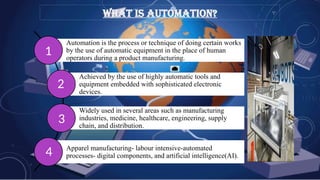
WHAT IS AUTOMATION?
Automation is the process or technique of doing certain works
by the use of automatic equipment in the place of human
operators during a product manufacturing.
Achieved by the use of highly automatic tools and
equipment embedded with sophisticated electronic
devices.
Widely used in several areas such as manufacturing
industries, medicine, healthcare, engineering, supply
chain, and distribution.
Apparel manufacturing- labour intensive-automated
processes- digital components, and artificial intelligence(AI).
1
2
3
4
Less progress in the clothing industry as
compared to automobile production.
Availability of low cost labour in many
developing countries.
High initial investment on the automatic
tools and equipment.
Complexities involved in the automation.
Production of a garment style in different
sizes with change in specification.
Frequent style changes.
FACTORS THAT PROHIBIT AUTOMATIC EQUIPMENTS
TO BE USED:
ROLE OF INFORMATION TECHNOLOGY IN
APPAREL INDUSTRY
Information technology is the capability to
electronically input process, store, and output,
transmit, and receive data and information. It plays a
very important role in today's business world
Today information technology has become an integral
part of the Garment Industry.
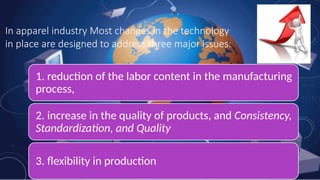
In apparel industry Most changes in the technology
in place are designed to address three major issues:
1. reduction of the labor content in the manufacturing
process,
2. increase in the quality of products, and Consistency,
Standardization, and Quality
3. flexibility in production
Information
Technology
Order
Management
Design
Production,
Planning and
Scheduling
Manufacturing
Logistics and
Distribution
Procurement
and Enterprise
management
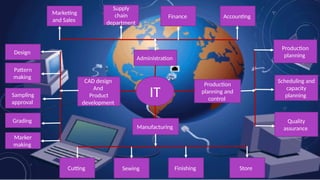
IT
Administration
CAD design
And
Product
development
Manufacturing
Production
planning and
control
Marketing
and Sales
Supply
chain
department
Finance Accounting
Pattern
making
Design
Grading
Marker
making
Scheduling and
capacity
planning
Production
planning
Quality
assurance
Sampling
approval
Cutting Sewing Finishing Store
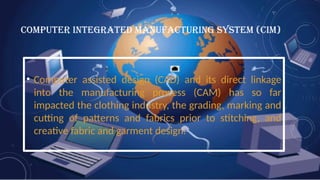
COMPUTER INTEGRATED MANUFACTURING SYSTEM (CIM)
• Computer assisted design (CAD) and its direct linkage
into the manufacturing process (CAM) has so far
impacted the clothing industry, the grading, marking and
cutting of patterns and fabrics prior to stitching, and
creative fabric and garment design.
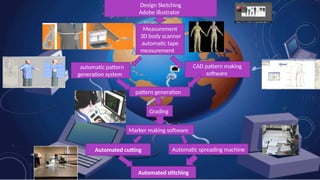
Design Sketching
Adobe illustrator
Measurement
3D body scanner
automatic tape
measurement
automatic pattern
generation system
CAD pattern making
software
pattern generation
Marker making software
Grading
Automated cutting Automatic spreading machine
Automated stitching
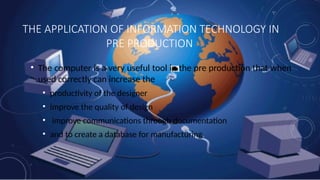
THE APPLICATION OF INFORMATION TECHNOLOGY IN
PRE PRODUCTION
• The computer is a very useful tool in the pre production that when
used correctly can increase the
• productivity of the designer
• improve the quality of design
• improve communications through documentation
• and to create a database for manufacturing.
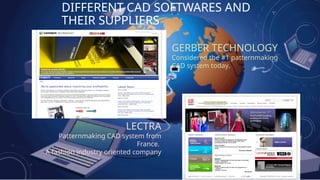
DIFFERENT CAD SOFTWARES AND
THEIR SUPPLIERS
GERBER TECHNOLOGY
Considered the #1 patternmaking
CAD system today.
LECTRA
Patternmaking CAD system from
France.
A fashion industry oriented company
.
TUKATECH
Patternmaking CAD system cited by
many users in user survey.
OPTITEX
Considered the main competitor
from Israel.
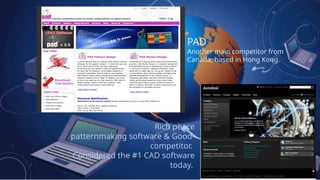
PAD
Another main competitor from
Canada, based in Hong Kong.
Rich peace
patternmaking software & Good-
competitor.
Considered the #1 CAD software
today.
PhiMatrix Professional
PhiMatrix is an amazing
software that is made to design
different things like house, car
and in our case clothing.
The colors are absolutely vivid
and the texture is so realistic you
can almost touch the fabric.
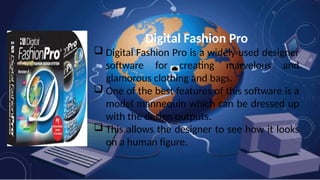
Digital Fashion Pro
 Digital Fashion Pro is a widely used designer
software for creating marvelous and
glamorous clothing and bags.
 One of the best features of this software is a
model mannequin which can be dressed up
with the design outputs.
 This allows the designer to see how it looks
on a human figure.
THE APPLICATION OF INFORMATION TECHNOLOGY
IN SCM AND OTHER DEPARTMENT
• Today, textile companies employ many information
technology solutions, including
• supply chain management (SCM)
• material requirements planning (MRP)
• data warehousing
• e-commerce.
• The goal is to make information processing, order
processing and product distribution more efficient.
ENTERPRISE RESOURCE PLANNING
ERP is a method of effective planning of all the resources in an
organization.
ERP software is designed to model and automate many processes of a
company, from finance to the shop floor, with goal of eliminating complex
processes in the company.
Here we will see some of the most common modules available in almost
all packages.
FEATURE-RICH TECHNOLOGY
• Blue Cherry ERP is the most widely deployed, feature-
rich and comprehensive solution available in the
marketplace, and is used by leading fashion, shoe
and footwear brands across the globe to plan, manage,
synchronize and optimize supply chain and distribution
activities.
• Market-Leading Capabilities Include:
• Financial Management
• Purchasing and Receiving
•Predictive and Actual Costing
•With a comprehensive range of
capabilities, BlueCherry ERP
empowers companies to streamline
processes, gain greater visibility,
increase productivity and
operational efficiency, reduce costs
and enhance competitiveness.
ERP SOFTWARE IN APPAREL INDUSTRY
• Simparel® brings a fresh approach to apparel and fashion software;
one that delivers a simpler, better way.
• Simparel Includes:
• Enterprise Resource Planning (ERP)
• Product Lifecycle Management (PLM)
• Supply Chain Management (SCM)
• Manufacturing Requirements Planning
(MRP)
PRODUCTION PLANNING SOFTWARE FOR GARMENT
MANUFACTURING
• Production planning and control tools for the factory level
management are very essential to manage production to deliver
shipment on time.
• Though there is number of IT solution providers especially for the
garment manufacturing, we found few names that provide production
planning solution with detailed scheduling. Those are
Evolve by Fast React:
Plan-IT by Gemserp
MAE by Parallax
• Plan-IT
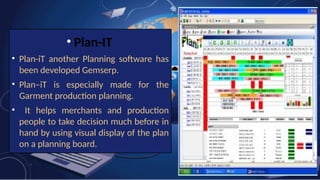
• Plan-iT another Planning software has
been developed Gemserp.
• Plan–iT is especially made for the
Garment production planning.
• It helps merchants and production
people to take decision much before in
hand by using visual display of the plan
on a planning board.
SOFTWARES USED IN CUTTING
INTELLOCUT
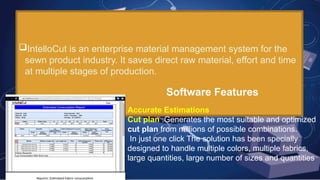
IntelloCut is an enterprise material management system for the
sewn product industry. It saves direct raw material, effort and time
at multiple stages of production.
Software Features
.
Accurate Estimations
Cut plan :Generates the most suitable and optimized
cut plan from millions of possible combinations.
In just one click The solution has been specially
designed to handle multiple colors, multiple fabrics,
large quantities, large number of sizes and quantities
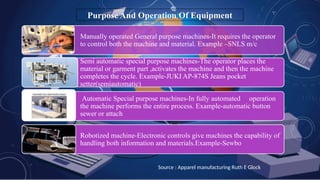
Purpose And Operation Of Equipment
Manually operated General purpose machines-It requires the operator
to control both the machine and material. Example –SNLS m/c
Semi automatic special purpose machines-The operator places the
material or garment part ,activates the machine and then the machine
completes the cycle. Example-JUKI AP-874S Jeans pocket
setter(semiautomatic)
Automatic Special purpose machines-In fully automated operation
the machine performs the entire process. Example-automatic button
sewer or attach
Robotized machine-Electronic controls give machines the capability of
handling both information and materials.Example-Sewbo
Source : Apparel manufacturing Ruth E Glock
SOFTWARE TO ESTABLISH GARMENT SAM (SMV)
Different software suppliers
• General Sewing Data (GSD) GSD is the most popular and globally accepted product for
work measurement and setting up standard time for garment sewing operations
GSD limited is the company.
2. Sew Easy® Quick Garment Sewing Data
Sew Easy is developed by Sri Lanka based company Sew Easy.
Sew Easy® Quick Garment Sewing Data system is used for
estimating the Standard Minute Value (SMV, SAM), a measure of
labor content of garments, home furnishing, lingerie, leather
goods and all sewn products.
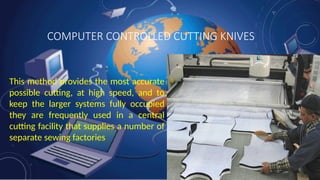
COMPUTER CONTROLLED CUTTING KNIVES
This method provides the most accurate
possible cutting, at high speed, and to
keep the larger systems fully occupied
they are frequently used in a central
cutting facility that supplies a number of
separate sewing factories
THE APPLICATION OF TECHNOLOGY IN SEWING
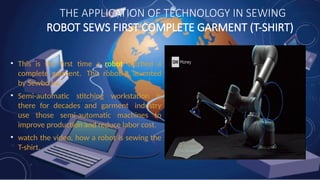
ROBOT SEWS FIRST COMPLETE GARMENT (T-SHIRT)
• This is the first time a robot stitched a
complete garment. This robot is invented
by Sewbo Inc.
• Semi-automatic stitching workstation is
there for decades and garment industry
use those semi-automatic machines to
improve production and reduce labor cost.
• watch the video, how a robot is sewing the
T-shirt.
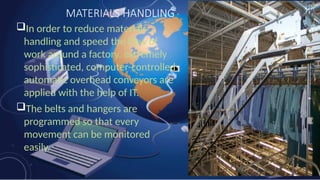
MATERIALS HANDLING
In order to reduce materials
handling and speed the flow of
work around a factory, extremely
sophisticated, computer-controlled
automatic overhead conveyors are
applied with the help of IT.
The belts and hangers are
programmed so that every
movement can be monitored
easily.
APPLICATION OF INFORMATION
TECHNOLOGY IN APPAREL RETAIL
APPLICATION OF INFORMATION TECHNOLOGY IN
APPAREL RETAIL
1. Forecasting
Retail Demand Forecasting: Modern demand-
forecasting systems provide new opportunities
to improve retail performance. Although the art
of the individual merchant may never be
replaced, it can be augmented by an efficient,
objective and scientific approach to forecasting
demand.
HOW INFORMATION TECHNOLOGY INVOLVED IN
RETAILING OPERATIONS
2. Inventory Management
An IT solution is a proven and market leading solution for
determining optimal time-varying inventory targets for every
item, at every location throughout supply chain.
3.Store Management
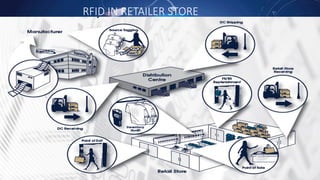
The in-store system use magnetic strips or barcodes or RFID to
monitor actual versus intended product location on the floor or in
the stockroom.
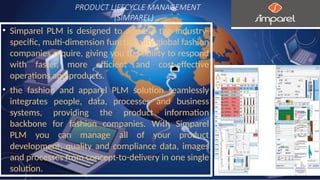
PRODUCT LIFECYCLE MANAGEMENT
(SIMPAREL)
• Simparel PLM is designed to address the industry-
specific, multi-dimension functionality global fashion
companies require, giving you the ability to respond
with faster, more efficient and cost-effective
operations and products.
• the fashion and apparel PLM solution seamlessly
integrates people, data, processes and business
systems, providing the product information
backbone for fashion companies. With Simparel
PLM you can manage all of your product
development, quality and compliance data, images
and processes from concept-to-delivery in one single
solution.
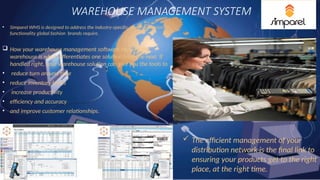
WAREHOUSE MANAGEMENT SYSTEM
• Simparel WMS is designed to address the industry-specific, multi-dimension
functionality global fashion brands require.
 How your warehouse management software handles the
warehouse is what differentiates one solution from the next. If
handled right, your warehouse solution can give you the tools to
• reduce turn around time
• reduce inventory levels
• increase productivity
• efficiency and accuracy
• and improve customer relationships.
 The efficient management of your
distribution network is the final link to
ensuring your products get to the right
place, at the right time.
E-COMMERCE
• E-Commerce is nothing but electronics commerce.
• it is changing the way business is conducted these days.in todays internet-
driven environment, it has become the only way for companies to compete
with each other. Enterprises are utilizing e-business solutions to increase
productivity, efficiency and sales. At the same time.
• As an intermediary service, E-Commerce marketplaces deliver end-to-end
business procurement and fulfillment tools over the internet to connect
buyers with suppliers and service providers.
• E-Commerce driven market places are committed to the mission of providing
small and medium-sized companies with the same cutting-edge technology
that empowers high profile companies, through an easy-to-use system and at
an affordable price.
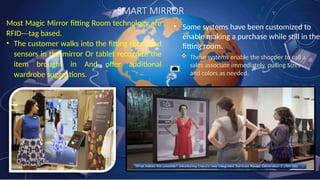
SMART MIRROR
Most Magic Mirror fitting Room technology are
RFID-- tag based.
‐
• The customer walks into the fitting room and
sensors in the mirror Or tablet recognize the
item brought in And offer additional
wardrobe suggestions.
 These systems enable the shopper to call a
sales associate immediately, pulling Sizes
and colors as needed.
• Some systems have been customized to
enable making a purchase while still in the
fitting room.
THE APPLICATION OF RFID IN APPAREL INDUSTRY
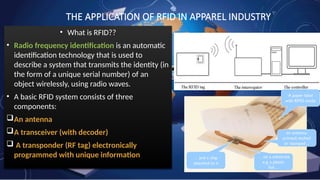
• What is RFID??
• Radio frequency identification is an automatic
identification technology that is used to
describe a system that transmits the identity (in
the form of a unique serial number) of an
object wirelessly, using radio waves.
• A basic RFID system consists of three
components:
An antenna
A transceiver (with decoder)
 A transponder (RF tag) electronically
programmed with unique information
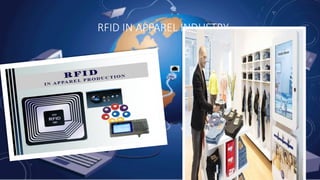
RFID IN APPAREL INDUSTRY
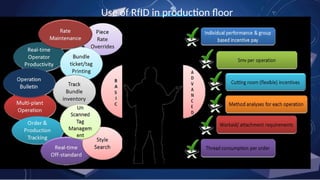
Use of RfID in production floor
RFID IN RETAILER STORE
Thank you!

applicationofinformationtechnologyingik-161118081802.pptx

  • 1.
    AUTOMATION IN GARMENTMANUFACTURING PREPAERD BY Dr. Aqsa imran
  • 2.
    CONTENT • Introduction • Computerintegrated manufacturing system • Cad in pattern making • Enterprise Resource Planning • Production Planning Software for Garment Manufacturing • software used in cutting • Application of Information Technology in Apparel Retail • The application of rfid in apparel industry
  • 3.
    WHAT IS AUTOMATION? Automationis the process or technique of doing certain works by the use of automatic equipment in the place of human operators during a product manufacturing. Achieved by the use of highly automatic tools and equipment embedded with sophisticated electronic devices. Widely used in several areas such as manufacturing industries, medicine, healthcare, engineering, supply chain, and distribution. Apparel manufacturing- labour intensive-automated processes- digital components, and artificial intelligence(AI). 1 2 3 4
  • 4.
    Less progress inthe clothing industry as compared to automobile production. Availability of low cost labour in many developing countries. High initial investment on the automatic tools and equipment. Complexities involved in the automation. Production of a garment style in different sizes with change in specification. Frequent style changes. FACTORS THAT PROHIBIT AUTOMATIC EQUIPMENTS TO BE USED:
  • 5.
    ROLE OF INFORMATIONTECHNOLOGY IN APPAREL INDUSTRY Information technology is the capability to electronically input process, store, and output, transmit, and receive data and information. It plays a very important role in today's business world Today information technology has become an integral part of the Garment Industry.
  • 6.
    In apparel industryMost changes in the technology in place are designed to address three major issues: 1. reduction of the labor content in the manufacturing process, 2. increase in the quality of products, and Consistency, Standardization, and Quality 3. flexibility in production
  • 7.
  • 8.
    IT Administration CAD design And Product development Manufacturing Production planning and control Marketing andSales Supply chain department Finance Accounting Pattern making Design Grading Marker making Scheduling and capacity planning Production planning Quality assurance Sampling approval Cutting Sewing Finishing Store
  • 9.
    COMPUTER INTEGRATED MANUFACTURINGSYSTEM (CIM) • Computer assisted design (CAD) and its direct linkage into the manufacturing process (CAM) has so far impacted the clothing industry, the grading, marking and cutting of patterns and fabrics prior to stitching, and creative fabric and garment design.
  • 10.
    Design Sketching Adobe illustrator Measurement 3Dbody scanner automatic tape measurement automatic pattern generation system CAD pattern making software pattern generation Marker making software Grading Automated cutting Automatic spreading machine Automated stitching
  • 11.
    THE APPLICATION OFINFORMATION TECHNOLOGY IN PRE PRODUCTION • The computer is a very useful tool in the pre production that when used correctly can increase the • productivity of the designer • improve the quality of design • improve communications through documentation • and to create a database for manufacturing.
  • 13.
    DIFFERENT CAD SOFTWARESAND THEIR SUPPLIERS GERBER TECHNOLOGY Considered the #1 patternmaking CAD system today. LECTRA Patternmaking CAD system from France. A fashion industry oriented company .
  • 14.
    TUKATECH Patternmaking CAD systemcited by many users in user survey. OPTITEX Considered the main competitor from Israel.
  • 15.
    PAD Another main competitorfrom Canada, based in Hong Kong. Rich peace patternmaking software & Good- competitor. Considered the #1 CAD software today.
  • 16.
    PhiMatrix Professional PhiMatrix isan amazing software that is made to design different things like house, car and in our case clothing. The colors are absolutely vivid and the texture is so realistic you can almost touch the fabric.
  • 17.
    Digital Fashion Pro Digital Fashion Pro is a widely used designer software for creating marvelous and glamorous clothing and bags.  One of the best features of this software is a model mannequin which can be dressed up with the design outputs.  This allows the designer to see how it looks on a human figure.
  • 18.
    THE APPLICATION OFINFORMATION TECHNOLOGY IN SCM AND OTHER DEPARTMENT • Today, textile companies employ many information technology solutions, including • supply chain management (SCM) • material requirements planning (MRP) • data warehousing • e-commerce. • The goal is to make information processing, order processing and product distribution more efficient.
  • 19.
    ENTERPRISE RESOURCE PLANNING ERPis a method of effective planning of all the resources in an organization. ERP software is designed to model and automate many processes of a company, from finance to the shop floor, with goal of eliminating complex processes in the company. Here we will see some of the most common modules available in almost all packages.
  • 20.
    FEATURE-RICH TECHNOLOGY • BlueCherry ERP is the most widely deployed, feature- rich and comprehensive solution available in the marketplace, and is used by leading fashion, shoe and footwear brands across the globe to plan, manage, synchronize and optimize supply chain and distribution activities. • Market-Leading Capabilities Include: • Financial Management • Purchasing and Receiving
  • 21.
    •Predictive and ActualCosting •With a comprehensive range of capabilities, BlueCherry ERP empowers companies to streamline processes, gain greater visibility, increase productivity and operational efficiency, reduce costs and enhance competitiveness.
  • 22.
    ERP SOFTWARE INAPPAREL INDUSTRY • Simparel® brings a fresh approach to apparel and fashion software; one that delivers a simpler, better way. • Simparel Includes: • Enterprise Resource Planning (ERP) • Product Lifecycle Management (PLM) • Supply Chain Management (SCM) • Manufacturing Requirements Planning (MRP)
  • 23.
    PRODUCTION PLANNING SOFTWAREFOR GARMENT MANUFACTURING • Production planning and control tools for the factory level management are very essential to manage production to deliver shipment on time. • Though there is number of IT solution providers especially for the garment manufacturing, we found few names that provide production planning solution with detailed scheduling. Those are Evolve by Fast React: Plan-IT by Gemserp MAE by Parallax
  • 24.
    • Plan-IT • Plan-iTanother Planning software has been developed Gemserp. • Plan–iT is especially made for the Garment production planning. • It helps merchants and production people to take decision much before in hand by using visual display of the plan on a planning board.
  • 25.
    SOFTWARES USED INCUTTING INTELLOCUT IntelloCut is an enterprise material management system for the sewn product industry. It saves direct raw material, effort and time at multiple stages of production. Software Features . Accurate Estimations Cut plan :Generates the most suitable and optimized cut plan from millions of possible combinations. In just one click The solution has been specially designed to handle multiple colors, multiple fabrics, large quantities, large number of sizes and quantities
  • 26.
    Purpose And OperationOf Equipment Manually operated General purpose machines-It requires the operator to control both the machine and material. Example –SNLS m/c Semi automatic special purpose machines-The operator places the material or garment part ,activates the machine and then the machine completes the cycle. Example-JUKI AP-874S Jeans pocket setter(semiautomatic) Automatic Special purpose machines-In fully automated operation the machine performs the entire process. Example-automatic button sewer or attach Robotized machine-Electronic controls give machines the capability of handling both information and materials.Example-Sewbo Source : Apparel manufacturing Ruth E Glock
  • 27.
    SOFTWARE TO ESTABLISHGARMENT SAM (SMV) Different software suppliers • General Sewing Data (GSD) GSD is the most popular and globally accepted product for work measurement and setting up standard time for garment sewing operations GSD limited is the company. 2. Sew Easy® Quick Garment Sewing Data Sew Easy is developed by Sri Lanka based company Sew Easy. Sew Easy® Quick Garment Sewing Data system is used for estimating the Standard Minute Value (SMV, SAM), a measure of labor content of garments, home furnishing, lingerie, leather goods and all sewn products.
  • 28.
    COMPUTER CONTROLLED CUTTINGKNIVES This method provides the most accurate possible cutting, at high speed, and to keep the larger systems fully occupied they are frequently used in a central cutting facility that supplies a number of separate sewing factories
  • 29.
    THE APPLICATION OFTECHNOLOGY IN SEWING ROBOT SEWS FIRST COMPLETE GARMENT (T-SHIRT) • This is the first time a robot stitched a complete garment. This robot is invented by Sewbo Inc. • Semi-automatic stitching workstation is there for decades and garment industry use those semi-automatic machines to improve production and reduce labor cost. • watch the video, how a robot is sewing the T-shirt.
  • 30.
    MATERIALS HANDLING In orderto reduce materials handling and speed the flow of work around a factory, extremely sophisticated, computer-controlled automatic overhead conveyors are applied with the help of IT. The belts and hangers are programmed so that every movement can be monitored easily.
  • 31.
  • 32.
    APPLICATION OF INFORMATIONTECHNOLOGY IN APPAREL RETAIL 1. Forecasting Retail Demand Forecasting: Modern demand- forecasting systems provide new opportunities to improve retail performance. Although the art of the individual merchant may never be replaced, it can be augmented by an efficient, objective and scientific approach to forecasting demand.
  • 33.
    HOW INFORMATION TECHNOLOGYINVOLVED IN RETAILING OPERATIONS 2. Inventory Management An IT solution is a proven and market leading solution for determining optimal time-varying inventory targets for every item, at every location throughout supply chain. 3.Store Management The in-store system use magnetic strips or barcodes or RFID to monitor actual versus intended product location on the floor or in the stockroom.
  • 34.
    PRODUCT LIFECYCLE MANAGEMENT (SIMPAREL) •Simparel PLM is designed to address the industry- specific, multi-dimension functionality global fashion companies require, giving you the ability to respond with faster, more efficient and cost-effective operations and products. • the fashion and apparel PLM solution seamlessly integrates people, data, processes and business systems, providing the product information backbone for fashion companies. With Simparel PLM you can manage all of your product development, quality and compliance data, images and processes from concept-to-delivery in one single solution.
  • 35.
    WAREHOUSE MANAGEMENT SYSTEM •Simparel WMS is designed to address the industry-specific, multi-dimension functionality global fashion brands require.  How your warehouse management software handles the warehouse is what differentiates one solution from the next. If handled right, your warehouse solution can give you the tools to • reduce turn around time • reduce inventory levels • increase productivity • efficiency and accuracy • and improve customer relationships.  The efficient management of your distribution network is the final link to ensuring your products get to the right place, at the right time.
  • 36.
    E-COMMERCE • E-Commerce isnothing but electronics commerce. • it is changing the way business is conducted these days.in todays internet- driven environment, it has become the only way for companies to compete with each other. Enterprises are utilizing e-business solutions to increase productivity, efficiency and sales. At the same time. • As an intermediary service, E-Commerce marketplaces deliver end-to-end business procurement and fulfillment tools over the internet to connect buyers with suppliers and service providers. • E-Commerce driven market places are committed to the mission of providing small and medium-sized companies with the same cutting-edge technology that empowers high profile companies, through an easy-to-use system and at an affordable price.
  • 37.
    SMART MIRROR Most MagicMirror fitting Room technology are RFID-- tag based. ‐ • The customer walks into the fitting room and sensors in the mirror Or tablet recognize the item brought in And offer additional wardrobe suggestions.  These systems enable the shopper to call a sales associate immediately, pulling Sizes and colors as needed. • Some systems have been customized to enable making a purchase while still in the fitting room.
  • 38.
    THE APPLICATION OFRFID IN APPAREL INDUSTRY • What is RFID?? • Radio frequency identification is an automatic identification technology that is used to describe a system that transmits the identity (in the form of a unique serial number) of an object wirelessly, using radio waves. • A basic RFID system consists of three components: An antenna A transceiver (with decoder)  A transponder (RF tag) electronically programmed with unique information
  • 39.
  • 40.
    Use of RfIDin production floor
  • 41.
  • 42.