Equations of Uniform
Accelerated Motion
Physics
Mr. Berman
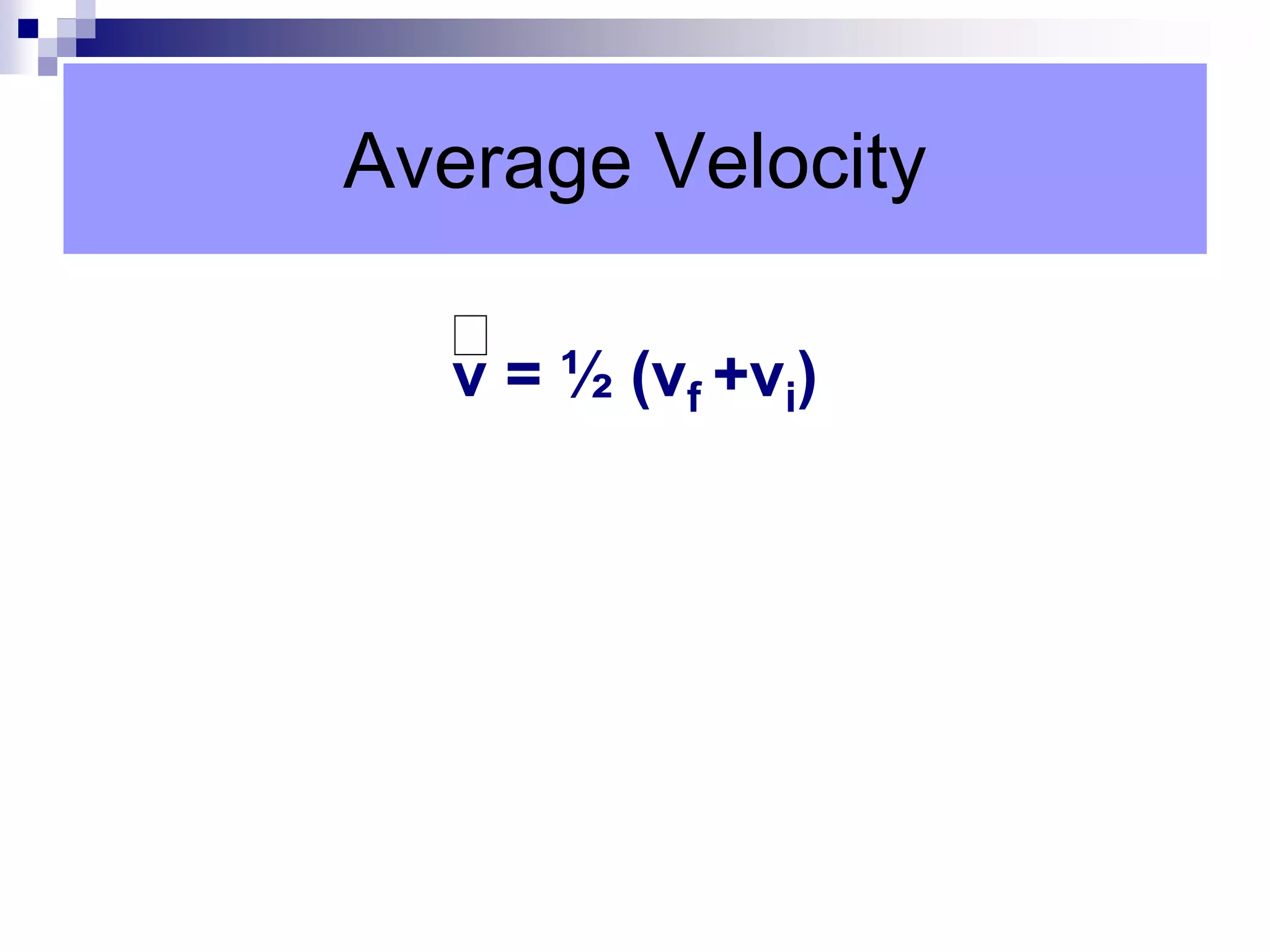
Average Velocity
v = ½ (vf +vi)
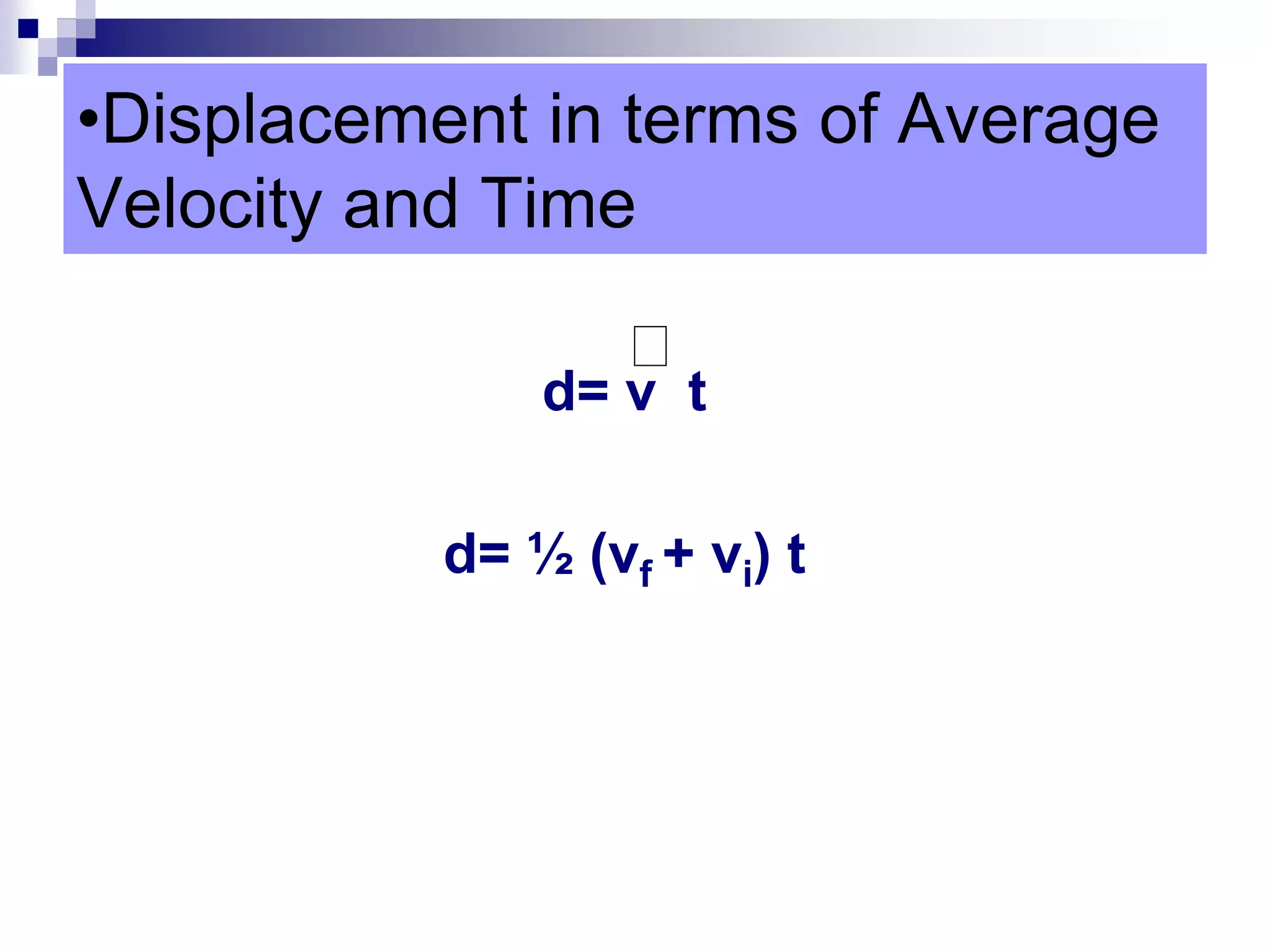
•Displacement in terms of Average
Velocity and Time
d= v t
d= ½ (vf + vi) t
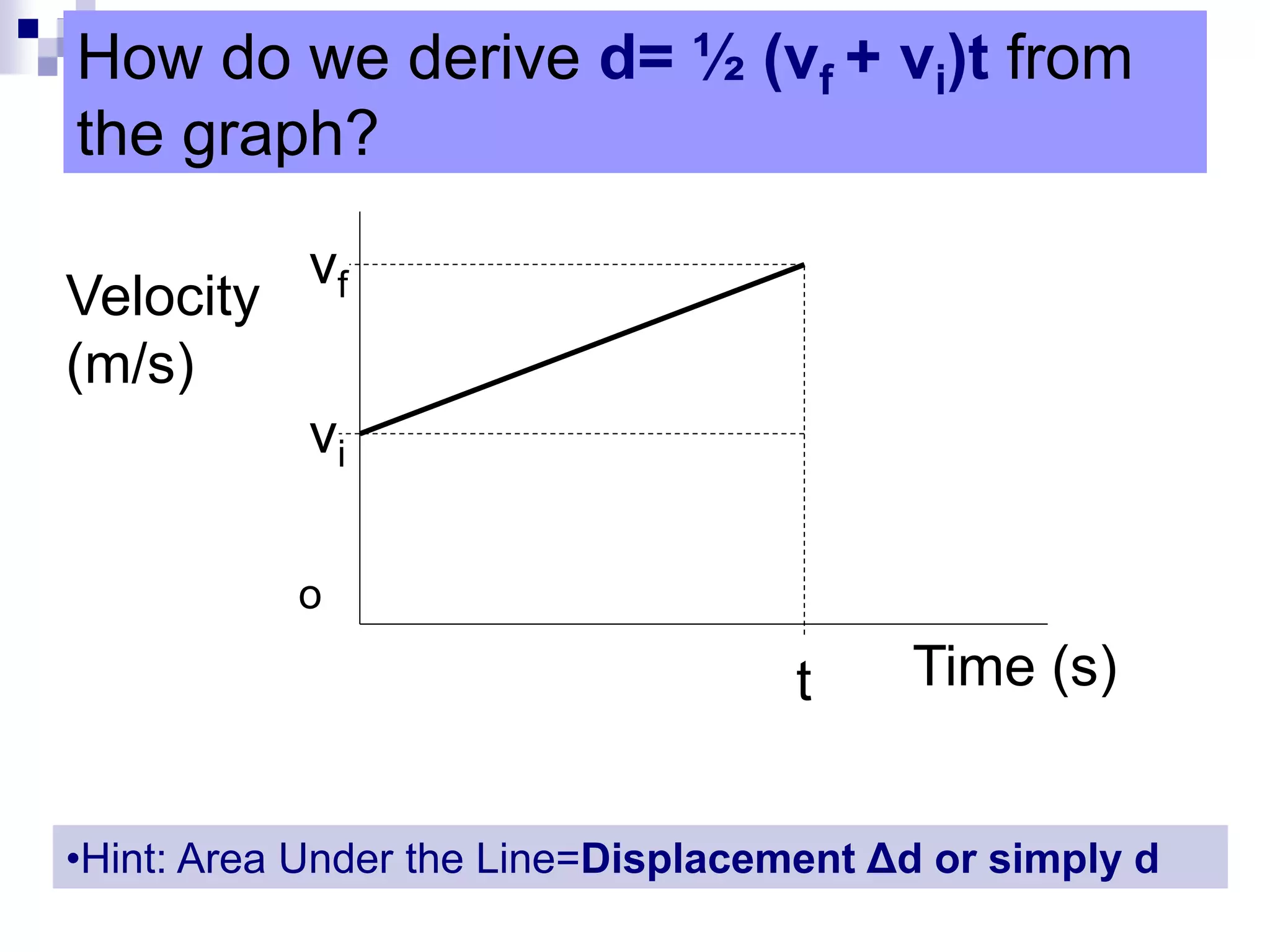
How do we derive d= ½ (vf + vi)t from
the graph?
Time (s)
o
Velocity
(m/s)
•Hint: Area Under the Line=Displacement Δd or simply d
vf
vi
t
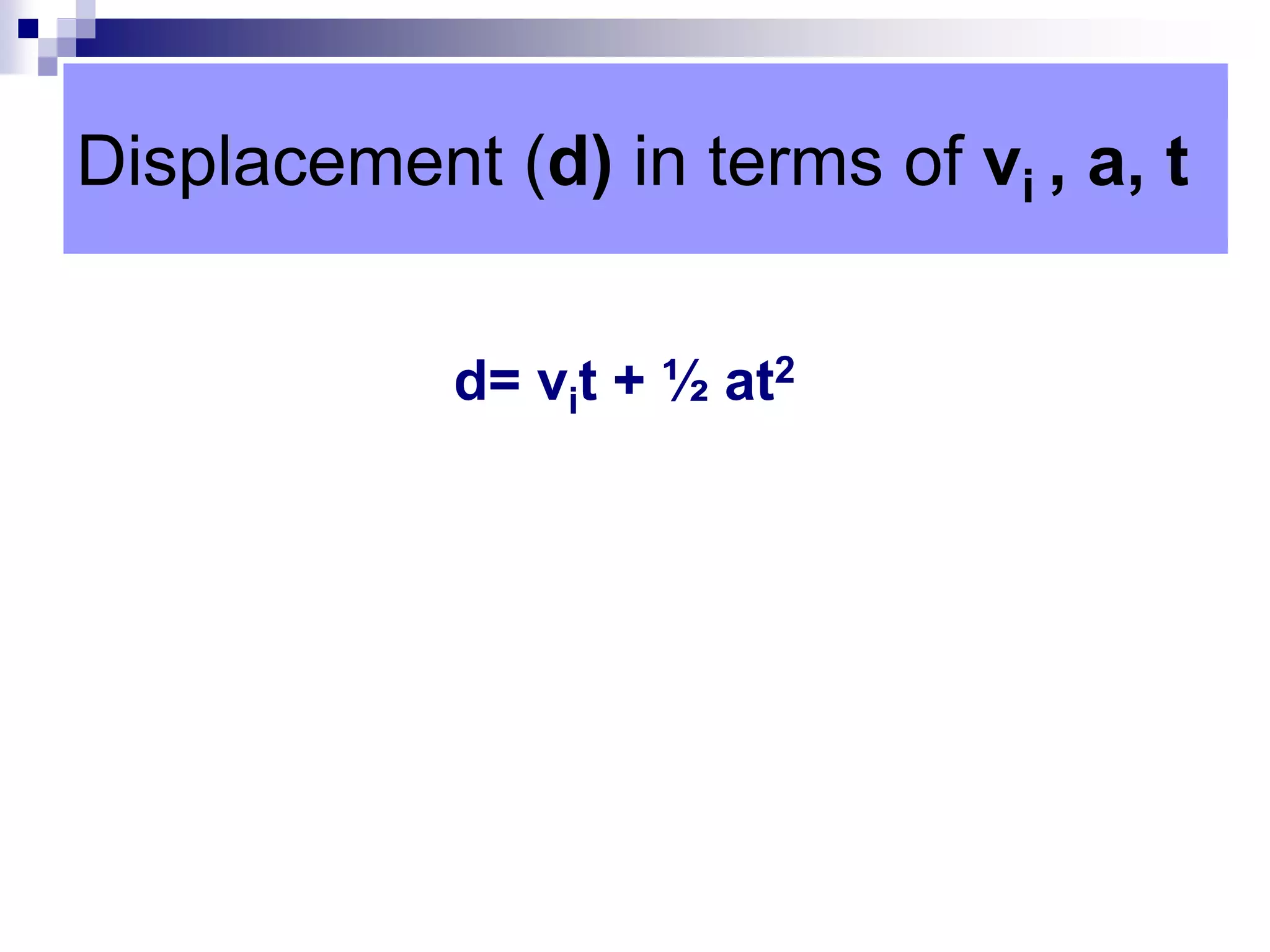
Displacement (d) in terms of vi , a, t
d= vit + ½ at2
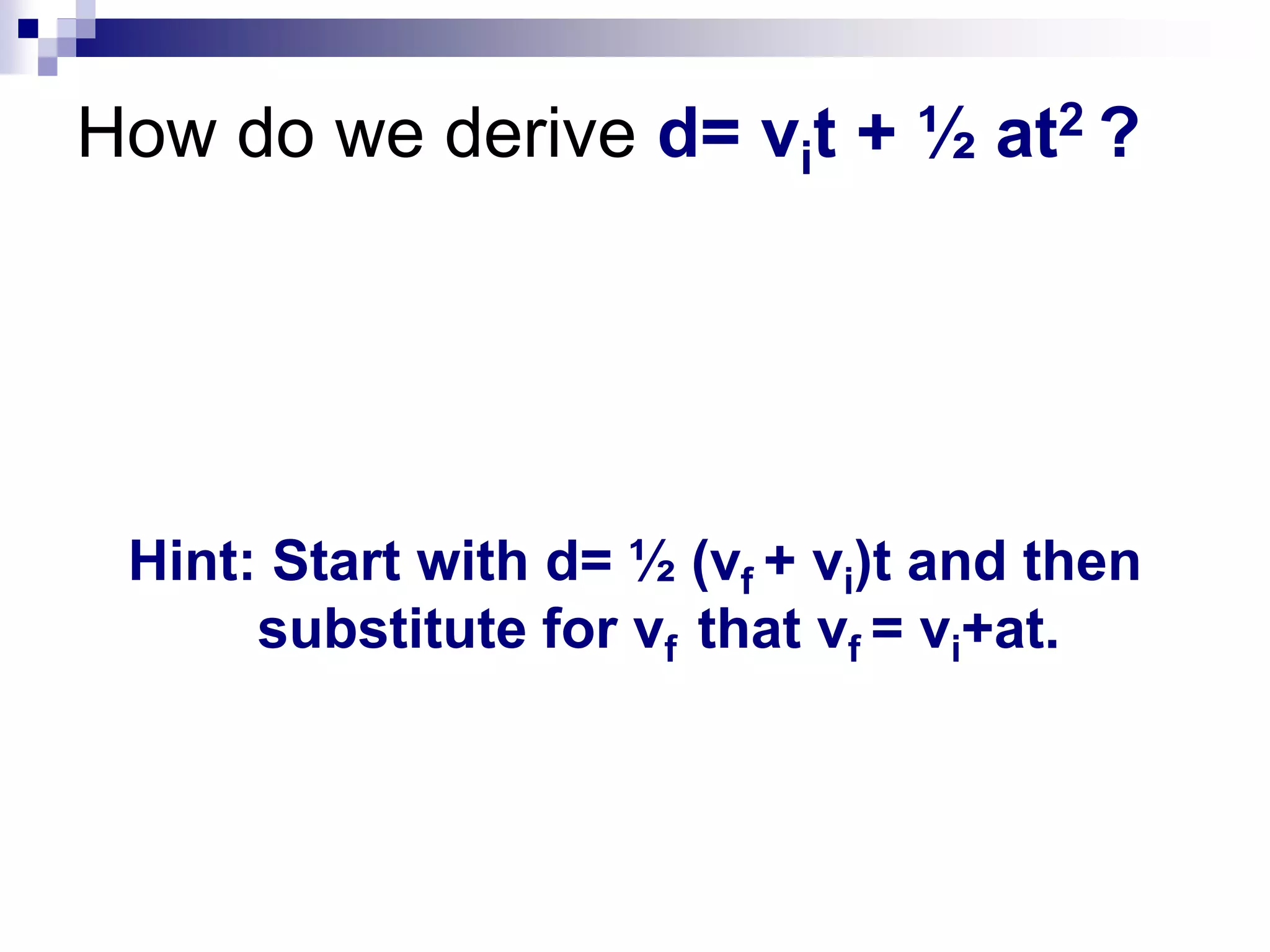
How do we derive d= vit + ½ at2 ?
Hint: Start with d= ½ (vf + vi)t and then
substitute for vf that vf = vi+at.
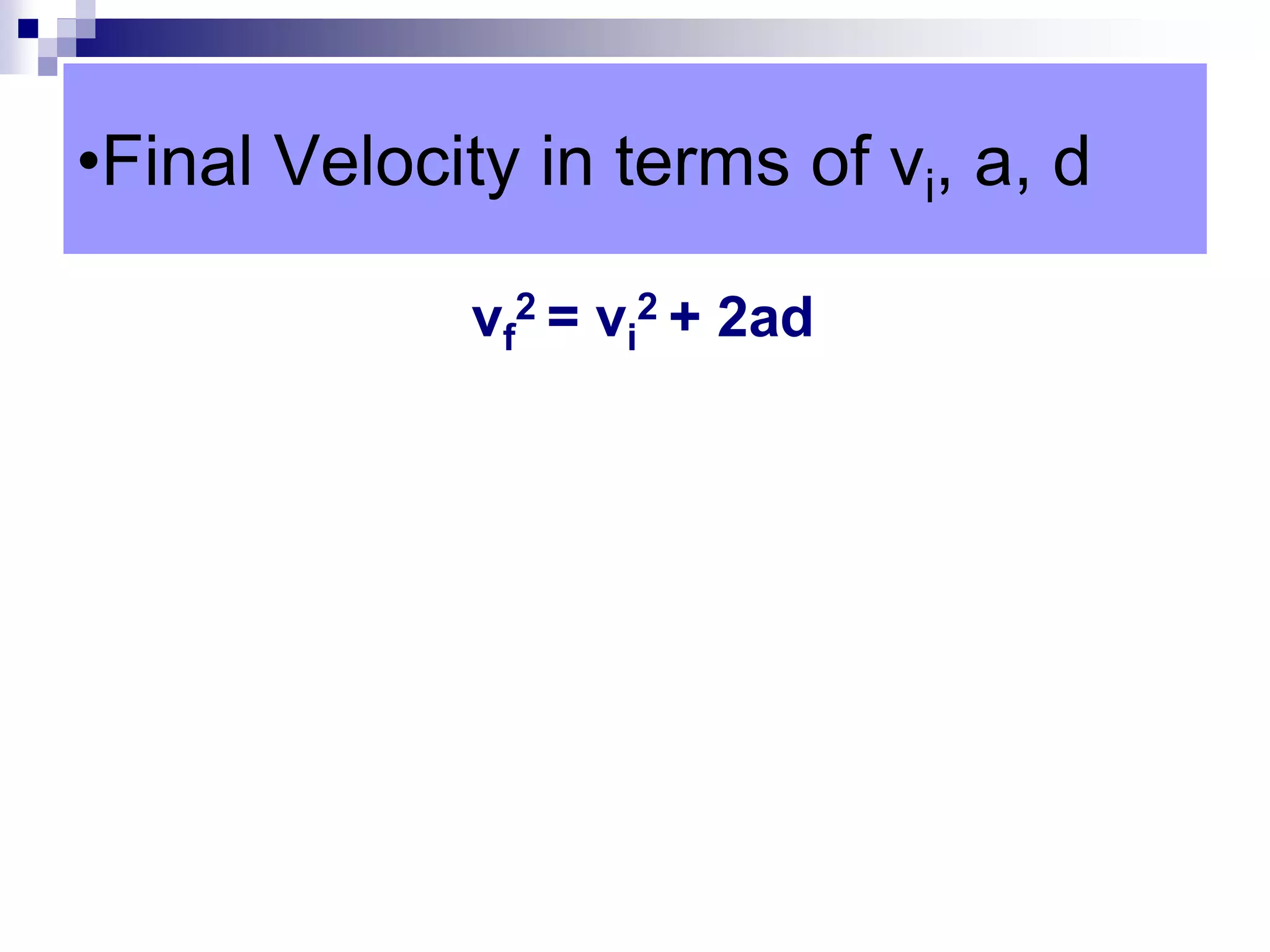
•Final Velocity in terms of vi, a, d
vf
2 = vi
2 + 2ad
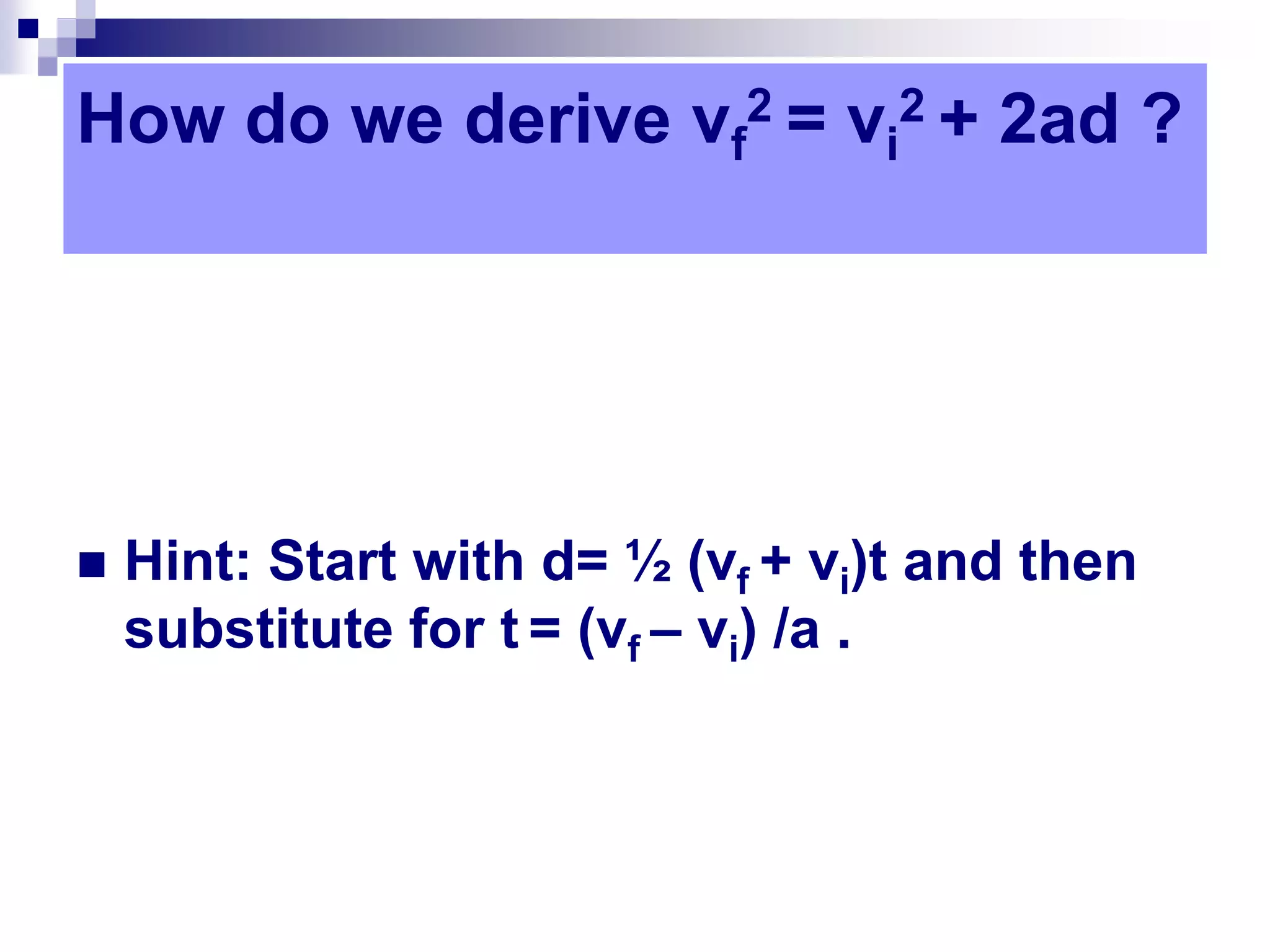
How do we derive vf
2 = vi
2 + 2ad ?
 Hint: Start with d= ½ (vf + vi)t and then
substitute for t = (vf – vi) /a .
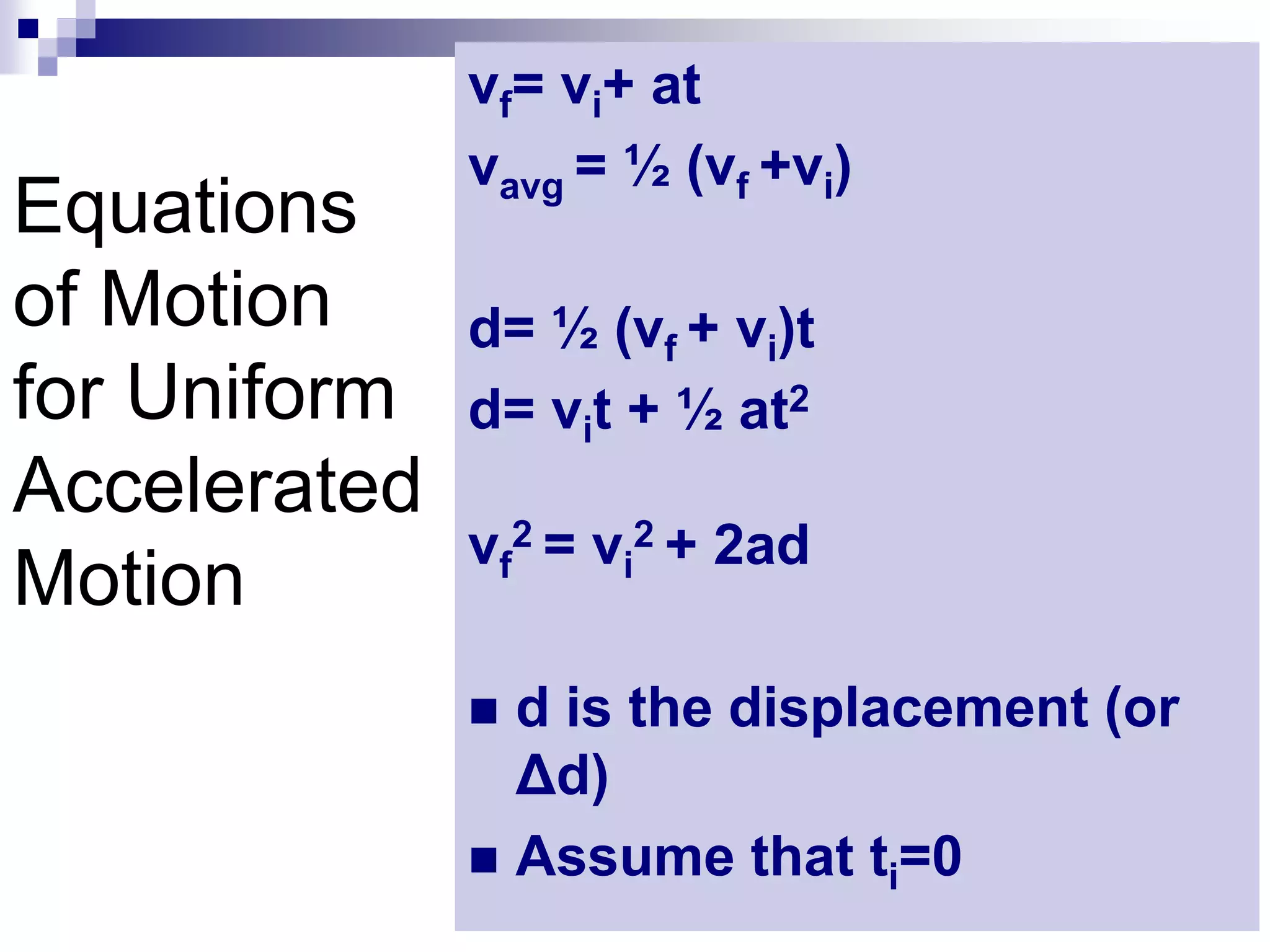
Equations
of Motion
for Uniform
Accelerated
Motion
vf= vi+ at
vavg = ½ (vf +vi)
d= ½ (vf + vi)t
d= vit + ½ at2
vf
2 = vi
2 + 2ad
 d is the displacement (or
Δd)
 Assume that ti=0
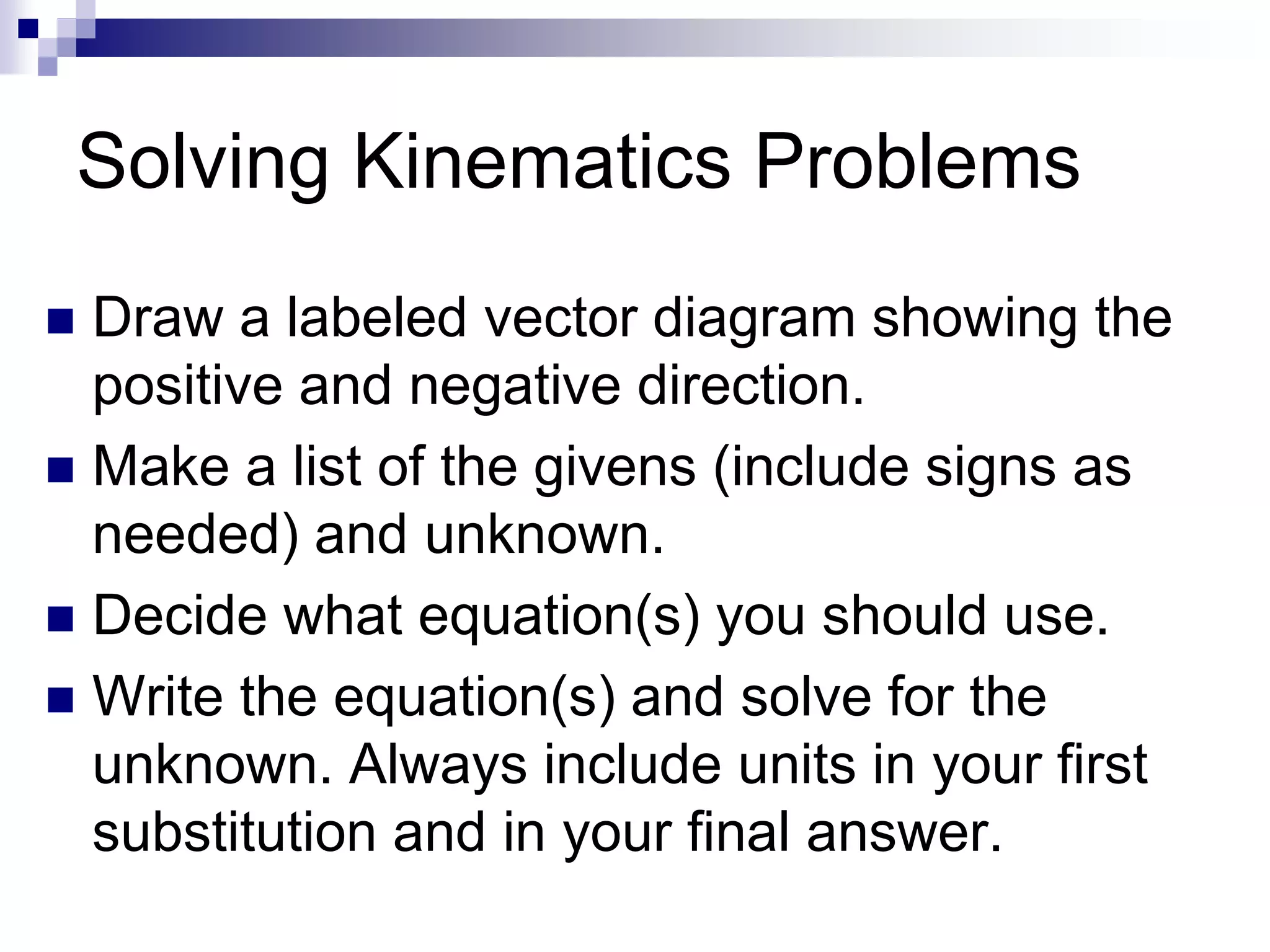
Solving Kinematics Problems
 Draw a labeled vector diagram showing the
positive and negative direction.
 Make a list of the givens (include signs as
needed) and unknown.
 Decide what equation(s) you should use.
 Write the equation(s) and solve for the
unknown. Always include units in your first
substitution and in your final answer.
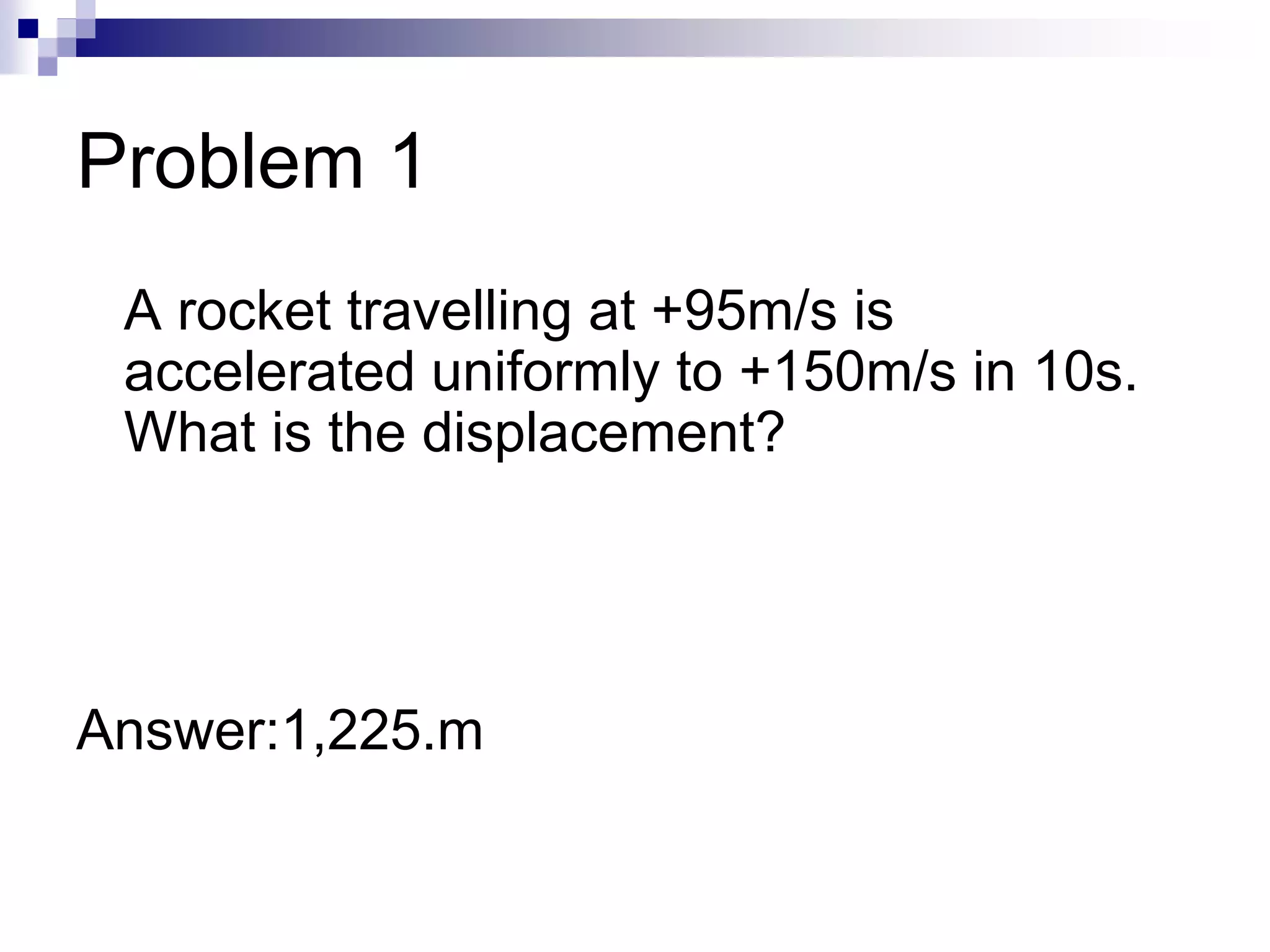
Problem 1
A rocket travelling at +95m/s is
accelerated uniformly to +150m/s in 10s.
What is the displacement?
Answer:1,225.m
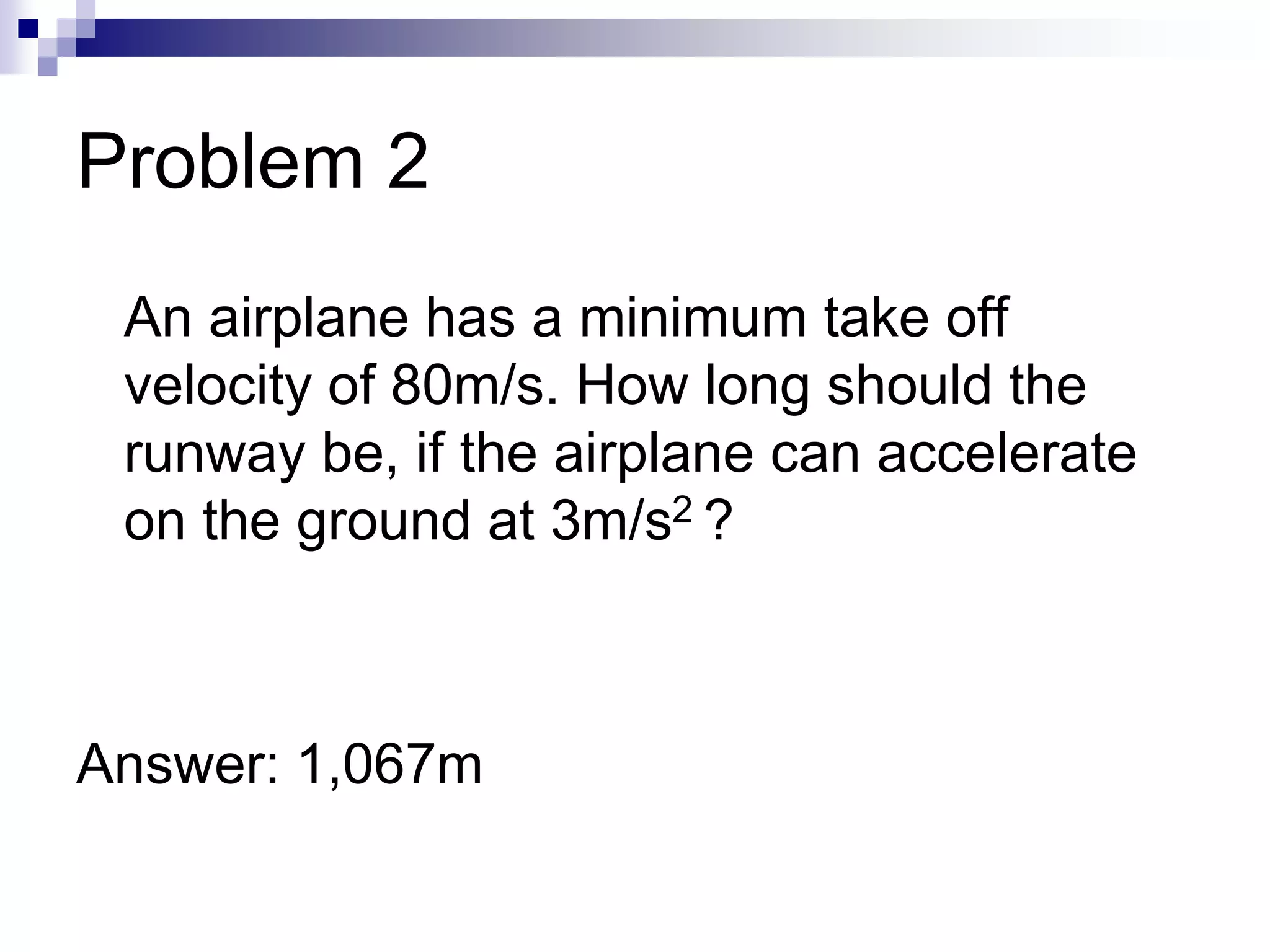
Problem 2
An airplane has a minimum take off
velocity of 80m/s. How long should the
runway be, if the airplane can accelerate
on the ground at 3m/s2 ?
Answer: 1,067m
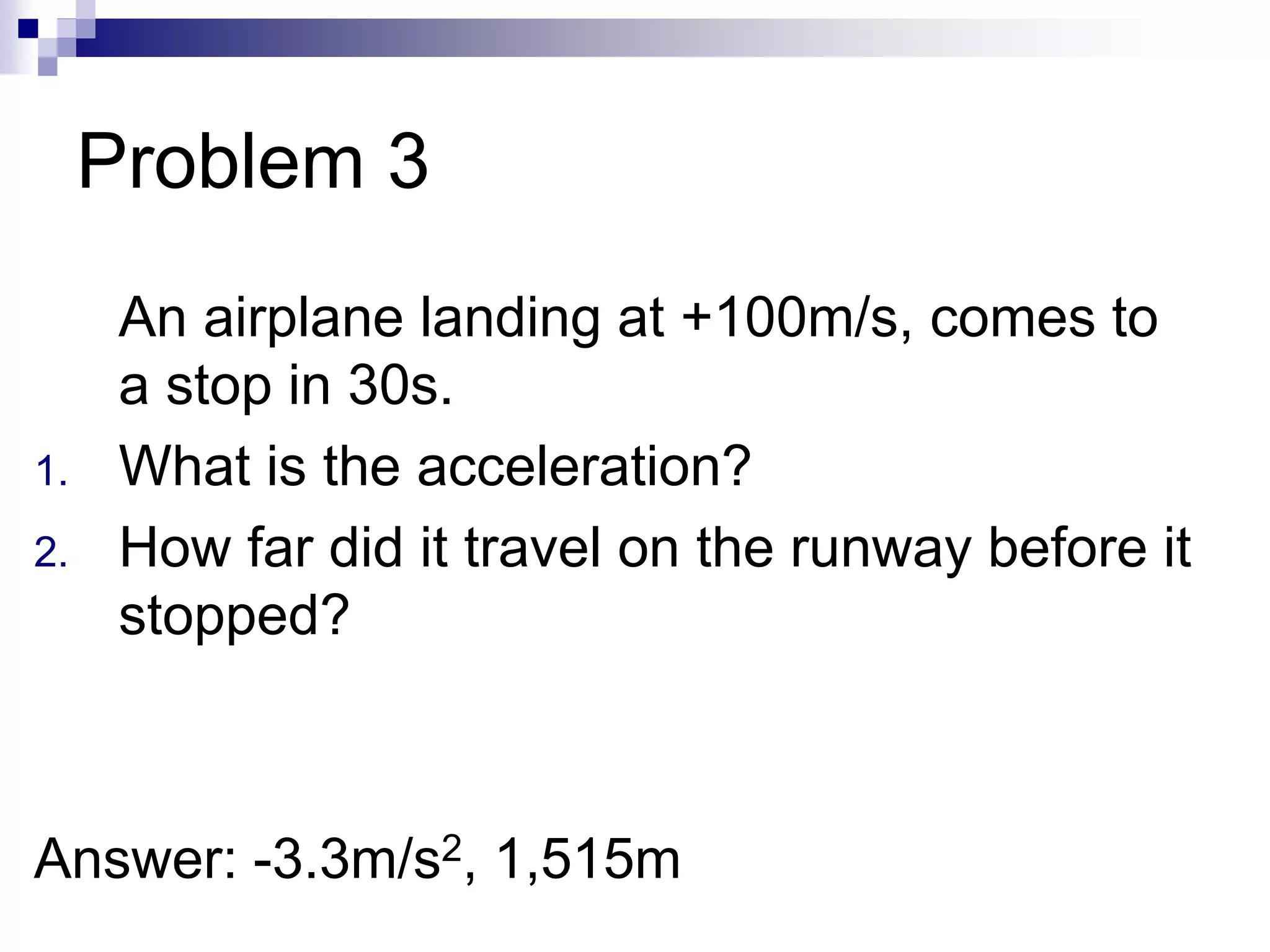
Problem 3
An airplane landing at +100m/s, comes to
a stop in 30s.
1. What is the acceleration?
2. How far did it travel on the runway before it
stopped?
Answer: -3.3m/s2, 1,515m

PP7_-_2_Equation_of_Motion_for_Accelerated_Motion.ppt

  • 1.
    Equations of Uniform AcceleratedMotion Physics Mr. Berman
  • 2.
  • 3.
    •Displacement in termsof Average Velocity and Time d= v t d= ½ (vf + vi) t
  • 4.
    How do wederive d= ½ (vf + vi)t from the graph? Time (s) o Velocity (m/s) •Hint: Area Under the Line=Displacement Δd or simply d vf vi t
  • 5.
    Displacement (d) interms of vi , a, t d= vit + ½ at2
  • 6.
    How do wederive d= vit + ½ at2 ? Hint: Start with d= ½ (vf + vi)t and then substitute for vf that vf = vi+at.
  • 7.
    •Final Velocity interms of vi, a, d vf 2 = vi 2 + 2ad
  • 8.
    How do wederive vf 2 = vi 2 + 2ad ?  Hint: Start with d= ½ (vf + vi)t and then substitute for t = (vf – vi) /a .
  • 9.
    Equations of Motion for Uniform Accelerated Motion vf=vi+ at vavg = ½ (vf +vi) d= ½ (vf + vi)t d= vit + ½ at2 vf 2 = vi 2 + 2ad  d is the displacement (or Δd)  Assume that ti=0
  • 10.
    Solving Kinematics Problems Draw a labeled vector diagram showing the positive and negative direction.  Make a list of the givens (include signs as needed) and unknown.  Decide what equation(s) you should use.  Write the equation(s) and solve for the unknown. Always include units in your first substitution and in your final answer.
  • 11.
    Problem 1 A rockettravelling at +95m/s is accelerated uniformly to +150m/s in 10s. What is the displacement? Answer:1,225.m
  • 12.
    Problem 2 An airplanehas a minimum take off velocity of 80m/s. How long should the runway be, if the airplane can accelerate on the ground at 3m/s2 ? Answer: 1,067m
  • 13.
    Problem 3 An airplanelanding at +100m/s, comes to a stop in 30s. 1. What is the acceleration? 2. How far did it travel on the runway before it stopped? Answer: -3.3m/s2, 1,515m