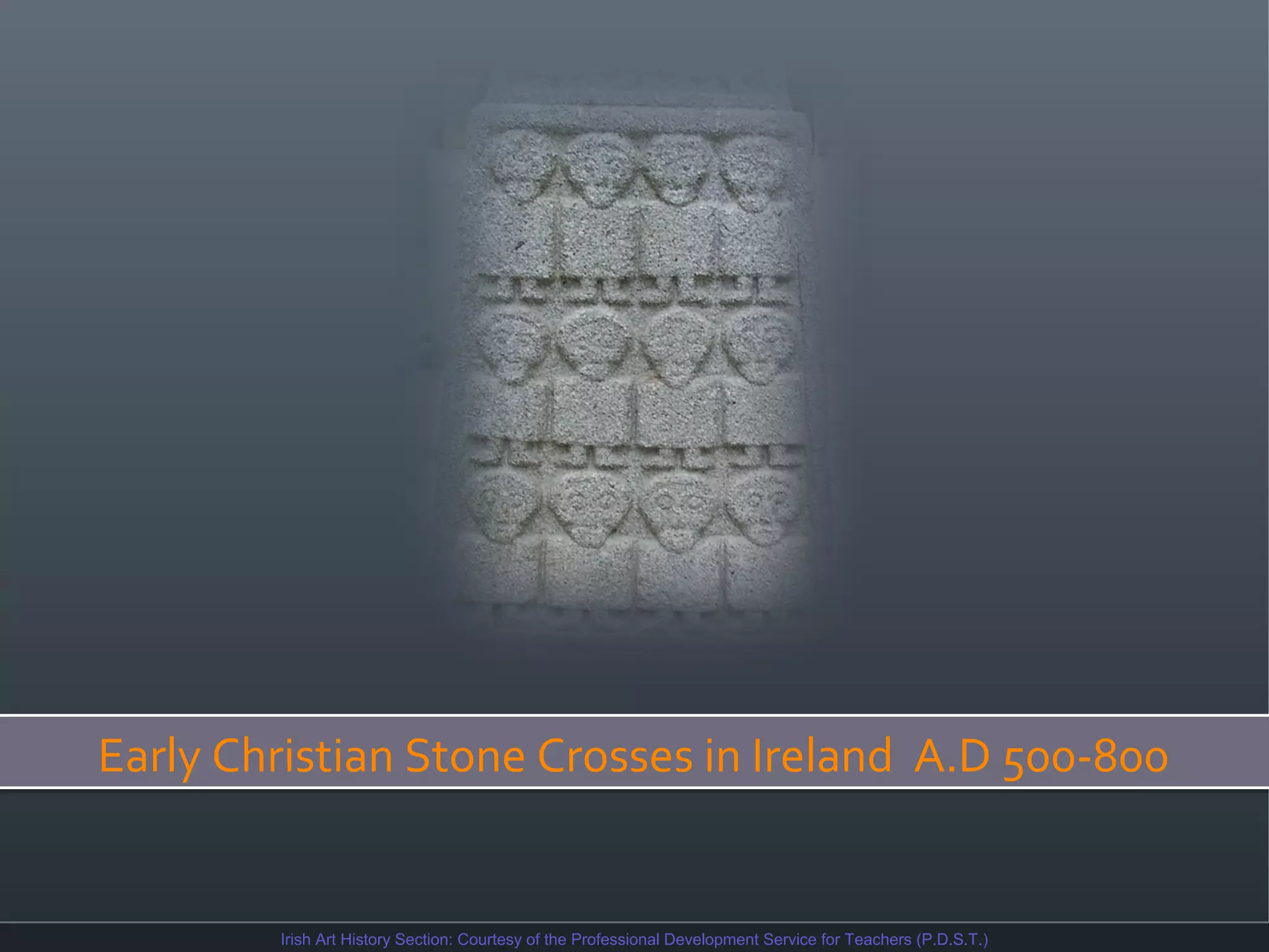
Early Christian Stone Crosses in Ireland A.D 500-800

Irish Art History Section: Courtesy of the Professional Development Service for Teachers (P.D.S.T.)
Early Christian Stone Crosses in Ireland A.D 500-800

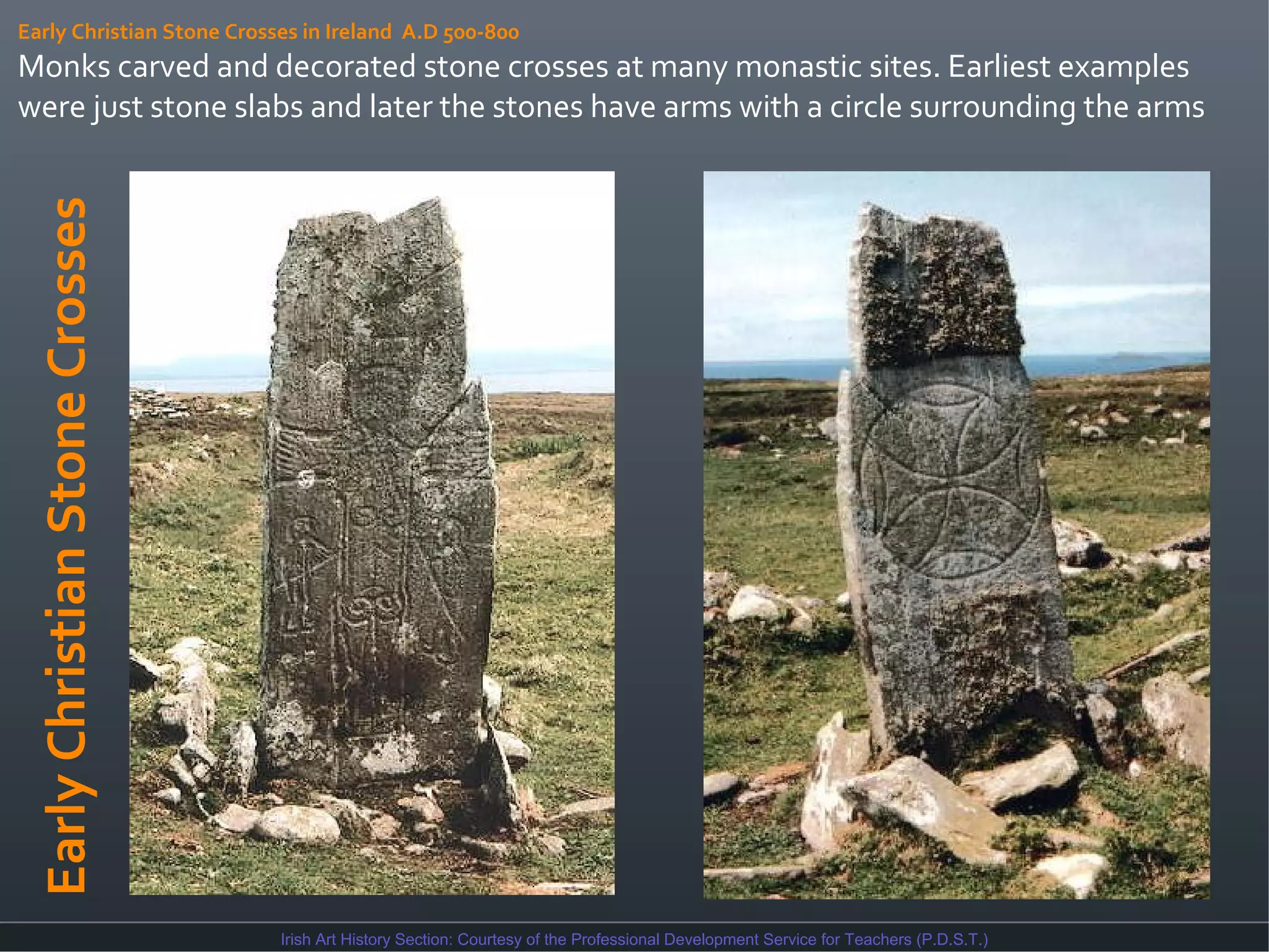
Early Christian Stone Crosses

Monks carved and decorated stone crosses at many monastic sites. Earliest examples
were just stone slabs and later the stones have arms with a circle surrounding the arms

Irish Art History Section: Courtesy of the Professional Development Service for Teachers (P.D.S.T.)
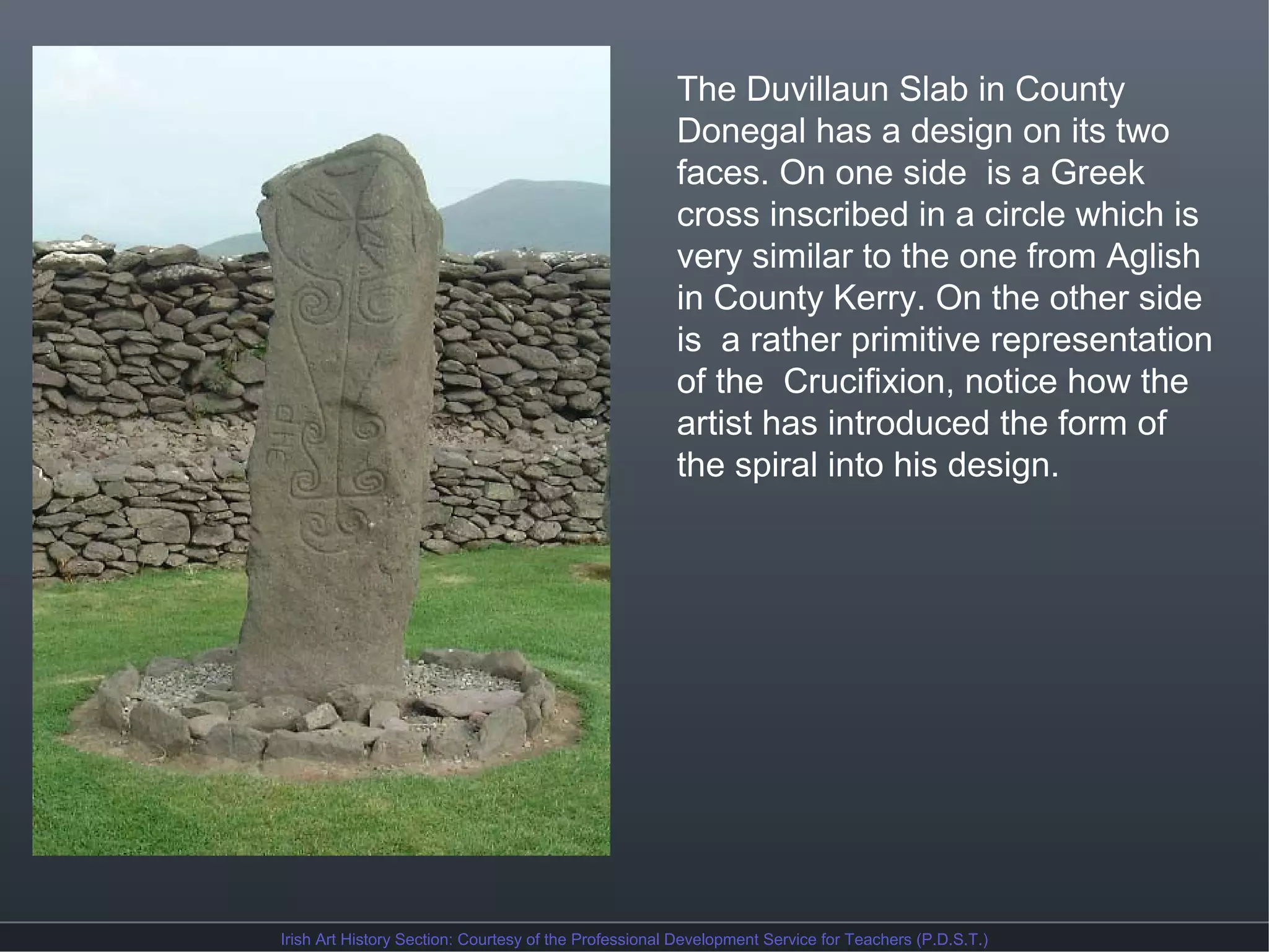
The Duvillaun Slab in County
Donegal has a design on its two
faces. On one side is a Greek
cross inscribed in a circle which is
very similar to the one from Aglish
in County Kerry. On the other side
is a rather primitive representation
of the Crucifixion, notice how the
artist has introduced the form of
the spiral into his design.

Irish Art History Section: Courtesy of the Professional Development Service for Teachers (P.D.S.T.)
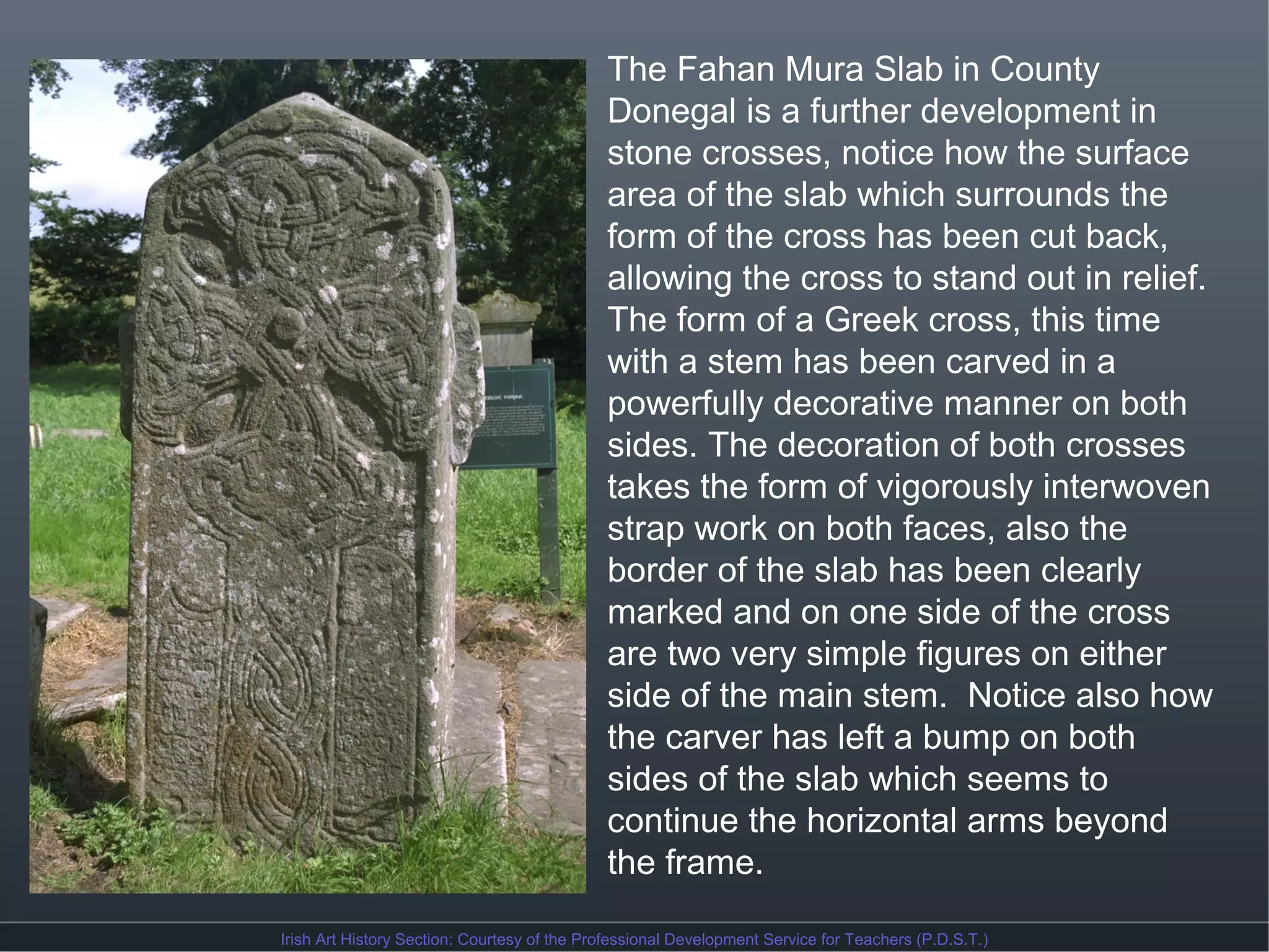
The Fahan Mura Slab in County
Donegal is a further development in
stone crosses, notice how the surface
area of the slab which surrounds the
form of the cross has been cut back,
allowing the cross to stand out in relief.
The form of a Greek cross, this time
with a stem has been carved in a
powerfully decorative manner on both
sides. The decoration of both crosses
takes the form of vigorously interwoven
strap work on both faces, also the
border of the slab has been clearly
marked and on one side of the cross
are two very simple figures on either
side of the main stem. Notice also how
the carver has left a bump on both
sides of the slab which seems to
continue the horizontal arms beyond
the frame.
Irish Art History Section: Courtesy of the Professional Development Service for Teachers (P.D.S.T.)
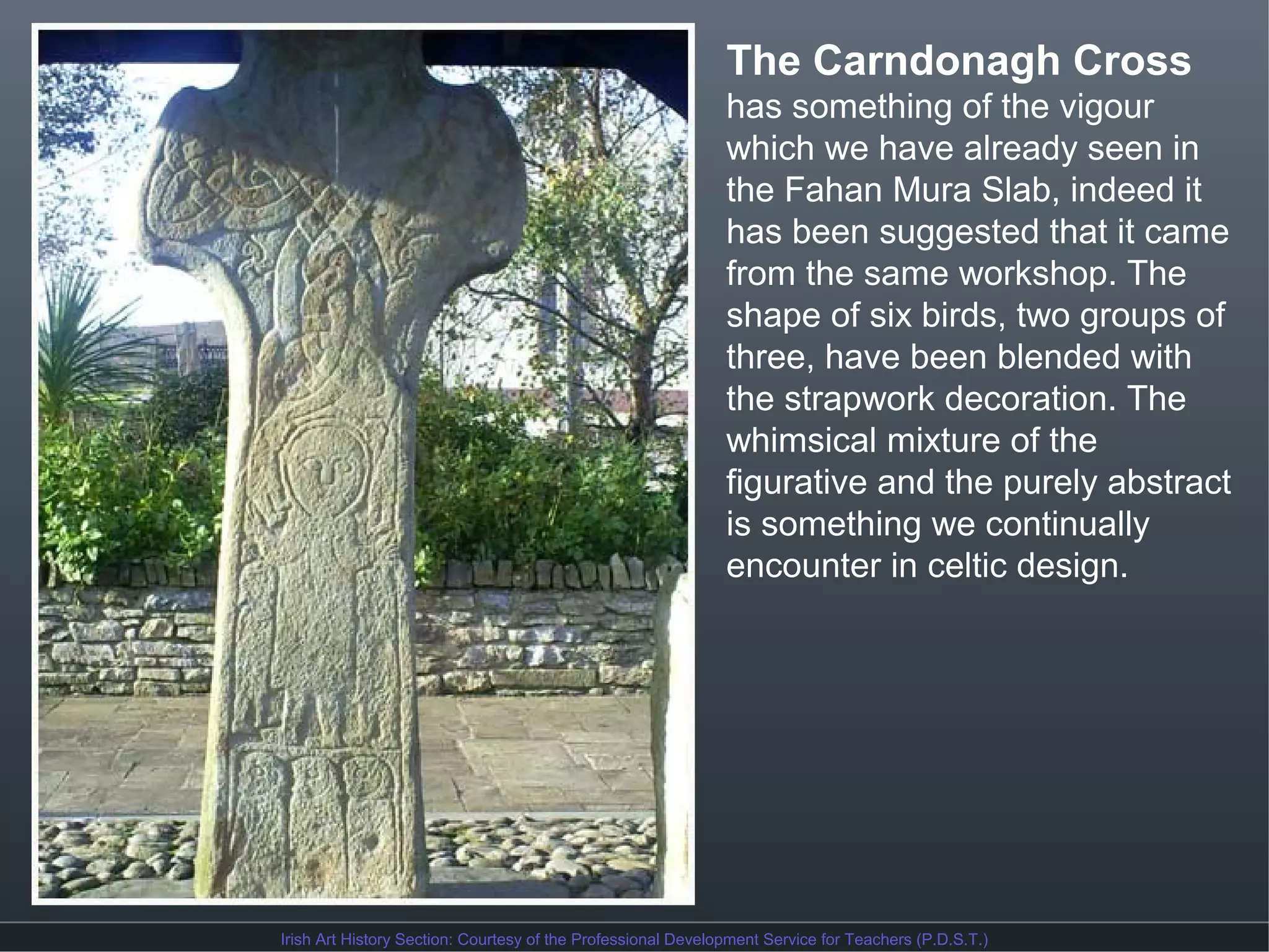
The Carndonagh Cross
has something of the vigour
which we have already seen in
the Fahan Mura Slab, indeed it
has been suggested that it came
from the same workshop. The
shape of six birds, two groups of
three, have been blended with
the strapwork decoration. The
whimsical mixture of the
figurative and the purely abstract
is something we continually
encounter in celtic design.

Irish Art History Section: Courtesy of the Professional Development Service for Teachers (P.D.S.T.)
High Period of Christian Irish Culture 7th to
the 9th C
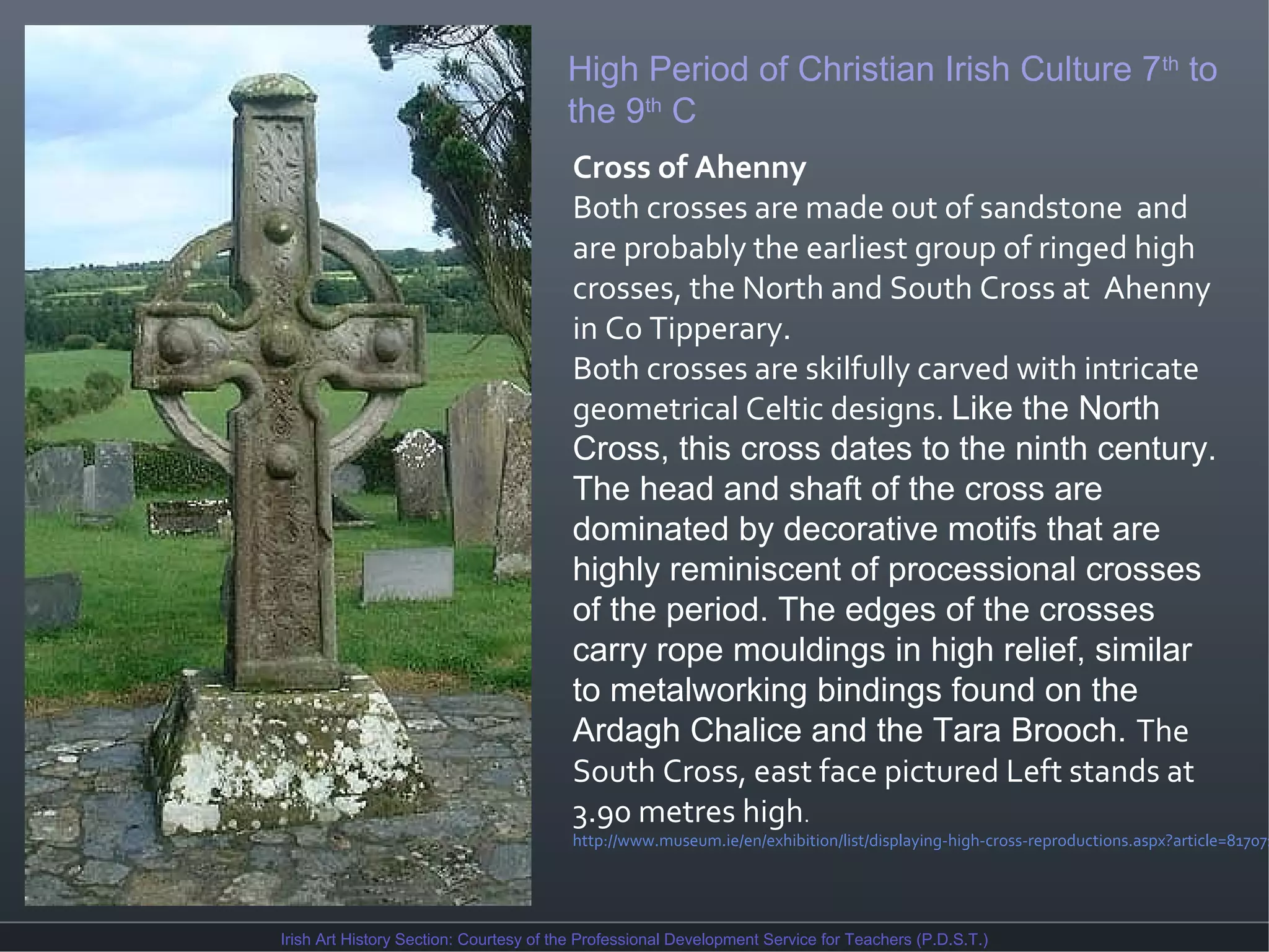
Cross of Ahenny
Both crosses are made out of sandstone and
are probably the earliest group of ringed high
crosses, the North and South Cross at Ahenny
in Co Tipperary.
Both crosses are skilfully carved with intricate
geometrical Celtic designs. Like the North
Cross, this cross dates to the ninth century.
The head and shaft of the cross are
dominated by decorative motifs that are
highly reminiscent of processional crosses
of the period. The edges of the crosses
carry rope mouldings in high relief, similar
to metalworking bindings found on the
Ardagh Chalice and the Tara Brooch. The
South Cross, east face pictured Left stands at
3.90 metres high.

http://www.museum.ie/en/exhibition/list/displaying-high-cross-reproductions.aspx?article=817071

Irish Art History Section: Courtesy of the Professional Development Service for Teachers (P.D.S.T.)
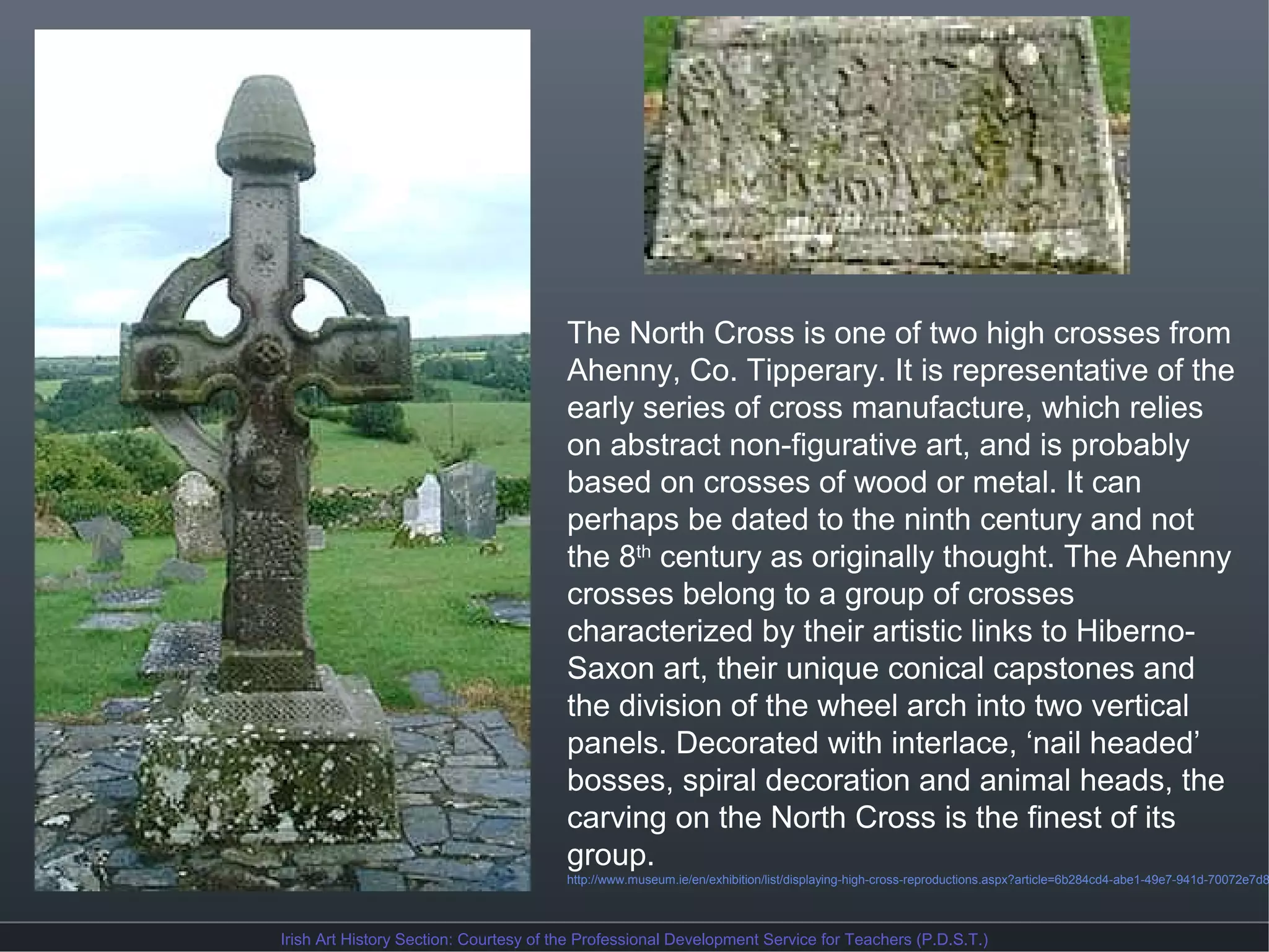
The North Cross is one of two high crosses from
Ahenny, Co. Tipperary. It is representative of the
early series of cross manufacture, which relies
on abstract non-figurative art, and is probably
based on crosses of wood or metal. It can
perhaps be dated to the ninth century and not
the 8th century as originally thought. The Ahenny
crosses belong to a group of crosses
characterized by their artistic links to HibernoSaxon art, their unique conical capstones and
the division of the wheel arch into two vertical
panels. Decorated with interlace, ‘nail headed’
bosses, spiral decoration and animal heads, the
carving on the North Cross is the finest of its
group.

http://www.museum.ie/en/exhibition/list/displaying-high-cross-reproductions.aspx?article=6b284cd4-abe1-49e7-941d-70072e7d8

Irish Art History Section: Courtesy of the Professional Development Service for Teachers (P.D.S.T.)
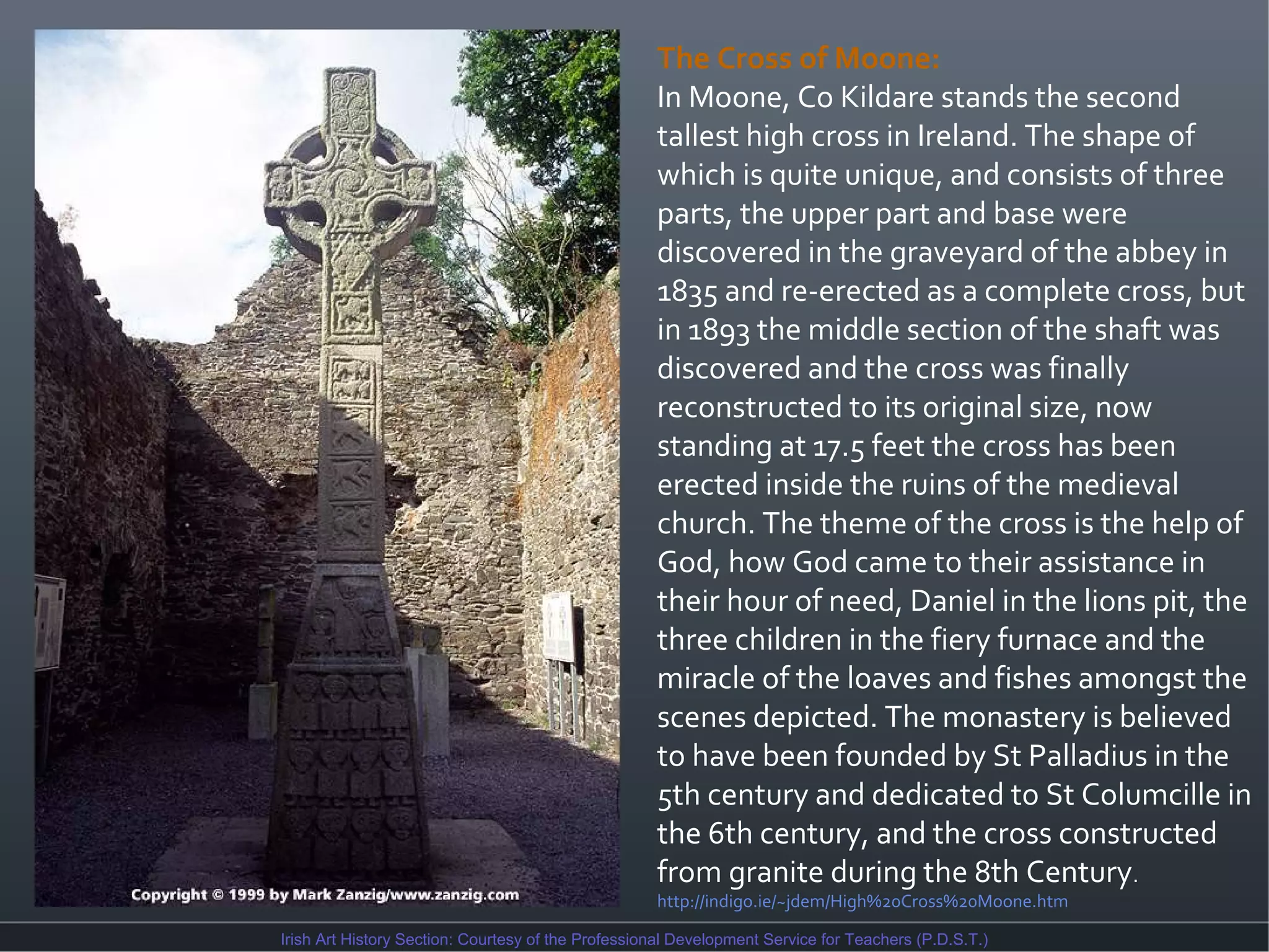
The Cross of Moone:
In Moone, Co Kildare stands the second
tallest high cross in Ireland. The shape of
which is quite unique, and consists of three
parts, the upper part and base were
discovered in the graveyard of the abbey in
1835 and re-erected as a complete cross, but
in 1893 the middle section of the shaft was
discovered and the cross was finally
reconstructed to its original size, now
standing at 17.5 feet the cross has been
erected inside the ruins of the medieval
church. The theme of the cross is the help of
God, how God came to their assistance in
their hour of need, Daniel in the lions pit, the
three children in the fiery furnace and the
miracle of the loaves and fishes amongst the
scenes depicted. The monastery is believed
to have been founded by St Palladius in the
5th century and dedicated to St Columcille in
the 6th century, and the cross constructed
from granite during the 8th Century.
http://indigo.ie/~jdem/High%20Cross%20Moone.htm
Irish Art History Section: Courtesy of the Professional Development Service for Teachers (P.D.S.T.)
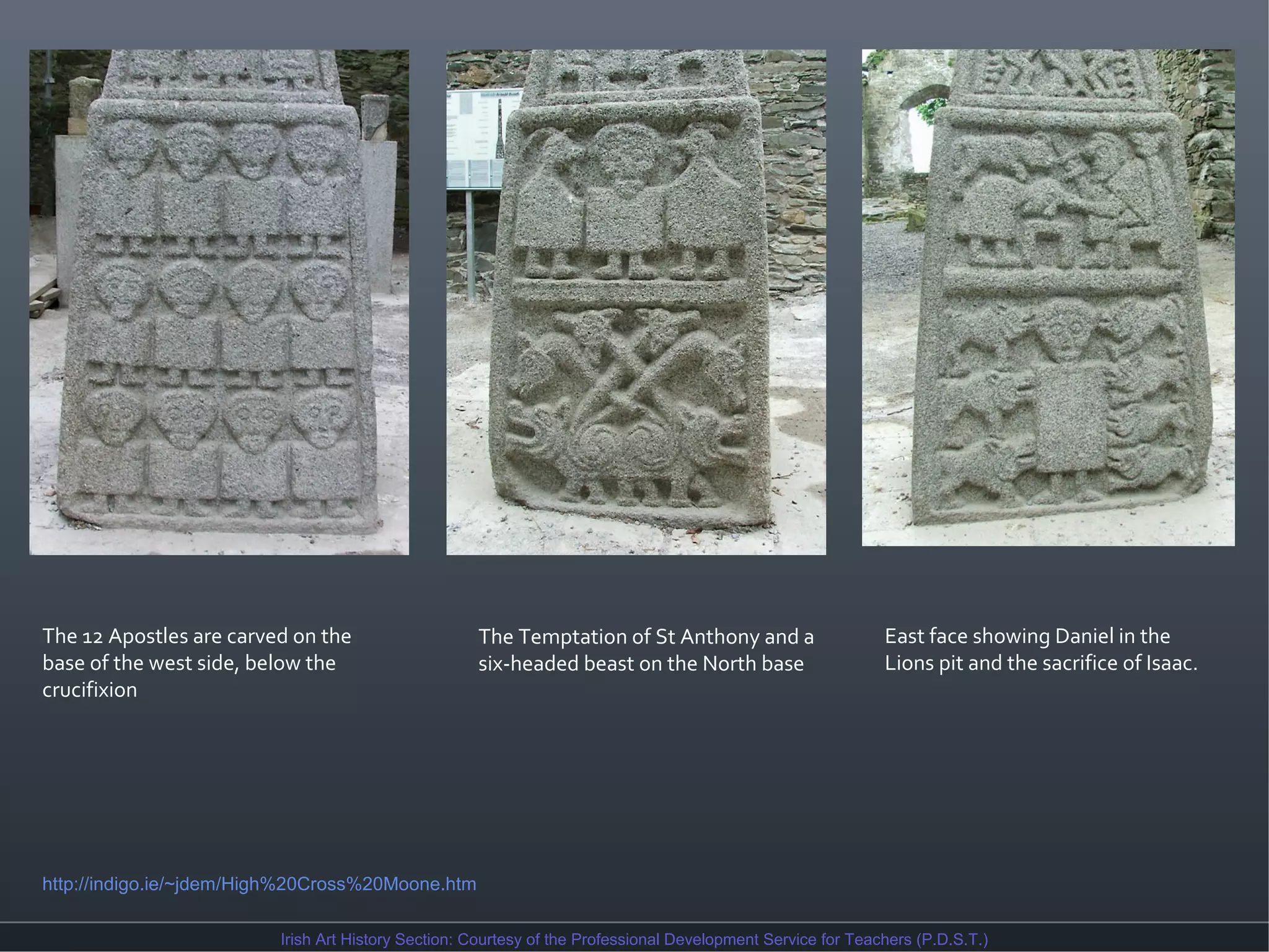
The 12 Apostles are carved on the
base of the west side, below the
crucifixion

The Temptation of St Anthony and a
six-headed beast on the North base

East face showing Daniel in the
Lions pit and the sacrifice of Isaac.

http://indigo.ie/~jdem/High%20Cross%20Moone.htm
Irish Art History Section: Courtesy of the Professional Development Service for Teachers (P.D.S.T.)
Castledermot:
A monastery was founded here by St Dermot, there is a
Round Tower and two High Crosses, the North and
South Cross, both of which are granite, plus the base of
a third Cross.
The North Cross
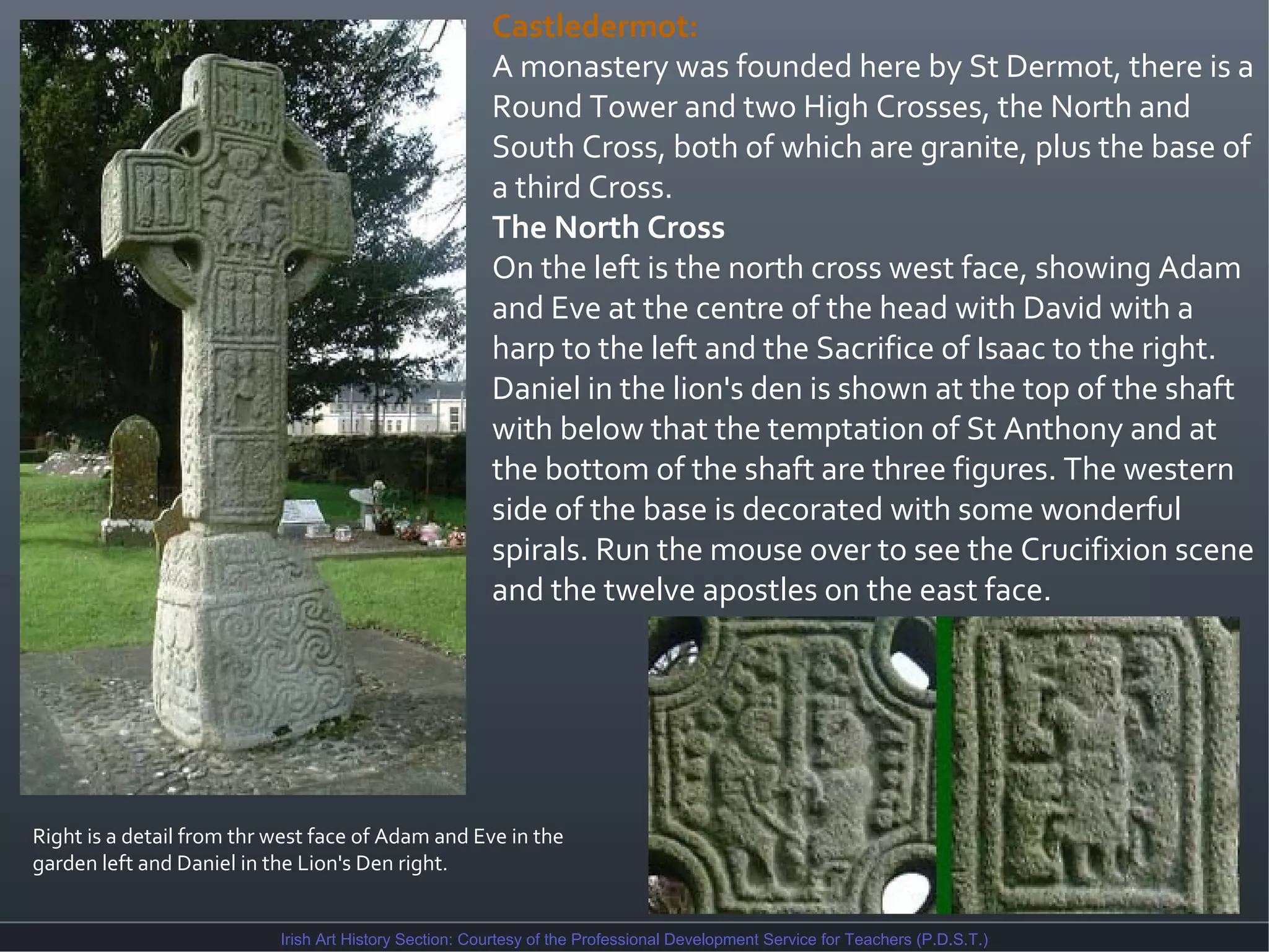
On the left is the north cross west face, showing Adam
and Eve at the centre of the head with David with a
harp to the left and the Sacrifice of Isaac to the right.
Daniel in the lion's den is shown at the top of the shaft
with below that the temptation of St Anthony and at
the bottom of the shaft are three figures. The western
side of the base is decorated with some wonderful
spirals. Run the mouse over to see the Crucifixion scene
and the twelve apostles on the east face.

Right is a detail from thr west face of Adam and Eve in the
garden left and Daniel in the Lion's Den right.
Irish Art History Section: Courtesy of the Professional Development Service for Teachers (P.D.S.T.)
The South Cross:
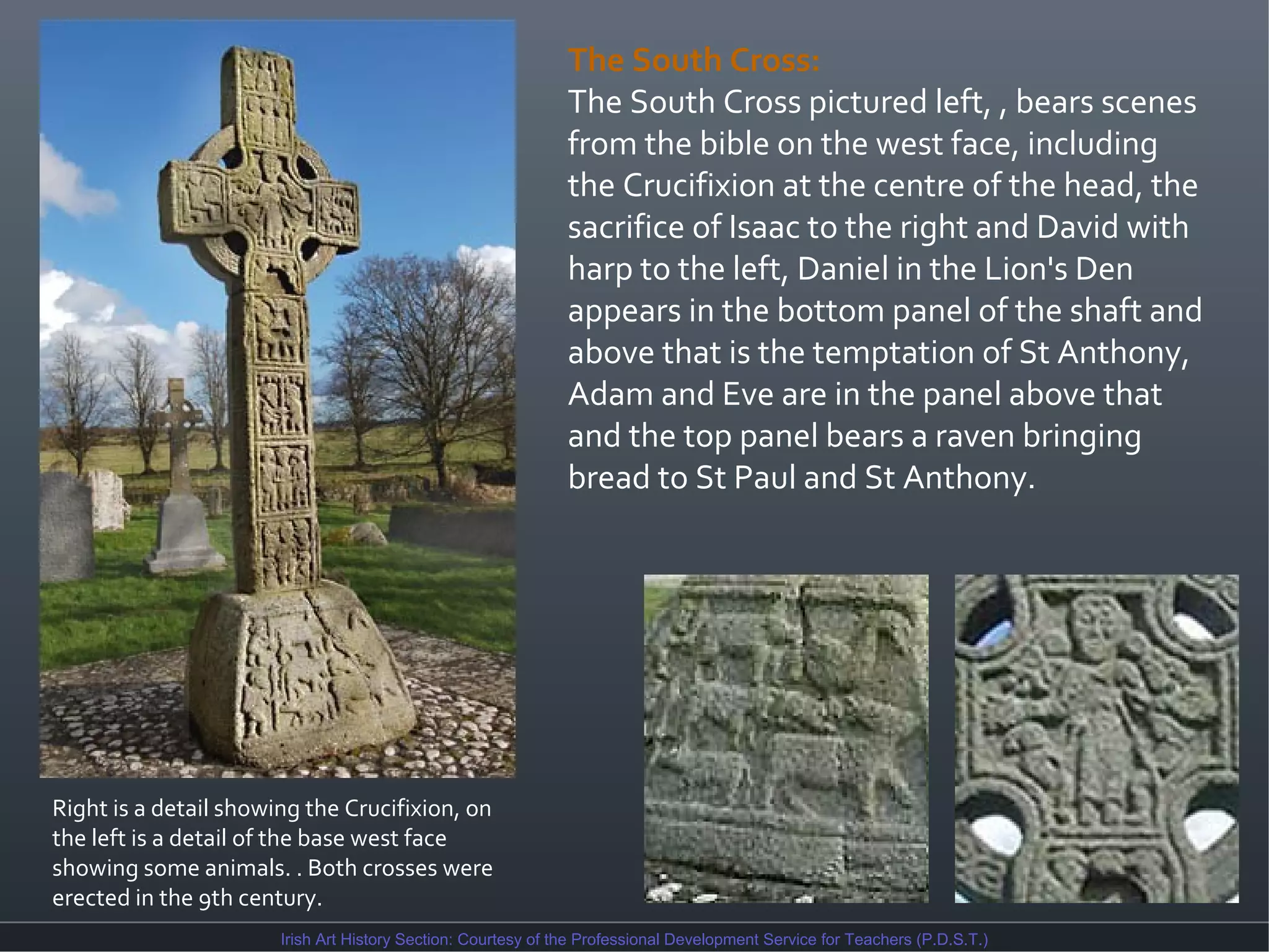
The South Cross pictured left, , bears scenes
from the bible on the west face, including
the Crucifixion at the centre of the head, the
sacrifice of Isaac to the right and David with
harp to the left, Daniel in the Lion's Den
appears in the bottom panel of the shaft and
above that is the temptation of St Anthony,
Adam and Eve are in the panel above that
and the top panel bears a raven bringing
bread to St Paul and St Anthony.

Right is a detail showing the Crucifixion, on
the left is a detail of the base west face
showing some animals. . Both crosses were
erected in the 9th century.
Irish Art History Section: Courtesy of the Professional Development Service for Teachers (P.D.S.T.)
Clonmacnois:
The Monastery at Clonmacnois, Co Offally,
was founded in the 6th century by St Ciaran,.
Amongst the many remains at Clonmacnois
are two complete High Crosses plus the
remains of another. The most famous being,
the Cross of the Scriptures, also known as
King Flann's Cross.
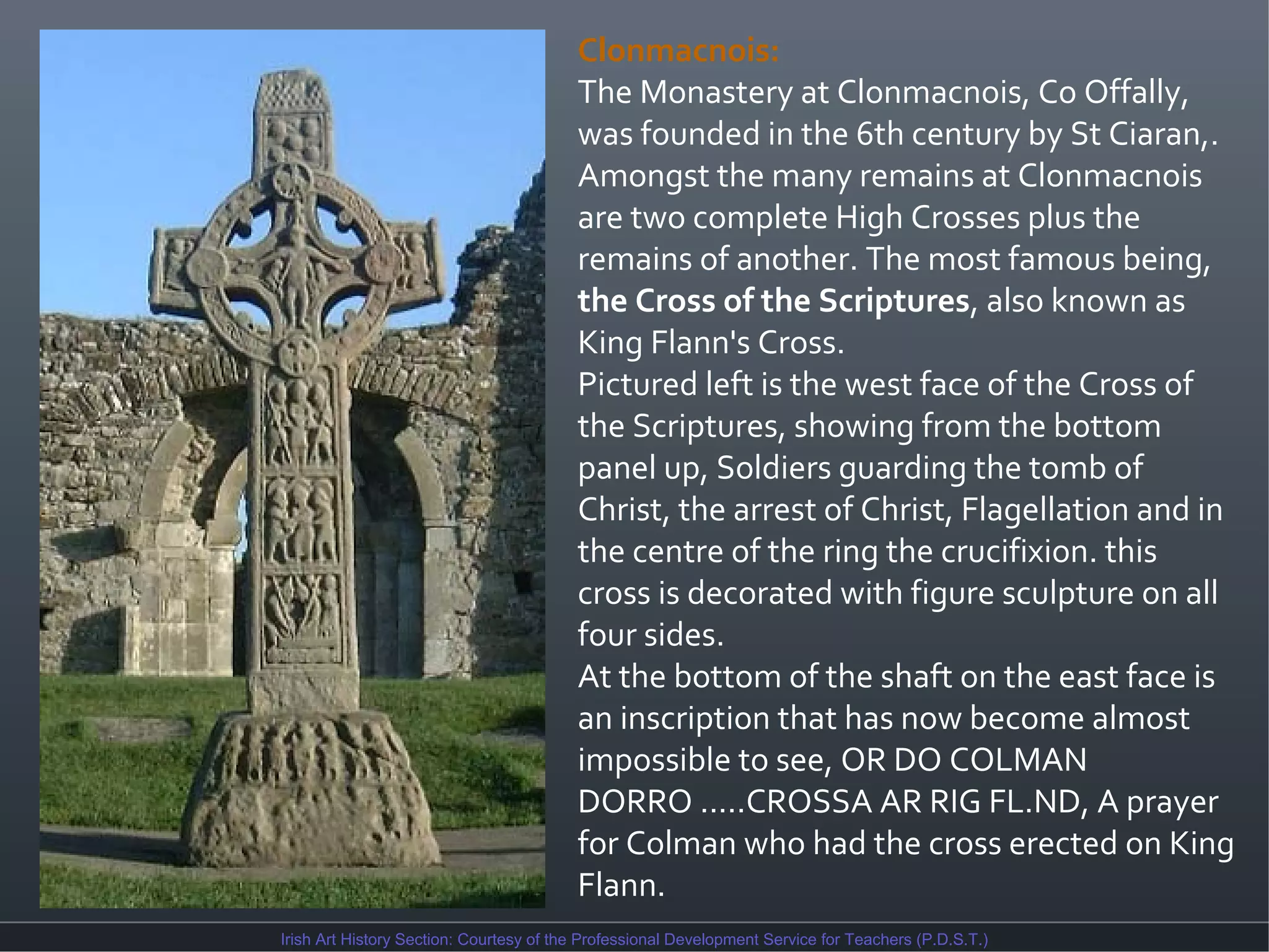
Pictured left is the west face of the Cross of
the Scriptures, showing from the bottom
panel up, Soldiers guarding the tomb of
Christ, the arrest of Christ, Flagellation and in
the centre of the ring the crucifixion. this
cross is decorated with figure sculpture on all
four sides.
At the bottom of the shaft on the east face is
an inscription that has now become almost
impossible to see, OR DO COLMAN
DORRO .....CROSSA AR RIG FL.ND, A prayer
for Colman who had the cross erected on King
Flann.
Irish Art History Section: Courtesy of the Professional Development Service for Teachers (P.D.S.T.)
Monasterboice:
Monasterboice County Louth, contains
two of the finest High Crosses in
Ireland, both of these Crosses are
made of sandstone and date to around
the 9th century. The site also has a
round tower, which is in excellent
condition.
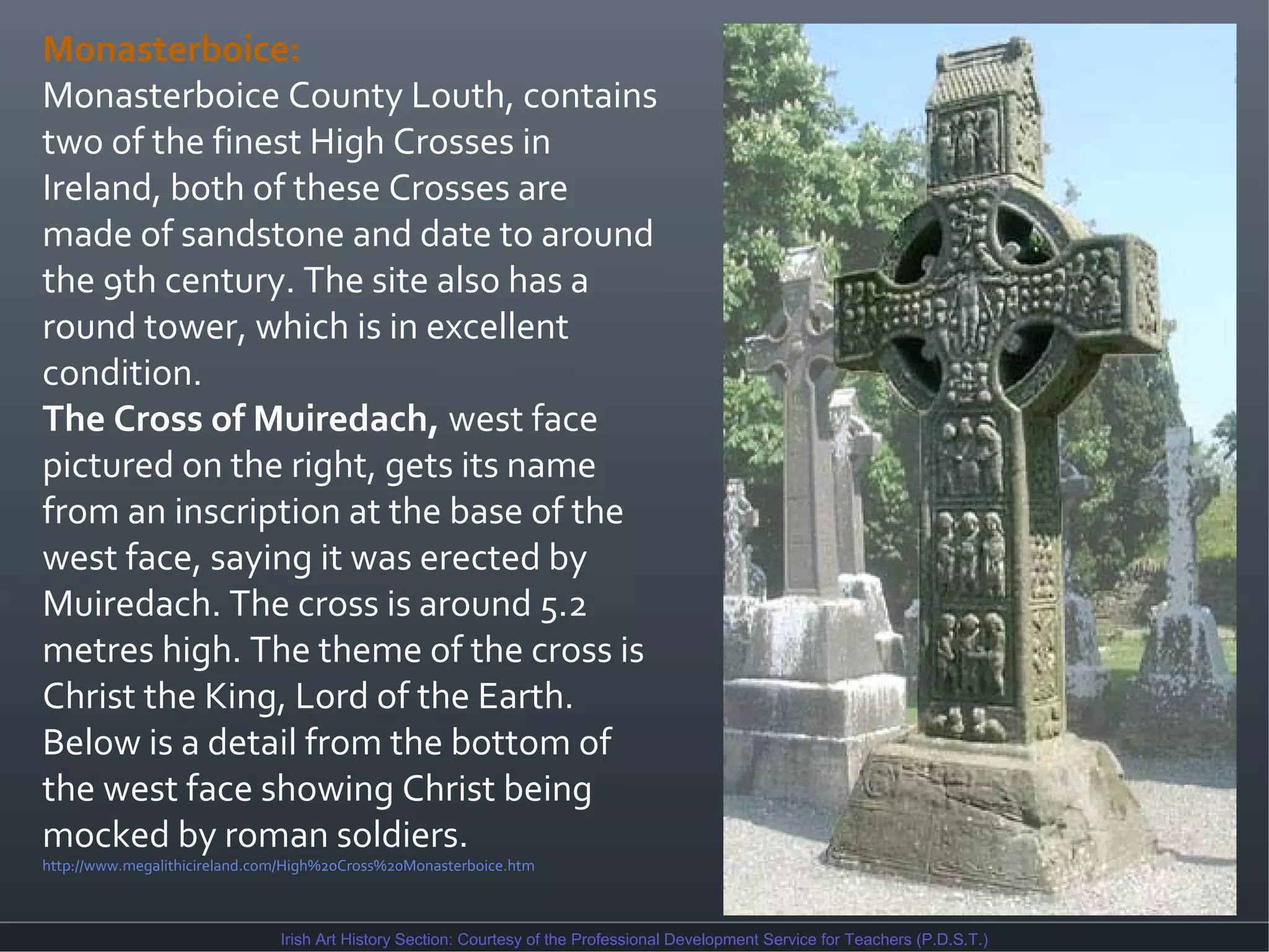
The Cross of Muiredach, west face
pictured on the right, gets its name
from an inscription at the base of the
west face, saying it was erected by
Muiredach. The cross is around 5.2
metres high. The theme of the cross is
Christ the King, Lord of the Earth.
Below is a detail from the bottom of
the west face showing Christ being
mocked by roman soldiers.
http://www.megalithicireland.com/High%20Cross%20Monasterboice.htm

Irish Art History Section: Courtesy of the Professional Development Service for Teachers (P.D.S.T.)
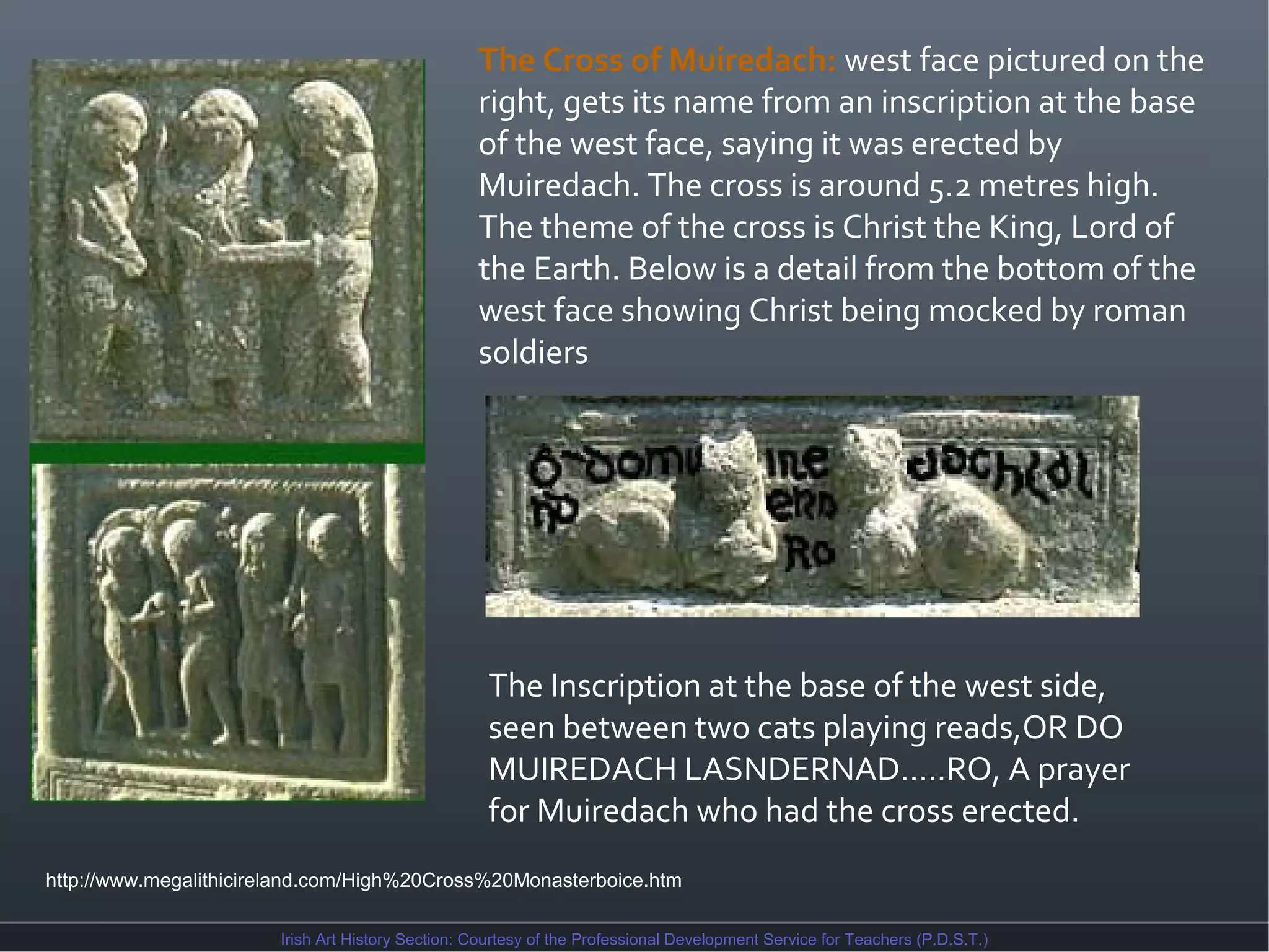
The Cross of Muiredach: west face pictured on the
right, gets its name from an inscription at the base
of the west face, saying it was erected by
Muiredach. The cross is around 5.2 metres high.
The theme of the cross is Christ the King, Lord of
the Earth. Below is a detail from the bottom of the
west face showing Christ being mocked by roman
soldiers

The Inscription at the base of the west side,
seen between two cats playing reads,OR DO
MUIREDACH LASNDERNAD.....RO, A prayer
for Muiredach who had the cross erected.
http://www.megalithicireland.com/High%20Cross%20Monasterboice.htm
Irish Art History Section: Courtesy of the Professional Development Service for Teachers (P.D.S.T.)
Professional Development Service for Teachers

Irish Art History Section: Courtesy of the
Professional Development Service for Teachers
(P.D.S.T.)

Cultural & Environmental Education
National Co-ordinator

Conor Harrison
E-mail: conorharrison@pdst.ie
The PDST is funded by the
Department of Education and Skills
under the National Development Plan
2007 - 2013

Special thanks to Tony Morrissey for researching and compiling the
information, images and video for this Power Point :

Irish Art History Section: Courtesy of the Professional Development Service for Teachers (P.D.S.T.)
Reference:
The following websites were accessed in the making of this PowerPoint:
http://www.museum.ie/en/exhibition/list/displaying-high-cross-reproductions.aspx
http://www.megalithicireland.com/High%20Cross%20Home.htm
http://www.traleetimes.com/files/HISTORY/Early_Christian_IrelandPDF.pdf
http://www.novelguide.com/a/discover/eich_01/eich_01_00031.html
http://indigo.ie/~jdem/High%20Cross%20Moone.htm

Irish Art History Section: Courtesy of the Professional Development Service for Teachers (P.D.S.T.)

Pp5 the development of stone carving

  • 1.
    Early Christian StoneCrosses in Ireland A.D 500-800 Early Christian Stone Crosses in Ireland A.D 500-800 Irish Art History Section: Courtesy of the Professional Development Service for Teachers (P.D.S.T.)
  • 2.
    Early Christian StoneCrosses in Ireland A.D 500-800 Early Christian Stone Crosses Monks carved and decorated stone crosses at many monastic sites. Earliest examples were just stone slabs and later the stones have arms with a circle surrounding the arms Irish Art History Section: Courtesy of the Professional Development Service for Teachers (P.D.S.T.)
  • 3.
    The Duvillaun Slabin County Donegal has a design on its two faces. On one side is a Greek cross inscribed in a circle which is very similar to the one from Aglish in County Kerry. On the other side is a rather primitive representation of the Crucifixion, notice how the artist has introduced the form of the spiral into his design. Irish Art History Section: Courtesy of the Professional Development Service for Teachers (P.D.S.T.)
  • 4.
    The Fahan MuraSlab in County Donegal is a further development in stone crosses, notice how the surface area of the slab which surrounds the form of the cross has been cut back, allowing the cross to stand out in relief. The form of a Greek cross, this time with a stem has been carved in a powerfully decorative manner on both sides. The decoration of both crosses takes the form of vigorously interwoven strap work on both faces, also the border of the slab has been clearly marked and on one side of the cross are two very simple figures on either side of the main stem. Notice also how the carver has left a bump on both sides of the slab which seems to continue the horizontal arms beyond the frame. Irish Art History Section: Courtesy of the Professional Development Service for Teachers (P.D.S.T.)
  • 5.
    The Carndonagh Cross hassomething of the vigour which we have already seen in the Fahan Mura Slab, indeed it has been suggested that it came from the same workshop. The shape of six birds, two groups of three, have been blended with the strapwork decoration. The whimsical mixture of the figurative and the purely abstract is something we continually encounter in celtic design. Irish Art History Section: Courtesy of the Professional Development Service for Teachers (P.D.S.T.)
  • 6.
    High Period ofChristian Irish Culture 7th to the 9th C Cross of Ahenny Both crosses are made out of sandstone and are probably the earliest group of ringed high crosses, the North and South Cross at Ahenny in Co Tipperary. Both crosses are skilfully carved with intricate geometrical Celtic designs. Like the North Cross, this cross dates to the ninth century. The head and shaft of the cross are dominated by decorative motifs that are highly reminiscent of processional crosses of the period. The edges of the crosses carry rope mouldings in high relief, similar to metalworking bindings found on the Ardagh Chalice and the Tara Brooch. The South Cross, east face pictured Left stands at 3.90 metres high. http://www.museum.ie/en/exhibition/list/displaying-high-cross-reproductions.aspx?article=817071 Irish Art History Section: Courtesy of the Professional Development Service for Teachers (P.D.S.T.)
  • 7.
    The North Crossis one of two high crosses from Ahenny, Co. Tipperary. It is representative of the early series of cross manufacture, which relies on abstract non-figurative art, and is probably based on crosses of wood or metal. It can perhaps be dated to the ninth century and not the 8th century as originally thought. The Ahenny crosses belong to a group of crosses characterized by their artistic links to HibernoSaxon art, their unique conical capstones and the division of the wheel arch into two vertical panels. Decorated with interlace, ‘nail headed’ bosses, spiral decoration and animal heads, the carving on the North Cross is the finest of its group. http://www.museum.ie/en/exhibition/list/displaying-high-cross-reproductions.aspx?article=6b284cd4-abe1-49e7-941d-70072e7d8 Irish Art History Section: Courtesy of the Professional Development Service for Teachers (P.D.S.T.)
  • 8.
    The Cross ofMoone: In Moone, Co Kildare stands the second tallest high cross in Ireland. The shape of which is quite unique, and consists of three parts, the upper part and base were discovered in the graveyard of the abbey in 1835 and re-erected as a complete cross, but in 1893 the middle section of the shaft was discovered and the cross was finally reconstructed to its original size, now standing at 17.5 feet the cross has been erected inside the ruins of the medieval church. The theme of the cross is the help of God, how God came to their assistance in their hour of need, Daniel in the lions pit, the three children in the fiery furnace and the miracle of the loaves and fishes amongst the scenes depicted. The monastery is believed to have been founded by St Palladius in the 5th century and dedicated to St Columcille in the 6th century, and the cross constructed from granite during the 8th Century. http://indigo.ie/~jdem/High%20Cross%20Moone.htm Irish Art History Section: Courtesy of the Professional Development Service for Teachers (P.D.S.T.)
  • 9.
    The 12 Apostlesare carved on the base of the west side, below the crucifixion The Temptation of St Anthony and a six-headed beast on the North base East face showing Daniel in the Lions pit and the sacrifice of Isaac. http://indigo.ie/~jdem/High%20Cross%20Moone.htm Irish Art History Section: Courtesy of the Professional Development Service for Teachers (P.D.S.T.)
  • 10.
    Castledermot: A monastery wasfounded here by St Dermot, there is a Round Tower and two High Crosses, the North and South Cross, both of which are granite, plus the base of a third Cross. The North Cross On the left is the north cross west face, showing Adam and Eve at the centre of the head with David with a harp to the left and the Sacrifice of Isaac to the right. Daniel in the lion's den is shown at the top of the shaft with below that the temptation of St Anthony and at the bottom of the shaft are three figures. The western side of the base is decorated with some wonderful spirals. Run the mouse over to see the Crucifixion scene and the twelve apostles on the east face. Right is a detail from thr west face of Adam and Eve in the garden left and Daniel in the Lion's Den right. Irish Art History Section: Courtesy of the Professional Development Service for Teachers (P.D.S.T.)
  • 11.
    The South Cross: TheSouth Cross pictured left, , bears scenes from the bible on the west face, including the Crucifixion at the centre of the head, the sacrifice of Isaac to the right and David with harp to the left, Daniel in the Lion's Den appears in the bottom panel of the shaft and above that is the temptation of St Anthony, Adam and Eve are in the panel above that and the top panel bears a raven bringing bread to St Paul and St Anthony. Right is a detail showing the Crucifixion, on the left is a detail of the base west face showing some animals. . Both crosses were erected in the 9th century. Irish Art History Section: Courtesy of the Professional Development Service for Teachers (P.D.S.T.)
  • 12.
    Clonmacnois: The Monastery atClonmacnois, Co Offally, was founded in the 6th century by St Ciaran,. Amongst the many remains at Clonmacnois are two complete High Crosses plus the remains of another. The most famous being, the Cross of the Scriptures, also known as King Flann's Cross. Pictured left is the west face of the Cross of the Scriptures, showing from the bottom panel up, Soldiers guarding the tomb of Christ, the arrest of Christ, Flagellation and in the centre of the ring the crucifixion. this cross is decorated with figure sculpture on all four sides. At the bottom of the shaft on the east face is an inscription that has now become almost impossible to see, OR DO COLMAN DORRO .....CROSSA AR RIG FL.ND, A prayer for Colman who had the cross erected on King Flann. Irish Art History Section: Courtesy of the Professional Development Service for Teachers (P.D.S.T.)
  • 13.
    Monasterboice: Monasterboice County Louth,contains two of the finest High Crosses in Ireland, both of these Crosses are made of sandstone and date to around the 9th century. The site also has a round tower, which is in excellent condition. The Cross of Muiredach, west face pictured on the right, gets its name from an inscription at the base of the west face, saying it was erected by Muiredach. The cross is around 5.2 metres high. The theme of the cross is Christ the King, Lord of the Earth. Below is a detail from the bottom of the west face showing Christ being mocked by roman soldiers. http://www.megalithicireland.com/High%20Cross%20Monasterboice.htm Irish Art History Section: Courtesy of the Professional Development Service for Teachers (P.D.S.T.)
  • 14.
    The Cross ofMuiredach: west face pictured on the right, gets its name from an inscription at the base of the west face, saying it was erected by Muiredach. The cross is around 5.2 metres high. The theme of the cross is Christ the King, Lord of the Earth. Below is a detail from the bottom of the west face showing Christ being mocked by roman soldiers The Inscription at the base of the west side, seen between two cats playing reads,OR DO MUIREDACH LASNDERNAD.....RO, A prayer for Muiredach who had the cross erected. http://www.megalithicireland.com/High%20Cross%20Monasterboice.htm Irish Art History Section: Courtesy of the Professional Development Service for Teachers (P.D.S.T.)
  • 15.
    Professional Development Servicefor Teachers Irish Art History Section: Courtesy of the Professional Development Service for Teachers (P.D.S.T.) Cultural & Environmental Education National Co-ordinator Conor Harrison E-mail: conorharrison@pdst.ie The PDST is funded by the Department of Education and Skills under the National Development Plan 2007 - 2013 Special thanks to Tony Morrissey for researching and compiling the information, images and video for this Power Point : Irish Art History Section: Courtesy of the Professional Development Service for Teachers (P.D.S.T.)
  • 16.
    Reference: The following websiteswere accessed in the making of this PowerPoint: http://www.museum.ie/en/exhibition/list/displaying-high-cross-reproductions.aspx http://www.megalithicireland.com/High%20Cross%20Home.htm http://www.traleetimes.com/files/HISTORY/Early_Christian_IrelandPDF.pdf http://www.novelguide.com/a/discover/eich_01/eich_01_00031.html http://indigo.ie/~jdem/High%20Cross%20Moone.htm Irish Art History Section: Courtesy of the Professional Development Service for Teachers (P.D.S.T.)

Editor's Notes

  • #13 The east face The Cross was mentioned twice in the annals of the Four Masters, first in 957 and later in 1060. At the centre of the East face is the Last Judgement, and at the top of the East shaft is a panel showing Christ with Peter and Paul, on the base are three riders facing left and two chariots facing right. Below this panel are two more panels bearing iconography that are still open to interpretation. At the bottom of the shaft on the east face is an inscription that has now become almost impossible to see, OR DO COLMAN DORRO .....CROSSA AR RIG FL.ND, A prayer for Colman who had the cross erected on King Flann.