Graphics from Microsoft ™ ClipArt and Google Images
All you need to know about
Author’s Purpose, Position
and Point of View
in a nonfiction text
What will we learn today?
We will learn how to identify the author’s
purpose for writing different texts.
We will learn that one author’s position
can differ from another.
We will learn how the
author’s point of view
affects the text.
The author’s purpose is the
reason for writing the text:
to Persuade, Inform, or Entertain.
What is
Author’s Purpose?
Everything you read has a purpose.
When authors write books, magazines,
newspapers, on-line articles, even commercials,
they choose their words for a purpose.
PIE
Persuade
Inform
Entertain
When the author’s purpose is to
persuade, the author wants the
reader to side with his or her
position.
A persuasive text contains facts
and the author’s opinion.
Author’s Purpose
to persuade
With persuasive texts, the author’s position
is for or against the issue or topic.
Author’s
Purpose
to inform
If the author’s purpose is to
inform, the reader learns
something from the text.
Informational texts often include:
 Facts  Details  Instructions
 Descriptions  Explanations
Can you identify
the author’s
purpose?
YES! The correct
answer is to inform.
The label contains information and
instructions on how to use the medicine.
Author’s Purpose
to entertain
If the author’s purpose is to
entertain, an author writes
to interest the reader.
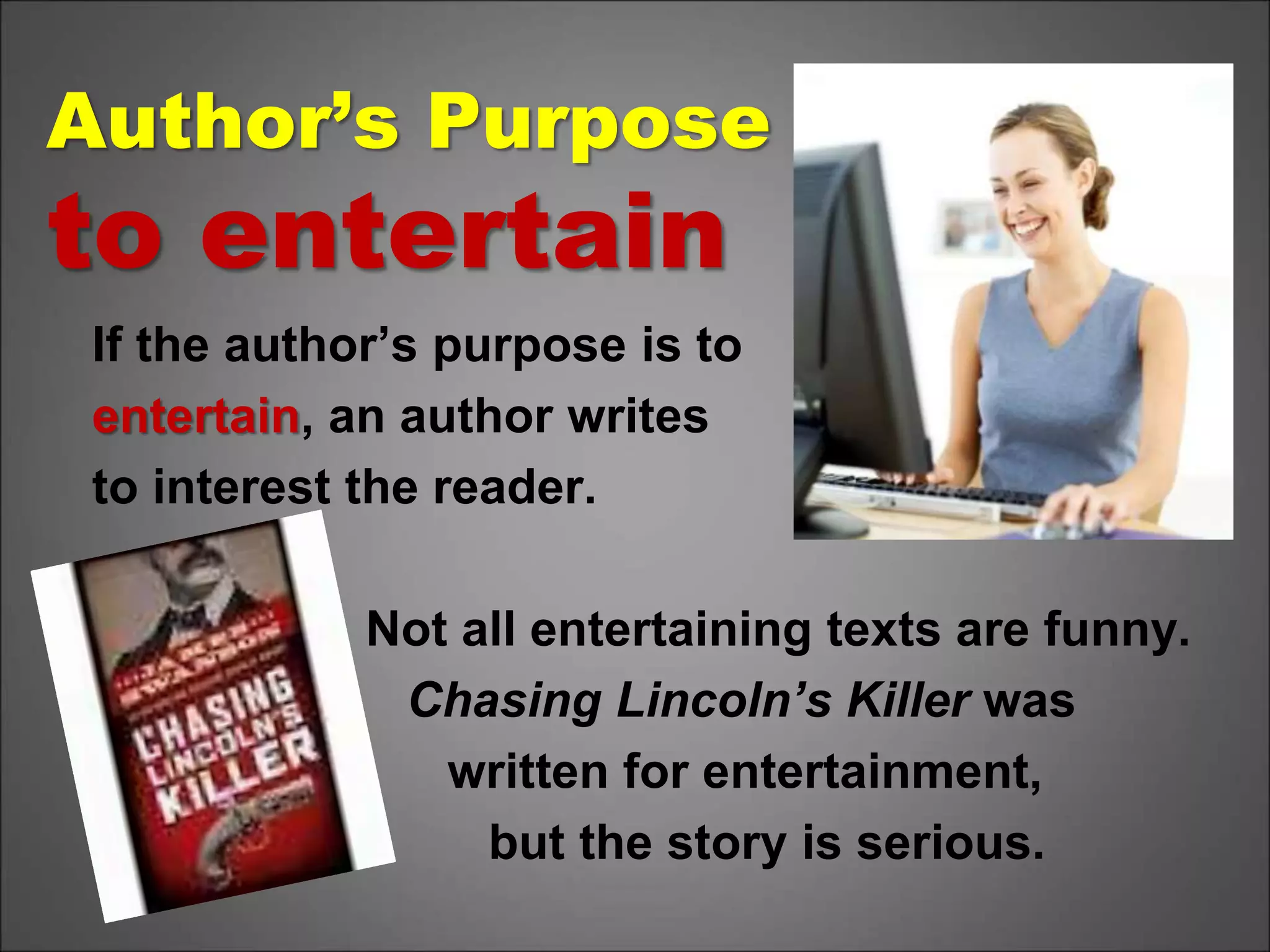
Not all entertaining texts are funny.
Chasing Lincoln’s Killer was
written for entertainment,
but the story is serious.
Can a text have
2 purposes?
YES! Some texts will
have two purposes.
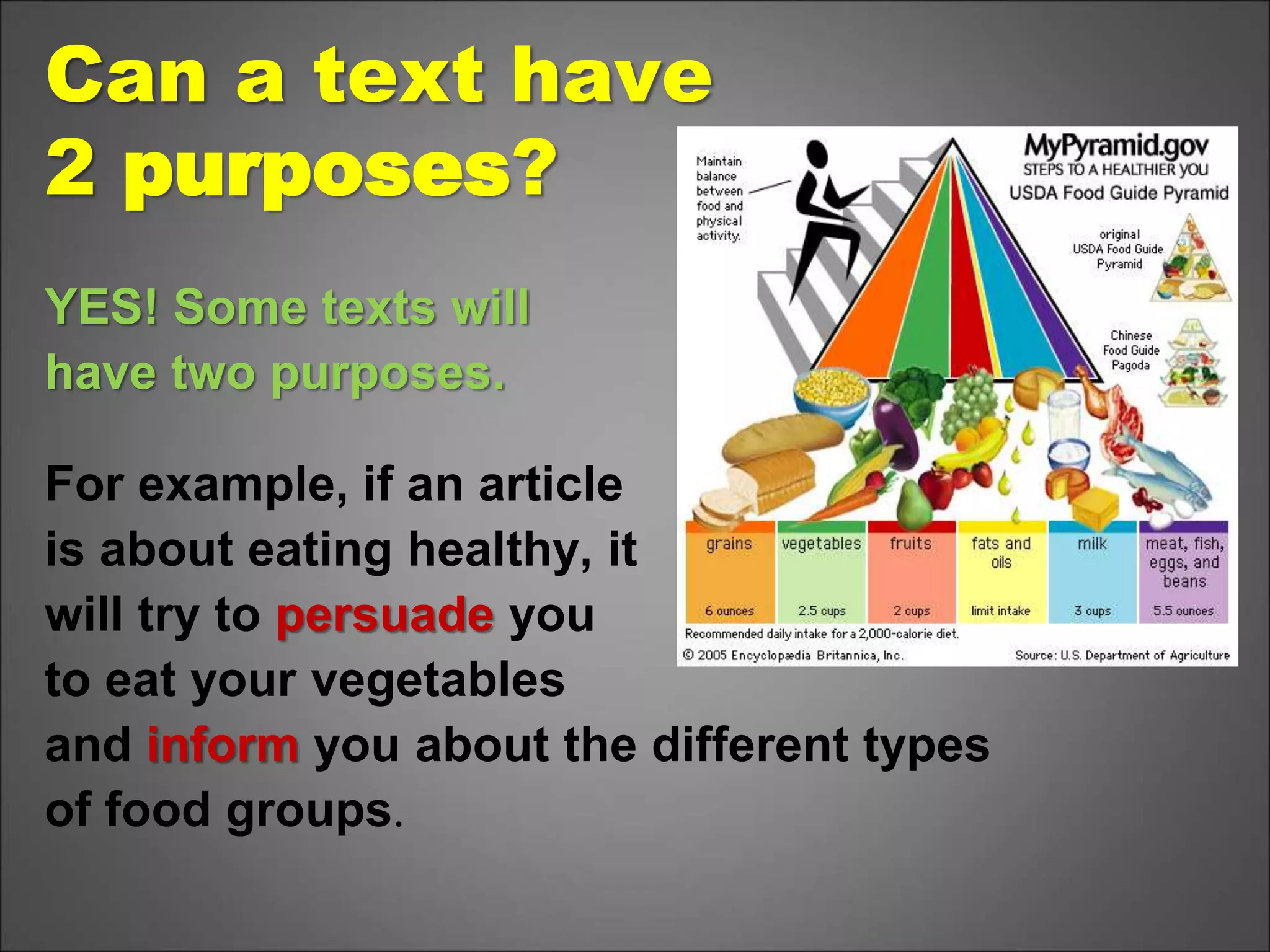
For example, if an article
is about eating healthy, it
will try to persuade you
to eat your vegetables
and inform you about the different types
of food groups.
Can a text have
2 purposes?
Some texts do
have two purposes.
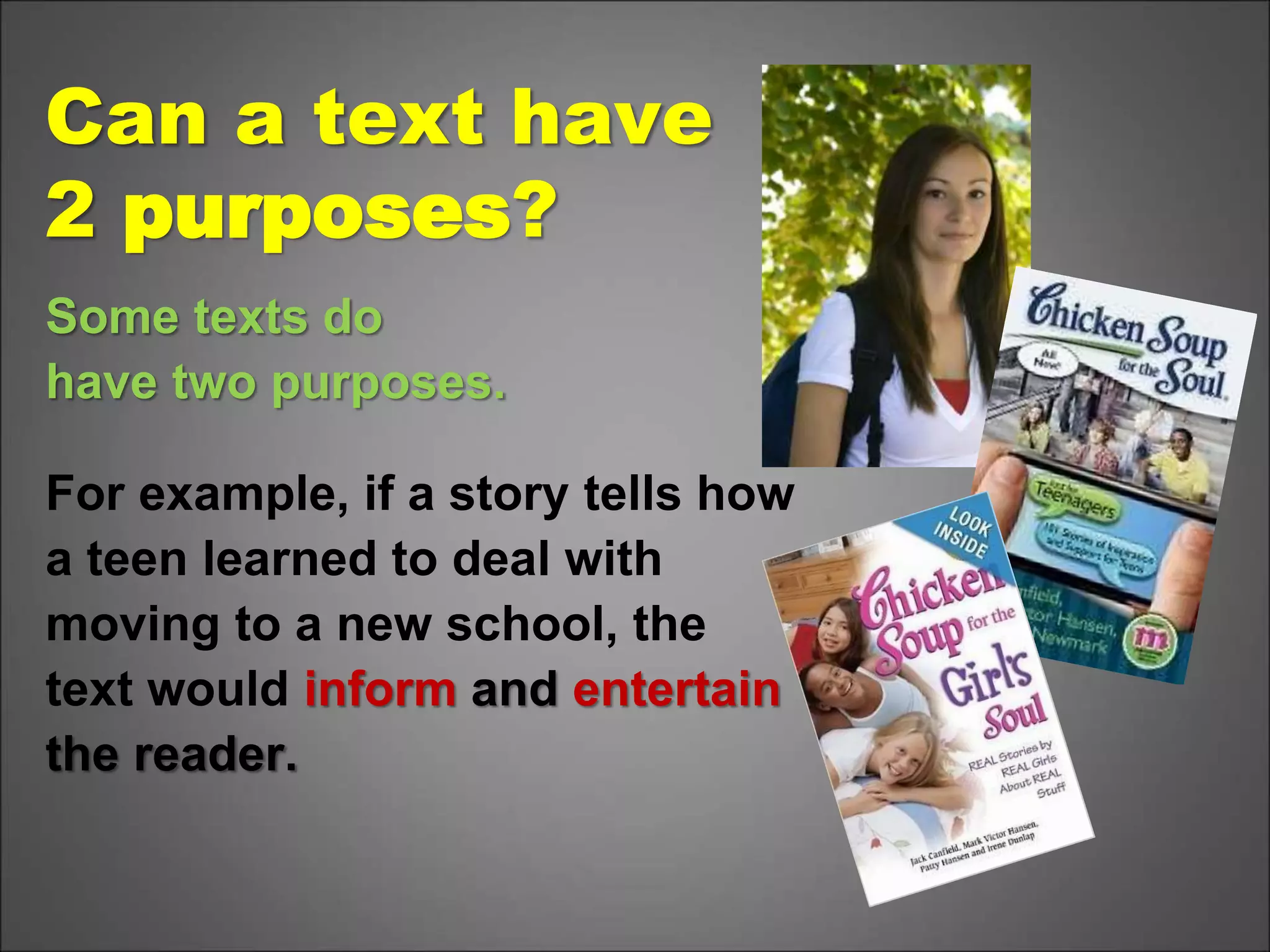
For example, if a story tells how
a teen learned to deal with
moving to a new school, the
text would inform and entertain
the reader.
Inform?
Entertain?
Persuade?
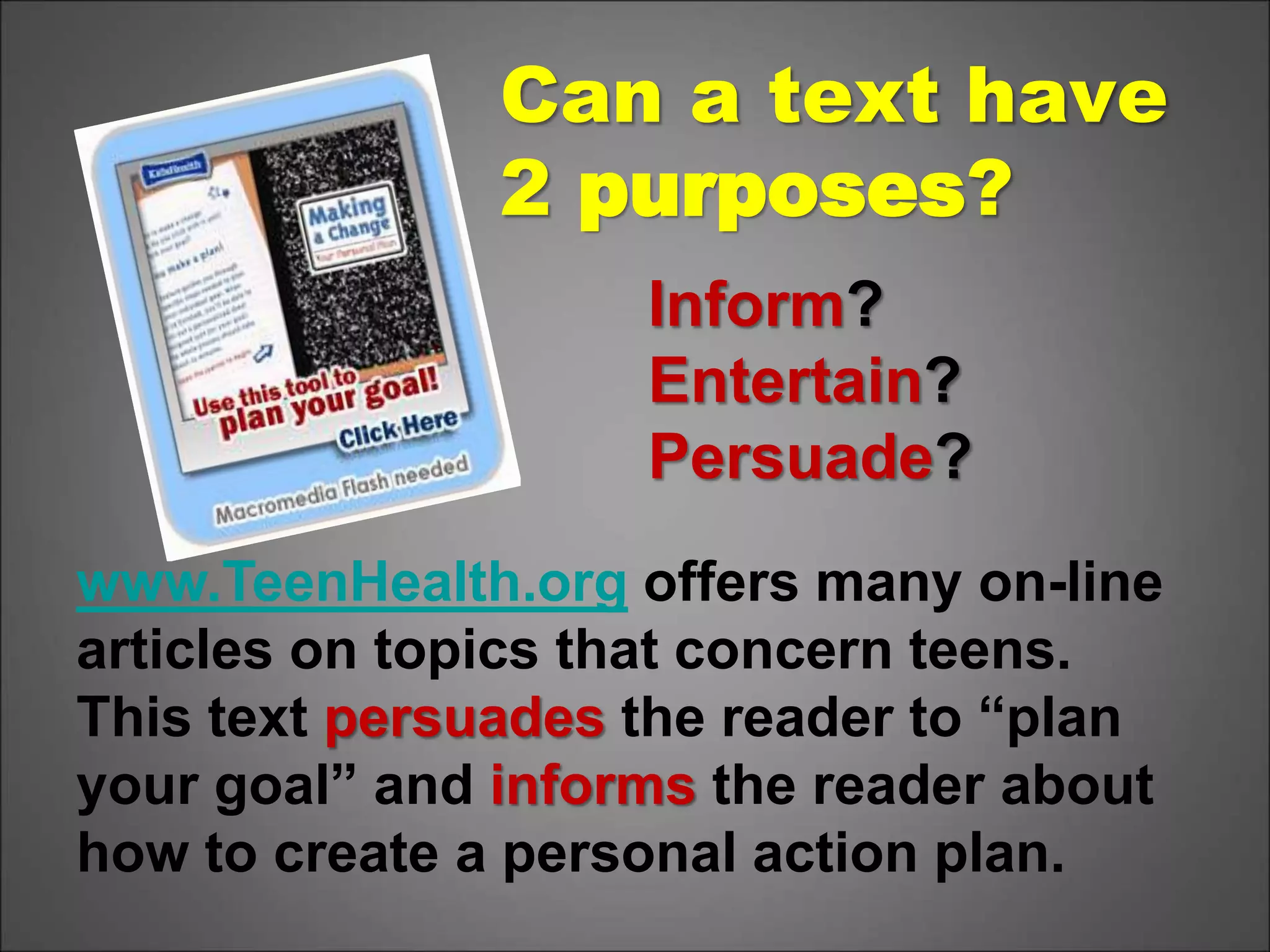
www.TeenHealth.org offers many on-line
articles on topics that concern teens.
This text persuades the reader to “plan
your goal” and informs the reader about
how to create a personal action plan.
Can a text have
2 purposes?
Author’s Position
An author’s position on a topic refers to
what the author thinks about the topic,
his or her perspective on the subject.
Authors’ Positions on Italian Food
One author may write about the many types of pasta and
cheeses available in Italian food. This author’s position is
that Italian food offers many delicious choices.
Another author may write that pasta has too many carbs and
cheese includes too many fat calories. This author’s
position is that Italian food is fattening.
An author’s
Point of View
in nonfiction
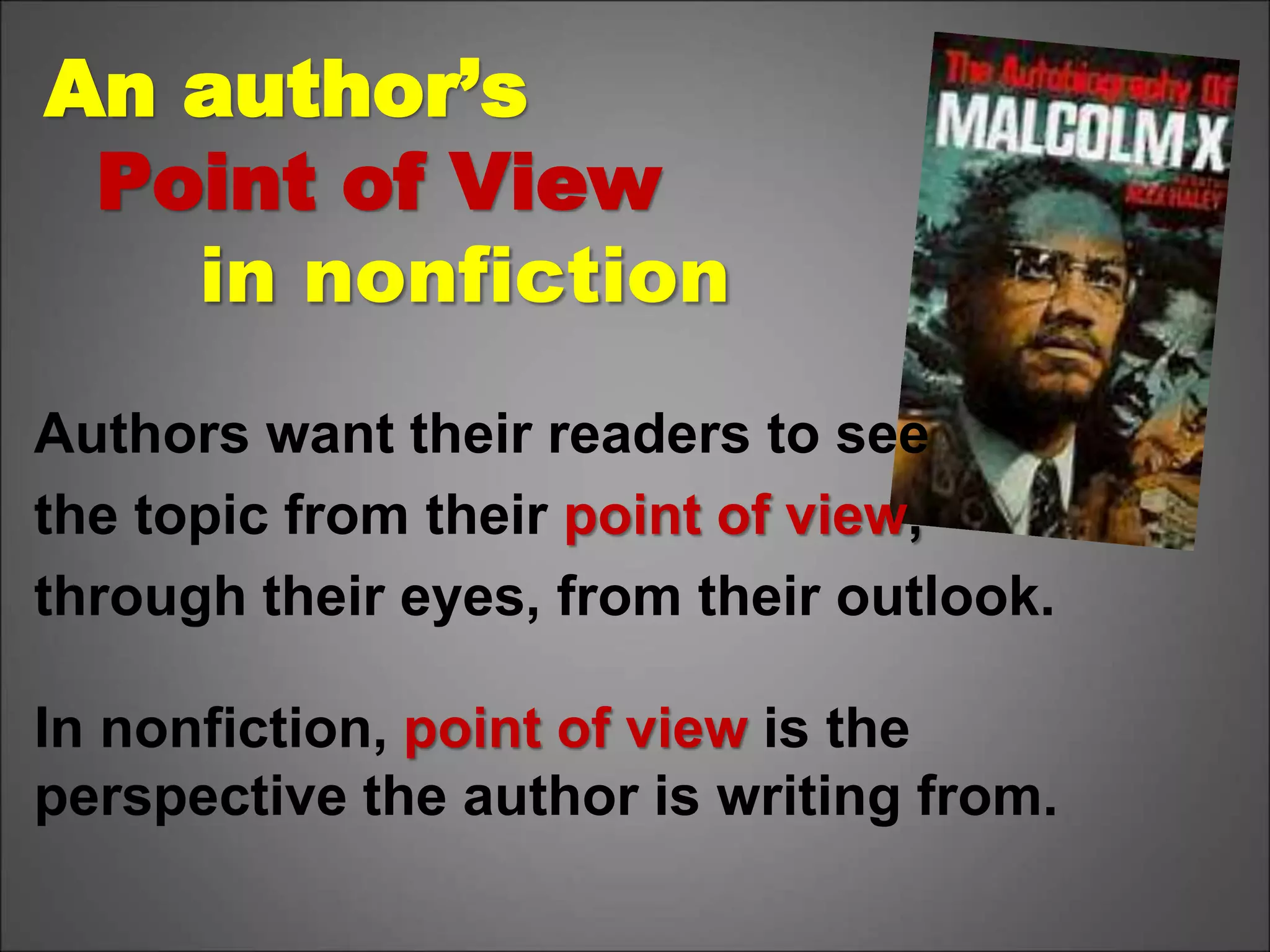
Authors want their readers to see
the topic from their point of view,
through their eyes, from their outlook.
In nonfiction, point of view is the
perspective the author is writing from.
An author’s
Point of View
in nonfiction
First Person - (I, we)
Examples - autobiographies,
memoirs, speeches
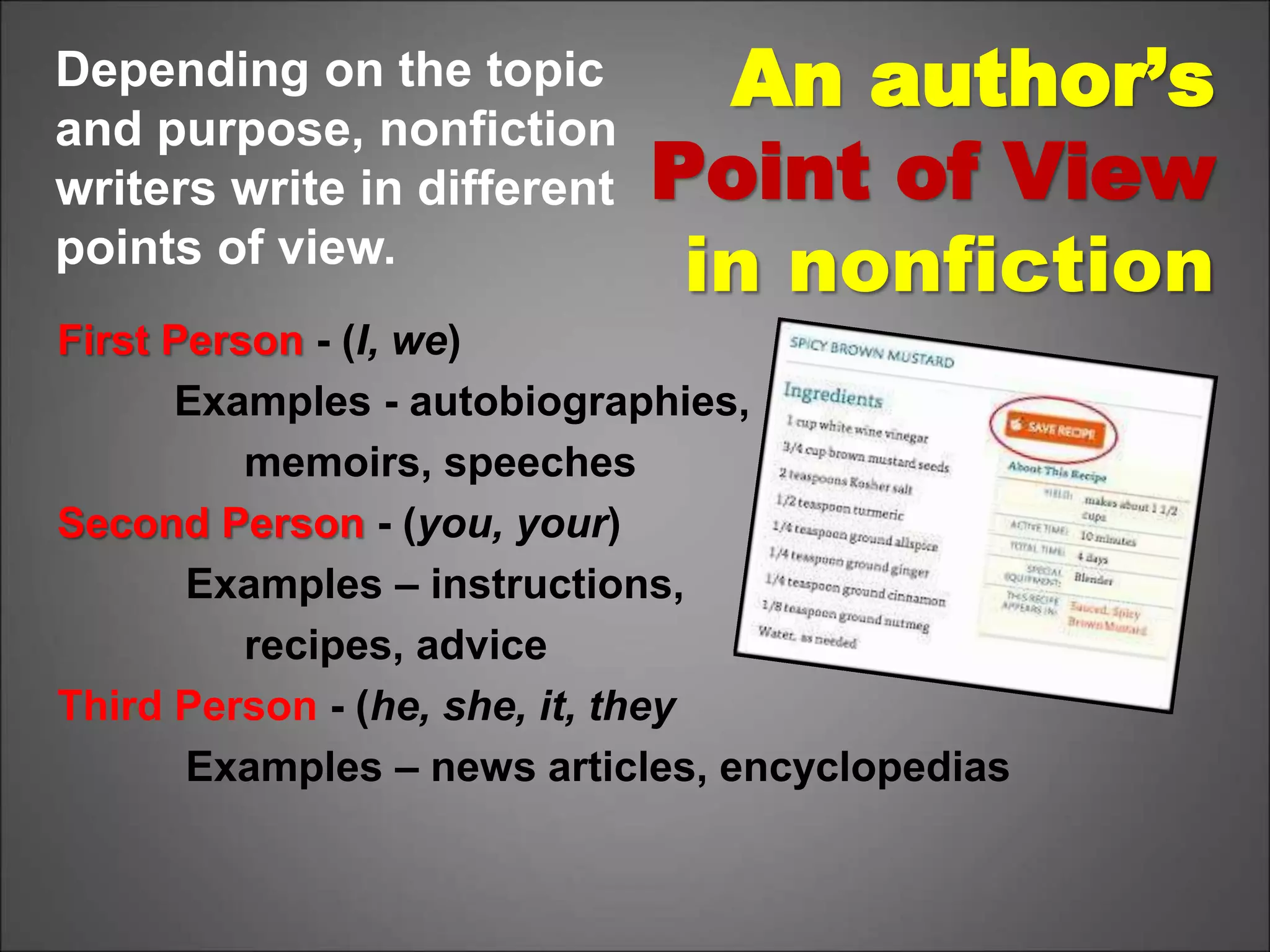
Second Person - (you, your)
Examples – instructions,
recipes, advice
Third Person - (he, she, it, they
Examples – news articles, encyclopedias
Depending on the topic
and purpose, nonfiction
writers write in different
points of view.
Let’s review:
 What is Author’s Purpose?
 What are the 3 reasons authors write a text?
 What does the term author’s position mean?
 For a nonfiction text, what is Point of View?
Author’s Purpose
Position, and
Point of View
Now you understand
Author’s Purpose
Author’s Position
and Point of View
Let’s
read!

PP Author's Purpose.ppt

  • 1.
    Graphics from Microsoft™ ClipArt and Google Images All you need to know about Author’s Purpose, Position and Point of View in a nonfiction text
  • 2.
    What will welearn today? We will learn how to identify the author’s purpose for writing different texts. We will learn that one author’s position can differ from another. We will learn how the author’s point of view affects the text.
  • 3.
    The author’s purposeis the reason for writing the text: to Persuade, Inform, or Entertain. What is Author’s Purpose? Everything you read has a purpose. When authors write books, magazines, newspapers, on-line articles, even commercials, they choose their words for a purpose. PIE Persuade Inform Entertain
  • 4.
    When the author’spurpose is to persuade, the author wants the reader to side with his or her position. A persuasive text contains facts and the author’s opinion. Author’s Purpose to persuade With persuasive texts, the author’s position is for or against the issue or topic.
  • 5.
    Author’s Purpose to inform If theauthor’s purpose is to inform, the reader learns something from the text. Informational texts often include:  Facts  Details  Instructions  Descriptions  Explanations
  • 6.
    Can you identify theauthor’s purpose? YES! The correct answer is to inform. The label contains information and instructions on how to use the medicine.
  • 7.
    Author’s Purpose to entertain Ifthe author’s purpose is to entertain, an author writes to interest the reader. Not all entertaining texts are funny. Chasing Lincoln’s Killer was written for entertainment, but the story is serious.
  • 8.
    Can a texthave 2 purposes? YES! Some texts will have two purposes. For example, if an article is about eating healthy, it will try to persuade you to eat your vegetables and inform you about the different types of food groups.
  • 9.
    Can a texthave 2 purposes? Some texts do have two purposes. For example, if a story tells how a teen learned to deal with moving to a new school, the text would inform and entertain the reader.
  • 10.
    Inform? Entertain? Persuade? www.TeenHealth.org offers manyon-line articles on topics that concern teens. This text persuades the reader to “plan your goal” and informs the reader about how to create a personal action plan. Can a text have 2 purposes?
  • 11.
    Author’s Position An author’sposition on a topic refers to what the author thinks about the topic, his or her perspective on the subject. Authors’ Positions on Italian Food One author may write about the many types of pasta and cheeses available in Italian food. This author’s position is that Italian food offers many delicious choices. Another author may write that pasta has too many carbs and cheese includes too many fat calories. This author’s position is that Italian food is fattening.
  • 12.
    An author’s Point ofView in nonfiction Authors want their readers to see the topic from their point of view, through their eyes, from their outlook. In nonfiction, point of view is the perspective the author is writing from.
  • 13.
    An author’s Point ofView in nonfiction First Person - (I, we) Examples - autobiographies, memoirs, speeches Second Person - (you, your) Examples – instructions, recipes, advice Third Person - (he, she, it, they Examples – news articles, encyclopedias Depending on the topic and purpose, nonfiction writers write in different points of view.
  • 14.
    Let’s review:  Whatis Author’s Purpose?  What are the 3 reasons authors write a text?  What does the term author’s position mean?  For a nonfiction text, what is Point of View? Author’s Purpose Position, and Point of View
  • 15.
    Now you understand Author’sPurpose Author’s Position and Point of View Let’s read!