Evolution of operating system
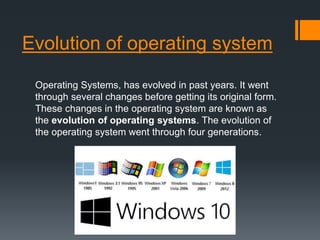
Operating Systems, has evolved in past years. It went
through several changes before getting its original form.
These changes in the operating system are known as
the evolution of operating systems. The evolution of
the operating system went through four generations.
1. First generation 2. Second generation
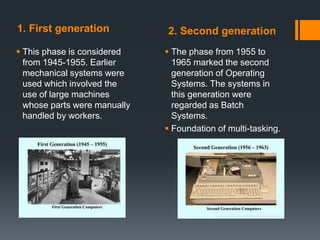
 The phase from 1955 to
1965 marked the second
generation of Operating
Systems. The systems in
this generation were
regarded as Batch
Systems.
 Foundation of multi-tasking.
 This phase is considered
from 1945-1955. Earlier
mechanical systems were
used which involved the
use of large machines
whose parts were manually
handled by workers.
3. Third generation 4. Fourth generation
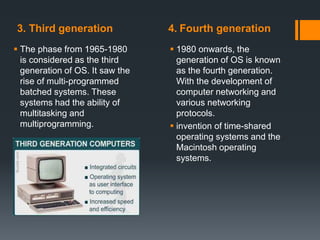
 The phase from 1965-1980
is considered as the third
generation of OS. It saw the
rise of multi-programmed
batched systems. These
systems had the ability of
multitasking and
multiprogramming.
 1980 onwards, the
generation of OS is known
as the fourth generation.
With the development of
computer networking and
various networking
protocols.
 invention of time-shared
operating systems and the
Macintosh operating
systems.
TYPES OF OPERATING SYSTEM
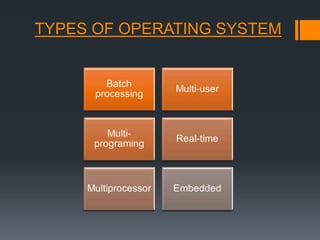
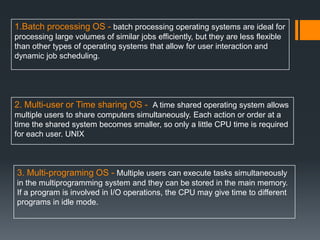
1.Batch processing OS - batch processing operating systems are ideal for
processing large volumes of similar jobs efficiently, but they are less flexible
than other types of operating systems that allow for user interaction and
dynamic job scheduling.
2. Multi-user or Time sharing OS - A time shared operating system allows
multiple users to share computers simultaneously. Each action or order at a
time the shared system becomes smaller, so only a little CPU time is required
for each user. UNIX
3. Multi-programing OS - Multiple users can execute tasks simultaneously
in the multiprogramming system and they can be stored in the main memory.
If a program is involved in I/O operations, the CPU may give time to different
programs in idle mode.
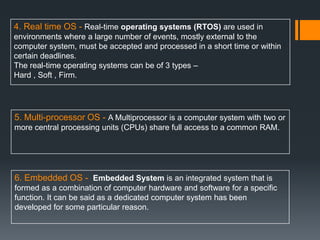
4. Real time OS - Real-time operating systems (RTOS) are used in
environments where a large number of events, mostly external to the
computer system, must be accepted and processed in a short time or within
certain deadlines.
The real-time operating systems can be of 3 types –
Hard , Soft , Firm.
5. Multi-processor OS - A Multiprocessor is a computer system with two or
more central processing units (CPUs) share full access to a common RAM.
6. Embedded OS - Embedded System is an integrated system that is
formed as a combination of computer hardware and software for a specific
function. It can be said as a dedicated computer system has been
developed for some particular reason.

PowerPoint presentation on Operating Systems

  • 1.
    Evolution of operatingsystem Operating Systems, has evolved in past years. It went through several changes before getting its original form. These changes in the operating system are known as the evolution of operating systems. The evolution of the operating system went through four generations.
  • 2.
    1. First generation2. Second generation  The phase from 1955 to 1965 marked the second generation of Operating Systems. The systems in this generation were regarded as Batch Systems.  Foundation of multi-tasking.  This phase is considered from 1945-1955. Earlier mechanical systems were used which involved the use of large machines whose parts were manually handled by workers.
  • 3.
    3. Third generation4. Fourth generation  The phase from 1965-1980 is considered as the third generation of OS. It saw the rise of multi-programmed batched systems. These systems had the ability of multitasking and multiprogramming.  1980 onwards, the generation of OS is known as the fourth generation. With the development of computer networking and various networking protocols.  invention of time-shared operating systems and the Macintosh operating systems.
  • 4.
  • 5.
    1.Batch processing OS- batch processing operating systems are ideal for processing large volumes of similar jobs efficiently, but they are less flexible than other types of operating systems that allow for user interaction and dynamic job scheduling. 2. Multi-user or Time sharing OS - A time shared operating system allows multiple users to share computers simultaneously. Each action or order at a time the shared system becomes smaller, so only a little CPU time is required for each user. UNIX 3. Multi-programing OS - Multiple users can execute tasks simultaneously in the multiprogramming system and they can be stored in the main memory. If a program is involved in I/O operations, the CPU may give time to different programs in idle mode.
  • 6.
    4. Real timeOS - Real-time operating systems (RTOS) are used in environments where a large number of events, mostly external to the computer system, must be accepted and processed in a short time or within certain deadlines. The real-time operating systems can be of 3 types – Hard , Soft , Firm. 5. Multi-processor OS - A Multiprocessor is a computer system with two or more central processing units (CPUs) share full access to a common RAM. 6. Embedded OS - Embedded System is an integrated system that is formed as a combination of computer hardware and software for a specific function. It can be said as a dedicated computer system has been developed for some particular reason.