Evaluation Question 6
Since creating my preliminary task, I have learnt how to use several
different pieces of equipment.
Panasonic Camcorder – Preliminary
 For our preliminary we used this basic camcorder
because it was easy to set up and use, but still
provided decent quality footage.
 It had limited settings and as a result we had to use
auto focus.This meant we didn’t have to learn about
focusing or mess with the lighting settings for this
task, which saved time.
 The only advantage to using this device was the fact
that we could charge it while we were filming,
meaning we never had to worry about running out of
battery.
 I have used equipment like this before so I didn’t
really improve my camera skills very much.
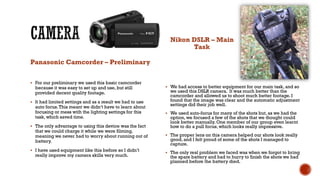
Nikon DSLR – Main
Task
 We had access to better equipment for our main task, and so
we used this DSLR camera. It was much better than the
camcorder and allowed us to shoot much better footage. I
found that the image was clear and the automatic adjustment
settings did their job well.
 We used auto-focus for many of the shots but, as we had the
option, we focused a few of the shots that we thought could
look better manually. One member of our group even learnt
how to do a pull focus, which looks really impressive.
 The proper lens on this camera helped our shots look really
good, and I felt proud of some of the shots I managed to
capture.
 The only real problem we faced was when we forgot to bring
the spare battery and had to hurry to finish the shots we had
planned before the battery died.
Tripod
 For our preliminary we used a very small basic tripod.
However, this was useful because I hadn’t had all that much
experience with using tripods before, and this helped me
get more used to them.
 Panning, tilting and properly framing shots was also
something I hadn’t done before. It was really difficult to get
it to look good at first, but after some practice we improved
a lot.
 For the main task we got to use a much better and bigger
tripod called a Velbon DF-51 which made the camera much
easier to use. In the end we achieved some really
impressive pans and tilts.
 We had to get shots on tricky terrain such as rocky slopes
and in a stream, and also from different heights, and the
range of adjustment on the tripod made this surprisingly
quick and easy.
 Even though it is was larger than the previous one, it was
still compact and light and very easy to transport, which is
good because we had to walk a fair way to reach our
filming location.
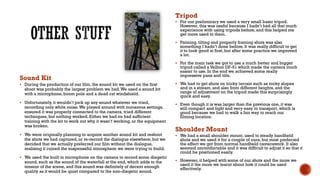
Sound Kit
 During the production of our film, the sound kit we used on the first
shoot was probably the largest problem we had.We used a sound kit
with a microphone, boom pole and a dead cat windshield.
 Unfortunately, it wouldn’t pick up any sound whatever we tried,
recording only white noise.We played around with numerous settings,
ensured it was properly connected to the camera, tried different
techniques, but nothing worked. Either we had no had sufficient
training with the kit to work out why it wasn’t working, or the equipment
was broken.
 We were originally planning to acquire another sound kit and reshoot
the shots we had captured, or re-record the dialogue elsewhere, but we
decided that we actually preferred our film without the dialogue,
realising it ruined the suspenseful atmosphere we were trying to build.
 We used the built in microphone on the camera to record some diegetic
sound, such as the sound of the waterfall at the end, which adds to the
tension of the scene, and this sound was definitely of decent enough
quality as it would be quiet compared to the non-diegetic sound.
Shoulder Mount
 We had a small shoulder mount, used to steady handheld
shots and we used it for a couple of ours, but most preferred
the effect we got from normal handheld camerawork. It also
seemed uncomfortable and it was difficult to adjust it so that it
could be positioned easily.
 However, it helped with some of our shots and the more we
used it the more we learnt about how it could be used
effectively.
The editing part process was probably my favourite part of production,
because I learnt loads of new skills.
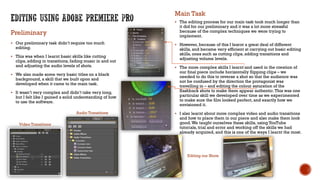
 Our preliminary task didn’t require too much
editing.
 This was when I learnt basic skills like cutting
clips, adding in transitions, fading music in and out
and adjusting the audio levels of shots.
 We also made some very basic titles on a black
background, a skill that we built upon and
developed when it came to the main task.
 It wasn’t very complex and didn’t take very long,
but I felt like I gained a solid understanding of how
to use the software.
 The editing process for our main task took much longer than
it did for our preliminary and it was a lot more stressful
because of the complex techniques we were trying to
implement.
 However, because of this I learnt a great deal of different
skills, and became very efficient at carrying out basic editing
skills, ones such as cutting clips, adding transitions and
adjusting volume levels.
 The more complex skills I learnt and used in the creation of
our final piece include horizontally flipping clips – we
needed to do this to reverse a shot so that the audience was
not be confused by the direction the protagonist was
travelling in – and editing the colour saturation of the
flashback shots to make them appear authentic.This was one
particular skill we developed over time as we experimented
to make sure the film looked perfect, and exactly how we
envisioned it.
 I also learnt about more complex video and audio transitions
and how to place them in our piece and also make them look
good.We taught ourselves these skills, using YouTube
tutorials, trial and error and working off the skills we had
already acquired, and this is one of the ways I learnt the most.
Preliminary
Main Task
Video Transitions
Audio Transitions
Editing our Shots
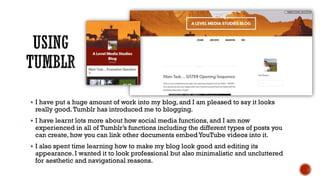
Tumblr is the blogging site we have used to document our AS Media Studies
course, and it has improved my knowledge of social media and blogs in
particular.
 I have put a huge amount of work into my blog, and I am pleased to say it looks
really good.Tumblr has introduced me to blogging.
 I have learnt lots more about how social media functions, and I am now
experienced in all of Tumblr’s functions including the different types of posts you
can create, how you can link other documents embedYouTube videos into it.
 I also spent time learning how to make my blog look good and editing its
appearance. I wanted it to look professional but also minimalistic and uncluttered
for aesthetic and navigational reasons.
While studying AS Media Studies, I have learnt how to use a number of
different pieces of software, as well as building on skills I already had.
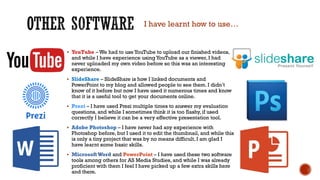
 YouTube – We had to useYouTube to upload our finished videos,
and while I have experience using YouTube as a viewer, I had
never uploaded my own video before so this was an interesting
experience.
 SlideShare – SlideShare is how I linked documents and
PowerPoint to my blog and allowed people to see them. I didn’t
know of it before but now I have used it numerous times and know
that it is a useful tool to get your documents online.
 Prezi – I have used Prezi multiple times to answer my evaluation
questions, and while I sometimes think it is too flashy, if used
correctly I believe it can be a very effective presentation tool.
 Adobe Photoshop – I have never had any experience with
Photoshop before, but I used it to edit the thumbnail, and while this
is only a tiny project that was by no means difficult, I am glad I
have learnt some basic skills.
 MicrosoftWord and PowerPoint – I have used these two software
tools among others for AS Media Studies, and while I was already
proficient with them I feel I have picked up a few extra skills here
and there.
I have learnt how to use…
I have gained so much experience studying AS Media, developing skills I
already had, introducing new ones and then expanding on them too. I am
much more proficient at filming, editing and have learnt how to use several
new software tools.

PowerPoint Presentation - Evaluation Question 6

  • 1.
  • 2.
    Since creating mypreliminary task, I have learnt how to use several different pieces of equipment.
  • 3.
    Panasonic Camcorder –Preliminary  For our preliminary we used this basic camcorder because it was easy to set up and use, but still provided decent quality footage.  It had limited settings and as a result we had to use auto focus.This meant we didn’t have to learn about focusing or mess with the lighting settings for this task, which saved time.  The only advantage to using this device was the fact that we could charge it while we were filming, meaning we never had to worry about running out of battery.  I have used equipment like this before so I didn’t really improve my camera skills very much. Nikon DSLR – Main Task  We had access to better equipment for our main task, and so we used this DSLR camera. It was much better than the camcorder and allowed us to shoot much better footage. I found that the image was clear and the automatic adjustment settings did their job well.  We used auto-focus for many of the shots but, as we had the option, we focused a few of the shots that we thought could look better manually. One member of our group even learnt how to do a pull focus, which looks really impressive.  The proper lens on this camera helped our shots look really good, and I felt proud of some of the shots I managed to capture.  The only real problem we faced was when we forgot to bring the spare battery and had to hurry to finish the shots we had planned before the battery died.
  • 4.
    Tripod  For ourpreliminary we used a very small basic tripod. However, this was useful because I hadn’t had all that much experience with using tripods before, and this helped me get more used to them.  Panning, tilting and properly framing shots was also something I hadn’t done before. It was really difficult to get it to look good at first, but after some practice we improved a lot.  For the main task we got to use a much better and bigger tripod called a Velbon DF-51 which made the camera much easier to use. In the end we achieved some really impressive pans and tilts.  We had to get shots on tricky terrain such as rocky slopes and in a stream, and also from different heights, and the range of adjustment on the tripod made this surprisingly quick and easy.  Even though it is was larger than the previous one, it was still compact and light and very easy to transport, which is good because we had to walk a fair way to reach our filming location. Sound Kit  During the production of our film, the sound kit we used on the first shoot was probably the largest problem we had.We used a sound kit with a microphone, boom pole and a dead cat windshield.  Unfortunately, it wouldn’t pick up any sound whatever we tried, recording only white noise.We played around with numerous settings, ensured it was properly connected to the camera, tried different techniques, but nothing worked. Either we had no had sufficient training with the kit to work out why it wasn’t working, or the equipment was broken.  We were originally planning to acquire another sound kit and reshoot the shots we had captured, or re-record the dialogue elsewhere, but we decided that we actually preferred our film without the dialogue, realising it ruined the suspenseful atmosphere we were trying to build.  We used the built in microphone on the camera to record some diegetic sound, such as the sound of the waterfall at the end, which adds to the tension of the scene, and this sound was definitely of decent enough quality as it would be quiet compared to the non-diegetic sound. Shoulder Mount  We had a small shoulder mount, used to steady handheld shots and we used it for a couple of ours, but most preferred the effect we got from normal handheld camerawork. It also seemed uncomfortable and it was difficult to adjust it so that it could be positioned easily.  However, it helped with some of our shots and the more we used it the more we learnt about how it could be used effectively.
  • 5.
    The editing partprocess was probably my favourite part of production, because I learnt loads of new skills.
  • 6.
     Our preliminarytask didn’t require too much editing.  This was when I learnt basic skills like cutting clips, adding in transitions, fading music in and out and adjusting the audio levels of shots.  We also made some very basic titles on a black background, a skill that we built upon and developed when it came to the main task.  It wasn’t very complex and didn’t take very long, but I felt like I gained a solid understanding of how to use the software.  The editing process for our main task took much longer than it did for our preliminary and it was a lot more stressful because of the complex techniques we were trying to implement.  However, because of this I learnt a great deal of different skills, and became very efficient at carrying out basic editing skills, ones such as cutting clips, adding transitions and adjusting volume levels.  The more complex skills I learnt and used in the creation of our final piece include horizontally flipping clips – we needed to do this to reverse a shot so that the audience was not be confused by the direction the protagonist was travelling in – and editing the colour saturation of the flashback shots to make them appear authentic.This was one particular skill we developed over time as we experimented to make sure the film looked perfect, and exactly how we envisioned it.  I also learnt about more complex video and audio transitions and how to place them in our piece and also make them look good.We taught ourselves these skills, using YouTube tutorials, trial and error and working off the skills we had already acquired, and this is one of the ways I learnt the most. Preliminary Main Task Video Transitions Audio Transitions Editing our Shots
  • 7.
    Tumblr is theblogging site we have used to document our AS Media Studies course, and it has improved my knowledge of social media and blogs in particular.
  • 8.
     I haveput a huge amount of work into my blog, and I am pleased to say it looks really good.Tumblr has introduced me to blogging.  I have learnt lots more about how social media functions, and I am now experienced in all of Tumblr’s functions including the different types of posts you can create, how you can link other documents embedYouTube videos into it.  I also spent time learning how to make my blog look good and editing its appearance. I wanted it to look professional but also minimalistic and uncluttered for aesthetic and navigational reasons.
  • 9.
    While studying ASMedia Studies, I have learnt how to use a number of different pieces of software, as well as building on skills I already had.
  • 10.
     YouTube –We had to useYouTube to upload our finished videos, and while I have experience using YouTube as a viewer, I had never uploaded my own video before so this was an interesting experience.  SlideShare – SlideShare is how I linked documents and PowerPoint to my blog and allowed people to see them. I didn’t know of it before but now I have used it numerous times and know that it is a useful tool to get your documents online.  Prezi – I have used Prezi multiple times to answer my evaluation questions, and while I sometimes think it is too flashy, if used correctly I believe it can be a very effective presentation tool.  Adobe Photoshop – I have never had any experience with Photoshop before, but I used it to edit the thumbnail, and while this is only a tiny project that was by no means difficult, I am glad I have learnt some basic skills.  MicrosoftWord and PowerPoint – I have used these two software tools among others for AS Media Studies, and while I was already proficient with them I feel I have picked up a few extra skills here and there. I have learnt how to use…
  • 11.
    I have gainedso much experience studying AS Media, developing skills I already had, introducing new ones and then expanding on them too. I am much more proficient at filming, editing and have learnt how to use several new software tools.