Forklift Safety
 “This material was produced under grant number SH-22300-11-60-F-17 from the Occupational
Safety and Health Administration, U.S. Department of Labor. It does not necessarily reflect the
views or policies of the US Department of Labor, nor does mention of trade names, commercial
products, or organization imply endorsement by the U.S. Government.””
Presentation Objectives
Define Powered Industrial Trucks (PIT)
Discuss the Benefits of Forklift Training
Discuss the Different Types of Forklifts
Discuss Forklift Training Requirements
Discuss Why is Forklift Training Important
3
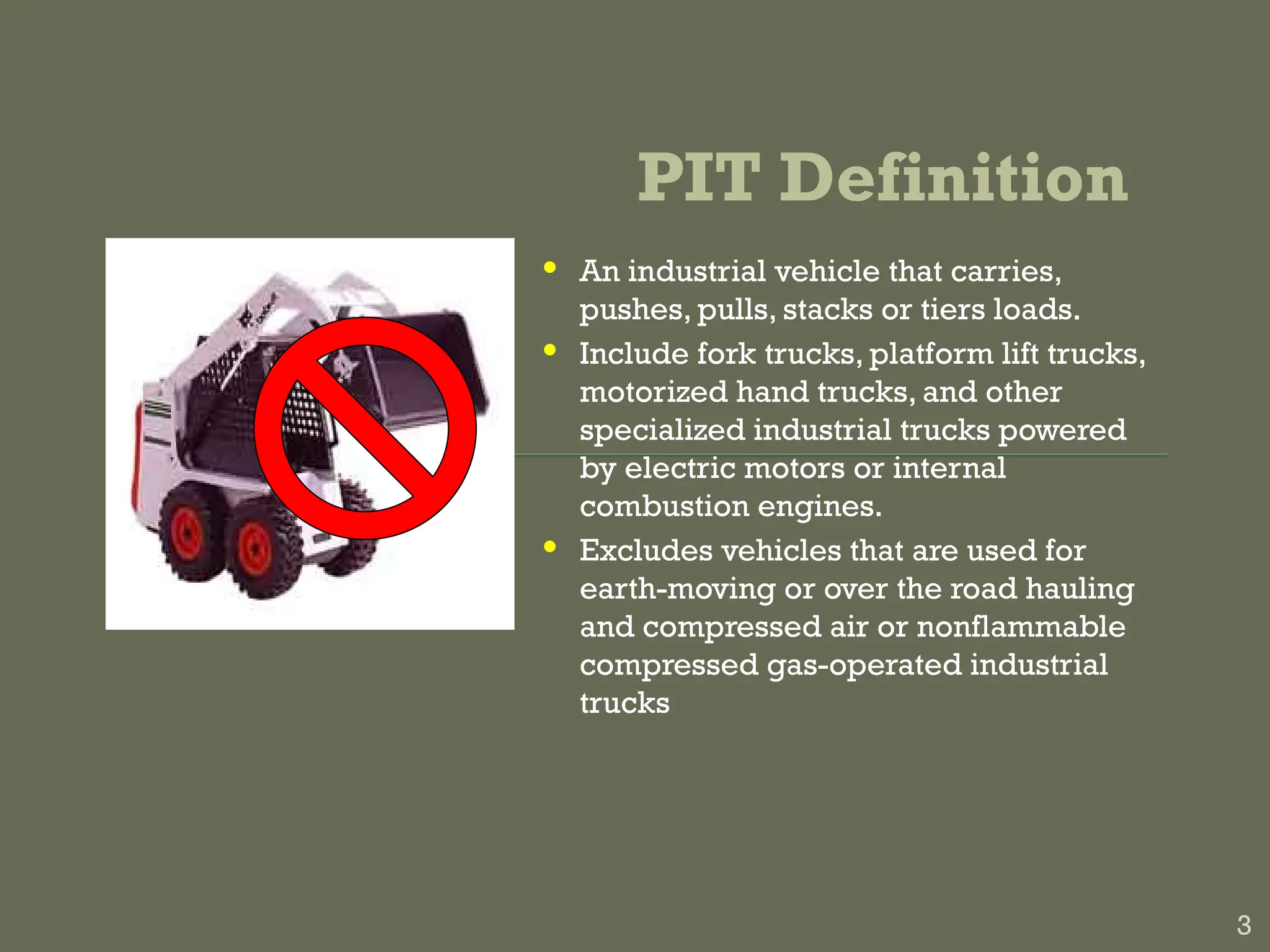
PIT Definition
 An industrial vehicle that carries,
pushes, pulls, stacks or tiers loads.
 Include fork trucks, platform lift trucks,
motorized hand trucks, and other
specialized industrial trucks powered
by electric motors or internal
combustion engines.
 Excludes vehicles that are used for
earth-moving or over the road hauling
and compressed air or nonflammable
compressed gas-operated industrial
trucks
4
Benefits of Forklift Training:
REDUCES ACCIDENTS
by teaching correct methods of avoiding accidents
REDUCES PRODUCT DAMAGE
by teaching best load handling techniques
REDUCES EQUIPMENT DAMAGE
by giving instruction in correct operation and
handling
REDUCES LOST TIME
by reducing accidents, and unplanned work
stoppages
Benefits of Forklift Training (Cont.):
INCREASES OPERATOR
CONFIDENCE
by showing correct methods of operation
INCREASE PRODUCTIVITY
by increasing operator skills
INCREASES EMPLOYEE MORALE
by showing management’s concern for employee
health
INCREASES COMPLIANCE
by ensuring compliance with the OSHA Forklift
Benefits of Forklift Training (Cont.):
INCREASES EQUIPMENT LIFE
by ensuring that forklifts are:
• Properly operated
• Properly maintained in accordance with
manufacturers recommendations
• Inspected for damage daily and prior to
use
• Taken out of service if damaged and until
repaired
8
Classes of Commonly-Used Powered
Industrial Trucks*
 The Industrial Truck Association has placed powered industrial
trucks into 7 classes.
 Class I - Electric motor rider trucks
 Class II - Electric motor narrow aisle trucks
 Class III - Electric motor hand trucks or hand/rider trucks
 Class IV - Internal combustion engine trucks (solid/cushion
tires)
 Class V - Internal combustion engine trucks (pneumatic
tires)
 Class VI - Electric and internal combustion engine tractors
 Class VII - Rough terrain forklift trucks
Note that this classification refers to commonly-used vehicles and does
not include all powered industrial trucks covered by the OSHA
standard.
9
Class I - Electric Motor Rider Trucks
10
Class II - Electric Motor
Narrow Aisle Trucks
11
Class III - Electric Motor Hand or
Hand/Rider Trucks
12
Class IV - Internal Combustion Engine
Trucks - Cushion (Solid) Tires
Fork, counterbalanced (cushion/solid tires)
13
ClassV - Internal Combustion
Engine Trucks - Pneumatic Tires
Fork, counterbalanced (pneumatic tires)
14
ClassVI - Electric & Internal
Combustion Engine Tractors
Sit-down rider
15
ClassVII - Rough Terrain
Forklift Trucks
• Straight-mast forklift • Extended-reach
forklift
Training Requirements
Employer & Operator
Responsibilities
Employer Responsibilities
• Provide employees with training and evaluation once every
three years, after a near-miss or an accident, and if an
employee has been observed operating a forklift in an
unsafe manner (i.e., horseplay)
• Employer is to document and certify that employee has
been trained and evaluated on forklift operations.The
certification records need to be maintained including a
copy of the test, the training provided, and evaluation of the
driving.
• Enforce forklift safety rules – does the employer have a
disciplinary policy?
• Enforce forklift inspections to check on damage and remove
from service until repaired
Operator Responsibilities
• Operate a forklift in a safe manner
• Inspect PIT for damage prior to use
• Report damage to supervisor & take out of service until repaired
• Know the load capacity for the forklift you are operating
• Use only factory-approved forklift attachments on the forklift
• Never lift employees with your forklift
• Have zero tolerance for horseplay
• Drive within employer-specified speed limits
• Never leave your forklift unattended
• Engage the brakes prior to dismounting
• Honk your horn when in a blind spot
• Never drive with a load blocking your vision
• Know your surroundings & hazards in your work area
OSHA Code: 29 CFR 1910.178
Code of Federal Regulations
OSHA Final Rule
Effective March 1, 1999
mandates a training program that bases the amount and type of
training required on:
 the operator’s prior knowledge and skill,
 the types of equipment the operator will be operating,
 the hazards present in the workplace, and
the operator’s demonstrated ability to operate a forklift safely
Refresher Training is required if:
 the operator is involved in an accident or near-miss,
 the operator has been observed to be unsafe,
 evaluation indicates need for additional training,
changes in the workplace affect safe forklift operation,
or
the operator is assigned to a different type of truck.
OSHA Code: 29 CFR 1910.178
Code of Federal Regulations
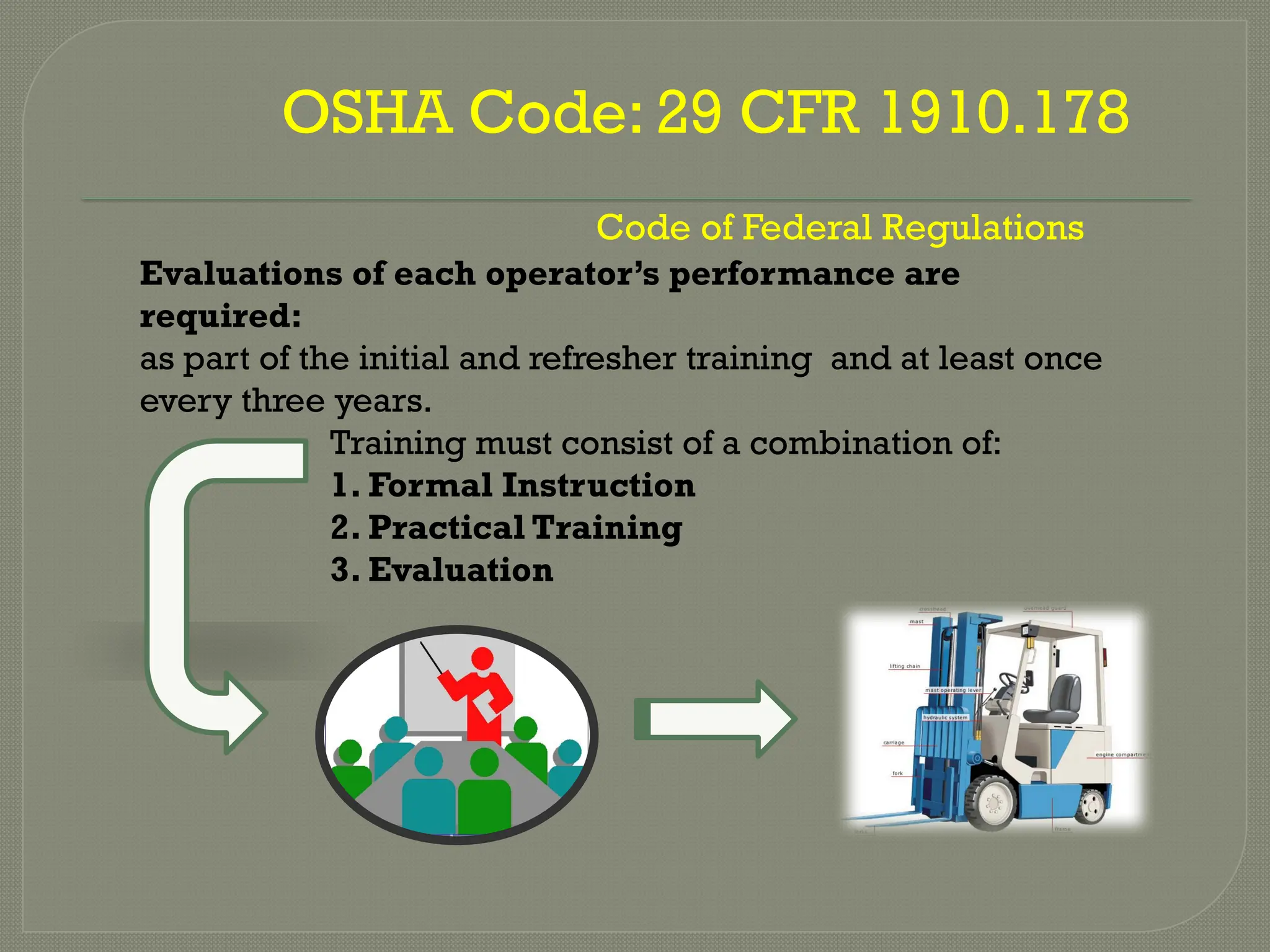
Evaluations of each operator’s performance are
required:
as part of the initial and refresher training and at least once
every three years.
Training must consist of a combination of:
1. Formal Instruction
2. Practical Training
3. Evaluation
OSHA Code: 29 CFR 1910.178
NOTE:
Employers must conduct an evaluation of the
effectiveness of the forklift training by conducting
an evaluation of the operator’s driving
performance and/or ability after the in-class and
practical training has been conducted.
Why Is Forklift Training
Important?
Powered industrial truck accidents cause
approximately 100 fatalities and 36,340
serious injuries in general industry and
construction annually.
It is estimated that 20 - 25% of the accidents
are, at least in part, caused by inadequate
training.
Since a large percentage of accidents and
fatalities were due to operator
inexperience, OSHA mandated that
operators must be trained and competent.
24
Under
16
16-17 18-19 20-24 25-34 35-44 45-54 55-64 65yrs
+
11 23 63
339
840
1084
1257
887
559
Forklift Injuries / Illnesses,
2008(p)
AGES of Workers
Number
Count
 Source: Bureau of Labor Statistics,
 Job Related Fatalities Involving Forklifts
 (p) Preliminary Data, Report Finalized
Apr/2010
25
2003 2004 2005 2006 2007 2008(p)
89 92 94
81 78
67
Forklift Fatalities, 2003-2008(p)
 Source: Bureau of Labor Statistics,
 Job Related Fatalities Involving Forklifts
 (p) Preliminary Data, Report Finalized
Apr/2010
Refueling or Recharging
Park in designated recharging/refueling area
Ensure adequate ventilation
Don’t smoke
No open flames, sparks, or electric arcs
nearby
Have fire extinguisher nearby
Use proper personal protective equipment
Always check lines, wires, hoses for leaks
Recharging Electric Trucks
 Wear splash proof goggles and protective
clothing
 Check electrolyte level before charging
 Keep tools and metallic objects away from
battery top
 Do not pour water into acid –
add acid to water.
 Watch for spilled materials
 Ensure battery is secure
Refueling Gas or Diesel Trucks
Turn off ignition and lights
Make contact between spout and fill pipe before
pouring
Check for leaks
Clean up any spills
If a container must be used, make sure
it is an approved container
Refueling Liquid Propane Trucks
Shut valve; let engine run until it stalls
Turn off ignition and lights
Check for leaks and damage to
connections
Wear protective clothing
Remove empty tank and store it
Install new tank securely
THANKYOU!

Forklift Safety Training for industrial users

  • 1.
    Forklift Safety  “Thismaterial was produced under grant number SH-22300-11-60-F-17 from the Occupational Safety and Health Administration, U.S. Department of Labor. It does not necessarily reflect the views or policies of the US Department of Labor, nor does mention of trade names, commercial products, or organization imply endorsement by the U.S. Government.””
  • 2.
    Presentation Objectives Define PoweredIndustrial Trucks (PIT) Discuss the Benefits of Forklift Training Discuss the Different Types of Forklifts Discuss Forklift Training Requirements Discuss Why is Forklift Training Important
  • 3.
    3 PIT Definition  Anindustrial vehicle that carries, pushes, pulls, stacks or tiers loads.  Include fork trucks, platform lift trucks, motorized hand trucks, and other specialized industrial trucks powered by electric motors or internal combustion engines.  Excludes vehicles that are used for earth-moving or over the road hauling and compressed air or nonflammable compressed gas-operated industrial trucks
  • 4.
  • 5.
    Benefits of ForkliftTraining: REDUCES ACCIDENTS by teaching correct methods of avoiding accidents REDUCES PRODUCT DAMAGE by teaching best load handling techniques REDUCES EQUIPMENT DAMAGE by giving instruction in correct operation and handling REDUCES LOST TIME by reducing accidents, and unplanned work stoppages
  • 6.
    Benefits of ForkliftTraining (Cont.): INCREASES OPERATOR CONFIDENCE by showing correct methods of operation INCREASE PRODUCTIVITY by increasing operator skills INCREASES EMPLOYEE MORALE by showing management’s concern for employee health INCREASES COMPLIANCE by ensuring compliance with the OSHA Forklift
  • 7.
    Benefits of ForkliftTraining (Cont.): INCREASES EQUIPMENT LIFE by ensuring that forklifts are: • Properly operated • Properly maintained in accordance with manufacturers recommendations • Inspected for damage daily and prior to use • Taken out of service if damaged and until repaired
  • 8.
    8 Classes of Commonly-UsedPowered Industrial Trucks*  The Industrial Truck Association has placed powered industrial trucks into 7 classes.  Class I - Electric motor rider trucks  Class II - Electric motor narrow aisle trucks  Class III - Electric motor hand trucks or hand/rider trucks  Class IV - Internal combustion engine trucks (solid/cushion tires)  Class V - Internal combustion engine trucks (pneumatic tires)  Class VI - Electric and internal combustion engine tractors  Class VII - Rough terrain forklift trucks Note that this classification refers to commonly-used vehicles and does not include all powered industrial trucks covered by the OSHA standard.
  • 9.
    9 Class I -Electric Motor Rider Trucks
  • 10.
    10 Class II -Electric Motor Narrow Aisle Trucks
  • 11.
    11 Class III -Electric Motor Hand or Hand/Rider Trucks
  • 12.
    12 Class IV -Internal Combustion Engine Trucks - Cushion (Solid) Tires Fork, counterbalanced (cushion/solid tires)
  • 13.
    13 ClassV - InternalCombustion Engine Trucks - Pneumatic Tires Fork, counterbalanced (pneumatic tires)
  • 14.
    14 ClassVI - Electric& Internal Combustion Engine Tractors Sit-down rider
  • 15.
    15 ClassVII - RoughTerrain Forklift Trucks • Straight-mast forklift • Extended-reach forklift
  • 16.
    Training Requirements Employer &Operator Responsibilities
  • 17.
    Employer Responsibilities • Provideemployees with training and evaluation once every three years, after a near-miss or an accident, and if an employee has been observed operating a forklift in an unsafe manner (i.e., horseplay) • Employer is to document and certify that employee has been trained and evaluated on forklift operations.The certification records need to be maintained including a copy of the test, the training provided, and evaluation of the driving. • Enforce forklift safety rules – does the employer have a disciplinary policy? • Enforce forklift inspections to check on damage and remove from service until repaired
  • 18.
    Operator Responsibilities • Operatea forklift in a safe manner • Inspect PIT for damage prior to use • Report damage to supervisor & take out of service until repaired • Know the load capacity for the forklift you are operating • Use only factory-approved forklift attachments on the forklift • Never lift employees with your forklift • Have zero tolerance for horseplay • Drive within employer-specified speed limits • Never leave your forklift unattended • Engage the brakes prior to dismounting • Honk your horn when in a blind spot • Never drive with a load blocking your vision • Know your surroundings & hazards in your work area
  • 19.
    OSHA Code: 29CFR 1910.178 Code of Federal Regulations OSHA Final Rule Effective March 1, 1999 mandates a training program that bases the amount and type of training required on:  the operator’s prior knowledge and skill,  the types of equipment the operator will be operating,  the hazards present in the workplace, and the operator’s demonstrated ability to operate a forklift safely Refresher Training is required if:  the operator is involved in an accident or near-miss,  the operator has been observed to be unsafe,  evaluation indicates need for additional training, changes in the workplace affect safe forklift operation, or the operator is assigned to a different type of truck.
  • 20.
    OSHA Code: 29CFR 1910.178 Code of Federal Regulations Evaluations of each operator’s performance are required: as part of the initial and refresher training and at least once every three years. Training must consist of a combination of: 1. Formal Instruction 2. Practical Training 3. Evaluation
  • 21.
    OSHA Code: 29CFR 1910.178 NOTE: Employers must conduct an evaluation of the effectiveness of the forklift training by conducting an evaluation of the operator’s driving performance and/or ability after the in-class and practical training has been conducted.
  • 22.
    Why Is ForkliftTraining Important?
  • 23.
    Powered industrial truckaccidents cause approximately 100 fatalities and 36,340 serious injuries in general industry and construction annually. It is estimated that 20 - 25% of the accidents are, at least in part, caused by inadequate training. Since a large percentage of accidents and fatalities were due to operator inexperience, OSHA mandated that operators must be trained and competent.
  • 24.
    24 Under 16 16-17 18-19 20-2425-34 35-44 45-54 55-64 65yrs + 11 23 63 339 840 1084 1257 887 559 Forklift Injuries / Illnesses, 2008(p) AGES of Workers Number Count  Source: Bureau of Labor Statistics,  Job Related Fatalities Involving Forklifts  (p) Preliminary Data, Report Finalized Apr/2010
  • 25.
    25 2003 2004 20052006 2007 2008(p) 89 92 94 81 78 67 Forklift Fatalities, 2003-2008(p)  Source: Bureau of Labor Statistics,  Job Related Fatalities Involving Forklifts  (p) Preliminary Data, Report Finalized Apr/2010
  • 26.
    Refueling or Recharging Parkin designated recharging/refueling area Ensure adequate ventilation Don’t smoke No open flames, sparks, or electric arcs nearby Have fire extinguisher nearby Use proper personal protective equipment Always check lines, wires, hoses for leaks
  • 27.
    Recharging Electric Trucks Wear splash proof goggles and protective clothing  Check electrolyte level before charging  Keep tools and metallic objects away from battery top  Do not pour water into acid – add acid to water.  Watch for spilled materials  Ensure battery is secure
  • 28.
    Refueling Gas orDiesel Trucks Turn off ignition and lights Make contact between spout and fill pipe before pouring Check for leaks Clean up any spills If a container must be used, make sure it is an approved container
  • 29.
    Refueling Liquid PropaneTrucks Shut valve; let engine run until it stalls Turn off ignition and lights Check for leaks and damage to connections Wear protective clothing Remove empty tank and store it Install new tank securely
  • 30.

Editor's Notes

  • #4 Instructor will communicate that these photos are simply illustrating the types of trucks/vehicles we are referring to in our discussion today. Detailed reference to the specific ITA Classes of trucks is covered in later slides of this presentation.
  • #9 Instructor will discuss the typical use and work environment these trucks can be found.
  • #10 Instructor will discuss the typical use and work environment these trucks can be found.
  • #11 Instructor will discuss the typical use and work environment these trucks can be found.
  • #12 Instructor will discuss the typical use and work environment these trucks can be found.
  • #13 Instructor will discuss the typical use and work environment these trucks can be found.
  • #14 Instructor will discuss the typical use and work environment these trucks can be found.
  • #15 Instructor will discuss the typical use and work environment these trucks can be found.
  • #21 Note: [Employers often miss this key point. They conduct in-class training, which may include a test, they conduct practical training, but they fail to conduct and document the evaluation of the operator’s ability to operate the forklift in a safe manner.]
  • #26 Instructor will review each of these and detail potential hazards, best practices, Do’s/Don’t as they are discussed; soliciting audience participation whenever possible.
  • #27 Instructor will review each of these and detail potential hazards, best practices, Do’s/Don’t as they are discussed; soliciting audience participation whenever possible.
  • #28 Instructor will review each of these and detail potential hazards, best practices, Do’s/Don’t as they are discussed; soliciting audience participation whenever possible.
  • #29 Instructor will review each of these and detail potential hazards, best practices, Do’s/Don’t as they are discussed; soliciting audience participation whenever possible.