Power Factor Fundamentals
What we will learn:
Most Industrial loads require both Real power and
Reactive power to produce useful work
You pay for BOTH types of power
Capacitors can supply the REACTIVE
the utility doesn’t need to
power thus
Capacitors save you money!
2
Why
Power Factor Correction Saves
Apply
Money!
PFC’s?
»
»
»
»
Reduces Power Bills
Reduces I2R losses in conductors
Reduces loading on transformers
Improves voltage drop
PqcA2.ppt 3
What is PF ?
Introduction:
» Most plant loads are Inductive and require a magnetic field to
operate:
–
–
–
Motors
Transformers
Florescent lighting
»
»
The magnetic field is necessary, but produces no useful work
The utility must supply the power to produce the magnetic field
and the power to produce the usefu work: You pay for all of it!
» These two types of current are the ACTIVE and REACTIVE
components
PqcA2.ppt 4
s l
the
The
and the
The Basics:
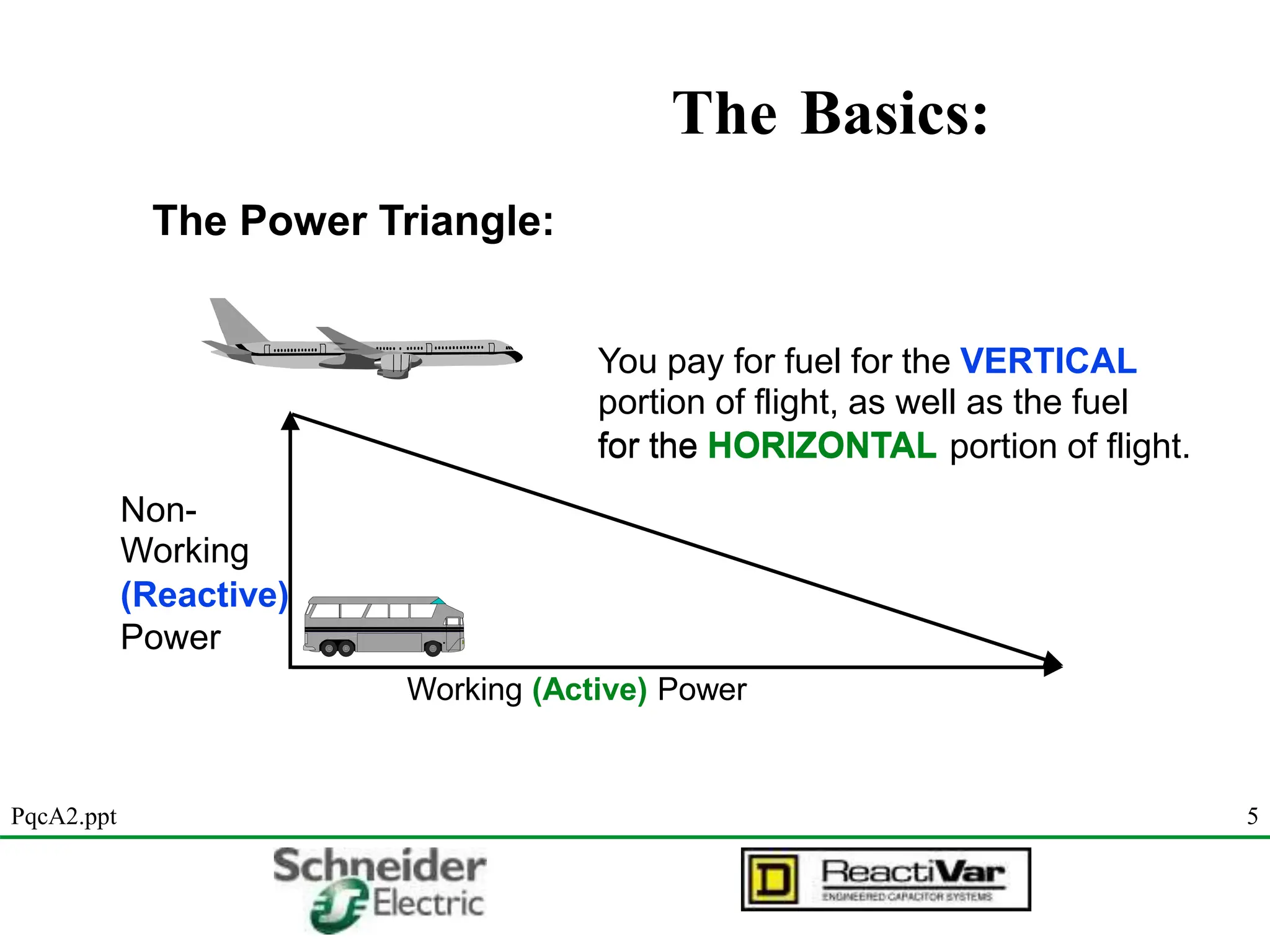
The Power Triangle:
You pay for fuel for the VERTICAL
portion of flight, as well as the fuel
for the HORIZONTAL portion of flight.
Non-
Working
(Reactive)
Power
Working (Active) Power
PqcA2.ppt 5
for the HORIZONTAL
The Power Triangle:
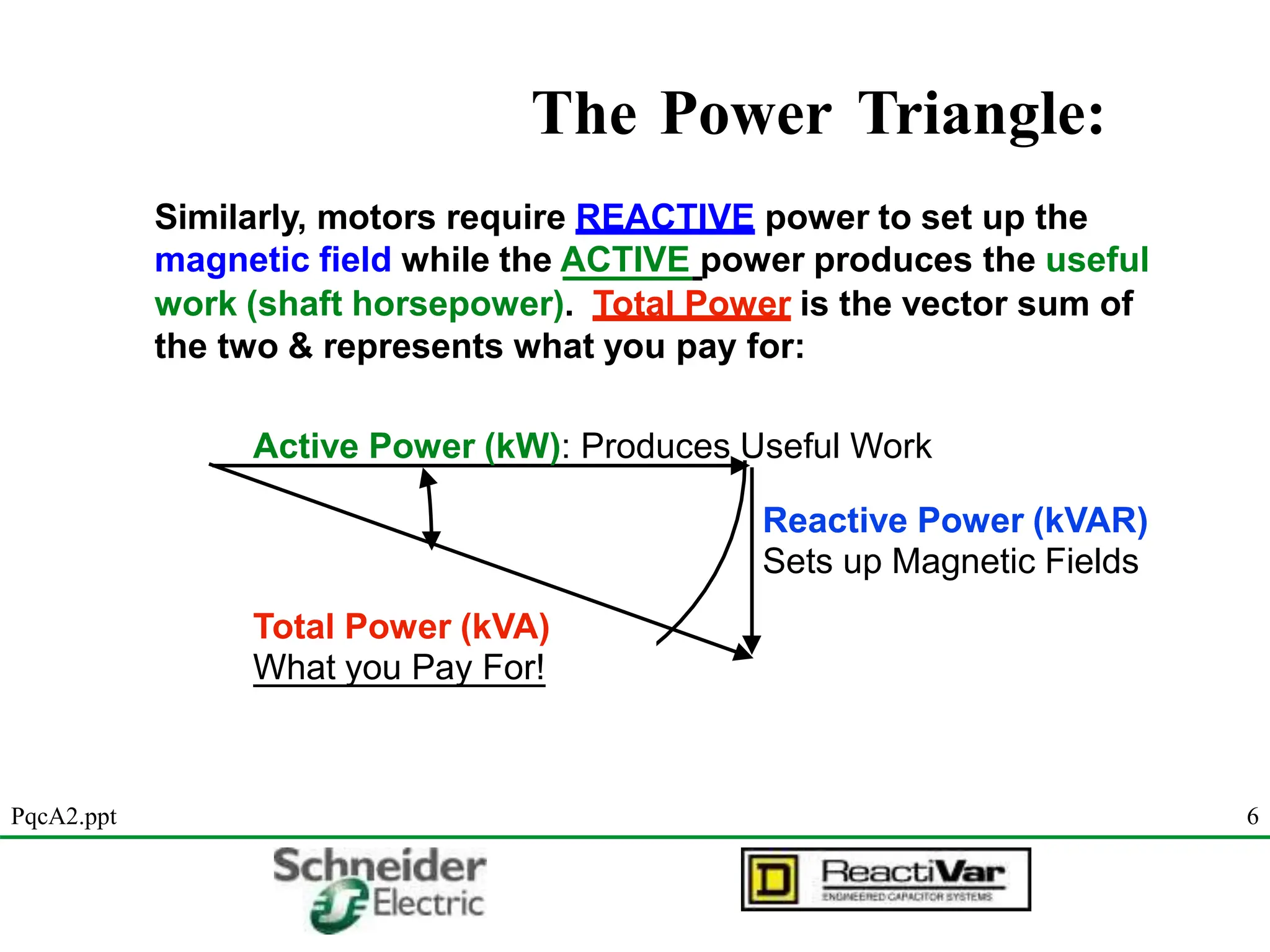
Similarly, motors require REACTIVE power to set up the
magnetic field while the ACTIVE power produces the useful
work (shaft horsepower). Total Power is the vector sum of
the two & represents what you pay for:
Active Power (kW): Produces Useful Work
Reactive Power (kVAR)
Sets up Magnetic Fields
Total Power (kVA)
What you Pay For!
PqcA2.ppt 6
The Power Triangle:
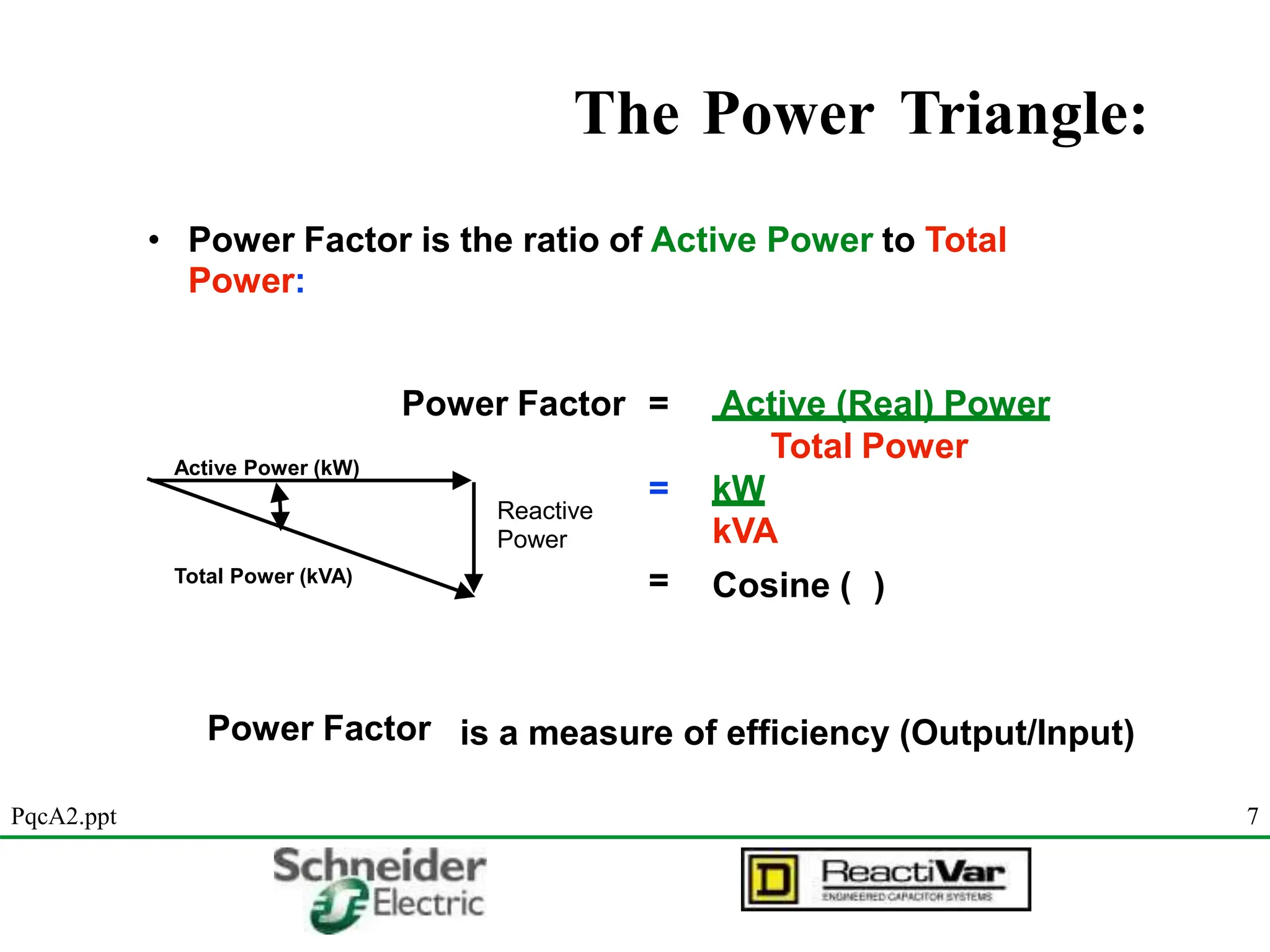
• Power Factor is the ratio of Active Power to Total
Power:
Power Factor = Active (Real) Power
Total Power
kW
Active Power (kW)
=
Reactive
Power kVA
Cosine ( )
=
Total Power (kVA)
Power Factor is a measure of efficiency (Output/Input)
PqcA2.ppt 7
Why do we Install Capacitors?
Capacitors supply, for free, the reactive energy required
inductive loads.
by
»
»
You only have to pay for the capacitor !
Since the utility doesn’t supply it (kVAR), you don’t pay for it!
M M
Utility Supplies
Reactive Current
Capacitor Supplies
Reactive Current
PqcA2.ppt 8
Other Benefits:
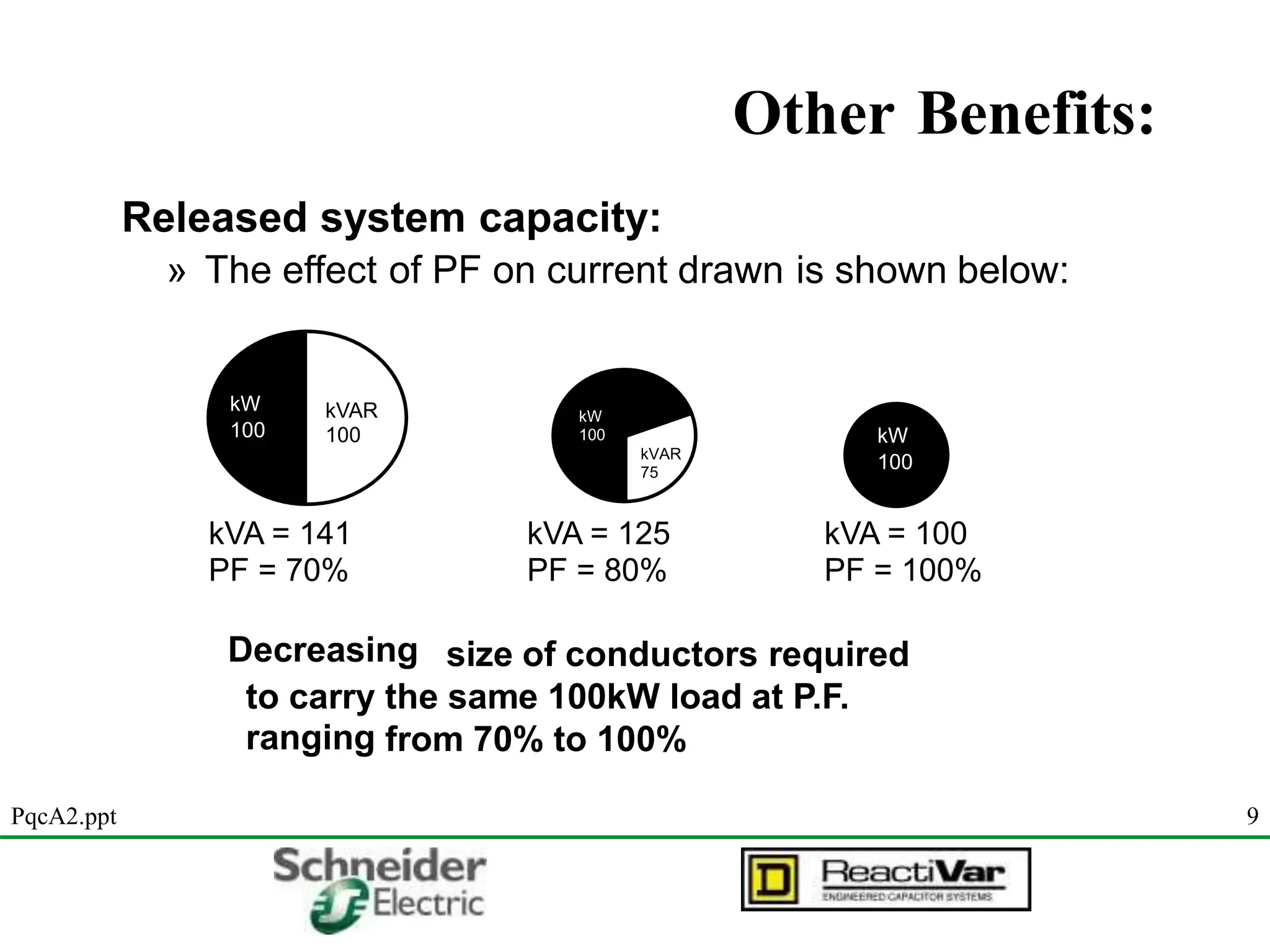
Released system capacity:
» The effect of PF on current drawn is shown below:
kVAR
100
kVAR
75
kVA = 141
PF = 70%
kVA = 125
PF = 80%
kVA = 100
PF = 100%
Decreasing size of conductors required
to carry
ranging
the same 100kW load at P.F.
from 70% to 100%
PqcA2.ppt 9
kW
100
kW
100
kW
100
Other Benefits:
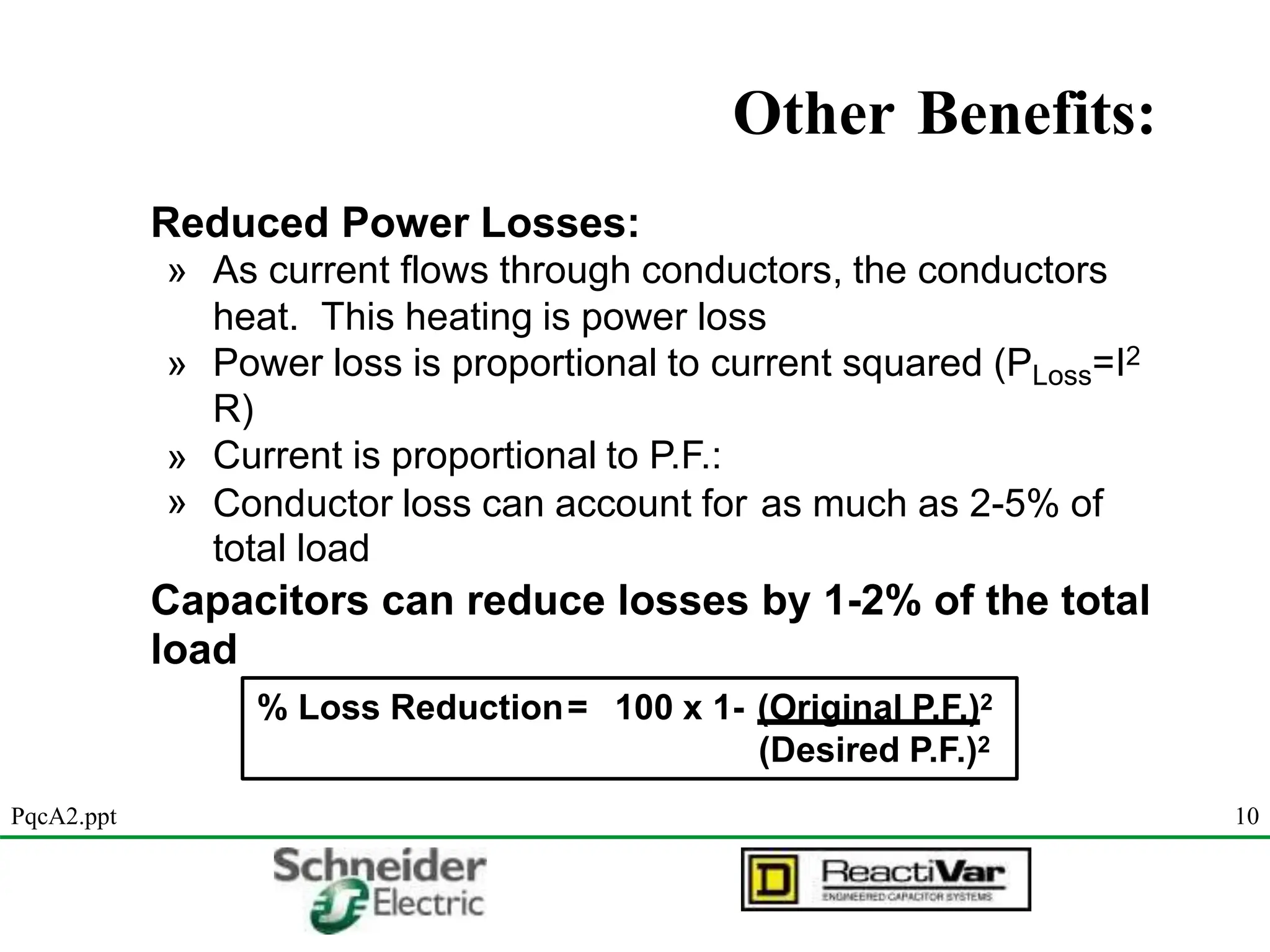
Reduced Power Losses:
» As current flows through conductors, the conductors
heat. This heating is power loss
Power loss is proportional to current squared (PLoss=I2
R)
Current is proportional to P.F.:
»
»
» Conductor loss can account for
total load
as much as 2-5% of
Capacitors can reduce losses
load
by 1-2% of the total
PqcA2.ppt 10
% Loss Reduction= 100 x 1- (Original P.F.)2
(Desired P.F.)2
Other Benefits:
Voltage Improvement:
»
»
When capacitors are added, voltage will increase
Typically only a few percent
– Not a significant economic or system benefit
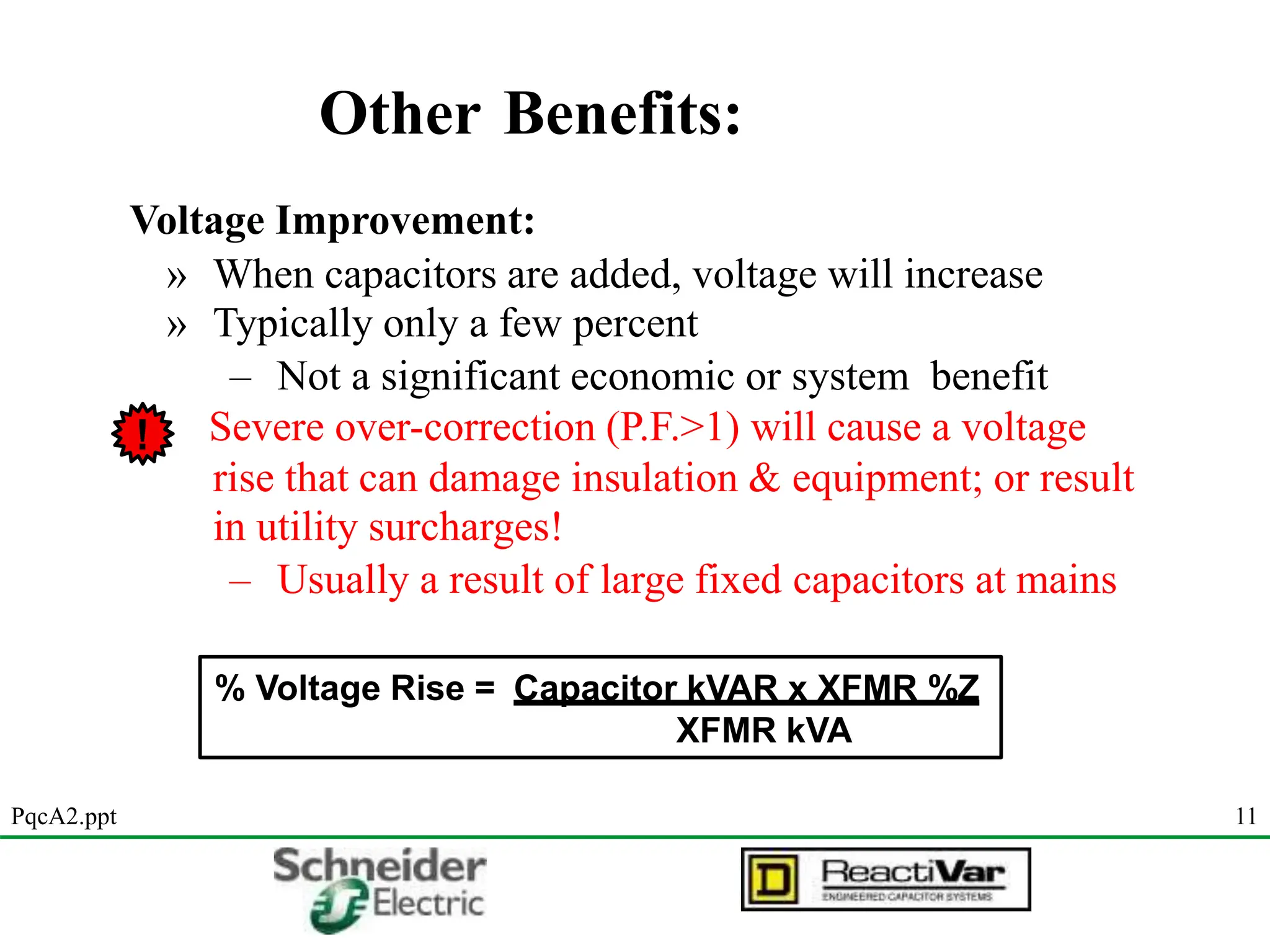
Severe over-correction (P.F.>1) will cause a voltage
!
rise that can damage insulation &
in utility surcharges!
equipment; or result
– Usually a result of large fixed capacitors at mains
PqcA2.ppt 11
% Voltage Rise = Capacitor kVAR x XFMR %Z
XFMR kVA
Summary of Benefits:
Reduced Power Costs:
» Since Capacitors supply reactive power, you
don’t pay the utility for it
» You can calculate the savings
Off-load transformers
» Defer buying a larger transformer when adding
loads
Reduce voltage drop at loads
»
»
Only if capacitors are applied at loads
(minimal benefit at best)
PqcA2.ppt 12
A2
What we learned..
Most Industrial loads (i.e. motors)are Inductive and
REACTIVE power
draw
The Utility supplies this energy therefore you pay for it
Power Factor Capacitors supply REACTIVE
the utility doesn’t need to
Power Factor Capacitors save money
energy thus
There are other benefits to correcting power factor,
»
»
»
reduced heating in cables
reduced heating in transformer(s)
frees up system capacity
PqcA2.ppt 13
A2

Power factor calculation and step by step

  • 1.
  • 2.
    What we willlearn: Most Industrial loads require both Real power and Reactive power to produce useful work You pay for BOTH types of power Capacitors can supply the REACTIVE the utility doesn’t need to power thus Capacitors save you money! 2
  • 3.
    Why Power Factor CorrectionSaves Apply Money! PFC’s? » » » » Reduces Power Bills Reduces I2R losses in conductors Reduces loading on transformers Improves voltage drop PqcA2.ppt 3
  • 4.
    What is PF? Introduction: » Most plant loads are Inductive and require a magnetic field to operate: – – – Motors Transformers Florescent lighting » » The magnetic field is necessary, but produces no useful work The utility must supply the power to produce the magnetic field and the power to produce the usefu work: You pay for all of it! » These two types of current are the ACTIVE and REACTIVE components PqcA2.ppt 4 s l the The and the
  • 5.
    The Basics: The PowerTriangle: You pay for fuel for the VERTICAL portion of flight, as well as the fuel for the HORIZONTAL portion of flight. Non- Working (Reactive) Power Working (Active) Power PqcA2.ppt 5 for the HORIZONTAL
  • 6.
    The Power Triangle: Similarly,motors require REACTIVE power to set up the magnetic field while the ACTIVE power produces the useful work (shaft horsepower). Total Power is the vector sum of the two & represents what you pay for: Active Power (kW): Produces Useful Work Reactive Power (kVAR) Sets up Magnetic Fields Total Power (kVA) What you Pay For! PqcA2.ppt 6
  • 7.
    The Power Triangle: •Power Factor is the ratio of Active Power to Total Power: Power Factor = Active (Real) Power Total Power kW Active Power (kW) = Reactive Power kVA Cosine ( ) = Total Power (kVA) Power Factor is a measure of efficiency (Output/Input) PqcA2.ppt 7
  • 8.
    Why do weInstall Capacitors? Capacitors supply, for free, the reactive energy required inductive loads. by » » You only have to pay for the capacitor ! Since the utility doesn’t supply it (kVAR), you don’t pay for it! M M Utility Supplies Reactive Current Capacitor Supplies Reactive Current PqcA2.ppt 8
  • 9.
    Other Benefits: Released systemcapacity: » The effect of PF on current drawn is shown below: kVAR 100 kVAR 75 kVA = 141 PF = 70% kVA = 125 PF = 80% kVA = 100 PF = 100% Decreasing size of conductors required to carry ranging the same 100kW load at P.F. from 70% to 100% PqcA2.ppt 9 kW 100 kW 100 kW 100
  • 10.
    Other Benefits: Reduced PowerLosses: » As current flows through conductors, the conductors heat. This heating is power loss Power loss is proportional to current squared (PLoss=I2 R) Current is proportional to P.F.: » » » Conductor loss can account for total load as much as 2-5% of Capacitors can reduce losses load by 1-2% of the total PqcA2.ppt 10 % Loss Reduction= 100 x 1- (Original P.F.)2 (Desired P.F.)2
  • 11.
    Other Benefits: Voltage Improvement: » » Whencapacitors are added, voltage will increase Typically only a few percent – Not a significant economic or system benefit Severe over-correction (P.F.>1) will cause a voltage ! rise that can damage insulation & in utility surcharges! equipment; or result – Usually a result of large fixed capacitors at mains PqcA2.ppt 11 % Voltage Rise = Capacitor kVAR x XFMR %Z XFMR kVA
  • 12.
    Summary of Benefits: ReducedPower Costs: » Since Capacitors supply reactive power, you don’t pay the utility for it » You can calculate the savings Off-load transformers » Defer buying a larger transformer when adding loads Reduce voltage drop at loads » » Only if capacitors are applied at loads (minimal benefit at best) PqcA2.ppt 12 A2
  • 13.
    What we learned.. MostIndustrial loads (i.e. motors)are Inductive and REACTIVE power draw The Utility supplies this energy therefore you pay for it Power Factor Capacitors supply REACTIVE the utility doesn’t need to Power Factor Capacitors save money energy thus There are other benefits to correcting power factor, » » » reduced heating in cables reduced heating in transformer(s) frees up system capacity PqcA2.ppt 13 A2