Power distribution 1
Distribution system
• The transmission & distribution system resemble to
human’s blood circulating system:
– Transmission system = arteries
– Distribution system = capillaries
• Distribution is that part of Power system which
distributes electric power for local use
• In general distribution system start from the
substation fed by the transmission system to the
consumers’ meters.
Power distribution 2
Feeders, distributor and
service mains
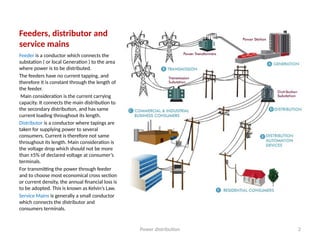
Feeder is a conductor which connects the
substation ( or local Generation ) to the area
where power is to be distributed.
The feeders have no current tapping, and
therefore it is constant through the length of
the feeder.
Main consideration is the current carrying
capacity. It connects the main distribution to
the secondary distribution, and has same
current loading throughout its length.
Distributor is a conductor where tapings are
taken for supplying power to several
consumers. Current is therefore not same
throughout its length. Main consideration is
the voltage drop which should not be more
than ±5% of declared voltage at consumer’s
terminals.
For transmitting the power through feeder
and to choose most economical cross section
or current density, the annual financial loss is
to be adopted. This is known as Kelvin’s Law.
Service Mains is generally a small conductor
which connects the distributor and
consumers terminals.
Power distribution 3
Classification of
distribution system
According to the type of
current:
ac or dc distribution
According to construction:
• overhead or
underground.
• Overhead is preferred
as it is 5 to 10 times
cheaper than
underground
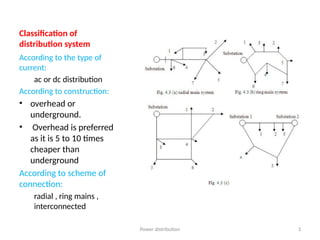
According to scheme of
connection:
radial , ring mains ,
interconnected
Power distribution 4
AC distribution system
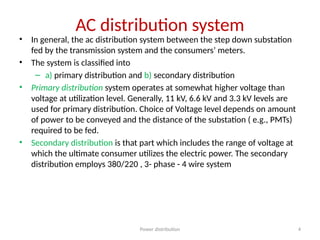
• In general, the ac distribution system between the step down substation
fed by the transmission system and the consumers’ meters.
• The system is classified into
– a) primary distribution and b) secondary distribution
• Primary distribution system operates at somewhat higher voltage than
voltage at utilization level. Generally, 11 kV, 6.6 kV and 3.3 kV levels are
used for primary distribution. Choice of Voltage level depends on amount
of power to be conveyed and the distance of the substation ( e.g., PMTs)
required to be fed.
• Secondary distribution is that part which includes the range of voltage at
which the ultimate consumer utilizes the electric power. The secondary
distribution employs 380/220 , 3- phase - 4 wire system
Power distribution 5
DC distribution
• Some applications such as variable speed dc drives in industrial
units, electrochemical work, data centres etc require dc power.
Hence ac supply is converted into dc through rectifiers or rotary
convertors and then distributed through a dc distribution system.
• DC supply can be obtained from converter substation in the form
of (i) 2-wire distribution , consisting of one outgoing ( or Positive)
and one return ( or negative) wire. It has low efficiency
• (ii) 3- wire distribution , consists of two outer and one middle or
neutral wire which is earthed. Load requiring high voltage is
connected between two outer whereas low voltage equipment is
connected between an outer and middle wire.
Power distribution 6
Requirement of distribution system
• Proper voltage : low voltage cause loss of revenue, inefficient
lightning, and possible burning out of motors. Good
distribution system must ensure voltage variation at
consumers’ terminals within permissible limits
• Availability of power on demand: distribution system must be
capable to meet load demand as it can change time to time
without advance warning to supply company.
• Reliability : can be improved by interconnecting systems,
reliable automatic control system and providing additional
reserve facilities
Power distribution 7
Overhead and underground distribution- a
comparison
• Public safety
• Initial cost
• Flexibility of system
• Faults
• Appearance
• Fault location & repairs
• Voltage drop
• Useful life
• Maintenance cost
• Interference with
communication circuits
• Annual cost of
operation

Power Distribution aPower Distribution a

  • 1.
    Power distribution 1 Distributionsystem • The transmission & distribution system resemble to human’s blood circulating system: – Transmission system = arteries – Distribution system = capillaries • Distribution is that part of Power system which distributes electric power for local use • In general distribution system start from the substation fed by the transmission system to the consumers’ meters.
  • 2.
    Power distribution 2 Feeders,distributor and service mains Feeder is a conductor which connects the substation ( or local Generation ) to the area where power is to be distributed. The feeders have no current tapping, and therefore it is constant through the length of the feeder. Main consideration is the current carrying capacity. It connects the main distribution to the secondary distribution, and has same current loading throughout its length. Distributor is a conductor where tapings are taken for supplying power to several consumers. Current is therefore not same throughout its length. Main consideration is the voltage drop which should not be more than ±5% of declared voltage at consumer’s terminals. For transmitting the power through feeder and to choose most economical cross section or current density, the annual financial loss is to be adopted. This is known as Kelvin’s Law. Service Mains is generally a small conductor which connects the distributor and consumers terminals.
  • 3.
    Power distribution 3 Classificationof distribution system According to the type of current: ac or dc distribution According to construction: • overhead or underground. • Overhead is preferred as it is 5 to 10 times cheaper than underground According to scheme of connection: radial , ring mains , interconnected
  • 4.
    Power distribution 4 ACdistribution system • In general, the ac distribution system between the step down substation fed by the transmission system and the consumers’ meters. • The system is classified into – a) primary distribution and b) secondary distribution • Primary distribution system operates at somewhat higher voltage than voltage at utilization level. Generally, 11 kV, 6.6 kV and 3.3 kV levels are used for primary distribution. Choice of Voltage level depends on amount of power to be conveyed and the distance of the substation ( e.g., PMTs) required to be fed. • Secondary distribution is that part which includes the range of voltage at which the ultimate consumer utilizes the electric power. The secondary distribution employs 380/220 , 3- phase - 4 wire system
  • 5.
    Power distribution 5 DCdistribution • Some applications such as variable speed dc drives in industrial units, electrochemical work, data centres etc require dc power. Hence ac supply is converted into dc through rectifiers or rotary convertors and then distributed through a dc distribution system. • DC supply can be obtained from converter substation in the form of (i) 2-wire distribution , consisting of one outgoing ( or Positive) and one return ( or negative) wire. It has low efficiency • (ii) 3- wire distribution , consists of two outer and one middle or neutral wire which is earthed. Load requiring high voltage is connected between two outer whereas low voltage equipment is connected between an outer and middle wire.
  • 6.
    Power distribution 6 Requirementof distribution system • Proper voltage : low voltage cause loss of revenue, inefficient lightning, and possible burning out of motors. Good distribution system must ensure voltage variation at consumers’ terminals within permissible limits • Availability of power on demand: distribution system must be capable to meet load demand as it can change time to time without advance warning to supply company. • Reliability : can be improved by interconnecting systems, reliable automatic control system and providing additional reserve facilities
  • 7.
    Power distribution 7 Overheadand underground distribution- a comparison • Public safety • Initial cost • Flexibility of system • Faults • Appearance • Fault location & repairs • Voltage drop • Useful life • Maintenance cost • Interference with communication circuits • Annual cost of operation