POWER AWARE LOAD BALANCING IN
CLOUD
Guide:
Madhu B.R
Associate Professor
Dept of CSE ,Jain University
By:
Manjula
15MT1CS003
MTech CSE – 4th Sem
AGENDA
 Introduction
 literature survey
 Methodology
 Requirements
 Conclusion
 Data centers have become a important part of today's IT infrastructure .
Government Institutions, hospitals, many companies use data centers to perform
their activities
 Data centers are designed to meet certain SLA. Data centers consume more
energy while running.
 There are many ways of provisioning data centers so as to reduce
power, There has also been extensive research into more aggressive
provisioning algorithms.
INTRODUCTION
 Paper I
• We evaluate AutoScale in a tested structured as a multi-tier data
center. And this paper include MWA,LR ,by using this algorithm
how to save power in data center .
 paper II
• This paper ,there are different load balancing techniques are there
and they are comparing each and every algorithm . And they
decided which algorithm is best for power saving in data center
LITERATURE SURVEY
AUTOSCALE ALGORITHM
 Algorithm: automatically adjusts resources based on the incoming
requests
 AutoScale works by dynamically provisioning data center
capacity as needed. AutoScale is load-oblivious and can also
be deployed as a distributed application.
 It has 3 types
1. Reactive
2. Proactive
3. Predictive
Existing System:
• The existing system is they already implemented when system is on
they took result and they implemented when system is idle and they
implemented system is shut down. By using AutoScale
algorithm.
• AutoScale algorithm AlwaysOn algorithm is implemented, this
algorithm can be divided into reactive and predictive approaches
METHODOLOGY
Proposed System:
• In this project, Explore using sleep states of processors instead of turning off
servers to reduce setup time of data center. in desktop processors low-power
sleep states do not yet exist, although they do exist in mobile processors.
• We compare AutoScale against AlwaysSleep, Reactive, MWA, and LR. the
algorithms that AutoScale is compared against We find that AutoScale
performs well against the other algorithms.
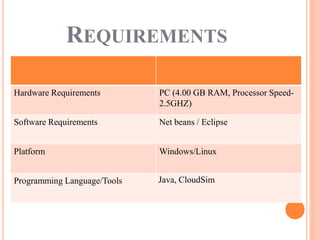
REQUIREMENTS
Hardware Requirements PC (4.00 GB RAM, Processor Speed-
2.5GHZ)
Software Requirements Net beans / Eclipse
Platform Windows/Linux
Programming Language/Tools Java, CloudSim
 Data center costs are mounting each year.
 One of the many ways to reduce power consumption is to
dynamically provision the data center capacity to
meet demand with the minimum number of servers.
 AutoScale effectively manages power consumption and meets
SLA's all while being simple and computationally cheap.
CONCLUSION
Power aware load balancing in cloud

Power aware load balancing in cloud

  • 1.
    POWER AWARE LOADBALANCING IN CLOUD Guide: Madhu B.R Associate Professor Dept of CSE ,Jain University By: Manjula 15MT1CS003 MTech CSE – 4th Sem
  • 2.
    AGENDA  Introduction  literaturesurvey  Methodology  Requirements  Conclusion
  • 3.
     Data centershave become a important part of today's IT infrastructure . Government Institutions, hospitals, many companies use data centers to perform their activities  Data centers are designed to meet certain SLA. Data centers consume more energy while running.  There are many ways of provisioning data centers so as to reduce power, There has also been extensive research into more aggressive provisioning algorithms. INTRODUCTION
  • 4.
     Paper I •We evaluate AutoScale in a tested structured as a multi-tier data center. And this paper include MWA,LR ,by using this algorithm how to save power in data center .  paper II • This paper ,there are different load balancing techniques are there and they are comparing each and every algorithm . And they decided which algorithm is best for power saving in data center LITERATURE SURVEY
  • 5.
    AUTOSCALE ALGORITHM  Algorithm:automatically adjusts resources based on the incoming requests  AutoScale works by dynamically provisioning data center capacity as needed. AutoScale is load-oblivious and can also be deployed as a distributed application.  It has 3 types 1. Reactive 2. Proactive 3. Predictive
  • 6.
    Existing System: • Theexisting system is they already implemented when system is on they took result and they implemented when system is idle and they implemented system is shut down. By using AutoScale algorithm. • AutoScale algorithm AlwaysOn algorithm is implemented, this algorithm can be divided into reactive and predictive approaches METHODOLOGY
  • 7.
    Proposed System: • Inthis project, Explore using sleep states of processors instead of turning off servers to reduce setup time of data center. in desktop processors low-power sleep states do not yet exist, although they do exist in mobile processors. • We compare AutoScale against AlwaysSleep, Reactive, MWA, and LR. the algorithms that AutoScale is compared against We find that AutoScale performs well against the other algorithms.
  • 8.
    REQUIREMENTS Hardware Requirements PC(4.00 GB RAM, Processor Speed- 2.5GHZ) Software Requirements Net beans / Eclipse Platform Windows/Linux Programming Language/Tools Java, CloudSim
  • 9.
     Data centercosts are mounting each year.  One of the many ways to reduce power consumption is to dynamically provision the data center capacity to meet demand with the minimum number of servers.  AutoScale effectively manages power consumption and meets SLA's all while being simple and computationally cheap. CONCLUSION