What is an obvious
invention under 35
U.S.C. § 103(a) in
the post-KSR
world? Theodore C. McCullough,
Associate
tmccullough@slwk.com
 Types of Prior Art
 A Breakdown of 35 U.S.C. 103(a)
 Applying 35 U.S.C. 103(a): Graham v. John
Deere Co. of Kansas City, 383 U.S. 1 (1966)
 Evolution of Graham: the Rise of the
Teaching, Suggestion, and Motivation (TSM)
Test
 A Problem with TSM: Room for Common
Sense?
 Going Back to Graham: KSR International
Co., v. Teleflex Inc. et al., 127 S. Ct. 1727,
__U.S.__ (2007), and the use of Common
Sense
Introduction
Types of Prior Art
 Anticipation: prior art that anticipates the
claimed features of an invention (See 35
U.S.C. 102 et seq.)
 Obviousness: “A patent may not be obtained
though the invention is not identically
disclosed or described as set forth in section
102 of this title, if the differences between the
subject matter sought to be patented and the
prior art are such that the subject matter as a
whole would have been obvious at the time
the invention was made to a person having
ordinary skill in the art to which said subject
matter pertains.” (See 35 U.S.C. 103(A))
Statutory Definition of Obviousness
 “the differences between the subject matter
sought to be patented and the prior art are
such”
– A mostly factual issue.
 “that the subject matter as a whole would
have been obvious at the time the invention
was made to a person having ordinary skill in
the art to which said subject matter pertains”
– A mostly legal issue.
A Break Down of 35 U.S.C. §
103(A)
Applying 35 U.S.C. 103(a): Graham v.
John Deere Co. of Kansas City, 383
U.S. 1 (1966)
 The Breakdown as Reflected in the Graham
Factors:
– Determining the scope and contents of
the prior art
– Ascertaining the differences between the
prior art and the claims in issue
– Resolving the level of ordinary skill in the
pertinent art and
– Evaluating evidence of secondary
considerations
(See MPEP 2141. See also KSR
International Co., 127 S. Ct. at 1734
(describing the language of Graham).)
Evolution of Graham: the Rise of the
Teaching, Suggestion, and Motivation
(TSM) test
How are we to understand the basis upon which one
of ordinary skill in the art (e.g., an examiner) arrives
at a conclusion of obviousness?
-”Because I say it is obvious?”
The Rise of the TSM test: A way to provide an
objective basis to support a conclusion of
obviousness.
-What about “the problem” of using
hindsight to justify obviousness?
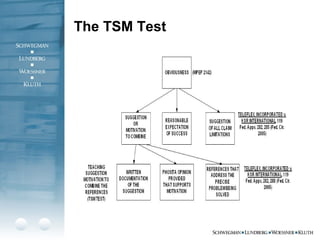
The TSM Test
A Problem with TSM: Room for
Common Sense?
 One Result of TSM: common sense of one of
skill in the art having to justify itself, even
where common sense may dictate that an
invention is obvious
 Statements of Amicus in KSR: TSM Test
Stifles Innovation and Rewards Routine
Technological Advances-
– Jack-O’-Lantern Trash Bags: Patent
granted because BPAI had not particularly
identified any suggestion, teaching, or
motivation to combine the children’s art
references
– Baseball with Finger Placement Indicia:
Appeals court concluded that it was not
obvious because the motivation to
combine two pre-existing patents had not
been established.
Going Back to Graham: KSR
International Co., v. Teleflex Inc. et
al., 127 S. Ct. 1727, __U.S.__ (2007),
and the use of Common Sense
 According to the U.S. Supreme Court in KSR:
“Rigid preventative rules that deny fact
finders recourse to common sense, however,
are neither necessary under our case law
nor consistent with it.” (See KSR
International Co., 127 S. Ct. at 1743.)
 Upshot: TSM unnecessarily rigid, and not
required so long the basis for the conclusion
of obviousness is not conclusory and has
some articulated reasoning with rational
underpinnings. (See KSR International Co.,
127 S. Ct. at 1741.)
Some Ways to Deal With
Obviousness Post-KSR
1. At least one claimed element is not
“familiar”/known/shown in the art.
2. The claimed invention is not a combination of discrete
elements at all.
3. The proposed combination of elements does not yield
the claimed invention.
4. At least one claimed element functions differently from
that in the prior art.
5. At least one claimed element was known only in
substantially unrelated area.
6. It would take ingenuity, beyond one of "ordinary skill in
the art," to combine elements. [Remembering that KSR
renders one of ordinary skill as omnificent, as expert as
any inventor.]
7. The number of alternative solutions for one claimed
element was large or infinite. [This attempts to overcome
a rejection on 'obvious to try.']
8. The result of the claimed combination would not have
been predictable, or would not have had a reasonable
expectation of success. [An unlikely sell without some
evidence to point to.]
9. Secondary considerations: long-felt but unsolved need;
commercial success; prior art expressions of doubt.
Note that KSR reaffirmed.
Questions?

Obviousness Post KSR

  • 1.
    What is anobvious invention under 35 U.S.C. § 103(a) in the post-KSR world? Theodore C. McCullough, Associate tmccullough@slwk.com
  • 2.
     Types ofPrior Art  A Breakdown of 35 U.S.C. 103(a)  Applying 35 U.S.C. 103(a): Graham v. John Deere Co. of Kansas City, 383 U.S. 1 (1966)  Evolution of Graham: the Rise of the Teaching, Suggestion, and Motivation (TSM) Test  A Problem with TSM: Room for Common Sense?  Going Back to Graham: KSR International Co., v. Teleflex Inc. et al., 127 S. Ct. 1727, __U.S.__ (2007), and the use of Common Sense Introduction
  • 3.
    Types of PriorArt  Anticipation: prior art that anticipates the claimed features of an invention (See 35 U.S.C. 102 et seq.)  Obviousness: “A patent may not be obtained though the invention is not identically disclosed or described as set forth in section 102 of this title, if the differences between the subject matter sought to be patented and the prior art are such that the subject matter as a whole would have been obvious at the time the invention was made to a person having ordinary skill in the art to which said subject matter pertains.” (See 35 U.S.C. 103(A))
  • 4.
    Statutory Definition ofObviousness  “the differences between the subject matter sought to be patented and the prior art are such” – A mostly factual issue.  “that the subject matter as a whole would have been obvious at the time the invention was made to a person having ordinary skill in the art to which said subject matter pertains” – A mostly legal issue. A Break Down of 35 U.S.C. § 103(A)
  • 5.
    Applying 35 U.S.C.103(a): Graham v. John Deere Co. of Kansas City, 383 U.S. 1 (1966)  The Breakdown as Reflected in the Graham Factors: – Determining the scope and contents of the prior art – Ascertaining the differences between the prior art and the claims in issue – Resolving the level of ordinary skill in the pertinent art and – Evaluating evidence of secondary considerations (See MPEP 2141. See also KSR International Co., 127 S. Ct. at 1734 (describing the language of Graham).)
  • 6.
    Evolution of Graham:the Rise of the Teaching, Suggestion, and Motivation (TSM) test How are we to understand the basis upon which one of ordinary skill in the art (e.g., an examiner) arrives at a conclusion of obviousness? -”Because I say it is obvious?” The Rise of the TSM test: A way to provide an objective basis to support a conclusion of obviousness. -What about “the problem” of using hindsight to justify obviousness?
  • 7.
  • 8.
    A Problem withTSM: Room for Common Sense?  One Result of TSM: common sense of one of skill in the art having to justify itself, even where common sense may dictate that an invention is obvious  Statements of Amicus in KSR: TSM Test Stifles Innovation and Rewards Routine Technological Advances- – Jack-O’-Lantern Trash Bags: Patent granted because BPAI had not particularly identified any suggestion, teaching, or motivation to combine the children’s art references – Baseball with Finger Placement Indicia: Appeals court concluded that it was not obvious because the motivation to combine two pre-existing patents had not been established.
  • 9.
    Going Back toGraham: KSR International Co., v. Teleflex Inc. et al., 127 S. Ct. 1727, __U.S.__ (2007), and the use of Common Sense  According to the U.S. Supreme Court in KSR: “Rigid preventative rules that deny fact finders recourse to common sense, however, are neither necessary under our case law nor consistent with it.” (See KSR International Co., 127 S. Ct. at 1743.)  Upshot: TSM unnecessarily rigid, and not required so long the basis for the conclusion of obviousness is not conclusory and has some articulated reasoning with rational underpinnings. (See KSR International Co., 127 S. Ct. at 1741.)
  • 10.
    Some Ways toDeal With Obviousness Post-KSR 1. At least one claimed element is not “familiar”/known/shown in the art. 2. The claimed invention is not a combination of discrete elements at all. 3. The proposed combination of elements does not yield the claimed invention. 4. At least one claimed element functions differently from that in the prior art. 5. At least one claimed element was known only in substantially unrelated area. 6. It would take ingenuity, beyond one of "ordinary skill in the art," to combine elements. [Remembering that KSR renders one of ordinary skill as omnificent, as expert as any inventor.] 7. The number of alternative solutions for one claimed element was large or infinite. [This attempts to overcome a rejection on 'obvious to try.'] 8. The result of the claimed combination would not have been predictable, or would not have had a reasonable expectation of success. [An unlikely sell without some evidence to point to.] 9. Secondary considerations: long-felt but unsolved need; commercial success; prior art expressions of doubt. Note that KSR reaffirmed.
  • 11.