The Medically Complex Child:
It Takes a Village
Mary	L.	Ehlenbach,	M.D.		
Medical	Director,	UW	Health-American	Family	Children’s	Hospital	Pediatric	
Complex	Care	Program;	Assistant	Professor	of	Pediatrics,	University	of	
Wisconsin	School	of	Medicine	and	Public	Health	
David	Hall,	M.D.	
Professor	of	Clinical	Pediatrics,	Vanderbilt	University	School	of	Medicine;	
SecFon	Head,	Program	for	Children	with	Medically	Complex	Needs,	Monroe	
Carell	Jr	Children’s	Hospital	
Ingrid	A.	Larson,	MBA,	DNP,	NEA-BC,	APRN	
Director,	Beacon	Program,	Children’s	Mercy	Kansas	City
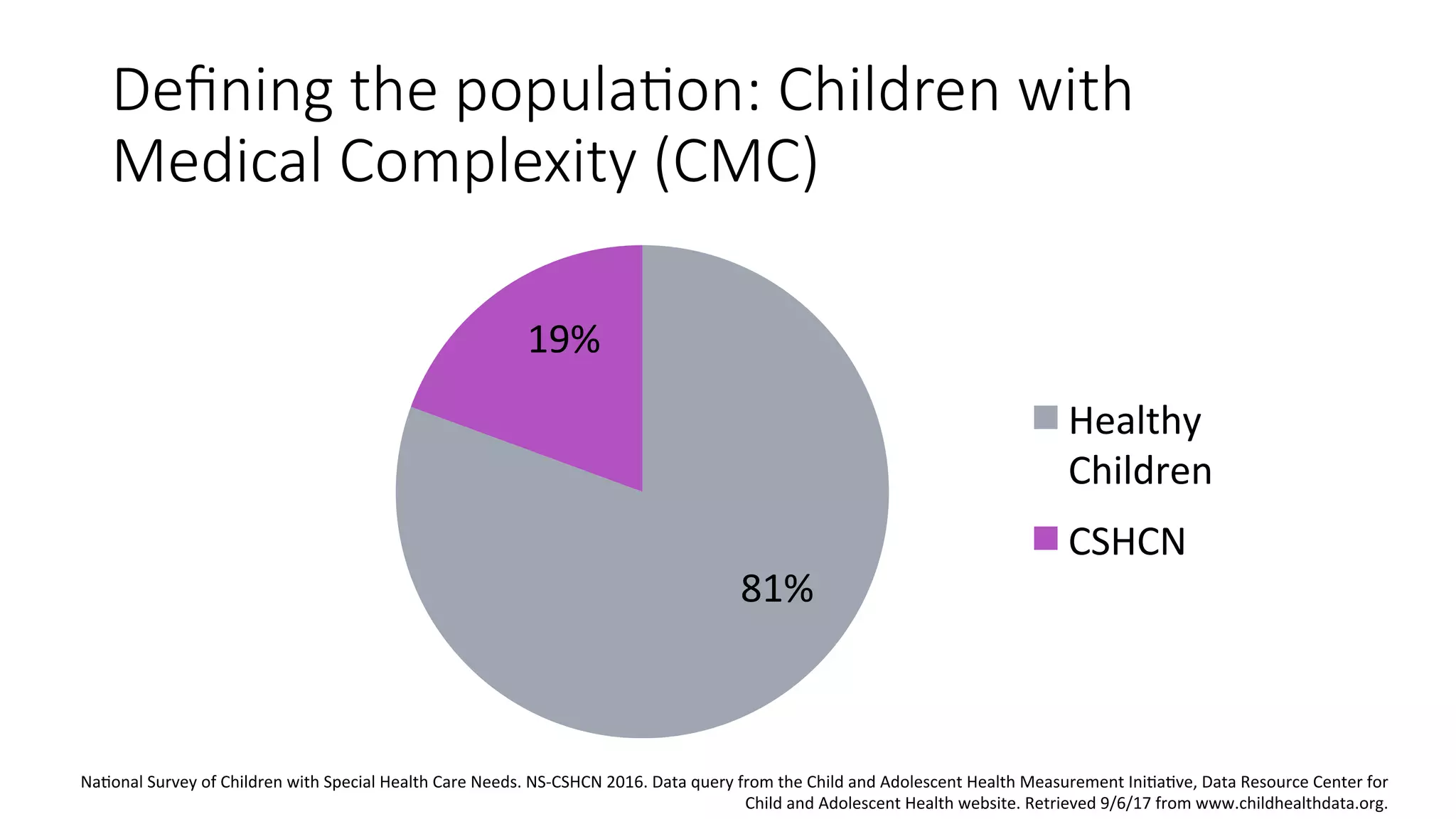
Defining the popula=on: Children with
Medical Complexity (CMC)
	NaFonal	Survey	of	Children	with	Special	Health	Care	Needs.	NS-CSHCN	2016.	Data	query	from	the	Child	and	Adolescent	Health	Measurement	IniFaFve,	Data	Resource	Center	for	
Child	and	Adolescent	Health	website.	Retrieved	9/6/17	from	www.childhealthdata.org.	
81%	
19%	
Healthy	
Children	
CSHCN
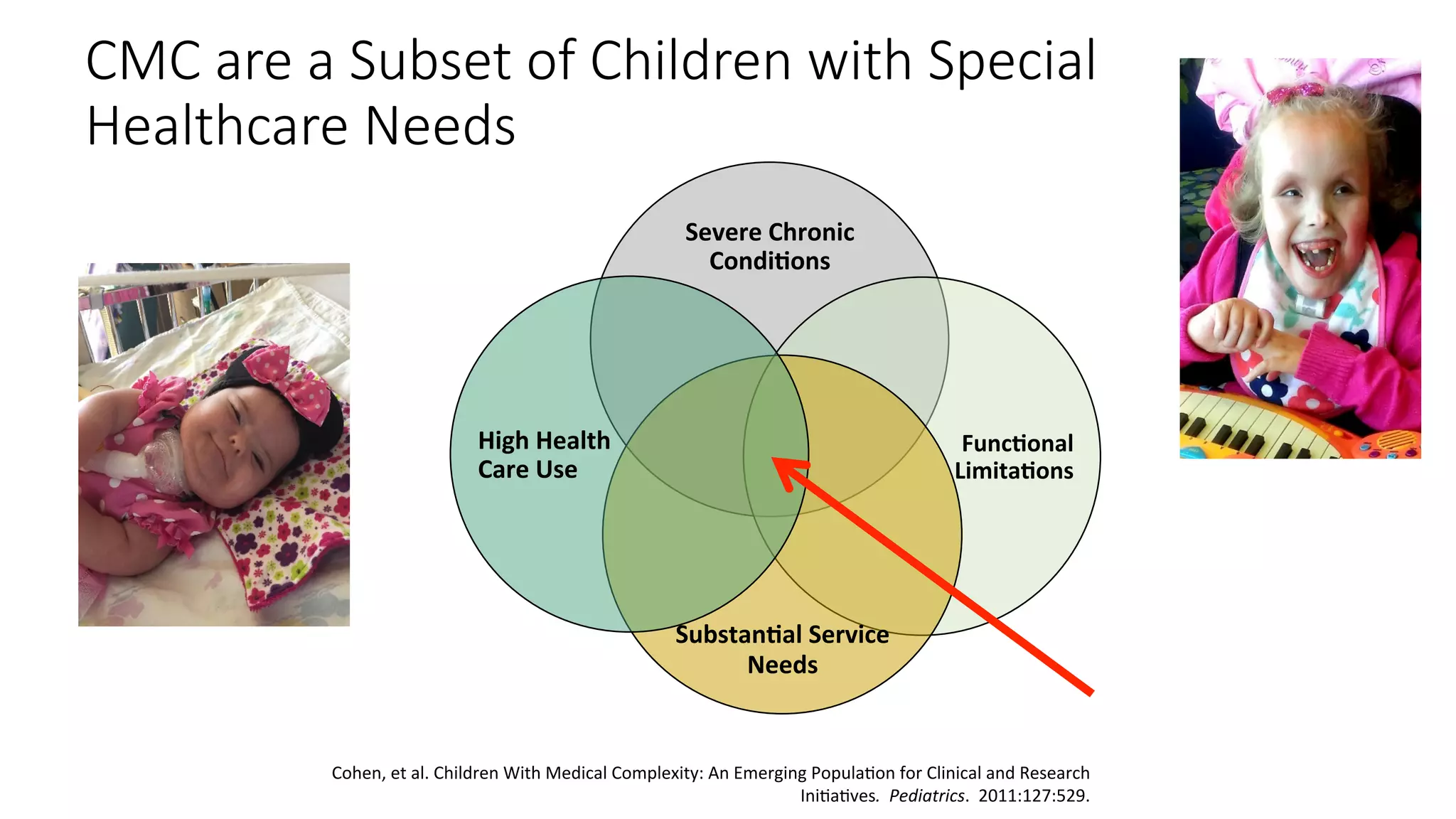
CMC are a Subset of Children with Special
Healthcare Needs
Severe	Chronic					
CondiAons	
	
		FuncAonal			
LimitaAons	
	
	
SubstanAal	Service					
Needs						
High	Health	
Care	Use	
Cohen,	et	al.	Children	With	Medical	Complexity:	An	Emerging	PopulaFon	for	Clinical	and	Research	
IniFaFves.		Pediatrics.		2011:127:529.
Impact of CMC on Children’s Hospitals in US
-5	
0	
5	
10	
15	
20	
25	
30	
35	
40	
2004	 2005	 2006	 2007	 2008	 2009	 2010	 2011	 2012	 2013	
%	Growth	in	Reference	to	2004	
Year	
Growth	in	Number	of	PaAents	
(Less	ConservaAve)	
Non_Chronic	
Non_Complex	
Complex	
p<0.0001	
Source:	Children’s	Hospital	AssociaFon
Small but Mighty - Impact on Cost is Dispropor=onate
<1%	of	all	children		
	
	
~33%	of	healthcare	
spending	on	children	
	
Cohen	E,	et	al.	Paaerns	and	costs	of	health	care	use	of	children	with	medical	complexity.	Pediatrics.		2012.	
Neff	JM,	et	al.	IdenFfying	and	classifying	children	with	chronic	condiFons	using	administraFve	data	with	the	clinical	risk	group	classificaFon	system.	Ambulatory	Pediatrics.		2002.	
CMC	
nonCMC
55%	of	all	inpaFent	costs	in	
children’s	hospitals	
	
	
85%	of	all	30-day	readmission	
costs	in	children’s	hospitals	
	
Berry,	J.	G.	(02/2013).	JAMA	pediatrics:	InpaFent	growth	and	resource	use	in	28	children's	hospitals	A	longitudinal,	mulF-insFtuFonal	study	American	Medical	AssociaFon.		
Berry	et	al.	Health	Affairs	(2014)	
CMC	
nonCMC	
Cost Impact on Children’s Hospitals
Child Health Spending and CMC
Non-CMC	
66%	 Hospital	use	
Home	nursing	
OutpaFent	
Pharmacy		
ED	
CMC	
33%	
Slide	courtesy	of	Ryan	Coller,	MD	MPH.	
Cohen	E,	et	al.	Paaerns	and	Costs	of	health	care	use	of	children	with	medical	complexity.	Pediatrics.	2012	
Neff	J,	et	al.	Profile	of	medical	charges	for	children	by	health	status	group	and	severity	level	in	a	Washington	State	Health	Plan.	Health	Services	Research.	2004	
$650	billion	
annually	
85%	of	all	
costs	are		
just	for	
medicaAons,	
specialty	care,	
and	hospital	
care.
Liam’s Story
Medical Issues at Enrollment
Lennox-Gastaut	Seizures	
Cerebral	palsy	
Diabetes	insipidus	
Chronic	lung	disease	
AspiraFon	pneumonia	
Profound	intellectual	disability	
Cardiac	arrhythmia	
G-tube	feeding	dependence	
Sleep	apnea	
Autonomic	dysfuncFon	
CorFcal	visual	impairment	
Kidney	stones
Medical Management AND Care Coordina=on
•  Took over prescrip=on drug management
•  Created crisis plans – and ensured they were implemented!
•  ED visits
•  Hospitaliza=ons
•  Made his EMR a useful tool
•  Priori=zed (at =mes eliminated) specialty visits 
•  Advocated for labs to be performed by peds phlebotomists at the children’s
hospital instead of local clinic
•  Facilitated mul=ple follow-up appointments on the same day
•  Wrote a grant for rent assistance so family could buy an accessible vehicle
“In the span of 21 months, I have
received over 300 responses to my
inquiries in MyChart…This speaks to the
level of health issues that my son
chronically faces but [also] to the level
of care and management that Jess [RN]
extends to my son.”
“The	Complex	Care	team	funcFons…as	the	‘CEO’	of	
[Liam’s]	health…Every	health	issue	that	Liam	has	is	
cloaked	under	the	Complex	Care	team…”	
“If…Complex	Care	did	not	exist…	
•  Liam	would	have	more	ER	visits	that	would	lead	
to	more	admissions.		
•  Liam	would	spend	less	Ame	in	school…	
•  I	would	spend	more	Ame	contacAng	mulFple	
subspecialists…trying	to	arrange	doctors’	
appointments,	x-rays,	and	lab	draws.”	
In the words of Liam’s mom…
Contact Informa=on

•  Mary	Ehlenbach	
•  Pediatric	Complex	Care	Program:	UW	Health-American	Family	Children’s	
Hospital	
•  mehlenbach@pediatrics.wisc.edu	
•  David	Hall	
•  Program	for	Children	with	Medically	Complex	Needs:	Monroe	Carell	Jr	
Children’s	Hospital	
•  david.e.hall@vanderbilt.edu	
•  Ingrid	Larson	
•  Beacon	Program:	Children’s	Mercy	Hospital	Kansas	City	
•  ialarson@cmh.edu

The Medically Complex Child: It Takes a Village

  • 1.
    The Medically ComplexChild: It Takes a Village Mary L. Ehlenbach, M.D. Medical Director, UW Health-American Family Children’s Hospital Pediatric Complex Care Program; Assistant Professor of Pediatrics, University of Wisconsin School of Medicine and Public Health David Hall, M.D. Professor of Clinical Pediatrics, Vanderbilt University School of Medicine; SecFon Head, Program for Children with Medically Complex Needs, Monroe Carell Jr Children’s Hospital Ingrid A. Larson, MBA, DNP, NEA-BC, APRN Director, Beacon Program, Children’s Mercy Kansas City
  • 3.
    Defining the popula=on:Children with Medical Complexity (CMC) NaFonal Survey of Children with Special Health Care Needs. NS-CSHCN 2016. Data query from the Child and Adolescent Health Measurement IniFaFve, Data Resource Center for Child and Adolescent Health website. Retrieved 9/6/17 from www.childhealthdata.org. 81% 19% Healthy Children CSHCN
  • 4.
    CMC are aSubset of Children with Special Healthcare Needs Severe Chronic CondiAons FuncAonal LimitaAons SubstanAal Service Needs High Health Care Use Cohen, et al. Children With Medical Complexity: An Emerging PopulaFon for Clinical and Research IniFaFves. Pediatrics. 2011:127:529.
  • 6.
    Impact of CMCon Children’s Hospitals in US -5 0 5 10 15 20 25 30 35 40 2004 2005 2006 2007 2008 2009 2010 2011 2012 2013 % Growth in Reference to 2004 Year Growth in Number of PaAents (Less ConservaAve) Non_Chronic Non_Complex Complex p<0.0001 Source: Children’s Hospital AssociaFon
  • 7.
    Small but Mighty- Impact on Cost is Dispropor=onate <1% of all children ~33% of healthcare spending on children Cohen E, et al. Paaerns and costs of health care use of children with medical complexity. Pediatrics. 2012. Neff JM, et al. IdenFfying and classifying children with chronic condiFons using administraFve data with the clinical risk group classificaFon system. Ambulatory Pediatrics. 2002. CMC nonCMC
  • 8.
  • 9.
    Child Health Spendingand CMC Non-CMC 66% Hospital use Home nursing OutpaFent Pharmacy ED CMC 33% Slide courtesy of Ryan Coller, MD MPH. Cohen E, et al. Paaerns and Costs of health care use of children with medical complexity. Pediatrics. 2012 Neff J, et al. Profile of medical charges for children by health status group and severity level in a Washington State Health Plan. Health Services Research. 2004 $650 billion annually 85% of all costs are just for medicaAons, specialty care, and hospital care.
  • 11.
  • 12.
    Medical Issues atEnrollment Lennox-Gastaut Seizures Cerebral palsy Diabetes insipidus Chronic lung disease AspiraFon pneumonia Profound intellectual disability Cardiac arrhythmia G-tube feeding dependence Sleep apnea Autonomic dysfuncFon CorFcal visual impairment Kidney stones
  • 13.
    Medical Management ANDCare Coordina=on •  Took over prescrip=on drug management •  Created crisis plans – and ensured they were implemented! •  ED visits •  Hospitaliza=ons •  Made his EMR a useful tool •  Priori=zed (at =mes eliminated) specialty visits •  Advocated for labs to be performed by peds phlebotomists at the children’s hospital instead of local clinic •  Facilitated mul=ple follow-up appointments on the same day •  Wrote a grant for rent assistance so family could buy an accessible vehicle
  • 14.
    “In the spanof 21 months, I have received over 300 responses to my inquiries in MyChart…This speaks to the level of health issues that my son chronically faces but [also] to the level of care and management that Jess [RN] extends to my son.”
  • 15.
  • 16.
    Contact Informa=on •  Mary Ehlenbach • Pediatric Complex Care Program: UW Health-American Family Children’s Hospital •  mehlenbach@pediatrics.wisc.edu •  David Hall •  Program for Children with Medically Complex Needs: Monroe Carell Jr Children’s Hospital •  david.e.hall@vanderbilt.edu •  Ingrid Larson •  Beacon Program: Children’s Mercy Hospital Kansas City •  ialarson@cmh.edu