Wet corrosion is defined as the corrosion that requires an
electrolyte or a medium for its occurrence. Example: Oxidation
of iron is known as rusting of iron. Here, the water acts as the
electrolyte and facilitates the movement of electrons from
anode to cathode. As a result, the rate of corrosion is much
faster in wet corrosion as compared to dry corrosion.
Fe+O2+H2O→Fe2O3.xH2O
In this type of corrosion, hydrogen ions present in the
acidic medium gain electrons to evolve hydrogen.
2H++2e−→H2
In this type of wet corrosion, oxygen absorbs electrons in
the presence of water to form hydroxide ions.
Corrosion is often a slow change and can be observed over a great period
of time. The iconic bluish-green Statue of Liberty on the Liberty island of
the New York Harbor, USA is a great example of such an observation. The
305-feet (93 meters) Initially, the copper went under oxidation reaction by
donating its electrons to the oxygen present in the air.
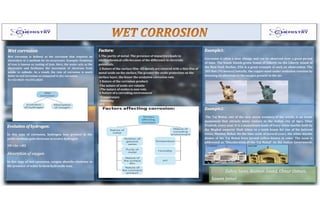
1.The purity of metal: The presence of impurities leads to
electrochemical cells because of the difference in electrode
potentials.
2.Nature of the surface film: All metals are covered with a thin film of
metal oxide on the surface,The greater the oxide protection on the
surface layer, the lesser the oxidation corrosion rate.
3.Nature of the corrosion product:
-The nature of oxide are volatile
-The nature of oxides is non-vola
4.Nature of a corroding environment
-Temperature
-Humidity
-PH
The Taj Mahal, one of the new seven wonders of the world, is an iconic
monument that attracts many visitors to the Indian city of Agra, Uttar
Pradesh, every year. It is a mausoleum made of ivory-white marble built by
the Mughal emperor Shah Jahan as a tomb house for one of his beloved
wives, Mumtaj Mahal. On the time scale of several years, the white marble
domes of the Taj Mahal have turned yellow-brown in color. The issue is
addressed as “Discoloration of the Taj Mahal” by the Indian Government.

POSTER CHEMISTRY.pdf

  • 1.
    Wet corrosion isdefined as the corrosion that requires an electrolyte or a medium for its occurrence. Example: Oxidation of iron is known as rusting of iron. Here, the water acts as the electrolyte and facilitates the movement of electrons from anode to cathode. As a result, the rate of corrosion is much faster in wet corrosion as compared to dry corrosion. Fe+O2+H2O→Fe2O3.xH2O In this type of corrosion, hydrogen ions present in the acidic medium gain electrons to evolve hydrogen. 2H++2e−→H2 In this type of wet corrosion, oxygen absorbs electrons in the presence of water to form hydroxide ions. Corrosion is often a slow change and can be observed over a great period of time. The iconic bluish-green Statue of Liberty on the Liberty island of the New York Harbor, USA is a great example of such an observation. The 305-feet (93 meters) Initially, the copper went under oxidation reaction by donating its electrons to the oxygen present in the air. 1.The purity of metal: The presence of impurities leads to electrochemical cells because of the difference in electrode potentials. 2.Nature of the surface film: All metals are covered with a thin film of metal oxide on the surface,The greater the oxide protection on the surface layer, the lesser the oxidation corrosion rate. 3.Nature of the corrosion product: -The nature of oxide are volatile -The nature of oxides is non-vola 4.Nature of a corroding environment -Temperature -Humidity -PH The Taj Mahal, one of the new seven wonders of the world, is an iconic monument that attracts many visitors to the Indian city of Agra, Uttar Pradesh, every year. It is a mausoleum made of ivory-white marble built by the Mughal emperor Shah Jahan as a tomb house for one of his beloved wives, Mumtaj Mahal. On the time scale of several years, the white marble domes of the Taj Mahal have turned yellow-brown in color. The issue is addressed as “Discoloration of the Taj Mahal” by the Indian Government.