
Post-Disaster Cathartic
Reflection
Abbie Gaffey
Community Development Program Specialist
Iowa State University Extension & Outreach
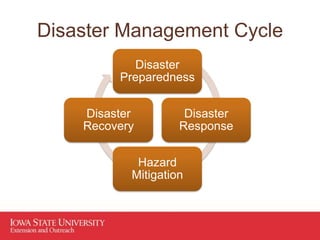
Disaster
Preparedness
Disaster
Response
Hazard
Mitigation
Disaster
Recovery
Disaster Management Cycle
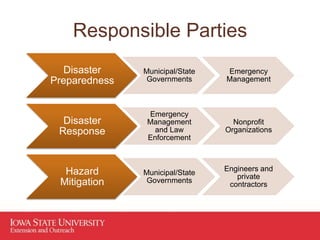
Disaster
Preparedness
Municipal/State
Governments
Emergency
Management
Disaster
Response
Emergency
Management
and Law
Enforcement
Nonprofit
Organizations
Hazard
Mitigation
Municipal/State
Governments
Engineers and
private
contractors
Responsible Parties
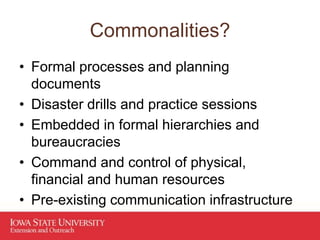
Commonalities?
• Formal processes and planning
documents
• Disaster drills and practice sessions
• Embedded in formal hierarchies and
bureaucracies
• Command and control of physical,
financial and human resources
• Pre-existing communication infrastructure
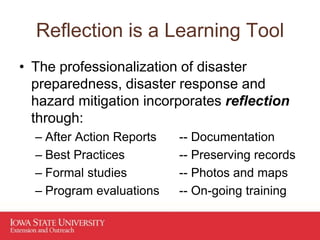
Reflection is a Learning Tool
• The professionalization of disaster
preparedness, disaster response and
hazard mitigation incorporates reflection
through:
– After Action Reports -- Documentation
– Best Practices -- Preserving records
– Formal studies -- Photos and maps
– Program evaluations -- On-going training
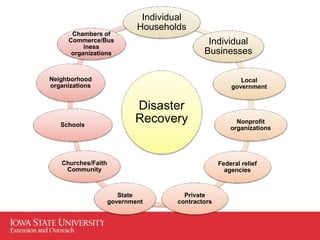
Disaster
Recovery
Individual
Households
Individual
Businesses
Local
government
Nonprofit
organizations
Federal relief
agencies
Private
contractors
State
government
Churches/Faith
Community
Schools
Neighborhood
organizations
Chambers of
Commerce/Bus
iness
organizations
Commonalities?
• Once in a lifetime experience
• Multiple leaders – formal and informal
• Outside of formal hierarchies and bureaucracies
• Impacted negatively in varying degrees
• Varying levels of resources available to respond
• No formal pre-existing communication
infrastructure
• No norms of decision-making
• No “Best Practices” to rely upon
“Disasters are stressful not only for individuals
experiencing personal loss but also for the
community-at-large. Communities share
damages and disruptions to the various
environments of which they are composed.
Destruction of a ‘keystone’ neighborhood, such
as a central business district, may challenge an
entire city or region.”
“Transient Dysfunction”
• A period of weeks and months – up to
three years – when normal community
functions are disrupted or substantially
altered following a natural disaster.
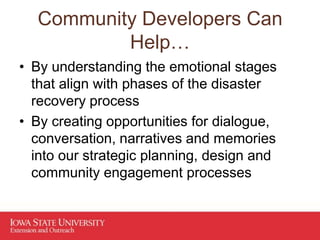
Community Developers Can
Help…
• By understanding the emotional stages
that align with phases of the disaster
recovery process
• By creating opportunities for dialogue,
conversation, narratives and memories
into our strategic planning, design and
community engagement processes
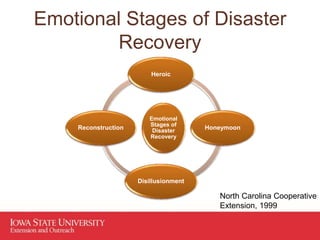
Emotional Stages of Disaster
Recovery
Emotional
Stages of
Disaster
Recovery
Heroic
Honeymoon
Disillusionment
Reconstruction
North Carolina Cooperative
Extension, 1999
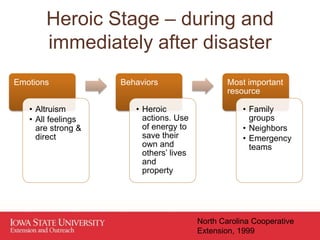
Emotions
• Altruism
• All feelings
are strong &
direct
Behaviors
• Heroic
actions. Use
of energy to
save their
own and
others’ lives
and
property
Most important
resource
• Family
groups
• Neighbors
• Emergency
teams
Heroic Stage – during and
immediately after disaster
North Carolina Cooperative
Extension, 1999
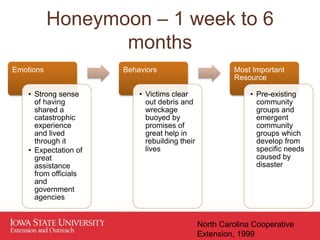
Honeymoon – 1 week to 6
months
Emotions
• Strong sense
of having
shared a
catastrophic
experience
and lived
through it
• Expectation of
great
assistance
from officials
and
government
agencies
Behaviors
• Victims clear
out debris and
wreckage
buoyed by
promises of
great help in
rebuilding their
lives
Most Important
Resource
• Pre-existing
community
groups and
emergent
community
groups which
develop from
specific needs
caused by
disaster
North Carolina Cooperative
Extension, 1999
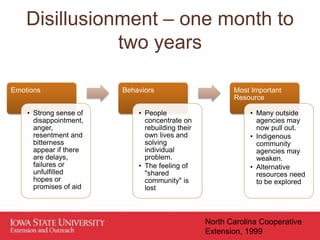
Disillusionment – one month to
two years
Emotions
• Strong sense of
disappointment,
anger,
resentment and
bitterness
appear if there
are delays,
failures or
unfulfilled
hopes or
promises of aid
Behaviors
• People
concentrate on
rebuilding their
own lives and
solving
individual
problem.
• The feeling of
"shared
community" is
lost
Most Important
Resource
• Many outside
agencies may
now pull out.
• Indigenous
community
agencies may
weaken.
• Alternative
resources need
to be explored
North Carolina Cooperative
Extension, 1999
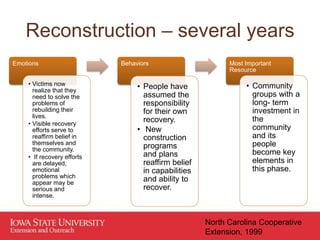
Reconstruction – several years
Emotions
• Victims now
realize that they
need to solve the
problems of
rebuilding their
lives.
• Visible recovery
efforts serve to
reaffirm belief in
themselves and
the community.
• If recovery efforts
are delayed,
emotional
problems which
appear may be
serious and
intense.
Behaviors
• People have
assumed the
responsibility
for their own
recovery.
• New
construction
programs
and plans
reaffirm belief
in capabilities
and ability to
recover.
Most Important
Resource
• Community
groups with a
long- term
investment in
the
community
and its
people
become key
elements in
this phase.
North Carolina Cooperative
Extension, 1999
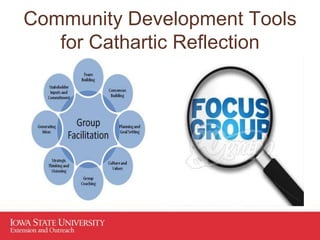
Community Development Tools
for Cathartic Reflection
Community Development Tools
for Cathartic Reflection
Community Development Tools
for Cathartic Reflection
Community Development Tools
for Cathartic Reflection
Why These Tools are Effective
• Allows multiple ways for people to process
their disaster experiences – public grief
• People feel heard and listened to
• Relief of knowing that what they are
experiencing is part of a normal cycle
• Results in richer research that may lead to
better best practices
• Engagement always builds community
Contact Info
• Questions?
• Abbie Gaffey, Community Development
Program Specialist, Iowa State University
Extension & Outreach
agaffey@iastate.edu
(712) 539-1169
Link to Study
• http://lib.dr.iastate.edu/cgi/viewcontent.cgi
?article=4254&context=etd&sei-
redir=1&referer=http%3A%2F%2Fsearch.
yahoo.com%2Fsearch%3Fei%3Dutf-
8%26fr%3Daaplw%26p%3Dcathartic%2Br
eflection#search=%22cathartic%20reflecti
on%22

Post Disaster Cathartic Reflection

  • 1.
    Post-Disaster Cathartic Reflection Abbie Gaffey CommunityDevelopment Program Specialist Iowa State University Extension & Outreach
  • 4.
  • 5.
  • 6.
    Commonalities? • Formal processesand planning documents • Disaster drills and practice sessions • Embedded in formal hierarchies and bureaucracies • Command and control of physical, financial and human resources • Pre-existing communication infrastructure
  • 7.
    Reflection is aLearning Tool • The professionalization of disaster preparedness, disaster response and hazard mitigation incorporates reflection through: – After Action Reports -- Documentation – Best Practices -- Preserving records – Formal studies -- Photos and maps – Program evaluations -- On-going training
  • 8.
  • 9.
    Commonalities? • Once ina lifetime experience • Multiple leaders – formal and informal • Outside of formal hierarchies and bureaucracies • Impacted negatively in varying degrees • Varying levels of resources available to respond • No formal pre-existing communication infrastructure • No norms of decision-making • No “Best Practices” to rely upon
  • 10.
    “Disasters are stressfulnot only for individuals experiencing personal loss but also for the community-at-large. Communities share damages and disruptions to the various environments of which they are composed. Destruction of a ‘keystone’ neighborhood, such as a central business district, may challenge an entire city or region.”
  • 11.
    “Transient Dysfunction” • Aperiod of weeks and months – up to three years – when normal community functions are disrupted or substantially altered following a natural disaster.
  • 14.
    Community Developers Can Help… •By understanding the emotional stages that align with phases of the disaster recovery process • By creating opportunities for dialogue, conversation, narratives and memories into our strategic planning, design and community engagement processes
  • 15.
    Emotional Stages ofDisaster Recovery Emotional Stages of Disaster Recovery Heroic Honeymoon Disillusionment Reconstruction North Carolina Cooperative Extension, 1999
  • 16.
    Emotions • Altruism • Allfeelings are strong & direct Behaviors • Heroic actions. Use of energy to save their own and others’ lives and property Most important resource • Family groups • Neighbors • Emergency teams Heroic Stage – during and immediately after disaster North Carolina Cooperative Extension, 1999
  • 17.
    Honeymoon – 1week to 6 months Emotions • Strong sense of having shared a catastrophic experience and lived through it • Expectation of great assistance from officials and government agencies Behaviors • Victims clear out debris and wreckage buoyed by promises of great help in rebuilding their lives Most Important Resource • Pre-existing community groups and emergent community groups which develop from specific needs caused by disaster North Carolina Cooperative Extension, 1999
  • 18.
    Disillusionment – onemonth to two years Emotions • Strong sense of disappointment, anger, resentment and bitterness appear if there are delays, failures or unfulfilled hopes or promises of aid Behaviors • People concentrate on rebuilding their own lives and solving individual problem. • The feeling of "shared community" is lost Most Important Resource • Many outside agencies may now pull out. • Indigenous community agencies may weaken. • Alternative resources need to be explored North Carolina Cooperative Extension, 1999
  • 19.
    Reconstruction – severalyears Emotions • Victims now realize that they need to solve the problems of rebuilding their lives. • Visible recovery efforts serve to reaffirm belief in themselves and the community. • If recovery efforts are delayed, emotional problems which appear may be serious and intense. Behaviors • People have assumed the responsibility for their own recovery. • New construction programs and plans reaffirm belief in capabilities and ability to recover. Most Important Resource • Community groups with a long- term investment in the community and its people become key elements in this phase. North Carolina Cooperative Extension, 1999
  • 20.
    Community Development Tools forCathartic Reflection
  • 21.
    Community Development Tools forCathartic Reflection
  • 22.
    Community Development Tools forCathartic Reflection
  • 23.
    Community Development Tools forCathartic Reflection
  • 24.
    Why These Toolsare Effective • Allows multiple ways for people to process their disaster experiences – public grief • People feel heard and listened to • Relief of knowing that what they are experiencing is part of a normal cycle • Results in richer research that may lead to better best practices • Engagement always builds community
  • 25.
    Contact Info • Questions? •Abbie Gaffey, Community Development Program Specialist, Iowa State University Extension & Outreach agaffey@iastate.edu (712) 539-1169
  • 26.
    Link to Study •http://lib.dr.iastate.edu/cgi/viewcontent.cgi ?article=4254&context=etd&sei- redir=1&referer=http%3A%2F%2Fsearch. yahoo.com%2Fsearch%3Fei%3Dutf- 8%26fr%3Daaplw%26p%3Dcathartic%2Br eflection#search=%22cathartic%20reflecti on%22