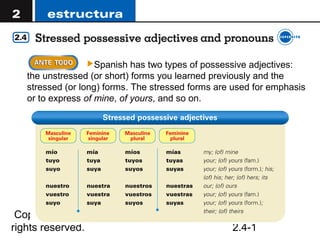
Spanish    has two types of possessive adjectives:
   the unstressed (or short) forms you learned previously and the
   stressed (or long) forms. The stressed forms are used for emphasis
   or to express of mine, of yours, and so on.


 Copyright © 2008 Vista Higher Learning. All
rights reserved.                                   2.4-1
 ¡Atención! Used with un/una, these
     possessives are similar in meaning to the
     English expression of mine/yours/etc.


 Copyright © 2008 Vista Higher Learning. All
rights reserved.                               2.4-2
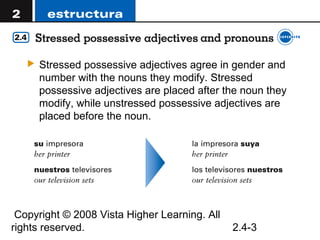
   Stressed possessive adjectives agree in gender and
       number with the nouns they modify. Stressed
       possessive adjectives are placed after the noun they
       modify, while unstressed possessive adjectives are
       placed before the noun.


 Copyright © 2008 Vista Higher Learning. All
rights reserved.                               2.4-3
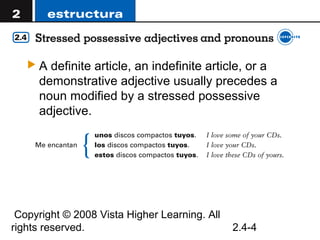
A  definite article, an indefinite article, or a
     demonstrative adjective usually precedes a
     noun modified by a stressed possessive
     adjective.


 Copyright © 2008 Vista Higher Learning. All
rights reserved.                               2.4-4
 Since   suyo, suya, suyos, and suyas have
     more than one meaning, you can avoid
     confusion by using the construction:
     [article] + [noun] + de + [subject pronoun].


 Copyright © 2008 Vista Higher Learning. All
rights reserved.                               2.4-5
Possessive pronouns
    Possessive  pronouns are used to replace a
     noun + [possessive adjective]. In Spanish, the
     possessive pronouns have the same forms as
     the stressed possessive adjectives, and they
     are preceded by a definite article.


 Copyright © 2008 Vista Higher Learning. All
rights reserved.                               2.4-6
   A possessive pronoun agrees in number and gender
       with the noun it replaces.


 Copyright © 2008 Vista Higher Learning. All
rights reserved.                               2.4-7
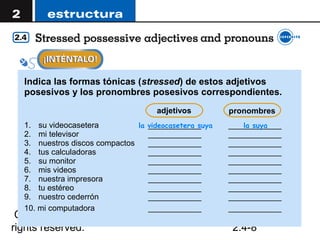
Indica las formas tónicas (stressed) de estos adjetivos
  posesivos y los pronombres posesivos correspondientes.
                                     adjetivos         pronombres
  1. su videocasetera          la videocasetera suya
                                  ____________            la suya
                                                       ____________
  2. mi televisor                 ____________         ____________
  3. nuestros discos compactos    ____________         ____________
  4. tus calculadoras             ____________         ____________
  5. su monitor                   ____________         ____________
  6. mis videos                   ____________         ____________
  7. nuestra impresora            ____________         ____________
  8. tu estéreo                   ____________         ____________
  9. nuestro cederrón             ____________         ____________
  10. mi computadora              ____________         ____________
 Copyright © 2008 Vista Higher Learning. All
rights reserved.                                       2.4-8

Posesivos

  • 1.
    Spanish has two types of possessive adjectives: the unstressed (or short) forms you learned previously and the stressed (or long) forms. The stressed forms are used for emphasis or to express of mine, of yours, and so on. Copyright © 2008 Vista Higher Learning. All rights reserved. 2.4-1
  • 2.
     ¡Atención! Usedwith un/una, these possessives are similar in meaning to the English expression of mine/yours/etc. Copyright © 2008 Vista Higher Learning. All rights reserved. 2.4-2
  • 3.
    Stressed possessive adjectives agree in gender and number with the nouns they modify. Stressed possessive adjectives are placed after the noun they modify, while unstressed possessive adjectives are placed before the noun. Copyright © 2008 Vista Higher Learning. All rights reserved. 2.4-3
  • 4.
    A definitearticle, an indefinite article, or a demonstrative adjective usually precedes a noun modified by a stressed possessive adjective. Copyright © 2008 Vista Higher Learning. All rights reserved. 2.4-4
  • 5.
     Since suyo, suya, suyos, and suyas have more than one meaning, you can avoid confusion by using the construction: [article] + [noun] + de + [subject pronoun]. Copyright © 2008 Vista Higher Learning. All rights reserved. 2.4-5
  • 6.
    Possessive pronouns  Possessive pronouns are used to replace a noun + [possessive adjective]. In Spanish, the possessive pronouns have the same forms as the stressed possessive adjectives, and they are preceded by a definite article. Copyright © 2008 Vista Higher Learning. All rights reserved. 2.4-6
  • 7.
    A possessive pronoun agrees in number and gender with the noun it replaces. Copyright © 2008 Vista Higher Learning. All rights reserved. 2.4-7
  • 8.
    Indica las formastónicas (stressed) de estos adjetivos posesivos y los pronombres posesivos correspondientes. adjetivos pronombres 1. su videocasetera la videocasetera suya ____________ la suya ____________ 2. mi televisor ____________ ____________ 3. nuestros discos compactos ____________ ____________ 4. tus calculadoras ____________ ____________ 5. su monitor ____________ ____________ 6. mis videos ____________ ____________ 7. nuestra impresora ____________ ____________ 8. tu estéreo ____________ ____________ 9. nuestro cederrón ____________ ____________ 10. mi computadora ____________ ____________ Copyright © 2008 Vista Higher Learning. All rights reserved. 2.4-8