Portland Protocol – Review
Runal Shah
2nd year Resident
Masters in Emergency Medicine
Kokilaben Dhirubhai Ambani Hospital
Mumbai
Objectives
• Know your insulin
• Clinical applicability
• Portland protocol
Know your Insulin
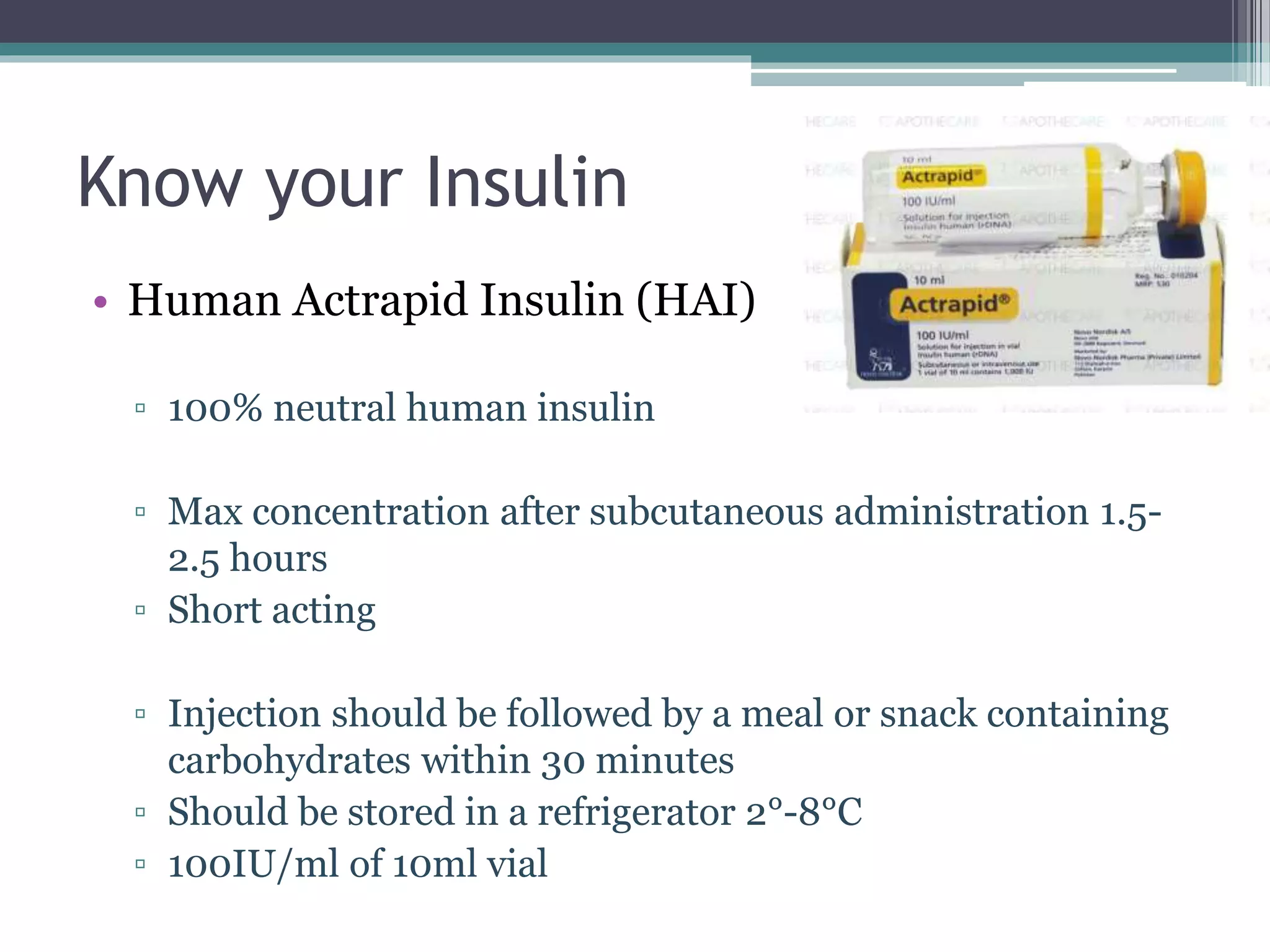
• Human Actrapid Insulin (HAI)
▫ 100% neutral human insulin
▫ Max concentration after subcutaneous administration 1.5-
2.5 hours
▫ Short acting
▫ Injection should be followed by a meal or snack containing
carbohydrates within 30 minutes
▫ Should be stored in a refrigerator 2°-8°C
▫ 100IU/ml of 10ml vial
Clinical applicability
• ICU application
• Hyperglycemia–Increased Morbidity, Mortality
▫ Immune dysfunction
▫ Increased systemic inflammation
▫ Vascular insufficiency
• Improved glycemic control leads to decrease in mortality
from 8.0 to 4.6% *
• *Van den Berghe G, Wouters P, Weekers F, Verwaest C, Bruyninckx F, Schetz M,
et al. Intensive insulin therapy in the critically ill patients. N Engl J Med. 2001
Nov 8. 345(19):1359-67.
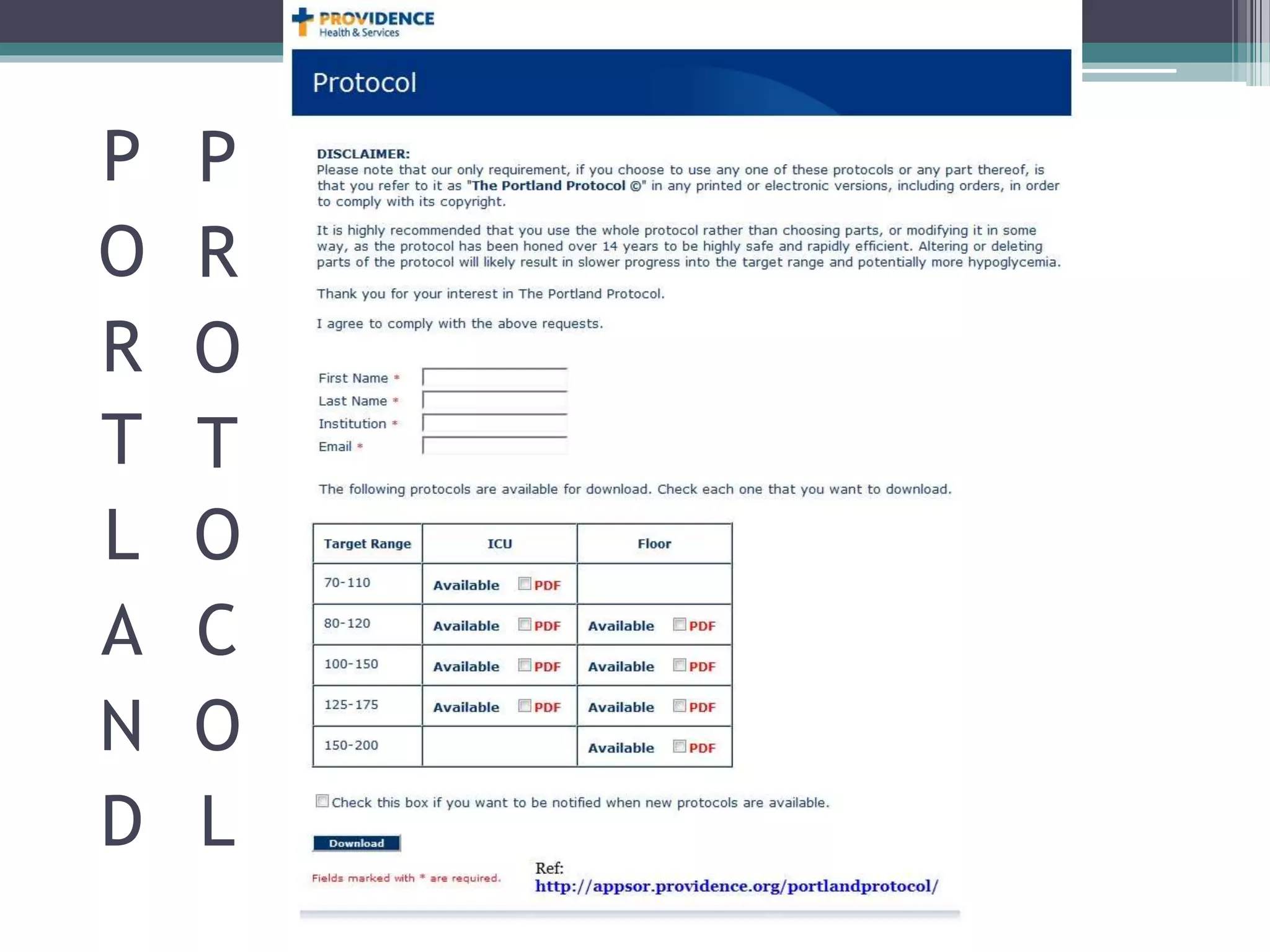
Portland Protocol
• In 1992, the Providence Heart and Vascular Institute
developed the Portland Protocol© from data
extrapolated from diabetic patients who underwent
cardiac surgery.
• It has undergone multiple modifications since its
inception and takes into account many of the nuances
previously identified.
• Other protocols
▫ Georgia Hospital Association Protocol (the Davidson or
Glucommander Protocol)
P
O
R
T
L
A
N
D
P
R
O
T
O
C
O
L
Portland Protocol
• Target blood sugar range : 100-150 mg/dl
▫ Initial blood glucose check upon admission and then every
2 hours
▫ HbA1c to check
▫ Portland protocol starts at Sugars > 125 mg/dl
• Mix 1 unit of Regular human insulin per 1 ml of 0.9%
normal saline and start IV infusion via pump.
Portland Protocol
• Frequency of testing is as follows:
▫ Check blood glucose every 30 minutes when blood glucose
is more than 200mg/dL or less than 100 mg/dL
▫ Check blood glucose every hour when levels are 100-200
mg/dL.
▫ Check blood glucose every two hours when levels are 125-
175 mg/dL and blood glucose varies less than 15 mg/dL
over 4 hours and the insulin rate remains unchanged for 4
hours.
▫ Note: If any change in blood glucose more than 15mg/dL
occurs or any change in insulin rate more than 0.5 units
occurs, return to checking blood glucose every hour.
Portland Protocol
• Pros
▫ Good control of sugars over intermittent SC Insulin
▫ Known diabetics in whom sugar is not controlled with
subcutaneous Insulin
• Cons
▫ Bedside calculation of insulin dose is cumbersome work
▫ Hypoglycemia – the most feared side effect
▫ Warning signs of hypoglycemia are difficult to appreciate in
critically ill patients
▫ Nurse driven with varying physician output
▫ Capillary blood vs. Venous blood sugar diff !! (~70)
Thank You…
• Ref :
Medscape
Tintinalli 7/e
http://appsor.providence.org/portlandprotocol

Portland protocol - review

  • 1.
    Portland Protocol –Review Runal Shah 2nd year Resident Masters in Emergency Medicine Kokilaben Dhirubhai Ambani Hospital Mumbai
  • 2.
    Objectives • Know yourinsulin • Clinical applicability • Portland protocol
  • 3.
    Know your Insulin •Human Actrapid Insulin (HAI) ▫ 100% neutral human insulin ▫ Max concentration after subcutaneous administration 1.5- 2.5 hours ▫ Short acting ▫ Injection should be followed by a meal or snack containing carbohydrates within 30 minutes ▫ Should be stored in a refrigerator 2°-8°C ▫ 100IU/ml of 10ml vial
  • 4.
    Clinical applicability • ICUapplication • Hyperglycemia–Increased Morbidity, Mortality ▫ Immune dysfunction ▫ Increased systemic inflammation ▫ Vascular insufficiency • Improved glycemic control leads to decrease in mortality from 8.0 to 4.6% * • *Van den Berghe G, Wouters P, Weekers F, Verwaest C, Bruyninckx F, Schetz M, et al. Intensive insulin therapy in the critically ill patients. N Engl J Med. 2001 Nov 8. 345(19):1359-67.
  • 5.
    Portland Protocol • In1992, the Providence Heart and Vascular Institute developed the Portland Protocol© from data extrapolated from diabetic patients who underwent cardiac surgery. • It has undergone multiple modifications since its inception and takes into account many of the nuances previously identified. • Other protocols ▫ Georgia Hospital Association Protocol (the Davidson or Glucommander Protocol)
  • 6.
  • 7.
    Portland Protocol • Targetblood sugar range : 100-150 mg/dl ▫ Initial blood glucose check upon admission and then every 2 hours ▫ HbA1c to check ▫ Portland protocol starts at Sugars > 125 mg/dl • Mix 1 unit of Regular human insulin per 1 ml of 0.9% normal saline and start IV infusion via pump.
  • 8.
    Portland Protocol • Frequencyof testing is as follows: ▫ Check blood glucose every 30 minutes when blood glucose is more than 200mg/dL or less than 100 mg/dL ▫ Check blood glucose every hour when levels are 100-200 mg/dL. ▫ Check blood glucose every two hours when levels are 125- 175 mg/dL and blood glucose varies less than 15 mg/dL over 4 hours and the insulin rate remains unchanged for 4 hours. ▫ Note: If any change in blood glucose more than 15mg/dL occurs or any change in insulin rate more than 0.5 units occurs, return to checking blood glucose every hour.
  • 9.
    Portland Protocol • Pros ▫Good control of sugars over intermittent SC Insulin ▫ Known diabetics in whom sugar is not controlled with subcutaneous Insulin • Cons ▫ Bedside calculation of insulin dose is cumbersome work ▫ Hypoglycemia – the most feared side effect ▫ Warning signs of hypoglycemia are difficult to appreciate in critically ill patients ▫ Nurse driven with varying physician output ▫ Capillary blood vs. Venous blood sugar diff !! (~70)
  • 10.
    Thank You… • Ref: Medscape Tintinalli 7/e http://appsor.providence.org/portlandprotocol