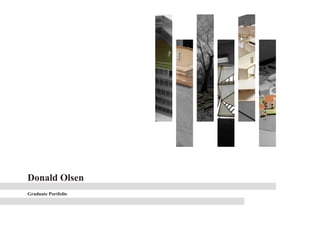
Donald Olsen
Graduate Portfolio
Trinity River Revival 1
Dallas the Connected City
ARC 451- Urban Design
The Transition Between 3
Designing a Border Crossing
ARC 452- Design Integration
Elevated Life Tree House Museum 5
Displaying a Building Collection
ARC 550- Regional Design
2016 Olympic Legacy Plan for Rio De Janeiro 7
Designing a Community
ARC 551- Comprehensive Studio
Fabricating an Assembly of Connections 9
Graduate Thesis
ARC 552- Independent Thesis Studio
TABLE OF CONTENTS
Trinity River Revival
Dallas the Connected City
ARC 451- Urban Design
Dallas, Texas
•	Objectives:
•	Enhance major spine connections,
providing pedestrian-scale amenities.
•	Create and develop new interest
along the levee to support the Trinity
River as a grand public space.
•	Developed small, incremental
pedestrian nodes as the beginning of
new anchors for the area;
•	One goal was to enhance existing
site and introduce new spaces
dominated by green space and water
elements to create an enjoyable
experience leading to and from the
river.
•	Dallas the connected city as an
Urban design project offered me the
opportunity to design beyond the
context of one lot, one block, but
rather a large percentage of an entire
city. The site offered a number of
challenges including the highways,
flooding risks, and division of spaces.
•	The main area of my focus was on
the Civic Center design as well as the
surrounding area.
1
2
The Transition Between
Designing a Border Crossing
ARC 452- Design Integration
Laredo, Texas
•	Objectives:
•	 This design challenge was to
redesign an existing border crossing.
•	Due to the complexity of a border
crossing there were a number os
program space decisions needed
within the design including: a police
station, staff living quarters, offices,
an impound warehouse and dog
kennels.
•	The smaller mid lane building is
intended to be a truck registration
and check in station. It would also
serve as a customs office for all the
commercial vehicles passing through.
•	One of the major design goals
was continued lines of sight that run
from the interior to exterior of the
buildings.
•	The bridge above the lanes is
intended to be an open walkable green
space open to the passing trucks who
may be stopped.
•	The overall goal was to create an
inviting, efficient crossing.
3
First Floor Plan Second Floor Plan
East/ West Section
North/ South Section
Scan QR Code for
Walk Through Video
4
www.autodesk.com/revit
Scale
Date
Drawn By
Checked By
Project Number
Consultant
Address
Address
Address
Phone
Consultant
Address
Address
Address
Phone
Consultant
Address
Address
Address
Phone
Consultant
Address
Address
Address
Phone
Consultant
Address
Address
Address
Phone
7/30/20147:03:05PM
107
Unnamed
Owner
Project Name
Checker
Author
Issue Date
Project Number
No. Description Date
Elevated Life Tree House Museum
Displaying a building collection
ARC 550- Regional Design
Rend Lake, Illinois
•	Objectives:
•	Develop and design a museum 	
for the purpose of displaying a 	
collection of treehouses.
•	 This design was based on the
inherant nature of an elevated space
while still trying to memorable spaces.
•	 One goal was to create the
“dinosaur effect”, meaning the
creation of an iconic grand entrance.
•	To create the “dinosaur” this design
includes a permanant tree house built
into the main atrium space.
•	Like many tree houses, this design
offers a multiple ways into the
exhibition space from the ground
level.
•	The walking paths that travel
through the site lead to the rotating
building collection (not pictured).
•	The exterior louvres are inspired
by a number of cladding systems
including the Loblolly House,
Maryland.
5
Project Abstract: Designing a great tree house only requires two
things, imagination and desire. Tree houses are something created in
a plethora of regions all of the world and no two are exactly the same.
Each tree house does however share some similar guiding principals:
the tectonic relationship of the tree house to the tree itself, the variety
of styles of connections at these intersections, that have successfully
worked, the journey from ground to the platform, and the artistic
factor that comes into tree house design. The connections to the trees
is an important part of how tree houses work. Some rely on bolted
connections and cables while others let gravity do all the work. The
journey from the ground to the platform is an important element for
any tree house. It can tell a story, provide intended views, and leave
people with a variety of specific memories about their journey.  The
artistic factor is clearly seen in overall design because overall there
are no rules beyond connection principles and physics in tree house
design. Creativity is something that is encouraged to run free with tree
houses, making them the ideal candidates to see the inner child come
out in many designers.
	 Elevated Life Tree House Museum is one that envisions
a community of both children and adults that are inspired by the
whimsical nature of a tree house. Our goal is one of exhibition,
inspiration and education pertaining to tree houses and the wonder
they excite in people based on the aforementioned guiding principles.
Ultimately our goal is to inspire more people to experience a view
from above and feel the magic that is a tree house.
Exploded Building Model
Building Section
Scan QR Code for
Walk Through Video
-
---
1/8" = 1'-0"
1
Section 9
1/8" = 1'-0"
3
Section 6
6
2016 Olympic Legacy Plan for Rio De Janeiro
Designing a Community
ARC 551- Comprehensive Studio
Rio De Janeiro, Brazil
•	Objectives:
•	 Designed to be built in 2030, as
part of a sports legacy village plan by
AECOM for Rio.
•	The master planning design utilized
a raised olympic way walk that helped
to divide the site between the more
permanent residents and the visiting
athletes.
•	 The Olympic way in this design
was intended to double as a retail mall
that would act as a point of interaction
between residents and travelers.
•	The plan’s West side is intended
to create a sense of local community.
•	The East side of the plan has a large
sports facility and hotel.
•	My design focus was on the west
residential.
•	Due to climate the intention of
the design was to create small
microclimates between the buildings.
7
Scan for Residential
Walk Through Video
Scan for Complete Site
Walk Through Video
8
Fabricating an Assembly of Connections
Graduate Thesis
ARC 552- Independent Thesis
•	Objectives:
•	 Design housing as a kit of parts
that can be flat packed and assembled
with minimal building knowledge and
tools.
•	The kit development is a study on
the various connection types that
make up a complete structure.
•	 One of the goals of the thesis is to
minimize the cost and tools needed to
create a complete structure.
•	This construction assembly helps to
eliminate the need for large machines,
and a large skilled labor force.
•	The kit is designed to utilize friction
connections to hold the structure
together rather than use hardware.
9
Thesis Abstract: It took hundreds of thousands of years for the world population
to reach 1 billion, but only took from 1950 to 2011 for the world population
to double from 2.5 to 5 billion. As the population grows, so does the need
for affordable, easily constructed housing. Construction methods in the less
developed world vary from the standards currently seen in more developed
nations. Construction in the less developed world consists of far fewer
construction managers, guidelines, restrictions, and skilled labor. Perhaps there
is a way to eliminate the need for skilled labor and construction managers, by
developing a new construction assembly.
	 Designers spend large amounts of time working at computers to create
drawings that give direction to contractors and trades in carrying out their
intended visions. Our current construction methods prove slow in, wasteful of
materials, and require a large group of skilled labor. Through the use of digital
fabrication machines we are able to eliminate the need for a skilled labor force,
reduce construction waste, and time. For these reasons, digital fabrication
needs to be the next step in the evolution of construction. Rapidly generating
housing is a step towards aiding the need the world population growth poses in
the future.
	 This thesis poses the creation of a construction assembly method that
could create affordable, multi-story housing kit, cut using digital fabrication
machines. These housing kits could function in a number of capacities, but the
hope is that they will provide some options for the need for housing worldwide.
Precedents to Build On
Professor Larry Sass
MIT School of Architecture
Larry Sass has been doing research on the topic of modular
friction fit housing for nearly a decade. He is currently
writting a software in conjunction with Lujie Chen, of the
Singapore University of Technology and Design, that will
automatically add connection tabs and create planar surfaces
of any 3D object. His research is what has paved the way for
the research and process that I have been working on pushing
further.
10
Corner Detail Assembly
The corner detail assembly is where I started my assembly design process. The reason for this decision is that the corner is a unique point where three different surfaces come
together. Most other parts of the assembly have instances where only two surfaces come together. By making the corner the first priority in the design it later would simplify the
remaining connections to be designed. The coner itself was a series of trials and errors. After many models itterations this was the settled on design method.
11
12

portfolio.compressed

  • 1.
  • 2.
    Trinity River Revival1 Dallas the Connected City ARC 451- Urban Design The Transition Between 3 Designing a Border Crossing ARC 452- Design Integration Elevated Life Tree House Museum 5 Displaying a Building Collection ARC 550- Regional Design 2016 Olympic Legacy Plan for Rio De Janeiro 7 Designing a Community ARC 551- Comprehensive Studio Fabricating an Assembly of Connections 9 Graduate Thesis ARC 552- Independent Thesis Studio TABLE OF CONTENTS
  • 3.
    Trinity River Revival Dallasthe Connected City ARC 451- Urban Design Dallas, Texas • Objectives: • Enhance major spine connections, providing pedestrian-scale amenities. • Create and develop new interest along the levee to support the Trinity River as a grand public space. • Developed small, incremental pedestrian nodes as the beginning of new anchors for the area; • One goal was to enhance existing site and introduce new spaces dominated by green space and water elements to create an enjoyable experience leading to and from the river. • Dallas the connected city as an Urban design project offered me the opportunity to design beyond the context of one lot, one block, but rather a large percentage of an entire city. The site offered a number of challenges including the highways, flooding risks, and division of spaces. • The main area of my focus was on the Civic Center design as well as the surrounding area. 1
  • 4.
  • 5.
    The Transition Between Designinga Border Crossing ARC 452- Design Integration Laredo, Texas • Objectives: • This design challenge was to redesign an existing border crossing. • Due to the complexity of a border crossing there were a number os program space decisions needed within the design including: a police station, staff living quarters, offices, an impound warehouse and dog kennels. • The smaller mid lane building is intended to be a truck registration and check in station. It would also serve as a customs office for all the commercial vehicles passing through. • One of the major design goals was continued lines of sight that run from the interior to exterior of the buildings. • The bridge above the lanes is intended to be an open walkable green space open to the passing trucks who may be stopped. • The overall goal was to create an inviting, efficient crossing. 3 First Floor Plan Second Floor Plan East/ West Section North/ South Section Scan QR Code for Walk Through Video
  • 6.
  • 7.
    www.autodesk.com/revit Scale Date Drawn By Checked By ProjectNumber Consultant Address Address Address Phone Consultant Address Address Address Phone Consultant Address Address Address Phone Consultant Address Address Address Phone Consultant Address Address Address Phone 7/30/20147:03:05PM 107 Unnamed Owner Project Name Checker Author Issue Date Project Number No. Description Date Elevated Life Tree House Museum Displaying a building collection ARC 550- Regional Design Rend Lake, Illinois • Objectives: • Develop and design a museum for the purpose of displaying a collection of treehouses. • This design was based on the inherant nature of an elevated space while still trying to memorable spaces. • One goal was to create the “dinosaur effect”, meaning the creation of an iconic grand entrance. • To create the “dinosaur” this design includes a permanant tree house built into the main atrium space. • Like many tree houses, this design offers a multiple ways into the exhibition space from the ground level. • The walking paths that travel through the site lead to the rotating building collection (not pictured). • The exterior louvres are inspired by a number of cladding systems including the Loblolly House, Maryland. 5 Project Abstract: Designing a great tree house only requires two things, imagination and desire. Tree houses are something created in a plethora of regions all of the world and no two are exactly the same. Each tree house does however share some similar guiding principals: the tectonic relationship of the tree house to the tree itself, the variety of styles of connections at these intersections, that have successfully worked, the journey from ground to the platform, and the artistic factor that comes into tree house design. The connections to the trees is an important part of how tree houses work. Some rely on bolted connections and cables while others let gravity do all the work. The journey from the ground to the platform is an important element for any tree house. It can tell a story, provide intended views, and leave people with a variety of specific memories about their journey. The artistic factor is clearly seen in overall design because overall there are no rules beyond connection principles and physics in tree house design. Creativity is something that is encouraged to run free with tree houses, making them the ideal candidates to see the inner child come out in many designers. Elevated Life Tree House Museum is one that envisions a community of both children and adults that are inspired by the whimsical nature of a tree house. Our goal is one of exhibition, inspiration and education pertaining to tree houses and the wonder they excite in people based on the aforementioned guiding principles. Ultimately our goal is to inspire more people to experience a view from above and feel the magic that is a tree house. Exploded Building Model Building Section Scan QR Code for Walk Through Video - --- 1/8" = 1'-0" 1 Section 9 1/8" = 1'-0" 3 Section 6
  • 8.
  • 9.
    2016 Olympic LegacyPlan for Rio De Janeiro Designing a Community ARC 551- Comprehensive Studio Rio De Janeiro, Brazil • Objectives: • Designed to be built in 2030, as part of a sports legacy village plan by AECOM for Rio. • The master planning design utilized a raised olympic way walk that helped to divide the site between the more permanent residents and the visiting athletes. • The Olympic way in this design was intended to double as a retail mall that would act as a point of interaction between residents and travelers. • The plan’s West side is intended to create a sense of local community. • The East side of the plan has a large sports facility and hotel. • My design focus was on the west residential. • Due to climate the intention of the design was to create small microclimates between the buildings. 7 Scan for Residential Walk Through Video Scan for Complete Site Walk Through Video
  • 10.
  • 11.
    Fabricating an Assemblyof Connections Graduate Thesis ARC 552- Independent Thesis • Objectives: • Design housing as a kit of parts that can be flat packed and assembled with minimal building knowledge and tools. • The kit development is a study on the various connection types that make up a complete structure. • One of the goals of the thesis is to minimize the cost and tools needed to create a complete structure. • This construction assembly helps to eliminate the need for large machines, and a large skilled labor force. • The kit is designed to utilize friction connections to hold the structure together rather than use hardware. 9 Thesis Abstract: It took hundreds of thousands of years for the world population to reach 1 billion, but only took from 1950 to 2011 for the world population to double from 2.5 to 5 billion. As the population grows, so does the need for affordable, easily constructed housing. Construction methods in the less developed world vary from the standards currently seen in more developed nations. Construction in the less developed world consists of far fewer construction managers, guidelines, restrictions, and skilled labor. Perhaps there is a way to eliminate the need for skilled labor and construction managers, by developing a new construction assembly. Designers spend large amounts of time working at computers to create drawings that give direction to contractors and trades in carrying out their intended visions. Our current construction methods prove slow in, wasteful of materials, and require a large group of skilled labor. Through the use of digital fabrication machines we are able to eliminate the need for a skilled labor force, reduce construction waste, and time. For these reasons, digital fabrication needs to be the next step in the evolution of construction. Rapidly generating housing is a step towards aiding the need the world population growth poses in the future. This thesis poses the creation of a construction assembly method that could create affordable, multi-story housing kit, cut using digital fabrication machines. These housing kits could function in a number of capacities, but the hope is that they will provide some options for the need for housing worldwide. Precedents to Build On Professor Larry Sass MIT School of Architecture Larry Sass has been doing research on the topic of modular friction fit housing for nearly a decade. He is currently writting a software in conjunction with Lujie Chen, of the Singapore University of Technology and Design, that will automatically add connection tabs and create planar surfaces of any 3D object. His research is what has paved the way for the research and process that I have been working on pushing further.
  • 12.
    10 Corner Detail Assembly Thecorner detail assembly is where I started my assembly design process. The reason for this decision is that the corner is a unique point where three different surfaces come together. Most other parts of the assembly have instances where only two surfaces come together. By making the corner the first priority in the design it later would simplify the remaining connections to be designed. The coner itself was a series of trials and errors. After many models itterations this was the settled on design method.
  • 13.
  • 14.