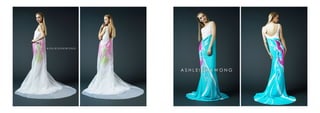
A S H L E I G H K W O N G
F A S H I O N D E S I G N P O R T F O L I O
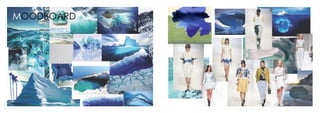
MOODBOARD
INSPIRATION
HELEN FRANKENTHALER
‘The Bay’ 1963
Helen Frankenthaler
Institute of Arts, Detroit, Michigan
“White Center (Yellow, Pink and Lavender on
Rose)” 1950. (205.8cm x 141cm) by Mark Rothko
MARK ROTHKO
Abstract Expressionism grew in New York in the 1940s-50s. Not only did it encompass the work of painters who expressed vivid fields of
colour and abstract forms, but also those paints who attacked their canvas with vigorous gestural expressionism. All were committed
to an expressive art displaying emotion and reflecting universal themes.
The expressive potential of colour itself was explored by artists such as Rothko, Newman, and Still. They created artworks that con-
sisted of simplified, large-forment, colour dominated fields. The reflective and cerebral feel is expresssed in the simplified paintings,
which create an elemetal impact. It is not about the subject matter itself, but more about the sensory and emotional experience
that it takes you on. Rothko’s paintings are beautiful and powerful.
Helen Frankenthaler was a painter and printmaker, who invented the “soak-stain” technique, in which she poured turpen-
tine-thinned paint onto canvas, producing luminous colour washes that appeared to merge with the canvas, which made it appear
as if there was no three-dimensional illusion. Frankenthaler was an abstract artist that focused on the natural landscape as the major
inspiration, rather than the existential confrontation with the canvas or the search for the sumblime. Her paintings were impressions of
nature.
ABSTRACT EXPRESSIONISM
Paul.S (2004) “Abstract Expresionism” In Heilbrunn Timeline of Art History. New York: The Metropolitan Museum of Art, 2000. [ONLINE] Available at: http://www.met.museum.org/toah/
hb/abex.htm [Accessed: 22 July 2014]
The Art Story Foundation (2014) Helen Frankenthaler | The Art Story.org [ONLINE] Available at: www.theartstory.org/artist-frankenthaler-helen.htm [Accessed 26 July 2014]
Wolf.J (2014) Abstract Expressionism [ONLINE] Available at: www.theartstory.org/move- ment-abstract-expressionism.htm [Accessed 22 July 2014
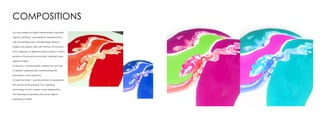
COMPOSITIONS
As I was inspired by Helen Frankenthaler’s beautiful
organic paintings, I proceeded in experimenting
with her painting style. I painted large abstract
shapes onto paper. Then with the flow of my brush,
and a selection of different paints loaded in various
sections of the brush (sumi-e style), I painted more
organic shapes.
In doing so, I spontaneously created my own style
of abstract expressionistic painting using the
techniques I was inspired by.
To take this futher, I used photoshop to manipulate
the colours of the painting. Thus, applying
technology to art to create a new perspective.
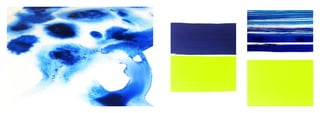
The following compositions are some original
paintings and edits
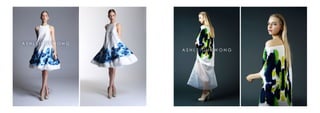
FASHION ILLUSTRATIONS
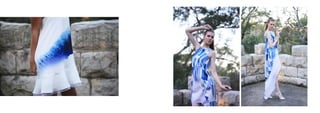
BEIJING FASHION WEEK
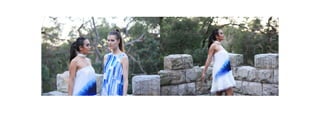
CHINA GRADUATE FASHION WEEK
RAFFLES GRADUATE FASHION SHOW
w w w . a s h l e i g h k w o n g . c o m

PORTFOLIO ASHLEIGH KWONG PAGE SPREAD

  • 1.
    A S HL E I G H K W O N G F A S H I O N D E S I G N P O R T F O L I O
  • 2.
  • 3.
    INSPIRATION HELEN FRANKENTHALER ‘The Bay’1963 Helen Frankenthaler Institute of Arts, Detroit, Michigan “White Center (Yellow, Pink and Lavender on Rose)” 1950. (205.8cm x 141cm) by Mark Rothko MARK ROTHKO Abstract Expressionism grew in New York in the 1940s-50s. Not only did it encompass the work of painters who expressed vivid fields of colour and abstract forms, but also those paints who attacked their canvas with vigorous gestural expressionism. All were committed to an expressive art displaying emotion and reflecting universal themes. The expressive potential of colour itself was explored by artists such as Rothko, Newman, and Still. They created artworks that con- sisted of simplified, large-forment, colour dominated fields. The reflective and cerebral feel is expresssed in the simplified paintings, which create an elemetal impact. It is not about the subject matter itself, but more about the sensory and emotional experience that it takes you on. Rothko’s paintings are beautiful and powerful. Helen Frankenthaler was a painter and printmaker, who invented the “soak-stain” technique, in which she poured turpen- tine-thinned paint onto canvas, producing luminous colour washes that appeared to merge with the canvas, which made it appear as if there was no three-dimensional illusion. Frankenthaler was an abstract artist that focused on the natural landscape as the major inspiration, rather than the existential confrontation with the canvas or the search for the sumblime. Her paintings were impressions of nature. ABSTRACT EXPRESSIONISM Paul.S (2004) “Abstract Expresionism” In Heilbrunn Timeline of Art History. New York: The Metropolitan Museum of Art, 2000. [ONLINE] Available at: http://www.met.museum.org/toah/ hb/abex.htm [Accessed: 22 July 2014] The Art Story Foundation (2014) Helen Frankenthaler | The Art Story.org [ONLINE] Available at: www.theartstory.org/artist-frankenthaler-helen.htm [Accessed 26 July 2014] Wolf.J (2014) Abstract Expressionism [ONLINE] Available at: www.theartstory.org/move- ment-abstract-expressionism.htm [Accessed 22 July 2014
  • 4.
    COMPOSITIONS As I wasinspired by Helen Frankenthaler’s beautiful organic paintings, I proceeded in experimenting with her painting style. I painted large abstract shapes onto paper. Then with the flow of my brush, and a selection of different paints loaded in various sections of the brush (sumi-e style), I painted more organic shapes. In doing so, I spontaneously created my own style of abstract expressionistic painting using the techniques I was inspired by. To take this futher, I used photoshop to manipulate the colours of the painting. Thus, applying technology to art to create a new perspective. The following compositions are some original paintings and edits
  • 6.
  • 9.
    BEIJING FASHION WEEK CHINAGRADUATE FASHION WEEK RAFFLES GRADUATE FASHION SHOW
  • 12.
    w w w. a s h l e i g h k w o n g . c o m