Helen Frankenthaler was an influential American
abstract expressionist painter. Renowned for her
innovative approach to color and best known for her
“soak-stain” technique, Frankenthaler played a
pivotal role in the development of postwar American
art. Born in New York City, Frankenthaler studied at
the Dalton School under Rufino Tamayo and later
attended Bennington College in Vermont. she later
studied with Wallace Harrison and Hans Hofmann,
too. Frankenthaler's breakthrough came in the early
1950s when she developed her signature "soak-stain"
method.
This method gave a unique and ethereal quality to
Frankenthaler’s painting that set her apart from the
other abstract action painters of her generation, many
of whom employed thick applications of paint and
heavy layers of impasto. Helen Frankenthaler's
paintings often involve sweeping washes of color
overlaid by swift, eloquent brushwork, ultimately
capturing a subject without representing it. She
embraced spontaneity and subconscious impulse,
allowing her embodied responses to guide her artistic
process. This approach is evident in her prints as
well as her paintings and is perhaps best illustrated in
Frankenthaler’s experimentation with the Mixografía
technique.
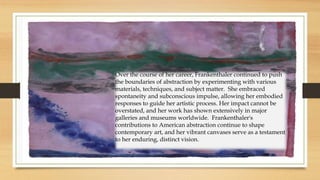
Over the course of her career, Frankenthaler continued to push
the boundaries of abstraction by experimenting with various
materials, techniques, and subject matter. She embraced
spontaneity and subconscious impulse, allowing her embodied
responses to guide her artistic process. Her impact cannot be
overstated, and her work has shown extensively in major
galleries and museums worldwide. Frankenthaler's
contributions to American abstraction continue to shape
contemporary art, and her vibrant canvases serve as a testament
to her enduring, distinct vision.
PPt for Larsen Art.pptx

PPt for Larsen Art.pptx

  • 2.
    Helen Frankenthaler wasan influential American abstract expressionist painter. Renowned for her innovative approach to color and best known for her “soak-stain” technique, Frankenthaler played a pivotal role in the development of postwar American art. Born in New York City, Frankenthaler studied at the Dalton School under Rufino Tamayo and later attended Bennington College in Vermont. she later studied with Wallace Harrison and Hans Hofmann, too. Frankenthaler's breakthrough came in the early 1950s when she developed her signature "soak-stain" method.
  • 3.
    This method gavea unique and ethereal quality to Frankenthaler’s painting that set her apart from the other abstract action painters of her generation, many of whom employed thick applications of paint and heavy layers of impasto. Helen Frankenthaler's paintings often involve sweeping washes of color overlaid by swift, eloquent brushwork, ultimately capturing a subject without representing it. She embraced spontaneity and subconscious impulse, allowing her embodied responses to guide her artistic process. This approach is evident in her prints as well as her paintings and is perhaps best illustrated in Frankenthaler’s experimentation with the Mixografía technique.
  • 4.
    Over the courseof her career, Frankenthaler continued to push the boundaries of abstraction by experimenting with various materials, techniques, and subject matter. She embraced spontaneity and subconscious impulse, allowing her embodied responses to guide her artistic process. Her impact cannot be overstated, and her work has shown extensively in major galleries and museums worldwide. Frankenthaler's contributions to American abstraction continue to shape contemporary art, and her vibrant canvases serve as a testament to her enduring, distinct vision.