Competitive Structure
Of Industries:
Michael Porter’s Model
By: Pranjali Srivastava
Michael Porter’s Five(Six)
Forces Model:(Objective)
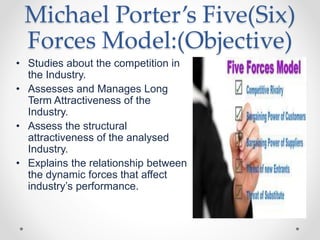
• Studies about the competition in
the Industry.
• Assesses and Manages Long
Term Attractiveness of the
Industry.
• Assess the structural
attractiveness of the analysed
Industry.
• Explains the relationship between
the dynamic forces that affect
industry’s performance.
Porter’s Five(Six) Forces:
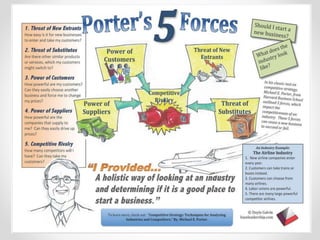
• Threat of Entry.
• Threat of Substitutes.
• Rivalry among existing firms.
• Bargaining power of Buyers.
• Bargaining power of Suppliers.
Another sixth force added later on in this model
• Other Stakeholders.
Threat of Entry:
• Existence of Barriers to entry.(Patents, Rights etc.)
• Government Policies .
• Capital Requirements.
• Product Differentiation.
• Monopoly Elements.
• Access to Distribution.
• Customer Loyalty to established Brand.
• Industry Profitability(The more profitable the industry
more Profitable it will be for new Entrants.
Threat of Substitutes:
• Perceived level of Product Differentiation.
• Buyers Switching Costs.
• Number of Substitutes available in the market .
• Availability of Close Substitute.
• Customer loyalty towards their Brand.
• Quality Depreciation.
• Ease of Substitution.
• Substandard Product.
Rivalry Among Existing
Firms:
• Number of Firms and Their Relative Market
Share, Strengths etc.
• Degree of Transparency.
• Level of Advertisement Expense.
• Sustainable Competitive advantage through
Innovation.
• Diverse Competitors.
• Exit Barrier.
Bargaining Power of
Buyers:
• Degree of Dependency upon Existing channels
of Distribution.
• Force down Prices.
• Buyers Switching costs relative to Firm’s
Switching Costs.
• Buyers information Availability.
• Buyers price Sensitivity.
• Differential Advantage of Industry Products.
• Availability of existing Substitute Products.
Bargaining Power of
Suppliers:
• Suppliers switching costs related to firm
Switching Cost.
• Degree of differentiation of Inputs.
• Importance of Buyer to the Supplier.
• Extent of Substitutability of the Product.
• Extent of Differentiation or Standardisation of
the Product.
• Importance of the Product to the Buyer.
Sixth Force :Other
Stakeholders
• It was added in the revised 1990s model.
• Impact of complementary product and
services.
• Reliability of the functions.
• Stakeholders are also the owner of their
stakes in the organisation.
Limitations of Porter’s
Model:
• Its just a snapshot of an Industry at a
time.
• It does not tells about the Complex
Dynamics of the Industry.
• It does not takes into account
Corporate Social Responsibility.
THANK YOU

Porter's model

  • 1.
    Competitive Structure Of Industries: MichaelPorter’s Model By: Pranjali Srivastava
  • 3.
    Michael Porter’s Five(Six) ForcesModel:(Objective) • Studies about the competition in the Industry. • Assesses and Manages Long Term Attractiveness of the Industry. • Assess the structural attractiveness of the analysed Industry. • Explains the relationship between the dynamic forces that affect industry’s performance.
  • 4.
    Porter’s Five(Six) Forces: •Threat of Entry. • Threat of Substitutes. • Rivalry among existing firms. • Bargaining power of Buyers. • Bargaining power of Suppliers. Another sixth force added later on in this model • Other Stakeholders.
  • 5.
    Threat of Entry: •Existence of Barriers to entry.(Patents, Rights etc.) • Government Policies . • Capital Requirements. • Product Differentiation. • Monopoly Elements. • Access to Distribution. • Customer Loyalty to established Brand. • Industry Profitability(The more profitable the industry more Profitable it will be for new Entrants.
  • 6.
    Threat of Substitutes: •Perceived level of Product Differentiation. • Buyers Switching Costs. • Number of Substitutes available in the market . • Availability of Close Substitute. • Customer loyalty towards their Brand. • Quality Depreciation. • Ease of Substitution. • Substandard Product.
  • 7.
    Rivalry Among Existing Firms: •Number of Firms and Their Relative Market Share, Strengths etc. • Degree of Transparency. • Level of Advertisement Expense. • Sustainable Competitive advantage through Innovation. • Diverse Competitors. • Exit Barrier.
  • 8.
    Bargaining Power of Buyers: •Degree of Dependency upon Existing channels of Distribution. • Force down Prices. • Buyers Switching costs relative to Firm’s Switching Costs. • Buyers information Availability. • Buyers price Sensitivity. • Differential Advantage of Industry Products. • Availability of existing Substitute Products.
  • 9.
    Bargaining Power of Suppliers: •Suppliers switching costs related to firm Switching Cost. • Degree of differentiation of Inputs. • Importance of Buyer to the Supplier. • Extent of Substitutability of the Product. • Extent of Differentiation or Standardisation of the Product. • Importance of the Product to the Buyer.
  • 10.
    Sixth Force :Other Stakeholders •It was added in the revised 1990s model. • Impact of complementary product and services. • Reliability of the functions. • Stakeholders are also the owner of their stakes in the organisation.
  • 11.
    Limitations of Porter’s Model: •Its just a snapshot of an Industry at a time. • It does not tells about the Complex Dynamics of the Industry. • It does not takes into account Corporate Social Responsibility.
  • 12.