Population Projection
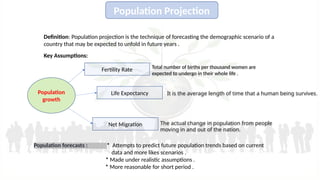
Definition: Population projection is the technique of forecasting the demographic scenario of a
country that may be expected to unfold in future years .
Key Assumptions:
Population
growth
Fertility Rate
Life Expectancy
Net Migration
Total number of births per thousand women are
expected to undergo in their whole life .
It is the average length of time that a human being survives.
The actual change in population from people
moving in and out of the nation.
Population forecasts : * Attempts to predict future population trends based on current
data and more likes scenarios .
* Made under realistic assumptions .
* More reasonable for short period .
Methods of projection
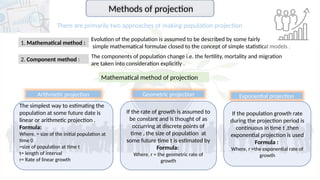
There are primarily two approaches of making population projection .
1. Mathematical method :
Evolution of the population is assumed to be described by some fairly
simple mathematical formulae closed to the concept of simple statistical models .
2. Component method :
The components of population change i.e. the fertility, mortality and migration
are taken into consideration explicitly .
Mathematical method of projection
The simplest way to estimating the
population at some future date is
linear or arithmetic projection .
Formula:
Where, = size of the initial population at
time 0
=size of population at time t
t= length of interval
r= Rate of linear growth
If the rate of growth is assumed to
be constant and is thought of as
occurring at discrete points of
time , the size of population at
some future time t is estimated by
Formula:
Where, r = the geometric rate of
growth
If the population growth rate
during the projection period is
continuous in time t ,then
exponential projection is used
Formula :
Where, r =the exponential rate of
growth
Arithmetic projection Exponential projection
Geometric projection
Importance and uses of
Population Projection
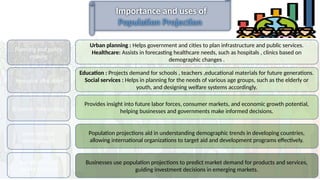
Planning and policy
making
Resource allocation
Economic forecasting
International
development
Investment and
market research
Urban planning : Helps government and cities to plan infrastructure and public services.
Healthcare: Assists in forecasting healthcare needs, such as hospitals , clinics based on
demographic changes .
Education : Projects demand for schools , teachers ,educational materials for future generations.
Social services : Helps in planning for the needs of various age groups, such as the elderly or
youth, and designing welfare systems accordingly.
Provides insight into future labor forces, consumer markets, and economic growth potential,
helping businesses and governments make informed decisions.
Population projections aid in understanding demographic trends in developing countries,
allowing international organizations to target aid and development programs effectively.
Businesses use population projections to predict market demand for products and services,
guiding investment decisions in emerging markets.

Population Projection in Demography.pptx

  • 1.
    Population Projection Definition: Populationprojection is the technique of forecasting the demographic scenario of a country that may be expected to unfold in future years . Key Assumptions: Population growth Fertility Rate Life Expectancy Net Migration Total number of births per thousand women are expected to undergo in their whole life . It is the average length of time that a human being survives. The actual change in population from people moving in and out of the nation. Population forecasts : * Attempts to predict future population trends based on current data and more likes scenarios . * Made under realistic assumptions . * More reasonable for short period .
  • 2.
    Methods of projection Thereare primarily two approaches of making population projection . 1. Mathematical method : Evolution of the population is assumed to be described by some fairly simple mathematical formulae closed to the concept of simple statistical models . 2. Component method : The components of population change i.e. the fertility, mortality and migration are taken into consideration explicitly . Mathematical method of projection The simplest way to estimating the population at some future date is linear or arithmetic projection . Formula: Where, = size of the initial population at time 0 =size of population at time t t= length of interval r= Rate of linear growth If the rate of growth is assumed to be constant and is thought of as occurring at discrete points of time , the size of population at some future time t is estimated by Formula: Where, r = the geometric rate of growth If the population growth rate during the projection period is continuous in time t ,then exponential projection is used Formula : Where, r =the exponential rate of growth Arithmetic projection Exponential projection Geometric projection
  • 3.
    Importance and usesof Population Projection Planning and policy making Resource allocation Economic forecasting International development Investment and market research Urban planning : Helps government and cities to plan infrastructure and public services. Healthcare: Assists in forecasting healthcare needs, such as hospitals , clinics based on demographic changes . Education : Projects demand for schools , teachers ,educational materials for future generations. Social services : Helps in planning for the needs of various age groups, such as the elderly or youth, and designing welfare systems accordingly. Provides insight into future labor forces, consumer markets, and economic growth potential, helping businesses and governments make informed decisions. Population projections aid in understanding demographic trends in developing countries, allowing international organizations to target aid and development programs effectively. Businesses use population projections to predict market demand for products and services, guiding investment decisions in emerging markets.