presentation
Poplar fiction
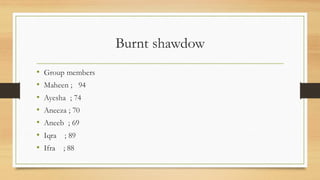
Burnt shawdow
• Group members
• Maheen ; 94
• Ayesha ; 74
• Aneeza ; 70
• Aneeb ; 69
• Iqra ; 89
• Ifra ; 88
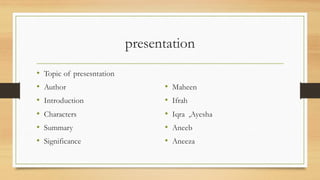
presentation
• Topic of presesntation
• Author
• Introduction
• Characters
• Summary
• Significance
• Maheen
• Ifrah
• Iqra ,Ayesha
• Aneeb
• Aneeza
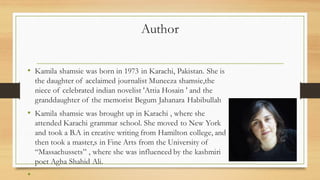
Author
• Kamila shamsie was born in 1973 in Karachi, Pakistan. She is
the daughter of acclaimed journalist Muneeza shamsie,the
niece of celebrated indian novelist 'Attia Hosain ' and the
granddaughter of the memorist Begum Jahanara Habibullah
• Kamila shamsie was brought up in Karachi , where she
attended Karachi grammar school. She moved to New York
and took a B.A in creative writing from Hamilton college, and
then took a master,s in Fine Arts from the University of
“Massachussets” , where she was influenced by the kashmiri
poet Agha Shahid Ali.
•
• Kamila shamsie is one of the most remarkable storytellers of our time.she was named as one of the Granta,s best
young British Novelist.
Kamila shamsie is one of a new wave of Pakistani writers who are based in Britain and successful inboth Pakistan and
the west.
As a female born in Pakistan in the early 1970,s in a culture in which girls are expected to become only wives and mother,
Kamila was fortunate in her family background and the support she received. Her affluent and literary family already
included, several female writers including her mother Muneeza shamsie and her great Aunt ,Attia Hosain. Consequently,her
literary aspirations were positively encouraged.
After her Pakistani childhood , Kamila shamsie attended university in the US. Though she is now mainly based in the UK.
She has homes in all the three continents. Her first four novels are set in her home city , Karachi , Pakistan. While”Burnt
Shadow” (2009)spans several continents but partly Based in Karachi.
Kamila shamsie,s portrayal of Karachi are affectionate, vivid and complex , painting a picture of vibrant and lively city
without romanticizing it. Her international experiences have given her a different perspective on her home environment
and this
• underpin her fiction_ she often explore cross – cultural relationship and culture identity, particularly the
burden of cultural history and family expectations.
Famous work by Kamila shamsie
Kamila shamsie is the author of seven novels. She wrote her firstnovel “In the city by the sea” published by the
grantabooks UK in 1998. This first novel was shortalized for the”Llewelyn Rhys” Award in the UK, and Kamila
shamsie received the “Prime Minister,s “ Award for literature in Pakistan in 1999.
Her second novel “ salt and saffron “ led to the shamsie’s selection as one of the Orange,s “21 writers of the 21st
century”.
With her third novel” kartography” , Kamila shamsie was again shortalized for the “ John Llewellyn Rhys” award in the
UK. Both “kartography”and her next novel ,”Broken verses” won the “ Patras Bokhari” Award from the Academy of
letters in Pakistan.
Her fifth novel “ Burnt shadow” has been long listed for the Orange prize for fiction. Her sixth novel “ A God in every
stone” was shortalized for the “2015 Walter Scott prize” and for the “ Baileys women’s prize for fiction”.
Her seventh novel “ Home fire” was longlisted for “ Man booker prize” , shortalized for the “Costa novel Award “ and
won the women prize for fiction in 2018 .Her books have been translated into a number of languages.
Introduction
In an extraordinary article for Guernica magazine, published in February 2012, Kamila Shamsie reflected on
the genesis of her (even more extraordinary!) novel Burnt Shadows (2009). The essay begins by describing
how the thought of an atom bomb falling on Nagasaki came to her in the space between writing projects and
seemed at first a source of trouble. It interfered with her creative process, stymied her search for “an image
[rather than a thought] from which a [new] novel [might] emerge.” She could not get the thought out of her
head, however, despite the trouble it seemed to be causing. And gradually, the trouble proved fruitful. The
thought that had taken up residence inside her became the occasion for Shamsie to explore a historical disaster
about which she knew little. It led her, among other things, to read a nonfiction book by John Hersey called
Hiroshima (1946), which traces the story of six hibakusha (bomb survivors) in the city named by the book’s
title. In Hersey’s book, and much to her surprise, Shamsie came upon her “originating image.”
In my memory, the moment I read that line an image came of a woman facing away from me, three bird-shaped burns on
her bare back from the pattern of the kimono she was wearing at the moment the bomb fell…. Hersey had given me my
originating image, and very quickly it started to exert a magnetic force, tugging at other images and ideas and elements of
plot and character until a tiny universe was wheeling around it, impossible to ignore. Eventually it went on to become my
fifth novel, Burnt Shadows, which started in Nagasaki in 1945 and ended with a man on his way to Guantánamo in 2002.
The passage provides an unusuallyacute depiction of Shamsie’s creative process. It draws our attention to the complex
relation between thinking and imagining—conceptualizing and creating—in that process. Shamsie begins by feeling
distracted by thought, diverted from the imaginative act by the nagging intrusion of thoughts about history. But that
intrusion turns out to provoke an astonishing act of creative vision. Shamsie’s imagination is fired by the actual, by the
thinking about history that seemed at first a block to her creativity but is in the end drawn into and magnetized by the
creative imagination. This process gestates an entire universe—a fictional world—whose “imagistic” and metaphorical
forms reveal dimensions of history and power that reportage alone can never show us.
Shamsie’s account of the creative process is only part of what makes her essay valuable for thinking about Burnt Shadows.
Just as significant is how the essay describes the novel’s affiliations with other contemporary writings. Burnt Shadows is,
of course, a “9/11 novel”—it’s a book composed in the aftermath of those attacks and concerned with their world-
historical significance. It begins with Hiroko Tanaka
those bird-shaped atomic wounds at Nagasaki in 1945 and ends with her son, Raza, being secreted away to
Guantánamo in 2002. The purpose of bookending the plot in this way is to suggest that there is a deep, structural
relationship between the two events. You cannot understand 9/11 (or Guantánamo)without seeing it as part of the
history of U.S. world-hegemony inaugurated by the Bomb.
The Guernica article is, meanwhile, entitled “The Storytellers of Empire”; its central point is the insularity and
parochialism of so much U.S. fiction written in response to the 9/11 attacks. While nonfiction writers concerned
with 9/11 have probed the history of U.S. foreign policy to answer the question, “why do they hate us?,” fiction
writers have tended instead to focus on “9/11 the day itself, in New York.” These writers treat the attacks as
something that defies historical or even narrative explanation: they depict it as “a traumatic event as ahistorical as an
earthquake.” Their fictions seek less to situate 9/11 in history than to stress the inexplicable pain and bewilderment
caused to Americans by those attacks. “Your soldiers will come to our lands, but your novelists won’t,” Shamsie
concludes. “The unmanned drone hovering over Pakistan, controlled by someone in Langley, is an apt metaphorfor
America’s imaginative engagement with my nation.”
bombs; the Cold War and the proxy (hot) war in Afghanistan through which the U.S. defended its global hegemony; the
CIA’s fostering of radical Islam among the fighters recruited for that war; the attacks on the World Trade Center and
Washington, DC on September 11, 2001; and the subsequent War on Terror that destroyed and distorted so much in the
name of national security and an ongoing state of exception.
Readers will know that Shamsie routes this history through the bodies and psyches of two families across three
generations: the Tanaka-Ashrafs and the Burton-Weisses. This routing is a way of concretizing history, of enacting it not
in the abstract, but by grounding it in the most intimate reaches of persons and families and their ongoing interrelations.
It is also a way of embodying the power dynamics that shape historical violence along racial-national lines. The Tanaka-
Ashrafs (Hiroko, Sajjad, and Raza) hail originally from Japan and the Indian subcontinent; the Burton-Weisses (Illse,
James, their son Harry, and his daughter Kim) are German, English, and (once Harry becomes a citizen) American. Each
of the book’s main sections details a calamity that befalls the first of these family units, the racially “other” Tanaka-
Ashrafs. Hiroko survives the bomb at Nagasaki but loses her fiancé, her father, and her homeland. Sajjad is forced to
repatriate from Delhi to Pakistan in the wake of Indian Partition. Raza is seduced into joining a Mujahadin camp in
Pakistan, and his father, Sajjad, is shot dead while searching for him, mistaken for a CIA agent. Raza himself is later
recruited into the world of U.S. military contractors, then denounced and detained and disappeared because his “racial”
origins render his loyalties intrinsically suspect in the age of the PATRIOT Act.
imperialism. But with the exception of the atom bomb, the proximate cause in each case is a member of the Burton-
Weiss clan. It’s James Burton who browbeats Sajjad into spending his honeymoon in Istanbul during the crucial months
of 1947 when Pakistan is partitioned off from India. The man who shoots Sajjad is Harry Burton’s driver in Karachi—a
lower-level operative of the Pakistani intelligence service, whom Sajjad only meets because Harry suddenly reenters his
life after years of separation. And Raza, finally, is betrayed (inadvertently) to American authorities by Harry’s daughter
Kim, in a sequence that reveals how even the most well-intentioned, liberal-minded of Americans often retains a set of
unquestioned assumptions that permit them to remain “innocent” of the racist violence committed in their name.
The issue of human rights pertains especially to this latter dynamic. In its depictions of how history’s victors inflict
injuries on those they dispossess, Burnt Shadows can be read as chronicling the serial violation of such rights: Hiroko’s
right to security and (though the UN Declaration does not name this) bodily integrity; Sajjad’s right to life itself; and
Raza’s rights to liberty and to freedom from torture and degrading treatment. Nevertheless, it should be stressed that the
novel’s main concern is less with human rights per se than with what the political philosopher Hannah Arendt has called
“the right to have rights.” Arendt asked an important but little noticed (until recently) question in her 1951 book, The
Origins of Totalitarianism: if we are indeed endowed with certain basic rights by virtue of being human, how is it that
those who have been reduced to their bare humanity by losing their citizenship, being forced into exile, becoming
refugees, and so forth—how is it that such stateless people have historically lost any recourse to rights rather than had
their rights affirmed? Where does the right to have rights come from if rights themselves
require for their enactment something in addition to just being “human”—a nation or some other legally binding
collectivity?
Burnt Shadows does not so much answer these questions as invite us to ponder and probe them. In the interest of
encouraging that process, I’d like to conclude by suggesting that the questions can be fruitfully approached by
passing them through three of the novel’s other main concerns:
Uprootedness, nationalism, and cosmopolitanism
Languages and the possibilities of translation
The eroticized body
https://youtu.be/i9c6_qob
Mko
Characters of the novel
• Hiroko Tanaka
• Hiroko Tanaka (later Hiroko Ashef) is the protagonist of Burnt Shadows. She is the only character
who appears in every section of the novel. Hiroko is from Nagasaki. She is 21 years old in 1945
when the United States military drops an atomic bomb on Nagasaki, killing her father and her
fiancé, Konrad Weiss. Hiroko later moves to Delhi, where she meets Sajjad and falls in love. They
get married and after Partition they move to Pakistan, where they have a son, Raza, and live
happily for 35 years. After Sajjad dies in 1984, Hiroko moves to New York City.
• Hiroko is a strong-willed character who is suspicious of nations and religion. She judges other
people on their character rather than their stereotype. She is excellent at learning languages and is
fluent in Japanese, English, German, and Urdu.
•
Konrad Weiss
Konrad Weiss is a German who was living in Nagasaki when the atomic bomb is dropped. He was studying
the lives of foreigners in Nagasaki before the wartime atmosphere placed him under suspicion by the
government. He was engaged to Hiroko Tanaka. Elizabeth Burton is his half-sister; they share the same
father.
Sajjad Ashef
Sajjad is originally from Dehli, India. He is Muslim and his family originally intends to provide him with an
arranged marriage. He works for James Burton in Delhi for eight years in the hopes of one day becoming a
lawyer. He gives Hiroko Urdu lessons while she is staying with the Burtons and they fall in love. His
employment with the Burtons is harshly terminated when they falsely accuse him of trying to sexually
assault Hiroko. After his mother dies, he asks Hiroko to marry him. They take their honeymoon in Istanbul,
which means that they are forced to move to Pakistan instead of returning to Dehli after Partition. This
causes Sajjad great pain; he misses Dehli for the rest of his life. In Pakistan, Sajjad is a manager at a factory.
He is shot and killed while looking for Raza, who goes missing.
Elizabeth Burton
Elizabeth Burton (also called Ilse) is a German woman living in Delhi during the British Raj. She is married
to James Burton and they have one son, Harry. After Partition, she leaves her husband and moves in with
her cousin in New York City. While she carries prejudices against Indians as a result of her colonial status in
India, she is very kind to Hiroko.
James Burton
James Burton is Elizabeth's husband. He lives in Delhi with her until Partition, when he moves back to the
UK. He is a solicitor.
Harry Burton
Harry is James and Elizabeth's son. He is sent to boarding school in England during his adolescence,
leaving him constantly longing for home. He moves with his mother to NYC after she leaves his father. He
falls in love with the United States and reveres it for its capitalism and acceptance of immigrants. Later in
life, he becomes a CIA agent. He lives in Pakistan during the Afghan War, providing Afghan militants with
weapons to support their war against the Soviets. Later, he leaves the CIA to become a private contractor
that is hired by the U.S. government. This leads him to Afghanistan during the War on Terror, where he is
shot and killed by an Afghan man.
Raza Ashef
Raza is Hiroko and Sajjad's son. He was born and raised in Karachi, Pakistan. Sajjad hopes that Raza will grow up to
become a lawyer. Unfortunately, however, Raza fails his exams to graduate high school three times. Raza is treated like he
is an outsider in Karachi because he is mixed-race (his mother is Japanese). Eventually, Raza makes friends with a young
Afghan boy named Abdullah. They run away to a mujahideen training camp together, which tragically also causes Sajjad's
death.
After his father dies, Raza moves to Dubai where he works in a convenience store with his cousins. Eventually, he gets in
touch with Harry Burton who gives him a job at the private contractor company where he is working. They live near
each other for ten years in Miami, doing contractor work on behalf of the U.S. government all over the world. This leads
Raza to Afghanistan to support U.S. interests during the Afghanistan War. When Harry is killed, Steve (Harry's ex-CIA
colleague) blames Raza. Raza goes on the run and gets smuggled into Canada. There, he switches places with Abdullah,
who is about to be arrested because Kim Burton turned him in. He is sent to Guantanamo Bay as a prisoner.
Kim Burton
Kim Burton is James' daughter. She is strong-willed, with a fiery character. Her loved ones see her as a kind, caring, and
generous person. However, she also has strong patriotic sentiment, especially after the September 11 terrorist attack. She
is an engineer who specializes in constructing buildings that are safe from disaster.
Abdullah
Abdullah is Raza's friend from Karachi. He is a Pashtun from Afghanistan. He and Raza go to a mujahideen
training camp in the hopes of eventually joining the Afghan war against the Soviets. After the war,
Abdullah moves to NYC, where he works as a taxi driver for several years. After 9/11, he is approached by
the FBI, which causes him to flee. Kim Burton smuggles him into Canada, at Hiroko and Raza's request.
She ends up regretting her decision and turns him in. However, Raza takes Abdullah's place and Abdullah
is able to escape to safety.
Omar
Omar is a taxi driver in NYC from Pakistan. He is close friends with Hiroko. Steve
Steve is Harry's colleague in the CIA. He goes with Harry to Pakistan in the 80s and also works alongside Harry in
Afghanistan in 2001.
Sher Mohammed
Sher Mohammed is Harry's rickshaw driver in Karachi. He has ties to the CIA. When Sajjad identifies him in the fish
harbour while looking for Raza, Sher Mohammed believes that Sajjad is there to kill him. He shoots Sajjad, killing him.
Bilal
Bilal is Raza's best friend and schoolmate. He and Raza live in the same molholla (neighborhood).
Salma
Salma is Bilal's sister. She and Raza keep up a secret relationship for several months before she breaks up with Raza
because she believes her parents would never let her marry him.
Yoshi Wanatabe
Yoshi Wanatabe is Konrad's friend in Nagasaki. Because of the tense wartime atmosphere in Nagasaki where
foreigners, especially Westerners, are under intense suspicion, Yoshi stops being friends with Konrad. He promises
Konrad, however, that they will resume their friendship when the war is over.
After the bomb, Yoshi helps Hiroko move to Japan. He keeps in touch with Hiroko over the following decades. He
eventually dies of cancer and tells Hiroko on the phone that he regrets his past life decisions.
Summary
Plot Summary
In the Prologue, an unnamed prisoner waits alone in a cell at Guantanamo Bay.
Part 1 then opens on August 9, 1945 in Nagasaki, Japan, with Hiroko Tanaka, a former schoolteacher
turned factory worker, and her lover, an idealistic German expatriate named Konrad Weiss. Konrad seeks
out Hiroko after hearing about the nuclear bomb dropped in Hiroshima and asks her to marry him.
Hiroko accepts. Just after Konrad leaves, Nagasaki is bombed. The nuclear explosion burns the birds on
Hiroko’s kimono into her back, permanently scarring her. Afterwards, all that Hiroko can find of Konrad is
his shadow, the result of body fat burned into stone due to radiation.
Part 2 begins two years later when Hiroko travels to the Delhi, India home of Konrad’s half-sister Ilse, who uses the
name Elizabeth to hide her German ancestry, and who strikes up an immediate friendship with Hiroko. Elizabeth is
unhappily married to James Burton. James’s clerk, Sajjad Ali Ashraf, agrees to teach Urdu to Hiroko, and a romance
develops between them. The Burtons disapprove of the relationship because Sajjad is Muslim and poor, and
Elizabeth misinterprets an intimate moment in which Hiroko shows Sajjad her burn scars as assault. Hiroko is able
to correct the error, but Sajjad is fired. After his mother dies, Sajjad proposes marriage to Hiroko, who accepts.
Meanwhile, Elizabeth decides to leave James and go live in New York City as Ilse Weiss. James suggests that Sajjad
and Hiroko leave the country to avoid political violence, and so they travel to Istanbul. However, because Sajjad
leaves India during Partition, his Indian citizenship is revoked, and so Hiroko and Sajjad go to Karachi, Pakistan as
refugees.
Part 3 takes place 15 years later in Karachi in 1982 at the height of the Cold War. Hiroko and Sajjad’s teenage son, Raza,
struggles to fit in as a half-Japanese Pakistani boy. Harry Burton, James and Ilse’s son, works for the CIA, arming Islamic
extremist fighters to support the US proxy war in Afghanistan against the USSR. Harry reconnects with the Tanaka-
Ashrafs while on assignment in Pakistan. Raza meets Abdullah, a young Afghan refugee, and assumes the Afghan alias
“Raza Hazara.” Wanting one last adventure before college, Raza convinces Abdullah to join the Islamic guerilla forces and
promises to go with him, planning to desert and let Abdullah think that “Raza Hazara” simply vanished. Once at the camp,
Raza realizes he is in danger but is saved by the Commander, who knows Raza is a friend of CIA operative Harry Burton.
Raza arrives home to find that Sajjad was murdered while looking for him.
Part 4 opens in 2001, three months after the September 11 attacks. Hiroko lives with Ilse and Kim Burton, Harry’s
daughter, in New York City. Harry and Raza work for a private military company, contracted by the United
States to search for Al-Qaeda insurgents in Afghanistan. Raza searches for Abdullah and learns that he is an
undocumented taxi driver in New York. Abdullah, fearful of being profiled, wants to leave the United States, so Raza
asks Kim to help, but she refuses. Harry is killed, and the CIA assumes Raza is responsible due to his teenage
encounter with Islamic extremists. Raza, now a fugitive, travels to Canada hoping to see Hiroko. Hiroko convinces
Kim to drive Abdullah across the border to Canada, but Kim argues with Abdullah about Islam on the way. Kim
drops off Abdullah at a fast-food restaurant as planned, then reports Abdullah to the Canadian police. Raza, also at
the restaurant, covers for Abdullah, who escapes. When Kim tries to tell the police that they have the wrong man,
Raza stops her, allowing himself to be arrested. Kim returns to New York to find a furious Hiroko, who compares Kim
to the Americans who justified the use of nuclear bombs in Japan. Kim calls the Canadian police to exonerate Raza
but discovers that he has been handed over to the United States. Raza is implied to be the prisoner at Guantanamo
Bay from the Prologue. then reports Abdullah to the Canadian police. Raza, also at the restaurant, covers for Abdullah,
who escapes. When Kim tries to tell the police that they have the wrong man, Raza stops her, allowing himself to be
arrested. Kim returns to New York to find a furious Hiroko, who compares Kim to the Americans who justified the use
of nuclear bombs in Japan. Kim calls the Canadian police to exonerate Raza but discovers that he has been handed over
to the United States. Raza is implied to be the prisoner at Guantanamo Bay from the Prologue.
Significances
Burnt Shadows (2009) is a well-read novel of Shamsie that won Anisfield-Wolf Book Award 2010. It also stood in
finalists for Orange Prize for fiction 2009. The story “is an epic” that revolves around the two families of east
[Ashraf-Tanakas] and west [Weiss Burtons] which “takes in 60 years of modern history” (“Panellist: Kamila Shamsie”,
n.d.). This story is a comprehensive study of the exchange of language and culture among individuals,societies and
nations. Burnt Shadows recapitulates the intervening myths of globalization, nationalism and cosmopolitanism. In
the novel, readers see “pieces of lives” and then they experience how these lives “collide” with each other to form
ever-increasing burnt shadows (Celt, 2009). The characters of the novel move around main cosmopolitan cities of
each of the four politically important regions of the world. The story takes its leap from “one of the most traumatic
experience for not only the Japanese people but all human beings” the nuclear bombing of Nagasaki—one of the
cosmopolitan cities of Japan (Yamamoto, 2013). The story takes a shift with the shifting of a hibakusha (bomb
stricken person) towards Delhi, a cosmopolitan site of India, to make herself able to forget the painful memories of
the past. The stay is temporary as she has to move forward towards Karachi, a modern city of Pakistan. But her
memories do not let her to be alone at any place. Hiroko is a globalized character who is less patriotic and more
humane in her stan.
New York, Mimic man: A man who copies others. The man who does not have any personal ideas, emotions and
feelings, and imitates what is expected from him. The cosmopolitan site in America, is the final place where Hiroko
Tanaka resides but is unable to achieve her hibakusha-less identity. The identity has reduced her own personality thus
she appears more pathetic for the people around her. With despise she utters, “[h]ibakusha. New York. I hate that
word. It reduces you to the bomb” (Shamsie, 2009, p.101). Throughout her life, Hiroko runs from her this
dehumanized identity. Gen ‘ichiro Itakura (2014) relates the affected perception of Hiroko after bombing of
Nagasaki as “the process of dehumanization” (p. 4). But finally in New York, because of some incidents, she feels
pride in her being a hibakusha. Here, In New York, she associates the concept of hibakusha with the people who feel
empathy for other people in pain. She realizes that in the modern days human beings are unable to understand the
pains and stresses of homeless and identityless people. Only a grief-stricken person, hibakusha, has enough humanity
in him to feel the pain of others.
The title of the novel Burnt Shadows is quite significantand is the major theme of the novel. It associates
its characters with pain whether it is physical or psychological.The burnt shadows on the back of Hiroko
are the symbol of cartographic territorialization. She is destined to be a ‘hibakusha’ (bomb-stricken) forever.
“[S]he knew intimately the stigma of being defined by the bomb” (Shamsie, 2009, p. 226). The more she desired
to forget “the bomb”, the more cartographic society reminds her of the bomb (ibid). Thus the burnt shadows
of her body are an inscription of pain, and they have territorialized her sorrow also. “Like these burns, her
trauma is inscribed in her body” (‘ichiro Itakura, 2014). She has lost her father and fiancé in the bomb, she is left
alone with her burnt shadows.
The Issue of cartography is as old as the presence of man in the world. The modern man has the most diverse
experience of witnessing the shifting cartographies. Modern world has become the melting pot of the
unexpected incidents that has added in man‘s destruction which is constantly provoking the man to migrate and
then to reconstruct his place. Leaving of previous homes and then the making of new homes with new identity
are the actual dilemmas of the modern man. “Never before in human history had so many crossings –
geographical, cultural, racial – happened at such scales” (Awan, 2013, p. 06). Shamsie poses questions on
borders, geographies and on the series of territorialization of masses under the particular State’s rules where
they are living in the shelter.
“Shamsie has squeezed a violent century‘s universe into a ball, and rolled it forward with an overwhelming
question: Why?” (Tripathi, 2009). The novel is covering four territories in four different eras. Starting from 1945
– the nuclear attacks on Japan – it introduces a miserable situation which common masses are facing because of
the territories created by men.
Then it travels from Nagasaki, Japan to Delhi, India where in 1947 before independence of the sub-continent, people are
still under the rule of a colonizer who is living in the territory of ‘others’ with the intention of civilizing them. It further
takes us into Karachi, “Shamsie has squeezed a violent century‘s universe into a ball, and rolled it forward with an
overwhelming question: Why?” (Tripathi, 2009). The novel is covering four territories in four different eras. Starting from 1945
– the nuclear attacks on Japan – it introduces a miserable situation which common masses are facing because of the territories
created by men. It further takes us into Karachi, Pakistan and there in 1982-3 people are hovering around the tussle of
religious, sectarian, and geographical territories. Lastly, because of these trifling territories the novel finally takes us into the
grand hysterical event of 9/11 in New York, America. Out of it, the anger and rage once produced by territories, has been once
again evolved and has stirred a war in Afghanistan.
Shu-chuan Yan (2007) assumes cartography as “central to the very constitution of culture and civilization” (p. 03). Thus
physical cartography is not only delimiting the characters of Burnt Shadows in their boundaries but they are also affecting and
defining the behavior of the characters of a particular location with one another and with other people as well. The complex
plot of Burnt Shadows takes its roots from its complex territories as Shamsie believes that “context always matters” (“Live
webchat: Kamila Shamsie at A Room for London”, 2012). Hiroko Tanaka, Sajjad Ali Ashraf and Raza Konrad Ashraf, three
members of a family are the characters of different origins. Hiroko Tanaka who is a Japanese marries Sajjad Ali Ashraf, an
Indian Muslim. It is difficult for both of them to think only for each other beyond their territorial origins. Their son, Raza
Konrad Ashraf whose diversity is not only evident in his name but his origin is also making him diverse in his behavior and
attitude. He is a hybrid and he is confused about his territorial loyalties.
He loves his mother but does not like her Japanese territorial background which,
many a times, has made him embarrassed and ‘estranged’ in his own Pakistani territories. Sanadanand
Dhume (2009) elaborates this natural behavior of Raza when he criticizes her mother “to cover her legs in
order to be “more Pakistani”, in the lengthening of kameez sleeves on a Karachi beachThe daughter of Harry
Burton, Kim, is an American in her origin but because of her father‘s intense love for a Pakistani man, Sajjad,
she has been divided in her territorial ideology. Kim and Raza– the future of two nations i.e. of America and
Pakistan – are psychologicallyperplexed because of their annoyance about their society’s demand from them
to show a defined territorial behavior.
The society did not let them to feel freedom and it impelled them to be bound in their previous role of colonized
and colonizer. The war in Afghanistan was the ultimate result. This war was not the end but the beginning of a new
disturbing era of revengeand hate produced by the man‘s affection for some defined, fixed and
non-flexible territories. This war did not remain within the physical territories rather it also disturbed the psychological
territorial loyalties of all the men of the world. Thus taking from Second World War to the war in Afghanistan, the
question Of the striated and unchangeable psychological and physical territories again evolves here as a monstrous
reality which is mocking the modern man’s progress.
The End.
POPULAR FICTION 'SUMMARY....pdf

POPULAR FICTION 'SUMMARY....pdf

  • 1.
  • 2.
    Burnt shawdow • Groupmembers • Maheen ; 94 • Ayesha ; 74 • Aneeza ; 70 • Aneeb ; 69 • Iqra ; 89 • Ifra ; 88
  • 3.
    presentation • Topic ofpresesntation • Author • Introduction • Characters • Summary • Significance • Maheen • Ifrah • Iqra ,Ayesha • Aneeb • Aneeza
  • 4.
    Author • Kamila shamsiewas born in 1973 in Karachi, Pakistan. She is the daughter of acclaimed journalist Muneeza shamsie,the niece of celebrated indian novelist 'Attia Hosain ' and the granddaughter of the memorist Begum Jahanara Habibullah • Kamila shamsie was brought up in Karachi , where she attended Karachi grammar school. She moved to New York and took a B.A in creative writing from Hamilton college, and then took a master,s in Fine Arts from the University of “Massachussets” , where she was influenced by the kashmiri poet Agha Shahid Ali. •
  • 5.
    • Kamila shamsieis one of the most remarkable storytellers of our time.she was named as one of the Granta,s best young British Novelist. Kamila shamsie is one of a new wave of Pakistani writers who are based in Britain and successful inboth Pakistan and the west. As a female born in Pakistan in the early 1970,s in a culture in which girls are expected to become only wives and mother, Kamila was fortunate in her family background and the support she received. Her affluent and literary family already included, several female writers including her mother Muneeza shamsie and her great Aunt ,Attia Hosain. Consequently,her literary aspirations were positively encouraged. After her Pakistani childhood , Kamila shamsie attended university in the US. Though she is now mainly based in the UK. She has homes in all the three continents. Her first four novels are set in her home city , Karachi , Pakistan. While”Burnt Shadow” (2009)spans several continents but partly Based in Karachi. Kamila shamsie,s portrayal of Karachi are affectionate, vivid and complex , painting a picture of vibrant and lively city without romanticizing it. Her international experiences have given her a different perspective on her home environment and this
  • 6.
    • underpin herfiction_ she often explore cross – cultural relationship and culture identity, particularly the burden of cultural history and family expectations. Famous work by Kamila shamsie Kamila shamsie is the author of seven novels. She wrote her firstnovel “In the city by the sea” published by the grantabooks UK in 1998. This first novel was shortalized for the”Llewelyn Rhys” Award in the UK, and Kamila shamsie received the “Prime Minister,s “ Award for literature in Pakistan in 1999. Her second novel “ salt and saffron “ led to the shamsie’s selection as one of the Orange,s “21 writers of the 21st century”. With her third novel” kartography” , Kamila shamsie was again shortalized for the “ John Llewellyn Rhys” award in the UK. Both “kartography”and her next novel ,”Broken verses” won the “ Patras Bokhari” Award from the Academy of letters in Pakistan. Her fifth novel “ Burnt shadow” has been long listed for the Orange prize for fiction. Her sixth novel “ A God in every stone” was shortalized for the “2015 Walter Scott prize” and for the “ Baileys women’s prize for fiction”. Her seventh novel “ Home fire” was longlisted for “ Man booker prize” , shortalized for the “Costa novel Award “ and won the women prize for fiction in 2018 .Her books have been translated into a number of languages.
  • 7.
    Introduction In an extraordinaryarticle for Guernica magazine, published in February 2012, Kamila Shamsie reflected on the genesis of her (even more extraordinary!) novel Burnt Shadows (2009). The essay begins by describing how the thought of an atom bomb falling on Nagasaki came to her in the space between writing projects and seemed at first a source of trouble. It interfered with her creative process, stymied her search for “an image [rather than a thought] from which a [new] novel [might] emerge.” She could not get the thought out of her head, however, despite the trouble it seemed to be causing. And gradually, the trouble proved fruitful. The thought that had taken up residence inside her became the occasion for Shamsie to explore a historical disaster about which she knew little. It led her, among other things, to read a nonfiction book by John Hersey called Hiroshima (1946), which traces the story of six hibakusha (bomb survivors) in the city named by the book’s title. In Hersey’s book, and much to her surprise, Shamsie came upon her “originating image.”
  • 8.
    In my memory,the moment I read that line an image came of a woman facing away from me, three bird-shaped burns on her bare back from the pattern of the kimono she was wearing at the moment the bomb fell…. Hersey had given me my originating image, and very quickly it started to exert a magnetic force, tugging at other images and ideas and elements of plot and character until a tiny universe was wheeling around it, impossible to ignore. Eventually it went on to become my fifth novel, Burnt Shadows, which started in Nagasaki in 1945 and ended with a man on his way to Guantánamo in 2002. The passage provides an unusuallyacute depiction of Shamsie’s creative process. It draws our attention to the complex relation between thinking and imagining—conceptualizing and creating—in that process. Shamsie begins by feeling distracted by thought, diverted from the imaginative act by the nagging intrusion of thoughts about history. But that intrusion turns out to provoke an astonishing act of creative vision. Shamsie’s imagination is fired by the actual, by the thinking about history that seemed at first a block to her creativity but is in the end drawn into and magnetized by the creative imagination. This process gestates an entire universe—a fictional world—whose “imagistic” and metaphorical forms reveal dimensions of history and power that reportage alone can never show us. Shamsie’s account of the creative process is only part of what makes her essay valuable for thinking about Burnt Shadows. Just as significant is how the essay describes the novel’s affiliations with other contemporary writings. Burnt Shadows is, of course, a “9/11 novel”—it’s a book composed in the aftermath of those attacks and concerned with their world- historical significance. It begins with Hiroko Tanaka
  • 9.
    those bird-shaped atomicwounds at Nagasaki in 1945 and ends with her son, Raza, being secreted away to Guantánamo in 2002. The purpose of bookending the plot in this way is to suggest that there is a deep, structural relationship between the two events. You cannot understand 9/11 (or Guantánamo)without seeing it as part of the history of U.S. world-hegemony inaugurated by the Bomb. The Guernica article is, meanwhile, entitled “The Storytellers of Empire”; its central point is the insularity and parochialism of so much U.S. fiction written in response to the 9/11 attacks. While nonfiction writers concerned with 9/11 have probed the history of U.S. foreign policy to answer the question, “why do they hate us?,” fiction writers have tended instead to focus on “9/11 the day itself, in New York.” These writers treat the attacks as something that defies historical or even narrative explanation: they depict it as “a traumatic event as ahistorical as an earthquake.” Their fictions seek less to situate 9/11 in history than to stress the inexplicable pain and bewilderment caused to Americans by those attacks. “Your soldiers will come to our lands, but your novelists won’t,” Shamsie concludes. “The unmanned drone hovering over Pakistan, controlled by someone in Langley, is an apt metaphorfor America’s imaginative engagement with my nation.”
  • 10.
    bombs; the ColdWar and the proxy (hot) war in Afghanistan through which the U.S. defended its global hegemony; the CIA’s fostering of radical Islam among the fighters recruited for that war; the attacks on the World Trade Center and Washington, DC on September 11, 2001; and the subsequent War on Terror that destroyed and distorted so much in the name of national security and an ongoing state of exception. Readers will know that Shamsie routes this history through the bodies and psyches of two families across three generations: the Tanaka-Ashrafs and the Burton-Weisses. This routing is a way of concretizing history, of enacting it not in the abstract, but by grounding it in the most intimate reaches of persons and families and their ongoing interrelations. It is also a way of embodying the power dynamics that shape historical violence along racial-national lines. The Tanaka- Ashrafs (Hiroko, Sajjad, and Raza) hail originally from Japan and the Indian subcontinent; the Burton-Weisses (Illse, James, their son Harry, and his daughter Kim) are German, English, and (once Harry becomes a citizen) American. Each of the book’s main sections details a calamity that befalls the first of these family units, the racially “other” Tanaka- Ashrafs. Hiroko survives the bomb at Nagasaki but loses her fiancé, her father, and her homeland. Sajjad is forced to repatriate from Delhi to Pakistan in the wake of Indian Partition. Raza is seduced into joining a Mujahadin camp in Pakistan, and his father, Sajjad, is shot dead while searching for him, mistaken for a CIA agent. Raza himself is later recruited into the world of U.S. military contractors, then denounced and detained and disappeared because his “racial” origins render his loyalties intrinsically suspect in the age of the PATRIOT Act.
  • 11.
    imperialism. But withthe exception of the atom bomb, the proximate cause in each case is a member of the Burton- Weiss clan. It’s James Burton who browbeats Sajjad into spending his honeymoon in Istanbul during the crucial months of 1947 when Pakistan is partitioned off from India. The man who shoots Sajjad is Harry Burton’s driver in Karachi—a lower-level operative of the Pakistani intelligence service, whom Sajjad only meets because Harry suddenly reenters his life after years of separation. And Raza, finally, is betrayed (inadvertently) to American authorities by Harry’s daughter Kim, in a sequence that reveals how even the most well-intentioned, liberal-minded of Americans often retains a set of unquestioned assumptions that permit them to remain “innocent” of the racist violence committed in their name. The issue of human rights pertains especially to this latter dynamic. In its depictions of how history’s victors inflict injuries on those they dispossess, Burnt Shadows can be read as chronicling the serial violation of such rights: Hiroko’s right to security and (though the UN Declaration does not name this) bodily integrity; Sajjad’s right to life itself; and Raza’s rights to liberty and to freedom from torture and degrading treatment. Nevertheless, it should be stressed that the novel’s main concern is less with human rights per se than with what the political philosopher Hannah Arendt has called “the right to have rights.” Arendt asked an important but little noticed (until recently) question in her 1951 book, The Origins of Totalitarianism: if we are indeed endowed with certain basic rights by virtue of being human, how is it that those who have been reduced to their bare humanity by losing their citizenship, being forced into exile, becoming refugees, and so forth—how is it that such stateless people have historically lost any recourse to rights rather than had their rights affirmed? Where does the right to have rights come from if rights themselves
  • 12.
    require for theirenactment something in addition to just being “human”—a nation or some other legally binding collectivity? Burnt Shadows does not so much answer these questions as invite us to ponder and probe them. In the interest of encouraging that process, I’d like to conclude by suggesting that the questions can be fruitfully approached by passing them through three of the novel’s other main concerns: Uprootedness, nationalism, and cosmopolitanism Languages and the possibilities of translation The eroticized body
  • 14.
  • 15.
    Characters of thenovel • Hiroko Tanaka • Hiroko Tanaka (later Hiroko Ashef) is the protagonist of Burnt Shadows. She is the only character who appears in every section of the novel. Hiroko is from Nagasaki. She is 21 years old in 1945 when the United States military drops an atomic bomb on Nagasaki, killing her father and her fiancé, Konrad Weiss. Hiroko later moves to Delhi, where she meets Sajjad and falls in love. They get married and after Partition they move to Pakistan, where they have a son, Raza, and live happily for 35 years. After Sajjad dies in 1984, Hiroko moves to New York City. • Hiroko is a strong-willed character who is suspicious of nations and religion. She judges other people on their character rather than their stereotype. She is excellent at learning languages and is fluent in Japanese, English, German, and Urdu. •
  • 16.
    Konrad Weiss Konrad Weissis a German who was living in Nagasaki when the atomic bomb is dropped. He was studying the lives of foreigners in Nagasaki before the wartime atmosphere placed him under suspicion by the government. He was engaged to Hiroko Tanaka. Elizabeth Burton is his half-sister; they share the same father. Sajjad Ashef Sajjad is originally from Dehli, India. He is Muslim and his family originally intends to provide him with an arranged marriage. He works for James Burton in Delhi for eight years in the hopes of one day becoming a lawyer. He gives Hiroko Urdu lessons while she is staying with the Burtons and they fall in love. His employment with the Burtons is harshly terminated when they falsely accuse him of trying to sexually assault Hiroko. After his mother dies, he asks Hiroko to marry him. They take their honeymoon in Istanbul, which means that they are forced to move to Pakistan instead of returning to Dehli after Partition. This causes Sajjad great pain; he misses Dehli for the rest of his life. In Pakistan, Sajjad is a manager at a factory. He is shot and killed while looking for Raza, who goes missing.
  • 17.
    Elizabeth Burton Elizabeth Burton(also called Ilse) is a German woman living in Delhi during the British Raj. She is married to James Burton and they have one son, Harry. After Partition, she leaves her husband and moves in with her cousin in New York City. While she carries prejudices against Indians as a result of her colonial status in India, she is very kind to Hiroko. James Burton James Burton is Elizabeth's husband. He lives in Delhi with her until Partition, when he moves back to the UK. He is a solicitor. Harry Burton Harry is James and Elizabeth's son. He is sent to boarding school in England during his adolescence, leaving him constantly longing for home. He moves with his mother to NYC after she leaves his father. He falls in love with the United States and reveres it for its capitalism and acceptance of immigrants. Later in life, he becomes a CIA agent. He lives in Pakistan during the Afghan War, providing Afghan militants with weapons to support their war against the Soviets. Later, he leaves the CIA to become a private contractor that is hired by the U.S. government. This leads him to Afghanistan during the War on Terror, where he is shot and killed by an Afghan man.
  • 18.
    Raza Ashef Raza isHiroko and Sajjad's son. He was born and raised in Karachi, Pakistan. Sajjad hopes that Raza will grow up to become a lawyer. Unfortunately, however, Raza fails his exams to graduate high school three times. Raza is treated like he is an outsider in Karachi because he is mixed-race (his mother is Japanese). Eventually, Raza makes friends with a young Afghan boy named Abdullah. They run away to a mujahideen training camp together, which tragically also causes Sajjad's death. After his father dies, Raza moves to Dubai where he works in a convenience store with his cousins. Eventually, he gets in touch with Harry Burton who gives him a job at the private contractor company where he is working. They live near each other for ten years in Miami, doing contractor work on behalf of the U.S. government all over the world. This leads Raza to Afghanistan to support U.S. interests during the Afghanistan War. When Harry is killed, Steve (Harry's ex-CIA colleague) blames Raza. Raza goes on the run and gets smuggled into Canada. There, he switches places with Abdullah, who is about to be arrested because Kim Burton turned him in. He is sent to Guantanamo Bay as a prisoner. Kim Burton Kim Burton is James' daughter. She is strong-willed, with a fiery character. Her loved ones see her as a kind, caring, and generous person. However, she also has strong patriotic sentiment, especially after the September 11 terrorist attack. She is an engineer who specializes in constructing buildings that are safe from disaster.
  • 19.
    Abdullah Abdullah is Raza'sfriend from Karachi. He is a Pashtun from Afghanistan. He and Raza go to a mujahideen training camp in the hopes of eventually joining the Afghan war against the Soviets. After the war, Abdullah moves to NYC, where he works as a taxi driver for several years. After 9/11, he is approached by the FBI, which causes him to flee. Kim Burton smuggles him into Canada, at Hiroko and Raza's request. She ends up regretting her decision and turns him in. However, Raza takes Abdullah's place and Abdullah is able to escape to safety. Omar Omar is a taxi driver in NYC from Pakistan. He is close friends with Hiroko. Steve Steve is Harry's colleague in the CIA. He goes with Harry to Pakistan in the 80s and also works alongside Harry in Afghanistan in 2001. Sher Mohammed Sher Mohammed is Harry's rickshaw driver in Karachi. He has ties to the CIA. When Sajjad identifies him in the fish harbour while looking for Raza, Sher Mohammed believes that Sajjad is there to kill him. He shoots Sajjad, killing him. Bilal Bilal is Raza's best friend and schoolmate. He and Raza live in the same molholla (neighborhood).
  • 20.
    Salma Salma is Bilal'ssister. She and Raza keep up a secret relationship for several months before she breaks up with Raza because she believes her parents would never let her marry him. Yoshi Wanatabe Yoshi Wanatabe is Konrad's friend in Nagasaki. Because of the tense wartime atmosphere in Nagasaki where foreigners, especially Westerners, are under intense suspicion, Yoshi stops being friends with Konrad. He promises Konrad, however, that they will resume their friendship when the war is over. After the bomb, Yoshi helps Hiroko move to Japan. He keeps in touch with Hiroko over the following decades. He eventually dies of cancer and tells Hiroko on the phone that he regrets his past life decisions.
  • 21.
    Summary Plot Summary In thePrologue, an unnamed prisoner waits alone in a cell at Guantanamo Bay. Part 1 then opens on August 9, 1945 in Nagasaki, Japan, with Hiroko Tanaka, a former schoolteacher turned factory worker, and her lover, an idealistic German expatriate named Konrad Weiss. Konrad seeks out Hiroko after hearing about the nuclear bomb dropped in Hiroshima and asks her to marry him. Hiroko accepts. Just after Konrad leaves, Nagasaki is bombed. The nuclear explosion burns the birds on Hiroko’s kimono into her back, permanently scarring her. Afterwards, all that Hiroko can find of Konrad is his shadow, the result of body fat burned into stone due to radiation.
  • 22.
    Part 2 beginstwo years later when Hiroko travels to the Delhi, India home of Konrad’s half-sister Ilse, who uses the name Elizabeth to hide her German ancestry, and who strikes up an immediate friendship with Hiroko. Elizabeth is unhappily married to James Burton. James’s clerk, Sajjad Ali Ashraf, agrees to teach Urdu to Hiroko, and a romance develops between them. The Burtons disapprove of the relationship because Sajjad is Muslim and poor, and Elizabeth misinterprets an intimate moment in which Hiroko shows Sajjad her burn scars as assault. Hiroko is able to correct the error, but Sajjad is fired. After his mother dies, Sajjad proposes marriage to Hiroko, who accepts. Meanwhile, Elizabeth decides to leave James and go live in New York City as Ilse Weiss. James suggests that Sajjad and Hiroko leave the country to avoid political violence, and so they travel to Istanbul. However, because Sajjad leaves India during Partition, his Indian citizenship is revoked, and so Hiroko and Sajjad go to Karachi, Pakistan as refugees.
  • 23.
    Part 3 takesplace 15 years later in Karachi in 1982 at the height of the Cold War. Hiroko and Sajjad’s teenage son, Raza, struggles to fit in as a half-Japanese Pakistani boy. Harry Burton, James and Ilse’s son, works for the CIA, arming Islamic extremist fighters to support the US proxy war in Afghanistan against the USSR. Harry reconnects with the Tanaka- Ashrafs while on assignment in Pakistan. Raza meets Abdullah, a young Afghan refugee, and assumes the Afghan alias “Raza Hazara.” Wanting one last adventure before college, Raza convinces Abdullah to join the Islamic guerilla forces and promises to go with him, planning to desert and let Abdullah think that “Raza Hazara” simply vanished. Once at the camp, Raza realizes he is in danger but is saved by the Commander, who knows Raza is a friend of CIA operative Harry Burton. Raza arrives home to find that Sajjad was murdered while looking for him.
  • 24.
    Part 4 opensin 2001, three months after the September 11 attacks. Hiroko lives with Ilse and Kim Burton, Harry’s daughter, in New York City. Harry and Raza work for a private military company, contracted by the United States to search for Al-Qaeda insurgents in Afghanistan. Raza searches for Abdullah and learns that he is an undocumented taxi driver in New York. Abdullah, fearful of being profiled, wants to leave the United States, so Raza asks Kim to help, but she refuses. Harry is killed, and the CIA assumes Raza is responsible due to his teenage encounter with Islamic extremists. Raza, now a fugitive, travels to Canada hoping to see Hiroko. Hiroko convinces Kim to drive Abdullah across the border to Canada, but Kim argues with Abdullah about Islam on the way. Kim drops off Abdullah at a fast-food restaurant as planned, then reports Abdullah to the Canadian police. Raza, also at the restaurant, covers for Abdullah, who escapes. When Kim tries to tell the police that they have the wrong man, Raza stops her, allowing himself to be arrested. Kim returns to New York to find a furious Hiroko, who compares Kim to the Americans who justified the use of nuclear bombs in Japan. Kim calls the Canadian police to exonerate Raza but discovers that he has been handed over to the United States. Raza is implied to be the prisoner at Guantanamo Bay from the Prologue. then reports Abdullah to the Canadian police. Raza, also at the restaurant, covers for Abdullah, who escapes. When Kim tries to tell the police that they have the wrong man, Raza stops her, allowing himself to be arrested. Kim returns to New York to find a furious Hiroko, who compares Kim to the Americans who justified the use of nuclear bombs in Japan. Kim calls the Canadian police to exonerate Raza but discovers that he has been handed over to the United States. Raza is implied to be the prisoner at Guantanamo Bay from the Prologue.
  • 25.
    Significances Burnt Shadows (2009)is a well-read novel of Shamsie that won Anisfield-Wolf Book Award 2010. It also stood in finalists for Orange Prize for fiction 2009. The story “is an epic” that revolves around the two families of east [Ashraf-Tanakas] and west [Weiss Burtons] which “takes in 60 years of modern history” (“Panellist: Kamila Shamsie”, n.d.). This story is a comprehensive study of the exchange of language and culture among individuals,societies and nations. Burnt Shadows recapitulates the intervening myths of globalization, nationalism and cosmopolitanism. In the novel, readers see “pieces of lives” and then they experience how these lives “collide” with each other to form ever-increasing burnt shadows (Celt, 2009). The characters of the novel move around main cosmopolitan cities of each of the four politically important regions of the world. The story takes its leap from “one of the most traumatic experience for not only the Japanese people but all human beings” the nuclear bombing of Nagasaki—one of the cosmopolitan cities of Japan (Yamamoto, 2013). The story takes a shift with the shifting of a hibakusha (bomb stricken person) towards Delhi, a cosmopolitan site of India, to make herself able to forget the painful memories of the past. The stay is temporary as she has to move forward towards Karachi, a modern city of Pakistan. But her memories do not let her to be alone at any place. Hiroko is a globalized character who is less patriotic and more humane in her stan.
  • 26.
    New York, Mimicman: A man who copies others. The man who does not have any personal ideas, emotions and feelings, and imitates what is expected from him. The cosmopolitan site in America, is the final place where Hiroko Tanaka resides but is unable to achieve her hibakusha-less identity. The identity has reduced her own personality thus she appears more pathetic for the people around her. With despise she utters, “[h]ibakusha. New York. I hate that word. It reduces you to the bomb” (Shamsie, 2009, p.101). Throughout her life, Hiroko runs from her this dehumanized identity. Gen ‘ichiro Itakura (2014) relates the affected perception of Hiroko after bombing of Nagasaki as “the process of dehumanization” (p. 4). But finally in New York, because of some incidents, she feels pride in her being a hibakusha. Here, In New York, she associates the concept of hibakusha with the people who feel empathy for other people in pain. She realizes that in the modern days human beings are unable to understand the pains and stresses of homeless and identityless people. Only a grief-stricken person, hibakusha, has enough humanity in him to feel the pain of others.
  • 27.
    The title ofthe novel Burnt Shadows is quite significantand is the major theme of the novel. It associates its characters with pain whether it is physical or psychological.The burnt shadows on the back of Hiroko are the symbol of cartographic territorialization. She is destined to be a ‘hibakusha’ (bomb-stricken) forever. “[S]he knew intimately the stigma of being defined by the bomb” (Shamsie, 2009, p. 226). The more she desired to forget “the bomb”, the more cartographic society reminds her of the bomb (ibid). Thus the burnt shadows of her body are an inscription of pain, and they have territorialized her sorrow also. “Like these burns, her trauma is inscribed in her body” (‘ichiro Itakura, 2014). She has lost her father and fiancé in the bomb, she is left alone with her burnt shadows. The Issue of cartography is as old as the presence of man in the world. The modern man has the most diverse experience of witnessing the shifting cartographies. Modern world has become the melting pot of the unexpected incidents that has added in man‘s destruction which is constantly provoking the man to migrate and then to reconstruct his place. Leaving of previous homes and then the making of new homes with new identity are the actual dilemmas of the modern man. “Never before in human history had so many crossings – geographical, cultural, racial – happened at such scales” (Awan, 2013, p. 06). Shamsie poses questions on borders, geographies and on the series of territorialization of masses under the particular State’s rules where they are living in the shelter. “Shamsie has squeezed a violent century‘s universe into a ball, and rolled it forward with an overwhelming question: Why?” (Tripathi, 2009). The novel is covering four territories in four different eras. Starting from 1945 – the nuclear attacks on Japan – it introduces a miserable situation which common masses are facing because of the territories created by men.
  • 28.
    Then it travelsfrom Nagasaki, Japan to Delhi, India where in 1947 before independence of the sub-continent, people are still under the rule of a colonizer who is living in the territory of ‘others’ with the intention of civilizing them. It further takes us into Karachi, “Shamsie has squeezed a violent century‘s universe into a ball, and rolled it forward with an overwhelming question: Why?” (Tripathi, 2009). The novel is covering four territories in four different eras. Starting from 1945 – the nuclear attacks on Japan – it introduces a miserable situation which common masses are facing because of the territories created by men. It further takes us into Karachi, Pakistan and there in 1982-3 people are hovering around the tussle of religious, sectarian, and geographical territories. Lastly, because of these trifling territories the novel finally takes us into the grand hysterical event of 9/11 in New York, America. Out of it, the anger and rage once produced by territories, has been once again evolved and has stirred a war in Afghanistan. Shu-chuan Yan (2007) assumes cartography as “central to the very constitution of culture and civilization” (p. 03). Thus physical cartography is not only delimiting the characters of Burnt Shadows in their boundaries but they are also affecting and defining the behavior of the characters of a particular location with one another and with other people as well. The complex plot of Burnt Shadows takes its roots from its complex territories as Shamsie believes that “context always matters” (“Live webchat: Kamila Shamsie at A Room for London”, 2012). Hiroko Tanaka, Sajjad Ali Ashraf and Raza Konrad Ashraf, three members of a family are the characters of different origins. Hiroko Tanaka who is a Japanese marries Sajjad Ali Ashraf, an Indian Muslim. It is difficult for both of them to think only for each other beyond their territorial origins. Their son, Raza Konrad Ashraf whose diversity is not only evident in his name but his origin is also making him diverse in his behavior and attitude. He is a hybrid and he is confused about his territorial loyalties.
  • 29.
    He loves hismother but does not like her Japanese territorial background which, many a times, has made him embarrassed and ‘estranged’ in his own Pakistani territories. Sanadanand Dhume (2009) elaborates this natural behavior of Raza when he criticizes her mother “to cover her legs in order to be “more Pakistani”, in the lengthening of kameez sleeves on a Karachi beachThe daughter of Harry Burton, Kim, is an American in her origin but because of her father‘s intense love for a Pakistani man, Sajjad, she has been divided in her territorial ideology. Kim and Raza– the future of two nations i.e. of America and Pakistan – are psychologicallyperplexed because of their annoyance about their society’s demand from them to show a defined territorial behavior.
  • 30.
    The society didnot let them to feel freedom and it impelled them to be bound in their previous role of colonized and colonizer. The war in Afghanistan was the ultimate result. This war was not the end but the beginning of a new disturbing era of revengeand hate produced by the man‘s affection for some defined, fixed and non-flexible territories. This war did not remain within the physical territories rather it also disturbed the psychological territorial loyalties of all the men of the world. Thus taking from Second World War to the war in Afghanistan, the question Of the striated and unchangeable psychological and physical territories again evolves here as a monstrous reality which is mocking the modern man’s progress. The End.