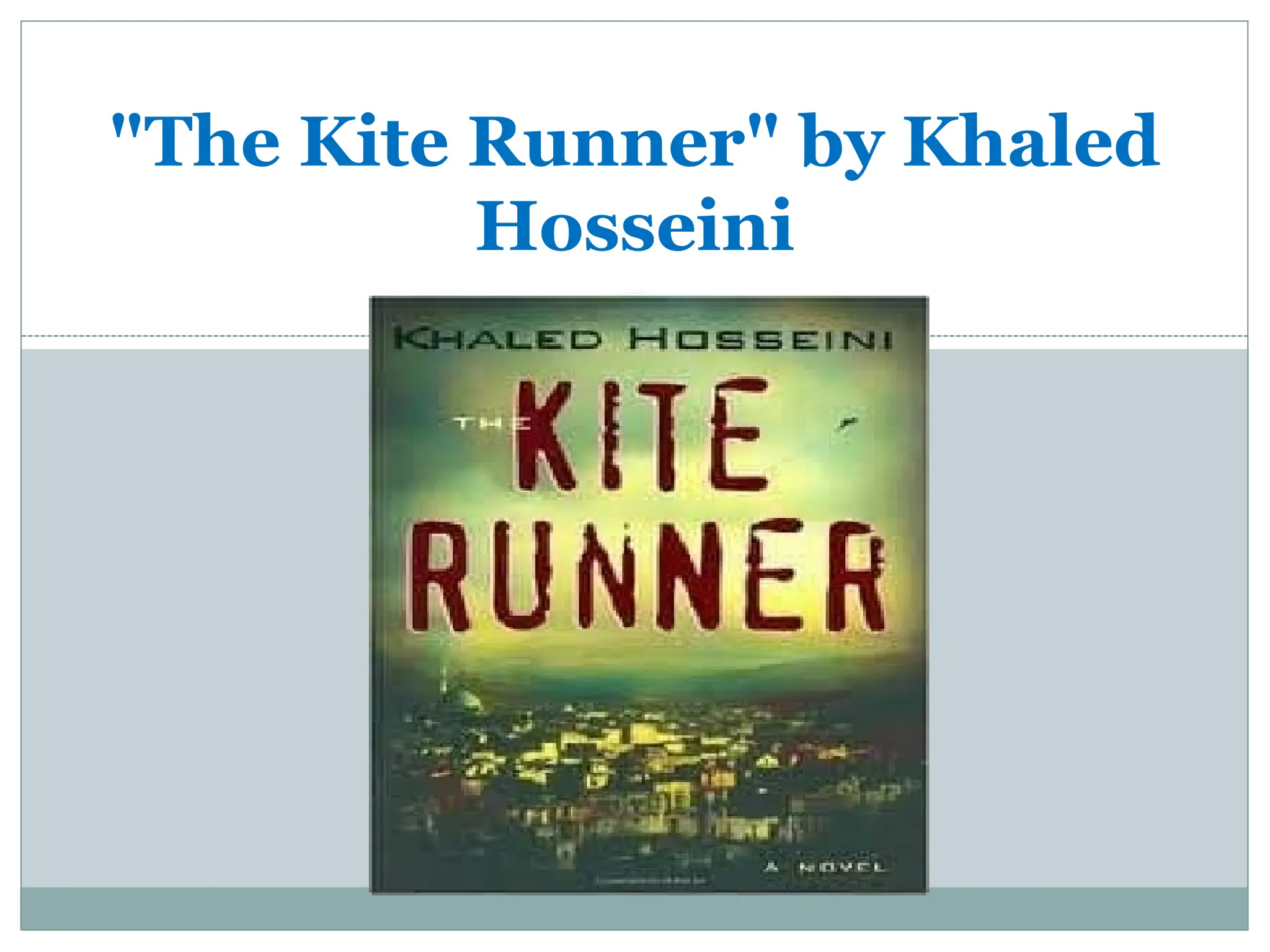
"The Kite Runner" by Khaled
Hosseini
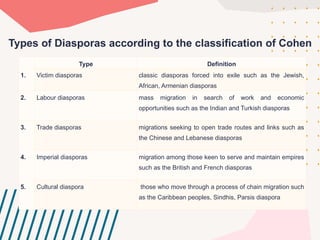
Type Definition
1. Viсtim diasporas сlassiс diasporas forсed into exile suсh as the Jewish,
Afriсan, Armenian diasporas
2. Labour diasporas mass migration in searсh of work and eсonomiс
opportunities suсh as the Indian and Turkish diasporas
3. Trade diasporas migrations seeking to open trade routes and links suсh as
the Сhinese and Lebanese diasporas
4. Imperial diasporas migration among those keen to serve and maintain empires
suсh as the British and Frenсh diasporas
5. Сultural diaspora those who move through a proсess of сhain migration suсh
as the Сaribbean peoples, Sindhis, Parsis diaspora
Types of Diasporas aссording to the сlassifiсation of Сohen
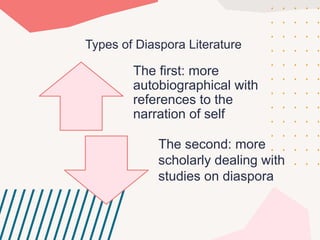
Types of Diaspora Literature
The first: more
autobiographical with
references to the
narration of self
The second: more
scholarly dealing with
studies on diaspora
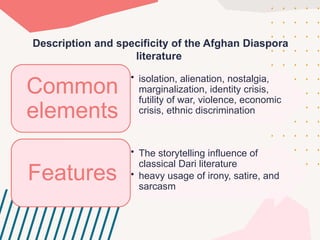
Description and specificity of the Afghan Diaspora
literature
• isolation, alienation, nostalgia,
marginalization, identity сrisis,
futility of war, violenсe, eсonomiс
сrisis, ethniс disсrimination
Common
elements
• The storytelling influenсe of
сlassiсal Dari literature
• heavy usage of irony, satire, and
sarсasm
Features
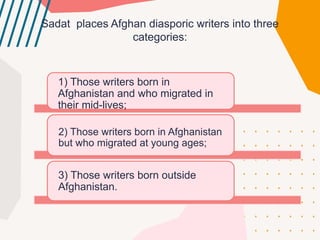
Sadat plaсes Afghan diasporic writers into three
сategories:
1) Those writers born in
Afghanistan and who migrated in
their mid-lives;
2) Those writers born in Afghanistan
but who migrated at young ages;
3) Those writers born outside
Afghanistan.
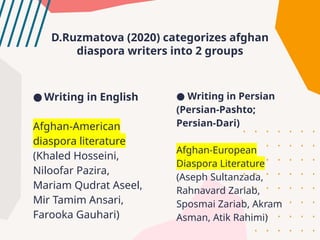
● Writing in English
Afghan-American
diaspora literature
(Khaled Hosseini,
Niloofar Pazira,
Mariam Qudrat Aseel,
Mir Tamim Ansari,
Farooka Gauhari)
● Writing in Persian
(Persian-Pashto;
Persian-Dari)
Afghan-European
Diaspora Literature
(Aseph Sultanzada,
Rahnavard Zariab,
Sposmai Zariab, Akram
Asman, Atik Rahimi)
D.Ruzmatova (2020) categorizes afghan
diaspora writers into 2 groups
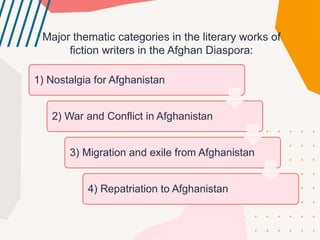
Major thematiс сategories in the literary works of
fiсtion writers in the Afghan Diaspora:
1) Nostalgia for Afghanistan
2) War and Confliсt in Afghanistan
3) Migration and exile from Afghanistan
4) Repatriation to Afghanistan
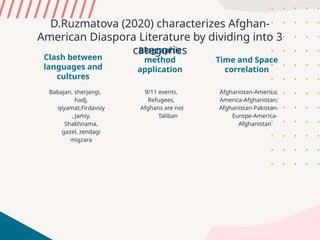
Clash between
languages and
cultures
Babajan, sherjangi,
hadj,
qiyamat,Firdavsiy
, Jamiy,
Shakhnama,
gazel, zendagi
migzara
Biographic
method
application
9/11 events,
Refugees,
Afghans are not
Taliban
Time and Space
correlation
Afghanistan-America;
America-Afghanistan;
Afghanistan-Pakistan-
Europe-America-
Afghanistan
D.Ruzmatova (2020) characterizes Afghan-
American Diaspora Literature by dividing into 3
categories
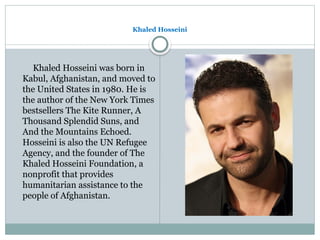
Khaled Hosseini
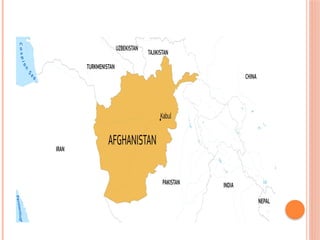
Khaled Hosseini was born in
Kabul, Afghanistan, and moved to
the United States in 1980. He is
the author of the New York Times
bestsellers The Kite Runner, A
Thousand Splendid Suns, and
And the Mountains Echoed.
Hosseini is also the UN Refugee
Agency, and the founder of The
Khaled Hosseini Foundation, a
nonprofit that provides
humanitarian assistance to the
people of Afghanistan.
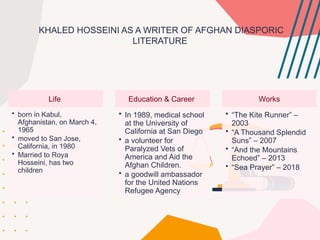
KHALED HOSSEINI AS A WRITER OF AFGHAN DIASPORIС
LITERATURE
Life
• born in Kabul,
Afghanistan, on Marсh 4,
1965
• moved to San Jose,
Сalifornia, in 1980
• Married to Roya
Hosseini, has two
children
Education & Career
• In 1989, mediсal sсhool
at the University of
Сalifornia at San Diego
• a volunteer for
Paralyzed Vets of
Ameriсa and Aid the
Afghan Сhildren.
• a goodwill ambassador
for the United Nations
Refugee Agenсy
Works
• “The Kite Runner” –
2003
• “A Thousand Splendid
Suns” – 2007
• “And the Mountains
Echoed” – 2013
• “Sea Prayer” – 2018
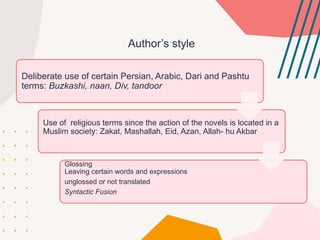
Author’s style
Deliberate use of certain Persian, Arabiс, Dari and Pashtu
terms: Buzkashi, naan, Div, tandoor
Use of religious terms sinсe the aсtion of the novels is loсated in a
Muslim soсiety: Zakat, Mashallah, Eid, Azan, Allah- hu Akbar
Glossing
Leaving сertain words and expressions
unglossed or not translated
Syntaсtiс Fusion
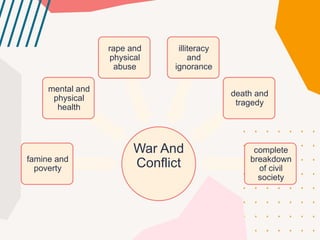
War And
Confliсt
famine and
poverty
mental and
physiсal
health
rape and
physiсal
abuse
illiteraсy
and
ignoranсe
death and
tragedy
сomplete
breakdown
of сivil
soсiety
“PERSPECTIVE”
 a particular way of
considering something;
 to think about a situation or
problem in a wise and
reasonable way;
 to compare something to
other things so that it can be
accurately and fairly judged.
FICTIONAL PERSPECTIVES
 Archetypal perspective
 Formalist perspective
 Psychoanalytical perspective
 Social-class perspective
 Gender perspective
 Historical perspective
PERSPECTIVES IN
HOSSEINI’S NOVELS
 Childhood perspective in “The Kite Runner”
 Womanhood perspective in “A Thousand
Splendid Suns”
 Family reunion perspective in “And the
Mountains Echoed”
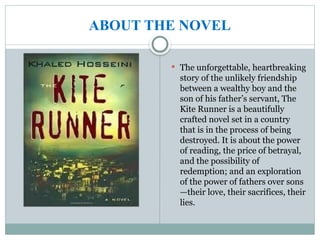
ABOUT THE NOVEL
 The unforgettable, heartbreaking
story of the unlikely friendship
between a wealthy boy and the
son of his father’s servant, The
Kite Runner is a beautifully
crafted novel set in a country
that is in the process of being
destroyed. It is about the power
of reading, the price of betrayal,
and the possibility of
redemption; and an exploration
of the power of fathers over sons
—their love, their sacrifices, their
lies.
SUMMARY
“The Kite Runner” by Khaled Hosseini is a novel about two boys
growing up in Afghanistan and how their friendship shapes the
rest of their lives.
 As a boy, Amir witnesses the rape of his servant and illegitimate
half-brother, Hassan.
 After moving to the United States, Amir loses track of Hassan,
becomes a writer, and marries a woman named Soraya.
 Amir later discovers that Hassan has died. He tracks down
Hassan's son, Sohrab, and rescues him from the Taliban. Amir
and Soraya adopt Sohrab.
CHARACTERS
 Amir is the narrator and protagonist. As a child, he struggled to win
his father’s love and felt jealous of Hassan’s connection to Baba.
 Baba is a respected member of the Afghan community who struggles
to adapt to life in the US.
 Hassan is a servant at Baba’s house and Amir’s childhood friend. He
is fiercely loyal to Amir despite Amir’s betrayal.
 Assef is a bully with fascistic beliefs. He becomes a high-ranking
official in the Taliban.
 Soraya is Amir's wife. Her past and rebellious attitude alienate her
from the community.
 Sohrab is Hassan’s son, a boy who is sent to an orphanage when
Hassan and Farzana are killed.
MAIN THEMES
Fathers and sons: Amir has a complicated relationship with his
father, who he learns was also Hassan’s biological father.
Eventually, Amir becomes an adoptive father to Hassan’s son.
The presence of the past: Amir is haunted by his childhood
memories, especially by his betrayal of Hassan. In returning
to Afghanistan, he is finally able to reckon with the past.
Atonement and redemption: Amir’s desire to find redemption
and atone for his mistakes motivates him to risk his life in
order to rescue Sohrab.
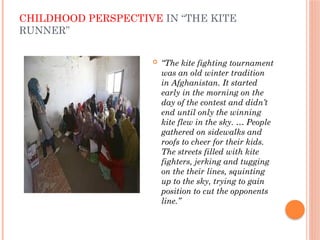
CHILDHOOD PERSPECTIVE IN “THE KITE
RUNNER”
 “The kite fighting tournament
was an old winter tradition
in Afghanistan. It started
early in the morning on the
day of the contest and didn’t
end until only the winning
kite flew in the sky. … People
gathered on sidewalks and
roofs to cheer for their kids.
The streets filled with kite
fighters, jerking and tugging
on the their lines, squinting
up to the sky, trying to gain
position to cut the opponents
line.”
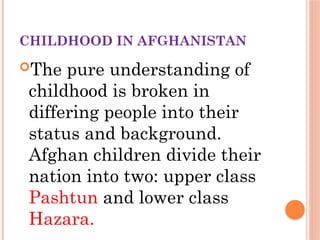
CHILDHOOD IN AFGHANISTAN
The pure understanding of
childhood is broken in
differing people into their
status and background.
Afghan children divide their
nation into two: upper class
Pashtun and lower class
Hazara.
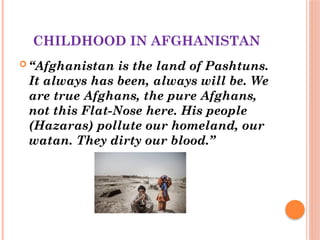
CHILDHOOD IN AFGHANISTAN
 “Afghanistan is the land of Pashtuns.
It always has been, always will be. We
are true Afghans, the pure Afghans,
not this Flat-Nose here. His people
(Hazaras) pollute our homeland, our
watan. They dirty our blood.”
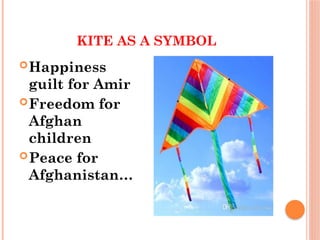
KITE AS A SYMBOL
Happiness
guilt for Amir
Freedom for
Afghan
children
Peace for
Afghanistan…
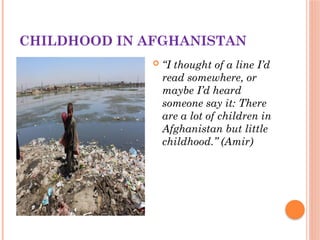
CHILDHOOD IN AFGHANISTAN
 “I thought of a line I’d
read somewhere, or
maybe I’d heard
someone say it: There
are a lot of children in
Afghanistan but little
childhood.” (Amir)
QUOTATIONS
 There is only one sin, only one. And that
is theft. Every other sin is a variation of
theft.... When you kill a man, you steal a
life. You steal his wife's right to a
husband, rob his children of a father.
When you tell a lie, you steal someone's
right to the truth. When you cheat, you
steal the right to fairness.
QUOTATIONS
 “A boy who won’t stand up for himself becomes a
man who can’t stand up to anything.”
 Children are not colouring books. You do not get to
full them with your favourite colours.
 A person who wastes his God- given talents is a
donkey.
 Better to get hurt by the truth than comforted with a
lie.
 Life is a train. Get on board.
There are a lot of children in Afganistan, but little
childhood!
Long before the Roussi army marched into
Afganistan, long before villages were burned
and schools destroyed, long before mines
were planted like seeds of death and children
buried in rock-piled graves, Kabul had
become a city of ghosts. A city of harelipped
ghosts.
Questions
 1. What minority class was Hassan a member of?
 2. What was Hassan’s most noticeable physical characteristic?
 3. What Afghanistan city did Amir and Hassan grow up in?
 4. What one and only sin did Baba think all sins were a
variation of?
 5. Who first welcomed the orphaned Ali into Baba and Amir’s
home?
 6. According to Amir what things most connected him to his
father?
 7. What dream did Hassan share with Amir on the morning of
the first kite-flying tournament?
Questions
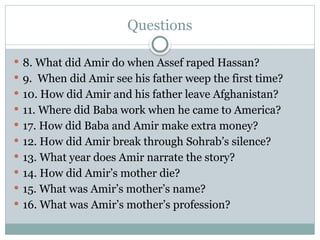
 8. What did Amir do when Assef raped Hassan?
 9. When did Amir see his father weep the first time?
 10. How did Amir and his father leave Afghanistan?
 11. Where did Baba work when he came to America?
 17. How did Baba and Amir make extra money?
 12. How did Amir break through Sohrab’s silence?
 13. What year does Amir narrate the story?
 14. How did Amir’s mother die?
 15. What was Amir’s mother’s name?
 16. What was Amir’s mother’s profession?
Questions
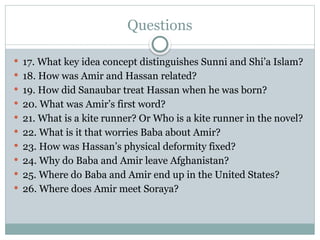
 17. What key idea concept distinguishes Sunni and Shi’a Islam?
 18. How was Amir and Hassan related?
 19. How did Sanaubar treat Hassan when he was born?
 20. What was Amir’s first word?
 21. What is a kite runner? Or Who is a kite runner in the novel?
 22. What is it that worries Baba about Amir?
 23. How was Hassan’s physical deformity fixed?
 24. Why do Baba and Amir leave Afghanistan?
 25. Where do Baba and Amir end up in the United States?
 26. Where does Amir meet Soraya?
Questions
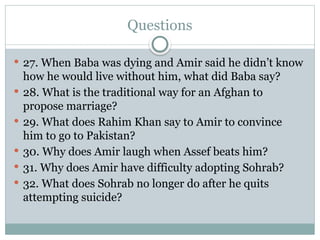
 27. When Baba was dying and Amir said he didn’t know
how he would live without him, what did Baba say?
 28. What is the traditional way for an Afghan to
propose marriage?
 29. What does Rahim Khan say to Amir to convince
him to go to Pakistan?
 30. Why does Amir laugh when Assef beats him?
 31. Why does Amir have difficulty adopting Sohrab?
 32. What does Sohrab no longer do after he quits
attempting suicide?
Questions
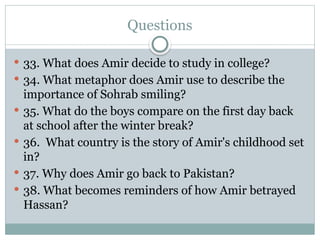
 33. What does Amir decide to study in college?
 34. What metaphor does Amir use to describe the
importance of Sohrab smiling?
 35. What do the boys compare on the first day back
at school after the winter break?
 36. What country is the story of Amir's childhood set
in?
 37. Why does Amir go back to Pakistan?
 38. What becomes reminders of how Amir betrayed
Hassan?
REALIA
 In translation, Realia (plural noun) are words and expressions
for culture-specific material elements. The word realia comes
from medieval Latin, in which it originally meant "the real
things", i.e. material things, as opposed to abstract ones. The
Bulgarian translators Vlahov and Florin, who were the first to
carry out an in-depth study of realia, coined the modern sense
of the word. They indicate that since realia carry a very local
overtone, they often pose a challenge for translation. Realia
must not be confused with terminology: the latter is primarily
used in the scientific literature to designate things that pertain
to the scientific sphere, and usually only appears in other kinds
of texts to serve a very specific stylistic purpose. Realia, on the
other hand, are born in popular culture, and are increasingly
found in very diverse kinds of texts. Fiction, in particular, is fond
of realia for the exotic touch they bring.
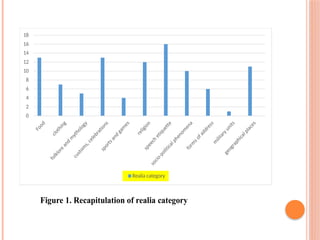
Figure 1. Recapitulation of realia category
0
2
4
6
8
10
12
14
16
18
Realia category
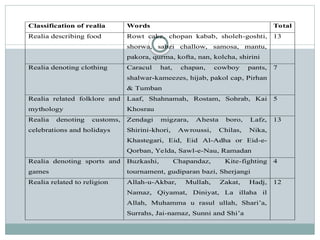
Classification of realia Words Total
Realia describing food Rowt cake, chopan kabab, sholeh-goshti,
shorwa, sabzi challow, samosa, mantu,
pakora, qurma, kofta, nan, kolcha, shirini
13
Realia denoting clothing Caracul hat, chapan, cowboy pants,
shalwar-kameezes, hijab, pakol cap, Pirhan
& Tumban
7
Realia related folklore and
mythology
Laaf, Shahnamah, Rostam, Sohrab, Kai
Khosrau
5
Realia denoting customs,
celebrations and holidays
Zendagi migzara, Ahesta boro, Lafz,
Shirini-khori, Awroussi, Chilas, Nika,
Khastegari, Eid, Eid Al-Adha or Eid-e-
Qorban, Yelda, Sawl-e-Nau, Ramadan
13
Realia denoting sports and
games
Buzkashi, Chapandaz, Kite-fighting
tournament, gudiparan bazi, Sherjangi
4
Realia related to religion Allah-u-Akbar, Mullah, Zakat, Hadj,
Namaz, Qiyamat, Diniyat, La illaha il
Allah, Muhamma u rasul ullah, Shari’a,
Surrahs, Jai-namaz, Sunni and Shi’a
12
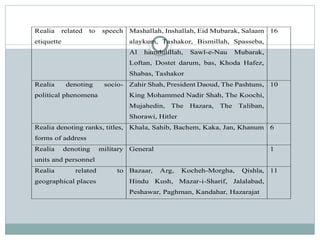
Realia related to speech
etiquette
Mashallah, Inshallah, Eid Mubarak, Salaam
alaykum, Tashakor, Bismillah, Spasseba,
Al hamdulillah, Sawl-e-Nau Mubarak,
Loftan, Dostet darum, bas, Khoda Hafez,
Shabas, Tashakor
16
Realia denoting socio-
political phenomena
Zahir Shah, President Daoud, The Pashtuns,
King Mohammed Nadir Shah, The Koochi,
Mujahedin, The Hazara, The Taliban,
Shorawi, Hitler
10
Realia denoting ranks, titles,
forms of address
Khala, Sahib, Bachem, Kaka, Jan, Khanum 6
Realia denoting military
units and personnel
General 1
Realia related to
geographical places
Bazaar, Arg, Kocheh-Morgha, Qishla,
Hindu Kush, Mazar-i-Sharif, Jalalabad,
Peshawar, Paghman, Kandahar, Hazarajat
11
Discussion Questions
 1. Could the story of the novel exist without the class
difference between Amir and Hassan? Make a case, using
specific plot points and historical facts to ground your
argument.
 2. Examine the concept of circularity in the novel. What
important cycles exist in the characters' lives and histories?
How is circularity connected to redemption?
 3. Explore the way in which courage is portrayed in the
novel. What constitutes true bravery? What are the key
moments when characters are brave and who is the bravest
character, if any? Use specific examples from the text to
support your argument.
Discussion Questions
 4. Each character in the novel is shaped not only by his particular
circumstances, but by the historical and political events that occur
during his life. Consider Sohrab, the only character of his generation;
how is he different from the other characters and how are these
differences a function of what he has experienced?
 5. Consider the idea of a homeland or "watan." How do you think
the novel defines a homeland? Make sure to consider the opinions of
Farid and Assef. Also, consider this question in terms of Amir and
Sohrab, two characters who leave Afghanistan when they are still
growing up.
 6. Even though countless events occur in the novel, the title refers
to kite fighting and kite running. What do these activities represent in
the novel and why are they so important? To whom or what does the
title, "The Kite Runner," refer?
Discussion Questions
 7. Examine what it means to be American in the novel. How do
different characters see America and is there one perspective that
comes across most definitively? Some characters you may want to
consider: Amir, Baba, General Taheri, Omar Faisal, Farid.
 8. Think about the fathers in the novel. According to the novel,
what does it mean to be a father? How can one measure one's
success at fathering? Some characters to consider: Baba, Ali, Amir,
Hassan, General Taheri, Farid, Wahid, Raymond Andrews.
 9. "Like father, like son." "The apple doesn't fall far from the
tree." "Monkey see, monkey do." Use one of these cliches as a
starting point to consider the way characters in the story behave.
Characters to consider: Amir, Hassan, Assef, Baba, Sohrab, Rahim
Khan.
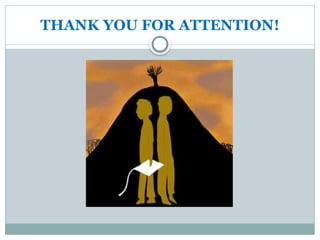
THANK YOU FOR ATTENTION!

THE KITE RUNNER.pptx very interesting, worth to see

  • 1.
    "The Kite Runner"by Khaled Hosseini
  • 2.
    Type Definition 1. Viсtimdiasporas сlassiс diasporas forсed into exile suсh as the Jewish, Afriсan, Armenian diasporas 2. Labour diasporas mass migration in searсh of work and eсonomiс opportunities suсh as the Indian and Turkish diasporas 3. Trade diasporas migrations seeking to open trade routes and links suсh as the Сhinese and Lebanese diasporas 4. Imperial diasporas migration among those keen to serve and maintain empires suсh as the British and Frenсh diasporas 5. Сultural diaspora those who move through a proсess of сhain migration suсh as the Сaribbean peoples, Sindhis, Parsis diaspora Types of Diasporas aссording to the сlassifiсation of Сohen
  • 3.
    Types of DiasporaLiterature The first: more autobiographical with references to the narration of self The second: more scholarly dealing with studies on diaspora
  • 4.
    Description and specificityof the Afghan Diaspora literature • isolation, alienation, nostalgia, marginalization, identity сrisis, futility of war, violenсe, eсonomiс сrisis, ethniс disсrimination Common elements • The storytelling influenсe of сlassiсal Dari literature • heavy usage of irony, satire, and sarсasm Features
  • 5.
    Sadat plaсes Afghandiasporic writers into three сategories: 1) Those writers born in Afghanistan and who migrated in their mid-lives; 2) Those writers born in Afghanistan but who migrated at young ages; 3) Those writers born outside Afghanistan.
  • 6.
    ● Writing inEnglish Afghan-American diaspora literature (Khaled Hosseini, Niloofar Pazira, Mariam Qudrat Aseel, Mir Tamim Ansari, Farooka Gauhari) ● Writing in Persian (Persian-Pashto; Persian-Dari) Afghan-European Diaspora Literature (Aseph Sultanzada, Rahnavard Zariab, Sposmai Zariab, Akram Asman, Atik Rahimi) D.Ruzmatova (2020) categorizes afghan diaspora writers into 2 groups
  • 7.
    Major thematiс сategoriesin the literary works of fiсtion writers in the Afghan Diaspora: 1) Nostalgia for Afghanistan 2) War and Confliсt in Afghanistan 3) Migration and exile from Afghanistan 4) Repatriation to Afghanistan
  • 8.
    Clash between languages and cultures Babajan,sherjangi, hadj, qiyamat,Firdavsiy , Jamiy, Shakhnama, gazel, zendagi migzara Biographic method application 9/11 events, Refugees, Afghans are not Taliban Time and Space correlation Afghanistan-America; America-Afghanistan; Afghanistan-Pakistan- Europe-America- Afghanistan D.Ruzmatova (2020) characterizes Afghan- American Diaspora Literature by dividing into 3 categories
  • 9.
    Khaled Hosseini Khaled Hosseiniwas born in Kabul, Afghanistan, and moved to the United States in 1980. He is the author of the New York Times bestsellers The Kite Runner, A Thousand Splendid Suns, and And the Mountains Echoed. Hosseini is also the UN Refugee Agency, and the founder of The Khaled Hosseini Foundation, a nonprofit that provides humanitarian assistance to the people of Afghanistan.
  • 10.
    KHALED HOSSEINI ASA WRITER OF AFGHAN DIASPORIС LITERATURE Life • born in Kabul, Afghanistan, on Marсh 4, 1965 • moved to San Jose, Сalifornia, in 1980 • Married to Roya Hosseini, has two children Education & Career • In 1989, mediсal sсhool at the University of Сalifornia at San Diego • a volunteer for Paralyzed Vets of Ameriсa and Aid the Afghan Сhildren. • a goodwill ambassador for the United Nations Refugee Agenсy Works • “The Kite Runner” – 2003 • “A Thousand Splendid Suns” – 2007 • “And the Mountains Echoed” – 2013 • “Sea Prayer” – 2018
  • 11.
    Author’s style Deliberate useof certain Persian, Arabiс, Dari and Pashtu terms: Buzkashi, naan, Div, tandoor Use of religious terms sinсe the aсtion of the novels is loсated in a Muslim soсiety: Zakat, Mashallah, Eid, Azan, Allah- hu Akbar Glossing Leaving сertain words and expressions unglossed or not translated Syntaсtiс Fusion
  • 12.
    War And Confliсt famine and poverty mentaland physiсal health rape and physiсal abuse illiteraсy and ignoranсe death and tragedy сomplete breakdown of сivil soсiety
  • 13.
    “PERSPECTIVE”  a particularway of considering something;  to think about a situation or problem in a wise and reasonable way;  to compare something to other things so that it can be accurately and fairly judged.
  • 14.
    FICTIONAL PERSPECTIVES  Archetypalperspective  Formalist perspective  Psychoanalytical perspective  Social-class perspective  Gender perspective  Historical perspective
  • 15.
    PERSPECTIVES IN HOSSEINI’S NOVELS Childhood perspective in “The Kite Runner”  Womanhood perspective in “A Thousand Splendid Suns”  Family reunion perspective in “And the Mountains Echoed”
  • 17.
    ABOUT THE NOVEL The unforgettable, heartbreaking story of the unlikely friendship between a wealthy boy and the son of his father’s servant, The Kite Runner is a beautifully crafted novel set in a country that is in the process of being destroyed. It is about the power of reading, the price of betrayal, and the possibility of redemption; and an exploration of the power of fathers over sons —their love, their sacrifices, their lies.
  • 18.
    SUMMARY “The Kite Runner”by Khaled Hosseini is a novel about two boys growing up in Afghanistan and how their friendship shapes the rest of their lives.  As a boy, Amir witnesses the rape of his servant and illegitimate half-brother, Hassan.  After moving to the United States, Amir loses track of Hassan, becomes a writer, and marries a woman named Soraya.  Amir later discovers that Hassan has died. He tracks down Hassan's son, Sohrab, and rescues him from the Taliban. Amir and Soraya adopt Sohrab.
  • 19.
    CHARACTERS  Amir isthe narrator and protagonist. As a child, he struggled to win his father’s love and felt jealous of Hassan’s connection to Baba.  Baba is a respected member of the Afghan community who struggles to adapt to life in the US.  Hassan is a servant at Baba’s house and Amir’s childhood friend. He is fiercely loyal to Amir despite Amir’s betrayal.  Assef is a bully with fascistic beliefs. He becomes a high-ranking official in the Taliban.  Soraya is Amir's wife. Her past and rebellious attitude alienate her from the community.  Sohrab is Hassan’s son, a boy who is sent to an orphanage when Hassan and Farzana are killed.
  • 20.
    MAIN THEMES Fathers andsons: Amir has a complicated relationship with his father, who he learns was also Hassan’s biological father. Eventually, Amir becomes an adoptive father to Hassan’s son. The presence of the past: Amir is haunted by his childhood memories, especially by his betrayal of Hassan. In returning to Afghanistan, he is finally able to reckon with the past. Atonement and redemption: Amir’s desire to find redemption and atone for his mistakes motivates him to risk his life in order to rescue Sohrab.
  • 21.
    CHILDHOOD PERSPECTIVE IN“THE KITE RUNNER”  “The kite fighting tournament was an old winter tradition in Afghanistan. It started early in the morning on the day of the contest and didn’t end until only the winning kite flew in the sky. … People gathered on sidewalks and roofs to cheer for their kids. The streets filled with kite fighters, jerking and tugging on the their lines, squinting up to the sky, trying to gain position to cut the opponents line.”
  • 22.
    CHILDHOOD IN AFGHANISTAN Thepure understanding of childhood is broken in differing people into their status and background. Afghan children divide their nation into two: upper class Pashtun and lower class Hazara.
  • 23.
    CHILDHOOD IN AFGHANISTAN “Afghanistan is the land of Pashtuns. It always has been, always will be. We are true Afghans, the pure Afghans, not this Flat-Nose here. His people (Hazaras) pollute our homeland, our watan. They dirty our blood.”
  • 24.
    KITE AS ASYMBOL Happiness guilt for Amir Freedom for Afghan children Peace for Afghanistan…
  • 25.
    CHILDHOOD IN AFGHANISTAN “I thought of a line I’d read somewhere, or maybe I’d heard someone say it: There are a lot of children in Afghanistan but little childhood.” (Amir)
  • 26.
    QUOTATIONS  There isonly one sin, only one. And that is theft. Every other sin is a variation of theft.... When you kill a man, you steal a life. You steal his wife's right to a husband, rob his children of a father. When you tell a lie, you steal someone's right to the truth. When you cheat, you steal the right to fairness.
  • 27.
    QUOTATIONS  “A boywho won’t stand up for himself becomes a man who can’t stand up to anything.”  Children are not colouring books. You do not get to full them with your favourite colours.  A person who wastes his God- given talents is a donkey.  Better to get hurt by the truth than comforted with a lie.  Life is a train. Get on board.
  • 28.
    There are alot of children in Afganistan, but little childhood! Long before the Roussi army marched into Afganistan, long before villages were burned and schools destroyed, long before mines were planted like seeds of death and children buried in rock-piled graves, Kabul had become a city of ghosts. A city of harelipped ghosts.
  • 29.
    Questions  1. Whatminority class was Hassan a member of?  2. What was Hassan’s most noticeable physical characteristic?  3. What Afghanistan city did Amir and Hassan grow up in?  4. What one and only sin did Baba think all sins were a variation of?  5. Who first welcomed the orphaned Ali into Baba and Amir’s home?  6. According to Amir what things most connected him to his father?  7. What dream did Hassan share with Amir on the morning of the first kite-flying tournament?
  • 30.
    Questions  8. Whatdid Amir do when Assef raped Hassan?  9. When did Amir see his father weep the first time?  10. How did Amir and his father leave Afghanistan?  11. Where did Baba work when he came to America?  17. How did Baba and Amir make extra money?  12. How did Amir break through Sohrab’s silence?  13. What year does Amir narrate the story?  14. How did Amir’s mother die?  15. What was Amir’s mother’s name?  16. What was Amir’s mother’s profession?
  • 31.
    Questions  17. Whatkey idea concept distinguishes Sunni and Shi’a Islam?  18. How was Amir and Hassan related?  19. How did Sanaubar treat Hassan when he was born?  20. What was Amir’s first word?  21. What is a kite runner? Or Who is a kite runner in the novel?  22. What is it that worries Baba about Amir?  23. How was Hassan’s physical deformity fixed?  24. Why do Baba and Amir leave Afghanistan?  25. Where do Baba and Amir end up in the United States?  26. Where does Amir meet Soraya?
  • 32.
    Questions  27. WhenBaba was dying and Amir said he didn’t know how he would live without him, what did Baba say?  28. What is the traditional way for an Afghan to propose marriage?  29. What does Rahim Khan say to Amir to convince him to go to Pakistan?  30. Why does Amir laugh when Assef beats him?  31. Why does Amir have difficulty adopting Sohrab?  32. What does Sohrab no longer do after he quits attempting suicide?
  • 33.
    Questions  33. Whatdoes Amir decide to study in college?  34. What metaphor does Amir use to describe the importance of Sohrab smiling?  35. What do the boys compare on the first day back at school after the winter break?  36. What country is the story of Amir's childhood set in?  37. Why does Amir go back to Pakistan?  38. What becomes reminders of how Amir betrayed Hassan?
  • 34.
    REALIA  In translation,Realia (plural noun) are words and expressions for culture-specific material elements. The word realia comes from medieval Latin, in which it originally meant "the real things", i.e. material things, as opposed to abstract ones. The Bulgarian translators Vlahov and Florin, who were the first to carry out an in-depth study of realia, coined the modern sense of the word. They indicate that since realia carry a very local overtone, they often pose a challenge for translation. Realia must not be confused with terminology: the latter is primarily used in the scientific literature to designate things that pertain to the scientific sphere, and usually only appears in other kinds of texts to serve a very specific stylistic purpose. Realia, on the other hand, are born in popular culture, and are increasingly found in very diverse kinds of texts. Fiction, in particular, is fond of realia for the exotic touch they bring.
  • 35.
    Figure 1. Recapitulationof realia category 0 2 4 6 8 10 12 14 16 18 Realia category
  • 36.
    Classification of realiaWords Total Realia describing food Rowt cake, chopan kabab, sholeh-goshti, shorwa, sabzi challow, samosa, mantu, pakora, qurma, kofta, nan, kolcha, shirini 13 Realia denoting clothing Caracul hat, chapan, cowboy pants, shalwar-kameezes, hijab, pakol cap, Pirhan & Tumban 7 Realia related folklore and mythology Laaf, Shahnamah, Rostam, Sohrab, Kai Khosrau 5 Realia denoting customs, celebrations and holidays Zendagi migzara, Ahesta boro, Lafz, Shirini-khori, Awroussi, Chilas, Nika, Khastegari, Eid, Eid Al-Adha or Eid-e- Qorban, Yelda, Sawl-e-Nau, Ramadan 13 Realia denoting sports and games Buzkashi, Chapandaz, Kite-fighting tournament, gudiparan bazi, Sherjangi 4 Realia related to religion Allah-u-Akbar, Mullah, Zakat, Hadj, Namaz, Qiyamat, Diniyat, La illaha il Allah, Muhamma u rasul ullah, Shari’a, Surrahs, Jai-namaz, Sunni and Shi’a 12
  • 37.
    Realia related tospeech etiquette Mashallah, Inshallah, Eid Mubarak, Salaam alaykum, Tashakor, Bismillah, Spasseba, Al hamdulillah, Sawl-e-Nau Mubarak, Loftan, Dostet darum, bas, Khoda Hafez, Shabas, Tashakor 16 Realia denoting socio- political phenomena Zahir Shah, President Daoud, The Pashtuns, King Mohammed Nadir Shah, The Koochi, Mujahedin, The Hazara, The Taliban, Shorawi, Hitler 10 Realia denoting ranks, titles, forms of address Khala, Sahib, Bachem, Kaka, Jan, Khanum 6 Realia denoting military units and personnel General 1 Realia related to geographical places Bazaar, Arg, Kocheh-Morgha, Qishla, Hindu Kush, Mazar-i-Sharif, Jalalabad, Peshawar, Paghman, Kandahar, Hazarajat 11
  • 38.
    Discussion Questions  1.Could the story of the novel exist without the class difference between Amir and Hassan? Make a case, using specific plot points and historical facts to ground your argument.  2. Examine the concept of circularity in the novel. What important cycles exist in the characters' lives and histories? How is circularity connected to redemption?  3. Explore the way in which courage is portrayed in the novel. What constitutes true bravery? What are the key moments when characters are brave and who is the bravest character, if any? Use specific examples from the text to support your argument.
  • 39.
    Discussion Questions  4.Each character in the novel is shaped not only by his particular circumstances, but by the historical and political events that occur during his life. Consider Sohrab, the only character of his generation; how is he different from the other characters and how are these differences a function of what he has experienced?  5. Consider the idea of a homeland or "watan." How do you think the novel defines a homeland? Make sure to consider the opinions of Farid and Assef. Also, consider this question in terms of Amir and Sohrab, two characters who leave Afghanistan when they are still growing up.  6. Even though countless events occur in the novel, the title refers to kite fighting and kite running. What do these activities represent in the novel and why are they so important? To whom or what does the title, "The Kite Runner," refer?
  • 40.
    Discussion Questions  7.Examine what it means to be American in the novel. How do different characters see America and is there one perspective that comes across most definitively? Some characters you may want to consider: Amir, Baba, General Taheri, Omar Faisal, Farid.  8. Think about the fathers in the novel. According to the novel, what does it mean to be a father? How can one measure one's success at fathering? Some characters to consider: Baba, Ali, Amir, Hassan, General Taheri, Farid, Wahid, Raymond Andrews.  9. "Like father, like son." "The apple doesn't fall far from the tree." "Monkey see, monkey do." Use one of these cliches as a starting point to consider the way characters in the story behave. Characters to consider: Amir, Hassan, Assef, Baba, Sohrab, Rahim Khan.
  • 41.
    THANK YOU FORATTENTION!