POM
Control and Quality Management
Unit: 9
Diwakar Singh
Introduction:
• The goal and objective of organization have
been:
– Well designed and organized
– Employees have been carefully selected
– Trained and instructed
– Communication channels have been well-set
• The environment in modern organization
operate:
– Becoming more and more complex
Diwakar Singh
Contd….
– More products
– More players
– Rapidly changing technology
– Market
• This chapter deals with two main aspects of
managerial controls:
– The basic concept
– Method and process control
– Second part:
• Quality management concepts
• issues
Diwakar Singh
Concept of Control System:
• We have selected the following definitions for
analysis:
– Robert J Mockler (1972)
– George Terry and Stephen Franklin (2005)
– Robert Kreinter (2016)
• Essentially, control means:
– Identification of variations
– Their caused and
– Corrective actions
Diwakar Singh
Contd…..
• The control function of management has close
relationship with:
– The planning function
• Controlling exists at every level of management:
– The chief executive has to control for:
• Overall corporate activities
– Whereas the lower-level managers have to
• Control the activities of their respective units
– Control is process activity to:
• The effectiveness of managers and
• organizations
Diwakar Singh
The Control Process:
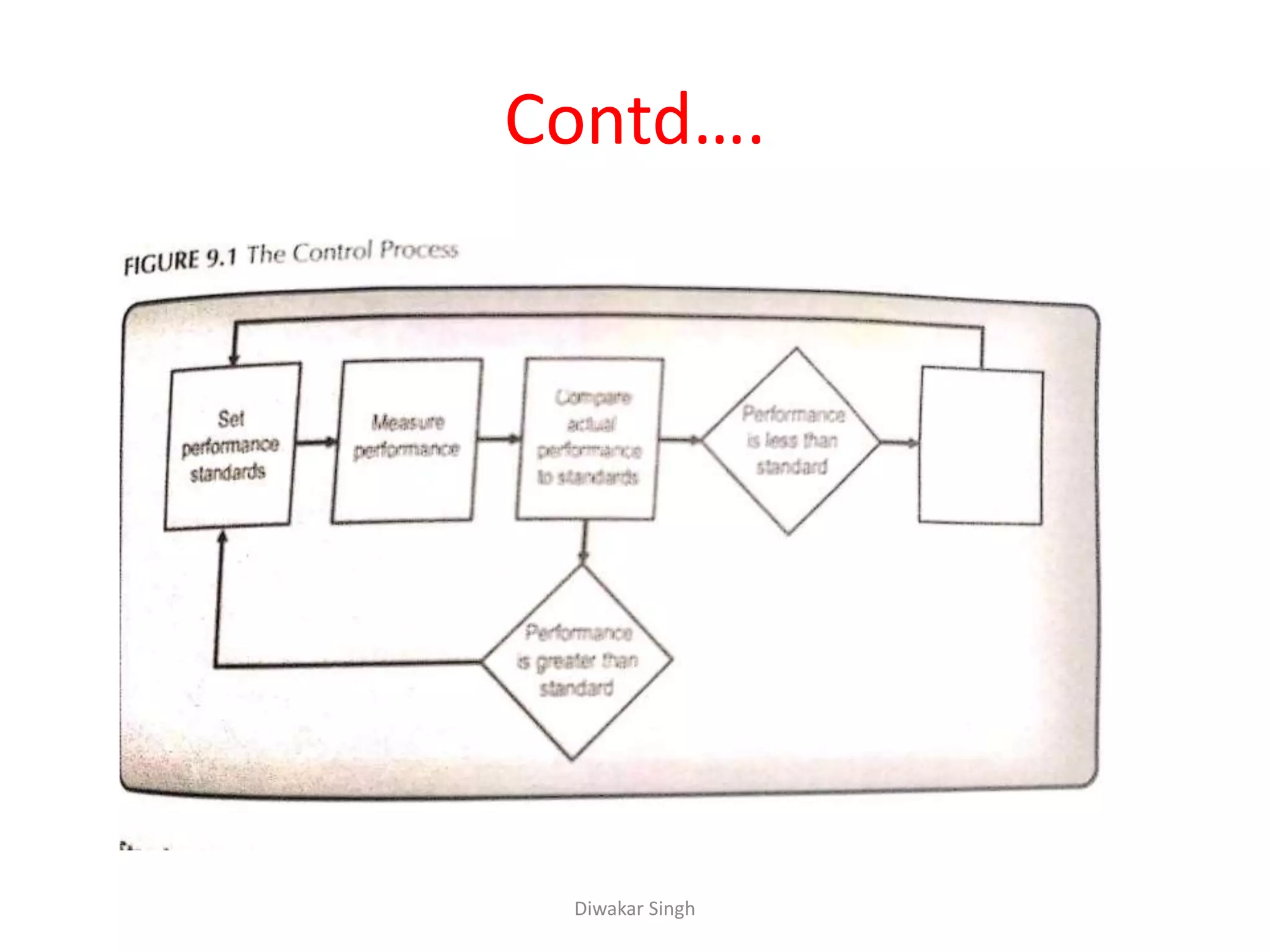
• An organization involves for major steps:
– Performance standard
– Performance measurement
– Comparison between standards and actual
performance
– Corrective action
• These steps together constitute the process of
control.
Diwakar Singh
Contd….
Diwakar Singh
Contd….
• Standard:
– Fixing performance standard
– A reference point against which,
• Performance can be measured
– These standards might include:
• Sales goals
• Production goals
• Service goals
• Profit goals
Diwakar Singh
Contd….
• These goals and objectives must be
– Clearly set by the corporate plans
• These should then translate into specific into:
– Specific performance standards for:
• Each units of the organization
• A performance can be formulated with respect:
– To any one factors like:
• Quality
• Quantity
• Time used
• cost
Diwakar Singh
Contd….
• The performance standards must be:
– Stated in clear and
– Measurable terms
• Abstract standards like:
– Quality service
– Employee satisfaction cannot be perfectively
measured
Diwakar Singh
Contd….
• Setting standards are useless everyone in the
organization understands:
– What they are?
– Why they exists?
• There are many ways to communicate:
– Performance standards to employees
• The methods of standards are:
– Job description
– Job instruction
Diwakar Singh
Contd….
– Polices & rules
– Target
– Procedure
– Time
• used as methods of performance standards
• Indicator used to measure performance
Diwakar Singh
Contd….
• Performance Measurement:
– In the second step of control process:
• The actual performance or units is measured
– Standards are the criteria against which,
• The performance is measured
– This is actually the phase of:
• Evaluation
• Appraisal or assessment
– Performance can be measured at:
• Weekly
• Monthly or
• Yearly basis
Diwakar Singh
Contd….
• For example:
– The fuel consumption by a vehicle
• Can be measured on a weekly basis
– Productions and sales can be:
• Measured on a monthly basis
– Unit costs, total costs, total expensive or
profitability can be:
• Measured at the end of every fiscal year at :
– The end of every year
Diwakar Singh
Contd….
• For control system to be effective:
– The management information system should be:
• Designed
• Strengthened
• An important purpose of assessment is:
– To help employees to discover their
• Strength and weakness
Diwakar Singh
Contd….
• They can make use of the most of their:
– Strengths
– Correct
– Minimize their weakness
• Managers must regularly discuss:
– Target and achievement
– Success and failures
– Strength and weakness
Diwakar Singh
Comparison between Standards and
Performance:
• The actual performance is captured with:
– The predetermined performance standards
– To determine how well the goals and objectives
have been met
– If performance matches the standard:
• The achievement is considered good
• If there is big gaps between these two:
– The performance is considered poor
Diwakar Singh
Corrective Actions:
• The management must determine:
– If the gap between standard and performance is significant
enough:
• To require corrective action
• When the gap is significant understanding the cause is:
– Crucial to determine
– Weather it should be changed or
– Some other remedy attempted
• Thus, corrective action may lead
– To changes in:
• Original standard
• Work procedures
• Schedules
Diwakar Singh
Types of Control System:
• Three types of control are used in the process
of control:
– Pre-control
– Concurrent
– Post control
• Pre-control system:
– Known as free-forward control
– The control system taken place before work is
performed
Diwakar Singh
Contd…..
Diwakar Singh
Contd….
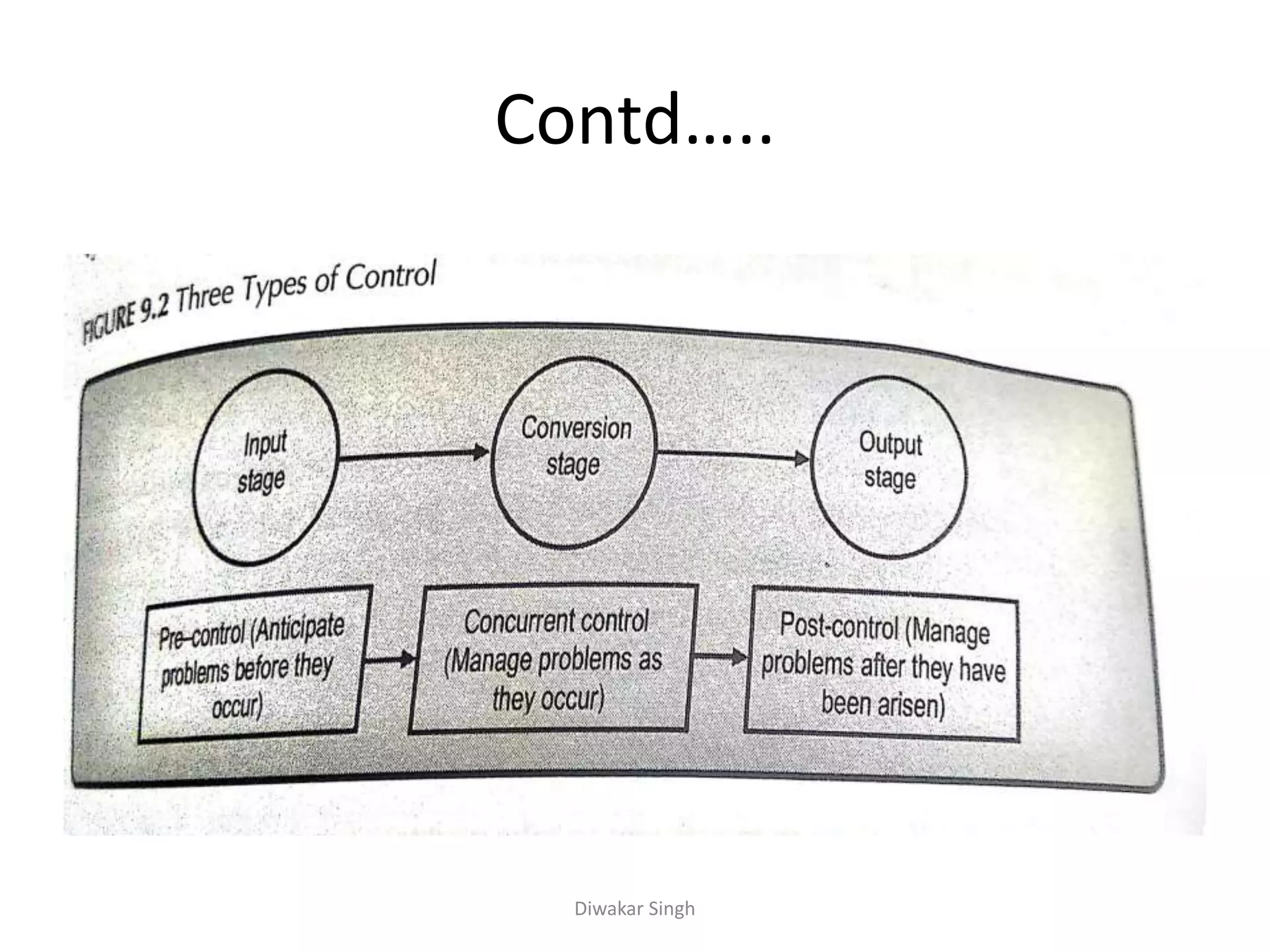
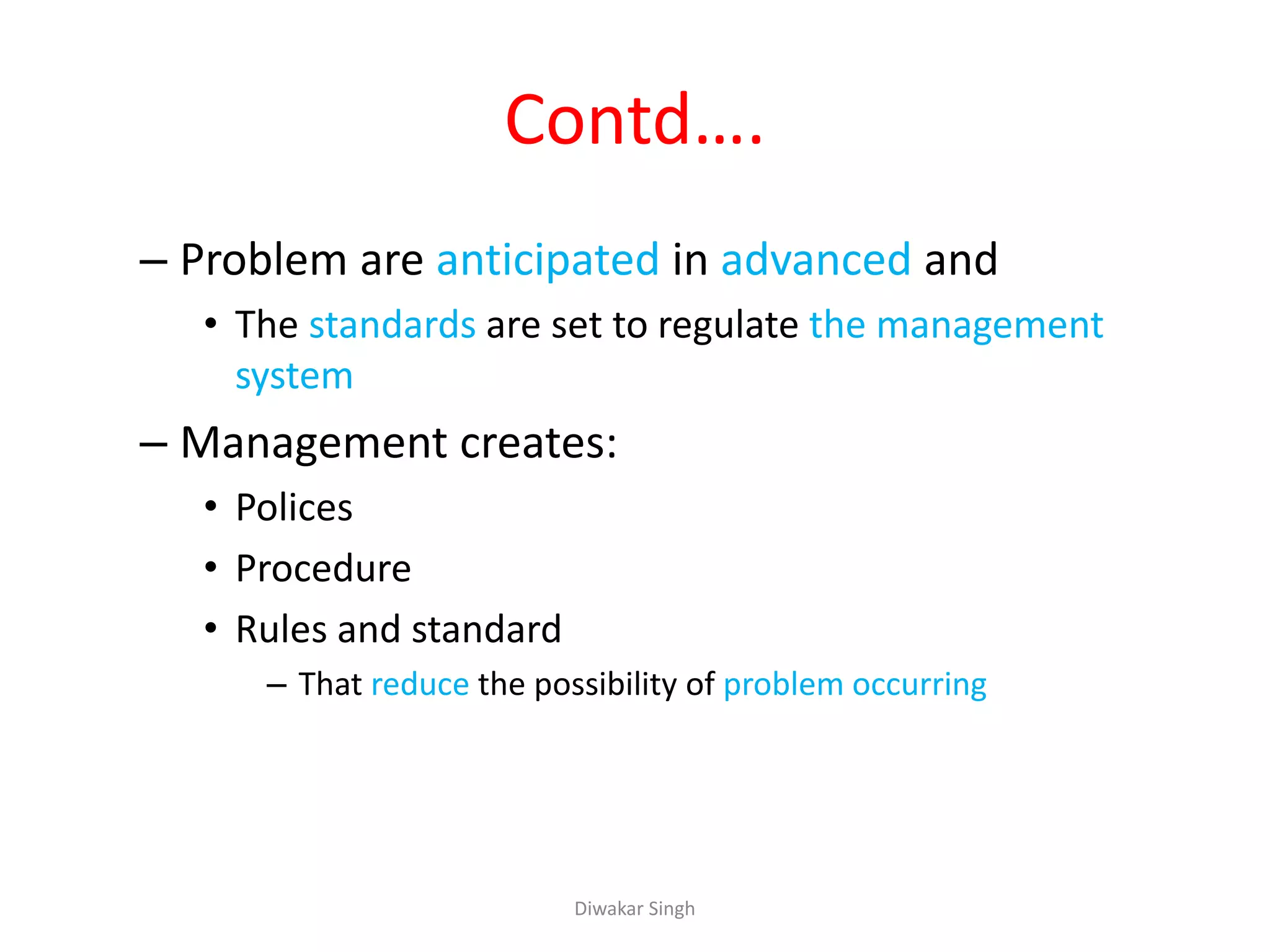
– Problem are anticipated in advanced and
• The standards are set to regulate the management
system
– Management creates:
• Polices
• Procedure
• Rules and standard
– That reduce the possibility of problem occurring
Diwakar Singh
Contd…
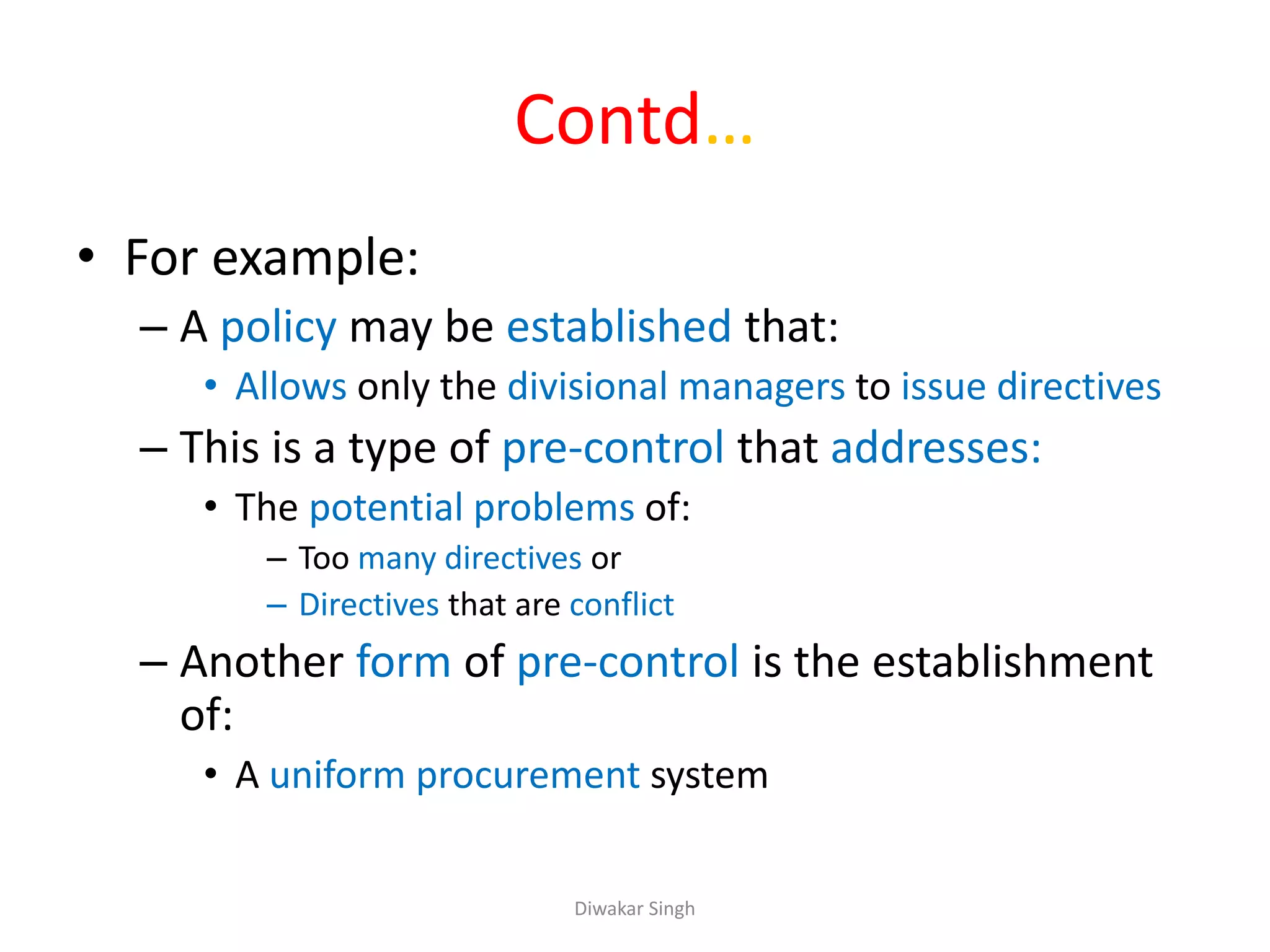
• For example:
– A policy may be established that:
• Allows only the divisional managers to issue directives
– This is a type of pre-control that addresses:
• The potential problems of:
– Too many directives or
– Directives that are conflict
– Another form of pre-control is the establishment
of:
• A uniform procurement system
Diwakar Singh
Contd….
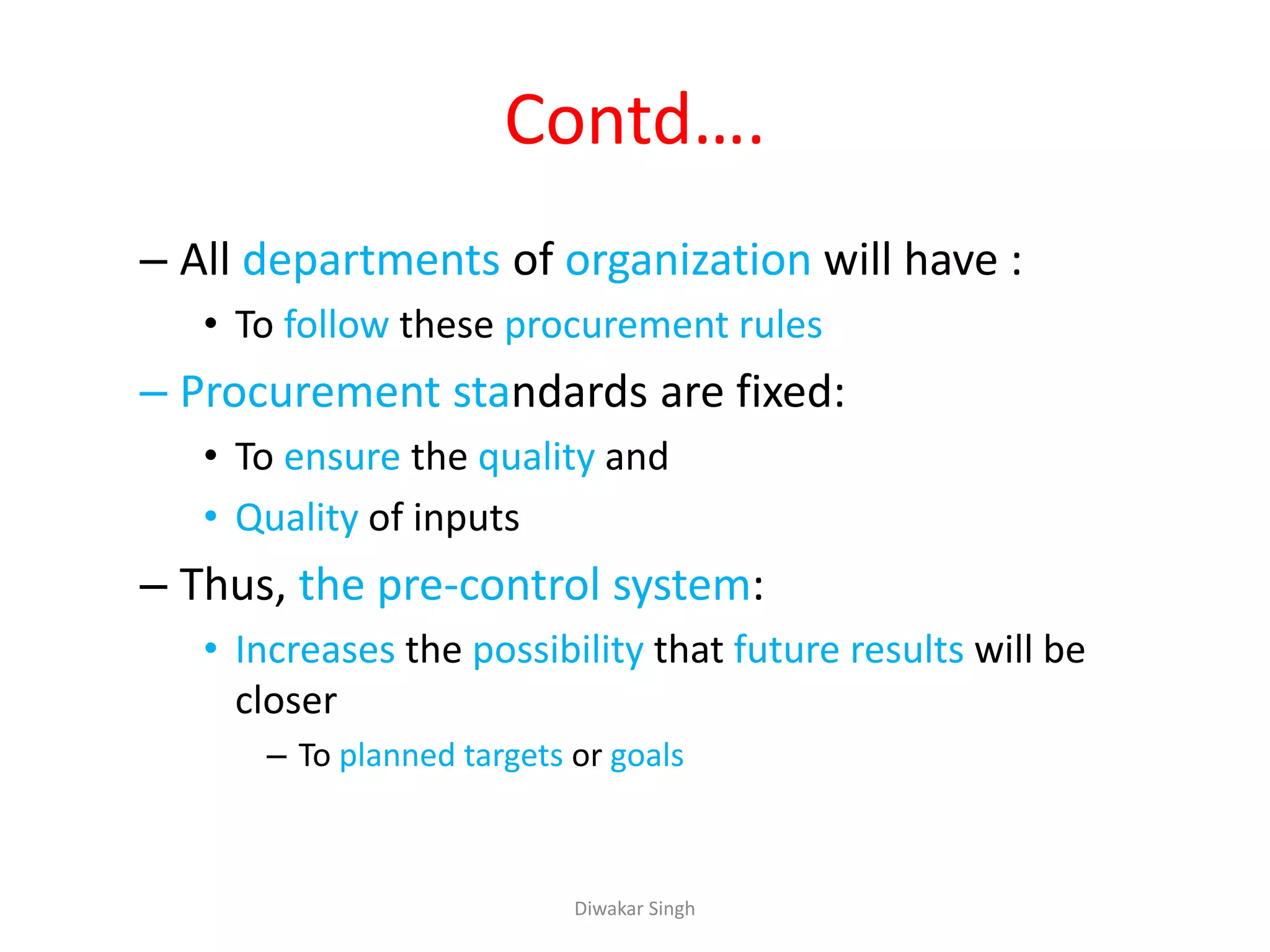
– All departments of organization will have :
• To follow these procurement rules
– Procurement standards are fixed:
• To ensure the quality and
• Quality of inputs
– Thus, the pre-control system:
• Increases the possibility that future results will be
closer
– To planned targets or goals
Diwakar Singh
Contd….
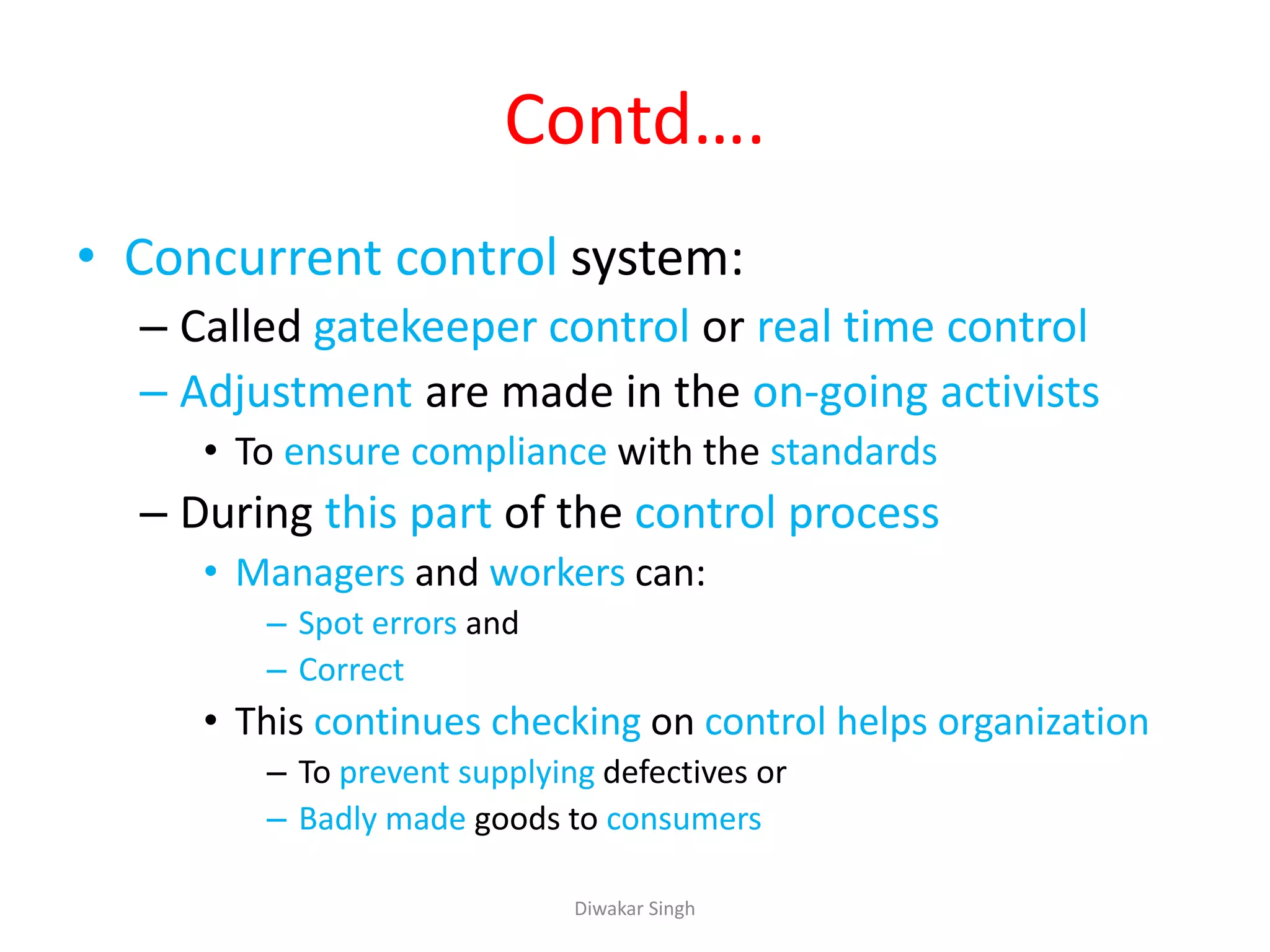
• Concurrent control system:
– Called gatekeeper control or real time control
– Adjustment are made in the on-going activists
• To ensure compliance with the standards
– During this part of the control process
• Managers and workers can:
– Spot errors and
– Correct
• This continues checking on control helps organization
– To prevent supplying defectives or
– Badly made goods to consumers
Diwakar Singh
Contd….
• For example:
– The quality of product is checked
• While in progress
– If some defects are found
• Send back for repair
– Similarly, the use of raw-material is
• Monitory regularly
– The stock is inspected to ensure
• The regular supply
Diwakar Singh
Contd….
• Post control system:
– Also called feedback control
– Takes place the work process in completed
– Thus, concentrates on past performance
– The basis of post-control is a comparison of:
• Historical data with current information
– For example:
• Financial analysis
• Productivity
• Profitability
• Employee performance
Diwakar Singh
Contd….
• Post-control activities give correct feedback to
management:
– To take necessary corrective actions
Diwakar Singh
Characteristics of Effective Control
System:
• The features of an effective control system:
– Stonner (1978) has suggested that an effective
control system should be:
– Timely:
• To maintain work standard
– To control measures should be token at:
» The right times depending on their purpose at
• Any particular time
– Simple:
• Control measures must be simple
Diwakar Singh
Contd….
– Minimal:
• Control should be as far as possible:
– The work done and standards are maintained
– Flexible:
• Too rigid controls may be self-defecting
– Accurate:
• The information provided by the control system must
be:
– Reliable and
– accurate
Diwakar Singh
Control:
– Objective and comprehensive:
• The control system must be clearly understood by:
– Employees working under it
– Focused:
• The control system should focus on points at which
deviations form:
– Standards are most likely to occur or
– Could do the greatest damage
– Realistic:
• The control system must be realistic
– Acceptable:
• To be effective, the control system must have:
– The general acceptance of the employees
Diwakar Singh
Potential Barrier to Successful
Controlling:
• There are sometimes barriers to:
– Testing
– Measuring
– Communicating
– Observation
• These barriers can reduce:
– The efficiency of the organization
– Also in the controlling process
Diwakar Singh
Contd….
• Barriers to organizational control can include:
– Scarcity of resources
– Inaccurate measurement of the process
– Improper information flow
– Incorrect analysis
• Resource scarcity:
– Managing control typically requires a number of
resources, they are:
• Supervisory staff
Diwakar Singh
Contd….
• Skilled specialists
• Tools to measure
– the control of the system
• Statistical software
• Inaccurate measurement:
– Managing control can happen for a number of
different reasons, including:
• Misunderstanding of the measurement process by staff
• Inaccurate or misleading measurement processes
• Lack of staff training to determine how
– To measure the control process
Diwakar Singh
Contd….
• Information flow issues:
– Information is collected point in
• The process and
• Analyzed contextually another
• This time lag in information flow can
– Misdirect management to problem at
• The wrong time in the sequence
– Barrier of information flow:
• A lack of resources
Diwakar Singh
Contd….
• Inaccurate measurement
• Information flow errors
• Incorrect analysis
• Managers should be aware of these barriers
and do their best:
– To avoid them together:
• Planning
• Training and
• Accuracy
Diwakar Singh
Quality Control System:
• Function of ensuring that:
– Product/service quality conforms
• To predetermined standards
• A quality control program involved:
– Determine minimum standards of accepting
• The standards have been determined:
– The acceptability of the actual work can:
• compared with expected standards
Diwakar Singh
Contd….
• If there is serious lack of:
– Conformity
– Corrective measure
• It implies five activities (Jones, George & Hill
(2012)):
• Determining tolerances:
– Range within which deviation in :
• Actual quality from standard
Diwakar Singh
Contd….
• Conducting inspections and test of:
– Materials
– Processes
– Products
• Isolating acceptable units from those
– Which do not conform to quality standard
– Pronging causes of deviation:
• To the attention of the concerned manager
– Suggesting ways and means of improving the quality
Diwakar Singh
Contd….
• Quality control has several advantages:
– Direct and indirect
– Which are stated as follows:
– Quality control directly attacks waste:
• It enables a manufacturer to minimize
– It costs he/she incurs through rejections
– his./her inspection costs
• Quality control helps management in finding:
– Defective products
• Which can be reworked
Diwakar Singh
Contd….
• Quality control has a beneficial on “machine-
shop production”
– The operatives and others involved can:
• See for themselves weather or not
• They are succeeding in maintaining the standards
• Quality control does not measure merely the final
products:
– Rather it starts with the input
– Samples of incoming materials are inspected:
• To determine . If they meet preset standards
Diwakar Singh
Total Quality Management:
• Concept of TQM:
– The focus of quality is on every activity of the
organization
– A comprehensive approach to improving
• Product quality and
• Theory customer satisfaction
– The TQM concept was first developed by:
• A member of consultants including:
• W. Edwards Deming
• Joshep Juran
• A.V. Feiganbaum
Diwakar Singh
Contd….
• They indicate the same principles and
elements of TQM:
– In these definitions, three ingredients:
– The TQM process to take place
• Customer- centered approach
• Contours process improvement
• The use of terms
Diwakar Singh
Contd…
• Customer- centered approach:
– Should be the ultimate goal of an enterprise
– Satisfied customers are the biggest assets of the
enterprise
– All the members of an enterprise who are involved
in:
• The process of producing the goods/services
– They are the internal customers of the enterprise
Diwakar Singh
Contd….
– Every individual/unit within the enterprise is:
• Viewed as a chain of which only the final part is:
– The external customer
– Therefore, the indicators of customer-centred
behavior are:
• Greeting
• Asking
• Speaking
• Assisting
• responding
Diwakar Singh
Contd….
• Continuous process improvement:
– TQM program emphasizes on never-ending quality
improvement activities
– A Japanese word describing this process of
involving everybody “Kaizen” means:
• Step-by-step gradual improved
• Doing little things better
• Continuously setting
• Achieving even-higher standards
Diwakar Singh
Contd….
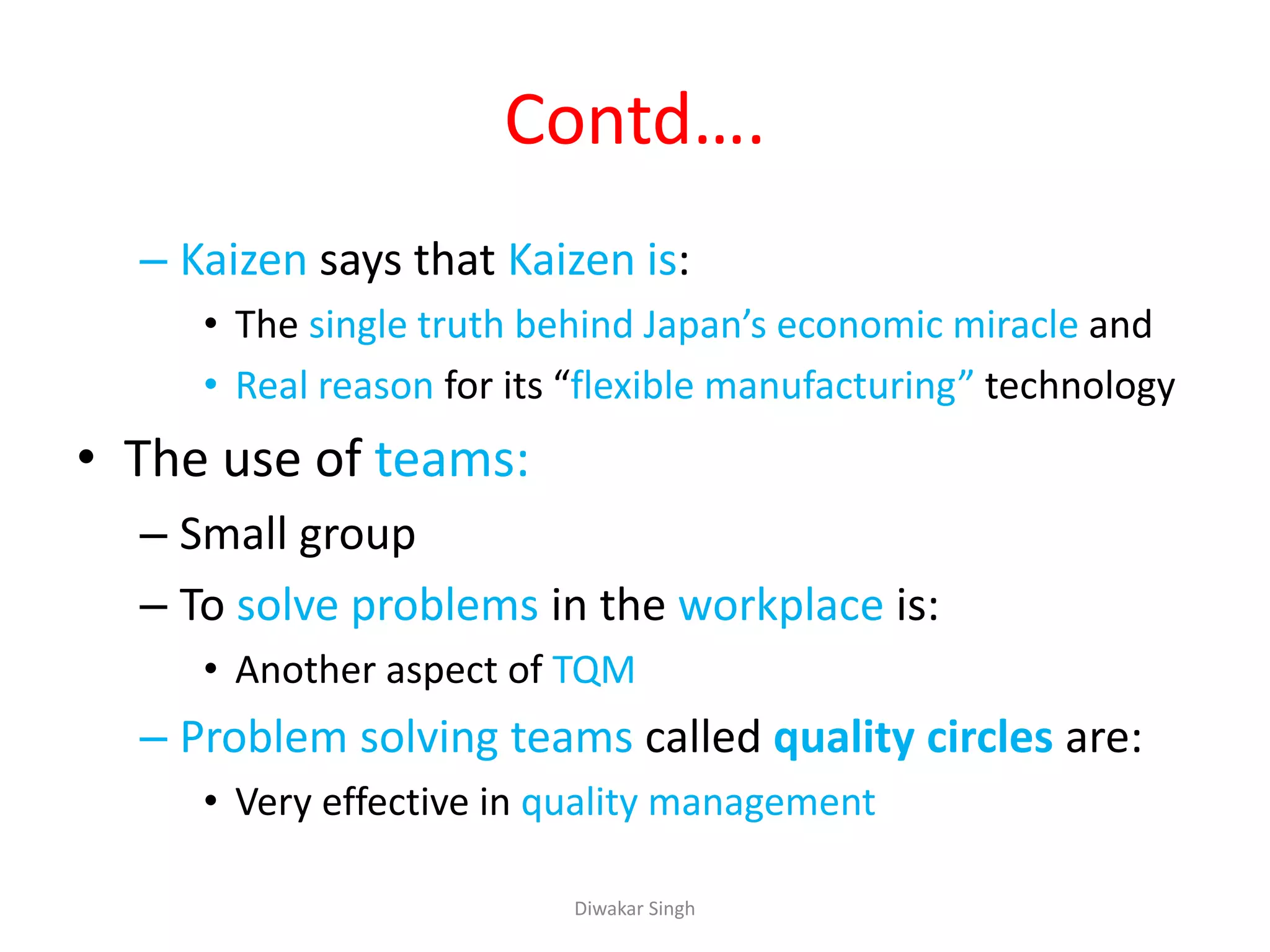
– Kaizen says that Kaizen is:
• The single truth behind Japan’s economic miracle and
• Real reason for its “flexible manufacturing” technology
• The use of teams:
– Small group
– To solve problems in the workplace is:
• Another aspect of TQM
– Problem solving teams called quality circles are:
• Very effective in quality management
Diwakar Singh
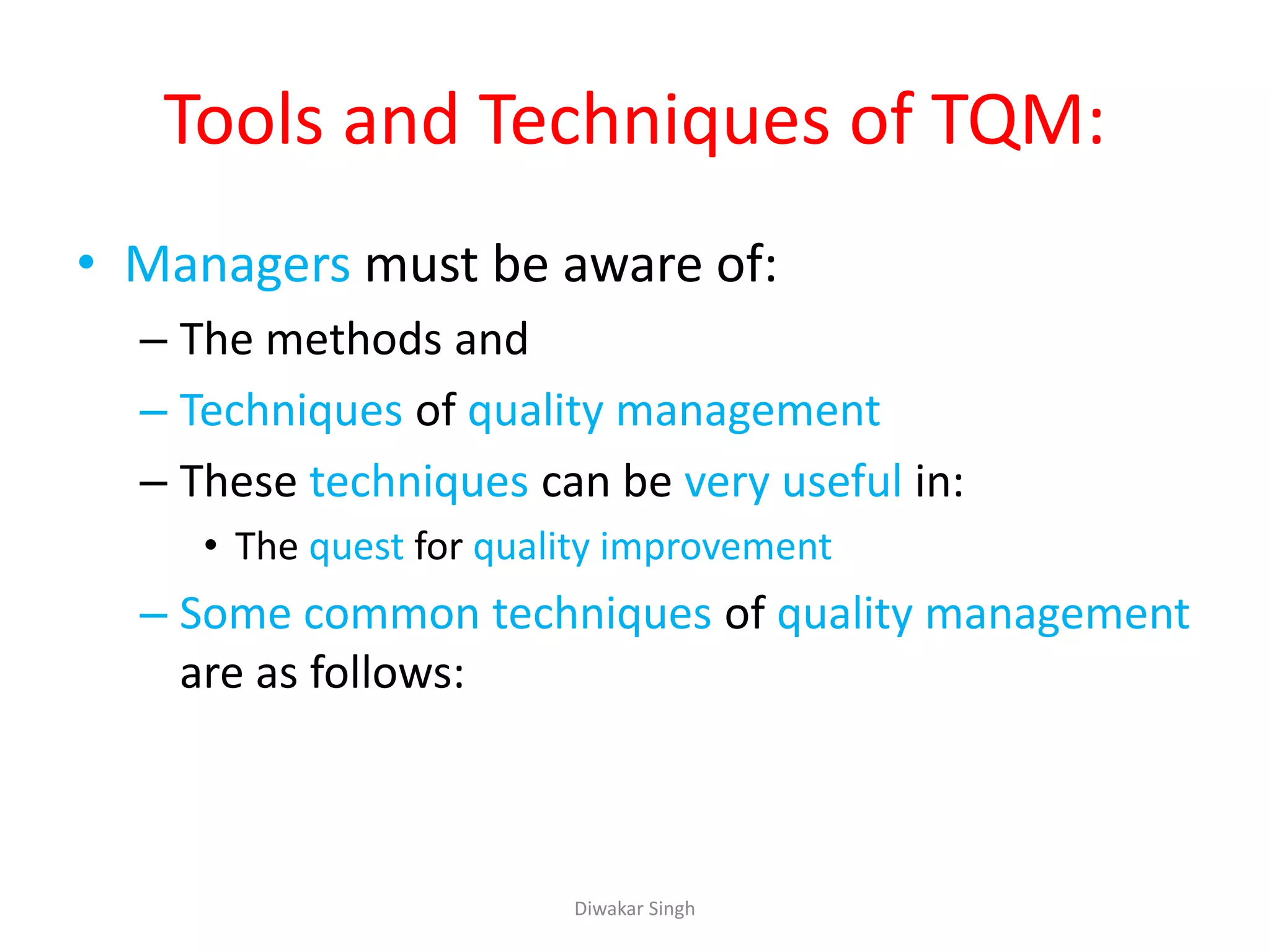
Tools and Techniques of TQM:
• Managers must be aware of:
– The methods and
– Techniques of quality management
– These techniques can be very useful in:
• The quest for quality improvement
– Some common techniques of quality management
are as follows:
Diwakar Singh
Contd….
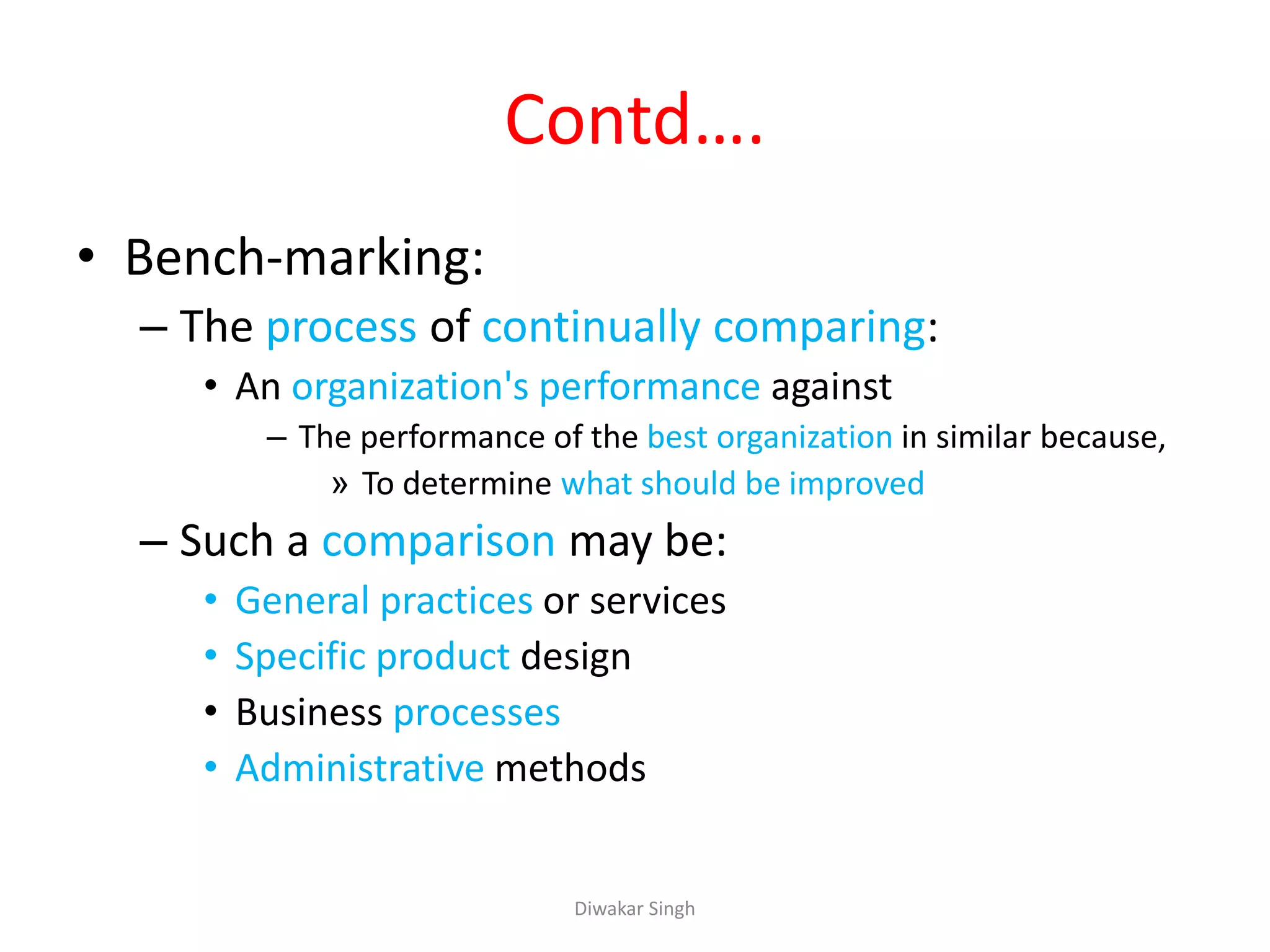
• Bench-marking:
– The process of continually comparing:
• An organization's performance against
– The performance of the best organization in similar because,
» To determine what should be improved
– Such a comparison may be:
• General practices or services
• Specific product design
• Business processes
• Administrative methods
Diwakar Singh
Contd…
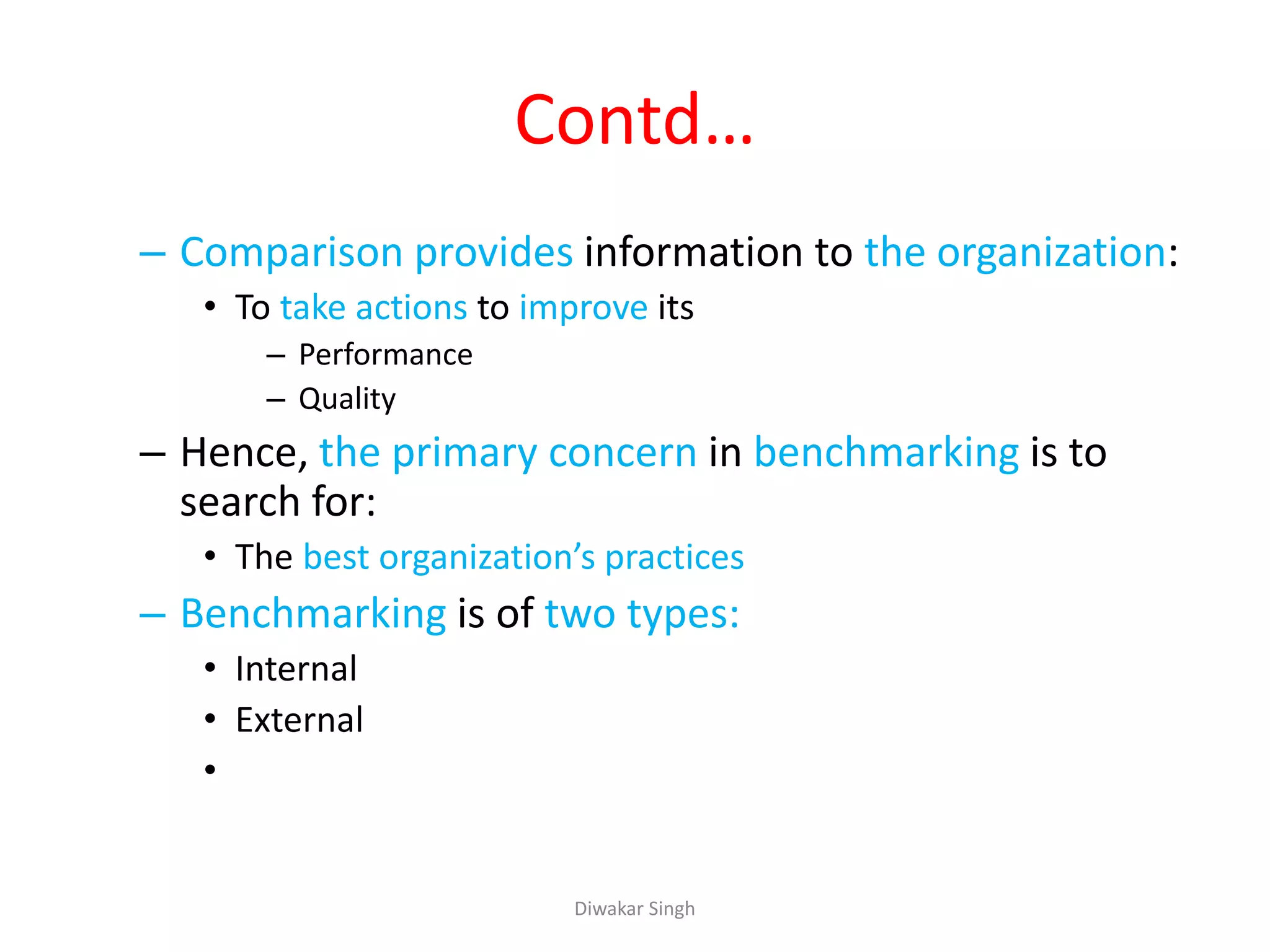
– Comparison provides information to the organization:
• To take actions to improve its
– Performance
– Quality
– Hence, the primary concern in benchmarking is to
search for:
• The best organization’s practices
– Benchmarking is of two types:
• Internal
• External
•
Diwakar Singh
Contd…
• Internal benchmarking:
– Measures and compares the process and of
• One of unit with the other unit of
– The same organization
• This naturally helps in upgrading
– The quality standard
– Efficiency
• External benchmarking:
– Compare process and practices with the best
organization
Diwakar Singh
Contd….
– Also known as competitor benchmarking
– Work process and practices are compared with:
• The competitor who is the best performance in that
business
– In other words:
• Both organizations agree to cooperate with each other
in:
– Sharing information about their practices
– Hence, both of them learn from one another’s
practice
Diwakar Singh
Contd….
• The important features and advantages of
bench marking practices are as follows:
– Symmetric approach to performance and quality
improvement
– Has a cyclical or repetitive nature
– Involves a goal-setting process
– Raises the importance of communication and
commitment
– Imitates a learning process
Diwakar Singh
Contd….
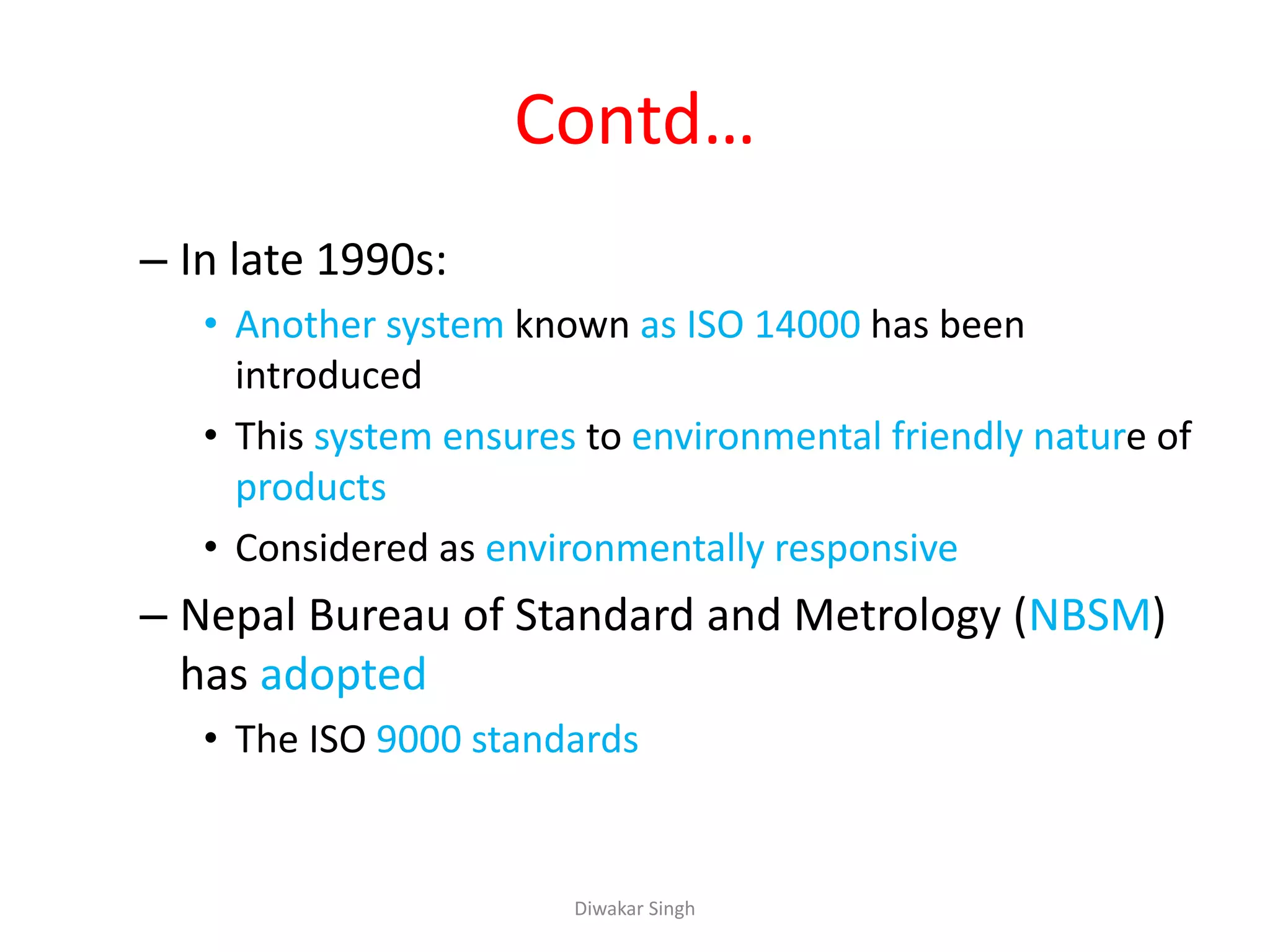
• ISO 9000:
– Stands for international organization for standards
– Derived from isos:
• A Greek word (meaning equals)
– Actually a series of five related standards:
• Numbered 9000 through 9004 that has
– Adopted by more than 90 countries
– An internationally agreed series of standards:
• Which sets out the criteria for world-class quality
mgmt. system
Diwakar Singh
Contd…
– In late 1990s:
• Another system known as ISO 14000 has been
introduced
• This system ensures to environmental friendly nature of
products
• Considered as environmentally responsive
– Nepal Bureau of Standard and Metrology (NBSM)
has adopted
• The ISO 9000 standards
Diwakar Singh
Contd….
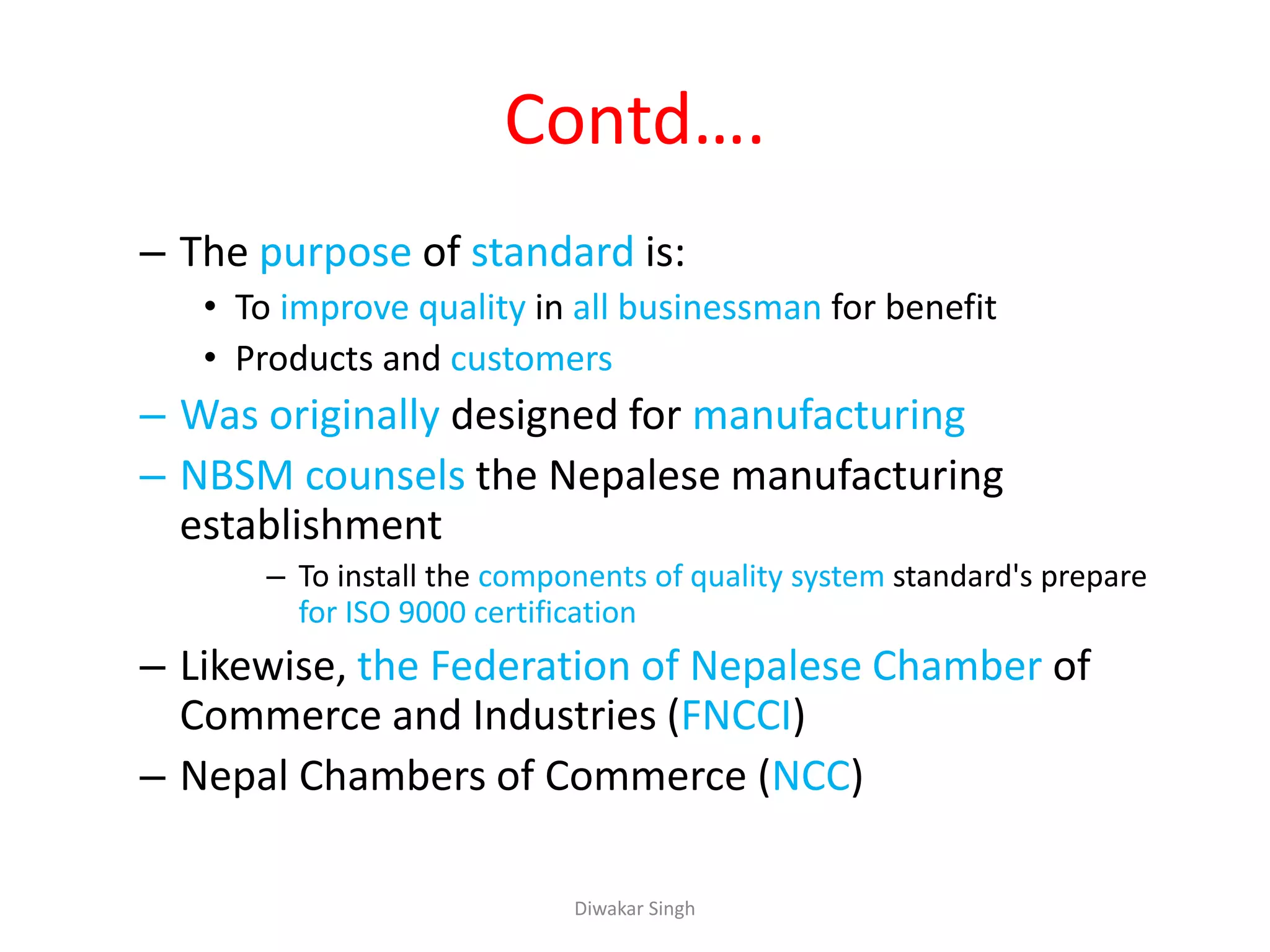
– The purpose of standard is:
• To improve quality in all businessman for benefit
• Products and customers
– Was originally designed for manufacturing
– NBSM counsels the Nepalese manufacturing
establishment
– To install the components of quality system standard's prepare
for ISO 9000 certification
– Likewise, the Federation of Nepalese Chamber of
Commerce and Industries (FNCCI)
– Nepal Chambers of Commerce (NCC)
Diwakar Singh
Contd….
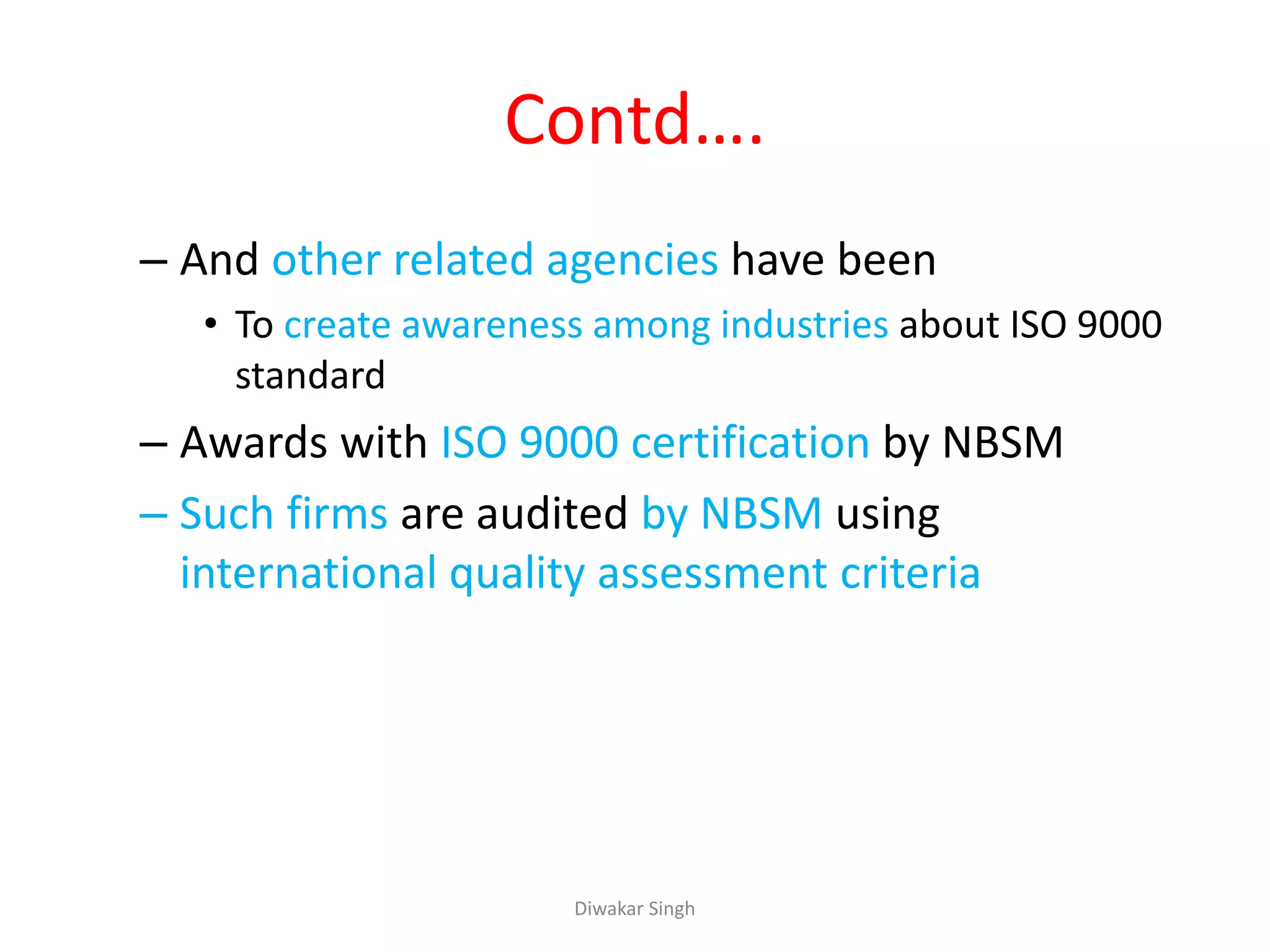
– And other related agencies have been
• To create awareness among industries about ISO 9000
standard
– Awards with ISO 9000 certification by NBSM
– Such firms are audited by NBSM using
international quality assessment criteria
Diwakar Singh
Contd…..
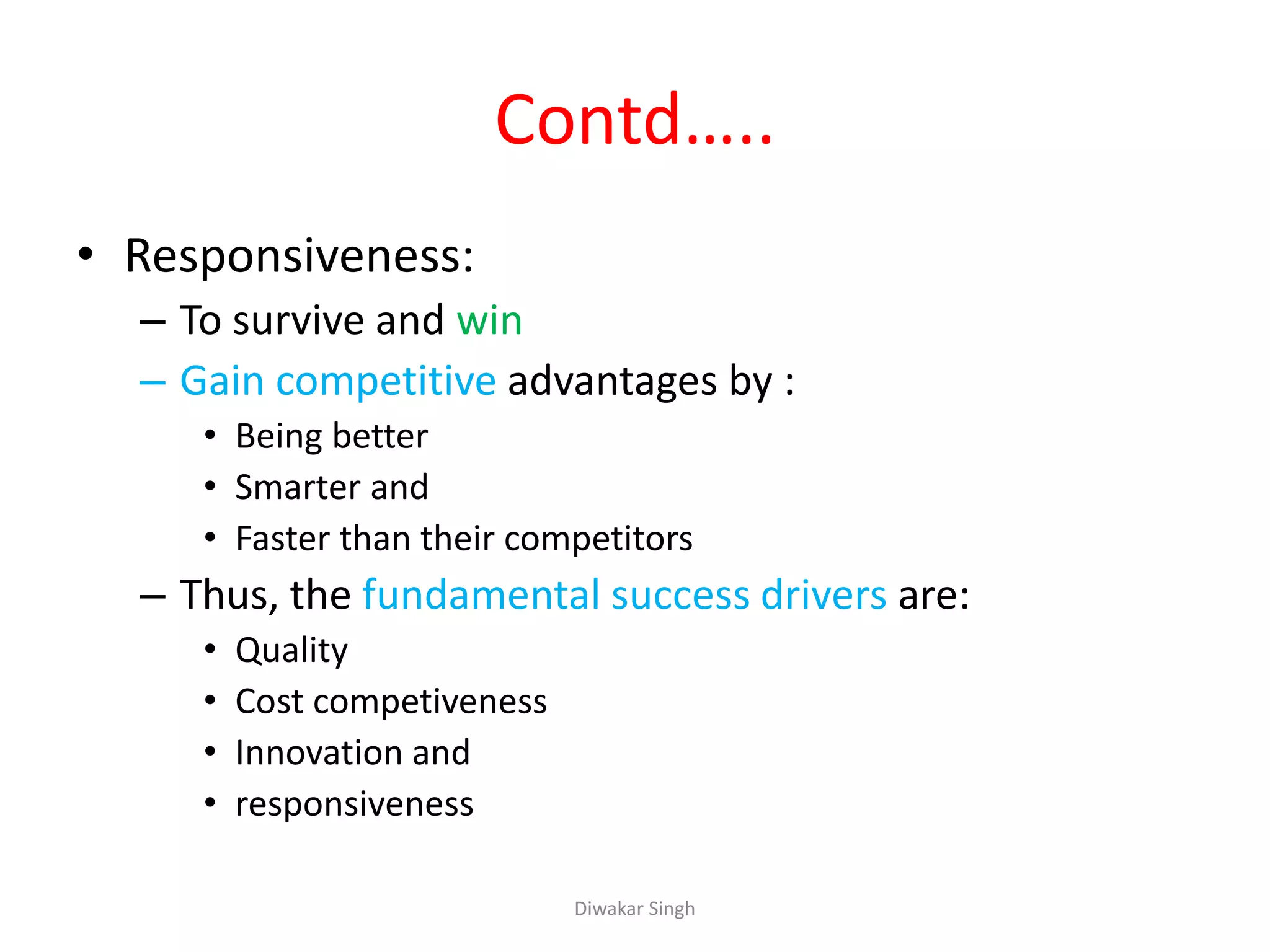
• Responsiveness:
– To survive and win
– Gain competitive advantages by :
• Being better
• Smarter and
• Faster than their competitors
– Thus, the fundamental success drivers are:
• Quality
• Cost competiveness
• Innovation and
• responsiveness
Diwakar Singh
Contd….
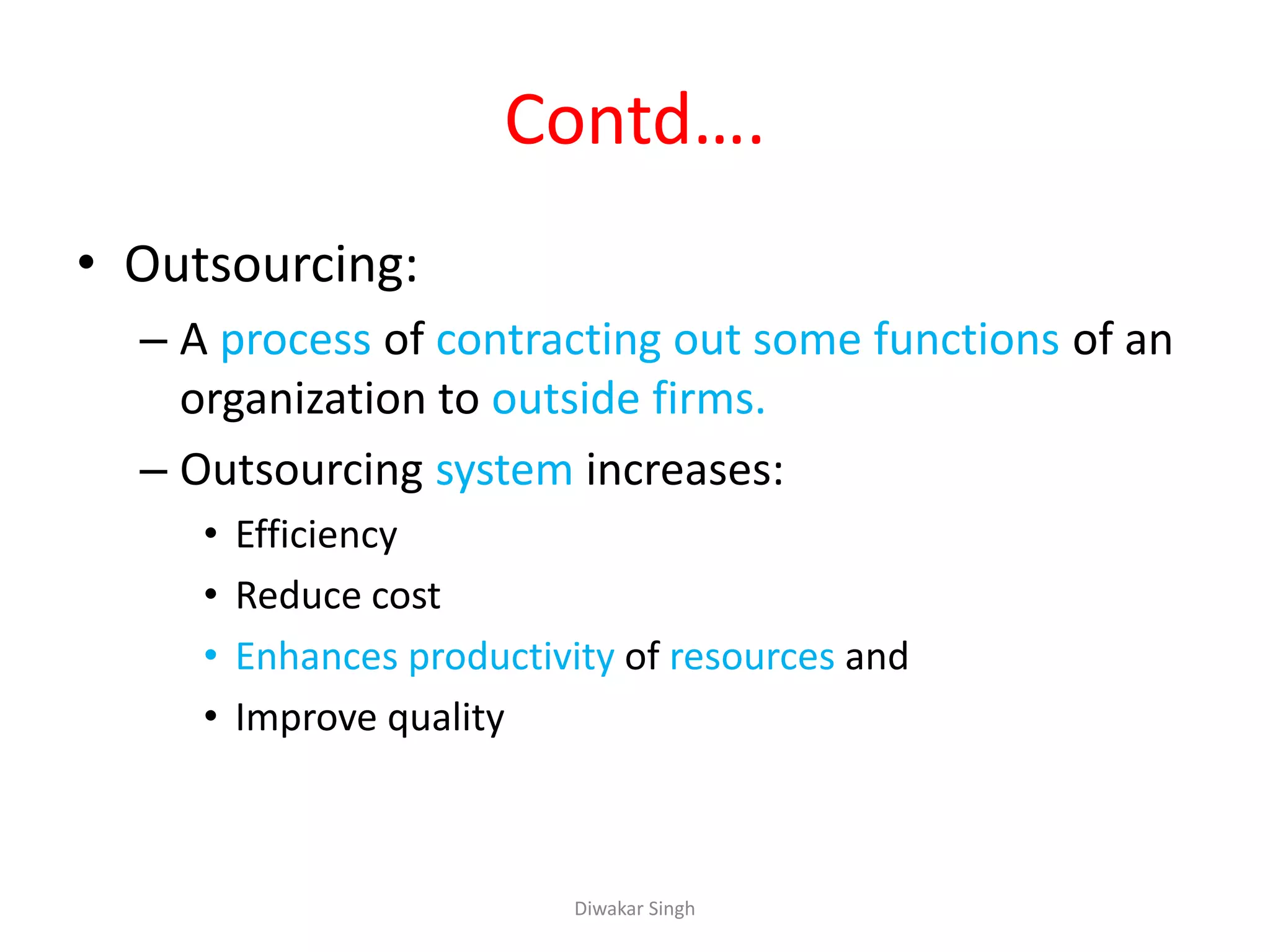
• Outsourcing:
– A process of contracting out some functions of an
organization to outside firms.
– Outsourcing system increases:
• Efficiency
• Reduce cost
• Enhances productivity of resources and
• Improve quality
Diwakar Singh
Contd….
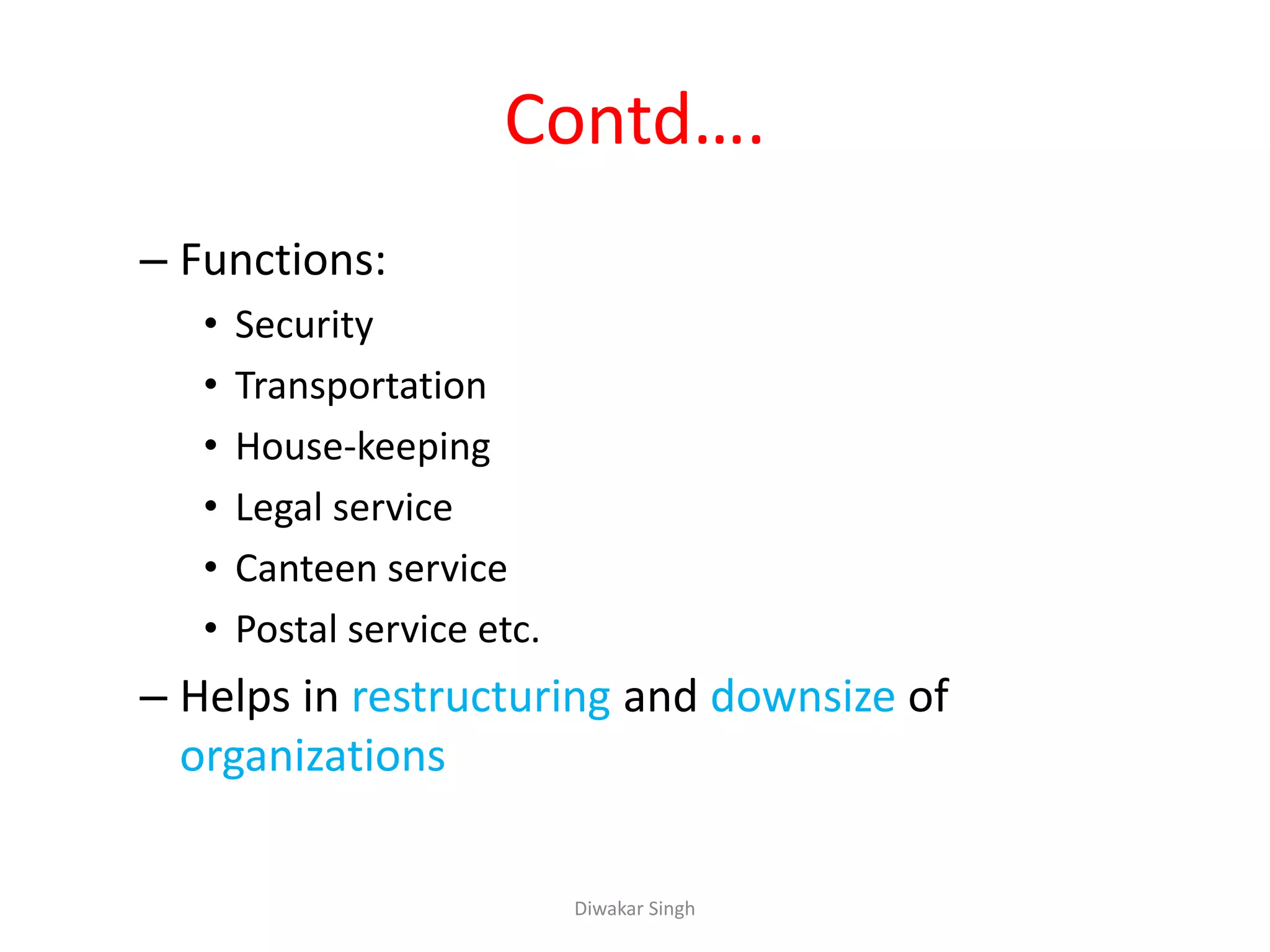
– Functions:
• Security
• Transportation
• House-keeping
• Legal service
• Canteen service
• Postal service etc.
– Helps in restructuring and downsize of
organizations
Diwakar Singh
Contd…..
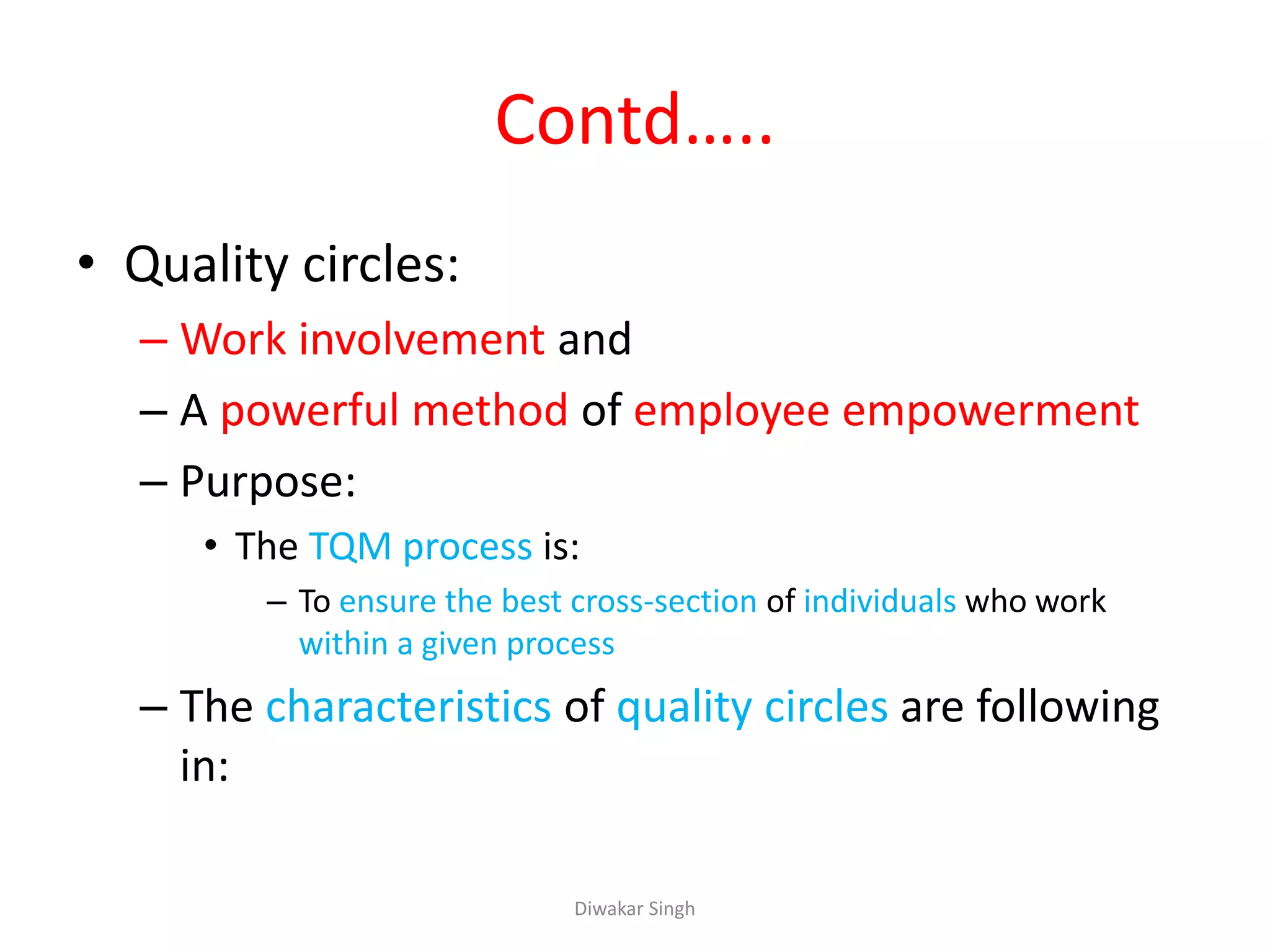
• Quality circles:
– Work involvement and
– A powerful method of employee empowerment
– Purpose:
• The TQM process is:
– To ensure the best cross-section of individuals who work
within a given process
– The characteristics of quality circles are following
in:
Diwakar Singh
Contd…..
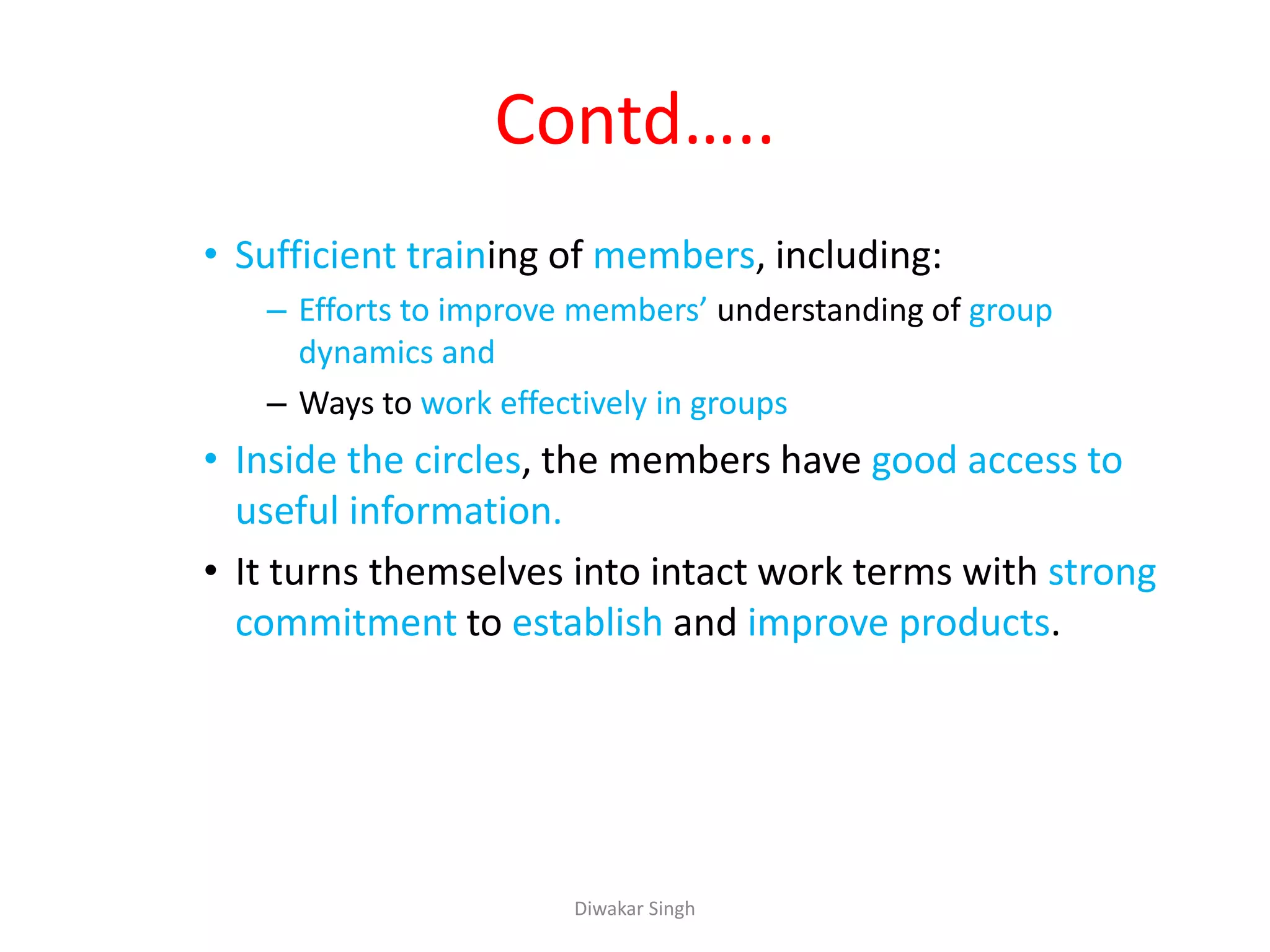
• Sufficient training of members, including:
– Efforts to improve members’ understanding of group
dynamics and
– Ways to work effectively in groups
• Inside the circles, the members have good access to
useful information.
• It turns themselves into intact work terms with strong
commitment to establish and improve products.
Diwakar Singh
Contd…..
• Six sigma:
– A fact base, data driven philosophy of quality
improvement that:
• Values defect prevention over defect detection.
– Defect-reduction program was pioneered by Motorola
(1980)
– It is to:
• Design
• Measure
• Analyze and
• Control the i/p side of production process
Diwakar Singh
Contd….
– A process that uses statistical models,
• Coupled with specific quality tools.
– Especially in identifying cost saving (application)
Diwakar Singh
Contd….
• Kaizen:
– A Japanese term
• The elimination of waste.
– Emphasizes that:
• Managers and other employees should be taught:
– Analyze all aspects of their organization’s product system
– To identify at sources of waste and to suggest ways to
eliminate waste
Diwakar Singh
Other Tools of TQM:
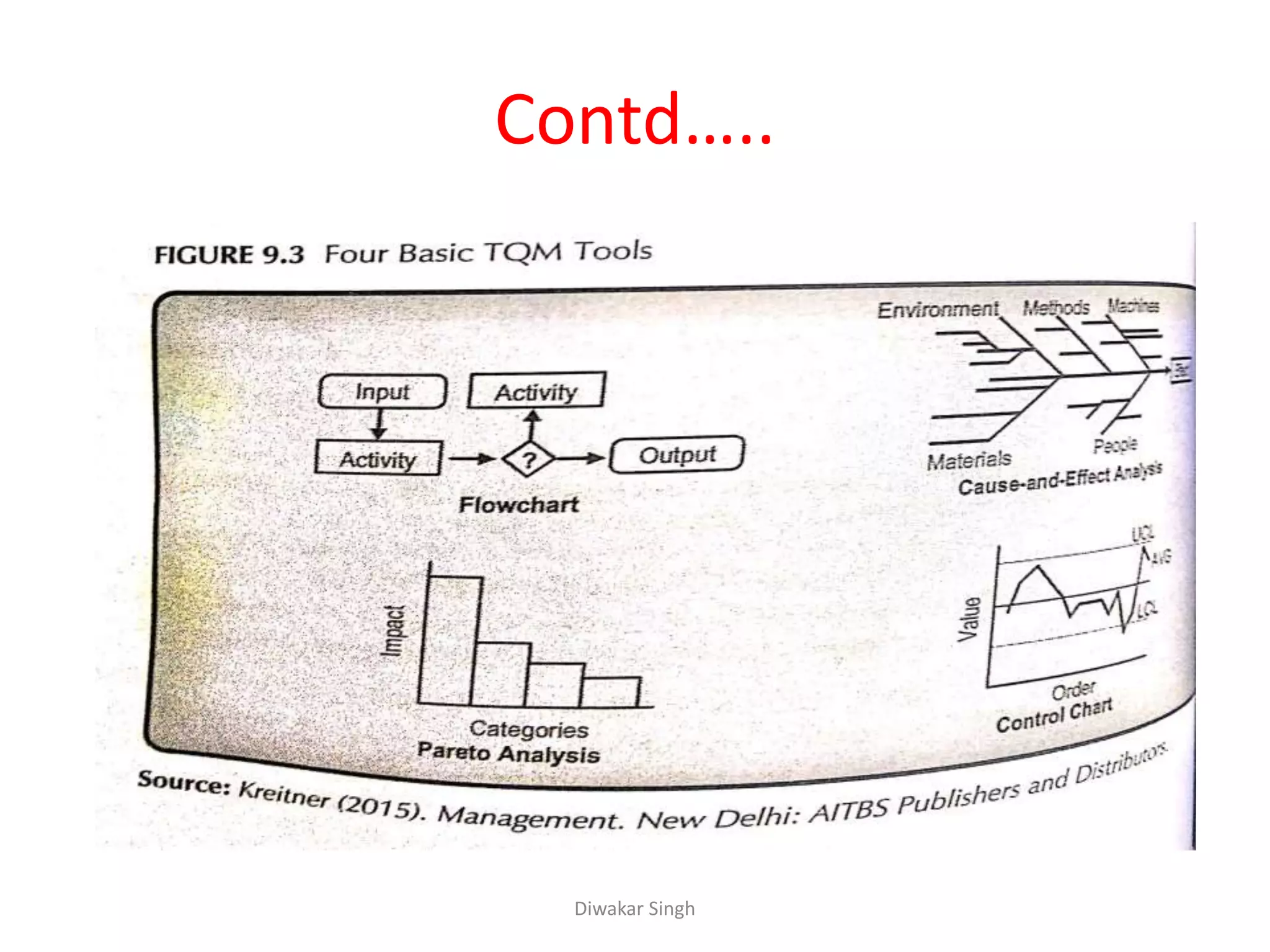
• Four important tools:
– Pareto Analysis
– Cause and effect diagram
– Control charts
– Flow charts
Diwakar Singh
Contd…..
Diwakar Singh
Contd…
• Pareto Analysis:
– Joshep M. Juran (1940) (proposed)
– An Italian economist Vilfredo Pareto (1848-1923)
observed that:
• 80% of the national wealth belonged to about 20% of
the population.
• “80 – 20 principle or the principle of “Vital few and
trivial many”
• Vital makes the biggest difference between in quality
and performance.
Diwakar Singh
Contd….
– Constructing a bar chart by counting the number
of times significant quality problems occur
– Tallest bar on the chart represents most common
problems
Diwakar Singh
Contd….
• Fishbone Diagram:
– Resembles the skeleton of a fish,
– K. Ishikawa, University of Tokyo (1943)
– Called Cause and effect diagram
– Used by organization for identification of various
causes and sub-causes responsible for a problem.
– The causes are:
• Men, machine methods and measurements.
Diwakar Singh
Contd….
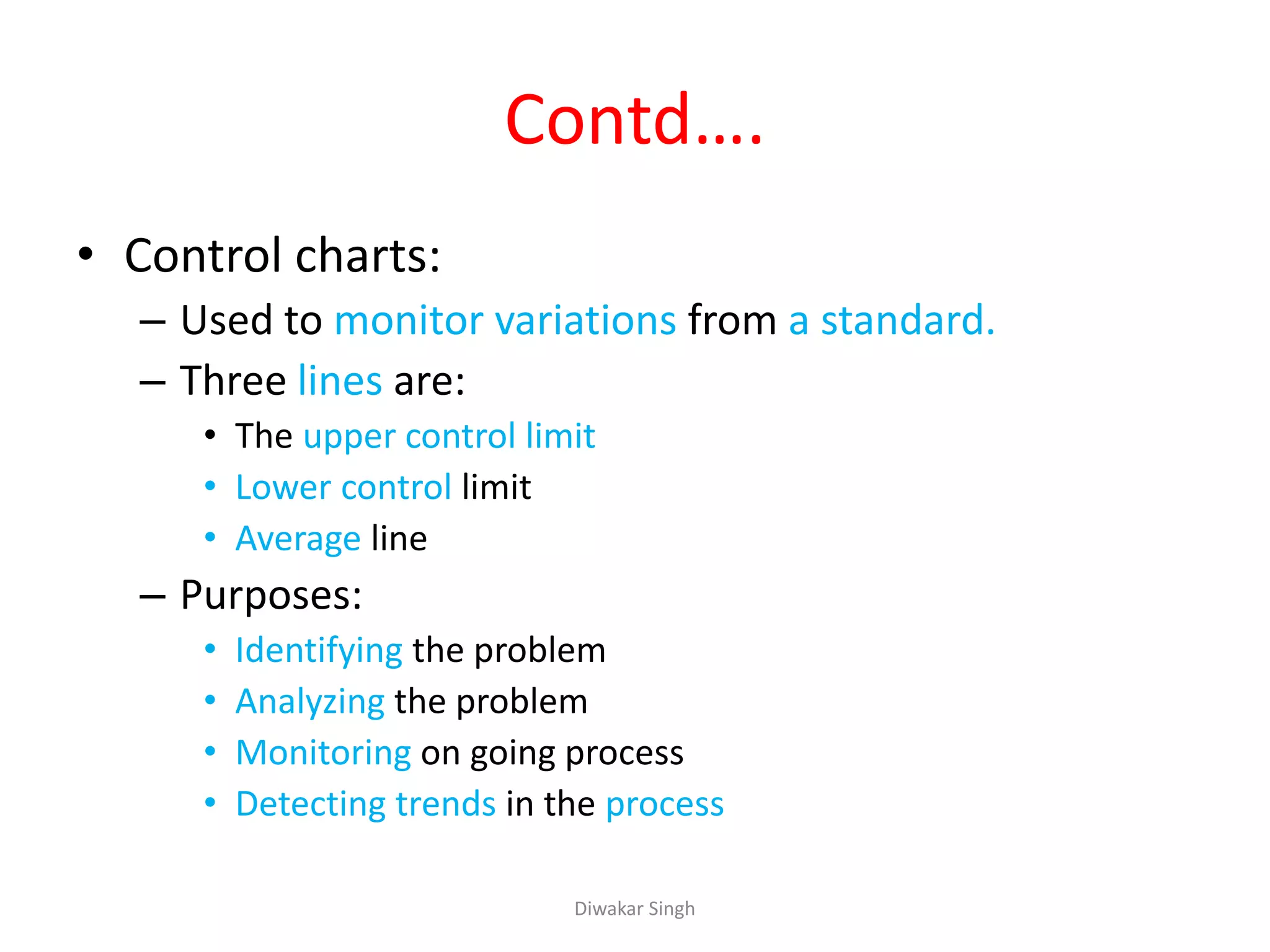
• Control charts:
– Used to monitor variations from a standard.
– Three lines are:
• The upper control limit
• Lower control limit
• Average line
– Purposes:
• Identifying the problem
• Analyzing the problem
• Monitoring on going process
• Detecting trends in the process
Diwakar Singh
Contd….
• Flow charts:
– Pictorial representation (show all steps)
– Any deviation from ideal path is detected. Thus this
technique can help detect deviation from the ideal
– Bar chart
– Pie chart
– Check sheet
– Run chart
– Scatter diagram and
– histogram
Diwakar Singh
Deming Management:
• Father of new industrial age.
• Studied mathematics and worked for the
US Dept. of Agriculture
• Developed the statistical process control
technique.
• To work with Japan on developing its
census system (1947)
• Japanese industries were convinced with
his idea and applied it
Diwakar Singh
Demining’s views on Quality
Management:
The following ideas for quality management:
• To increase quality,
– organization needs to develop strategic plans that
state goals and exactly and
– Spell out they will be achieved.
• Managers should realize that:
– Mistakes, defects and
– Poor quality materials should not be acceptable
• They should , therefore, be eliminated
Diwakar Singh
Contd…..
• First-line managers should be allowed:
– To spend more time working with employees and
– Providing them with the tools they need to do the
job.
• Management should create an environment in
which:
– Employees will not be afraid to report problems
or recommended improvements
Diwakar Singh
Contd….
• Output goals and targets should include not
only numbers or quotas or
– Also some notion of quality to promote the
production of defect-free output.
• Management should assume the
responsibilities to train employees in new
skills
– To keep pace with changes in workplace
Diwakar Singh
Principles of Deming’s Quality
Management:
Has proposed the following five principles of
quality management:
• Quality improvement drives the entire economy
• The customer always comes first.
• A person should not be blamed for quality
problem a system of management must be fixed
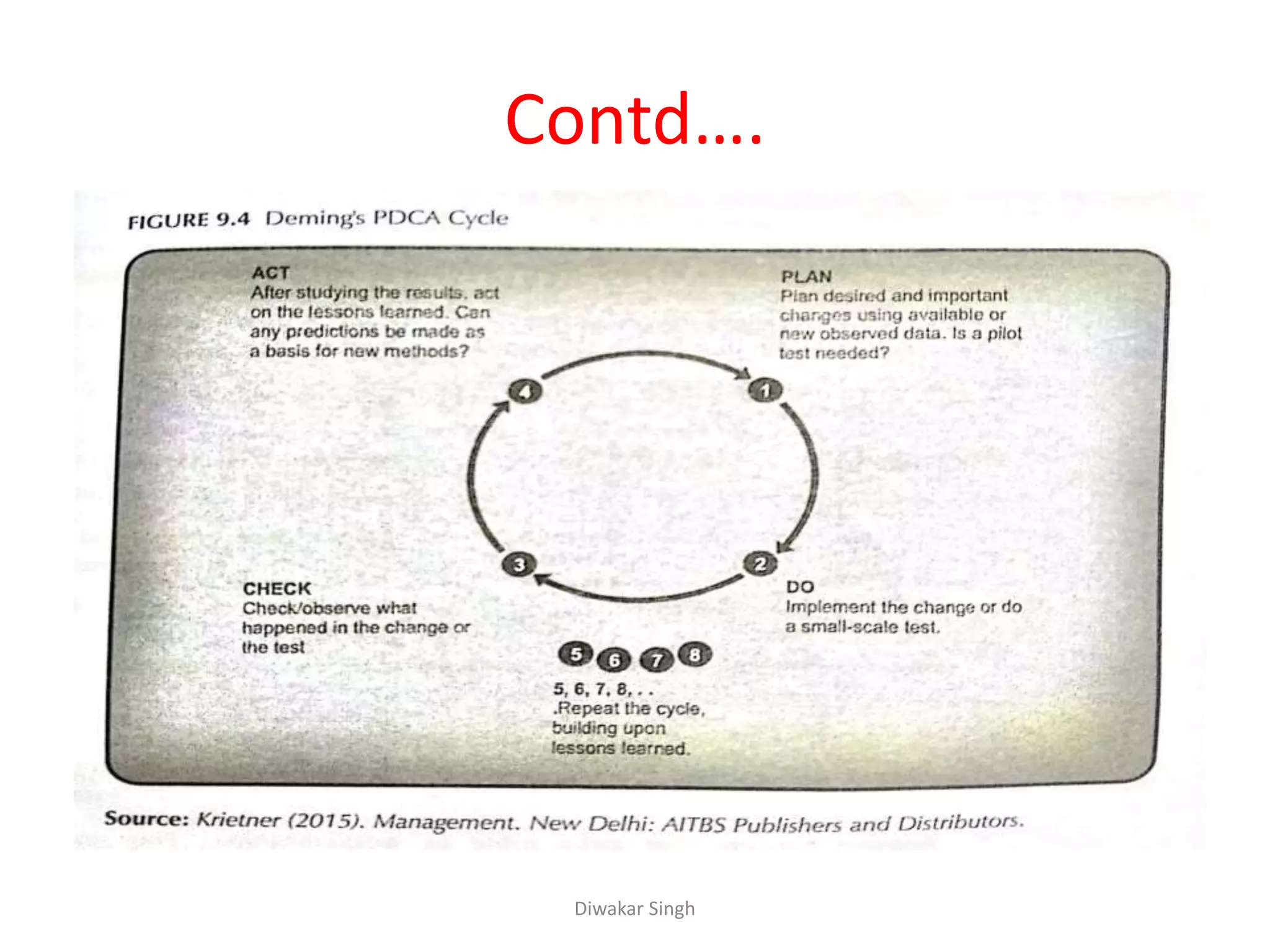
• Plan-do-check act (PDCA) should be enforced
• Continuous improvement should be sought
through extensive training, leadership, teamwork
and self-improvement
Diwakar Singh
Contd….
Diwakar Singh
Techniques of Deming’s Quality
Management:
• Proposed Fourteen points
• A summary of these fourteen techniques is
given below:
– Constant purpose
– New philosophy
– Give up quality by inspection
– Seek continuous improvement
– Train everyone
Diwakar Singh
Contd….
– Avoid the constant search for lowest-cost suppliers
– Provide real leadership drive fear out of the workplace
– Promote teamwork
– Avoid slogan and targets
– Get rid of numerical quotas
– Remove barriers that stifle pride in workmanship
– Education and self-improvement are key
– The transformation is everyone’s job.
Diwakar Singh
Quality Improvement Process:
Concept of Quality Improvement:
• An organization needs to understand its own
production, service, delivery system and key
process to understand quality improvement.
• Process is frequently measure in terms of
results, employee and stakeholder satisfaction
and cost.
• Quality is a circular process meaning that it
never really completed.
Diwakar Singh
Contd…..
Diwakar Singh
Contd….
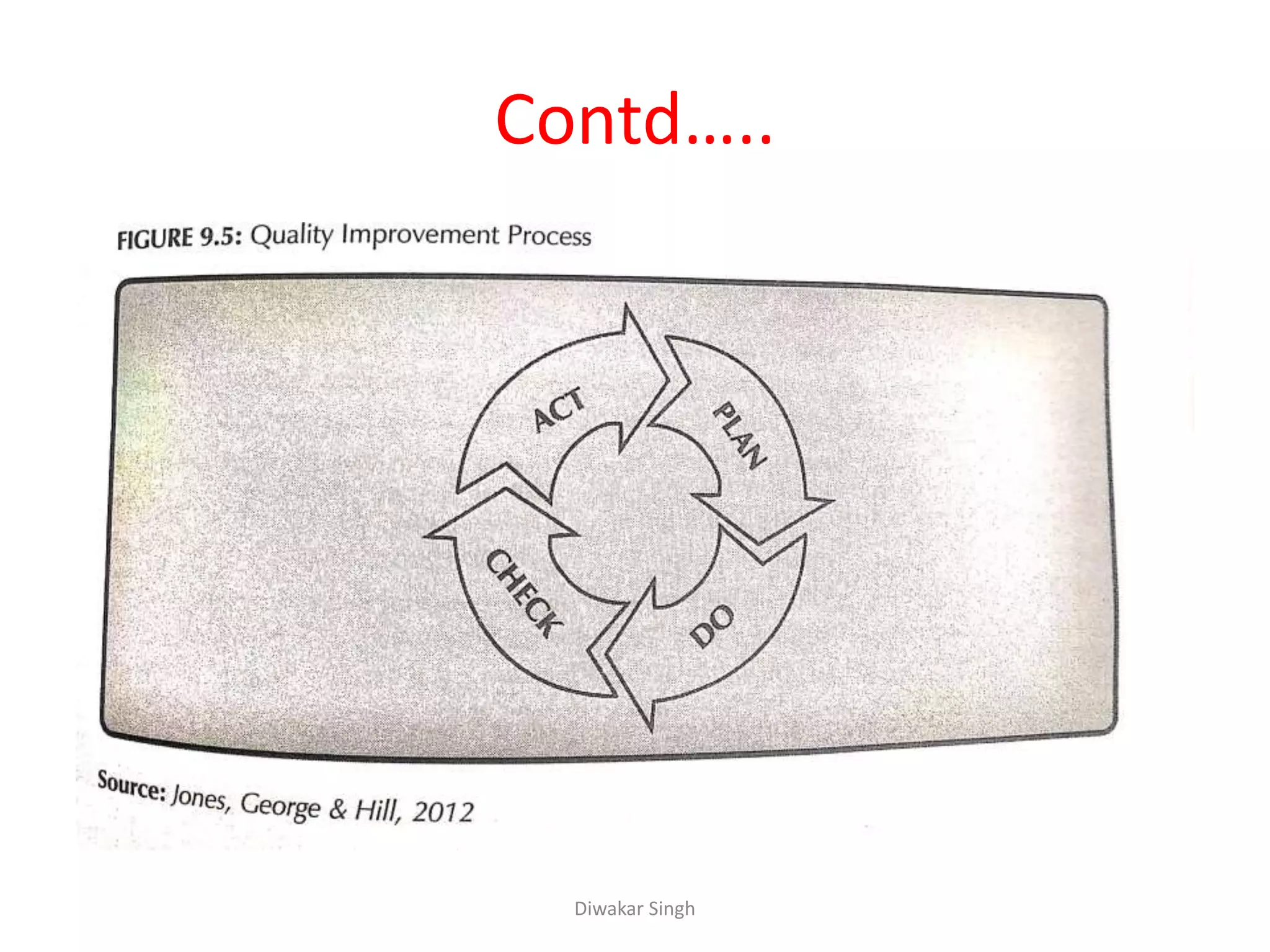
• The planning phase is used to determine the
root-cause of a problem
• In the do phase of the cycle the individual will
use a problem-solving method
• The check phase is used to test management’s
idea and see it actually working
• The act phase allows the individual to
implement and look for new ways to improve.
Diwakar Singh
Contd….
Steps in the quality improvement process:
• The following basic steps are:
– Establish a culture of quality
– Determine and prioritize potential areas for
improvement
– Collect and analyze data.
– Communicate your results
– Commit to ongoing evaluation
– Spread your successes
Diwakar Singh

Pom control and quality management

  • 1.
    POM Control and QualityManagement Unit: 9 Diwakar Singh
  • 2.
    Introduction: • The goaland objective of organization have been: – Well designed and organized – Employees have been carefully selected – Trained and instructed – Communication channels have been well-set • The environment in modern organization operate: – Becoming more and more complex Diwakar Singh
  • 3.
    Contd…. – More products –More players – Rapidly changing technology – Market • This chapter deals with two main aspects of managerial controls: – The basic concept – Method and process control – Second part: • Quality management concepts • issues Diwakar Singh
  • 4.
    Concept of ControlSystem: • We have selected the following definitions for analysis: – Robert J Mockler (1972) – George Terry and Stephen Franklin (2005) – Robert Kreinter (2016) • Essentially, control means: – Identification of variations – Their caused and – Corrective actions Diwakar Singh
  • 5.
    Contd….. • The controlfunction of management has close relationship with: – The planning function • Controlling exists at every level of management: – The chief executive has to control for: • Overall corporate activities – Whereas the lower-level managers have to • Control the activities of their respective units – Control is process activity to: • The effectiveness of managers and • organizations Diwakar Singh
  • 6.
    The Control Process: •An organization involves for major steps: – Performance standard – Performance measurement – Comparison between standards and actual performance – Corrective action • These steps together constitute the process of control. Diwakar Singh
  • 7.
  • 8.
    Contd…. • Standard: – Fixingperformance standard – A reference point against which, • Performance can be measured – These standards might include: • Sales goals • Production goals • Service goals • Profit goals Diwakar Singh
  • 9.
    Contd…. • These goalsand objectives must be – Clearly set by the corporate plans • These should then translate into specific into: – Specific performance standards for: • Each units of the organization • A performance can be formulated with respect: – To any one factors like: • Quality • Quantity • Time used • cost Diwakar Singh
  • 10.
    Contd…. • The performancestandards must be: – Stated in clear and – Measurable terms • Abstract standards like: – Quality service – Employee satisfaction cannot be perfectively measured Diwakar Singh
  • 11.
    Contd…. • Setting standardsare useless everyone in the organization understands: – What they are? – Why they exists? • There are many ways to communicate: – Performance standards to employees • The methods of standards are: – Job description – Job instruction Diwakar Singh
  • 12.
    Contd…. – Polices &rules – Target – Procedure – Time • used as methods of performance standards • Indicator used to measure performance Diwakar Singh
  • 13.
    Contd…. • Performance Measurement: –In the second step of control process: • The actual performance or units is measured – Standards are the criteria against which, • The performance is measured – This is actually the phase of: • Evaluation • Appraisal or assessment – Performance can be measured at: • Weekly • Monthly or • Yearly basis Diwakar Singh
  • 14.
    Contd…. • For example: –The fuel consumption by a vehicle • Can be measured on a weekly basis – Productions and sales can be: • Measured on a monthly basis – Unit costs, total costs, total expensive or profitability can be: • Measured at the end of every fiscal year at : – The end of every year Diwakar Singh
  • 15.
    Contd…. • For controlsystem to be effective: – The management information system should be: • Designed • Strengthened • An important purpose of assessment is: – To help employees to discover their • Strength and weakness Diwakar Singh
  • 16.
    Contd…. • They canmake use of the most of their: – Strengths – Correct – Minimize their weakness • Managers must regularly discuss: – Target and achievement – Success and failures – Strength and weakness Diwakar Singh
  • 17.
    Comparison between Standardsand Performance: • The actual performance is captured with: – The predetermined performance standards – To determine how well the goals and objectives have been met – If performance matches the standard: • The achievement is considered good • If there is big gaps between these two: – The performance is considered poor Diwakar Singh
  • 18.
    Corrective Actions: • Themanagement must determine: – If the gap between standard and performance is significant enough: • To require corrective action • When the gap is significant understanding the cause is: – Crucial to determine – Weather it should be changed or – Some other remedy attempted • Thus, corrective action may lead – To changes in: • Original standard • Work procedures • Schedules Diwakar Singh
  • 19.
    Types of ControlSystem: • Three types of control are used in the process of control: – Pre-control – Concurrent – Post control • Pre-control system: – Known as free-forward control – The control system taken place before work is performed Diwakar Singh
  • 20.
  • 21.
    Contd…. – Problem areanticipated in advanced and • The standards are set to regulate the management system – Management creates: • Polices • Procedure • Rules and standard – That reduce the possibility of problem occurring Diwakar Singh
  • 22.
    Contd… • For example: –A policy may be established that: • Allows only the divisional managers to issue directives – This is a type of pre-control that addresses: • The potential problems of: – Too many directives or – Directives that are conflict – Another form of pre-control is the establishment of: • A uniform procurement system Diwakar Singh
  • 23.
    Contd…. – All departmentsof organization will have : • To follow these procurement rules – Procurement standards are fixed: • To ensure the quality and • Quality of inputs – Thus, the pre-control system: • Increases the possibility that future results will be closer – To planned targets or goals Diwakar Singh
  • 24.
    Contd…. • Concurrent controlsystem: – Called gatekeeper control or real time control – Adjustment are made in the on-going activists • To ensure compliance with the standards – During this part of the control process • Managers and workers can: – Spot errors and – Correct • This continues checking on control helps organization – To prevent supplying defectives or – Badly made goods to consumers Diwakar Singh
  • 25.
    Contd…. • For example: –The quality of product is checked • While in progress – If some defects are found • Send back for repair – Similarly, the use of raw-material is • Monitory regularly – The stock is inspected to ensure • The regular supply Diwakar Singh
  • 26.
    Contd…. • Post controlsystem: – Also called feedback control – Takes place the work process in completed – Thus, concentrates on past performance – The basis of post-control is a comparison of: • Historical data with current information – For example: • Financial analysis • Productivity • Profitability • Employee performance Diwakar Singh
  • 27.
    Contd…. • Post-control activitiesgive correct feedback to management: – To take necessary corrective actions Diwakar Singh
  • 28.
    Characteristics of EffectiveControl System: • The features of an effective control system: – Stonner (1978) has suggested that an effective control system should be: – Timely: • To maintain work standard – To control measures should be token at: » The right times depending on their purpose at • Any particular time – Simple: • Control measures must be simple Diwakar Singh
  • 29.
    Contd…. – Minimal: • Controlshould be as far as possible: – The work done and standards are maintained – Flexible: • Too rigid controls may be self-defecting – Accurate: • The information provided by the control system must be: – Reliable and – accurate Diwakar Singh
  • 30.
    Control: – Objective andcomprehensive: • The control system must be clearly understood by: – Employees working under it – Focused: • The control system should focus on points at which deviations form: – Standards are most likely to occur or – Could do the greatest damage – Realistic: • The control system must be realistic – Acceptable: • To be effective, the control system must have: – The general acceptance of the employees Diwakar Singh
  • 31.
    Potential Barrier toSuccessful Controlling: • There are sometimes barriers to: – Testing – Measuring – Communicating – Observation • These barriers can reduce: – The efficiency of the organization – Also in the controlling process Diwakar Singh
  • 32.
    Contd…. • Barriers toorganizational control can include: – Scarcity of resources – Inaccurate measurement of the process – Improper information flow – Incorrect analysis • Resource scarcity: – Managing control typically requires a number of resources, they are: • Supervisory staff Diwakar Singh
  • 33.
    Contd…. • Skilled specialists •Tools to measure – the control of the system • Statistical software • Inaccurate measurement: – Managing control can happen for a number of different reasons, including: • Misunderstanding of the measurement process by staff • Inaccurate or misleading measurement processes • Lack of staff training to determine how – To measure the control process Diwakar Singh
  • 34.
    Contd…. • Information flowissues: – Information is collected point in • The process and • Analyzed contextually another • This time lag in information flow can – Misdirect management to problem at • The wrong time in the sequence – Barrier of information flow: • A lack of resources Diwakar Singh
  • 35.
    Contd…. • Inaccurate measurement •Information flow errors • Incorrect analysis • Managers should be aware of these barriers and do their best: – To avoid them together: • Planning • Training and • Accuracy Diwakar Singh
  • 36.
    Quality Control System: •Function of ensuring that: – Product/service quality conforms • To predetermined standards • A quality control program involved: – Determine minimum standards of accepting • The standards have been determined: – The acceptability of the actual work can: • compared with expected standards Diwakar Singh
  • 37.
    Contd…. • If thereis serious lack of: – Conformity – Corrective measure • It implies five activities (Jones, George & Hill (2012)): • Determining tolerances: – Range within which deviation in : • Actual quality from standard Diwakar Singh
  • 38.
    Contd…. • Conducting inspectionsand test of: – Materials – Processes – Products • Isolating acceptable units from those – Which do not conform to quality standard – Pronging causes of deviation: • To the attention of the concerned manager – Suggesting ways and means of improving the quality Diwakar Singh
  • 39.
    Contd…. • Quality controlhas several advantages: – Direct and indirect – Which are stated as follows: – Quality control directly attacks waste: • It enables a manufacturer to minimize – It costs he/she incurs through rejections – his./her inspection costs • Quality control helps management in finding: – Defective products • Which can be reworked Diwakar Singh
  • 40.
    Contd…. • Quality controlhas a beneficial on “machine- shop production” – The operatives and others involved can: • See for themselves weather or not • They are succeeding in maintaining the standards • Quality control does not measure merely the final products: – Rather it starts with the input – Samples of incoming materials are inspected: • To determine . If they meet preset standards Diwakar Singh
  • 41.
    Total Quality Management: •Concept of TQM: – The focus of quality is on every activity of the organization – A comprehensive approach to improving • Product quality and • Theory customer satisfaction – The TQM concept was first developed by: • A member of consultants including: • W. Edwards Deming • Joshep Juran • A.V. Feiganbaum Diwakar Singh
  • 42.
    Contd…. • They indicatethe same principles and elements of TQM: – In these definitions, three ingredients: – The TQM process to take place • Customer- centered approach • Contours process improvement • The use of terms Diwakar Singh
  • 43.
    Contd… • Customer- centeredapproach: – Should be the ultimate goal of an enterprise – Satisfied customers are the biggest assets of the enterprise – All the members of an enterprise who are involved in: • The process of producing the goods/services – They are the internal customers of the enterprise Diwakar Singh
  • 44.
    Contd…. – Every individual/unitwithin the enterprise is: • Viewed as a chain of which only the final part is: – The external customer – Therefore, the indicators of customer-centred behavior are: • Greeting • Asking • Speaking • Assisting • responding Diwakar Singh
  • 45.
    Contd…. • Continuous processimprovement: – TQM program emphasizes on never-ending quality improvement activities – A Japanese word describing this process of involving everybody “Kaizen” means: • Step-by-step gradual improved • Doing little things better • Continuously setting • Achieving even-higher standards Diwakar Singh
  • 46.
    Contd…. – Kaizen saysthat Kaizen is: • The single truth behind Japan’s economic miracle and • Real reason for its “flexible manufacturing” technology • The use of teams: – Small group – To solve problems in the workplace is: • Another aspect of TQM – Problem solving teams called quality circles are: • Very effective in quality management Diwakar Singh
  • 47.
    Tools and Techniquesof TQM: • Managers must be aware of: – The methods and – Techniques of quality management – These techniques can be very useful in: • The quest for quality improvement – Some common techniques of quality management are as follows: Diwakar Singh
  • 48.
    Contd…. • Bench-marking: – Theprocess of continually comparing: • An organization's performance against – The performance of the best organization in similar because, » To determine what should be improved – Such a comparison may be: • General practices or services • Specific product design • Business processes • Administrative methods Diwakar Singh
  • 49.
    Contd… – Comparison providesinformation to the organization: • To take actions to improve its – Performance – Quality – Hence, the primary concern in benchmarking is to search for: • The best organization’s practices – Benchmarking is of two types: • Internal • External • Diwakar Singh
  • 50.
    Contd… • Internal benchmarking: –Measures and compares the process and of • One of unit with the other unit of – The same organization • This naturally helps in upgrading – The quality standard – Efficiency • External benchmarking: – Compare process and practices with the best organization Diwakar Singh
  • 51.
    Contd…. – Also knownas competitor benchmarking – Work process and practices are compared with: • The competitor who is the best performance in that business – In other words: • Both organizations agree to cooperate with each other in: – Sharing information about their practices – Hence, both of them learn from one another’s practice Diwakar Singh
  • 52.
    Contd…. • The importantfeatures and advantages of bench marking practices are as follows: – Symmetric approach to performance and quality improvement – Has a cyclical or repetitive nature – Involves a goal-setting process – Raises the importance of communication and commitment – Imitates a learning process Diwakar Singh
  • 53.
    Contd…. • ISO 9000: –Stands for international organization for standards – Derived from isos: • A Greek word (meaning equals) – Actually a series of five related standards: • Numbered 9000 through 9004 that has – Adopted by more than 90 countries – An internationally agreed series of standards: • Which sets out the criteria for world-class quality mgmt. system Diwakar Singh
  • 54.
    Contd… – In late1990s: • Another system known as ISO 14000 has been introduced • This system ensures to environmental friendly nature of products • Considered as environmentally responsive – Nepal Bureau of Standard and Metrology (NBSM) has adopted • The ISO 9000 standards Diwakar Singh
  • 55.
    Contd…. – The purposeof standard is: • To improve quality in all businessman for benefit • Products and customers – Was originally designed for manufacturing – NBSM counsels the Nepalese manufacturing establishment – To install the components of quality system standard's prepare for ISO 9000 certification – Likewise, the Federation of Nepalese Chamber of Commerce and Industries (FNCCI) – Nepal Chambers of Commerce (NCC) Diwakar Singh
  • 56.
    Contd…. – And otherrelated agencies have been • To create awareness among industries about ISO 9000 standard – Awards with ISO 9000 certification by NBSM – Such firms are audited by NBSM using international quality assessment criteria Diwakar Singh
  • 57.
    Contd….. • Responsiveness: – Tosurvive and win – Gain competitive advantages by : • Being better • Smarter and • Faster than their competitors – Thus, the fundamental success drivers are: • Quality • Cost competiveness • Innovation and • responsiveness Diwakar Singh
  • 58.
    Contd…. • Outsourcing: – Aprocess of contracting out some functions of an organization to outside firms. – Outsourcing system increases: • Efficiency • Reduce cost • Enhances productivity of resources and • Improve quality Diwakar Singh
  • 59.
    Contd…. – Functions: • Security •Transportation • House-keeping • Legal service • Canteen service • Postal service etc. – Helps in restructuring and downsize of organizations Diwakar Singh
  • 60.
    Contd….. • Quality circles: –Work involvement and – A powerful method of employee empowerment – Purpose: • The TQM process is: – To ensure the best cross-section of individuals who work within a given process – The characteristics of quality circles are following in: Diwakar Singh
  • 61.
    Contd….. • Sufficient trainingof members, including: – Efforts to improve members’ understanding of group dynamics and – Ways to work effectively in groups • Inside the circles, the members have good access to useful information. • It turns themselves into intact work terms with strong commitment to establish and improve products. Diwakar Singh
  • 62.
    Contd….. • Six sigma: –A fact base, data driven philosophy of quality improvement that: • Values defect prevention over defect detection. – Defect-reduction program was pioneered by Motorola (1980) – It is to: • Design • Measure • Analyze and • Control the i/p side of production process Diwakar Singh
  • 63.
    Contd…. – A processthat uses statistical models, • Coupled with specific quality tools. – Especially in identifying cost saving (application) Diwakar Singh
  • 64.
    Contd…. • Kaizen: – AJapanese term • The elimination of waste. – Emphasizes that: • Managers and other employees should be taught: – Analyze all aspects of their organization’s product system – To identify at sources of waste and to suggest ways to eliminate waste Diwakar Singh
  • 65.
    Other Tools ofTQM: • Four important tools: – Pareto Analysis – Cause and effect diagram – Control charts – Flow charts Diwakar Singh
  • 66.
  • 67.
    Contd… • Pareto Analysis: –Joshep M. Juran (1940) (proposed) – An Italian economist Vilfredo Pareto (1848-1923) observed that: • 80% of the national wealth belonged to about 20% of the population. • “80 – 20 principle or the principle of “Vital few and trivial many” • Vital makes the biggest difference between in quality and performance. Diwakar Singh
  • 68.
    Contd…. – Constructing abar chart by counting the number of times significant quality problems occur – Tallest bar on the chart represents most common problems Diwakar Singh
  • 69.
    Contd…. • Fishbone Diagram: –Resembles the skeleton of a fish, – K. Ishikawa, University of Tokyo (1943) – Called Cause and effect diagram – Used by organization for identification of various causes and sub-causes responsible for a problem. – The causes are: • Men, machine methods and measurements. Diwakar Singh
  • 70.
    Contd…. • Control charts: –Used to monitor variations from a standard. – Three lines are: • The upper control limit • Lower control limit • Average line – Purposes: • Identifying the problem • Analyzing the problem • Monitoring on going process • Detecting trends in the process Diwakar Singh
  • 71.
    Contd…. • Flow charts: –Pictorial representation (show all steps) – Any deviation from ideal path is detected. Thus this technique can help detect deviation from the ideal – Bar chart – Pie chart – Check sheet – Run chart – Scatter diagram and – histogram Diwakar Singh
  • 72.
    Deming Management: • Fatherof new industrial age. • Studied mathematics and worked for the US Dept. of Agriculture • Developed the statistical process control technique. • To work with Japan on developing its census system (1947) • Japanese industries were convinced with his idea and applied it Diwakar Singh
  • 73.
    Demining’s views onQuality Management: The following ideas for quality management: • To increase quality, – organization needs to develop strategic plans that state goals and exactly and – Spell out they will be achieved. • Managers should realize that: – Mistakes, defects and – Poor quality materials should not be acceptable • They should , therefore, be eliminated Diwakar Singh
  • 74.
    Contd….. • First-line managersshould be allowed: – To spend more time working with employees and – Providing them with the tools they need to do the job. • Management should create an environment in which: – Employees will not be afraid to report problems or recommended improvements Diwakar Singh
  • 75.
    Contd…. • Output goalsand targets should include not only numbers or quotas or – Also some notion of quality to promote the production of defect-free output. • Management should assume the responsibilities to train employees in new skills – To keep pace with changes in workplace Diwakar Singh
  • 76.
    Principles of Deming’sQuality Management: Has proposed the following five principles of quality management: • Quality improvement drives the entire economy • The customer always comes first. • A person should not be blamed for quality problem a system of management must be fixed • Plan-do-check act (PDCA) should be enforced • Continuous improvement should be sought through extensive training, leadership, teamwork and self-improvement Diwakar Singh
  • 77.
  • 78.
    Techniques of Deming’sQuality Management: • Proposed Fourteen points • A summary of these fourteen techniques is given below: – Constant purpose – New philosophy – Give up quality by inspection – Seek continuous improvement – Train everyone Diwakar Singh
  • 79.
    Contd…. – Avoid theconstant search for lowest-cost suppliers – Provide real leadership drive fear out of the workplace – Promote teamwork – Avoid slogan and targets – Get rid of numerical quotas – Remove barriers that stifle pride in workmanship – Education and self-improvement are key – The transformation is everyone’s job. Diwakar Singh
  • 80.
    Quality Improvement Process: Conceptof Quality Improvement: • An organization needs to understand its own production, service, delivery system and key process to understand quality improvement. • Process is frequently measure in terms of results, employee and stakeholder satisfaction and cost. • Quality is a circular process meaning that it never really completed. Diwakar Singh
  • 81.
  • 82.
    Contd…. • The planningphase is used to determine the root-cause of a problem • In the do phase of the cycle the individual will use a problem-solving method • The check phase is used to test management’s idea and see it actually working • The act phase allows the individual to implement and look for new ways to improve. Diwakar Singh
  • 83.
    Contd…. Steps in thequality improvement process: • The following basic steps are: – Establish a culture of quality – Determine and prioritize potential areas for improvement – Collect and analyze data. – Communicate your results – Commit to ongoing evaluation – Spread your successes Diwakar Singh