Polynomials
Jordi Cortadella
Department of Computer Science
Outline
• How to represent a polynomial?
• Evaluation of a polynomial.
• Basic operations: sum, product and division.
• Greatest common divisor.
Introduction to Programming © Dept. CS, UPC 2
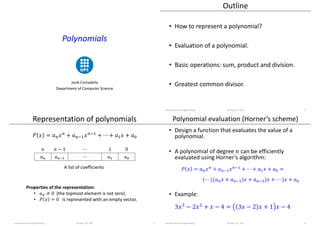
Representation of polynomials
Introduction to Programming © Dept. CS, UPC 3
A list of coefficients
Properties of the representation:
• 𝑎𝑛 ≠ 0 (the topmost element is not zero).
• 𝑃 𝑥 = 0 is represented with an empty vector.
𝑃 𝑥 = 𝑎𝑛𝑥𝑛 + 𝑎𝑛−1𝑥𝑛−1 + ⋯ + 𝑎1𝑥 + 𝑎0
𝑛 𝑛 − 1 ⋯ 1 0
𝑎𝑛 𝑎𝑛−1 ⋯ 𝑎1 𝑎0
Polynomial evaluation (Horner’s scheme)
• Design a function that evaluates the value of a
polynomial.
• A polynomial of degree 𝑛 can be efficiently
evaluated using Horner’s algorithm:
𝑃 𝑥 = 𝑎𝑛𝑥𝑛 + 𝑎𝑛−1𝑥𝑛−1 + ⋯ + 𝑎1𝑥 + 𝑎0 =
(⋯ ((𝑎𝑛𝑥 + 𝑎𝑛−1)𝑥 + 𝑎𝑛−2)𝑥 + ⋯ )𝑥 + 𝑎0
• Example:
3𝑥3
− 2𝑥2
+ 𝑥 − 4 = 3𝑥 − 2 𝑥 + 1 𝑥 − 4
Introduction to Programming © Dept. CS, UPC 4
Polynomial evaluation (Horner’s scheme)
Introduction to Programming © Dept. CS, UPC 5
3𝑥3
− 2𝑥2
+ 𝑥 − 4
3 𝑥 − 2 𝑥 + 1
3 𝑥 − 2 𝑥 + 1 𝑥 − 4
3 𝑥 − 2
3
Polynomial evaluation (Horner’s scheme)
def poly_eval(P, x):
"""Returns the evaluation of P(x)"""
r = 0
# Evaluates the polynomial using Horner's scheme
# The coefficients are visited from highest to lowest
for i in range(len(P)-1, -1, -1):
r = r*x + P[i]
return r
Introduction to Programming © Dept. CS, UPC 6
Product of polynomials
Example:
Introduction to Programming © Dept. CS, UPC 7
def poly_mul(P, Q):
"""Returns P*Q"""
𝑃 𝑥 = 2𝑥3 + 𝑥2 − 4
𝑄 𝑥 = 𝑥2
− 2𝑥 + 3
𝑃 ⋅ 𝑄 𝑥 = 2𝑥5 + −4 + 1 𝑥4 + 6 − 2 𝑥3 + −4 + 3 𝑥2 + 8𝑥 − 12
𝑃 ⋅ 𝑄 𝑥 = 2𝑥5
− 3𝑥4
+ 4𝑥3
− 𝑥2
+ 8𝑥 − 12
Product of polynomials
• Key point:
Given 𝑃 𝑥 = 𝑎𝑛𝑥𝑛 + 𝑎𝑛−1𝑥𝑛−1 + ⋯ + 𝑎1𝑥 + 𝑎0
and 𝑄 𝑥 = 𝑏𝑚𝑥𝑚 + 𝑏𝑚−1𝑥𝑚−1 + ⋯ + 𝑏1𝑥 + 𝑏0,
what is the coefficient 𝑐𝑖 of 𝑥𝑖
in (𝑃 ⋅ 𝑄)(𝑥)?
• The product 𝑎𝑖𝑥𝑖
⋅ 𝑏𝑗𝑥𝑗
must be added to the term
with 𝑥𝑖+𝑗
.
• Idea: for every 𝑖 and 𝑗, add 𝑎𝑖 ⋅ 𝑏𝑗 to the (𝑖 + 𝑗)-th
coefficient of the product.
Introduction to Programming © Dept. CS, UPC 8
Product of polynomials
Introduction to Programming © Dept. CS, UPC 9
2 -1 9 -5 10 -3
𝑥5
𝑥4
𝑥3
𝑥2
𝑥1
𝑥0
𝑥3 𝑥2 𝑥1 𝑥0
2 -1 3
1 0 3 -1
×
2 6
-1
0 -2
0 -3 1
3 0 9 -3
+
Product of polynomials
def poly_mul(P, Q):
"""Returns P*Q"""
# Special case for a polynomial of size 0
if len(P) == 0 or len(Q) == 0:
return []
R = [0]*(len(P)+len(Q)-1) # list of zeros
for i in range(len(P)):
for j in range(len(Q)):
R[i+j] += P[i]*Q[j]
return R
Introduction to Programming © Dept. CS, UPC 10
Sum of polynomials
• Note that over the real numbers,
degree 𝑃 ⋅ 𝑄 = degree 𝑃 + degree(𝑄)
(except if 𝑃 = 0 or 𝑄 = 0).
So we know the size of the result vector a priori.
• This is not true for the polynomial sum, e.g.,
degree 𝑥 + 5 + −𝑥 − 1 = 0
Introduction to Programming © Dept. CS, UPC 11
Sum of polynomials
A function to normalize a polynomial might be useful in
some algorithms, i.e., remove the leading zeros to
guarantee the most significant coefficient is not zero.
Introduction to Programming © Dept. CS, UPC 12
def poly_normalize(P):
"""Resizes the polynomial to guarantee that the
leading coefficient is not zero."""
while len(P) > 0 and P[-1] == 0:
P.pop(-1)
Sum of polynomials
def poly_add(P, Q):
"""Returns P+Q"""
if len(Q) > len(P): # guarantees len(P) >= len(Q)
P, Q = Q, P
# Adds the coefficients up to len(Q)
R = []
for i in range(len(Q)):
R.append(P[i]+Q[i])
R += P[i+1:] # appends the remaining coefficients of P
poly_normalize(R)
return R
Introduction to Programming © Dept. CS, UPC 13
P
Q
Euclidean division of polynomials
• For every pair of polynomials 𝐴 and 𝐵, such that
𝐵 ≠ 0, find 𝑄 and 𝑅 such that
𝐴 = 𝐵 ∙ 𝑄 + 𝑅
and degree 𝑅 < degree(𝐵).
𝑄 and 𝑅 are the only polynomials satisfying this
property.
• Classical algorithm: Polynomial long division.
Introduction to Programming © Dept. CS, UPC 14
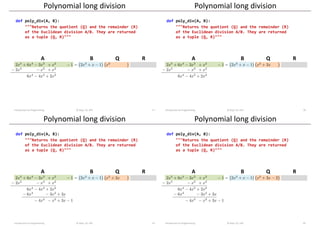
Polynomial long division
def poly_div(A, B):
"""Returns the quotient (Q) and the remainder (R)
of the Euclidean division A/B. They are returned
as a tuple (Q, R)"""
Introduction to Programming © Dept. CS, UPC 15
A B R
Q A B R
Q
Polynomial long division
Introduction to Programming © Dept. CS, UPC 16
def poly_div(A, B):
"""Returns the quotient (Q) and the remainder (R)
of the Euclidean division A/B. They are returned
as a tuple (Q, R)"""
A B R
Q
Polynomial long division
Introduction to Programming © Dept. CS, UPC 17
def poly_div(A, B):
"""Returns the quotient (Q) and the remainder (R)
of the Euclidean division A/B. They are returned
as a tuple (Q, R)"""
A B R
Q
Polynomial long division
Introduction to Programming © Dept. CS, UPC 18
def poly_div(A, B):
"""Returns the quotient (Q) and the remainder (R)
of the Euclidean division A/B. They are returned
as a tuple (Q, R)"""
A B R
Q
Polynomial long division
Introduction to Programming © Dept. CS, UPC 19
def poly_div(A, B):
"""Returns the quotient (Q) and the remainder (R)
of the Euclidean division A/B. They are returned
as a tuple (Q, R)"""
A B R
Q
Polynomial long division
Introduction to Programming © Dept. CS, UPC 20
def poly_div(A, B):
"""Returns the quotient (Q) and the remainder (R)
of the Euclidean division A/B. They are returned
as a tuple (Q, R)"""
A B R
Q
Polynomial long division
Introduction to Programming © Dept. CS, UPC 21
def poly_div(A, B):
"""Returns the quotient (Q) and the remainder (R)
of the Euclidean division A/B. They are returned
as a tuple (Q, R)"""
Polynomial long division
Introduction to Programming © Dept. CS, UPC 22
A B R
Q
def poly_div(A, B):
"""Returns the quotient (Q) and the remainder (R)
of the Euclidean division A/B. They are returned
as a tuple (Q, R)"""
Polynomial long division
Introduction to Programming © Dept. CS, UPC 23
2 6 -3 1 0 -1 2 0 1 -1
1 3 -2
5 4 3 2 1 0 3 2 1 0
2 1 0
R: B:
Q:
6 -4 2 0 -1
-4 -1 3 -1
-1 5 -3
A
Invariant: A = BQ+R
Polynomial long division
def poly_div(A, B):
"""Returns the quotient (Q) and the remainder (R) of the
Euclidean division A/B. They are returned as a tuple (Q, R)"""
R = A[:] # copy of A
if len(A) < len(B):
return [], R
Q = [0]*(len(A)-len(B)+1)
# For each digit of Q
for iQ in range(len(Q)-1, -1, -1):
Q[iQ] = R[-1]/B[-1]
R.pop(-1)
for k in range(len(B)-1):
R[k+iQ] -= Q[iQ]*B[k]
poly_normalize(R)
return Q, R
Introduction to Programming © Dept. CS, UPC 24
iQ
k
k+iQ
GCD of two polynomials
Introduction to Programming © Dept. CS, UPC 25
Example:
Re-visiting Euclidean algorithm for gcd
# gcd(a, 0) = a
# gcd(a, b) = gcd(b, a%b)
def gcd(a, b):
"""Returns gcd(a, b)"""
while b > 0:
a, b = b, a%b
return a
For polynomials:
• a and b are polynomials.
• a%b is the remainder of
the Euclidean division.
Introduction to Programming © Dept. CS, UPC 26
Euclidean algorithm for gcd
def poly_gcd(A, B):
"""Returns gcd(A, B)"""
while len(B) > 0:
Q, R = poly_div(A, B)
A, B = B, R
# Converts to monic polynomial (e.g., 3x-6  x-2)
c = A[–1]
for i in range(len(A)):
A[i] /= c
return A
Introduction to Programming © Dept. CS, UPC 27
Euclidean algorithm for gcd
monic polynomial
Introduction to Programming © Dept. CS, UPC 28
Conclusions
• Polynomials are used very often in numerical
analysis.
• Polynomial functions have nice properties:
continuous and simple derivatives and
antiderivatives.
• There are simple root-finding algorithms to
find approximations of the roots.
Introduction to Programming © Dept. CS, UPC 29

Polynomials.pdf

  • 1.
    Polynomials Jordi Cortadella Department ofComputer Science Outline • How to represent a polynomial? • Evaluation of a polynomial. • Basic operations: sum, product and division. • Greatest common divisor. Introduction to Programming © Dept. CS, UPC 2 Representation of polynomials Introduction to Programming © Dept. CS, UPC 3 A list of coefficients Properties of the representation: • 𝑎𝑛 ≠ 0 (the topmost element is not zero). • 𝑃 𝑥 = 0 is represented with an empty vector. 𝑃 𝑥 = 𝑎𝑛𝑥𝑛 + 𝑎𝑛−1𝑥𝑛−1 + ⋯ + 𝑎1𝑥 + 𝑎0 𝑛 𝑛 − 1 ⋯ 1 0 𝑎𝑛 𝑎𝑛−1 ⋯ 𝑎1 𝑎0 Polynomial evaluation (Horner’s scheme) • Design a function that evaluates the value of a polynomial. • A polynomial of degree 𝑛 can be efficiently evaluated using Horner’s algorithm: 𝑃 𝑥 = 𝑎𝑛𝑥𝑛 + 𝑎𝑛−1𝑥𝑛−1 + ⋯ + 𝑎1𝑥 + 𝑎0 = (⋯ ((𝑎𝑛𝑥 + 𝑎𝑛−1)𝑥 + 𝑎𝑛−2)𝑥 + ⋯ )𝑥 + 𝑎0 • Example: 3𝑥3 − 2𝑥2 + 𝑥 − 4 = 3𝑥 − 2 𝑥 + 1 𝑥 − 4 Introduction to Programming © Dept. CS, UPC 4
  • 2.
    Polynomial evaluation (Horner’sscheme) Introduction to Programming © Dept. CS, UPC 5 3𝑥3 − 2𝑥2 + 𝑥 − 4 3 𝑥 − 2 𝑥 + 1 3 𝑥 − 2 𝑥 + 1 𝑥 − 4 3 𝑥 − 2 3 Polynomial evaluation (Horner’s scheme) def poly_eval(P, x): """Returns the evaluation of P(x)""" r = 0 # Evaluates the polynomial using Horner's scheme # The coefficients are visited from highest to lowest for i in range(len(P)-1, -1, -1): r = r*x + P[i] return r Introduction to Programming © Dept. CS, UPC 6 Product of polynomials Example: Introduction to Programming © Dept. CS, UPC 7 def poly_mul(P, Q): """Returns P*Q""" 𝑃 𝑥 = 2𝑥3 + 𝑥2 − 4 𝑄 𝑥 = 𝑥2 − 2𝑥 + 3 𝑃 ⋅ 𝑄 𝑥 = 2𝑥5 + −4 + 1 𝑥4 + 6 − 2 𝑥3 + −4 + 3 𝑥2 + 8𝑥 − 12 𝑃 ⋅ 𝑄 𝑥 = 2𝑥5 − 3𝑥4 + 4𝑥3 − 𝑥2 + 8𝑥 − 12 Product of polynomials • Key point: Given 𝑃 𝑥 = 𝑎𝑛𝑥𝑛 + 𝑎𝑛−1𝑥𝑛−1 + ⋯ + 𝑎1𝑥 + 𝑎0 and 𝑄 𝑥 = 𝑏𝑚𝑥𝑚 + 𝑏𝑚−1𝑥𝑚−1 + ⋯ + 𝑏1𝑥 + 𝑏0, what is the coefficient 𝑐𝑖 of 𝑥𝑖 in (𝑃 ⋅ 𝑄)(𝑥)? • The product 𝑎𝑖𝑥𝑖 ⋅ 𝑏𝑗𝑥𝑗 must be added to the term with 𝑥𝑖+𝑗 . • Idea: for every 𝑖 and 𝑗, add 𝑎𝑖 ⋅ 𝑏𝑗 to the (𝑖 + 𝑗)-th coefficient of the product. Introduction to Programming © Dept. CS, UPC 8
  • 3.
    Product of polynomials Introductionto Programming © Dept. CS, UPC 9 2 -1 9 -5 10 -3 𝑥5 𝑥4 𝑥3 𝑥2 𝑥1 𝑥0 𝑥3 𝑥2 𝑥1 𝑥0 2 -1 3 1 0 3 -1 × 2 6 -1 0 -2 0 -3 1 3 0 9 -3 + Product of polynomials def poly_mul(P, Q): """Returns P*Q""" # Special case for a polynomial of size 0 if len(P) == 0 or len(Q) == 0: return [] R = [0]*(len(P)+len(Q)-1) # list of zeros for i in range(len(P)): for j in range(len(Q)): R[i+j] += P[i]*Q[j] return R Introduction to Programming © Dept. CS, UPC 10 Sum of polynomials • Note that over the real numbers, degree 𝑃 ⋅ 𝑄 = degree 𝑃 + degree(𝑄) (except if 𝑃 = 0 or 𝑄 = 0). So we know the size of the result vector a priori. • This is not true for the polynomial sum, e.g., degree 𝑥 + 5 + −𝑥 − 1 = 0 Introduction to Programming © Dept. CS, UPC 11 Sum of polynomials A function to normalize a polynomial might be useful in some algorithms, i.e., remove the leading zeros to guarantee the most significant coefficient is not zero. Introduction to Programming © Dept. CS, UPC 12 def poly_normalize(P): """Resizes the polynomial to guarantee that the leading coefficient is not zero.""" while len(P) > 0 and P[-1] == 0: P.pop(-1)
  • 4.
    Sum of polynomials defpoly_add(P, Q): """Returns P+Q""" if len(Q) > len(P): # guarantees len(P) >= len(Q) P, Q = Q, P # Adds the coefficients up to len(Q) R = [] for i in range(len(Q)): R.append(P[i]+Q[i]) R += P[i+1:] # appends the remaining coefficients of P poly_normalize(R) return R Introduction to Programming © Dept. CS, UPC 13 P Q Euclidean division of polynomials • For every pair of polynomials 𝐴 and 𝐵, such that 𝐵 ≠ 0, find 𝑄 and 𝑅 such that 𝐴 = 𝐵 ∙ 𝑄 + 𝑅 and degree 𝑅 < degree(𝐵). 𝑄 and 𝑅 are the only polynomials satisfying this property. • Classical algorithm: Polynomial long division. Introduction to Programming © Dept. CS, UPC 14 Polynomial long division def poly_div(A, B): """Returns the quotient (Q) and the remainder (R) of the Euclidean division A/B. They are returned as a tuple (Q, R)""" Introduction to Programming © Dept. CS, UPC 15 A B R Q A B R Q Polynomial long division Introduction to Programming © Dept. CS, UPC 16 def poly_div(A, B): """Returns the quotient (Q) and the remainder (R) of the Euclidean division A/B. They are returned as a tuple (Q, R)"""
  • 5.
    A B R Q Polynomiallong division Introduction to Programming © Dept. CS, UPC 17 def poly_div(A, B): """Returns the quotient (Q) and the remainder (R) of the Euclidean division A/B. They are returned as a tuple (Q, R)""" A B R Q Polynomial long division Introduction to Programming © Dept. CS, UPC 18 def poly_div(A, B): """Returns the quotient (Q) and the remainder (R) of the Euclidean division A/B. They are returned as a tuple (Q, R)""" A B R Q Polynomial long division Introduction to Programming © Dept. CS, UPC 19 def poly_div(A, B): """Returns the quotient (Q) and the remainder (R) of the Euclidean division A/B. They are returned as a tuple (Q, R)""" A B R Q Polynomial long division Introduction to Programming © Dept. CS, UPC 20 def poly_div(A, B): """Returns the quotient (Q) and the remainder (R) of the Euclidean division A/B. They are returned as a tuple (Q, R)"""
  • 6.
    A B R Q Polynomiallong division Introduction to Programming © Dept. CS, UPC 21 def poly_div(A, B): """Returns the quotient (Q) and the remainder (R) of the Euclidean division A/B. They are returned as a tuple (Q, R)""" Polynomial long division Introduction to Programming © Dept. CS, UPC 22 A B R Q def poly_div(A, B): """Returns the quotient (Q) and the remainder (R) of the Euclidean division A/B. They are returned as a tuple (Q, R)""" Polynomial long division Introduction to Programming © Dept. CS, UPC 23 2 6 -3 1 0 -1 2 0 1 -1 1 3 -2 5 4 3 2 1 0 3 2 1 0 2 1 0 R: B: Q: 6 -4 2 0 -1 -4 -1 3 -1 -1 5 -3 A Invariant: A = BQ+R Polynomial long division def poly_div(A, B): """Returns the quotient (Q) and the remainder (R) of the Euclidean division A/B. They are returned as a tuple (Q, R)""" R = A[:] # copy of A if len(A) < len(B): return [], R Q = [0]*(len(A)-len(B)+1) # For each digit of Q for iQ in range(len(Q)-1, -1, -1): Q[iQ] = R[-1]/B[-1] R.pop(-1) for k in range(len(B)-1): R[k+iQ] -= Q[iQ]*B[k] poly_normalize(R) return Q, R Introduction to Programming © Dept. CS, UPC 24 iQ k k+iQ
  • 7.
    GCD of twopolynomials Introduction to Programming © Dept. CS, UPC 25 Example: Re-visiting Euclidean algorithm for gcd # gcd(a, 0) = a # gcd(a, b) = gcd(b, a%b) def gcd(a, b): """Returns gcd(a, b)""" while b > 0: a, b = b, a%b return a For polynomials: • a and b are polynomials. • a%b is the remainder of the Euclidean division. Introduction to Programming © Dept. CS, UPC 26 Euclidean algorithm for gcd def poly_gcd(A, B): """Returns gcd(A, B)""" while len(B) > 0: Q, R = poly_div(A, B) A, B = B, R # Converts to monic polynomial (e.g., 3x-6  x-2) c = A[–1] for i in range(len(A)): A[i] /= c return A Introduction to Programming © Dept. CS, UPC 27 Euclidean algorithm for gcd monic polynomial Introduction to Programming © Dept. CS, UPC 28
  • 8.
    Conclusions • Polynomials areused very often in numerical analysis. • Polynomial functions have nice properties: continuous and simple derivatives and antiderivatives. • There are simple root-finding algorithms to find approximations of the roots. Introduction to Programming © Dept. CS, UPC 29