Graphs of
Polynomial
Functions
* Identify zeros of polynomial functions
with even and odd multiplicity.
* Write the equation of a polynomial function
given its graph.
* Draw the graph of a polynomial function
using end behavior, turning points,
intercepts, and the Intermediate Value
Theorem.
LEARNING OUTCOMES
Multiplicity and Turning Points
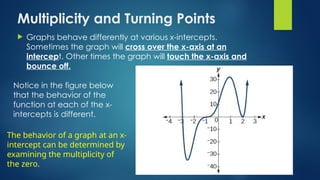
 Graphs behave differently at various x-intercepts.
Sometimes the graph will cross over the x-axis at an
intercept. Other times the graph will touch the x-axis and
bounce off.
Notice in the figure below
that the behavior of the
function at each of the x-
intercepts is different.
The behavior of a graph at an x-
intercept can be determined by
examining the multiplicity of
the zero.
Multiplicity and Turning Points
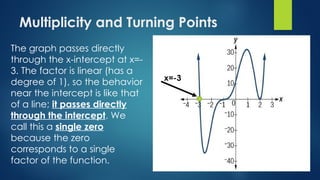
The graph passes directly
through the x-intercept at x=-
3. The factor is linear (has a
degree of 1), so the behavior
near the intercept is like that
of a line; it passes directly
through the intercept. We
call this a single zero
because the zero
corresponds to a single
factor of the function.
x=-3
Multiplicity and Turning Points
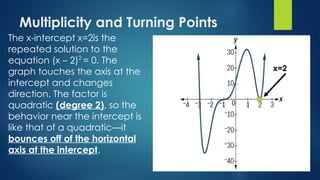
The x-intercept x=2is the
repeated solution to the
equation (x – 2)2
= 0. The
graph touches the axis at the
intercept and changes
direction. The factor is
quadratic (degree 2), so the
behavior near the intercept is
like that of a quadratic—it
bounces off of the horizontal
axis at the intercept.
x=2
Multiplicity and Turning Points
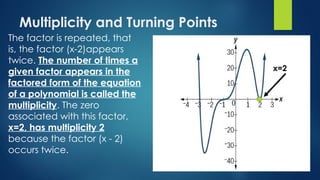
The factor is repeated, that
is, the factor (x-2)appears
twice. The number of times a
given factor appears in the
factored form of the equation
of a polynomial is called the
multiplicity. The zero
associated with this factor,
x=2, has multiplicity 2
because the factor (x - 2)
occurs twice.
x=2
Multiplicity and Turning Points
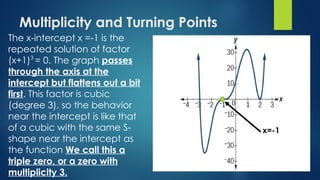
The x-intercept x =-1 is the
repeated solution of factor
(x+1)3
= 0. The graph passes
through the axis at the
intercept but flattens out a bit
first. This factor is cubic
(degree 3), so the behavior
near the intercept is like that
of a cubic with the same S-
shape near the intercept as
the function We call this a
triple zero, or a zero with
multiplicity 3.
x=-1
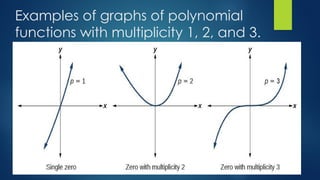
* For zeros with even multiplicities, the
graphs touch or are tangent to the x-axis
at these x-values.
* For zeros with odd multiplicities, the
graphs cross or intersect the x-axis at
these x-values.
Examples of graphs of polynomial
functions with multiplicity 1, 2, and 3.
For higher even powers, such as 4, 6,
and 8, the graph will still touch and
bounce off of the x-axis, but for each
increasing even power the graph will
appear flatter as it approaches and
leaves the x-axis.
For higher odd powers, such as 5, 7, and
9, the graph will still cross through the x-
axis, but for each increasing odd power,
the graph will appear flatter as it
approaches and leaves the x-axis.
A GENERAL NOTE: GRAPHICAL BEHAVIOR
OF POLYNOMIALS AT X-INTERCEPTS
If a polynomial contains a factor of the
form (x-h)p
, the behavior near the x-
intercept h is determined by the power p.
We say that x=h is a zero of multiplicity p.
A GENERAL NOTE: GRAPHICAL BEHAVIOR
OF POLYNOMIALS AT X-INTERCEPTS
The graph of a polynomial function will touch
the x-axis at zeros with even multiplicities. The
graph will cross the x-axis at zeros with odd
multiplicities.
The sum of the multiplicities is the degree of the
polynomial function.
HOW TO: GIVEN A GRAPH OF A POLYNOMIAL
FUNCTION OF DEGREE IDENTIFY THE ZEROS AND
THEIR MULTIPLICITIES.
If the graph crosses the x-axis and appears
almost linear at the intercept, it is a single
zero.
If the graph touches the x-axis and bounces
off of the axis, it is a zero with even
multiplicity.
HOW TO: GIVEN A GRAPH OF A POLYNOMIAL
FUNCTION OF DEGREE IDENTIFY THE ZEROS AND
THEIR MULTIPLICITIES.
If the graph crosses the x-axis at a zero, it
is a zero with odd multiplicity.
The sum of the multiplicities is the
degree n.
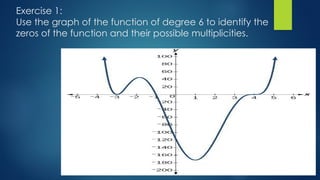
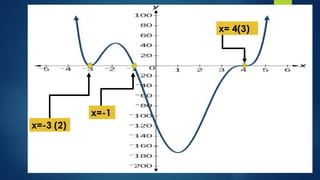
Exercise 1:
Use the graph of the function of degree 6 to identify the
zeros of the function and their possible multiplicities.
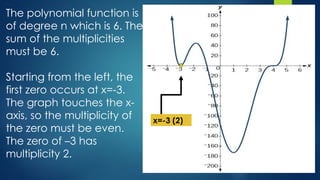
The polynomial function is
of degree n which is 6. The
sum of the multiplicities
must be 6.
Starting from the left, the
first zero occurs at x=-3.
The graph touches the x-
axis, so the multiplicity of
the zero must be even.
The zero of –3 has
multiplicity 2.
x=-3 (2)
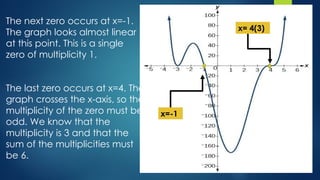
The next zero occurs at x=-1.
The graph looks almost linear
at this point. This is a single
zero of multiplicity 1.
The last zero occurs at x=4. The
graph crosses the x-axis, so the
multiplicity of the zero must be
odd. We know that the
multiplicity is 3 and that the
sum of the multiplicities must
be 6.
x=-1
x= 4(3)
x=-1
x= 4(3)
x=-3 (2)
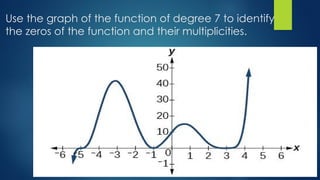
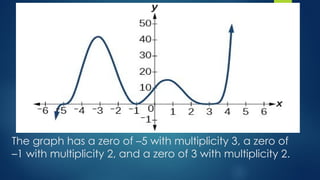
Use the graph of the function of degree 7 to identify
the zeros of the function and their multiplicities.
The graph has a zero of –5 with multiplicity 3, a zero of
–1 with multiplicity 2, and a zero of 3 with multiplicity 2.
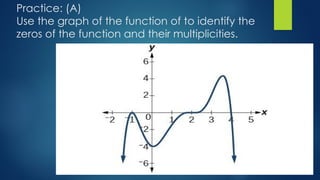
Practice: (A)
Use the graph of the function of to identify the
zeros of the function and their multiplicities.
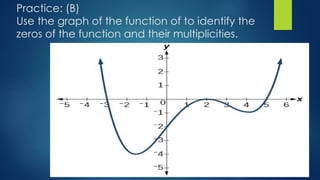
Practice: (B)
Use the graph of the function of to identify the
zeros of the function and their multiplicities.
Determining End Behavior
 The behavior of a graph of a polynomial function of the
form will either ultimately rise or fall as x increases without
bound and will either rise or fall as x decreases without
bound.
 We call this behavior the end behavior of a function.
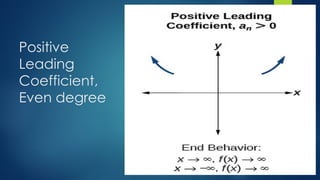
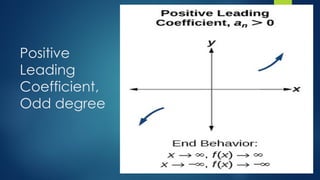
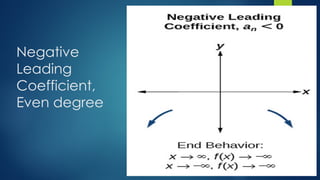
 When the leading term of a polynomial function, anxn, is
an even power function, as x increases or decreases
without bound, increases without bound.
Determining End Behavior
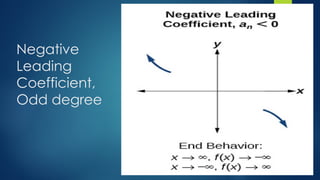
 When the leading term is an odd power function,
as x decreases without bound, f(x)also decreases without
bound; as x increases without bound f(x) also increases
without bound.
 If the leading term is negative, it will change the direction
of the end behavior.
Positive
Leading
Coefficient,
Even degree
Positive
Leading
Coefficient,
Odd degree
Negative
Leading
Coefficient,
Even degree
Negative
Leading
Coefficient,
Odd degree
Thank you for actively
participating and for
listening attentively
 

Polynomial Functions, ITS NATURE AND ITS Graphs

  • 1.
  • 2.
    * Identify zerosof polynomial functions with even and odd multiplicity. * Write the equation of a polynomial function given its graph. * Draw the graph of a polynomial function using end behavior, turning points, intercepts, and the Intermediate Value Theorem. LEARNING OUTCOMES
  • 3.
    Multiplicity and TurningPoints  Graphs behave differently at various x-intercepts. Sometimes the graph will cross over the x-axis at an intercept. Other times the graph will touch the x-axis and bounce off. Notice in the figure below that the behavior of the function at each of the x- intercepts is different. The behavior of a graph at an x- intercept can be determined by examining the multiplicity of the zero.
  • 4.
    Multiplicity and TurningPoints The graph passes directly through the x-intercept at x=- 3. The factor is linear (has a degree of 1), so the behavior near the intercept is like that of a line; it passes directly through the intercept. We call this a single zero because the zero corresponds to a single factor of the function. x=-3
  • 5.
    Multiplicity and TurningPoints The x-intercept x=2is the repeated solution to the equation (x – 2)2 = 0. The graph touches the axis at the intercept and changes direction. The factor is quadratic (degree 2), so the behavior near the intercept is like that of a quadratic—it bounces off of the horizontal axis at the intercept. x=2
  • 6.
    Multiplicity and TurningPoints The factor is repeated, that is, the factor (x-2)appears twice. The number of times a given factor appears in the factored form of the equation of a polynomial is called the multiplicity. The zero associated with this factor, x=2, has multiplicity 2 because the factor (x - 2) occurs twice. x=2
  • 7.
    Multiplicity and TurningPoints The x-intercept x =-1 is the repeated solution of factor (x+1)3 = 0. The graph passes through the axis at the intercept but flattens out a bit first. This factor is cubic (degree 3), so the behavior near the intercept is like that of a cubic with the same S- shape near the intercept as the function We call this a triple zero, or a zero with multiplicity 3. x=-1
  • 8.
    * For zeroswith even multiplicities, the graphs touch or are tangent to the x-axis at these x-values. * For zeros with odd multiplicities, the graphs cross or intersect the x-axis at these x-values.
  • 9.
    Examples of graphsof polynomial functions with multiplicity 1, 2, and 3.
  • 10.
    For higher evenpowers, such as 4, 6, and 8, the graph will still touch and bounce off of the x-axis, but for each increasing even power the graph will appear flatter as it approaches and leaves the x-axis.
  • 11.
    For higher oddpowers, such as 5, 7, and 9, the graph will still cross through the x- axis, but for each increasing odd power, the graph will appear flatter as it approaches and leaves the x-axis.
  • 12.
    A GENERAL NOTE:GRAPHICAL BEHAVIOR OF POLYNOMIALS AT X-INTERCEPTS If a polynomial contains a factor of the form (x-h)p , the behavior near the x- intercept h is determined by the power p. We say that x=h is a zero of multiplicity p.
  • 13.
    A GENERAL NOTE:GRAPHICAL BEHAVIOR OF POLYNOMIALS AT X-INTERCEPTS The graph of a polynomial function will touch the x-axis at zeros with even multiplicities. The graph will cross the x-axis at zeros with odd multiplicities. The sum of the multiplicities is the degree of the polynomial function.
  • 14.
    HOW TO: GIVENA GRAPH OF A POLYNOMIAL FUNCTION OF DEGREE IDENTIFY THE ZEROS AND THEIR MULTIPLICITIES. If the graph crosses the x-axis and appears almost linear at the intercept, it is a single zero. If the graph touches the x-axis and bounces off of the axis, it is a zero with even multiplicity.
  • 15.
    HOW TO: GIVENA GRAPH OF A POLYNOMIAL FUNCTION OF DEGREE IDENTIFY THE ZEROS AND THEIR MULTIPLICITIES. If the graph crosses the x-axis at a zero, it is a zero with odd multiplicity. The sum of the multiplicities is the degree n.
  • 16.
    Exercise 1: Use thegraph of the function of degree 6 to identify the zeros of the function and their possible multiplicities.
  • 17.
    The polynomial functionis of degree n which is 6. The sum of the multiplicities must be 6. Starting from the left, the first zero occurs at x=-3. The graph touches the x- axis, so the multiplicity of the zero must be even. The zero of –3 has multiplicity 2. x=-3 (2)
  • 18.
    The next zerooccurs at x=-1. The graph looks almost linear at this point. This is a single zero of multiplicity 1. The last zero occurs at x=4. The graph crosses the x-axis, so the multiplicity of the zero must be odd. We know that the multiplicity is 3 and that the sum of the multiplicities must be 6. x=-1 x= 4(3)
  • 19.
  • 20.
    Use the graphof the function of degree 7 to identify the zeros of the function and their multiplicities.
  • 21.
    The graph hasa zero of –5 with multiplicity 3, a zero of –1 with multiplicity 2, and a zero of 3 with multiplicity 2.
  • 22.
    Practice: (A) Use thegraph of the function of to identify the zeros of the function and their multiplicities.
  • 23.
    Practice: (B) Use thegraph of the function of to identify the zeros of the function and their multiplicities.
  • 24.
    Determining End Behavior The behavior of a graph of a polynomial function of the form will either ultimately rise or fall as x increases without bound and will either rise or fall as x decreases without bound.  We call this behavior the end behavior of a function.  When the leading term of a polynomial function, anxn, is an even power function, as x increases or decreases without bound, increases without bound.
  • 25.
    Determining End Behavior When the leading term is an odd power function, as x decreases without bound, f(x)also decreases without bound; as x increases without bound f(x) also increases without bound.  If the leading term is negative, it will change the direction of the end behavior.

  • 26.
  • 27.
  • 28.
  • 29.
  • 30.
    Thank you foractively participating and for listening attentively  