INSTRUCTOR: ENGR. MA. JESSA P. DOLLADO, MP
FORMULAS IN POLYGONS
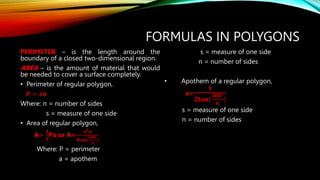
PERIMETER – is the length around the
boundary of a closed two-dimensional region.
AREA – is the amount of material that would
be needed to cover a surface completely.
• Perimeter of regular polygon,
𝑷 = 𝒔𝒏
Where: n = number of sides
s = measure of one side
• Area of regular polygon,
A=
𝟏
𝟐
Pa or A=
𝒔𝟐𝒏
𝟒𝐭𝐚𝐧(
𝟏𝟖𝟎°
𝒏
)
Where: P = perimeter
a = apothem
s = measure of one side
n = number of sides
• Apothem of a regular polygon,
a=
𝒔
𝟐𝐭𝐚𝐧(
𝟏𝟖𝟎°
𝒏
)
s = measure of one side
n = number of sides
FORMULAS IN POLYGONS
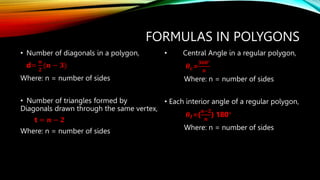
• Number of diagonals in a polygon,
d=
𝒏
𝟐
(𝒏 − 𝟑)
Where: n = number of sides
• Number of triangles formed by
Diagonals drawn through the same vertex,
t = 𝒏 − 𝟐
Where: n = number of sides
• Central Angle in a regular polygon,
𝜽𝒄=
𝟑𝟔𝟎°
𝐧
Where: n = number of sides
• Each interior angle of a regular polygon,
𝜽𝑰=(
𝒏−𝟐
𝒏
) 180°
Where: n = number of sides
FORMULAS IN POLYGONS
• Sum of interior Angles,
𝑰𝒔 = 𝒏 − 𝟐 𝟏𝟖𝟎°
Where: n = number of sides
TRIANGLES
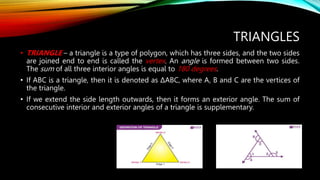
• TRIANGLE – a triangle is a type of polygon, which has three sides, and the two sides
are joined end to end is called the vertex. An angle is formed between two sides.
The sum of all three interior angles is equal to 180 degrees.
• If ABC is a triangle, then it is denoted as ∆ABC, where A, B and C are the vertices of
the triangle.
• If we extend the side length outwards, then it forms an exterior angle. The sum of
consecutive interior and exterior angles of a triangle is supplementary.
CLASSIFICATION OF TRIANGLES
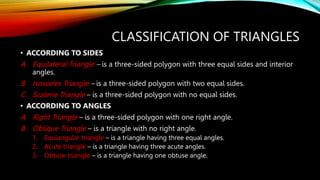
• ACCORDING TO SIDES
A. Equilateral Triangle – is a three-sided polygon with three equal sides and interior
angles.
B. Isosceles Triangle – is a three-sided polygon with two equal sides.
C. Scalene Triangle – is a three-sided polygon with no equal sides.
• ACCORDING TO ANGLES
A. Right Triangle – is a three-sided polygon with one right angle.
B. Oblique Triangle – is a triangle with no right angle.
1. Equiangular triangle – is a triangle having three equal angles.
2. Acute triangle – is a triangle having three acute angles.
3. Obtuse triangle – is a triangle having one obtuse angle.
CLASSIFICATION OF TRIANGLES
FORMULAS: AREA OF TRIANGLES
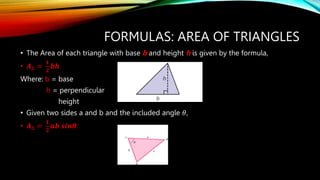
• The Area of each triangle with base b and height h is given by the formula,
• 𝑨∆ =
𝟏
𝟐
𝒃𝒉
Where: b = base
h = perpendicular
height
• Given two sides a and b and the included angle 𝜃,
• 𝑨∆ =
𝟏
𝟐
𝒂𝒃 𝒔𝒊𝒏𝜽
FORMULAS: AREA OF TRIANGLES
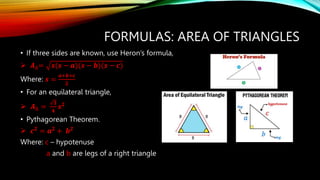
• If three sides are known, use Heron’s formula,
 𝑨∆= 𝒔(𝒔 − 𝒂)(𝒔 − 𝒃)(𝒔 − 𝒄)
Where: 𝒔 =
𝒂+𝒃+𝒄
𝟐
• For an equilateral triangle,
 𝑨∆ =
𝟑
𝟒
𝒔𝟐
• Pythagorean Theorem.
 𝒄𝟐 = 𝒂𝟐 + 𝒃𝟐
Where: c – hypotenuse
a and b are legs of a right triangle
FORMULAS: AREA OF TRIANGLES
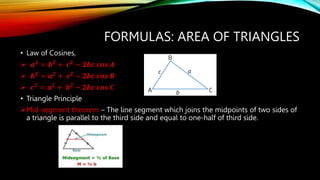
• Law of Cosines,
 𝒂𝟐
= 𝒃𝟐
+ 𝒄𝟐
− 𝟐𝒃𝒄 𝒄𝒐𝒔 𝑨
 𝒃𝟐
= 𝒂𝟐
+ 𝒄𝟐
− 𝟐𝒃𝒄 𝒄𝒐𝒔 𝑩
 𝒄𝟐
= 𝒂𝟐
+ 𝒃𝟐
− 𝟐𝒃𝒄 𝒄𝒐𝒔 𝑪
• Triangle Principle
Mid-segment theorem – The line segment which joins the midpoints of two sides of
a triangle is parallel to the third side and equal to one-half of third side.
FORMULAS: AREA OF TRIANGLES
• Triangle Principle
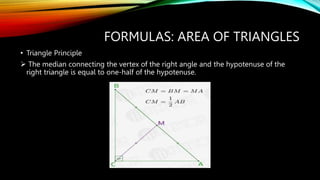
 The median connecting the vertex of the right angle and the hypotenuse of the
right triangle is equal to one-half of the hypotenuse.
FORMULAS: AREA OF TRIANGLES
• Triangle Principle
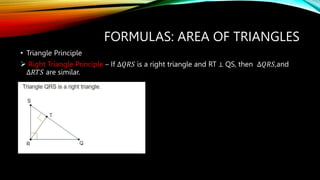
 Right Triangle Principle – If ∆𝑄𝑅𝑆 is a right triangle and RT ⊥ QS, then ∆𝑄𝑅𝑆,and
∆𝑅𝑇𝑆 are similar.
FORMULAS: AREA OF TRIANGLES
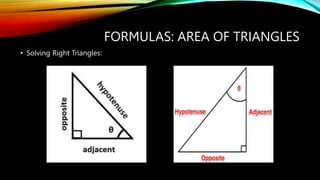
• Solving Right Triangles:
FORMULAS: AREA OF TRIANGLES
• Trigonometric Functions of an acute angle of a triangle.
FORMULAS: AREA OF TRIANGLES
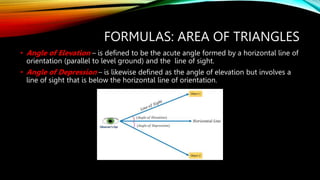
• Angle of Elevation – is defined to be the acute angle formed by a horizontal line of
orientation (parallel to level ground) and the line of sight.
• Angle of Depression – is likewise defined as the angle of elevation but involves a
line of sight that is below the horizontal line of orientation.

POLYGONS_TRIANGLE (SOLID MENSURATION).pptx

  • 1.
    INSTRUCTOR: ENGR. MA.JESSA P. DOLLADO, MP
  • 2.
    FORMULAS IN POLYGONS PERIMETER– is the length around the boundary of a closed two-dimensional region. AREA – is the amount of material that would be needed to cover a surface completely. • Perimeter of regular polygon, 𝑷 = 𝒔𝒏 Where: n = number of sides s = measure of one side • Area of regular polygon, A= 𝟏 𝟐 Pa or A= 𝒔𝟐𝒏 𝟒𝐭𝐚𝐧( 𝟏𝟖𝟎° 𝒏 ) Where: P = perimeter a = apothem s = measure of one side n = number of sides • Apothem of a regular polygon, a= 𝒔 𝟐𝐭𝐚𝐧( 𝟏𝟖𝟎° 𝒏 ) s = measure of one side n = number of sides
  • 3.
    FORMULAS IN POLYGONS •Number of diagonals in a polygon, d= 𝒏 𝟐 (𝒏 − 𝟑) Where: n = number of sides • Number of triangles formed by Diagonals drawn through the same vertex, t = 𝒏 − 𝟐 Where: n = number of sides • Central Angle in a regular polygon, 𝜽𝒄= 𝟑𝟔𝟎° 𝐧 Where: n = number of sides • Each interior angle of a regular polygon, 𝜽𝑰=( 𝒏−𝟐 𝒏 ) 180° Where: n = number of sides
  • 4.
    FORMULAS IN POLYGONS •Sum of interior Angles, 𝑰𝒔 = 𝒏 − 𝟐 𝟏𝟖𝟎° Where: n = number of sides
  • 5.
    TRIANGLES • TRIANGLE –a triangle is a type of polygon, which has three sides, and the two sides are joined end to end is called the vertex. An angle is formed between two sides. The sum of all three interior angles is equal to 180 degrees. • If ABC is a triangle, then it is denoted as ∆ABC, where A, B and C are the vertices of the triangle. • If we extend the side length outwards, then it forms an exterior angle. The sum of consecutive interior and exterior angles of a triangle is supplementary.
  • 6.
    CLASSIFICATION OF TRIANGLES •ACCORDING TO SIDES A. Equilateral Triangle – is a three-sided polygon with three equal sides and interior angles. B. Isosceles Triangle – is a three-sided polygon with two equal sides. C. Scalene Triangle – is a three-sided polygon with no equal sides. • ACCORDING TO ANGLES A. Right Triangle – is a three-sided polygon with one right angle. B. Oblique Triangle – is a triangle with no right angle. 1. Equiangular triangle – is a triangle having three equal angles. 2. Acute triangle – is a triangle having three acute angles. 3. Obtuse triangle – is a triangle having one obtuse angle.
  • 7.
  • 8.
    FORMULAS: AREA OFTRIANGLES • The Area of each triangle with base b and height h is given by the formula, • 𝑨∆ = 𝟏 𝟐 𝒃𝒉 Where: b = base h = perpendicular height • Given two sides a and b and the included angle 𝜃, • 𝑨∆ = 𝟏 𝟐 𝒂𝒃 𝒔𝒊𝒏𝜽
  • 9.
    FORMULAS: AREA OFTRIANGLES • If three sides are known, use Heron’s formula,  𝑨∆= 𝒔(𝒔 − 𝒂)(𝒔 − 𝒃)(𝒔 − 𝒄) Where: 𝒔 = 𝒂+𝒃+𝒄 𝟐 • For an equilateral triangle,  𝑨∆ = 𝟑 𝟒 𝒔𝟐 • Pythagorean Theorem.  𝒄𝟐 = 𝒂𝟐 + 𝒃𝟐 Where: c – hypotenuse a and b are legs of a right triangle
  • 10.
    FORMULAS: AREA OFTRIANGLES • Law of Cosines,  𝒂𝟐 = 𝒃𝟐 + 𝒄𝟐 − 𝟐𝒃𝒄 𝒄𝒐𝒔 𝑨  𝒃𝟐 = 𝒂𝟐 + 𝒄𝟐 − 𝟐𝒃𝒄 𝒄𝒐𝒔 𝑩  𝒄𝟐 = 𝒂𝟐 + 𝒃𝟐 − 𝟐𝒃𝒄 𝒄𝒐𝒔 𝑪 • Triangle Principle Mid-segment theorem – The line segment which joins the midpoints of two sides of a triangle is parallel to the third side and equal to one-half of third side.
  • 11.
    FORMULAS: AREA OFTRIANGLES • Triangle Principle  The median connecting the vertex of the right angle and the hypotenuse of the right triangle is equal to one-half of the hypotenuse.
  • 12.
    FORMULAS: AREA OFTRIANGLES • Triangle Principle  Right Triangle Principle – If ∆𝑄𝑅𝑆 is a right triangle and RT ⊥ QS, then ∆𝑄𝑅𝑆,and ∆𝑅𝑇𝑆 are similar.
  • 13.
    FORMULAS: AREA OFTRIANGLES • Solving Right Triangles:
  • 14.
    FORMULAS: AREA OFTRIANGLES • Trigonometric Functions of an acute angle of a triangle.
  • 15.
    FORMULAS: AREA OFTRIANGLES • Angle of Elevation – is defined to be the acute angle formed by a horizontal line of orientation (parallel to level ground) and the line of sight. • Angle of Depression – is likewise defined as the angle of elevation but involves a line of sight that is below the horizontal line of orientation.