Robert Gleim
   Oct. 27th, 2010
   Pipe is designed to handle the following load
    conditions:
    ◦ A minimum design life of 20 years at MAOP and
      MAOT
    ◦ Hydro testing to 1.25x MAOP for 8 hours at MAOT
      The Hydro test can be performed up to 3 times during
       the life of the pipe without degrading the 20 year
       design life
        Pipe shall have a minimum design life of 1 week when
         continuously operated at 1.25x MAOP
   The pipe design strength is based only on the
    aramid fiber.
    ◦ No strength is attributed to the plastic.
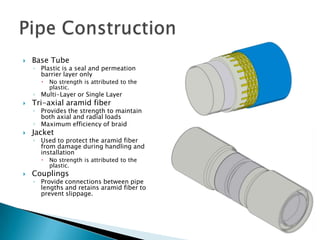
   Base Tube
    ◦ Plastic is a seal and permeation
      barrier layer only
         No strength is attributed to the
          plastic.
    ◦ Multi-Layer or Single Layer
   Tri-axial aramid fiber
    ◦ Provides the strength to maintain
      both axial and radial loads
    ◦ Maximum efficiency of braid
   Jacket
    ◦ Used to protect the aramid fiber
      from damage during handling and
      installation
         No strength is attributed to the
          plastic.
   Couplings
    ◦ Provide connections between pipe
      lengths and retains aramid fiber to
      prevent slippage.
   Fluid Compatibility          Liner Material:
                                  ◦ Nylon Inert to
    ◦ HDPE                          Hydrocarbons
      Water only                     Doesn’t Soften and Swell
    ◦ Nylon                           Doesn’t Lose Strength
                                      Inert to Wet CO2
      Water with                     Not for H2S over 200PPM
       Hydrocarbons & CO2         ◦ PPS
    ◦ PPS                           High H2S environments
      Water with                Jacket Material
       Hydrocarbons, CO2, &       ◦ Nylon for pipe pulls
       H2S                          Good abrasion resistance
                                  ◦ Polypropylene or nylon
                                    for direct bury
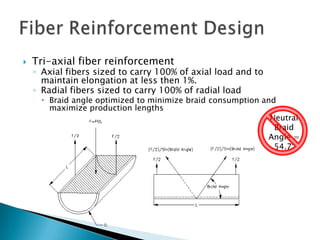
   Tri-axial fiber reinforcement
    ◦ Axial fibers sized to carry 100% of axial load and to
      maintain elongation at less then 1%.
    ◦ Radial fibers sized to carry 100% of radial load
      Braid angle optimized to minimize braid consumption and
       maximize production lengths
                                                             Neutral
                                                              Braid
                                                            Angle =
                                                              54.7°
   Graphite/Carbon fiber
    ◦ High strength & good
      resistance to cyclic loading
    ◦ Too expensive
   Aramid fiber
    ◦ Very similar properties to
      carbon fiber
    ◦ Good balance of cost and
      performance
   S- Glass fiber
    ◦ Low cost, high initial
      strength
    ◦ Reduced strength in moist
      environments due to crack
      growth
    ◦ Poor cyclic performance
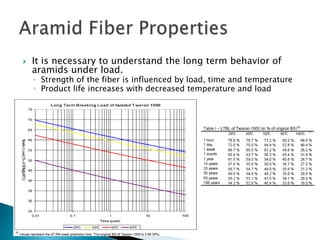
   It is necessary to understand the long term behavior of
    aramids under load.
    ◦ Strength of the fiber is influenced by load, time and temperature
    ◦ Product life increases with decreased temperature and load
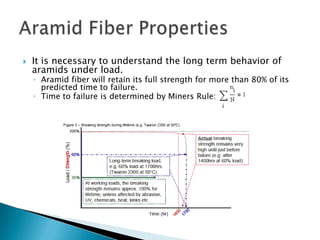
   It is necessary to understand the long term behavior of
    aramids under load.
    ◦ Aramid fiber will retain its full strength for more than 80% of its
      predicted time to failure.
    ◦ Time to failure is determined by Miners Rule:
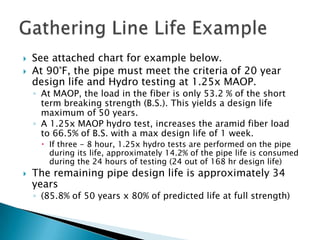
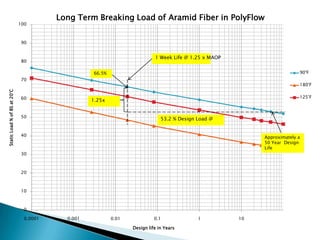
   See attached chart for example below.
   At 90°F, the pipe must meet the criteria of 20 year
    design life and Hydro testing at 1.25x MAOP.
    ◦ At MAOP, the load in the fiber is only 53.2 % of the short
      term breaking strength (B.S.). This yields a design life
      maximum of 50 years.
    ◦ A 1.25x MAOP hydro test, increases the aramid fiber load
      to 66.5% of B.S. with a max design life of 1 week.
       If three - 8 hour, 1.25x hydro tests are performed on the pipe
        during its life, approximately 14.2% of the pipe life is consumed
        during the 24 hours of testing (24 out of 168 hr design life)
   The remaining pipe design life is approximately 34
    years
    ◦ (85.8% of 50 years x 80% of predicted life at full strength)
Long Term Breaking Load of Aramid Fiber in PolyFlow
                              100


                               90


                                                                            1 Week Life @ 1.25 x MAOP
                               80

                                                   66.5%                                                                   90°F
                               70
                                                                                                                           180°F
Static Load % of BS at 20°C


                               60                                                                                          125°F
                                                   1.25x


                               50
                                                                               53.2 % Design Load @


                               40                                                                            Approximately a
                                                                                                             50 Year Design
                                                                                                             Life
                               30


                               20


                               10


                                0

                                0.0001     0.001           0.01             0.1              1          10

                                                                  Design life in Years
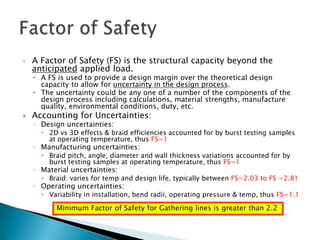
•   A Factor of Safety (FS) is the structural capacity beyond the
    anticipated applied load.
    • A FS is used to provide a design margin over the theoretical design
      capacity to allow for uncertainty in the design process.
    • The uncertainty could be any one of a number of the components of the
      design process including calculations, material strengths, manufacture
      quality, environmental conditions, duty, etc.
   Accounting for Uncertainties:
    ◦ Design uncertainties:
       2D vs 3D effects & braid efficiencies accounted for by burst testing samples
        at operating temperature, thus FS=1
    ◦ Manufacturing uncertainties:
       Braid pitch, angle, diameter and wall thickness variations accounted for by
        burst testing samples at operating temperature, thus FS=1
    ◦ Material uncertainties:
       Braid: varies for temp and design life, typically between FS=2.03 to FS =2.81
    ◦ Operating uncertainties:
       Variability in installation, bend radii, operating pressure & temp, thus FS=1.1

          Minimum Factor of Safety for Gathering lines is greater than 2.2

Polyflow Technical Data Powerpoint

  • 1.
    Robert Gleim Oct. 27th, 2010
  • 2.
    Pipe is designed to handle the following load conditions: ◦ A minimum design life of 20 years at MAOP and MAOT ◦ Hydro testing to 1.25x MAOP for 8 hours at MAOT  The Hydro test can be performed up to 3 times during the life of the pipe without degrading the 20 year design life  Pipe shall have a minimum design life of 1 week when continuously operated at 1.25x MAOP  The pipe design strength is based only on the aramid fiber. ◦ No strength is attributed to the plastic.
  • 3.
    Base Tube ◦ Plastic is a seal and permeation barrier layer only  No strength is attributed to the plastic. ◦ Multi-Layer or Single Layer  Tri-axial aramid fiber ◦ Provides the strength to maintain both axial and radial loads ◦ Maximum efficiency of braid  Jacket ◦ Used to protect the aramid fiber from damage during handling and installation  No strength is attributed to the plastic.  Couplings ◦ Provide connections between pipe lengths and retains aramid fiber to prevent slippage.
  • 4.
    Fluid Compatibility  Liner Material: ◦ Nylon Inert to ◦ HDPE Hydrocarbons  Water only  Doesn’t Soften and Swell ◦ Nylon  Doesn’t Lose Strength  Inert to Wet CO2  Water with  Not for H2S over 200PPM Hydrocarbons & CO2 ◦ PPS ◦ PPS  High H2S environments  Water with  Jacket Material Hydrocarbons, CO2, & ◦ Nylon for pipe pulls H2S  Good abrasion resistance ◦ Polypropylene or nylon for direct bury
  • 5.
    Tri-axial fiber reinforcement ◦ Axial fibers sized to carry 100% of axial load and to maintain elongation at less then 1%. ◦ Radial fibers sized to carry 100% of radial load  Braid angle optimized to minimize braid consumption and maximize production lengths Neutral Braid Angle = 54.7°
  • 6.
    Graphite/Carbon fiber ◦ High strength & good resistance to cyclic loading ◦ Too expensive  Aramid fiber ◦ Very similar properties to carbon fiber ◦ Good balance of cost and performance  S- Glass fiber ◦ Low cost, high initial strength ◦ Reduced strength in moist environments due to crack growth ◦ Poor cyclic performance
  • 7.
    It is necessary to understand the long term behavior of aramids under load. ◦ Strength of the fiber is influenced by load, time and temperature ◦ Product life increases with decreased temperature and load
  • 8.
    It is necessary to understand the long term behavior of aramids under load. ◦ Aramid fiber will retain its full strength for more than 80% of its predicted time to failure. ◦ Time to failure is determined by Miners Rule:
  • 9.
    See attached chart for example below.  At 90°F, the pipe must meet the criteria of 20 year design life and Hydro testing at 1.25x MAOP. ◦ At MAOP, the load in the fiber is only 53.2 % of the short term breaking strength (B.S.). This yields a design life maximum of 50 years. ◦ A 1.25x MAOP hydro test, increases the aramid fiber load to 66.5% of B.S. with a max design life of 1 week.  If three - 8 hour, 1.25x hydro tests are performed on the pipe during its life, approximately 14.2% of the pipe life is consumed during the 24 hours of testing (24 out of 168 hr design life)  The remaining pipe design life is approximately 34 years ◦ (85.8% of 50 years x 80% of predicted life at full strength)
  • 10.
    Long Term BreakingLoad of Aramid Fiber in PolyFlow 100 90 1 Week Life @ 1.25 x MAOP 80 66.5% 90°F 70 180°F Static Load % of BS at 20°C 60 125°F 1.25x 50 53.2 % Design Load @ 40 Approximately a 50 Year Design Life 30 20 10 0 0.0001 0.001 0.01 0.1 1 10 Design life in Years
  • 11.
    A Factor of Safety (FS) is the structural capacity beyond the anticipated applied load. • A FS is used to provide a design margin over the theoretical design capacity to allow for uncertainty in the design process. • The uncertainty could be any one of a number of the components of the design process including calculations, material strengths, manufacture quality, environmental conditions, duty, etc.  Accounting for Uncertainties: ◦ Design uncertainties:  2D vs 3D effects & braid efficiencies accounted for by burst testing samples at operating temperature, thus FS=1 ◦ Manufacturing uncertainties:  Braid pitch, angle, diameter and wall thickness variations accounted for by burst testing samples at operating temperature, thus FS=1 ◦ Material uncertainties:  Braid: varies for temp and design life, typically between FS=2.03 to FS =2.81 ◦ Operating uncertainties:  Variability in installation, bend radii, operating pressure & temp, thus FS=1.1 Minimum Factor of Safety for Gathering lines is greater than 2.2