INDEX
1. Air pollution
2. Light pollution
3. Noise pollution
4. Soil pollution
We have focused on these four types of pollution. We will
describe their causes, effects and possible solutions.
1. AIR POLLUTION
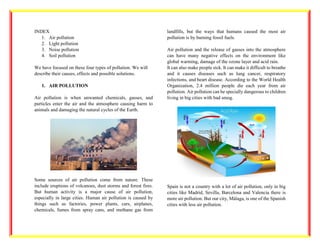
Air pollution is when unwanted chemicals, gasses, and
particles enter the air and the atmosphere causing harm to
animals and damaging the natural cycles of the Earth.
Some sources of air pollution come from nature. These
include eruptions of volcanoes, dust storms and forest fires.
But human activity is a major cause of air pollution,
especially in large cities. Human air pollution is caused by
things such as factories, power plants, cars, airplanes,
chemicals, fumes from spray cans, and methane gas from
landfills, but the ways that humans caused the most air
pollution is by burning fossil fuels.
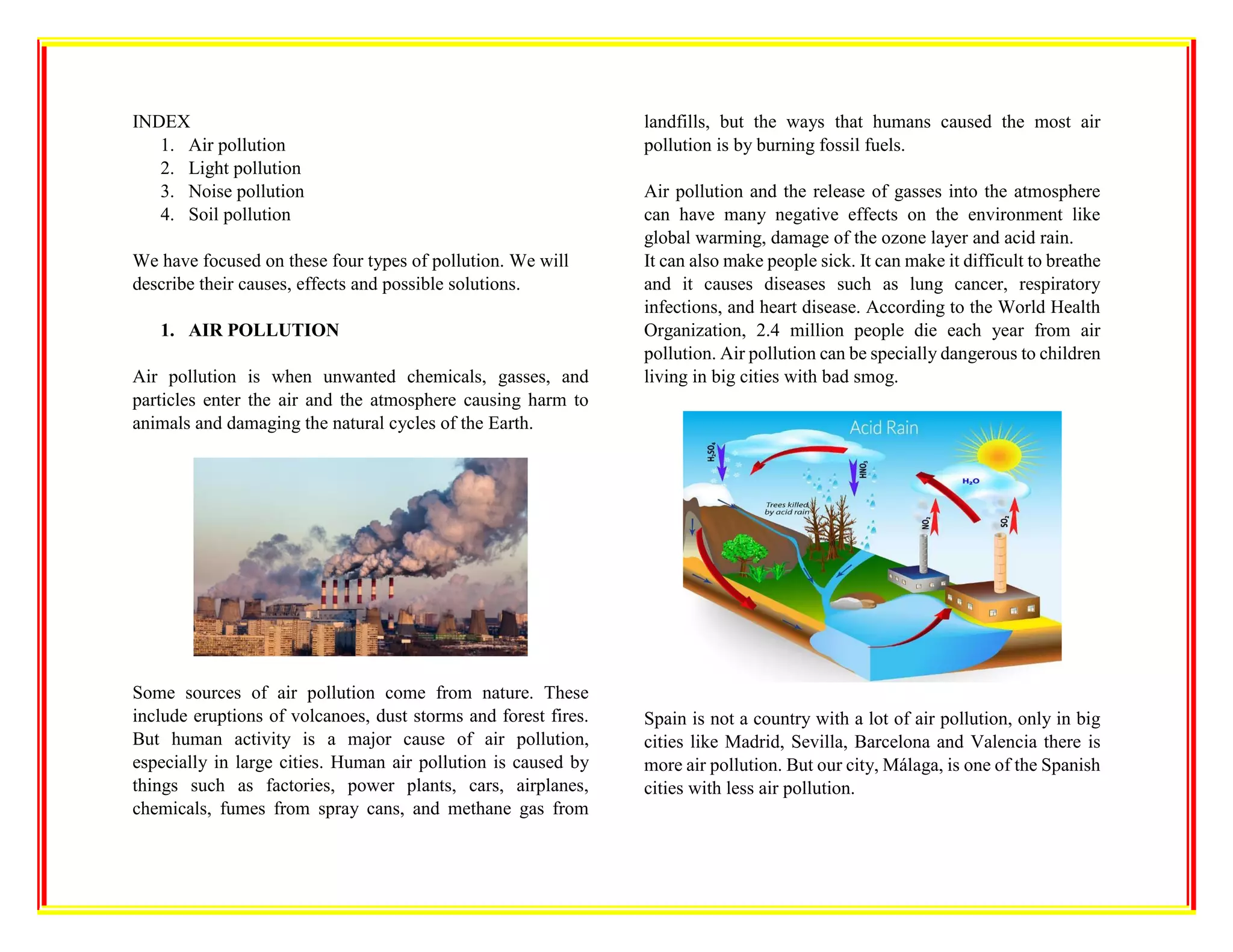
Air pollution and the release of gasses into the atmosphere
can have many negative effects on the environment like
global warming, damage of the ozone layer and acid rain.
It can also make people sick. It can make it difficult to breathe
and it causes diseases such as lung cancer, respiratory
infections, and heart disease. According to the World Health
Organization, 2.4 million people die each year from air
pollution. Air pollution can be specially dangerous to children
living in big cities with bad smog.
Spain is not a country with a lot of air pollution, only in big
cities like Madrid, Sevilla, Barcelona and Valencia there is
more air pollution. But our city, Málaga, is one of the Spanish
cities with less air pollution.
To reduce this serious problem the solutions are to use less
energy, like electricity or petrol, turning off the lights when
leaving your room, not leaving the TV or computer on when
you are not using them and use public transport to help to
reduce air pollution. Although they seem insignificant things,
everything helps to reduce air pollution.
2. LIGHT POLLUTION
It is the shine sent to the sky instead of to the floor, where we
really need it. It happens because of the bad quality and bad
design of the streetlight of our cities.
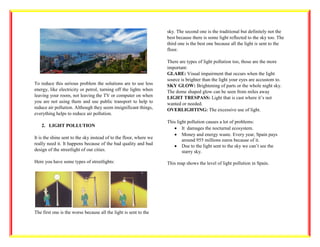
Here you have some types of streetlights:
The first one is the worse because all the light is sent to the
sky. The second one is the traditional but definitely not the
best because there is some light reflected to the sky too. The
third one is the best one because all the light is sent to the
floor.
There are types of light pollution too, those are the more
important:
GLARE: Visual impairment that occurs when the light
source is brighter than the light your eyes are accustom to.
SKY GLOW: Brightening of parts or the whole night sky.
The dome shaped glow can be seen from miles away
LIGHT TRESPASS: Light that is cast where it’s not
wanted or needed.
OVERLIGHTING: The excessive use of light.
This light pollution causes a lot of problems:
• It damages the nocturnal ecosystem.
• Money and energy waste. Every year, Spain pays
around 955 millions euros because of it.
• Due to the light sent to the sky we can’t see the
starry sky.
This map shows the level of light pollution in Spain.
Possible solutions? At first, we should think it twice the next
time we design a new type of streetlight, then, we should
decrease the intensity of the light bulbs and the hours they are
on to decrease this waste of money and energy also we can
pull our weight and join the Earth Hour. It is more than turn
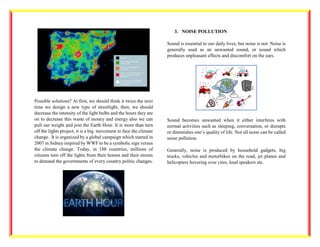
off the lights project, it is a big movement to face the climate
change. It is organized by a global campaign which started in
2007 in Sidney inspired by WWF to be a symbolic sign versus
the climate change. Today, in 188 countries, millions of
citizens turn off the lights from their homes and their streets
to demand the governments of every country politic changes.
3. NOISE POLLUTION
Sound is essential to our daily lives, but noise is not. Noise is
generally used as an unwanted sound, or sound which
produces unpleasant effects and discomfort on the ears.
Sound becomes unwanted when it either interferes with
normal activities such as sleeping, conversation, or disrupts
or diminishes one’s quality of life. Not all noise can be called
noise pollution.
Generally, noise is produced by household gadgets, big
trucks, vehicles and motorbikes on the road, jet planes and
helicopters hovering over cites, loud speakers etc.
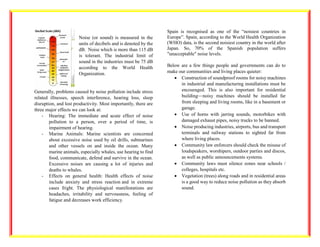
Noise (or sound) is measured in the
units of decibels and is denoted by the
dB. Noise which is more than 115 dB
is tolerant. The industrial limit of
sound in the industries must be 75 dB
according to the World Health
Organization.
Generally, problems caused by noise pollution include stress
related illnesses, speech interference, hearing loss, sleep
disruption, and lost productivity. Most importantly, there are
three major effects we can look at:
- Hearing: The immediate and acute effect of noise
pollution to a person, over a period of time, is
impairment of hearing.
- Marine Animals: Marine scientists are concerned
about excessive noise used by oil drills, submarines
and other vessels on and inside the ocean. Many
marine animals, especially whales, use hearing to find
food, communicate, defend and survive in the ocean.
Excessive noises are causing a lot of injuries and
deaths to whales.
- Effects on general health: Health effects of noise
include anxiety and stress reaction and in extreme
cases fright. The physiological manifestations are
headaches, irritability and nervousness, feeling of
fatigue and decreases work efficiency.
Spain is recognised as one of the “noisiest countries in
Europe”. Spain, according to the World Health Organization
(WHO) data, is the second noisiest country in the world after
Japan. So, 70% of the Spanish population suffers
"unacceptable" noise levels.
Below are a few things people and governments can do to
make our communities and living places quieter:
• Construction of soundproof rooms for noisy machines
in industrial and manufacturing installations must be
encouraged. This is also important for residential
building—noisy machines should be installed far
from sleeping and living rooms, like in a basement or
garage.
• Use of horns with jarring sounds, motorbikes with
damaged exhaust pipes, noisy trucks to be banned.
• Noise producing industries, airports, bus and transport
terminals and railway stations to sighted far from
where living places.
• Community law enforcers should check the misuse of
loudspeakers, worshipers, outdoor parties and discos,
as well as public announcements systems.
• Community laws must silence zones near schools /
colleges, hospitals etc.
• Vegetation (trees) along roads and in residential areas
is a good way to reduce noise pollution as they absorb
sound.
4. SOIL POLLUTION
Land or soil pollution is the deterioration (destruction) of the
earth’s land surfaces, often directly or indirectly as a result of
man’s activities and their misuse of land resources.
It occurs when waste is not disposed of properly, or can occur
when humans throw chemicals onto the soil in the form of
pesticides, insecticides and fertilizers during agricultural
practices. Exploitation of minerals (mining activities) has also
contributed to the destruction of the earth’s surface.
There are different types of land pollution: solid waste,
pesticides and fertilizers, chemicals and deforestation.
There can be catastrophic consequences of land pollution in
relation to humans, animals, water and soils. The effects are
even worse if the garbage is not separated into organic,
reusable and recyclable waste.
Contaminated lands and environments can:
- Cause problems in the human respiratory system.
- Cause problems on the skin.
- Cause various kinds of cancers.
The toxic materials that pollute the soil can get into the
human body directly by:
- Coming into contact with the skin.
- Being washed into water sources like reservoirs and rivers.
- Eating fruits and vegetables that have been grown in
polluted soil.
- Breathing in polluted dust or particles.
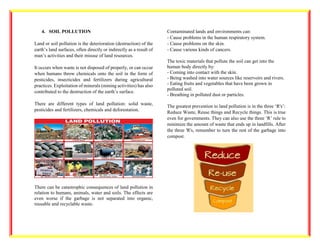
The greatest prevention to land pollution is in the three ‘R's’:
Reduce Waste, Reuse things and Recycle things. This is true
even for governments. They can also use the three ‘R’ rule to
minimize the amount of waste that ends up in landfills. After
the three 'R's, remember to turn the rest of the garbage into
compost.

Pollution

  • 1.
    INDEX 1. Air pollution 2.Light pollution 3. Noise pollution 4. Soil pollution We have focused on these four types of pollution. We will describe their causes, effects and possible solutions. 1. AIR POLLUTION Air pollution is when unwanted chemicals, gasses, and particles enter the air and the atmosphere causing harm to animals and damaging the natural cycles of the Earth. Some sources of air pollution come from nature. These include eruptions of volcanoes, dust storms and forest fires. But human activity is a major cause of air pollution, especially in large cities. Human air pollution is caused by things such as factories, power plants, cars, airplanes, chemicals, fumes from spray cans, and methane gas from landfills, but the ways that humans caused the most air pollution is by burning fossil fuels. Air pollution and the release of gasses into the atmosphere can have many negative effects on the environment like global warming, damage of the ozone layer and acid rain. It can also make people sick. It can make it difficult to breathe and it causes diseases such as lung cancer, respiratory infections, and heart disease. According to the World Health Organization, 2.4 million people die each year from air pollution. Air pollution can be specially dangerous to children living in big cities with bad smog. Spain is not a country with a lot of air pollution, only in big cities like Madrid, Sevilla, Barcelona and Valencia there is more air pollution. But our city, Málaga, is one of the Spanish cities with less air pollution.
  • 2.
    To reduce thisserious problem the solutions are to use less energy, like electricity or petrol, turning off the lights when leaving your room, not leaving the TV or computer on when you are not using them and use public transport to help to reduce air pollution. Although they seem insignificant things, everything helps to reduce air pollution. 2. LIGHT POLLUTION It is the shine sent to the sky instead of to the floor, where we really need it. It happens because of the bad quality and bad design of the streetlight of our cities. Here you have some types of streetlights: The first one is the worse because all the light is sent to the sky. The second one is the traditional but definitely not the best because there is some light reflected to the sky too. The third one is the best one because all the light is sent to the floor. There are types of light pollution too, those are the more important: GLARE: Visual impairment that occurs when the light source is brighter than the light your eyes are accustom to. SKY GLOW: Brightening of parts or the whole night sky. The dome shaped glow can be seen from miles away LIGHT TRESPASS: Light that is cast where it’s not wanted or needed. OVERLIGHTING: The excessive use of light. This light pollution causes a lot of problems: • It damages the nocturnal ecosystem. • Money and energy waste. Every year, Spain pays around 955 millions euros because of it. • Due to the light sent to the sky we can’t see the starry sky. This map shows the level of light pollution in Spain.
  • 3.
    Possible solutions? Atfirst, we should think it twice the next time we design a new type of streetlight, then, we should decrease the intensity of the light bulbs and the hours they are on to decrease this waste of money and energy also we can pull our weight and join the Earth Hour. It is more than turn off the lights project, it is a big movement to face the climate change. It is organized by a global campaign which started in 2007 in Sidney inspired by WWF to be a symbolic sign versus the climate change. Today, in 188 countries, millions of citizens turn off the lights from their homes and their streets to demand the governments of every country politic changes. 3. NOISE POLLUTION Sound is essential to our daily lives, but noise is not. Noise is generally used as an unwanted sound, or sound which produces unpleasant effects and discomfort on the ears. Sound becomes unwanted when it either interferes with normal activities such as sleeping, conversation, or disrupts or diminishes one’s quality of life. Not all noise can be called noise pollution. Generally, noise is produced by household gadgets, big trucks, vehicles and motorbikes on the road, jet planes and helicopters hovering over cites, loud speakers etc.
  • 4.
    Noise (or sound)is measured in the units of decibels and is denoted by the dB. Noise which is more than 115 dB is tolerant. The industrial limit of sound in the industries must be 75 dB according to the World Health Organization. Generally, problems caused by noise pollution include stress related illnesses, speech interference, hearing loss, sleep disruption, and lost productivity. Most importantly, there are three major effects we can look at: - Hearing: The immediate and acute effect of noise pollution to a person, over a period of time, is impairment of hearing. - Marine Animals: Marine scientists are concerned about excessive noise used by oil drills, submarines and other vessels on and inside the ocean. Many marine animals, especially whales, use hearing to find food, communicate, defend and survive in the ocean. Excessive noises are causing a lot of injuries and deaths to whales. - Effects on general health: Health effects of noise include anxiety and stress reaction and in extreme cases fright. The physiological manifestations are headaches, irritability and nervousness, feeling of fatigue and decreases work efficiency. Spain is recognised as one of the “noisiest countries in Europe”. Spain, according to the World Health Organization (WHO) data, is the second noisiest country in the world after Japan. So, 70% of the Spanish population suffers "unacceptable" noise levels. Below are a few things people and governments can do to make our communities and living places quieter: • Construction of soundproof rooms for noisy machines in industrial and manufacturing installations must be encouraged. This is also important for residential building—noisy machines should be installed far from sleeping and living rooms, like in a basement or garage. • Use of horns with jarring sounds, motorbikes with damaged exhaust pipes, noisy trucks to be banned. • Noise producing industries, airports, bus and transport terminals and railway stations to sighted far from where living places. • Community law enforcers should check the misuse of loudspeakers, worshipers, outdoor parties and discos, as well as public announcements systems. • Community laws must silence zones near schools / colleges, hospitals etc. • Vegetation (trees) along roads and in residential areas is a good way to reduce noise pollution as they absorb sound.
  • 5.
    4. SOIL POLLUTION Landor soil pollution is the deterioration (destruction) of the earth’s land surfaces, often directly or indirectly as a result of man’s activities and their misuse of land resources. It occurs when waste is not disposed of properly, or can occur when humans throw chemicals onto the soil in the form of pesticides, insecticides and fertilizers during agricultural practices. Exploitation of minerals (mining activities) has also contributed to the destruction of the earth’s surface. There are different types of land pollution: solid waste, pesticides and fertilizers, chemicals and deforestation. There can be catastrophic consequences of land pollution in relation to humans, animals, water and soils. The effects are even worse if the garbage is not separated into organic, reusable and recyclable waste. Contaminated lands and environments can: - Cause problems in the human respiratory system. - Cause problems on the skin. - Cause various kinds of cancers. The toxic materials that pollute the soil can get into the human body directly by: - Coming into contact with the skin. - Being washed into water sources like reservoirs and rivers. - Eating fruits and vegetables that have been grown in polluted soil. - Breathing in polluted dust or particles. The greatest prevention to land pollution is in the three ‘R's’: Reduce Waste, Reuse things and Recycle things. This is true even for governments. They can also use the three ‘R’ rule to minimize the amount of waste that ends up in landfills. After the three 'R's, remember to turn the rest of the garbage into compost.