Photo:DavidBrazier/IWMIPhoto:TomvanCakenberghe/IWMIPhoto:DavidBrazier/IWMIPhoto:DavidBrazier/IWMI
A water-secure world
www.iwmi.org
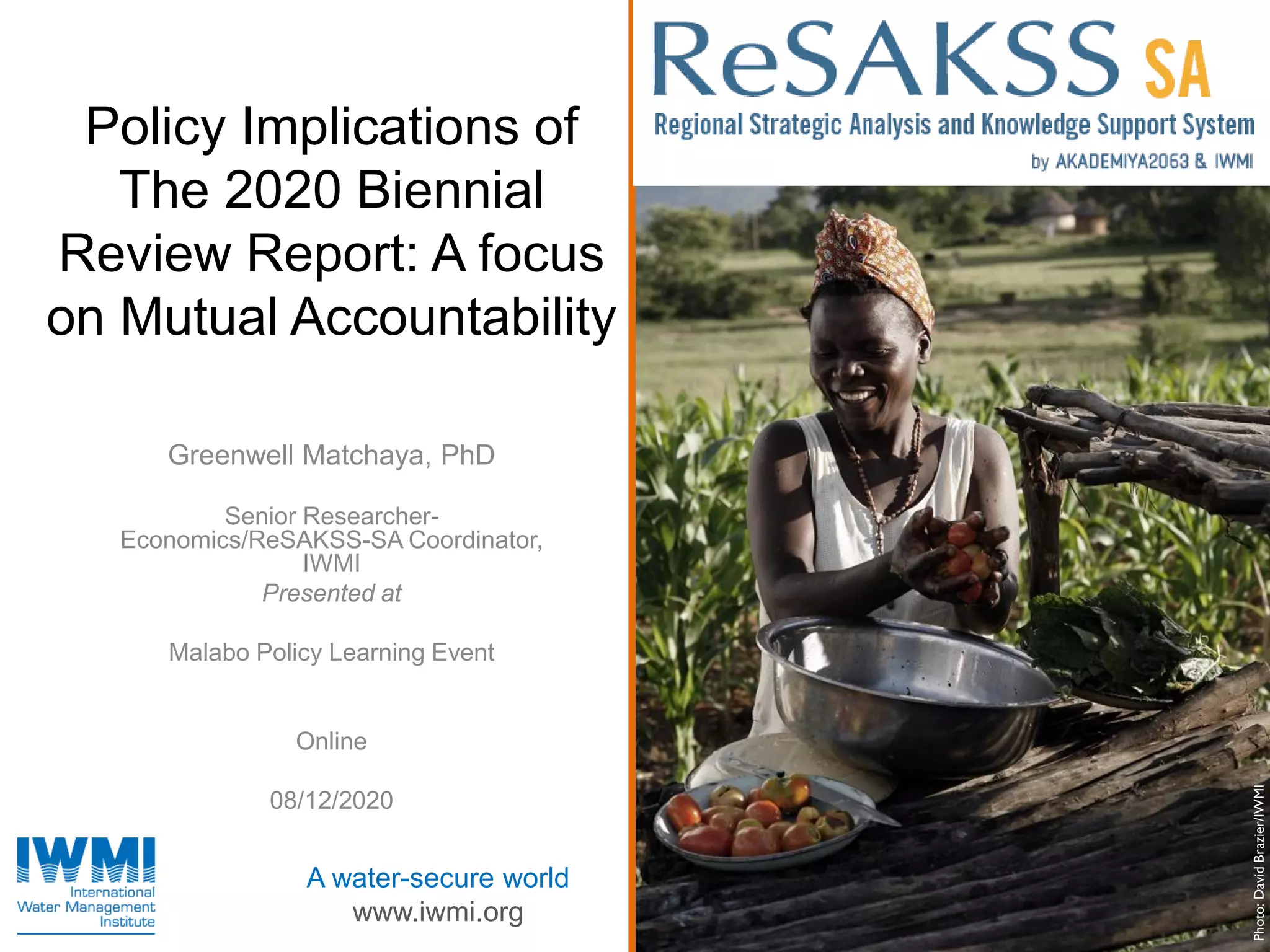
Policy Implications of
The 2020 Biennial
Review Report: A focus
on Mutual Accountability
Greenwell Matchaya, PhD
Senior Researcher-
Economics/ReSAKSS-SA Coordinator,
IWMI
Presented at
Malabo Policy Learning Event
Online
08/12/2020
www.iwmi.org
A water-secure world
Theme 1- CAADP process
– Three indicators
• 1-1 Commitment to CAADP Process, CAADPPro
• 1-2 Existence of, and Quality of multi-sectorial and multi-stakeholder
coordination body, Qc
• 1-3 Evidence-based policies, supportive institutions and corresponding human
resources, EIP
• WHAT WORKED
– Good number of countries reported and performed well. 23 countries
are not on track while 4 countries did not report.
– No data issues for indicators on CAADP and Evidence based policies
www.iwmi.org
A water-secure world
Theme 1- CAADP process II
What did not Work
– Indicator 1-2 on existence of multi-stakeholder coordinating body: Countries scoring
more than 100% out of 100.
– This signifies a computational problem (or) as well as challenges with collection of
data for parameters
– Parameters are data demanding and cumbersome to track eg meetings,
What we can do (Implications)
– Advocate for improving meetings data gathering at country level/
– Improve the planning process. A training to this extent is needed.
– Strengthen country and regional validation of data to improve quality
– Put up systems for recording meetings, leveraging on ICT
– Complete the CAADP process- political will needed here
www.iwmi.org
A water-secure world
Theme 7- Mutual Accountability
Three indicators
– 7-1 Index of capacity to generate and use agriculture statistical data
and information, ASCI
– 7-2 Existence of inclusive institutionalized mechanisms and platforms
for mutual accountability, ECI
– 7-3 Country Biennial Report submission, BR
What Worked
– There was nothing unusual in terms of data patterns
– But
www.iwmi.org
A water-secure world
Theme 7- Mutual Accountability II
What did not Work Well
– Frequency of data generation at source is a problem for 7-1 on index of capacity to
generate ag stats – as this is externally generated source.
http://www.gsars.org/wpcontent/uploads/2014/09/Guidelines_Country-
Assessment_FINAL.pdf
– For indicator 7-3 on country biennial report submission, the entry is supposed to be
completed at the country, regional and AUC level- often RECs did not enter.
What we can do (Implications)
– eBR team, RECs, ReSAKSS/experts should work together to fill EC7-3
– 7-3 action, should trigger action upon completing other steps- eg once a country
sends eBR, let an alert be generated to ensure the REC acts, etc
– Provide training to RECs on filling their parts of the reporting template
www.iwmi.org
A water-secure world
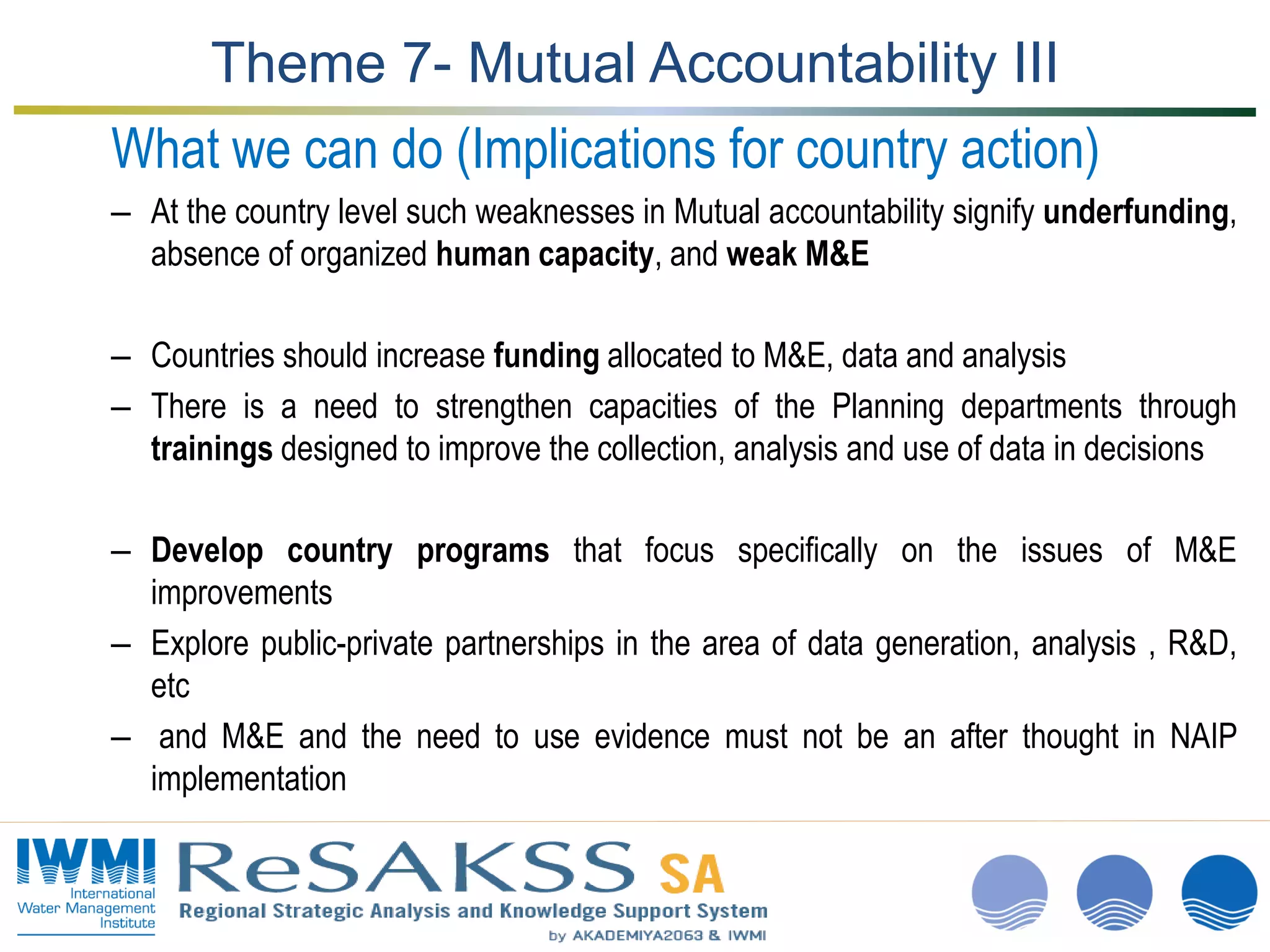
Theme 7- Mutual Accountability III
What we can do (Implications for country action)
– At the country level such weaknesses in Mutual accountability signify underfunding,
absence of organized human capacity, and weak M&E
– Countries should increase funding allocated to M&E, data and analysis
– There is a need to strengthen capacities of the Planning departments through
trainings designed to improve the collection, analysis and use of data in decisions
– Develop country programs that focus specifically on the issues of M&E
improvements
– Explore public-private partnerships in the area of data generation, analysis , R&D,
etc
– and M&E and the need to use evidence must not be an after thought in NAIP
implementation
www.iwmi.org
A water-secure world
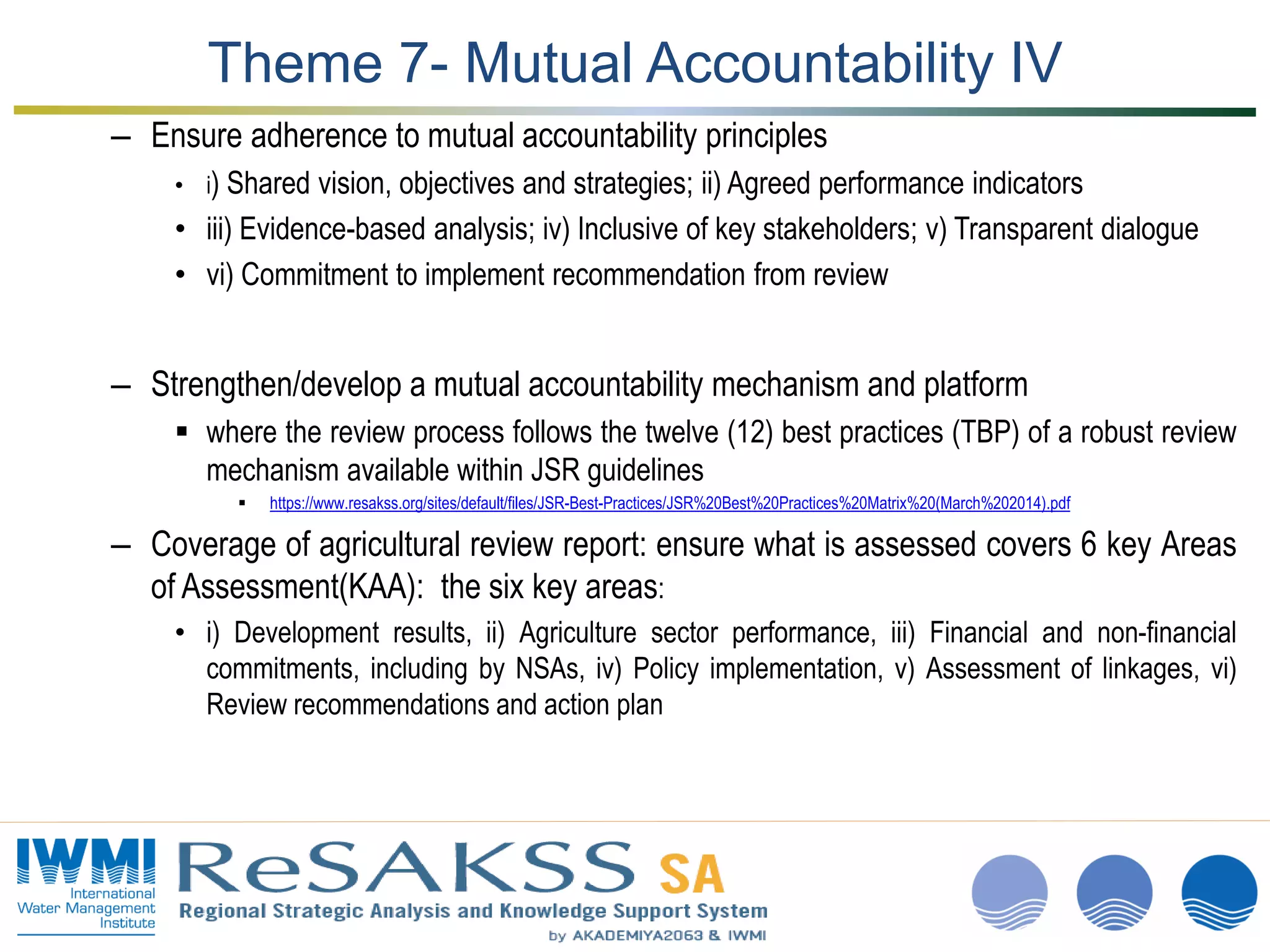
Theme 7- Mutual Accountability IV
– Ensure adherence to mutual accountability principles
• i) Shared vision, objectives and strategies; ii) Agreed performance indicators
• iii) Evidence-based analysis; iv) Inclusive of key stakeholders; v) Transparent dialogue
• vi) Commitment to implement recommendation from review
– Strengthen/develop a mutual accountability mechanism and platform
 where the review process follows the twelve (12) best practices (TBP) of a robust review
mechanism available within JSR guidelines
 https://www.resakss.org/sites/default/files/JSR-Best-Practices/JSR%20Best%20Practices%20Matrix%20(March%202014).pdf
– Coverage of agricultural review report: ensure what is assessed covers 6 key Areas
of Assessment(KAA): the six key areas:
• i) Development results, ii) Agriculture sector performance, iii) Financial and non-financial
commitments, including by NSAs, iv) Policy implementation, v) Assessment of linkages, vi)
Review recommendations and action plan
www.iwmi.org
A water-secure world
– Thank You
– Je vous remercie
– Muito obrigado

Policy Implications of the 2020 Biennial Review Report: A focus on Mutual Accountability - Malabo Policy Learning Event 2020

  • 1.
    Photo:DavidBrazier/IWMIPhoto:TomvanCakenberghe/IWMIPhoto:DavidBrazier/IWMIPhoto:DavidBrazier/IWMI A water-secure world www.iwmi.org PolicyImplications of The 2020 Biennial Review Report: A focus on Mutual Accountability Greenwell Matchaya, PhD Senior Researcher- Economics/ReSAKSS-SA Coordinator, IWMI Presented at Malabo Policy Learning Event Online 08/12/2020
  • 2.
    www.iwmi.org A water-secure world Theme1- CAADP process – Three indicators • 1-1 Commitment to CAADP Process, CAADPPro • 1-2 Existence of, and Quality of multi-sectorial and multi-stakeholder coordination body, Qc • 1-3 Evidence-based policies, supportive institutions and corresponding human resources, EIP • WHAT WORKED – Good number of countries reported and performed well. 23 countries are not on track while 4 countries did not report. – No data issues for indicators on CAADP and Evidence based policies
  • 3.
    www.iwmi.org A water-secure world Theme1- CAADP process II What did not Work – Indicator 1-2 on existence of multi-stakeholder coordinating body: Countries scoring more than 100% out of 100. – This signifies a computational problem (or) as well as challenges with collection of data for parameters – Parameters are data demanding and cumbersome to track eg meetings, What we can do (Implications) – Advocate for improving meetings data gathering at country level/ – Improve the planning process. A training to this extent is needed. – Strengthen country and regional validation of data to improve quality – Put up systems for recording meetings, leveraging on ICT – Complete the CAADP process- political will needed here
  • 4.
    www.iwmi.org A water-secure world Theme7- Mutual Accountability Three indicators – 7-1 Index of capacity to generate and use agriculture statistical data and information, ASCI – 7-2 Existence of inclusive institutionalized mechanisms and platforms for mutual accountability, ECI – 7-3 Country Biennial Report submission, BR What Worked – There was nothing unusual in terms of data patterns – But
  • 5.
    www.iwmi.org A water-secure world Theme7- Mutual Accountability II What did not Work Well – Frequency of data generation at source is a problem for 7-1 on index of capacity to generate ag stats – as this is externally generated source. http://www.gsars.org/wpcontent/uploads/2014/09/Guidelines_Country- Assessment_FINAL.pdf – For indicator 7-3 on country biennial report submission, the entry is supposed to be completed at the country, regional and AUC level- often RECs did not enter. What we can do (Implications) – eBR team, RECs, ReSAKSS/experts should work together to fill EC7-3 – 7-3 action, should trigger action upon completing other steps- eg once a country sends eBR, let an alert be generated to ensure the REC acts, etc – Provide training to RECs on filling their parts of the reporting template
  • 6.
    www.iwmi.org A water-secure world Theme7- Mutual Accountability III What we can do (Implications for country action) – At the country level such weaknesses in Mutual accountability signify underfunding, absence of organized human capacity, and weak M&E – Countries should increase funding allocated to M&E, data and analysis – There is a need to strengthen capacities of the Planning departments through trainings designed to improve the collection, analysis and use of data in decisions – Develop country programs that focus specifically on the issues of M&E improvements – Explore public-private partnerships in the area of data generation, analysis , R&D, etc – and M&E and the need to use evidence must not be an after thought in NAIP implementation
  • 7.
    www.iwmi.org A water-secure world Theme7- Mutual Accountability IV – Ensure adherence to mutual accountability principles • i) Shared vision, objectives and strategies; ii) Agreed performance indicators • iii) Evidence-based analysis; iv) Inclusive of key stakeholders; v) Transparent dialogue • vi) Commitment to implement recommendation from review – Strengthen/develop a mutual accountability mechanism and platform  where the review process follows the twelve (12) best practices (TBP) of a robust review mechanism available within JSR guidelines  https://www.resakss.org/sites/default/files/JSR-Best-Practices/JSR%20Best%20Practices%20Matrix%20(March%202014).pdf – Coverage of agricultural review report: ensure what is assessed covers 6 key Areas of Assessment(KAA): the six key areas: • i) Development results, ii) Agriculture sector performance, iii) Financial and non-financial commitments, including by NSAs, iv) Policy implementation, v) Assessment of linkages, vi) Review recommendations and action plan
  • 8.
    www.iwmi.org A water-secure world –Thank You – Je vous remercie – Muito obrigado