What are the
Functions of Management;
the POLC Framework?
REPORTER: MARY JANE B. BAJENTING, LPT
LETS HAVE A SHORT GAME!
ARRANGE THE SCRAMBLE LETTERS!
GNPNAINL-is the function of management that involves setting
objectives and determining a course of action for
achieving those objectives.
(Reference: http://open.lib.umn.edu/principlesmanagement/)
PLANNING
INRINZOAGG-is the function of management that involves
developing an organizational structure and
allocating human resources to ensure the
accomplishment of objectives.
(Reference: http://open.lib.umn.edu/principlesmanagement/)
ORGANIZING
INDLAGE
•involves the social and informal sources of influence
that you use to inspire action taken by others.
(Reference: http://open.lib.umn.edu/principlesmanagement/)
LEADING
LOLNRICGONT
•involves ensuring that performance does not deviate from
standards
(Reference: http://open.lib.umn.edu/principlesmanagement/)
CONTROLLING
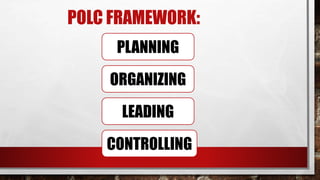
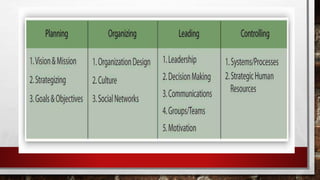
POLC FRAMEWORK:
PLANNING
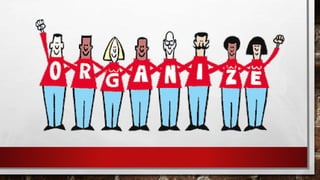
ORGANIZING
CONTROLLING
LEADING
THE PLANNING FUNCTION
The Foremost Management Function Is Planning. It is the setting of
direction for an organization, in some form of a system, and then
working to ensure that system follows that direction.
Reference: Zarate, C. A., (2009) Principles of Management, pg. 63 C & E Publishing , Inc.
Of the functions of management- planning, organizing , leading, and
controlling- planning is the primary function because it
precedes and, therefore, serves as the basis for organizing,
influencing, and controlling. Planning provides a framework for
organizing resources, structuring an organization, placing people, and
establishing control activities.
Reference: Zarate, C. A., (2009) Principles of Management, pg. 63 C & E Publishing , Inc.
Planning is the formal process of conceptualizing an organization
vision, mission and overall goals and objectives and deciding how
best to achieve them within a short, medium, and long term.
Reference: Santos, E.T. (2005) Practice, concepts and principles of management,, pg 64 Library of
CongressCatloging
Reference: Lorenzana (2003) Management: Theory and practice, pg. 15, Rex Bookstore
Planning is the process of setting the objectives to be
accomplished by an organization during a future time period
and deciding on the methods of reaching them.
BASIC CONCEPTS IN PLANNING
•GOALS- Goals are specific accomplishments or action plans targeted
usually for a particular period of time. Another term for goals is
objectives.
•STRATEGIES OR ACTIVITIES- These are the methods or processes required
in total, or in combination, to achieve the goals.
•TASKS- These are specific works or actions required to implement the
plan.
Reference: Zarate, C. A., (2009) Principles of Management, pg. 64C & E
Publishing , Inc.
PHASES IN PLANNING
• First Phase- Align the plan with the mission/vision of the company. This sets the overall
direction of the company.
• Second Phase- Scan the environment. Identify the resources need to implement the
plan. This is necessary because if the needed resources have not been provided or are
insufficient, even if plans have already been laid, then plans will most likely be put to
waste.
• Third Phase- Conduct a SWOT (Strengths, weaknesses, opportunities and
threats) analysis for the company.
Reference: Zarate, C. A., (2009) Principles of Management, pg. 66 C & E Publishing , Inc.
•Fourth Phase- Based on the mission/vision, it is time to formulate the goals or
objectives of the company for a specific period of time.
•Fifth Phase- Establish courses of action to implement the plans. The courses of
action should depend on affordability, efficiency and practicality.
•Sixth Phase- Based on the plans, assign responsibilities. In this phase the people
involved is identifies. Timeliness are also set.
•Seventh Phase- Document the whole plan and distribute it to people concerned.
•Eight Phase- Acknowledge completion of the plan.
Reference: Zarate, C. A., (2009) Principles of Management, C & E Publishing , Inc.
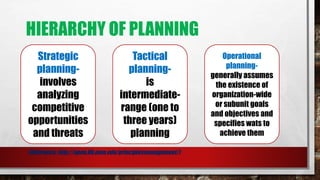
HIERARCHY OF PLANNING
Operational
planning-
generally assumes
the existence of
organization-wide
or subunit goals
and objectives and
specifies wats to
achieve them
Tactical
planning-
is
intermediate-
range (one to
three years)
planning
Strategic
planning-
involves
analyzing
competitive
opportunities
and threats
(Reference: http://open.lib.umn.edu/principlesmanagement/)
THE ORGANIZING FUNCTION
One of the key issues in implementing the goals of an
organization is structuring jobs, grouping them , and making
sure that the functions will be performed by qualified and
competent personnel. This is the organizing process.
Reference: Zarate, C. A., (2009) Principles of Management, pg. 87 C & E
Publishing , Inc.
Organizing is the process of building relationship among functions, material, and
people for a common purpose. Organizing answers these questions:
1. What needs to be done and how?
2. Who’s involved and how?
3. Who needs resources and when
4. What are the relationships among people, task, places, things and outcomes?
Reference: Santos, E.T. (2005) Practice, concepts and principles of management,, pg 136Library of
CongressCatloging
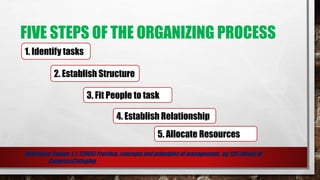
FIVE STEPS OF THE ORGANIZING PROCESS
Reference: Santos, E.T. (2005) Practice, concepts and principles of management,, pg 123 Library of
CongressCatloging
1. Identify tasks
2. Establish Structure
3. Fit People to task
4. Establish Relationship
5. Allocate Resources
THE LEADING FUNCTION
Leading is the complex process. It involves influencing
others to accomplish a mission, task or goal. A leader is
someone who directs the organization.
Reference: Zarate, C. A., (2009) Principles of Management, pg. 119 C & E
Publishing , Inc.
Stogdill (1974, As Cited in Bolden, Gosling, Maturano, &
Dennison, 2003) identified the key leadership
traits. See the following table:
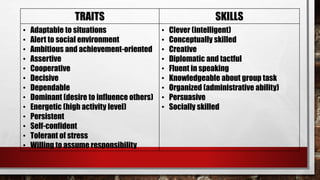
TRAITS SKILLS
• Adaptable to situations
• Alert to social environment
• Ambitious and achievement-oriented
• Assertive
• Cooperative
• Decisive
• Dependable
• Dominant (desire to influence others)
• Energetic (high activity level)
• Persistent
• Self-confident
• Tolerant of stress
• Willing to assume responsibility
• Clever (intelligent)
• Conceptually skilled
• Creative
• Diplomatic and tactful
• Fluent in speaking
• Knowledgeable about group task
• Organized (administrative ability)
• Persuasive
• Socially skilled
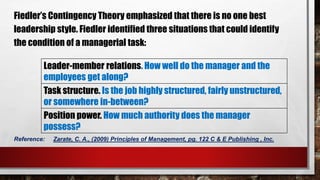
Fiedler’s Contingency Theory emphasized that there is no one best
leadership style. Fiedler identified three situations that could identify
the condition of a managerial task:
Leader-member relations. How well do the manager and the
employees get along?
Task structure. Is the job highly structured, fairly unstructured,
or somewhere in-between?
Position power. How much authority does the manager
possess?
Reference: Zarate, C. A., (2009) Principles of Management, pg. 122 C & E Publishing , Inc.
Tannenbaum and Schmidt developed the
Leadership Continuum. The believed that leadership
styles vary along a continuum. This continuum suggests that
when one moves away from the extremely autocratic
leadership, subordinate participation and involvement in
decision making increases.
Reference: Zarate, C. A., (2009) Principles of Management, pg. 125 C & E
Publishing , Inc.
Continuum
Noun | con-tin-u-um|
Plural con-tin-ua also con-tin-u-ums
1. A coherent whole characterized as a collection , sequence or
progression of values or elements varying by minute degrees
Reference: Merriam Dictionary
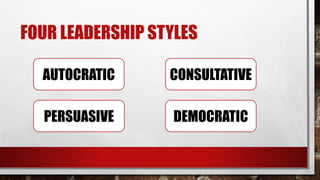
FOUR LEADERSHIP STYLES
AUTOCRATIC
PERSUASIVE
CONSULTATIVE
DEMOCRATIC
Autocratic- The Leader Takes The
Decisions And Relays Them To His
Subordinates (Telling Style)
Persuasive-the Leader Also Takes The Decisions
For The Group Without Consultation But
Persuades Them To Believe That These Will Make
Them More Motivated ( Selling Style)
Consultative- The Leader Asks And Confers With
The Group Members Before Taking Decisions. He
Considers Their Suggestions And Feelings
Before Taking Decision (Consulting Style)
•Democratic- The Leader Lays Down The Problem To
The Members. He Is Not The Decision Maker. The
Decision Will Come Out Of The Discussion Instead Of
Imposing His Decision To The Member (Joining Style)
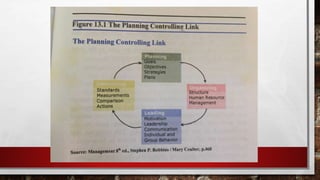
THE CONTROLLING FUNCTION
•Conrolling Involves the establishment of performance
standards based on the firm’s objectives , metasurement of
actual performance, and, after assessing actual
performance based on the standards, implementation of
corrective and/or preventive action as necessary.
Reference: Zarate, C. A., (2009) Principles of Management, pg. 135C & E
Publishing , Inc.
Controlling Is The Process managers go through
to find out what has been accomplished
compared to the predetermined targets.
Reference: Miranda, M. (2002) Management Principle and Practices, L & G Business House
CHARACTERISTICS OF THE
CONTROL PROCESS
EFFECTIVE CONTROL SYSTEMS HAVE THE
FOLLOWING CHARACTERISTICS
A.Control at all levels in the business;
B.Acceptability to those who will enforce decisions;
C.Flexibility;
D.Accuracy
E.Timeliness
Reference: Zarate, C. A., (2009) Principles of Management, pg. 136 C & E Publishing , Inc.
F. Cost effectiveness
G. Understandability;
H. Balance between objectivity and
subjectivity; and
I. Coordination in planning, organizing and leading
Reference: Zarate, C. A., (2009) Principles of Management, pg. 136 C & E Publishing , Inc.
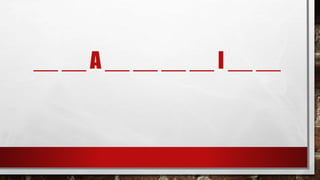
__ __ A __ __ __ __ I __ __
EVALUATION/FEEDBACKING-
“ MANAGEMENT IS A BALANCING ACT BETWEEN THE SHORT
TERM AND THE LONG TERM, BETWEEN OBJECTIVES AT
DIFFERENT TIMES”
-PETER F. DRUCKLER

POLC FRAMEWORK

  • 1.
    What are the Functionsof Management; the POLC Framework? REPORTER: MARY JANE B. BAJENTING, LPT
  • 2.
    LETS HAVE ASHORT GAME! ARRANGE THE SCRAMBLE LETTERS!
  • 3.
    GNPNAINL-is the functionof management that involves setting objectives and determining a course of action for achieving those objectives. (Reference: http://open.lib.umn.edu/principlesmanagement/)
  • 4.
  • 5.
    INRINZOAGG-is the functionof management that involves developing an organizational structure and allocating human resources to ensure the accomplishment of objectives. (Reference: http://open.lib.umn.edu/principlesmanagement/)
  • 6.
  • 7.
    INDLAGE •involves the socialand informal sources of influence that you use to inspire action taken by others. (Reference: http://open.lib.umn.edu/principlesmanagement/)
  • 8.
  • 9.
    LOLNRICGONT •involves ensuring thatperformance does not deviate from standards (Reference: http://open.lib.umn.edu/principlesmanagement/)
  • 10.
  • 11.
  • 13.
    THE PLANNING FUNCTION TheForemost Management Function Is Planning. It is the setting of direction for an organization, in some form of a system, and then working to ensure that system follows that direction. Reference: Zarate, C. A., (2009) Principles of Management, pg. 63 C & E Publishing , Inc.
  • 14.
    Of the functionsof management- planning, organizing , leading, and controlling- planning is the primary function because it precedes and, therefore, serves as the basis for organizing, influencing, and controlling. Planning provides a framework for organizing resources, structuring an organization, placing people, and establishing control activities. Reference: Zarate, C. A., (2009) Principles of Management, pg. 63 C & E Publishing , Inc.
  • 15.
    Planning is theformal process of conceptualizing an organization vision, mission and overall goals and objectives and deciding how best to achieve them within a short, medium, and long term. Reference: Santos, E.T. (2005) Practice, concepts and principles of management,, pg 64 Library of CongressCatloging
  • 16.
    Reference: Lorenzana (2003)Management: Theory and practice, pg. 15, Rex Bookstore Planning is the process of setting the objectives to be accomplished by an organization during a future time period and deciding on the methods of reaching them.
  • 17.
    BASIC CONCEPTS INPLANNING •GOALS- Goals are specific accomplishments or action plans targeted usually for a particular period of time. Another term for goals is objectives. •STRATEGIES OR ACTIVITIES- These are the methods or processes required in total, or in combination, to achieve the goals. •TASKS- These are specific works or actions required to implement the plan. Reference: Zarate, C. A., (2009) Principles of Management, pg. 64C & E Publishing , Inc.
  • 18.
    PHASES IN PLANNING •First Phase- Align the plan with the mission/vision of the company. This sets the overall direction of the company. • Second Phase- Scan the environment. Identify the resources need to implement the plan. This is necessary because if the needed resources have not been provided or are insufficient, even if plans have already been laid, then plans will most likely be put to waste. • Third Phase- Conduct a SWOT (Strengths, weaknesses, opportunities and threats) analysis for the company. Reference: Zarate, C. A., (2009) Principles of Management, pg. 66 C & E Publishing , Inc.
  • 19.
    •Fourth Phase- Basedon the mission/vision, it is time to formulate the goals or objectives of the company for a specific period of time. •Fifth Phase- Establish courses of action to implement the plans. The courses of action should depend on affordability, efficiency and practicality. •Sixth Phase- Based on the plans, assign responsibilities. In this phase the people involved is identifies. Timeliness are also set. •Seventh Phase- Document the whole plan and distribute it to people concerned. •Eight Phase- Acknowledge completion of the plan. Reference: Zarate, C. A., (2009) Principles of Management, C & E Publishing , Inc.
  • 20.
    HIERARCHY OF PLANNING Operational planning- generallyassumes the existence of organization-wide or subunit goals and objectives and specifies wats to achieve them Tactical planning- is intermediate- range (one to three years) planning Strategic planning- involves analyzing competitive opportunities and threats (Reference: http://open.lib.umn.edu/principlesmanagement/)
  • 22.
    THE ORGANIZING FUNCTION Oneof the key issues in implementing the goals of an organization is structuring jobs, grouping them , and making sure that the functions will be performed by qualified and competent personnel. This is the organizing process. Reference: Zarate, C. A., (2009) Principles of Management, pg. 87 C & E Publishing , Inc.
  • 23.
    Organizing is theprocess of building relationship among functions, material, and people for a common purpose. Organizing answers these questions: 1. What needs to be done and how? 2. Who’s involved and how? 3. Who needs resources and when 4. What are the relationships among people, task, places, things and outcomes? Reference: Santos, E.T. (2005) Practice, concepts and principles of management,, pg 136Library of CongressCatloging
  • 24.
    FIVE STEPS OFTHE ORGANIZING PROCESS Reference: Santos, E.T. (2005) Practice, concepts and principles of management,, pg 123 Library of CongressCatloging 1. Identify tasks 2. Establish Structure 3. Fit People to task 4. Establish Relationship 5. Allocate Resources
  • 25.
    THE LEADING FUNCTION Leadingis the complex process. It involves influencing others to accomplish a mission, task or goal. A leader is someone who directs the organization. Reference: Zarate, C. A., (2009) Principles of Management, pg. 119 C & E Publishing , Inc.
  • 26.
    Stogdill (1974, AsCited in Bolden, Gosling, Maturano, & Dennison, 2003) identified the key leadership traits. See the following table:
  • 27.
    TRAITS SKILLS • Adaptableto situations • Alert to social environment • Ambitious and achievement-oriented • Assertive • Cooperative • Decisive • Dependable • Dominant (desire to influence others) • Energetic (high activity level) • Persistent • Self-confident • Tolerant of stress • Willing to assume responsibility • Clever (intelligent) • Conceptually skilled • Creative • Diplomatic and tactful • Fluent in speaking • Knowledgeable about group task • Organized (administrative ability) • Persuasive • Socially skilled
  • 28.
    Fiedler’s Contingency Theoryemphasized that there is no one best leadership style. Fiedler identified three situations that could identify the condition of a managerial task: Leader-member relations. How well do the manager and the employees get along? Task structure. Is the job highly structured, fairly unstructured, or somewhere in-between? Position power. How much authority does the manager possess? Reference: Zarate, C. A., (2009) Principles of Management, pg. 122 C & E Publishing , Inc.
  • 29.
    Tannenbaum and Schmidtdeveloped the Leadership Continuum. The believed that leadership styles vary along a continuum. This continuum suggests that when one moves away from the extremely autocratic leadership, subordinate participation and involvement in decision making increases. Reference: Zarate, C. A., (2009) Principles of Management, pg. 125 C & E Publishing , Inc.
  • 30.
    Continuum Noun | con-tin-u-um| Pluralcon-tin-ua also con-tin-u-ums 1. A coherent whole characterized as a collection , sequence or progression of values or elements varying by minute degrees Reference: Merriam Dictionary
  • 31.
  • 32.
    Autocratic- The LeaderTakes The Decisions And Relays Them To His Subordinates (Telling Style)
  • 33.
    Persuasive-the Leader AlsoTakes The Decisions For The Group Without Consultation But Persuades Them To Believe That These Will Make Them More Motivated ( Selling Style)
  • 34.
    Consultative- The LeaderAsks And Confers With The Group Members Before Taking Decisions. He Considers Their Suggestions And Feelings Before Taking Decision (Consulting Style)
  • 35.
    •Democratic- The LeaderLays Down The Problem To The Members. He Is Not The Decision Maker. The Decision Will Come Out Of The Discussion Instead Of Imposing His Decision To The Member (Joining Style)
  • 37.
    THE CONTROLLING FUNCTION •ConrollingInvolves the establishment of performance standards based on the firm’s objectives , metasurement of actual performance, and, after assessing actual performance based on the standards, implementation of corrective and/or preventive action as necessary. Reference: Zarate, C. A., (2009) Principles of Management, pg. 135C & E Publishing , Inc.
  • 38.
    Controlling Is TheProcess managers go through to find out what has been accomplished compared to the predetermined targets. Reference: Miranda, M. (2002) Management Principle and Practices, L & G Business House
  • 39.
  • 40.
    EFFECTIVE CONTROL SYSTEMSHAVE THE FOLLOWING CHARACTERISTICS A.Control at all levels in the business; B.Acceptability to those who will enforce decisions; C.Flexibility; D.Accuracy E.Timeliness Reference: Zarate, C. A., (2009) Principles of Management, pg. 136 C & E Publishing , Inc.
  • 41.
    F. Cost effectiveness G.Understandability; H. Balance between objectivity and subjectivity; and I. Coordination in planning, organizing and leading Reference: Zarate, C. A., (2009) Principles of Management, pg. 136 C & E Publishing , Inc.
  • 44.
    __ __ A__ __ __ __ I __ __
  • 45.
  • 46.
    “ MANAGEMENT ISA BALANCING ACT BETWEEN THE SHORT TERM AND THE LONG TERM, BETWEEN OBJECTIVES AT DIFFERENT TIMES” -PETER F. DRUCKLER