Principles of
Principles of
Management
Management
MGT 301
MGT 301
VINODKUMAR
VINODKUMAR
Management: A Competency Base Approach
Methodology
Methodology
 Lectures
Lectures
 Videos
Videos
 Cases
Cases
 Presentations
Presentations
 Discussions and debates
Discussions and debates
 Research reports
Research reports
 Projects
Projects
Webpage, Blog, Wiki, email
 http://faculty.kfupm.edu.sa/MGM/jamilqaz/
 http://mgt301.pbwiki.com/
 http://mgt301.blogspot.com/
 mgt301.072@gmail.com
Chapter 1
Chapter 1
Managing in a Dynamic
Environment
Environment
Learning Objectives
Learning Objectives
 Define Managers And Management.
Define Managers And Management.
 Explain What Managers Do.
Explain What Managers Do.
 Describe The Competencies Used In
Describe The Competencies Used In
Managerial Work And Assess Your
Current Competency Levels.
Introductory Concepts: What Are
Managerial Competencies?
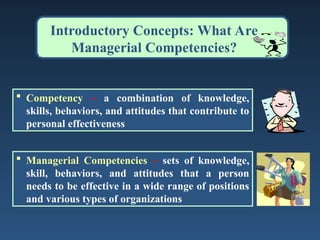
 Competency – a combination of knowledge,
skills, behaviors, and attitudes that contribute to
personal effectiveness
 Managerial Competencies – sets of knowledge,
skill, behaviors, and attitudes that a person
needs to be effective in a wide range of positions
and various types of organizations
Why are Managerial Competencies
Important?
 You need to use your strengths to do your best
 You need to know your weaknesses
 You need developmental experiences at work to become
successful leaders and address your weakness
 You probably like to be challenged with new learning
opportunities
 Organizations do not want to waste human resources
 Globalization deregulation, restructuring, and new
competitors add to the complexity of running a business
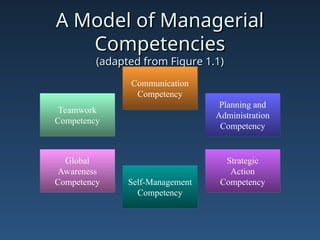
A Model of Managerial
Competencies
Competencies
(adapted from Figure 1.1)
Teamwork
Competency
Global
Awareness
Competency
Strategic
Action
Competency
Planning and
Administration
Competency
Self-Management
Competency
Communication
Competency
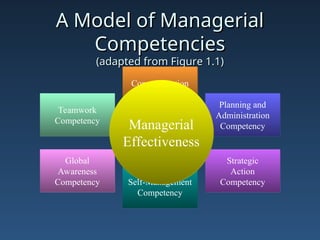
A Model of Managerial
Competencies
Competencies
(adapted from Figure 1.1)
Teamwork
Competency
Global
Awareness
Competency
Strategic
Action
Competency
Planning and
Administration
Competency
Self-Management
Competency
Communication
Competency
Managerial
Effectiveness
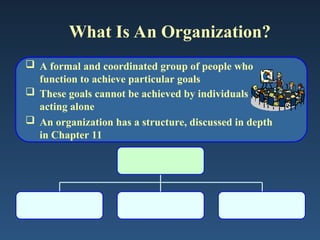
What Is An Organization?
 A formal and coordinated group of people who
function to achieve particular goals
 These goals cannot be achieved by individuals
acting alone
 An organization has a structure, discussed in depth
in Chapter 11
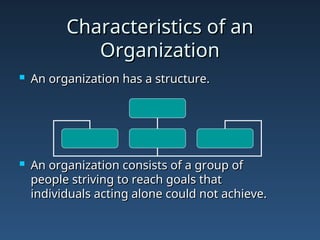
Characteristics of an
Organization
Organization
 An organization has a structure.
An organization has a structure.
 An organization consists of a group of
An organization consists of a group of
people striving to reach goals that
individuals acting alone could not achieve.
Management
Management
Organization
Organization
Two or more people who work together in a structured
way to achieve a specific goal or set of goals.
Goals
Goals
Purpose that an organization strives to achieve;
organizations often have more than one goals, goals are
fundamental elements of organization.
The Role of Management
To guide the organizations towards goal
accomplishment
accomplishment
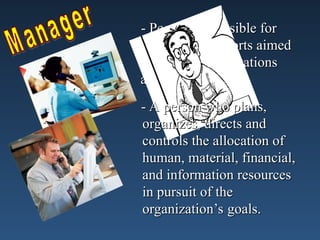
- People responsible for
directing the efforts aimed
at helping organizations
achieve their goals.
- A person who plans,
organizes, directs and
controls the allocation of
human, material, financial,
and information resources
in pursuit of the
in pursuit of the
organization’s goals.
Management
Management
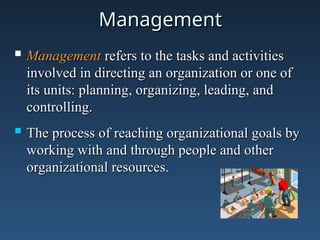
 Management
Management refers to the tasks and activities
refers to the tasks and activities
involved in directing an organization or one of
its units: planning, organizing, leading, and
controlling.
controlling.
 The process of reaching organizational goals by
The process of reaching organizational goals by
working with and through people and other
organizational resources.
Functional Managers: A manager responsible for
just one organizational activity such as accounting,
human resources, sales, finance, marketing, or
production
 Focus on technical areas of expertise
 Use communication, planning and
administration, teamwork and self-
management competencies to get work
done
Function: A classification referring to a group of
similar activities in an organization like marketing
marketing
or operations.
or operations.
General Managers: responsible for the operations
of more complex units—for example, a company or
division
 Oversee work of functional managers
 Responsible for all the activities of the unit
 Need to acquire strategic and multicultural
competencies to guide organization
(cont’d)
Many Other types of managers
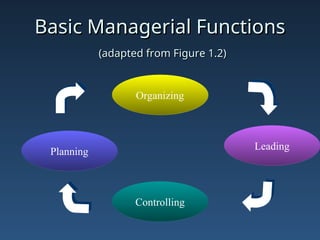
Basic Managerial Functions
(adapted from Figure 1.2)
Organizing
Planning
Controlling
Leading
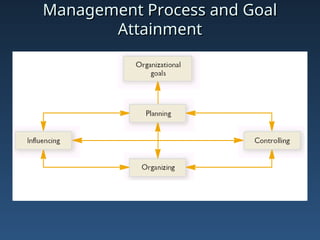
Management Process and Goal
Attainment
Attainment
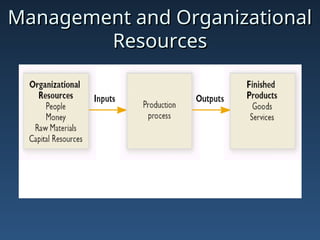
Management and Organizational
Resources
Resources
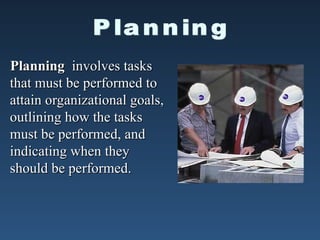
Planning
Planning involves tasks
involves tasks
that must be performed to
attain organizational goals,
outlining how the tasks
must be performed, and
indicating when they
should be performed.
Planning
 Determining organizational goals and
means to reach them
 Managers plan for three reasons
1. Establish an overall direction for the
organization’s future
2. Identify and commit resources to achieving
goals
3. Decide which tasks must be done to reach
those goals
 Discussed in depth in Chapter 7 & 8
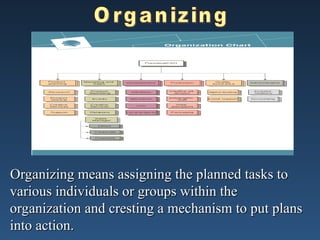
Organizing means assigning the planned tasks to
various individuals or groups within the
organization and cresting a mechanism to put plans
into action.
into action.
Organizing
 Process of deciding where decisions will be made, who
will perform what jobs and tasks, and who will report
to whom in the company
 Includes creating departments and job descriptions
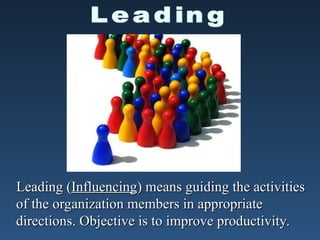
Leading (
Leading (Influencing
Influencing) means guiding the activities
) means guiding the activities
of the organization members in appropriate
directions. Objective is to improve productivity.
Leading
 Getting others to perform the
necessary tasks by motivating them to
achieve the organization’s goals
 Crucial element in all functions
 Discussed throughout the book and in
depth in Chapter 15—Dynamics of
Leadership
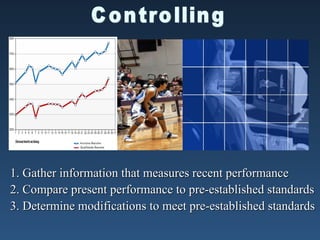
1. Gather information that measures recent performance
2. Compare present performance to pre-established standards
3. Determine modifications to meet pre-established standards
Controlling
 Process by which a person, group,
or
organization consciously monitors
performance and takes corrective
action
 Discussed in depth in Chapter 10
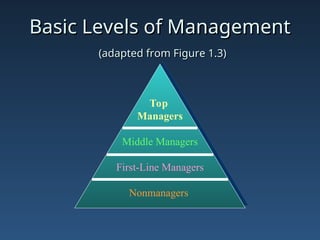
Basic Levels of Management
(adapted from Figure 1.3)
Top
Managers
Middle Managers
First-Line Managers
Nonmanagers
Top Managers
 Responsible for providing the overall direction of an
organization
 Develop goals and strategies for entire organization
 Spend most of their time planning and leading
 Communicate with key stakeholders—stockholders,
unions, governmental agencies, etc., company
policies
 Use of multicultural and strategic action
competencies to lead firm is crucial
Levels of Management
 First-line Managers:
First-line Managers: have direct responsibility for
have direct responsibility for
producing goods or services
producing goods or services Foreman, supervisors,
Foreman, supervisors,
clerical supervisors
 Middle Managers:
Middle Managers:
 Coordinate employee activities
Coordinate employee activities
 Determine which goods or services to provide
Determine which goods or services to provide
 Decide how to market goods or services to customers
Decide how to market goods or services to customers
Assistant Manager, Manager (Section Head)
 Top Managers:
Top Managers: provide the overall direction of an
organization Chief Executive Officer, President, Vice
President
First-line Managers
 Directly responsible for production of goods or services
 Employees who report to first-line managers do the
organization’s work
 Spend little time with top managers in large organizations
 Technical expertise is important
 Rely on planning and administration, self-management,
teamwork, and communication competencies to get work
done
Middle Managers
 Responsible for setting objectives that are consistent with
top management’s goals and translating them into specific
goals and plans for first-line managers to implement
 Responsible for coordinating activities of first-line
managers
 Establish target dates for products/services to be delivered
 Need to coordinate with others for resources
 Ability to develop others is important
 Rely on communication, teamwork, and planning and
administration competencies to achieve goals
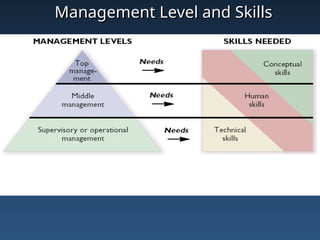
Management Level and Skills
Introductory Concepts: What Are
Managerial Competencies?
 Competency – a combination of knowledge,
skills, behaviors, and attitudes that contribute to
personal effectiveness
 Managerial Competencies – sets of knowledge,
skill, behaviors, and attitudes that a person
needs to be effective in a wide range of positions
and various types of organizations
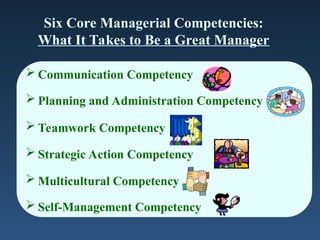
Six Core Managerial Competencies:
What It Takes to Be a Great Manager
 Communication Competency
 Planning and Administration Competency
 Teamwork Competency
 Strategic Action Competency
 Multicultural Competency
 Self-Management Competency
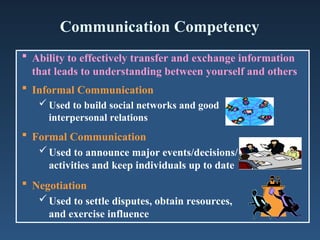
Communication Competency
 Ability to effectively transfer and exchange information
that leads to understanding between yourself and others
 Informal Communication
 Used to build social networks and good
interpersonal relations
 Formal Communication
Used to announce major events/decisions/
activities and keep individuals up to date
 Negotiation
Used to settle disputes, obtain resources,
and exercise influence
 Deciding what tasks need to be done, determining
how they can be done, allocating resources to enable
them to be done, and then monitoring progress to
ensure that they are done
 Information gathering, analysis, and problem solving
from employees and customers
 Planning and organizing projects with agreed
upon completion dates
 Time management
 Budgeting and financial management
 Accomplishing tasks through small groups of
people who are collectively responsible and
whose job requires coordination
 Designing teams properly involves having
people participate in setting goals
 Creating a supportive team environment gets
people committed to the team’s goals
 Managing team dynamics involves settling
conflicts, sharing team success, and assign tasks
that use team members’ strengths
Strategic Action Competency
 Understanding the overall mission and values of
the organization and ensuring that employees’
actions match with them
 Understanding how departments or divisions of
the organization are interrelated
 Taking key strategic actions to position the firm
for success, especially in relation to concern of
stakeholders
 Leapfrogging competitors
Snapshot
“Sony must sell off businesses that don’t fit
its core strategy of fusing gadgets with films,
music, and game software. That means
selling off its businesses in its Sony Financial
Holdings, which are very profitable.”
Howard Stringer, CEO, Sony
 Understanding, appreciating and responding to
diverse political, cultural, and economic issues
across and within nations
 Cultural knowledge and understanding of the
events in at least a few other cultures
 Cultural openness and sensitivity to how others
think, act, and feel
 Respectful of social etiquette variations
 Accepting of language differences
Multicultural Competency
Self-Management Competency
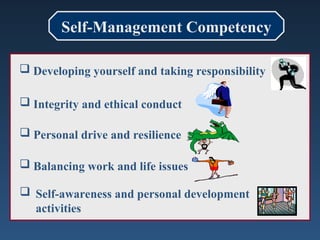
 Developing yourself and taking responsibility
 Integrity and ethical conduct
 Personal drive and resilience
 Balancing work and life issues
 Self-awareness and personal development
activities
Snapshot
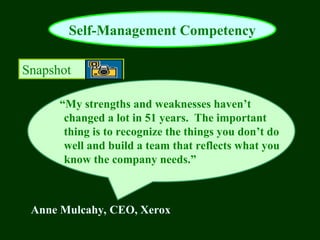
“My strengths and weaknesses haven’t
changed a lot in 51 years. The important
thing is to recognize the things you don’t do
well and build a team that reflects what you
know the company needs.”
Anne Mulcahy, CEO, Xerox
Self-Management Competency
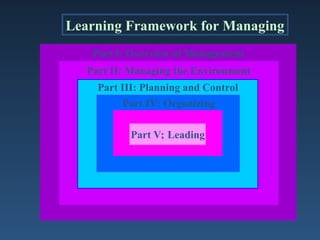
Learning Framework for Managing
Part I: Overview of Management
Part II: Managing the Environment
Part III: Planning and Control
Part IV: Organizing
Part V; Leading

PrinciplesofManagement_14_Communication.pptx

  • 1.
  • 2.
    Management: A CompetencyBase Approach Management: A Competency Base Approach
  • 3.
    Methodology Methodology  Lectures Lectures  Videos Videos Cases Cases  Presentations Presentations  Discussions and debates Discussions and debates  Research reports Research reports  Projects Projects
  • 4.
    Webpage, Blog, Wiki,email Webpage, Blog, Wiki, email  http://faculty.kfupm.edu.sa/MGM/jamilqaz/  http://mgt301.pbwiki.com/  http://mgt301.blogspot.com/  mgt301.072@gmail.com
  • 5.
    Chapter 1 Chapter 1 Managingin a Dynamic Managing in a Dynamic Environment Environment
  • 6.
    Learning Objectives Learning Objectives Define Managers And Management. Define Managers And Management.  Explain What Managers Do. Explain What Managers Do.  Describe The Competencies Used In Describe The Competencies Used In Managerial Work And Assess Your Managerial Work And Assess Your Current Competency Levels. Current Competency Levels.
  • 7.
    Introductory Concepts: WhatAre Managerial Competencies?  Competency – a combination of knowledge, skills, behaviors, and attitudes that contribute to personal effectiveness  Managerial Competencies – sets of knowledge, skill, behaviors, and attitudes that a person needs to be effective in a wide range of positions and various types of organizations
  • 8.
    Why are ManagerialCompetencies Important?  You need to use your strengths to do your best  You need to know your weaknesses  You need developmental experiences at work to become successful leaders and address your weakness  You probably like to be challenged with new learning opportunities  Organizations do not want to waste human resources  Globalization deregulation, restructuring, and new competitors add to the complexity of running a business
  • 9.
    A Model ofManagerial A Model of Managerial Competencies Competencies (adapted from Figure 1.1) (adapted from Figure 1.1) Teamwork Competency Global Awareness Competency Strategic Action Competency Planning and Administration Competency Self-Management Competency Communication Competency
  • 10.
    A Model ofManagerial A Model of Managerial Competencies Competencies (adapted from Figure 1.1) (adapted from Figure 1.1) Teamwork Competency Global Awareness Competency Strategic Action Competency Planning and Administration Competency Self-Management Competency Communication Competency Managerial Effectiveness
  • 11.
    What Is AnOrganization?  A formal and coordinated group of people who function to achieve particular goals  These goals cannot be achieved by individuals acting alone  An organization has a structure, discussed in depth in Chapter 11
  • 12.
    Characteristics of an Characteristicsof an Organization Organization  An organization has a structure. An organization has a structure.  An organization consists of a group of An organization consists of a group of people striving to reach goals that people striving to reach goals that individuals acting alone could not achieve. individuals acting alone could not achieve.
  • 13.
    Management Management Organization Organization Two or morepeople who work together in a structured Two or more people who work together in a structured way to achieve a specific goal or set of goals. way to achieve a specific goal or set of goals. Goals Goals Purpose that an organization strives to achieve; Purpose that an organization strives to achieve; organizations often have more than one goals, goals are organizations often have more than one goals, goals are fundamental elements of organization. fundamental elements of organization. The Role of Management The Role of Management To guide the organizations towards goal To guide the organizations towards goal accomplishment accomplishment
  • 14.
    - People responsiblefor - People responsible for directing the efforts aimed directing the efforts aimed at helping organizations at helping organizations achieve their goals. achieve their goals. - A person who plans, - A person who plans, organizes, directs and organizes, directs and controls the allocation of controls the allocation of human, material, financial, human, material, financial, and information resources and information resources in pursuit of the in pursuit of the organization’s goals. organization’s goals.
  • 15.
    Management Management  Management Management refersto the tasks and activities refers to the tasks and activities involved in directing an organization or one of involved in directing an organization or one of its units: planning, organizing, leading, and its units: planning, organizing, leading, and controlling. controlling.  The process of reaching organizational goals by The process of reaching organizational goals by working with and through people and other working with and through people and other organizational resources. organizational resources.
  • 16.
    Functional Managers: Amanager responsible for just one organizational activity such as accounting, human resources, sales, finance, marketing, or production  Focus on technical areas of expertise  Use communication, planning and administration, teamwork and self- management competencies to get work done Function: A classification referring to a group of similar activities in an organization like marketing marketing or operations. or operations.
  • 17.
    General Managers: responsiblefor the operations of more complex units—for example, a company or division  Oversee work of functional managers  Responsible for all the activities of the unit  Need to acquire strategic and multicultural competencies to guide organization (cont’d) Many Other types of managers
  • 18.
    Basic Managerial Functions BasicManagerial Functions (adapted from Figure 1.2) (adapted from Figure 1.2) Organizing Planning Controlling Leading
  • 19.
    Management Process andGoal Management Process and Goal Attainment Attainment
  • 20.
    Management and Organizational Managementand Organizational Resources Resources
  • 21.
    Planning Planning involves tasks involvestasks that must be performed to that must be performed to attain organizational goals, attain organizational goals, outlining how the tasks outlining how the tasks must be performed, and must be performed, and indicating when they indicating when they should be performed. should be performed.
  • 22.
    Planning  Determining organizationalgoals and means to reach them  Managers plan for three reasons 1. Establish an overall direction for the organization’s future 2. Identify and commit resources to achieving goals 3. Decide which tasks must be done to reach those goals  Discussed in depth in Chapter 7 & 8
  • 23.
    Organizing means assigningthe planned tasks to Organizing means assigning the planned tasks to various individuals or groups within the various individuals or groups within the organization and cresting a mechanism to put plans organization and cresting a mechanism to put plans into action. into action.
  • 24.
    Organizing  Process ofdeciding where decisions will be made, who will perform what jobs and tasks, and who will report to whom in the company  Includes creating departments and job descriptions
  • 25.
    Leading ( Leading (Influencing Influencing)means guiding the activities ) means guiding the activities of the organization members in appropriate of the organization members in appropriate directions. Objective is to improve productivity. directions. Objective is to improve productivity.
  • 26.
    Leading  Getting othersto perform the necessary tasks by motivating them to achieve the organization’s goals  Crucial element in all functions  Discussed throughout the book and in depth in Chapter 15—Dynamics of Leadership
  • 27.
    1. Gather informationthat measures recent performance 1. Gather information that measures recent performance 2. Compare present performance to pre-established standards 2. Compare present performance to pre-established standards 3. Determine modifications to meet pre-established standards 3. Determine modifications to meet pre-established standards
  • 28.
    Controlling  Process bywhich a person, group, or organization consciously monitors performance and takes corrective action  Discussed in depth in Chapter 10
  • 29.
    Basic Levels ofManagement Basic Levels of Management (adapted from Figure 1.3) (adapted from Figure 1.3) Top Managers Middle Managers First-Line Managers Nonmanagers
  • 30.
    Top Managers  Responsiblefor providing the overall direction of an organization  Develop goals and strategies for entire organization  Spend most of their time planning and leading  Communicate with key stakeholders—stockholders, unions, governmental agencies, etc., company policies  Use of multicultural and strategic action competencies to lead firm is crucial
  • 31.
    Levels of Management Levelsof Management  First-line Managers: First-line Managers: have direct responsibility for have direct responsibility for producing goods or services producing goods or services Foreman, supervisors, Foreman, supervisors, clerical supervisors clerical supervisors  Middle Managers: Middle Managers:  Coordinate employee activities Coordinate employee activities  Determine which goods or services to provide Determine which goods or services to provide  Decide how to market goods or services to customers Decide how to market goods or services to customers Assistant Manager, Manager (Section Head) Assistant Manager, Manager (Section Head)  Top Managers: Top Managers: provide the overall direction of an organization Chief Executive Officer, President, Vice President
  • 32.
    First-line Managers  Directlyresponsible for production of goods or services  Employees who report to first-line managers do the organization’s work  Spend little time with top managers in large organizations  Technical expertise is important  Rely on planning and administration, self-management, teamwork, and communication competencies to get work done
  • 33.
    Middle Managers  Responsiblefor setting objectives that are consistent with top management’s goals and translating them into specific goals and plans for first-line managers to implement  Responsible for coordinating activities of first-line managers  Establish target dates for products/services to be delivered  Need to coordinate with others for resources  Ability to develop others is important  Rely on communication, teamwork, and planning and administration competencies to achieve goals
  • 34.
    Management Level andSkills Management Level and Skills
  • 35.
    Introductory Concepts: WhatAre Managerial Competencies?  Competency – a combination of knowledge, skills, behaviors, and attitudes that contribute to personal effectiveness  Managerial Competencies – sets of knowledge, skill, behaviors, and attitudes that a person needs to be effective in a wide range of positions and various types of organizations
  • 36.
    Six Core ManagerialCompetencies: What It Takes to Be a Great Manager  Communication Competency  Planning and Administration Competency  Teamwork Competency  Strategic Action Competency  Multicultural Competency  Self-Management Competency
  • 37.
    Communication Competency  Abilityto effectively transfer and exchange information that leads to understanding between yourself and others  Informal Communication  Used to build social networks and good interpersonal relations  Formal Communication Used to announce major events/decisions/ activities and keep individuals up to date  Negotiation Used to settle disputes, obtain resources, and exercise influence
  • 38.
     Deciding whattasks need to be done, determining how they can be done, allocating resources to enable them to be done, and then monitoring progress to ensure that they are done  Information gathering, analysis, and problem solving from employees and customers  Planning and organizing projects with agreed upon completion dates  Time management  Budgeting and financial management
  • 39.
     Accomplishing tasksthrough small groups of people who are collectively responsible and whose job requires coordination  Designing teams properly involves having people participate in setting goals  Creating a supportive team environment gets people committed to the team’s goals  Managing team dynamics involves settling conflicts, sharing team success, and assign tasks that use team members’ strengths
  • 40.
    Strategic Action Competency Understanding the overall mission and values of the organization and ensuring that employees’ actions match with them  Understanding how departments or divisions of the organization are interrelated  Taking key strategic actions to position the firm for success, especially in relation to concern of stakeholders  Leapfrogging competitors
  • 41.
    Snapshot “Sony must selloff businesses that don’t fit its core strategy of fusing gadgets with films, music, and game software. That means selling off its businesses in its Sony Financial Holdings, which are very profitable.” Howard Stringer, CEO, Sony
  • 42.
     Understanding, appreciatingand responding to diverse political, cultural, and economic issues across and within nations  Cultural knowledge and understanding of the events in at least a few other cultures  Cultural openness and sensitivity to how others think, act, and feel  Respectful of social etiquette variations  Accepting of language differences Multicultural Competency Multicultural Competency
  • 43.
    Self-Management Competency  Developingyourself and taking responsibility  Integrity and ethical conduct  Personal drive and resilience  Balancing work and life issues  Self-awareness and personal development activities
  • 44.
    Snapshot “My strengths andweaknesses haven’t changed a lot in 51 years. The important thing is to recognize the things you don’t do well and build a team that reflects what you know the company needs.” Anne Mulcahy, CEO, Xerox Self-Management Competency
  • 45.
    Learning Framework forManaging Part I: Overview of Management Part II: Managing the Environment Part III: Planning and Control Part IV: Organizing Part V; Leading