Group 4 :
Sweety Deswal -
Vaibhav Savant
Seljin Mathew
Poruri Sai Rahul
Sundar M.N
An efficient tool in the study of Dust Properties and Magnetic Fields
Project Guide – C. Eswaraiah (Post Doc)
Outline of the Presentation
 Introduction
 Aim of the project
 Observations and data reduction
 Results
 Conclusions
Aim of the Project
 Dust properties using multiband polarimetry
 Finding the probable cluster members using Stoke’s
plane
 Magnetic field mapping
• The space between stars is not perfect vacuum:
filled with gas (ions, atoms and molecules) and dust
termed as ISM, which makes 10% of the visible mass
in the Milky-Way.
• ISM components : Gas 99% of ISM [90%H, 10%He,
0.1% Metals], Dust ~1%.
• The presence of ISM Dust can be studied by
observing the Extinction, Polarizations and dust
emission.
Inter Stellar Medium (ISM)
• Morphology-highly complex: Diffuse clouds, hot
and warm clouds, molecular cloud etc,
• Temperatures: 10-10^4 K;
• Densities: 10^2-8 H/cm^3).
• Molecular clouds have molecular H at low
temperature (~ 10K) and high densities (~10^4-9
cm^3) .
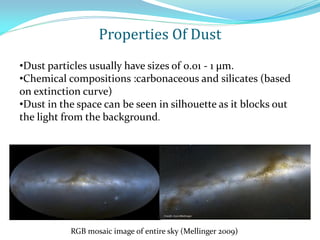
•Dust particles usually have sizes of 0.01 - 1 μm.
•Chemical compositions :carbonaceous and silicates (based
on extinction curve)
•Dust in the space can be seen in silhouette as it blocks out
the light from the background.
RGB mosaic image of entire sky (Mellinger 2009)
Properties Of Dust
Because of the small size of the dust particles, the blue light will
scatter more than red light and, as a result the images from a
dusty environment appear more red than they were without dust.
This effect is known as interstellar reddening.
When star light (or light from other astrophysical objects) passes
through the ISM, some of the light will be absorbed and some of
it will be scattered. These effective losses are known collectively as
extinction.
Extinction?
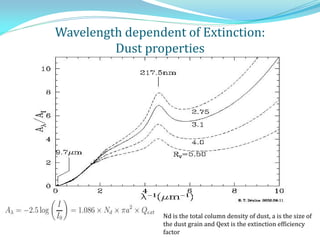
Nd is the total column density of dust, a is the size of
the dust grain and Qext is the extinction efficiency
factor
Wavelength dependent of Extinction:
Dust properties
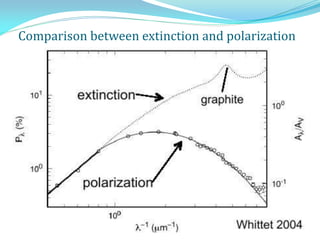
Comparison between extinction and polarization
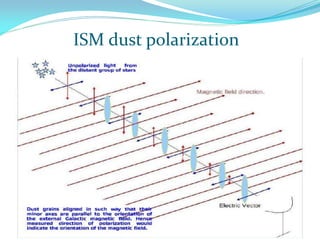
ISM dust polarization
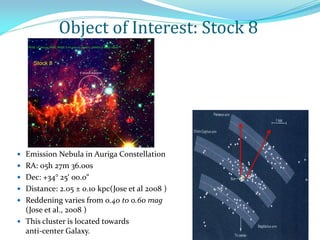
Object of Interest: Stock 8
 Emission Nebula in Auriga Constellation
 RA: 05h 27m 36.00s
 Dec: +34° 25‘ 00.0“
 Distance: 2.05 ± 0.10 kpc(Jose et al 2008 )
 Reddening varies from 0.40 to 0.60 mag
(Jose et al., 2008 )
 This cluster is located towards
anti-center Galaxy.
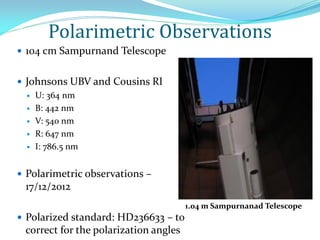
Polarimetric Observations
 104 cm Sampurnand Telescope
 Johnsons UBV and Cousins RI
 U: 364 nm
 B: 442 nm
 V: 540 nm
 R: 647 nm
 I: 786.5 nm
 Polarimetric observations –
17/12/2012
 Polarized standard: HD236633 – to
correct for the polarization angles
1.04 m Sampurnanad Telescope
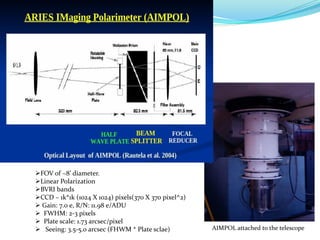
AIMPOL attached to the telescope
FOV of ~8’ diameter.
Linear Polarization
BVRI bands
CCD – 1k*1k (1024 X 1024) pixels(370 X 370 pixel^2)
 Gain: 7.0 e, R/N: 11.98 e/ADU
 FWHM: 2-3 pixels
 Plate scale: 1.73 arcsec/pixel
 Seeing: 3.5-5.0 arcsec (FHWM * Plate sclae)
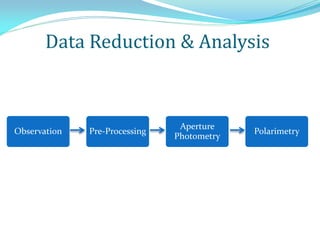
Data Reduction & Analysis
Observation Pre-Processing
Aperture
Photometry
Polarimetry
Data Reduction & Analysis
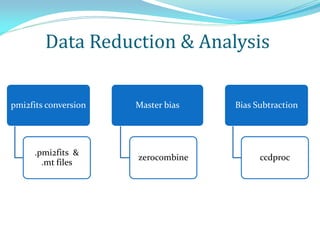
pmi2fits conversion
.pmi2fits &
.mt files
Master bias
zerocombine
Bias Subtraction
ccdproc
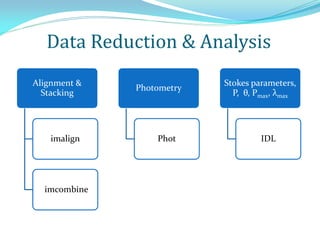
Alignment &
Stacking
imalign
imcombine
Photometry
Phot
Stokes parameters,
P, θ, Pmax, λmax
IDL
Data Reduction & Analysis
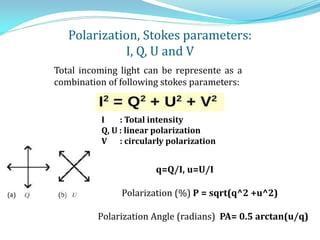
Polarization, Stokes parameters:
I, Q, U and V
I : Total intensity
Q, U : linear polarization
V : circularly polarization
Total incoming light can be represente as a
combination of following stokes parameters:
q=Q/I, u=U/I
Polarization (%) P = sqrt(q^2 +u^2)
Polarization Angle (radians) PA= 0.5 arctan(u/q)
To find P (polarization) and position angle:
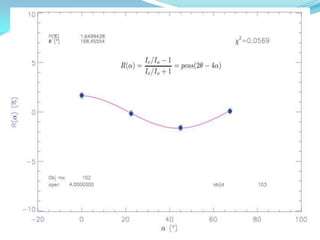
R() {q, u, q1, u1} at  => 0, 22.5, 45, 67.5 degree
FLAT FIELDING:
(Ramaprakash et al. 1998 & Medhi et al 2007, 2010, Eswaraiah et al. 2011, 2012)‫‏‬
σ R(α) {σ q , σ u , σq1 and σu1}
σR(α) = [(Ne + No + 2Nb )/(Ne + No )]^(1/2), (Ramaprakash et al. 1998)
Data Reduction & Analysis
Fit using Serkowski law:- P/Pmax = exp[-K * ln2 (λmax/ λ)]
K = 1.66 λmax ( Whittet, 1992)‫‏‬
 Standard stars were observed to correct for the
instrumental polarization and zero-point polarization
angles (ZPA)
 Instrumental polarization < 0.1 %
 The ZPA corrections in
 B : 6 deg
 V : 9 deg
 R : 12 deg
 I : 7 deg
Data Reduction & Analysis
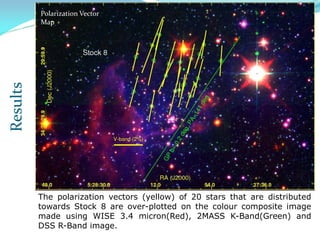
The polarization vectors (yellow) of 20 stars that are distributed
towards Stock 8 are over-plotted on the colour composite image
made using WISE 3.4 micron(Red), 2MASS K-Band(Green) and
DSS R-Band image.
Results Polarization Vector
Map
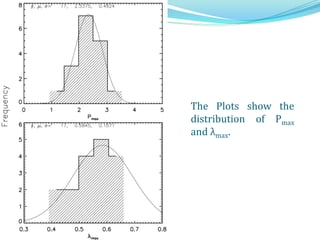
The Plots show the
distribution of Pmax
and λmax.
1. The Gaussian fitted mean values of the Pmax and λmax are
found to be 2.33 ± 0.49 % and 0.584 ± 0.10 μm,
respectively
2. The estimated λmax is approximately equal to the value
corresponding to the general ISM (0.545 μm; Serkowski et al.
1975).
3. Using the relation RV = (5.6 ± 0.3) λmax, it was found that the
value of total-to-selective extinction Rv =3.27 ± 0.58, which
close to the average value for the Milky Way Galaxy (Rv = 3.1),
indicating that the size of the dust grains within the cluster
Stock 8 is normal.
Results
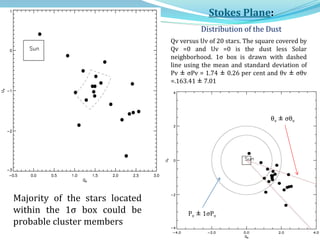
Stokes Plane:
Distribution of the Dust
Majority of the stars located
within the 1σ box could be
probable cluster members
Qv versus Uv of 20 stars. The square covered by
Qv =0 and Uv =0 is the dust less Solar
neighborhood. 1σ box is drawn with dashed
line using the mean and standard deviation of
Pv ± σPv = 1.74 ± 0.26 per cent and θv ± σθv
=.163.41 ± 7.01
Pv ± 1σPv
θv ± σθv
Conclusions
 Multiband Polarimetric data has been used to derive
Serkowski Parameters Pmax ,λmax.
 Mean λmax suggests that the dust size distribution is
similar to the general diffused ISM. And thus suggesting
normal extinction law.
 Stokes Plane has been used to find the probable cluster
members. And to study the dust distribution.
 Majority of the polarization vectors are closely aligned
with the Galactic parallel.
Thank You!!!

Polarimetric Study of emission nebulea Stock 8 in Auriga

  • 1.
    Group 4 : SweetyDeswal - Vaibhav Savant Seljin Mathew Poruri Sai Rahul Sundar M.N An efficient tool in the study of Dust Properties and Magnetic Fields Project Guide – C. Eswaraiah (Post Doc)
  • 2.
    Outline of thePresentation  Introduction  Aim of the project  Observations and data reduction  Results  Conclusions
  • 3.
    Aim of theProject  Dust properties using multiband polarimetry  Finding the probable cluster members using Stoke’s plane  Magnetic field mapping
  • 4.
    • The spacebetween stars is not perfect vacuum: filled with gas (ions, atoms and molecules) and dust termed as ISM, which makes 10% of the visible mass in the Milky-Way. • ISM components : Gas 99% of ISM [90%H, 10%He, 0.1% Metals], Dust ~1%. • The presence of ISM Dust can be studied by observing the Extinction, Polarizations and dust emission. Inter Stellar Medium (ISM)
  • 5.
    Inter Stellar Medium(ISM) • Morphology-highly complex: Diffuse clouds, hot and warm clouds, molecular cloud etc, • Temperatures: 10-10^4 K; • Densities: 10^2-8 H/cm^3). • Molecular clouds have molecular H at low temperature (~ 10K) and high densities (~10^4-9 cm^3) .
  • 6.
    •Dust particles usuallyhave sizes of 0.01 - 1 μm. •Chemical compositions :carbonaceous and silicates (based on extinction curve) •Dust in the space can be seen in silhouette as it blocks out the light from the background. RGB mosaic image of entire sky (Mellinger 2009) Properties Of Dust
  • 7.
    Because of thesmall size of the dust particles, the blue light will scatter more than red light and, as a result the images from a dusty environment appear more red than they were without dust. This effect is known as interstellar reddening. When star light (or light from other astrophysical objects) passes through the ISM, some of the light will be absorbed and some of it will be scattered. These effective losses are known collectively as extinction. Extinction?
  • 8.
    Nd is thetotal column density of dust, a is the size of the dust grain and Qext is the extinction efficiency factor Wavelength dependent of Extinction: Dust properties
  • 9.
  • 10.
  • 11.
    Object of Interest:Stock 8  Emission Nebula in Auriga Constellation  RA: 05h 27m 36.00s  Dec: +34° 25‘ 00.0“  Distance: 2.05 ± 0.10 kpc(Jose et al 2008 )  Reddening varies from 0.40 to 0.60 mag (Jose et al., 2008 )  This cluster is located towards anti-center Galaxy.
  • 12.
    Polarimetric Observations  104cm Sampurnand Telescope  Johnsons UBV and Cousins RI  U: 364 nm  B: 442 nm  V: 540 nm  R: 647 nm  I: 786.5 nm  Polarimetric observations – 17/12/2012  Polarized standard: HD236633 – to correct for the polarization angles 1.04 m Sampurnanad Telescope
  • 13.
    AIMPOL attached tothe telescope FOV of ~8’ diameter. Linear Polarization BVRI bands CCD – 1k*1k (1024 X 1024) pixels(370 X 370 pixel^2)  Gain: 7.0 e, R/N: 11.98 e/ADU  FWHM: 2-3 pixels  Plate scale: 1.73 arcsec/pixel  Seeing: 3.5-5.0 arcsec (FHWM * Plate sclae)
  • 14.
    Data Reduction &Analysis Observation Pre-Processing Aperture Photometry Polarimetry
  • 15.
    Data Reduction &Analysis pmi2fits conversion .pmi2fits & .mt files Master bias zerocombine Bias Subtraction ccdproc
  • 16.
  • 17.
    Polarization, Stokes parameters: I,Q, U and V I : Total intensity Q, U : linear polarization V : circularly polarization Total incoming light can be represente as a combination of following stokes parameters: q=Q/I, u=U/I Polarization (%) P = sqrt(q^2 +u^2) Polarization Angle (radians) PA= 0.5 arctan(u/q)
  • 19.
    To find P(polarization) and position angle: R() {q, u, q1, u1} at  => 0, 22.5, 45, 67.5 degree FLAT FIELDING: (Ramaprakash et al. 1998 & Medhi et al 2007, 2010, Eswaraiah et al. 2011, 2012)‫‏‬ σ R(α) {σ q , σ u , σq1 and σu1} σR(α) = [(Ne + No + 2Nb )/(Ne + No )]^(1/2), (Ramaprakash et al. 1998) Data Reduction & Analysis
  • 21.
    Fit using Serkowskilaw:- P/Pmax = exp[-K * ln2 (λmax/ λ)] K = 1.66 λmax ( Whittet, 1992)‫‏‬
  • 22.
     Standard starswere observed to correct for the instrumental polarization and zero-point polarization angles (ZPA)  Instrumental polarization < 0.1 %  The ZPA corrections in  B : 6 deg  V : 9 deg  R : 12 deg  I : 7 deg Data Reduction & Analysis
  • 23.
    The polarization vectors(yellow) of 20 stars that are distributed towards Stock 8 are over-plotted on the colour composite image made using WISE 3.4 micron(Red), 2MASS K-Band(Green) and DSS R-Band image. Results Polarization Vector Map
  • 24.
    The Plots showthe distribution of Pmax and λmax.
  • 25.
    1. The Gaussianfitted mean values of the Pmax and λmax are found to be 2.33 ± 0.49 % and 0.584 ± 0.10 μm, respectively 2. The estimated λmax is approximately equal to the value corresponding to the general ISM (0.545 μm; Serkowski et al. 1975). 3. Using the relation RV = (5.6 ± 0.3) λmax, it was found that the value of total-to-selective extinction Rv =3.27 ± 0.58, which close to the average value for the Milky Way Galaxy (Rv = 3.1), indicating that the size of the dust grains within the cluster Stock 8 is normal. Results
  • 26.
    Stokes Plane: Distribution ofthe Dust Majority of the stars located within the 1σ box could be probable cluster members Qv versus Uv of 20 stars. The square covered by Qv =0 and Uv =0 is the dust less Solar neighborhood. 1σ box is drawn with dashed line using the mean and standard deviation of Pv ± σPv = 1.74 ± 0.26 per cent and θv ± σθv =.163.41 ± 7.01 Pv ± 1σPv θv ± σθv
  • 27.
    Conclusions  Multiband Polarimetricdata has been used to derive Serkowski Parameters Pmax ,λmax.  Mean λmax suggests that the dust size distribution is similar to the general diffused ISM. And thus suggesting normal extinction law.  Stokes Plane has been used to find the probable cluster members. And to study the dust distribution.  Majority of the polarization vectors are closely aligned with the Galactic parallel.
  • 28.