
Poker Maths
   By Jim Makos
Contents
•   Using mathematics in poker
•   Expected Value
•   Pot Odds
•   Implied Odds
•   Calculating Expecting Value
•   Pot Equity
•   Fold Equity
•   Reverse Implied Odds
Using mathematics in poker
              • A sound knowledge of
                odds can only improve
                your game.
              • Maths are most commonly
                used when a player is on a
                draw such as a flush or
                straight draw.
              • Making the right decisions
                based on odds, you will be
                making more money in the
                long run.
Expected Value


• The long-term average outcome of a given scenario.
• Always make the decision that has the highest expected
  value.
• Maximizing +EV situations is often the difference
  between a long term winner and a long term loser.
Pot Odds


• The ratio of the amount of money actually in the pot
  compared to the amount of money required to call and
  maintain eligibility to win the pot, expressed with the
  pot amount first and calling amount second.


                    e.g. 3:1 or 5:1
Pot Odds
  Example


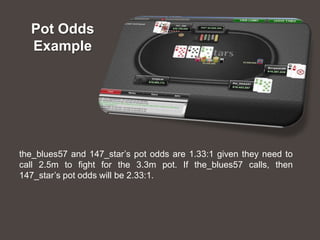
the_blues57 and 147_star’s pot odds are 1.33:1 given they need to
call 2.5m to fight for the 3.3m pot. If the_blues57 calls, then
147_star’s pot odds will be 2.33:1.
Implied Odds


The ratio of the amount of money that is expected to be
in the pot by the end of the round or the end of the hand
compared to the amount of money required to call and
maintain eligibility to win the pot, expressed with the
expected pot amount first and calling amount second.
Different from pot odds because implied odds account
for possible additional wagers.
Implied
 Odds
Example


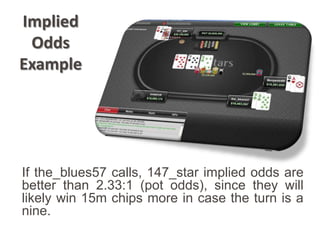
If the_blues57 calls, 147_star implied odds are
better than 2.33:1 (pot odds), since they will
likely win 15m chips more in case the turn is a
nine.
Calculating Expected
                                  Value

1.   List all the possible outcomes of that action.
2.   Find the probability and the win/loss of each outcome.
3.   Put it all together in an equation and work it out.


                        Expected value
 ∑ (probability to win)*win + ∑(probability to lose)*loss
Expected
  Value
Example


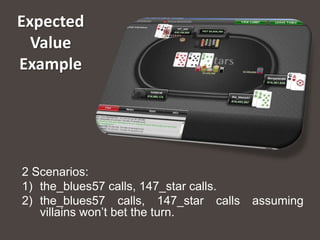
2 Scenarios:
1) the_blues57 calls, 147_star calls.
2) the_blues57 calls, 147_star calls    assuming
   villains won’t bet the turn.
Scenarios
1)   the_blues57 calls, 147_star calls.
2)   the_blues57 calls, 147_star calls assuming villains won’t bet the turn.

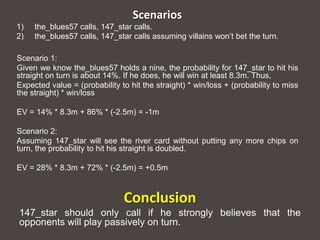
Scenario 1:
Given we know the_blues57 holds a nine, the probability for 147_star to hit his
straight on turn is about 14%. If he does, he will win at least 8.3m. Thus,
Expected value = (probability to hit the straight) * win/loss + (probability to miss
the straight) * win/loss

EV = 14% * 8.3m + 86% * (-2.5m) = -1m

Scenario 2:
Assuming 147_star will see the river card without putting any more chips on
turn, the probability to hit his straight is doubled.

EV = 28% * 8.3m + 72% * (-2.5m) = +0.5m


                               Conclusion
147_star should only call if he strongly believes that the
opponents will play passively on turn.
Pot Equity


• The average amount of money that a particular hand would win if
  the specific situation were repeated a large number of times; at a
  given point, the amount of money at stake in the pot multiplied by
  the percentage chance of winning. Different from expected value
  because it does not account for the cost of additional wagers.


                     e.g. 15% or 38%
Pot Equity
 Example


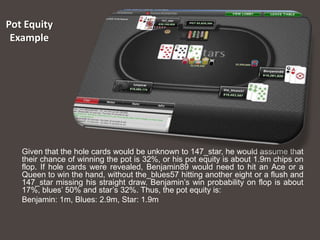
   Given that the hole cards would be unknown to 147_star, he would assume that
   their chance of winning the pot is 32%, or his pot equity is about 1.9m chips on
   flop. If hole cards were revealed, Benjamin89 would need to hit an Ace or a
   Queen to win the hand, without the_blues57 hitting another eight or a flush and
   147_star missing his straight draw. Benjamin’s win probability on flop is about
   17%, blues’ 50% and star’s 32%. Thus, the pot equity is:
   Benjamin: 1m, Blues: 2.9m, Star: 1.9m
Fold Equity
                             • Fold equity is the additional equity
                               you gain in the hand when you
                               believe that there is a chance that
                               your opponent will fold to your bet.


      (chance our opponent will fold)*(opponent's equity in the hand)

                         How much fold equity do we have?

•   If we think it is likely that our opponent will fold to our bet, we have a lot of
    fold equity.
•   If we think it is unlikely that our opponent will fold to our bet, we have little
    fold equity.
•   If we do not think our opponent will fold to our bet, we have no fold equity.
Fold Equity
 Example


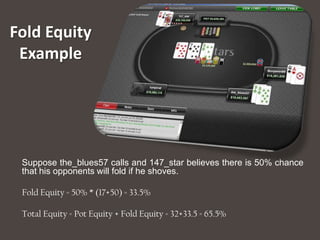
 Suppose the_blues57 calls and 147_star believes there is 50% chance
 that his opponents will fold if he shoves.

 Fold Equity = 50% * (17+50) = 33.5%

 Total Equity = Pot Equity + Fold Equity = 32+33.5 = 65.5%
Reverse Implied Odds


Reverse implied odds are reduced pot odds that include future losses that
could occur if an opponent has or gets the upper hand.

Reverse implied odds are the opposite of implied odds. With implied odds you
estimate how much you expect to win after making a draw, but with reverse
implied odds you estimate how much you expect to lose if you complete your
draw but your opponent still holds a better hand.


Reverse implied odds are how much you could expect to lose after hitting
your draw.
Reverse
Implied Odds
  Example


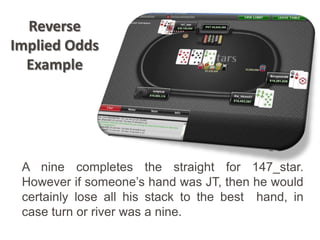
 A nine completes the straight for 147_star.
 However if someone’s hand was JT, then he would
 certainly lose all his stack to the best hand, in
 case turn or river was a nine.
Bibliography and
         References
 The theory of poker – David Sklansky
 Easy Game Vol. I & II – Andrew Seidman
 Hold’em Poker for Advanced Players – David
  Sklansky & Mason Malmuth
 Two Plus Two Forum
 PokerStrategy.com
 Pictures provided from pokerstars.com

Poker maths

  • 1.
    Poker Maths By Jim Makos
  • 2.
    Contents • Using mathematics in poker • Expected Value • Pot Odds • Implied Odds • Calculating Expecting Value • Pot Equity • Fold Equity • Reverse Implied Odds
  • 3.
    Using mathematics inpoker • A sound knowledge of odds can only improve your game. • Maths are most commonly used when a player is on a draw such as a flush or straight draw. • Making the right decisions based on odds, you will be making more money in the long run.
  • 4.
    Expected Value • Thelong-term average outcome of a given scenario. • Always make the decision that has the highest expected value. • Maximizing +EV situations is often the difference between a long term winner and a long term loser.
  • 5.
    Pot Odds • Theratio of the amount of money actually in the pot compared to the amount of money required to call and maintain eligibility to win the pot, expressed with the pot amount first and calling amount second. e.g. 3:1 or 5:1
  • 6.
    Pot Odds Example the_blues57 and 147_star’s pot odds are 1.33:1 given they need to call 2.5m to fight for the 3.3m pot. If the_blues57 calls, then 147_star’s pot odds will be 2.33:1.
  • 7.
    Implied Odds The ratioof the amount of money that is expected to be in the pot by the end of the round or the end of the hand compared to the amount of money required to call and maintain eligibility to win the pot, expressed with the expected pot amount first and calling amount second. Different from pot odds because implied odds account for possible additional wagers.
  • 8.
    Implied Odds Example If the_blues57calls, 147_star implied odds are better than 2.33:1 (pot odds), since they will likely win 15m chips more in case the turn is a nine.
  • 9.
    Calculating Expected Value 1. List all the possible outcomes of that action. 2. Find the probability and the win/loss of each outcome. 3. Put it all together in an equation and work it out. Expected value ∑ (probability to win)*win + ∑(probability to lose)*loss
  • 10.
    Expected Value Example 2Scenarios: 1) the_blues57 calls, 147_star calls. 2) the_blues57 calls, 147_star calls assuming villains won’t bet the turn.
  • 11.
    Scenarios 1) the_blues57 calls, 147_star calls. 2) the_blues57 calls, 147_star calls assuming villains won’t bet the turn. Scenario 1: Given we know the_blues57 holds a nine, the probability for 147_star to hit his straight on turn is about 14%. If he does, he will win at least 8.3m. Thus, Expected value = (probability to hit the straight) * win/loss + (probability to miss the straight) * win/loss EV = 14% * 8.3m + 86% * (-2.5m) = -1m Scenario 2: Assuming 147_star will see the river card without putting any more chips on turn, the probability to hit his straight is doubled. EV = 28% * 8.3m + 72% * (-2.5m) = +0.5m Conclusion 147_star should only call if he strongly believes that the opponents will play passively on turn.
  • 12.
    Pot Equity • Theaverage amount of money that a particular hand would win if the specific situation were repeated a large number of times; at a given point, the amount of money at stake in the pot multiplied by the percentage chance of winning. Different from expected value because it does not account for the cost of additional wagers. e.g. 15% or 38%
  • 13.
    Pot Equity Example Given that the hole cards would be unknown to 147_star, he would assume that their chance of winning the pot is 32%, or his pot equity is about 1.9m chips on flop. If hole cards were revealed, Benjamin89 would need to hit an Ace or a Queen to win the hand, without the_blues57 hitting another eight or a flush and 147_star missing his straight draw. Benjamin’s win probability on flop is about 17%, blues’ 50% and star’s 32%. Thus, the pot equity is: Benjamin: 1m, Blues: 2.9m, Star: 1.9m
  • 14.
    Fold Equity • Fold equity is the additional equity you gain in the hand when you believe that there is a chance that your opponent will fold to your bet. (chance our opponent will fold)*(opponent's equity in the hand) How much fold equity do we have? • If we think it is likely that our opponent will fold to our bet, we have a lot of fold equity. • If we think it is unlikely that our opponent will fold to our bet, we have little fold equity. • If we do not think our opponent will fold to our bet, we have no fold equity.
  • 15.
    Fold Equity Example Suppose the_blues57 calls and 147_star believes there is 50% chance that his opponents will fold if he shoves. Fold Equity = 50% * (17+50) = 33.5% Total Equity = Pot Equity + Fold Equity = 32+33.5 = 65.5%
  • 16.
    Reverse Implied Odds Reverseimplied odds are reduced pot odds that include future losses that could occur if an opponent has or gets the upper hand. Reverse implied odds are the opposite of implied odds. With implied odds you estimate how much you expect to win after making a draw, but with reverse implied odds you estimate how much you expect to lose if you complete your draw but your opponent still holds a better hand. Reverse implied odds are how much you could expect to lose after hitting your draw.
  • 17.
    Reverse Implied Odds Example A nine completes the straight for 147_star. However if someone’s hand was JT, then he would certainly lose all his stack to the best hand, in case turn or river was a nine.
  • 18.
    Bibliography and References  The theory of poker – David Sklansky  Easy Game Vol. I & II – Andrew Seidman  Hold’em Poker for Advanced Players – David Sklansky & Mason Malmuth  Two Plus Two Forum  PokerStrategy.com  Pictures provided from pokerstars.com