Poisson processes
in biology.
https://github.com/quinlan-lab/applied-computational-genomics
Aaron Quinlan
Departments of Human Genetics and Biomedical
Informatics
USTAR Center for Genetic Discovery
University of Utah
quinlanlab.org
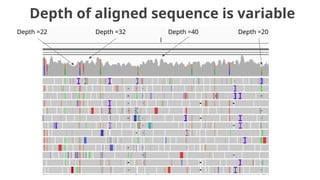
Depth of aligned sequence is variable
Depth =22 Depth =32 Depth =40 Depth =20
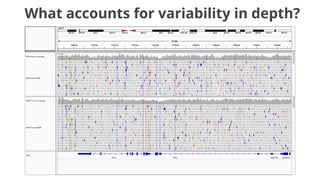
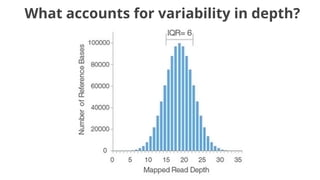
What accounts for variability in depth?
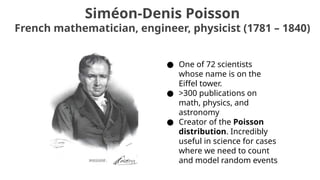
Siméon-Denis Poisson
French mathematician, engineer, physicist (1781 – 1840)
● One of 72 scientists
whose name is on the
Eiffel tower.
● >300 publications on
math, physics, and
astronomy
● Creator of the Poisson
distribution. Incredibly
useful in science for cases
where we need to count
and model random events
The Poisson distribution is used to describe the
distribution of rare events in a large population. For
example, at any particular time, there is a certain
probability that a particular cell within a large
population of cells will acquire a mutation.
A Poisson process is appropriate here because
mutation acquisition is a rare event, and each
mutation event is independent of one another.
https://www.sciencedirect.com/topics/biochemistry-genetics-and-molecular-biology/poisson-distribution
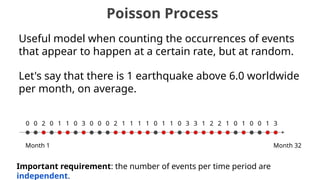
Poisson Process
Useful model when counting the occurrences of events
that appear to happen at a certain rate, but at random.
Let's say that there is 1 earthquake above 6.0 worldwide
per month, on average.
Month 1 Month 32
2
0
0 1
0 1 0
3
0 2
0 0 1
1
1 1
1 0 3
0
1 2
3 1 0
1
2 0
1 0 3
1
Important requirement: the number of events per time period are
independent.
Poisson Distribution. One parameter.
Lambda
Expresses the probability of a given
number of events occurring in a fixed
interval of time or space if these
events occur with a known constant
rate
P(2 earthquakes in one month) = e-2
(12
/2!)
# Plug lambda and k into the
equation
1^2 * exp(-1) / factorial(2)
[1] 0.1839397
# Shortcut (dpois)
dpois(x=2,lambda=1)
[1] 0.1839397
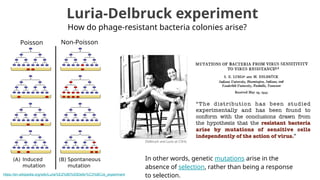
Luria-Delbruck experiment
How do phage-resistant bacteria colonies arise?
In other words, genetic mutations arise in the
absence of selection, rather than being a response
to selection.
https://en.wikipedia.org/wiki/Luria%E2%80%93Delbr%C3%BCck_experiment
Poisson Non-Poisson
Mutations at autosomal nucleotide sites are roughly 10 9
−
per year.
Consider a position in your genome. If you could trace its ancestry
back across the last 109
years, what is the probability that you
would find no mutations?
The expected number of mutations is λ = ut, where u = 10 9
−
and t =
109
. Thus, λ = 1. The probability of no mutations at the site you
chose is:
What about the probability of one
or more mutations?
1^0 * exp(-1) /
factorial(0)
[1] 0.3678794
dpois(x=0,lambda=1)
[1] 0.3678794
Alan Rogers
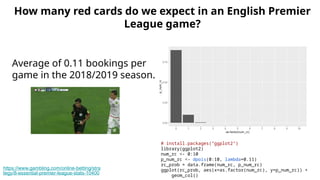
How many red cards do we expect in an English Premier
League game?
# install.packages("ggplot2")
library(ggplot2)
num_rc <- 0:10
p_num_rc <- dpois(0:10, lambda=0.11)
rc_prob = data.frame(num_rc, p_num_rc)
ggplot(rc_prob, aes(x=as.factor(num_rc), y=p_num_rc)) +
geom_col()
https://www.gambling.com/online-betting/stra
tegy/8-essential-premier-league-stats-10400
Average of 0.11 bookings per
game in the 2018/2019 season.
Slides:
https://docs.google.com/presentation/d/1T2KTEdk1h18oxic728BqI4UvW6P0
OZyvP7VUZKXsM8E/edit
Video:
https://youtu.be/4G4mvSWvwWo
An intro to ggplot2
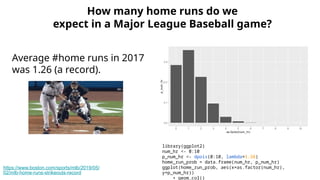
How many home runs do we
expect in a Major League Baseball game?
library(ggplot2)
num_hr <- 0:10
p_num_hr <- dpois(0:10, lambda=1.26)
home_run_prob = data.frame(num_hr, p_num_hr)
ggplot(home_run_prob, aes(x=as.factor(num_hr),
y=p_num_hr))
+ geom_col()
https://www.boston.com/sports/mlb/2019/05/
02/mlb-home-runs-strikeouts-record
Average #home runs in 2017
was 1.26 (a record).
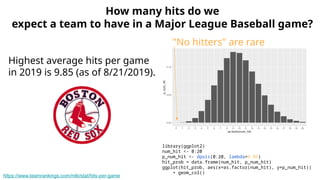
How many hits do we
expect a team to have in a Major League Baseball game?
https://www.teamrankings.com/mlb/stat/hits-per-game
Highest average hits per game
in 2019 is 9.85 (as of 8/21/2019).
library(ggplot2)
num_hit <- 0:20
p_num_hit <- dpois(0:20, lambda=9.85)
hit_prob = data.frame(num_hit, p_num_hit)
ggplot(hit_prob, aes(x=as.factor(num_hit), y=p_num_hit))
+ geom_col()
"No hitters" are rare
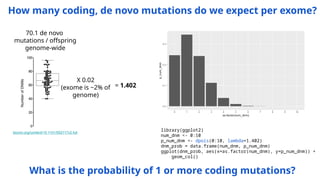
How many coding, de novo mutations do we expect per exome?
biorxiv.org/content/10.1101/552117v2.full
70.1 de novo
mutations / offspring
genome-wide
X 0.02
(exome is ~2% of
genome)
= 1.402
library(ggplot2)
num_dnm <- 0:10
p_num_dnm <- dpois(0:10, lambda=1.402)
dnm_prob = data.frame(num_dnm, p_num_dnm)
ggplot(dnm_prob, aes(x=as.factor(num_dnm), y=p_num_dnm)) +
geom_col()
What is the probability of 1 or more coding mutations?
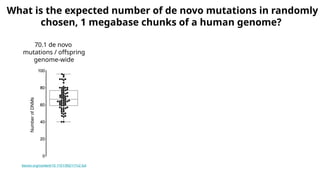
What is the expected number of de novo mutations in randomly
chosen, 1 megabase chunks of a human genome?
biorxiv.org/content/10.1101/552117v2.full
70.1 de novo
mutations / offspring
genome-wide
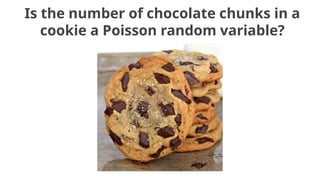
Is the number of chocolate chunks in a
cookie a Poisson random variable?
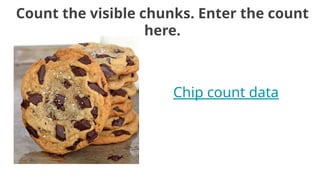
Count the visible chunks. Enter the count
here.
Chip count data
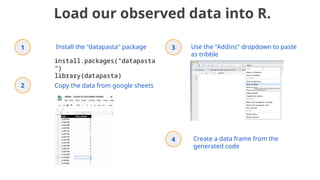
Load our observed data into R.
3 Use the "Addins" dropdown to paste
as tribble
install.packages("datapasta
")
library(datapasta)
1 Install the "datapasta" package
4 Create a data frame from the
generated code
2 Copy the data from google sheets
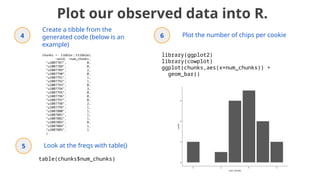
Plot our observed data into R.
library(ggplot2)
library(cowplot)
ggplot(chunks,aes(x=num_chunks)) +
geom_bar()
5 Plot the number of chips per cookie
6
chunks <- tibble::tribble(
~unid, ~num_chunks,
"u1007787", 0,
"u1007788", 0,
"u1007789", 2,
"u1007790", 0,
"u1007791", 1,
"u1007792", 1,
"u1007793", 0,
"u1007794", 3,
"u1007795", 0,
"u1007796", 0,
"u1007797", 0,
"u1007798", 2,
"u1007799", 1,
"u1007800", 1,
"u1007801", 1,
"u1007802", 1,
"u1007803", 0,
"u1007804", 1,
"u1007805", 1
)
4
Create a tibble from the
generated code (below is an
example)
table(chunks$num_chunks)
5 Look at the freqs with table()
Is the number of chocolate chunks in a
cookie a Poisson random variable?
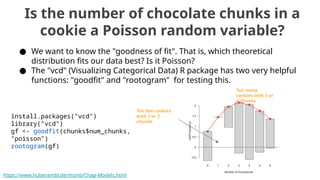
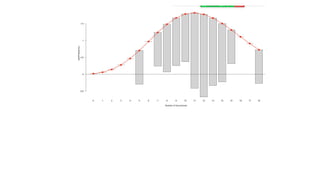
● We want to know the "goodness of fit". That is, which theoretical
distribution fits our data best? Is it Poisson?
● The "vcd" (Visualizing Categorical Data) R package has two very helpful
functions: "goodfit" and "rootogram" for testing this.
install.packages("vcd")
library("vcd")
gf <- goodfit(chunks$num_chunks,
"poisson")
rootogram(gf)
https://www.huber.embl.de/msmb/Chap-Models.html
Too few cookies
with 1 or 2
chunks
Too many
cookies with 3 or
4 chunks
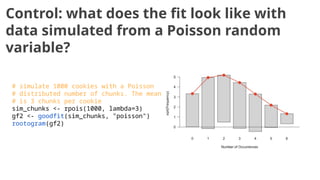
Control: what does the fit look like with
data simulated from a Poisson random
variable?
# simulate 1000 cookies with a Poisson
# distributed number of chunks. The mean
# is 3 chunks per cookie
sim_chunks <- rpois(1000, lambda=3)
gf2 <- goodfit(sim_chunks, "poisson")
rootogram(gf2)
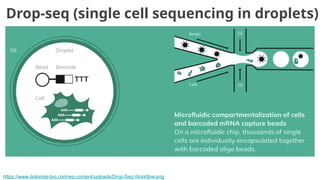
Drop-seq (single cell sequencing in droplets)
https://www.dolomite-bio.com/wp-content/uploads/Drop-Seq-Workflow.png
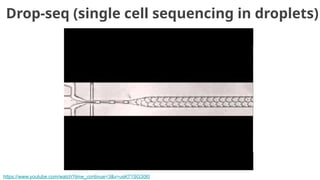
Drop-seq (single cell sequencing in droplets)
https://www.youtube.com/watch?time_continue=3&v=usK71SG30t0
Goal: one cell per droplet
Should one load
shooting for an average
of one cell per droplet
(lambda = 1)?
Let's simulate.
sc_sim <- rpois(2000, lambda=1)
barplot(table(sc_sim),
col="dodgerblue")
Lot's of droplets
with >1 cell.
"doublets",
"triplets".
What fraction
are expected to
be this way?
What about (lambda =
0.5)?
sc_sim <- rpois(2000, lambda=0.5)
barplot(table(sc_sim),
col="chartreuse4")
Better, but still
many cells with
>1 cell.
What about (lambda =
0.1)?
sc_sim <- rpois(2000, lambda=0.1)
barplot(table(sc_sim), col="darkred")
> dpois(x=1,
lambda=0.1)
[1] 0.09048374
> 0.09048374 * 2000
[1] 180.9675
Goal: one cell and one bead per droplet
Lamdba = 0.1 to minimize
>1 cell per droplet
> dpois(x=1,
lambda=0.1)
[1] 0.09048374
Lamdba = 0.1 to minimize
>1 bead per droplet
> dpois(x=1,
lambda=0.1)
[1] 0.09048374
X = 0.008
1
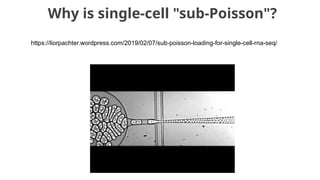
Why is single-cell "sub-Poisson"?
https://liorpachter.wordpress.com/2019/02/07/sub-poisson-loading-for-single-cell-rna-seq/
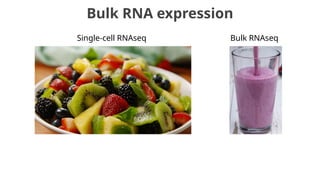
Bulk RNA expression
Single-cell RNAseq Bulk RNAseq

Poisson random variables in biology.pptx

  • 1.
    Poisson processes in biology. https://github.com/quinlan-lab/applied-computational-genomics AaronQuinlan Departments of Human Genetics and Biomedical Informatics USTAR Center for Genetic Discovery University of Utah quinlanlab.org
  • 2.
    Depth of alignedsequence is variable Depth =22 Depth =32 Depth =40 Depth =20
  • 3.
    What accounts forvariability in depth?
  • 4.
    What accounts forvariability in depth?
  • 5.
    Siméon-Denis Poisson French mathematician,engineer, physicist (1781 – 1840) ● One of 72 scientists whose name is on the Eiffel tower. ● >300 publications on math, physics, and astronomy ● Creator of the Poisson distribution. Incredibly useful in science for cases where we need to count and model random events
  • 6.
    The Poisson distributionis used to describe the distribution of rare events in a large population. For example, at any particular time, there is a certain probability that a particular cell within a large population of cells will acquire a mutation. A Poisson process is appropriate here because mutation acquisition is a rare event, and each mutation event is independent of one another. https://www.sciencedirect.com/topics/biochemistry-genetics-and-molecular-biology/poisson-distribution
  • 7.
    Poisson Process Useful modelwhen counting the occurrences of events that appear to happen at a certain rate, but at random. Let's say that there is 1 earthquake above 6.0 worldwide per month, on average. Month 1 Month 32 2 0 0 1 0 1 0 3 0 2 0 0 1 1 1 1 1 0 3 0 1 2 3 1 0 1 2 0 1 0 3 1 Important requirement: the number of events per time period are independent.
  • 8.
    Poisson Distribution. Oneparameter. Lambda Expresses the probability of a given number of events occurring in a fixed interval of time or space if these events occur with a known constant rate P(2 earthquakes in one month) = e-2 (12 /2!) # Plug lambda and k into the equation 1^2 * exp(-1) / factorial(2) [1] 0.1839397 # Shortcut (dpois) dpois(x=2,lambda=1) [1] 0.1839397
  • 9.
    Luria-Delbruck experiment How dophage-resistant bacteria colonies arise? In other words, genetic mutations arise in the absence of selection, rather than being a response to selection. https://en.wikipedia.org/wiki/Luria%E2%80%93Delbr%C3%BCck_experiment Poisson Non-Poisson
  • 10.
    Mutations at autosomalnucleotide sites are roughly 10 9 − per year. Consider a position in your genome. If you could trace its ancestry back across the last 109 years, what is the probability that you would find no mutations? The expected number of mutations is λ = ut, where u = 10 9 − and t = 109 . Thus, λ = 1. The probability of no mutations at the site you chose is: What about the probability of one or more mutations? 1^0 * exp(-1) / factorial(0) [1] 0.3678794 dpois(x=0,lambda=1) [1] 0.3678794 Alan Rogers
  • 11.
    How many redcards do we expect in an English Premier League game? # install.packages("ggplot2") library(ggplot2) num_rc <- 0:10 p_num_rc <- dpois(0:10, lambda=0.11) rc_prob = data.frame(num_rc, p_num_rc) ggplot(rc_prob, aes(x=as.factor(num_rc), y=p_num_rc)) + geom_col() https://www.gambling.com/online-betting/stra tegy/8-essential-premier-league-stats-10400 Average of 0.11 bookings per game in the 2018/2019 season.
  • 12.
  • 13.
    How many homeruns do we expect in a Major League Baseball game? library(ggplot2) num_hr <- 0:10 p_num_hr <- dpois(0:10, lambda=1.26) home_run_prob = data.frame(num_hr, p_num_hr) ggplot(home_run_prob, aes(x=as.factor(num_hr), y=p_num_hr)) + geom_col() https://www.boston.com/sports/mlb/2019/05/ 02/mlb-home-runs-strikeouts-record Average #home runs in 2017 was 1.26 (a record).
  • 14.
    How many hitsdo we expect a team to have in a Major League Baseball game? https://www.teamrankings.com/mlb/stat/hits-per-game Highest average hits per game in 2019 is 9.85 (as of 8/21/2019). library(ggplot2) num_hit <- 0:20 p_num_hit <- dpois(0:20, lambda=9.85) hit_prob = data.frame(num_hit, p_num_hit) ggplot(hit_prob, aes(x=as.factor(num_hit), y=p_num_hit)) + geom_col() "No hitters" are rare
  • 15.
    How many coding,de novo mutations do we expect per exome? biorxiv.org/content/10.1101/552117v2.full 70.1 de novo mutations / offspring genome-wide X 0.02 (exome is ~2% of genome) = 1.402 library(ggplot2) num_dnm <- 0:10 p_num_dnm <- dpois(0:10, lambda=1.402) dnm_prob = data.frame(num_dnm, p_num_dnm) ggplot(dnm_prob, aes(x=as.factor(num_dnm), y=p_num_dnm)) + geom_col() What is the probability of 1 or more coding mutations?
  • 16.
    What is theexpected number of de novo mutations in randomly chosen, 1 megabase chunks of a human genome? biorxiv.org/content/10.1101/552117v2.full 70.1 de novo mutations / offspring genome-wide
  • 17.
    Is the numberof chocolate chunks in a cookie a Poisson random variable?
  • 18.
    Count the visiblechunks. Enter the count here. Chip count data
  • 19.
    Load our observeddata into R. 3 Use the "Addins" dropdown to paste as tribble install.packages("datapasta ") library(datapasta) 1 Install the "datapasta" package 4 Create a data frame from the generated code 2 Copy the data from google sheets
  • 20.
    Plot our observeddata into R. library(ggplot2) library(cowplot) ggplot(chunks,aes(x=num_chunks)) + geom_bar() 5 Plot the number of chips per cookie 6 chunks <- tibble::tribble( ~unid, ~num_chunks, "u1007787", 0, "u1007788", 0, "u1007789", 2, "u1007790", 0, "u1007791", 1, "u1007792", 1, "u1007793", 0, "u1007794", 3, "u1007795", 0, "u1007796", 0, "u1007797", 0, "u1007798", 2, "u1007799", 1, "u1007800", 1, "u1007801", 1, "u1007802", 1, "u1007803", 0, "u1007804", 1, "u1007805", 1 ) 4 Create a tibble from the generated code (below is an example) table(chunks$num_chunks) 5 Look at the freqs with table()
  • 21.
    Is the numberof chocolate chunks in a cookie a Poisson random variable? ● We want to know the "goodness of fit". That is, which theoretical distribution fits our data best? Is it Poisson? ● The "vcd" (Visualizing Categorical Data) R package has two very helpful functions: "goodfit" and "rootogram" for testing this. install.packages("vcd") library("vcd") gf <- goodfit(chunks$num_chunks, "poisson") rootogram(gf) https://www.huber.embl.de/msmb/Chap-Models.html Too few cookies with 1 or 2 chunks Too many cookies with 3 or 4 chunks
  • 23.
    Control: what doesthe fit look like with data simulated from a Poisson random variable? # simulate 1000 cookies with a Poisson # distributed number of chunks. The mean # is 3 chunks per cookie sim_chunks <- rpois(1000, lambda=3) gf2 <- goodfit(sim_chunks, "poisson") rootogram(gf2)
  • 24.
    Drop-seq (single cellsequencing in droplets) https://www.dolomite-bio.com/wp-content/uploads/Drop-Seq-Workflow.png
  • 25.
    Drop-seq (single cellsequencing in droplets) https://www.youtube.com/watch?time_continue=3&v=usK71SG30t0
  • 26.
    Goal: one cellper droplet Should one load shooting for an average of one cell per droplet (lambda = 1)? Let's simulate. sc_sim <- rpois(2000, lambda=1) barplot(table(sc_sim), col="dodgerblue") Lot's of droplets with >1 cell. "doublets", "triplets". What fraction are expected to be this way? What about (lambda = 0.5)? sc_sim <- rpois(2000, lambda=0.5) barplot(table(sc_sim), col="chartreuse4") Better, but still many cells with >1 cell. What about (lambda = 0.1)? sc_sim <- rpois(2000, lambda=0.1) barplot(table(sc_sim), col="darkred") > dpois(x=1, lambda=0.1) [1] 0.09048374 > 0.09048374 * 2000 [1] 180.9675
  • 27.
    Goal: one celland one bead per droplet Lamdba = 0.1 to minimize >1 cell per droplet > dpois(x=1, lambda=0.1) [1] 0.09048374 Lamdba = 0.1 to minimize >1 bead per droplet > dpois(x=1, lambda=0.1) [1] 0.09048374 X = 0.008 1
  • 28.
    Why is single-cell"sub-Poisson"? https://liorpachter.wordpress.com/2019/02/07/sub-poisson-loading-for-single-cell-rna-seq/
  • 29.

Editor's Notes

  • #9 "Assuming a constant rate of mutation, Luria hypothesized that if mutations occurred after and in response to exposure to the selective agent, the number of survivors would be distributed according to a Poisson distribution with the mean equal to the variance. This was not what Delbrück and Luria found: Instead the number of resistant colonies on each plate varied drastically: the variance was considerably greater than the mean."