Point and Support
  Introduction to argument
What is a Point?
A point is a statement of your
  position, opinion, or idea.
A point is not an indisputable fact.

“Barack Obama won the presidential election in
  2008” -This is a fact. This is not a point.
“Barack Obama has been a good president.”
          -This is an opinion. This is a point.
More about Points
Here’s a good way to check whether or not you
 have a good point. Ask yourself:
 -could someone argue or disagree with it? For
 example, no one could argue that Barack
 Obama didn’t win the 2008 election, but they
 could argue that he has not been a good
 president.
More about Points
The other way to make sure you have a good
  point is to imagine yourself as part of a
  conversation:
     You: “Barack Obama has been a good
     president.”
     Someone else: “Why? How? What are your
     reasons for saying this?”
A good point needs to be explained, backed up
  with evidence and arguments, and supported.
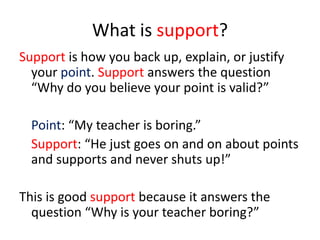
What is support?
Support is how you back up, explain, or justify
  your point. Support answers the question
  “Why do you believe your point is valid?”

  Point: “My teacher is boring.”
  Support: “He just goes on and on about points
  and supports and never shuts up!”

This is good support because it answers the
  question “Why is your teacher boring?”
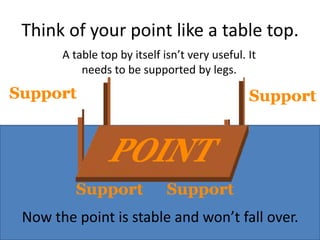
Think of your point like a table top.
      A table top by itself isn’t very useful. It
          needs to be supported by legs.


Now the point is stable and won’t fall over.
Now, try to identify the point and support in
               these examples:
                     1. a.

Point and support

  • 1.
    Point and Support Introduction to argument
  • 2.
    What is aPoint? A point is a statement of your position, opinion, or idea. A point is not an indisputable fact. “Barack Obama won the presidential election in 2008” -This is a fact. This is not a point. “Barack Obama has been a good president.” -This is an opinion. This is a point.
  • 3.
    More about Points Here’sa good way to check whether or not you have a good point. Ask yourself: -could someone argue or disagree with it? For example, no one could argue that Barack Obama didn’t win the 2008 election, but they could argue that he has not been a good president.
  • 4.
    More about Points Theother way to make sure you have a good point is to imagine yourself as part of a conversation: You: “Barack Obama has been a good president.” Someone else: “Why? How? What are your reasons for saying this?” A good point needs to be explained, backed up with evidence and arguments, and supported.
  • 5.
    What is support? Supportis how you back up, explain, or justify your point. Support answers the question “Why do you believe your point is valid?” Point: “My teacher is boring.” Support: “He just goes on and on about points and supports and never shuts up!” This is good support because it answers the question “Why is your teacher boring?”
  • 6.
    Think of yourpoint like a table top. A table top by itself isn’t very useful. It needs to be supported by legs. Now the point is stable and won’t fall over.
  • 7.
    Now, try toidentify the point and support in these examples: 1. a.