WRITING A POSITION PAPER
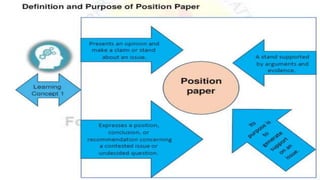
A position paper presents the writer’s stand or
viewpoint on a particular issue. Writing a position
paper entails outlining arguments and proposing the
course of action; by doing so, you are already taking
part in a large debate. It is a more complex version
of a persuasive essay, however, a position paper is
not an essay, but it has a various parts just like the
concept paper. It can be likened with a debate but
the presentation of the arguments is in a written
form. Presenting an argument implies that you are
favoring one side of the issue.
A position paper presents the writer’s stand or
viewpoint on a particular issue. Writing a position
paper entails outlining arguments and proposing the
course of action; by doing so, you are already taking
part in a large debate. It is a more complex version
of a persuasive essay, however, a position paper is
not an essay, but it has a various parts just like the
concept paper. It can be likened with a debate but
the presentation of the arguments is in a written
form. Presenting an argument implies that you are
favoring one side of the issue.
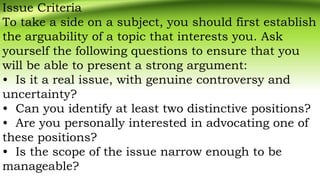
Issue Criteria
To take a side on a subject, you should first establish
the arguability of a topic that interests you. Ask
yourself the following questions to ensure that you
will be able to present a strong argument:
• Is it a real issue, with genuine controversy and
uncertainty?
• Can you identify at least two distinctive positions?
• Are you personally interested in advocating one of
these positions?
• Is the scope of the issue narrow enough to be
manageable?
Issue Criteria
To take a side on a subject, you should first establish
the arguability of a topic that interests you. Ask
yourself the following questions to ensure that you
will be able to present a strong argument:
• Is it a real issue, with genuine controversy and
uncertainty?
• Can you identify at least two distinctive positions?
• Are you personally interested in advocating one of
these positions?
• Is the scope of the issue narrow enough to be
manageable?
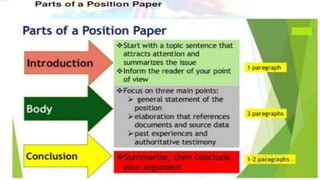
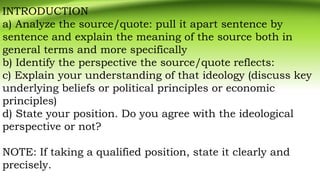
INTRODUCTION
a) Analyze the source/quote: pull it apart sentence by
sentence and explain the meaning of the source both in
general terms and more specifically
b) Identify the perspective the source/quote reflects:
c) Explain your understanding of that ideology (discuss key
underlying beliefs or political principles or economic
principles)
d) State your position. Do you agree with the ideological
perspective or not?
NOTE: If taking a qualified position, state it clearly and
precisely.
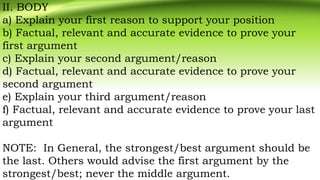
II. BODY
a) Explain your first reason to support your position
b) Factual, relevant and accurate evidence to prove your
first argument
c) Explain your second argument/reason
d) Factual, relevant and accurate evidence to prove your
second argument
e) Explain your third argument/reason
f) Factual, relevant and accurate evidence to prove your last
argument
NOTE: In General, the strongest/best argument should be
the last. Others would advise the first argument by the
strongest/best; never the middle argument.
Issue Criteria
To take a side on a subject, you should first establish
the arguability of a topic that interests you. Ask
yourself the following questions to ensure that you
will be able to present a strong argument:
• Is it a real issue, with genuine controversy and
uncertainty?
• Can you identify at least two distinctive positions?
• Are you personally interested in advocating one of
these positions?
• Is the scope of the issue narrow enough to be
manageable?
III.CONCLUSION (Summarize, restate in a forceful
manner your position)
NOTE: Please remember that the conclusion should
not merely be a brief repetition of your results – in
that case your discussion would seem fairly
pointless. Focus instead on what your results may
imply after careful consideration (consideration that
you have outlined in your discussion).
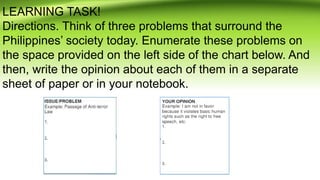
LEARNING TASK!
Directions. Think of three problems that surround the
Philippines’ society today. Enumerate these problems on
the space provided on the left side of the chart below. And
then, write the opinion about each of them in a separate
sheet of paper or in your notebook.

EAPP.WRITING A POSITION PAPER.pptx

  • 1.
  • 3.
    A position paperpresents the writer’s stand or viewpoint on a particular issue. Writing a position paper entails outlining arguments and proposing the course of action; by doing so, you are already taking part in a large debate. It is a more complex version of a persuasive essay, however, a position paper is not an essay, but it has a various parts just like the concept paper. It can be likened with a debate but the presentation of the arguments is in a written form. Presenting an argument implies that you are favoring one side of the issue.
  • 4.
    A position paperpresents the writer’s stand or viewpoint on a particular issue. Writing a position paper entails outlining arguments and proposing the course of action; by doing so, you are already taking part in a large debate. It is a more complex version of a persuasive essay, however, a position paper is not an essay, but it has a various parts just like the concept paper. It can be likened with a debate but the presentation of the arguments is in a written form. Presenting an argument implies that you are favoring one side of the issue.
  • 5.
    Issue Criteria To takea side on a subject, you should first establish the arguability of a topic that interests you. Ask yourself the following questions to ensure that you will be able to present a strong argument: • Is it a real issue, with genuine controversy and uncertainty? • Can you identify at least two distinctive positions? • Are you personally interested in advocating one of these positions? • Is the scope of the issue narrow enough to be manageable?
  • 6.
    Issue Criteria To takea side on a subject, you should first establish the arguability of a topic that interests you. Ask yourself the following questions to ensure that you will be able to present a strong argument: • Is it a real issue, with genuine controversy and uncertainty? • Can you identify at least two distinctive positions? • Are you personally interested in advocating one of these positions? • Is the scope of the issue narrow enough to be manageable?
  • 8.
    INTRODUCTION a) Analyze thesource/quote: pull it apart sentence by sentence and explain the meaning of the source both in general terms and more specifically b) Identify the perspective the source/quote reflects: c) Explain your understanding of that ideology (discuss key underlying beliefs or political principles or economic principles) d) State your position. Do you agree with the ideological perspective or not? NOTE: If taking a qualified position, state it clearly and precisely.
  • 9.
    II. BODY a) Explainyour first reason to support your position b) Factual, relevant and accurate evidence to prove your first argument c) Explain your second argument/reason d) Factual, relevant and accurate evidence to prove your second argument e) Explain your third argument/reason f) Factual, relevant and accurate evidence to prove your last argument NOTE: In General, the strongest/best argument should be the last. Others would advise the first argument by the strongest/best; never the middle argument.
  • 10.
    Issue Criteria To takea side on a subject, you should first establish the arguability of a topic that interests you. Ask yourself the following questions to ensure that you will be able to present a strong argument: • Is it a real issue, with genuine controversy and uncertainty? • Can you identify at least two distinctive positions? • Are you personally interested in advocating one of these positions? • Is the scope of the issue narrow enough to be manageable?
  • 11.
    III.CONCLUSION (Summarize, restatein a forceful manner your position) NOTE: Please remember that the conclusion should not merely be a brief repetition of your results – in that case your discussion would seem fairly pointless. Focus instead on what your results may imply after careful consideration (consideration that you have outlined in your discussion).
  • 12.
    LEARNING TASK! Directions. Thinkof three problems that surround the Philippines’ society today. Enumerate these problems on the space provided on the left side of the chart below. And then, write the opinion about each of them in a separate sheet of paper or in your notebook.