Notes from the Vegetable
Garden
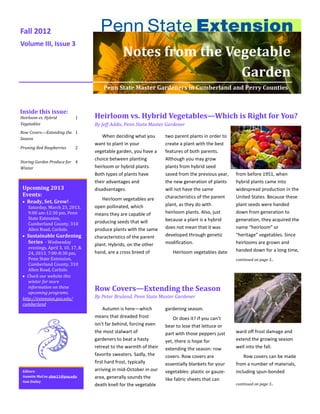
When deciding what you
want to plant in your
vegetable garden, you have a
choice between planting
heirloom or hybrid plants.
Both types of plants have
their advantages and
disadvantages.
Heirloom vegetables are
open pollinated, which
means they are capable of
producing seeds that will
produce plants with the same
characteristics of the parent
plant. Hybrids, on the other
hand, are a cross breed of
two parent plants in order to
create a plant with the best
features of both parents.
Although you may grow
plants from hybrid seed
saved from the previous year,
the new generation of plants
will not have the same
characteristics of the parent
plant, as they do with
heirloom plants. Also, just
because a plant is a hybrid
does not mean that it was
developed through genetic
modification.
Heirloom vegetables date
from before 1951, when
hybrid plants came into
widespread production in the
United States. Because these
plant seeds were handed
down from generation to
generation, they acquired the
name “heirloom” or
“heritage” vegetables. Since
heirlooms are grown and
handed down for a long time,
continued on page 3...
Heirloom vs. Hybrid Vegetables—Which is Right for You?
By Jeff Addis, Penn State Master Gardener
Autumn is here—which
means that dreaded frost
isn’t far behind, forcing even
the most stalwart of
gardeners to beat a hasty
retreat to the warmth of their
favorite sweaters. Sadly, the
first hard frost, typically
arriving in mid-October in our
area, generally sounds the
death knell for the vegetable
gardening season.
Or does it? If you can’t
bear to lose that lettuce or
part with those peppers just
yet, there is hope for
extending the season: row
covers. Row covers are
essentially blankets for your
vegetables: plastic or gauze-
like fabric sheets that can
ward off frost damage and
extend the growing season
well into the fall.
Row covers can be made
from a number of materials,
including spun-bonded
Row Covers—Extending the Season
By Peter Bruland, Penn State Master Gardener
Fall 2012
Volume III, Issue 3
Heirloom vs. Hybrid
Vegetables
1
Row Covers—Extending the
Season
1
Pruning Red Raspberries 2
Storing Garden Produce for
Winter
4
Inside this issue:
Upcoming 2013
Events:
Ready, Set, Grow! -
Saturday, March 23, 2013,
9:00 am-12:30 pm, Penn
State Extension,
Cumberland County, 310
Allen Road, Carlisle.
Sustainable Gardening
Series - Wednesday
evenings, April 3, 10, 17, &
24, 2013, 7:00-8:30 pm,
Penn State Extension,
Cumberland County, 310
Allen Road, Carlisle.
Check our website this
winter for more
information on these
upcoming programs.
http://extension.psu.edu/
cumberland
Penn State Master Gardeners in Cumberland and Perry Counties
continued on page 3...
Editors:
Annette MaCoy ahm11@psu.edu
Ann Dailey
For prime health and
productivity, prune your
raspberry canes during their
dormant period. Guidelines
often suggest pruning in
February or early March;
however, I was glad I pruned
on a nice January day this
year. The mild winter and
early spring brought buds and
growth much earlier than
usual. Ideally, pruning should
happen before leaf buds start
to pop out.
Understanding their
growth pattern is key to
pruning raspberries. The
roots and crowns are
perennial, while the canes are
biennial—growing one year
and producing fruit the next.
The first year a cane emerges,
it is called a primocane. In its
second year, it is called a
floricane (or fruiting cane).
Secondly, you must know
your variety. Do you have
summer-bearing or
everbearing raspberries? The
former bear one crop in the
summer, while the latter bear
a small summer crop and a
heavier fall crop. These
different fruiting patterns call
for different pruning
methods.
If you have everbearing
raspberries, dislike fussy
pruning, and don’t mind
sacrificing your summer crop,
you can prune all the canes
down to two inches each
dormant season. This will
result in one heavier and
earlier crop on primocanes in
the fall. If you want to retain
both summer and fall crops
of everbearing varieties,
however, more selective
pruning will be necessary, as
with summer-bearing
varieties.
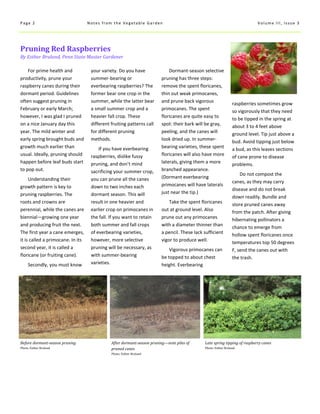
Dormant-season selective
pruning has three steps:
remove the spent floricanes,
thin out weak primocanes,
and prune back vigorous
primocanes. The spent
floricanes are quite easy to
spot: their bark will be gray,
peeling, and the canes will
look dried up. In summer-
bearing varieties, these spent
floricanes will also have more
laterals, giving them a more
branched appearance.
(Dormant everbearing
primocanes will have laterals
just near the tip.)
Take the spent floricanes
out at ground level. Also
prune out any primocanes
with a diameter thinner than
a pencil. These lack sufficient
vigor to produce well.
Vigorous primocanes can
be topped to about chest
height. Everbearing
Pruning Red Raspberries
By Esther Bruland, Penn State Master Gardener
After dormant-season pruning—note piles of
pruned canes
Photo: Esther Bruland
Page 2 Notes from the Vegetable Garden Volume III, Issue 3
Before dormant-season pruning
Photo: Esther Bruland
raspberries sometimes grow
so vigorously that they need
to be tipped in the spring at
about 3 to 4 feet above
ground level. Tip just above a
bud. Avoid tipping just below
a bud, as this leaves sections
of cane prone to disease
problems.
Do not compost the
canes, as they may carry
disease and do not break
down readily. Bundle and
store pruned canes away
from the patch. After giving
hibernating pollinators a
chance to emerge from
hollow spent floricanes once
temperatures top 50 degrees
F, send the canes out with
the trash.
Late spring tipping of raspberry canes
Photo: Esther Bruland
Choosing Plants
One of the easiest ways to
reduce chemical use in the
garden is to select pest and
disease-resistant plant varieties.
Many vegetable cultivars are
more resistant to powdery
mildew, bacterial wilt, blight,
beetles, and other pests.
Do some research before
shopping, and check
plant labels.
Heirloom vs. Hybrid Vegetables—Which is Right for You?
...continued from page 1
Row Covers—Extending the Season
...continued from page 1
they have become adapted to
an area’s soil, climate, and
pests, which may be an
advantage over hybrid plants.
Heirlooms, as opposed to
hybrids, are not used in large
scale agriculture. Since
hybrids were developed for
their ease of shipping,
uniform appearance, large
productivity, and ability to
grow well all over the
country, they are the
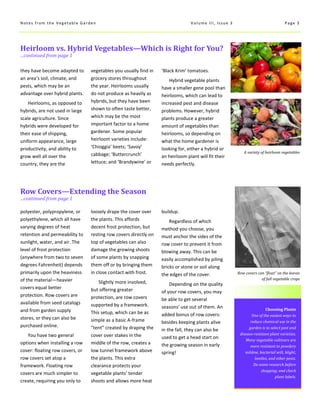
loosely drape the cover over
the plants. This affords
decent frost protection, but
resting row covers directly on
top of vegetables can also
damage the growing shoots
of some plants by snapping
them off or by bringing them
in close contact with frost.
Slightly more involved,
but offering greater
protection, are row covers
supported by a framework.
This setup, which can be as
simple as a basic A-frame
“tent” created by draping the
cover over stakes in the
middle of the row, creates a
low tunnel framework above
the plants. This extra
clearance protects your
vegetable plants’ tender
shoots and allows more heat
buildup.
Regardless of which
method you choose, you
must anchor the sides of the
row cover to prevent it from
blowing away. This can be
easily accomplished by piling
bricks or stone or soil along
the edges of the cover.
Depending on the quality
of your row covers, you may
be able to get several
seasons’ use out of them. An
added bonus of row covers:
besides keeping plants alive
in the fall, they can also be
used to get a head start on
the growing season in early
spring!
polyester, polypropylene, or
polyethylene, which all have
varying degrees of heat
retention and permeability to
sunlight, water, and air. The
level of frost protection
(anywhere from two to seven
degrees Fahrenheit) depends
primarily upon the heaviness
of the material—heavier
covers equal better
protection. Row covers are
available from seed catalogs
and from garden supply
stores, or they can also be
purchased online.
You have two general
options when installing a row
cover: floating row covers, or
row covers set atop a
framework. Floating row
covers are much simpler to
create, requiring you only to
Page 3Notes from the Vegetable Garden Volume III, Issue 3
vegetables you usually find in
grocery stores throughout
the year. Heirlooms usually
do not produce as heavily as
hybrids, but they have been
shown to often taste better,
which may be the most
important factor to a home
gardener. Some popular
heirloom varieties include:
‘Chioggia’ beets; ‘Savoy’
cabbage; ‘Buttercrunch’
lettuce; and ‘Brandywine’ or
‘Black Krim’ tomatoes.
Hybrid vegetable plants
have a smaller gene pool than
heirlooms, which can lead to
increased pest and disease
problems. However, hybrid
plants produce a greater
amount of vegetables than
heirlooms, so depending on
what the home gardener is
looking for, either a hybrid or
an heirloom plant will fit their
needs perfectly.
A variety of heirloom vegetables
Row covers can “float” on the leaves
of fall vegetable crops
Pesticides are poisonous. Read and follow label directions and safety precautions on labels. Handle carefully and
store in original labeled containers out of the reach of children, pets, and livestock. Dispose of empty containers
right away in a safe manner and place. Do not contaminate forage, streams, or ponds.
Where trade names appear, no discrimination is intended and no endorsement by the The Pennsylvania State
University is implied.
Penn State College of Agricultural Sciences research, extension, and resident education programs are funded in
part by Pennsylvania counties, the Commonwealth of Pennsylvania, and the U.S. Department of Agriculture.
Visit us on the web: extension.psu.edu
Penn State encourages persons with disabilities to participate in its programs and activities. If you anticipate
needing special accommodations or have questions about the physical access provided, please contact Annette
MaCoy at 717-240-6500 in advance of your participation or visit.
This publication is available in alternative media upon request.
The Pennsylvania State University is committed to the policy that all persons shall have equal access to programs,
facilities, admission, and employment without regard to personal characteristics not related to ability, perform-
ance, or qualifications as determined by University policy or by state or federal authorities. It is the policy of the
University to maintain an academic and work environment free of discrimination, including harassment. The
Pennsylvania State University prohibits discrimination and harassment against any person because of age,
ancestry, color, disability or handicap, national origin, race, religious creed, sex, sexual orientation, or veteran
status. Discrimination or harassment against faculty, staff, or students will not be tolerated at The Pennsylvania
State University. Direct all inquiries regarding the nondiscrimination policy to the Affirmative Action Director, The
Pennsylvania State University, 328 Boucke Building, University Park, PA 16802-5901; Tel 814-865-4700/V, 814-
863-1150/TTY.
Penn State Extension Office Hours:
Cumberland County Monday-Friday
310 Allen Road, Suite 601 8:00 a.m.-4:30 p.m.
Carlisle, PA 17013
We’re on the web!
http://extension.psu.edu/cumberland
include cone pits, long pits,
and tile storage. For more
details on these methods,
check out Purdue’s “Storing
Vegetables and Fruits at
Home” at http://
www.hort.purdue.edu/ext/ho
-125.pdf.
Storage conditions are
characterized by temperature
and humidity.
Cold, moist storage is
defined as 32-40° F and 90-
95% relative humidity. These
are ideal conditions for root
crops, such as beets, carrots,
horseradish, and potatoes;
and cole crops such as
cabbage. Temperatures
should not drop below 32°F.
Cool, moist storage is
defined as 45-50° F and 80-
90% relative humidity. Green
You’ve spent all summer
nurturing your wonderful
home-grown produce. You’ve
enjoyed it fresh, but you’d like
to store the bounty for use
during cold winter weather.
Different types of produce
require different storage
conditions. Although you may
not be able to provide perfect
conditions, an unheated but
well-ventilated basement is
often a good storage location
for many vegetables.
Lacking a basement, a
second refrigerator, or a root
cellar, there are some very
creative and ingenious
methods to store produce
outdoors, using the natural
warmth of soil to keep
produce from freezing while
still remaining fresh. These
tomatoes can be ripened in
these conditions and, by
wrapping each tomato in
newspaper, kept for 3 to 5
weeks.
Cool, dry storage is
defined as 45-50° F and 50-
60% relative humidity. This is
the best situation to keep
onions for winter storage.
Warm, dry storage is
defined as 55-60° F and 60-
70% relative humidity, ideal
for winter squash and
pumpkins. These fruits should
be harvested before frost,
with 3-4” stems left on.
Warm, moist storage is
defined as 55-60° F and 80-
85% relative humidity; sweet
potatoes are best stored in
these conditions.
Whatever situation you
Storing Garden Produce for Winter
By Annette MaCoy, Horticulture Extension Educator
Phone: 717-240-6500
Toll-free: 1-888-697-0371 x6500
Fax: 717-240-6548
E-mail: CumberlandExt@psu.edu Cumberland Extension
Page 4 Notes from the Vegetable Garden Volume III, Issue 3
use for storage, the
condition of the produce
going into storage is critical
to maintain its quality for
the longest time. Select
only mature and
undamaged produce for
long-term storage, and be
sure to clean it off carefully,
either by washing or with a
soft brush. Any bruises,
cuts, or wounds to the skin
will lead to more rapid
decay or disease problems.
Some vegetables, such as
onions, winter squash, and
potatoes, need a curing
period to dry and toughen
the skin before being put
into storage.

Row Covers - Extending the Season; Gardening Guidebook for Pennsylvania

  • 1.
    Notes from theVegetable Garden When deciding what you want to plant in your vegetable garden, you have a choice between planting heirloom or hybrid plants. Both types of plants have their advantages and disadvantages. Heirloom vegetables are open pollinated, which means they are capable of producing seeds that will produce plants with the same characteristics of the parent plant. Hybrids, on the other hand, are a cross breed of two parent plants in order to create a plant with the best features of both parents. Although you may grow plants from hybrid seed saved from the previous year, the new generation of plants will not have the same characteristics of the parent plant, as they do with heirloom plants. Also, just because a plant is a hybrid does not mean that it was developed through genetic modification. Heirloom vegetables date from before 1951, when hybrid plants came into widespread production in the United States. Because these plant seeds were handed down from generation to generation, they acquired the name “heirloom” or “heritage” vegetables. Since heirlooms are grown and handed down for a long time, continued on page 3... Heirloom vs. Hybrid Vegetables—Which is Right for You? By Jeff Addis, Penn State Master Gardener Autumn is here—which means that dreaded frost isn’t far behind, forcing even the most stalwart of gardeners to beat a hasty retreat to the warmth of their favorite sweaters. Sadly, the first hard frost, typically arriving in mid-October in our area, generally sounds the death knell for the vegetable gardening season. Or does it? If you can’t bear to lose that lettuce or part with those peppers just yet, there is hope for extending the season: row covers. Row covers are essentially blankets for your vegetables: plastic or gauze- like fabric sheets that can ward off frost damage and extend the growing season well into the fall. Row covers can be made from a number of materials, including spun-bonded Row Covers—Extending the Season By Peter Bruland, Penn State Master Gardener Fall 2012 Volume III, Issue 3 Heirloom vs. Hybrid Vegetables 1 Row Covers—Extending the Season 1 Pruning Red Raspberries 2 Storing Garden Produce for Winter 4 Inside this issue: Upcoming 2013 Events: Ready, Set, Grow! - Saturday, March 23, 2013, 9:00 am-12:30 pm, Penn State Extension, Cumberland County, 310 Allen Road, Carlisle. Sustainable Gardening Series - Wednesday evenings, April 3, 10, 17, & 24, 2013, 7:00-8:30 pm, Penn State Extension, Cumberland County, 310 Allen Road, Carlisle. Check our website this winter for more information on these upcoming programs. http://extension.psu.edu/ cumberland Penn State Master Gardeners in Cumberland and Perry Counties continued on page 3... Editors: Annette MaCoy ahm11@psu.edu Ann Dailey
  • 2.
    For prime healthand productivity, prune your raspberry canes during their dormant period. Guidelines often suggest pruning in February or early March; however, I was glad I pruned on a nice January day this year. The mild winter and early spring brought buds and growth much earlier than usual. Ideally, pruning should happen before leaf buds start to pop out. Understanding their growth pattern is key to pruning raspberries. The roots and crowns are perennial, while the canes are biennial—growing one year and producing fruit the next. The first year a cane emerges, it is called a primocane. In its second year, it is called a floricane (or fruiting cane). Secondly, you must know your variety. Do you have summer-bearing or everbearing raspberries? The former bear one crop in the summer, while the latter bear a small summer crop and a heavier fall crop. These different fruiting patterns call for different pruning methods. If you have everbearing raspberries, dislike fussy pruning, and don’t mind sacrificing your summer crop, you can prune all the canes down to two inches each dormant season. This will result in one heavier and earlier crop on primocanes in the fall. If you want to retain both summer and fall crops of everbearing varieties, however, more selective pruning will be necessary, as with summer-bearing varieties. Dormant-season selective pruning has three steps: remove the spent floricanes, thin out weak primocanes, and prune back vigorous primocanes. The spent floricanes are quite easy to spot: their bark will be gray, peeling, and the canes will look dried up. In summer- bearing varieties, these spent floricanes will also have more laterals, giving them a more branched appearance. (Dormant everbearing primocanes will have laterals just near the tip.) Take the spent floricanes out at ground level. Also prune out any primocanes with a diameter thinner than a pencil. These lack sufficient vigor to produce well. Vigorous primocanes can be topped to about chest height. Everbearing Pruning Red Raspberries By Esther Bruland, Penn State Master Gardener After dormant-season pruning—note piles of pruned canes Photo: Esther Bruland Page 2 Notes from the Vegetable Garden Volume III, Issue 3 Before dormant-season pruning Photo: Esther Bruland raspberries sometimes grow so vigorously that they need to be tipped in the spring at about 3 to 4 feet above ground level. Tip just above a bud. Avoid tipping just below a bud, as this leaves sections of cane prone to disease problems. Do not compost the canes, as they may carry disease and do not break down readily. Bundle and store pruned canes away from the patch. After giving hibernating pollinators a chance to emerge from hollow spent floricanes once temperatures top 50 degrees F, send the canes out with the trash. Late spring tipping of raspberry canes Photo: Esther Bruland
  • 3.
    Choosing Plants One ofthe easiest ways to reduce chemical use in the garden is to select pest and disease-resistant plant varieties. Many vegetable cultivars are more resistant to powdery mildew, bacterial wilt, blight, beetles, and other pests. Do some research before shopping, and check plant labels. Heirloom vs. Hybrid Vegetables—Which is Right for You? ...continued from page 1 Row Covers—Extending the Season ...continued from page 1 they have become adapted to an area’s soil, climate, and pests, which may be an advantage over hybrid plants. Heirlooms, as opposed to hybrids, are not used in large scale agriculture. Since hybrids were developed for their ease of shipping, uniform appearance, large productivity, and ability to grow well all over the country, they are the loosely drape the cover over the plants. This affords decent frost protection, but resting row covers directly on top of vegetables can also damage the growing shoots of some plants by snapping them off or by bringing them in close contact with frost. Slightly more involved, but offering greater protection, are row covers supported by a framework. This setup, which can be as simple as a basic A-frame “tent” created by draping the cover over stakes in the middle of the row, creates a low tunnel framework above the plants. This extra clearance protects your vegetable plants’ tender shoots and allows more heat buildup. Regardless of which method you choose, you must anchor the sides of the row cover to prevent it from blowing away. This can be easily accomplished by piling bricks or stone or soil along the edges of the cover. Depending on the quality of your row covers, you may be able to get several seasons’ use out of them. An added bonus of row covers: besides keeping plants alive in the fall, they can also be used to get a head start on the growing season in early spring! polyester, polypropylene, or polyethylene, which all have varying degrees of heat retention and permeability to sunlight, water, and air. The level of frost protection (anywhere from two to seven degrees Fahrenheit) depends primarily upon the heaviness of the material—heavier covers equal better protection. Row covers are available from seed catalogs and from garden supply stores, or they can also be purchased online. You have two general options when installing a row cover: floating row covers, or row covers set atop a framework. Floating row covers are much simpler to create, requiring you only to Page 3Notes from the Vegetable Garden Volume III, Issue 3 vegetables you usually find in grocery stores throughout the year. Heirlooms usually do not produce as heavily as hybrids, but they have been shown to often taste better, which may be the most important factor to a home gardener. Some popular heirloom varieties include: ‘Chioggia’ beets; ‘Savoy’ cabbage; ‘Buttercrunch’ lettuce; and ‘Brandywine’ or ‘Black Krim’ tomatoes. Hybrid vegetable plants have a smaller gene pool than heirlooms, which can lead to increased pest and disease problems. However, hybrid plants produce a greater amount of vegetables than heirlooms, so depending on what the home gardener is looking for, either a hybrid or an heirloom plant will fit their needs perfectly. A variety of heirloom vegetables Row covers can “float” on the leaves of fall vegetable crops
  • 4.
    Pesticides are poisonous.Read and follow label directions and safety precautions on labels. Handle carefully and store in original labeled containers out of the reach of children, pets, and livestock. Dispose of empty containers right away in a safe manner and place. Do not contaminate forage, streams, or ponds. Where trade names appear, no discrimination is intended and no endorsement by the The Pennsylvania State University is implied. Penn State College of Agricultural Sciences research, extension, and resident education programs are funded in part by Pennsylvania counties, the Commonwealth of Pennsylvania, and the U.S. Department of Agriculture. Visit us on the web: extension.psu.edu Penn State encourages persons with disabilities to participate in its programs and activities. If you anticipate needing special accommodations or have questions about the physical access provided, please contact Annette MaCoy at 717-240-6500 in advance of your participation or visit. This publication is available in alternative media upon request. The Pennsylvania State University is committed to the policy that all persons shall have equal access to programs, facilities, admission, and employment without regard to personal characteristics not related to ability, perform- ance, or qualifications as determined by University policy or by state or federal authorities. It is the policy of the University to maintain an academic and work environment free of discrimination, including harassment. The Pennsylvania State University prohibits discrimination and harassment against any person because of age, ancestry, color, disability or handicap, national origin, race, religious creed, sex, sexual orientation, or veteran status. Discrimination or harassment against faculty, staff, or students will not be tolerated at The Pennsylvania State University. Direct all inquiries regarding the nondiscrimination policy to the Affirmative Action Director, The Pennsylvania State University, 328 Boucke Building, University Park, PA 16802-5901; Tel 814-865-4700/V, 814- 863-1150/TTY. Penn State Extension Office Hours: Cumberland County Monday-Friday 310 Allen Road, Suite 601 8:00 a.m.-4:30 p.m. Carlisle, PA 17013 We’re on the web! http://extension.psu.edu/cumberland include cone pits, long pits, and tile storage. For more details on these methods, check out Purdue’s “Storing Vegetables and Fruits at Home” at http:// www.hort.purdue.edu/ext/ho -125.pdf. Storage conditions are characterized by temperature and humidity. Cold, moist storage is defined as 32-40° F and 90- 95% relative humidity. These are ideal conditions for root crops, such as beets, carrots, horseradish, and potatoes; and cole crops such as cabbage. Temperatures should not drop below 32°F. Cool, moist storage is defined as 45-50° F and 80- 90% relative humidity. Green You’ve spent all summer nurturing your wonderful home-grown produce. You’ve enjoyed it fresh, but you’d like to store the bounty for use during cold winter weather. Different types of produce require different storage conditions. Although you may not be able to provide perfect conditions, an unheated but well-ventilated basement is often a good storage location for many vegetables. Lacking a basement, a second refrigerator, or a root cellar, there are some very creative and ingenious methods to store produce outdoors, using the natural warmth of soil to keep produce from freezing while still remaining fresh. These tomatoes can be ripened in these conditions and, by wrapping each tomato in newspaper, kept for 3 to 5 weeks. Cool, dry storage is defined as 45-50° F and 50- 60% relative humidity. This is the best situation to keep onions for winter storage. Warm, dry storage is defined as 55-60° F and 60- 70% relative humidity, ideal for winter squash and pumpkins. These fruits should be harvested before frost, with 3-4” stems left on. Warm, moist storage is defined as 55-60° F and 80- 85% relative humidity; sweet potatoes are best stored in these conditions. Whatever situation you Storing Garden Produce for Winter By Annette MaCoy, Horticulture Extension Educator Phone: 717-240-6500 Toll-free: 1-888-697-0371 x6500 Fax: 717-240-6548 E-mail: CumberlandExt@psu.edu Cumberland Extension Page 4 Notes from the Vegetable Garden Volume III, Issue 3 use for storage, the condition of the produce going into storage is critical to maintain its quality for the longest time. Select only mature and undamaged produce for long-term storage, and be sure to clean it off carefully, either by washing or with a soft brush. Any bruises, cuts, or wounds to the skin will lead to more rapid decay or disease problems. Some vegetables, such as onions, winter squash, and potatoes, need a curing period to dry and toughen the skin before being put into storage.