1
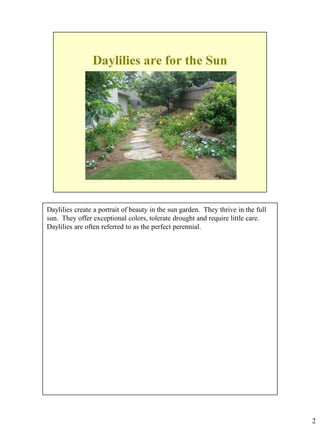
Daylilies create a portrait of beauty in the sun garden. They thrive in the full
sun. They offer exceptional colors, tolerate drought and require little care.
Daylilies are often referred to as the perfect perennial.

2
Hybridizers register hundreds of new cultivars yearly. Now – 72,095
During the 18th and 19th century daylilies came from Asia
In the 1930’s began hybridization in America
References go back 2000 years
Modern dayliles are hybridized from species (species meaning the daylilies created in nature)
The new hybrids – have almost every color in the rainbow with the exception of a true blue
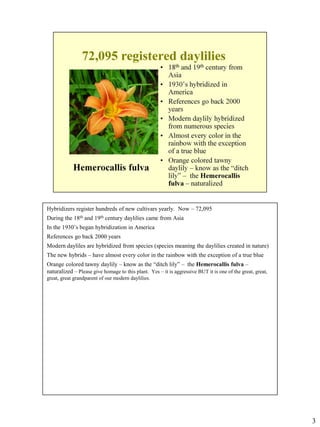
Orange colored tawny daylily – know as the “ditch lily” – the Hemerocallis fulva –
naturalized – Please give homage to this plant. Yes – it is aggressive BUT it is one of the great, great,
great, great grandparent of our modern daylilies.

3
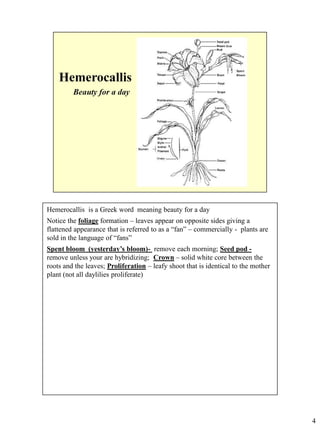
Hemerocallis is a Greek word meaning beauty for a day
Notice the foliage formation – leaves appear on opposite sides giving a
flattened appearance that is referred to as a “fan” – commercially - plants are
sold in the language of “fans”
Spent bloom (yesterday’s bloom)- remove each morning; Seed pod remove unless your are hybridizing; Crown – solid white core between the
roots and the leaves; Proliferation – leafy shoot that is identical to the mother
plant (not all daylilies proliferate)

4
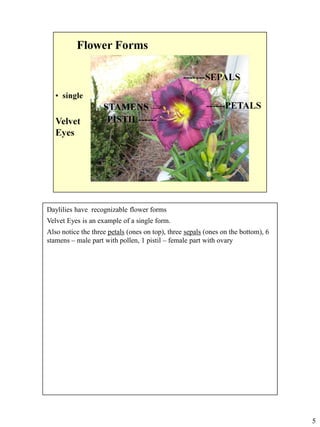
Daylilies have recognizable flower forms
Velvet Eyes is an example of a single form.

Also notice the three petals (ones on top), three sepals (ones on the bottom), 6
stamens – male part with pollen, 1 pistil – female part with ovary

5
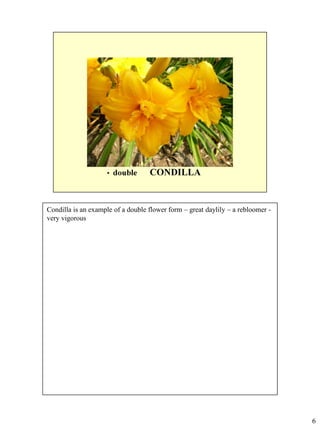
Condilla is an example of a double flower form – great daylily – a rebloomer very vigorous

6
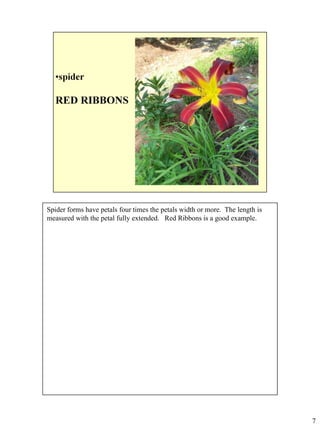
Spider forms have petals four times the petals width or more. The length is
measured with the petal fully extended. Red Ribbons is a good example.

7
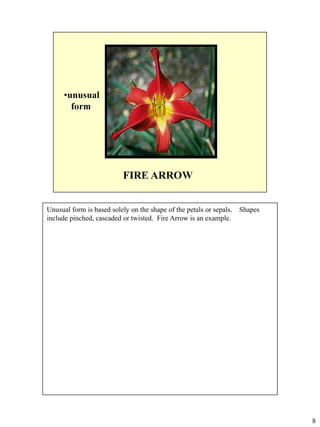
Unusual form is based solely on the shape of the petals or sepals.
include pinched, cascaded or twisted. Fire Arrow is an example.

Shapes

8
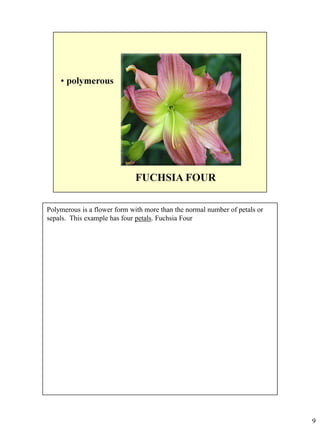
Polymerous is a flower form with more than the normal number of petals or
sepals. This example has four petals. Fuchsia Four

9
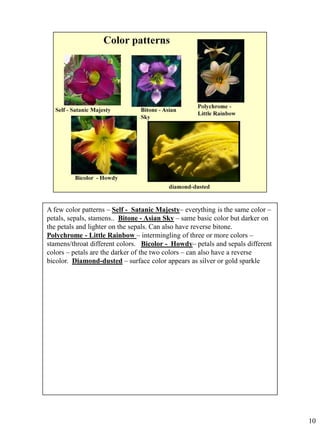
A few color patterns – Self - Satanic Majesty– everything is the same color –
petals, sepals, stamens.. Bitone - Asian Sky – same basic color but darker on
the petals and lighter on the sepals. Can also have reverse bitone.
Polychrome - Little Rainbow – intermingling of three or more colors –
stamens/throat different colors. Bicolor - Howdy– petals and sepals different
colors – petals are the darker of the two colors – can also have a reverse
bicolor. Diamond-dusted – surface color appears as silver or gold sparkle

10
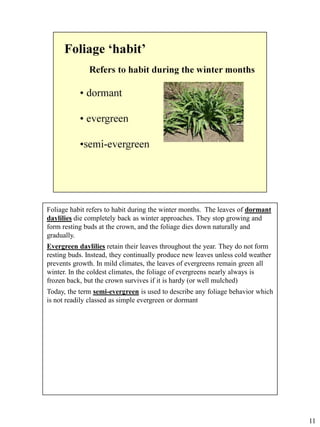
Foliage habit refers to habit during the winter months. The leaves of dormant
daylilies die completely back as winter approaches. They stop growing and
form resting buds at the crown, and the foliage dies down naturally and
gradually.
Evergreen daylilies retain their leaves throughout the year. They do not form
resting buds. Instead, they continually produce new leaves unless cold weather
prevents growth. In mild climates, the leaves of evergreens remain green all
winter. In the coldest climates, the foliage of evergreens nearly always is
frozen back, but the crown survives if it is hardy (or well mulched)
Today, the term semi-evergreen is used to describe any foliage behavior which
is not readily classed as simple evergreen or dormant

11
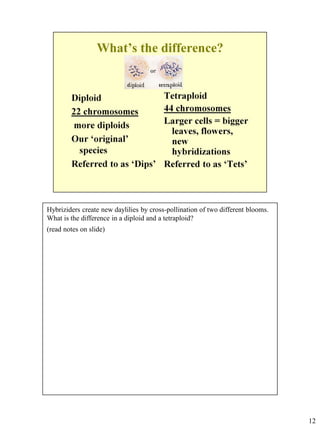
Hybriziders create new daylilies by cross-pollination of two different blooms.
What is the difference in a diploid and a tetraploid?
(read notes on slide)

12
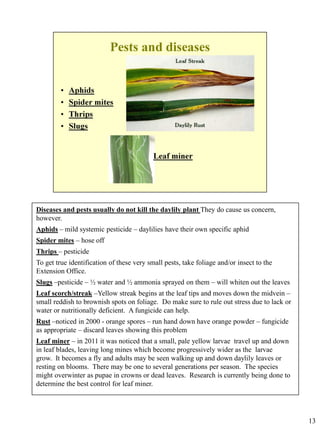
Diseases and pests usually do not kill the daylily plant They do cause us concern,
however.
Aphids – mild systemic pesticide – daylilies have their own specific aphid
Spider mites – hose off
Thrips – pesticide
To get true identification of these very small pests, take foliage and/or insect to the
Extension Office.
Slugs –pesticide – ½ water and ½ ammonia sprayed on them – will whiten out the leaves
Leaf scorch/streak –Yellow streak begins at the leaf tips and moves down the midvein –
small reddish to brownish spots on foliage. Do make sure to rule out stress due to lack or
water or nutritionally deficient. A fungicide can help.
Rust –noticed in 2000 - orange spores – run hand down have orange powder – fungicide
as appropriate – discard leaves showing this problem
Leaf miner – in 2011 it was noticed that a small, pale yellow larvae travel up and down
in leaf blades, leaving long mines which become progressively wider as the larvae
grow. It becomes a fly and adults may be seen walking up and down daylily leaves or
resting on blooms. There may be one to several generations per season. The species
might overwinter as pupae in crowns or dead leaves. Research is currently being done to
determine the best control for leaf miner.

13
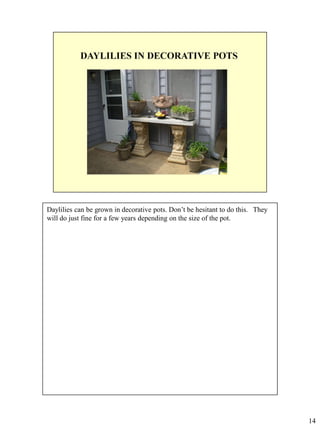
Daylilies can be grown in decorative pots. Don’t be hesitant to do this. They
will do just fine for a few years depending on the size of the pot.

14
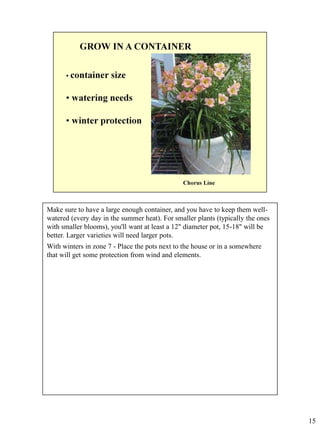
Make sure to have a large enough container, and you have to keep them wellwatered (every day in the summer heat). For smaller plants (typically the ones
with smaller blooms), you'll want at least a 12" diameter pot, 15-18" will be
better. Larger varieties will need larger pots.
With winters in zone 7 - Place the pots next to the house or in a somewhere
that will get some protection from wind and elements.

15
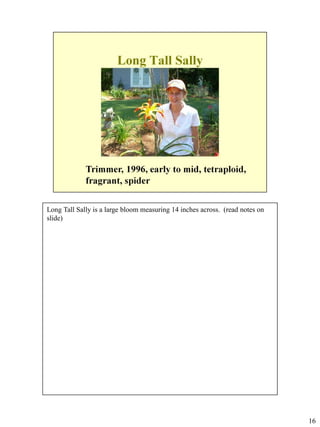
Long Tall Sally is a large bloom measuring 14 inches across. (read notes on
slide)

16
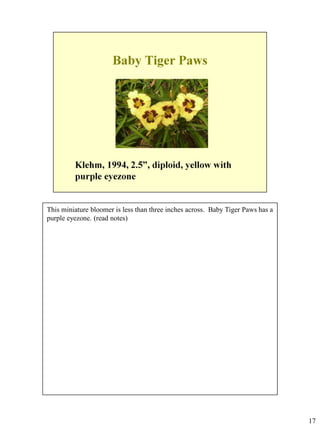
This miniature bloomer is less than three inches across. Baby Tiger Paws has a
purple eyezone. (read notes)

17
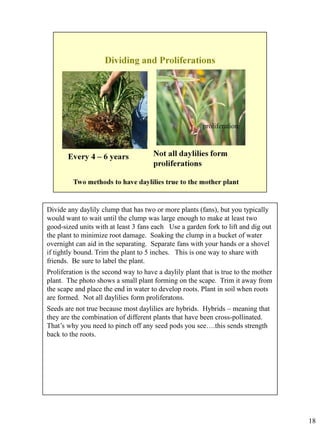
Divide any daylily clump that has two or more plants (fans), but you typically
would want to wait until the clump was large enough to make at least two
good-sized units with at least 3 fans each Use a garden fork to lift and dig out
the plant to minimize root damage. Soaking the clump in a bucket of water
overnight can aid in the separating. Separate fans with your hands or a shovel
if tightly bound. Trim the plant to 5 inches. This is one way to share with
friends. Be sure to label the plant.
Proliferation is the second way to have a daylily plant that is true to the mother
plant. The photo shows a small plant forming on the scape. Trim it away from
the scape and place the end in water to develop roots. Plant in soil when roots
are formed. Not all daylilies form proliferatons.
Seeds are not true because most daylilies are hybrids. Hybrids – meaning that
they are the combination of different plants that have been cross-pollinated.
That’s why you need to pinch off any seed pods you see….this sends strength
back to the roots.

18
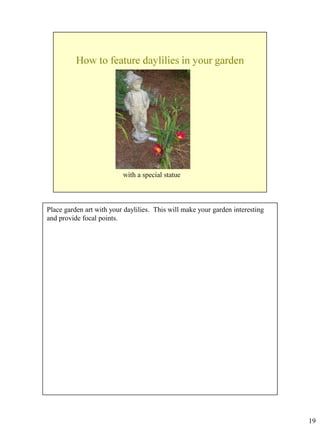
Place garden art with your daylilies. This will make your garden interesting
and provide focal points.

19
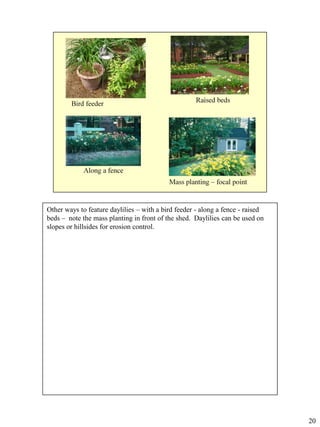
Other ways to feature daylilies – with a bird feeder - along a fence - raised
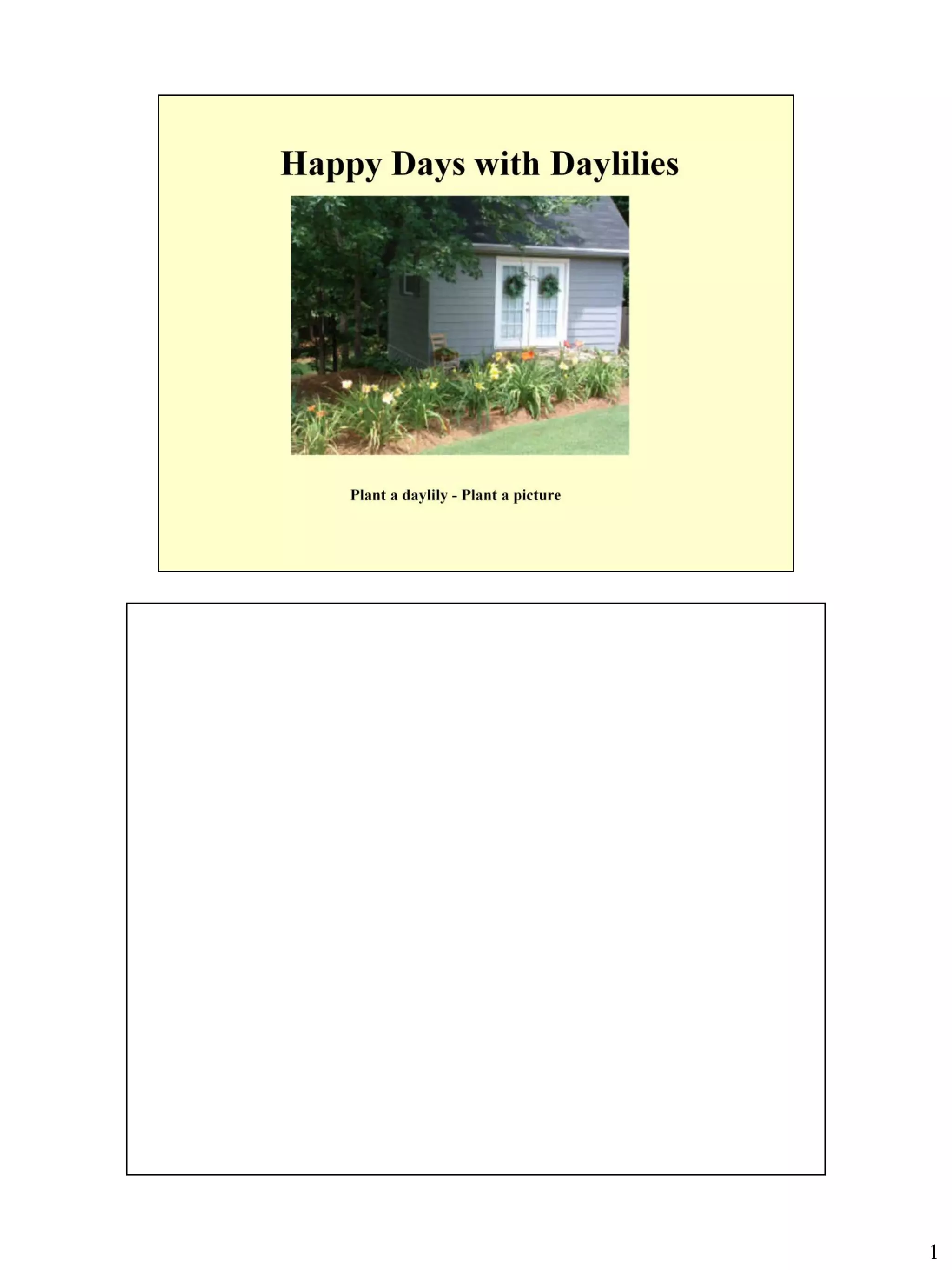
beds – note the mass planting in front of the shed. Daylilies can be used on
slopes or hillsides for erosion control.

20
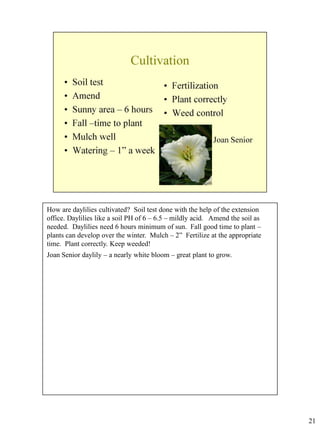
How are daylilies cultivated? Soil test done with the help of the extension
office. Daylilies like a soil PH of 6 – 6.5 – mildly acid. Amend the soil as
needed. Daylilies need 6 hours minimum of sun. Fall good time to plant –
plants can develop over the winter. Mulch – 2” Fertilize at the appropriate
time. Plant correctly. Keep weeded!
Joan Senior daylily – a nearly white bloom – great plant to grow.

21
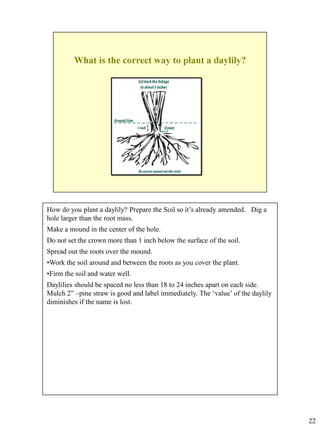
How do you plant a daylily? Prepare the Soil so it’s already amended. Dig a
hole larger than the root mass.
Make a mound in the center of the hole.
Do not set the crown more than 1 inch below the surface of the soil.
Spread out the roots over the mound.
•Work the soil around and between the roots as you cover the plant.
•Firm the soil and water well.
Daylilies should be spaced no less than 18 to 24 inches apart on each side.
Mulch 2” –pine straw is good and label immediately. The ‘value’ of the daylily
diminishes if the name is lost.

22
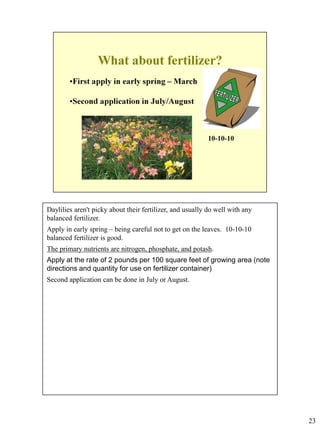
Daylilies aren't picky about their fertilizer, and usually do well with any
balanced fertilizer.
Apply in early spring – being careful not to get on the leaves. 10-10-10
balanced fertilizer is good.
The primary nutrients are nitrogen, phosphate, and potash.
Apply at the rate of 2 pounds per 100 square feet of growing area (note
directions and quantity for use on fertilizer container)
Second application can be done in July or August.

23
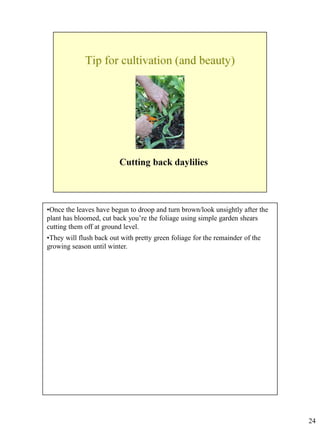
•Once the leaves have begun to droop and turn brown/look unsightly after the
plant has bloomed, cut back you’re the foliage using simple garden shears
cutting them off at ground level.
•They will flush back out with pretty green foliage for the remainder of the
growing season until winter.

24
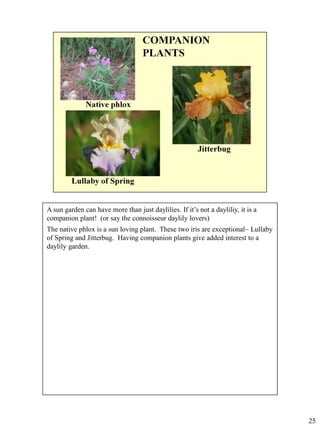
A sun garden can have more than just daylilies. If it’s not a dayliliy, it is a
companion plant! (or say the connoisseur daylily lovers)
The native phlox is a sun loving plant. These two iris are exceptional– Lullaby
of Spring and Jitterbug. Having companion plants give added interest to a
daylily garden.

25
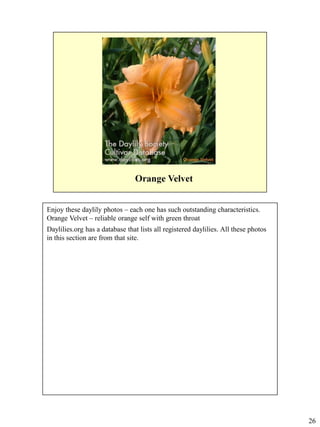
Enjoy these daylily photos – each one has such outstanding characteristics.
Orange Velvet – reliable orange self with green throat
Daylilies.org has a database that lists all registered daylilies. All these photos
in this section are from that site.

26
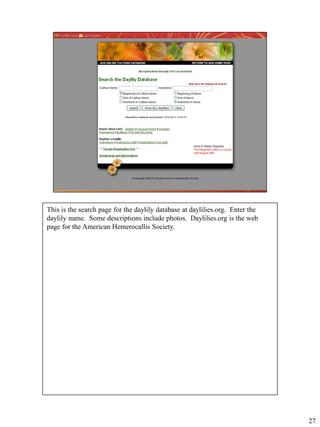
This is the search page for the daylily database at daylilies.org. Enter the
daylily name. Some descriptions include photos. Daylilies.org is the web
page for the American Hemerocallis Society.

27
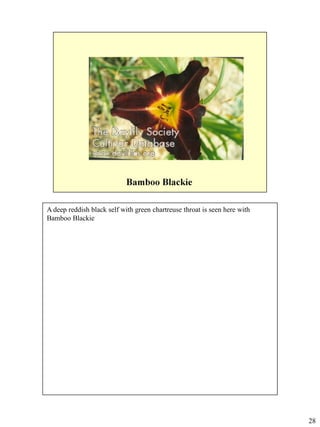
A deep reddish black self with green chartreuse throat is seen here with
Bamboo Blackie

28
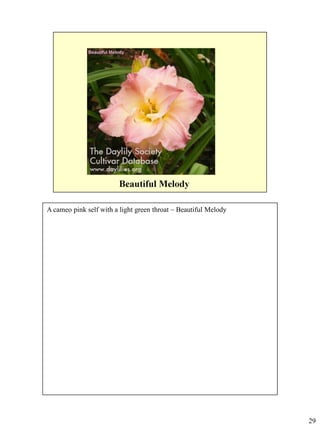
A cameo pink self with a light green throat – Beautiful Melody

29
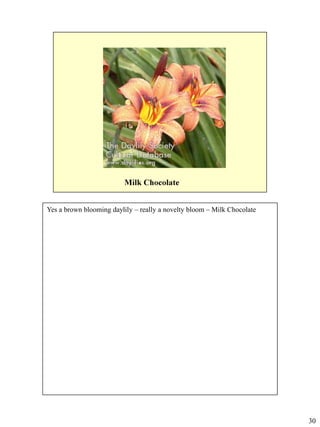
Yes a brown blooming daylily – really a novelty bloom – Milk Chocolate

30
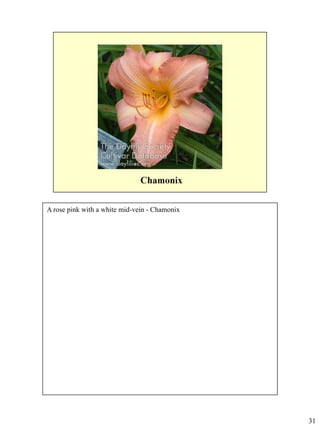
A rose pink with a white mid-vein - Chamonix

31
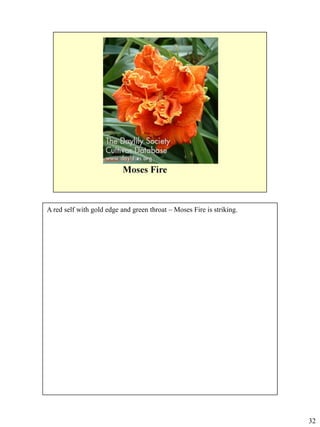
A red self with gold edge and green throat – Moses Fire is striking.

32
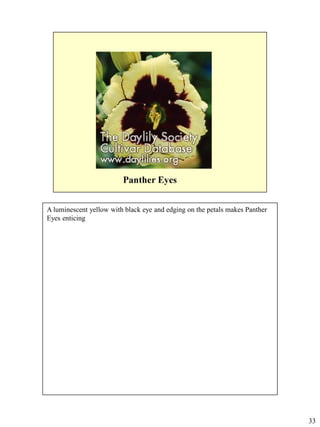
A luminescent yellow with black eye and edging on the petals makes Panther
Eyes enticing

33
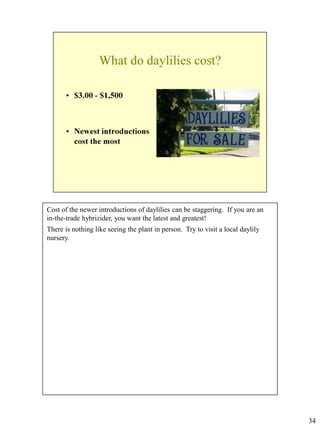
Cost of the newer introductions of daylilies can be staggering. If you are an
in-the-trade hybrizider, you want the latest and greatest!
There is nothing like seeing the plant in person. Try to visit a local daylily
nursery.

34
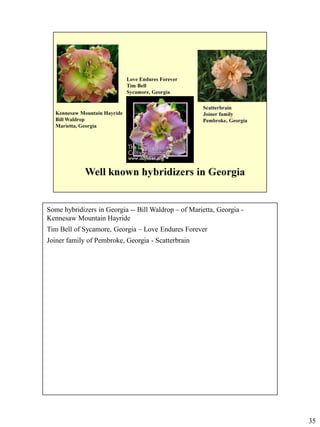
Some hybridizers in Georgia -- Bill Waldrop – of Marietta, Georgia Kennesaw Mountain Hayride
Tim Bell of Sycamore, Georgia – Love Endures Forever
Joiner family of Pembroke, Georgia - Scatterbrain

35
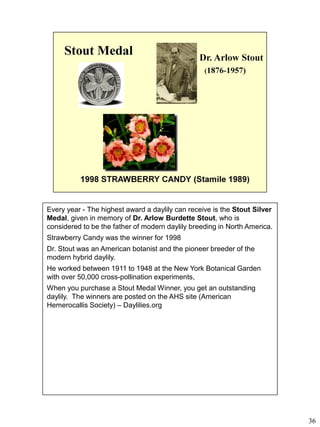
Every year - The highest award a daylily can receive is the Stout Silver
Medal, given in memory of Dr. Arlow Burdette Stout, who is
considered to be the father of modern daylily breeding in North America.
Strawberry Candy was the winner for 1998
Dr. Stout was an American botanist and the pioneer breeder of the
modern hybrid daylily.
He worked between 1911 to 1948 at the New York Botanical Garden
with over 50,000 cross-pollination experiments,
When you purchase a Stout Medal Winner, you get an outstanding
daylily. The winners are posted on the AHS site (American
Hemerocallis Society) – Daylilies.org

36
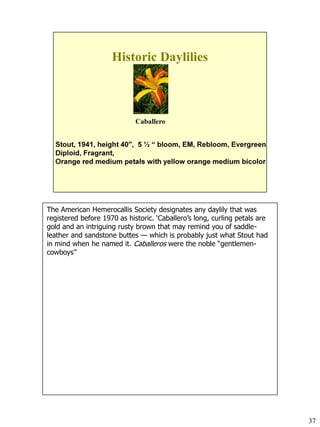
The American Hemerocallis Society designates any daylily that was
registered before 1970 as historic. ‘Caballero’s long, curling petals are
gold and an intriguing rusty brown that may remind you of saddleleather and sandstone buttes — which is probably just what Stout had
in mind when he named it. Caballeros were the noble “gentlemencowboys”

37
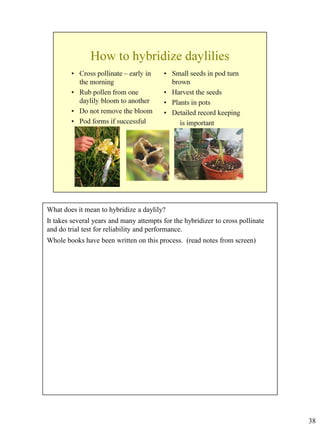
What does it mean to hybridize a daylily?
It takes several years and many attempts for the hybridizer to cross pollinate
and do trial test for reliability and performance.
Whole books have been written on this process. (read notes from screen)

38
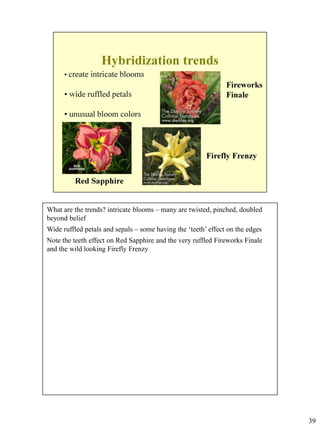
What are the trends? intricate blooms – many are twisted, pinched, doubled
beyond belief
Wide ruffled petals and sepals – some having the ‘teeth’ effect on the edges
Note the teeth effect on Red Sapphire and the very ruffled Fireworks Finale
and the wild looking Firefly Frenzy

39
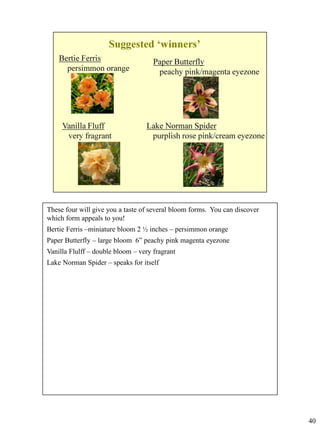
These four will give you a taste of several bloom forms. You can discover
which form appeals to you!
Bertie Ferris –miniature bloom 2 ½ inches – persimmon orange
Paper Butterfly – large bloom 6” peachy pink magenta eyezone
Vanilla Flulff – double bloom – very fragrant
Lake Norman Spider – speaks for itself

40
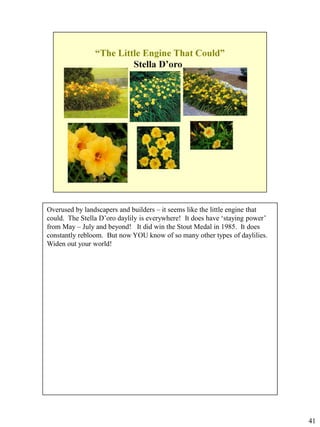
Overused by landscapers and builders – it seems like the little engine that
could. The Stella D’oro daylily is everywhere! It does have ‘staying power’
from May – July and beyond! It did win the Stout Medal in 1985. It does
constantly rebloom. But now YOU know of so many other types of daylilies.
Widen out your world!

41
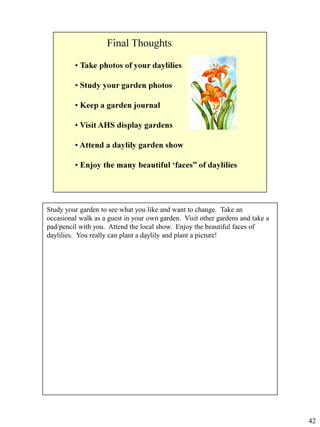
Study your garden to see what you like and want to change. Take an
occasional walk as a guest in your own garden. Visit other gardens and take a
pad/pencil with you. Attend the local show. Enjoy the beautiful faces of
daylilies. You really can plant a daylily and plant a picture!

42
Discover your own bit of heaven.

43
44

Daylily presentation

  • 1.
  • 2.
    Daylilies create aportrait of beauty in the sun garden. They thrive in the full sun. They offer exceptional colors, tolerate drought and require little care. Daylilies are often referred to as the perfect perennial. 2
  • 3.
    Hybridizers register hundredsof new cultivars yearly. Now – 72,095 During the 18th and 19th century daylilies came from Asia In the 1930’s began hybridization in America References go back 2000 years Modern dayliles are hybridized from species (species meaning the daylilies created in nature) The new hybrids – have almost every color in the rainbow with the exception of a true blue Orange colored tawny daylily – know as the “ditch lily” – the Hemerocallis fulva – naturalized – Please give homage to this plant. Yes – it is aggressive BUT it is one of the great, great, great, great grandparent of our modern daylilies. 3
  • 4.
    Hemerocallis is aGreek word meaning beauty for a day Notice the foliage formation – leaves appear on opposite sides giving a flattened appearance that is referred to as a “fan” – commercially - plants are sold in the language of “fans” Spent bloom (yesterday’s bloom)- remove each morning; Seed pod remove unless your are hybridizing; Crown – solid white core between the roots and the leaves; Proliferation – leafy shoot that is identical to the mother plant (not all daylilies proliferate) 4
  • 5.
    Daylilies have recognizableflower forms Velvet Eyes is an example of a single form. Also notice the three petals (ones on top), three sepals (ones on the bottom), 6 stamens – male part with pollen, 1 pistil – female part with ovary 5
  • 6.
    Condilla is anexample of a double flower form – great daylily – a rebloomer very vigorous 6
  • 7.
    Spider forms havepetals four times the petals width or more. The length is measured with the petal fully extended. Red Ribbons is a good example. 7
  • 8.
    Unusual form isbased solely on the shape of the petals or sepals. include pinched, cascaded or twisted. Fire Arrow is an example. Shapes 8
  • 9.
    Polymerous is aflower form with more than the normal number of petals or sepals. This example has four petals. Fuchsia Four 9
  • 10.
    A few colorpatterns – Self - Satanic Majesty– everything is the same color – petals, sepals, stamens.. Bitone - Asian Sky – same basic color but darker on the petals and lighter on the sepals. Can also have reverse bitone. Polychrome - Little Rainbow – intermingling of three or more colors – stamens/throat different colors. Bicolor - Howdy– petals and sepals different colors – petals are the darker of the two colors – can also have a reverse bicolor. Diamond-dusted – surface color appears as silver or gold sparkle 10
  • 11.
    Foliage habit refersto habit during the winter months. The leaves of dormant daylilies die completely back as winter approaches. They stop growing and form resting buds at the crown, and the foliage dies down naturally and gradually. Evergreen daylilies retain their leaves throughout the year. They do not form resting buds. Instead, they continually produce new leaves unless cold weather prevents growth. In mild climates, the leaves of evergreens remain green all winter. In the coldest climates, the foliage of evergreens nearly always is frozen back, but the crown survives if it is hardy (or well mulched) Today, the term semi-evergreen is used to describe any foliage behavior which is not readily classed as simple evergreen or dormant 11
  • 12.
    Hybriziders create newdaylilies by cross-pollination of two different blooms. What is the difference in a diploid and a tetraploid? (read notes on slide) 12
  • 13.
    Diseases and pestsusually do not kill the daylily plant They do cause us concern, however. Aphids – mild systemic pesticide – daylilies have their own specific aphid Spider mites – hose off Thrips – pesticide To get true identification of these very small pests, take foliage and/or insect to the Extension Office. Slugs –pesticide – ½ water and ½ ammonia sprayed on them – will whiten out the leaves Leaf scorch/streak –Yellow streak begins at the leaf tips and moves down the midvein – small reddish to brownish spots on foliage. Do make sure to rule out stress due to lack or water or nutritionally deficient. A fungicide can help. Rust –noticed in 2000 - orange spores – run hand down have orange powder – fungicide as appropriate – discard leaves showing this problem Leaf miner – in 2011 it was noticed that a small, pale yellow larvae travel up and down in leaf blades, leaving long mines which become progressively wider as the larvae grow. It becomes a fly and adults may be seen walking up and down daylily leaves or resting on blooms. There may be one to several generations per season. The species might overwinter as pupae in crowns or dead leaves. Research is currently being done to determine the best control for leaf miner. 13
  • 14.
    Daylilies can begrown in decorative pots. Don’t be hesitant to do this. They will do just fine for a few years depending on the size of the pot. 14
  • 15.
    Make sure tohave a large enough container, and you have to keep them wellwatered (every day in the summer heat). For smaller plants (typically the ones with smaller blooms), you'll want at least a 12" diameter pot, 15-18" will be better. Larger varieties will need larger pots. With winters in zone 7 - Place the pots next to the house or in a somewhere that will get some protection from wind and elements. 15
  • 16.
    Long Tall Sallyis a large bloom measuring 14 inches across. (read notes on slide) 16
  • 17.
    This miniature bloomeris less than three inches across. Baby Tiger Paws has a purple eyezone. (read notes) 17
  • 18.
    Divide any daylilyclump that has two or more plants (fans), but you typically would want to wait until the clump was large enough to make at least two good-sized units with at least 3 fans each Use a garden fork to lift and dig out the plant to minimize root damage. Soaking the clump in a bucket of water overnight can aid in the separating. Separate fans with your hands or a shovel if tightly bound. Trim the plant to 5 inches. This is one way to share with friends. Be sure to label the plant. Proliferation is the second way to have a daylily plant that is true to the mother plant. The photo shows a small plant forming on the scape. Trim it away from the scape and place the end in water to develop roots. Plant in soil when roots are formed. Not all daylilies form proliferatons. Seeds are not true because most daylilies are hybrids. Hybrids – meaning that they are the combination of different plants that have been cross-pollinated. That’s why you need to pinch off any seed pods you see….this sends strength back to the roots. 18
  • 19.
    Place garden artwith your daylilies. This will make your garden interesting and provide focal points. 19
  • 20.
    Other ways tofeature daylilies – with a bird feeder - along a fence - raised beds – note the mass planting in front of the shed. Daylilies can be used on slopes or hillsides for erosion control. 20
  • 21.
    How are dayliliescultivated? Soil test done with the help of the extension office. Daylilies like a soil PH of 6 – 6.5 – mildly acid. Amend the soil as needed. Daylilies need 6 hours minimum of sun. Fall good time to plant – plants can develop over the winter. Mulch – 2” Fertilize at the appropriate time. Plant correctly. Keep weeded! Joan Senior daylily – a nearly white bloom – great plant to grow. 21
  • 22.
    How do youplant a daylily? Prepare the Soil so it’s already amended. Dig a hole larger than the root mass. Make a mound in the center of the hole. Do not set the crown more than 1 inch below the surface of the soil. Spread out the roots over the mound. •Work the soil around and between the roots as you cover the plant. •Firm the soil and water well. Daylilies should be spaced no less than 18 to 24 inches apart on each side. Mulch 2” –pine straw is good and label immediately. The ‘value’ of the daylily diminishes if the name is lost. 22
  • 23.
    Daylilies aren't pickyabout their fertilizer, and usually do well with any balanced fertilizer. Apply in early spring – being careful not to get on the leaves. 10-10-10 balanced fertilizer is good. The primary nutrients are nitrogen, phosphate, and potash. Apply at the rate of 2 pounds per 100 square feet of growing area (note directions and quantity for use on fertilizer container) Second application can be done in July or August. 23
  • 24.
    •Once the leaveshave begun to droop and turn brown/look unsightly after the plant has bloomed, cut back you’re the foliage using simple garden shears cutting them off at ground level. •They will flush back out with pretty green foliage for the remainder of the growing season until winter. 24
  • 25.
    A sun gardencan have more than just daylilies. If it’s not a dayliliy, it is a companion plant! (or say the connoisseur daylily lovers) The native phlox is a sun loving plant. These two iris are exceptional– Lullaby of Spring and Jitterbug. Having companion plants give added interest to a daylily garden. 25
  • 26.
    Enjoy these daylilyphotos – each one has such outstanding characteristics. Orange Velvet – reliable orange self with green throat Daylilies.org has a database that lists all registered daylilies. All these photos in this section are from that site. 26
  • 27.
    This is thesearch page for the daylily database at daylilies.org. Enter the daylily name. Some descriptions include photos. Daylilies.org is the web page for the American Hemerocallis Society. 27
  • 28.
    A deep reddishblack self with green chartreuse throat is seen here with Bamboo Blackie 28
  • 29.
    A cameo pinkself with a light green throat – Beautiful Melody 29
  • 30.
    Yes a brownblooming daylily – really a novelty bloom – Milk Chocolate 30
  • 31.
    A rose pinkwith a white mid-vein - Chamonix 31
  • 32.
    A red selfwith gold edge and green throat – Moses Fire is striking. 32
  • 33.
    A luminescent yellowwith black eye and edging on the petals makes Panther Eyes enticing 33
  • 34.
    Cost of thenewer introductions of daylilies can be staggering. If you are an in-the-trade hybrizider, you want the latest and greatest! There is nothing like seeing the plant in person. Try to visit a local daylily nursery. 34
  • 35.
    Some hybridizers inGeorgia -- Bill Waldrop – of Marietta, Georgia Kennesaw Mountain Hayride Tim Bell of Sycamore, Georgia – Love Endures Forever Joiner family of Pembroke, Georgia - Scatterbrain 35
  • 36.
    Every year -The highest award a daylily can receive is the Stout Silver Medal, given in memory of Dr. Arlow Burdette Stout, who is considered to be the father of modern daylily breeding in North America. Strawberry Candy was the winner for 1998 Dr. Stout was an American botanist and the pioneer breeder of the modern hybrid daylily. He worked between 1911 to 1948 at the New York Botanical Garden with over 50,000 cross-pollination experiments, When you purchase a Stout Medal Winner, you get an outstanding daylily. The winners are posted on the AHS site (American Hemerocallis Society) – Daylilies.org 36
  • 37.
    The American HemerocallisSociety designates any daylily that was registered before 1970 as historic. ‘Caballero’s long, curling petals are gold and an intriguing rusty brown that may remind you of saddleleather and sandstone buttes — which is probably just what Stout had in mind when he named it. Caballeros were the noble “gentlemencowboys” 37
  • 38.
    What does itmean to hybridize a daylily? It takes several years and many attempts for the hybridizer to cross pollinate and do trial test for reliability and performance. Whole books have been written on this process. (read notes from screen) 38
  • 39.
    What are thetrends? intricate blooms – many are twisted, pinched, doubled beyond belief Wide ruffled petals and sepals – some having the ‘teeth’ effect on the edges Note the teeth effect on Red Sapphire and the very ruffled Fireworks Finale and the wild looking Firefly Frenzy 39
  • 40.
    These four willgive you a taste of several bloom forms. You can discover which form appeals to you! Bertie Ferris –miniature bloom 2 ½ inches – persimmon orange Paper Butterfly – large bloom 6” peachy pink magenta eyezone Vanilla Flulff – double bloom – very fragrant Lake Norman Spider – speaks for itself 40
  • 41.
    Overused by landscapersand builders – it seems like the little engine that could. The Stella D’oro daylily is everywhere! It does have ‘staying power’ from May – July and beyond! It did win the Stout Medal in 1985. It does constantly rebloom. But now YOU know of so many other types of daylilies. Widen out your world! 41
  • 42.
    Study your gardento see what you like and want to change. Take an occasional walk as a guest in your own garden. Visit other gardens and take a pad/pencil with you. Attend the local show. Enjoy the beautiful faces of daylilies. You really can plant a daylily and plant a picture! 42
  • 43.
    Discover your ownbit of heaven. 43
  • 44.