Effects of Belongingness and Synchronicity on
Face-to-face and Online Cooperative Learning

Andy Saltarelli, Ph.D.	

Stanford University	

vpol.stanford.edu | andysaltarelli.com	

@ajsalts
Game Plan

Talk a Little Theory-Research-Practice	

!

Share Results of Two Studies	

!

Make Some Preliminary Applications	

!

Share What’s Next
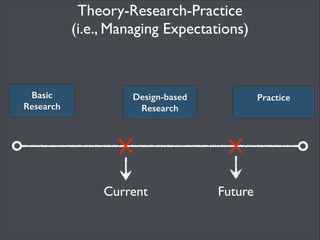
Theory-Research-Practice	

(i.e., Managing Expectations)

Basic
Research

Design-based
Research

Current

Practice

Future
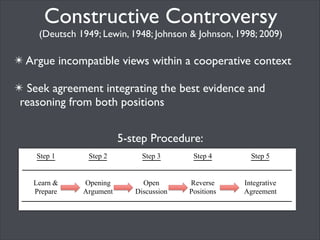
Constructive Controversy	


(Deutsch 1949; Lewin, 1948; Johnson & Johnson, 1998; 2009)

✴ Argue incompatible views within a cooperative context	

!

✴ Seek agreement integrating the best evidence and
reasoning from both positions
5-step Procedure:
Step 1

Step 2

Step 3

Step 4

Step 5

Learn &
Prepare

Opening
Argument

Open
Discussion

Reverse
Positions

Integrative
Agreement
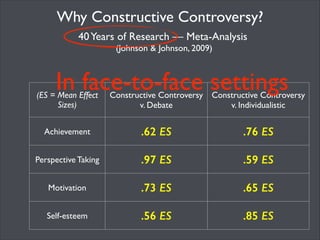
Why Constructive Controversy?
40 Years of Research — Meta-Analysis	

(Johnson & Johnson, 2009)	

!

In face-to-face settings

(ES = Mean Effect
Sizes)

Constructive Controversy
v. Debate

Constructive Controversy
v. Individualistic

Achievement

.62 ES

.76 ES

Perspective Taking

.97 ES

.59 ES

Motivation

.73 ES

.65 ES

Self-esteem

.56 ES

.85 ES
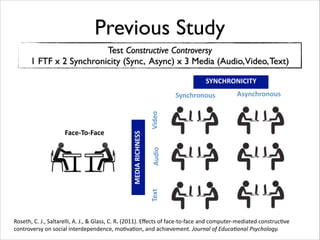
Previous Study
Test Constructive Controversy 	

1 FTF x 2 Synchronicity (Sync, Async) x 3 Media (Audio,Video, Text)
SYNCHRONICITY

Audio
Text

MEDIA	
  RICHNESS

Face-­‐To-­‐Face

Asynchronous

Video

Synchronous

Roseth,	
  C.	
  J.,	
  Saltarelli,	
  A.	
  J.,	
  &	
  Glass,	
  C.	
  R.	
  (2011).	
  Effects	
  of	
  face-­‐to-­‐face	
  and	
  computer-­‐mediated	
  construcCve	
  
controversy	
  on	
  social	
  interdependence,	
  moCvaCon,	
  and	
  achievement.	
  Journal	
  of	
  Educa-onal	
  Psychology.	
  
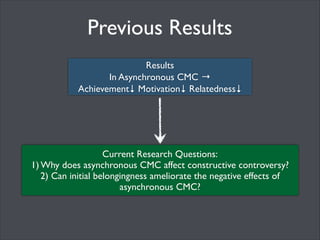
Previous Results

(Roseth,	
  Saltarelli,	
  &	
  Glass,	
  2011;	
  Journal	
  of	
  EducaConal	
  Psychology)	
  

Results	

In Asynchronous CMC → 	

Achievement↓ Motivation↓ Relatedness↓	


Current Research Questions:	

1) Why does asynchronous CMC affect constructive controversy?	

2) Can initial belongingness ameliorate the negative effects of
asynchronous CMC?
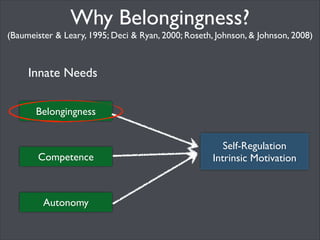
Why Belongingness?	

(Baumeister & Leary, 1995; Deci & Ryan, 2000; Roseth, Johnson, & Johnson, 2008)	


Innate Needs	

Belongingness	


Competence	


Autonomy	


Self-Regulation	

Intrinsic Motivation
Why Belongingness?	

!

Feeling for an answer
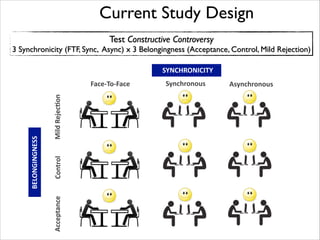
Current Study Design	

Test Constructive Controversy 	

3 Synchronicity (FTF, Sync, Async) x 3 Belongingness (Acceptance, Control, Mild Rejection)
SYNCHRONICITY

Mild	
  RejecFon
Control
Acceptance

BELONGINGNESS

Face-­‐To-­‐Face

Synchronous

Asynchronous
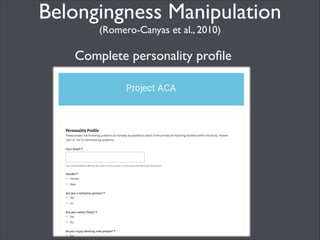
Belongingness Manipulation	

(Romero-Canyas et al., 2010)
!

Complete personality profile	

!
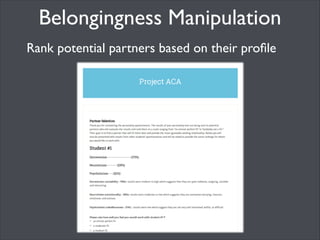
Belongingness Manipulation
!

Rank potential partners based on their profile	

!
!
Belongingness Manipulation
!

Get paired with partner	

!
!
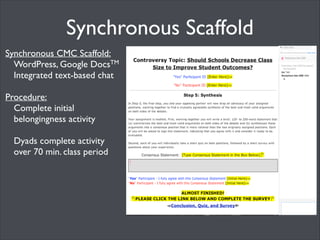
Synchronous Scaffold
Synchronous CMC Scaffold:	

WordPress, Google DocsTM	

Integrated text-based chat	

!

Procedure:	

Complete initial
belongingness activity	

!

Dyads complete activity
over 70 min. class period
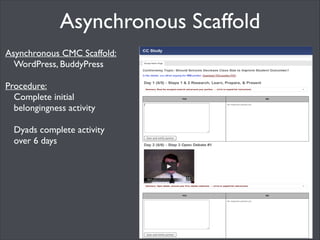
Asynchronous Scaffold
Asynchronous CMC Scaffold:	

WordPress, BuddyPress	

!

Procedure:	

Complete initial
belongingness activity	

!

Dyads complete activity
over 6 days
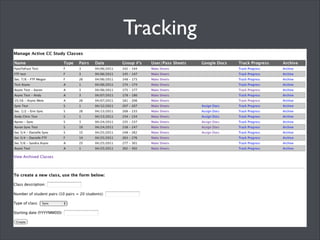
Tracking
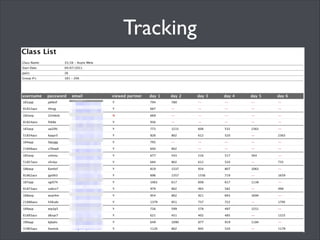
Tracking
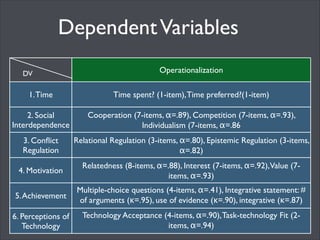
Dependent Variables
DV

Operationalization

1. Time

Time spent? (1-item), Time preferred?(1-item)

2. Social
Interdependence

Cooperation (7-items, α=.89), Competition (7-items, α=.93),
Individualism (7-items, α=.86

3. Conflict
Regulation

Relational Regulation (3-items, α=.80), Epistemic Regulation (3-items,
α=.82)

4. Motivation

Relatedness (8-items, α=.88), Interest (7-items, α=.92),Value (7items, α=.93)

5. Achievement

Multiple-choice questions (4-items, α=.41), Integrative statement: #
of arguments (κ=.95), use of evidence (κ=.90), integrative (κ=.87)

6. Perceptions of
Technology

Technology Acceptance (4-items, α=.90), Task-technology Fit (2items, α=.94)
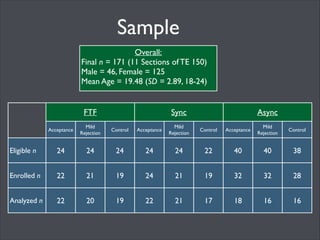
Sample
Overall:	

Final n = 171 (11 Sections of TE 150)	

Male = 46, Female = 125	

Mean Age = 19.48 (SD = 2.89, 18-24)	


FTF

Sync

Async

Acceptance

Mild
Rejection

Control

Acceptance

Mild
Rejection

Control

Acceptance

Mild
Rejection

Control

Eligible n

24

24

24

24

24

22

40

40

38

Enrolled n

22

21

19

24

21

19

32

32

28

Analyzed n

22

20

19

22

21

17

18

16

16
Results
DV

IV

1. Time
2. Social
Interdependence
3. Conflict
Elaboration
4. Belongingness
& Motivation
5. Achievement
6. Technology
Acceptance

Belongingness

Synchronicity
!

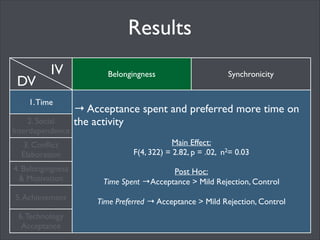
→ Acceptance spent and preferred more time on
the activity	

!

Main Effect:	

F(4, 322) = 2.82, p = .02, n2= 0.03	

!

Post Hoc:	

Time Spent →Acceptance > Mild Rejection, Control	

!

Time Preferred → Acceptance > Mild Rejection, Control
Results
DV

IV

1. Time

Belongingness
!

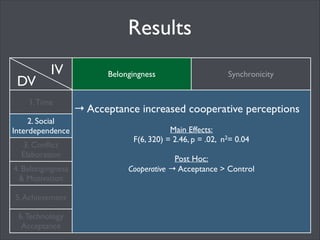
→ Acceptance increased cooperative perceptions	


2. Social
Interdependence
3. Conflict
Elaboration
4. Belongingness
& Motivation !
5. Achievement
6. Technology
Acceptance

Synchronicity

!

Main Effects:	

F(6, 320) = 2.46, p = .02, n2= 0.04	

!

Post Hoc:	

Cooperative → Acceptance > Control	

!
Results
DV

IV

1. Time
2. Social
Interdependence

Belongingness
!

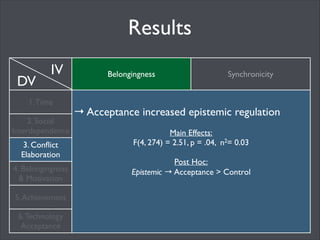
→ Acceptance increased epistemic regulation	

!

Main Effects:	

F(4, 274) = 2.51, p = .04, n2= 0.03	


3. Conflict
Elaboration

!

Post Hoc:	

Epistemic → Acceptance > Control 	


4. Belongingness
& Motivation
5. Achievement
6. Technology
Acceptance

Synchronicity

!
!
Results
DV

IV

1. Time

Belongingness
!

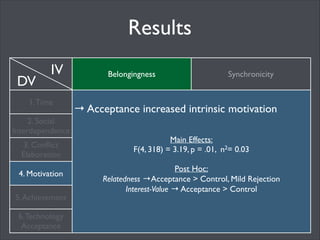
→ Acceptance increased intrinsic motivation	


2. Social
Interdependence

!
!

Main Effects:	

F(4, 318) = 3.19, p = .01, n2= 0.03	


3. Conflict
Elaboration

!

Post Hoc:	

Relatedness →Acceptance > Control, Mild Rejection	

Interest-Value → Acceptance > Control	


4. Motivation
5. Achievement !
6. Technology
Acceptance

Synchronicity

!
Results

1. Time
2. Social
Interdependence
3. Conflict
Elaboration
4. Motivation
5. Achievement
6. Technology
Acceptance

Belongingness

Synchronicity

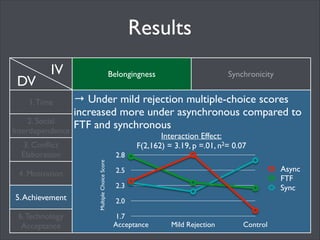
→ Under mild rejection multiple-choice scores
increased more under asynchronous compared to
FTF and synchronous	

Interaction Effect:	

F(2,162) = 3.19, p =.01, n2= 0.07	

!

2.8
Multiple Choice Score

DV

IV

Async
FTF
Sync

2.5
2.3
2.0
1.7
Acceptance

Mild Rejection

Control
Results
DV

IV

1. Time

Belongingness

Synchronicity

!

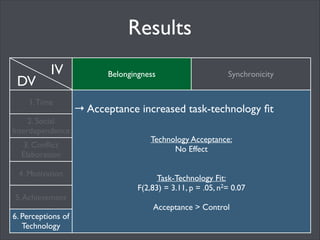
→ Acceptance increased task-technology fit	


!
2. Social
Interdependence

3. Conflict
Elaboration

!

Technology Acceptance:	

No Effect	

!
!

4. Motivation
5. Achievement !
6. Perceptions of
Technology
!
!

Task-Technology Fit:	

F(2,83) = 3.11, p = .05, n2= 0.07	

Acceptance > Control	

!
Results
DV

IV

1. Time
2. Social
Interdependence
3. Conflict
Elaboration
4. Belongingness
& Motivation
5. Achievement
6. Technology
Acceptance

Belongingness

Synchronicity
!

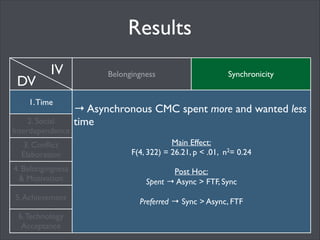
→ Asynchronous CMC spent more and wanted less
time	

!

Main Effect:	

F(4, 322) = 26.21, p < .01, n2= 0.24	

!

Post Hoc:	

Spent → Async > FTF, Sync	

!

Preferred → Sync > Async, FTF 	

!
Results
DV

IV

1. Time
2. Social
Interdependence
3. Conflict
Elaboration

Belongingness
!

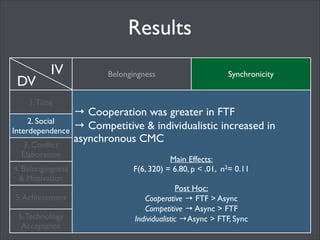
→ Cooperation was greater in FTF	

→ Competitive & individualistic increased in
asynchronous CMC	

!

Main Effects:	

F(6, 320) = 6.80, p < .01, n2= 0.11	


4. Belongingness
& Motivation

!

Post Hoc:	

Cooperative → FTF > Async	

Competitive → Async > FTF	

Individualistic →Async > FTF, Sync	


5. Achievement
6. Technology
Acceptance

Synchronicity

!
Results
DV

IV

1. Time

Belongingness
!

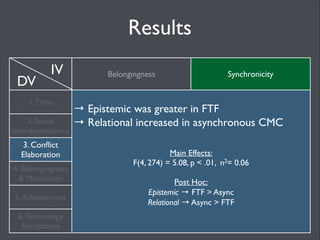
→ Epistemic was greater in FTF	

→ Relational increased in asynchronous CMC	


2. Social
Interdependence !
3. Conflict
Elaboration
4. Belongingness
& Motivation
5. Achievement
6. Technology
Acceptance

Synchronicity

!

Main Effects:	

F(4, 274) = 5.08, p < .01, n2= 0.06	

!

Post Hoc:	

Epistemic → FTF > Async	

Relational → Async > FTF	

!
Results
DV

IV

1. Time

Belongingness
!

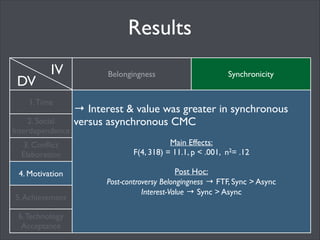
→ Interest & value was greater in synchronous
versus asynchronous CMC	


2. Social
Interdependence !
3. Conflict
Elaboration
4. Motivation
5. Achievement !
6. Technology
Acceptance

Synchronicity

Main Effects:	

F(4, 318) = 11.1, p < .001, n2= .12	

!

Post Hoc:	

Post-controversy Belongingness → FTF, Sync > Async	

Interest-Value → Sync > Async	

!

!
!
Results
DV

IV

1. Time
2. Social
Interdependence
3. Conflict
Elaboration
4. Motivation

Belongingness
!

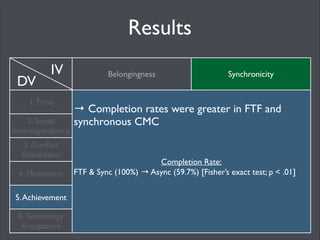
→ Completion rates were greater in FTF and
synchronous CMC	


6. Technology
Acceptance


!
!

Completion Rate:	

FTF & Sync (100%) → Async (59.7%) [Fisher’s exact test; p < .01]	

!

5. Achievement

Synchronicity
Results
DV

IV

1. Time
2. Social
Interdependence

Belongingness
!

→ Integrative statements were greater in FTF
versus asynchronous CMC 	

!
!

3. Conflict
Elaboration

Main Effects:	

F(6, 152) = 3.54, p < .01, n2= 0.12	

!

4. Motivation

Post Hoc:	

Evidence → Sync > FTF	

Integrative Statements → FTF > Async	


5. Achievement
6. Technology
Acceptance

Synchronicity

!
Results
DV

IV

1. Time

Belongingness

Synchronicity
!

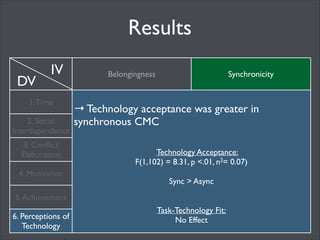
→ Technology acceptance was greater in
synchronous CMC	


2. Social
Interdependence !
!
3. Conflict
Elaboration
4. Motivation

Technology Acceptance:	

F(1,102) = 8.31, p <.01, n2= 0.07)	

!

Sync > Async	


!
5. Achievement !

6. Perceptions of
Technology

Task-Technology Fit:	

No Effect	

!
Summary of Findings
DV

IV

1. Time
2. Social
Interdependence
3. Conflict
Elaboration

Belongingness

Synchronicity
!

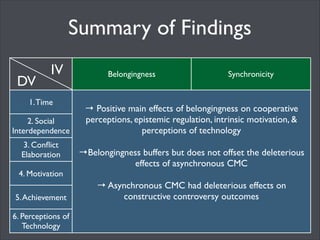
→ Positive main effects of belongingness on cooperative
perceptions, epistemic regulation, intrinsic motivation, &
perceptions of technology	

!

→Belongingness buffers but does not offset the deleterious
effects of asynchronous CMC	


4. Motivation

!

5. Achievement

→ Asynchronous CMC had deleterious effects on
constructive controversy outcomes	


6. Perceptions of
Technology

!
Implications for Practice
DV

IV

1. Time
2. Social
Interdependence
3. Conflict
Elaboration

Belongingness

Synchronicity
!

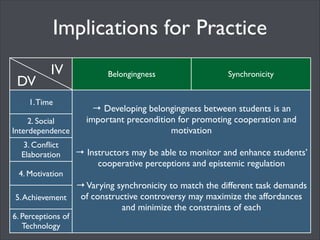
→ Developing belongingness between students is an
important precondition for promoting cooperation and
motivation	

!

→ Instructors may be able to monitor and enhance students’
cooperative perceptions and epistemic regulation	


4. Motivation

!

5. Achievement

→ Varying synchronicity to match the different task demands
of constructive controversy may maximize the affordances
and minimize the constraints of each	


6. Perceptions of
Technology

!
!
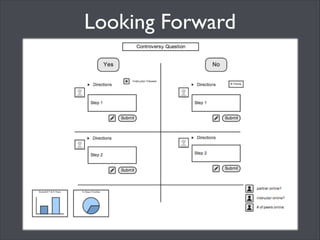
Looking Forward
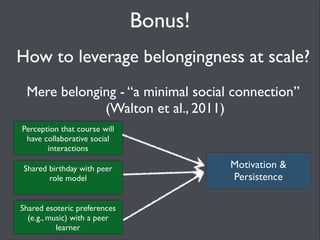
Bonus!
How to leverage belongingness at scale?	

!

Mere belonging - “a minimal social connection”	

(Walton et al., 2011)
Perception that course will
have collaborative social
interactions	

Shared birthday with peer
role model	

Shared esoteric preferences
(e.g., music) with a peer
learner	


Motivation &
Persistence
References
Baumeister, R. F., & Leary, M. R. (1995). The need to belong: Desire for interpersonal attachments as a fundamental human motivation.
Psychological Bulletin, 117, 497-497.	


!

Deci, E. L., & Ryan, R. (2000). The what and why of goal pursuits: Human needs and the self- determination of behavior. Psychological
Inquiry, 11, 227-268.	


!

Deutsch, M. (1949). A theory of cooperation and competition. Human Relations, 2, 129–152.	


!

Johnson, D. W., & Johnson, R. (1989). Cooperation and competition: Theory and research. Edina, MN:	

Interaction Book Company.	


Johnson, D. W., & Johnson, R. (1992). Positive interdependence: Key to effective cooperation. In R. Hertz-	

Lazarowitz & N. Miller (Eds.), Interaction in cooperative groups: The theoretical anatomy of group	

learning. New York: Cambridge University Press.	


!

Lewin, K. (1948). Resolving social conflicts. New York: Harper.	


!

Romero-Canyas, R., Downey, G., Reddy, K. S., Rodriguez, S., Cavanaugh, T. J., & Pelayo, R. (2010). Paying to belong: When does rejection
trigger ingratiation? Journal of Personality and Social Psychology, 99, 802-823.	


!

Walton, G. M., Cohen, G. L., Cwir, D., & Spencer, S. J. (2011). Mere belonging: The power of social connections. Retrieved from http://
psycnet.apa.org/psycinfo/2011-24226-001	


!
!
Thank You
Andy Saltarelli	

saltarel@stanford.edu	

Slides: http://bit.ly/cc-pod-2013	

andysaltarelli.com

Pod 2013 presentation

  • 1.
    Effects of Belongingnessand Synchronicity on Face-to-face and Online Cooperative Learning Andy Saltarelli, Ph.D. Stanford University vpol.stanford.edu | andysaltarelli.com @ajsalts
  • 3.
    Game Plan Talk aLittle Theory-Research-Practice ! Share Results of Two Studies ! Make Some Preliminary Applications ! Share What’s Next
  • 4.
  • 5.
    Constructive Controversy (Deutsch 1949;Lewin, 1948; Johnson & Johnson, 1998; 2009) ✴ Argue incompatible views within a cooperative context ! ✴ Seek agreement integrating the best evidence and reasoning from both positions 5-step Procedure: Step 1 Step 2 Step 3 Step 4 Step 5 Learn & Prepare Opening Argument Open Discussion Reverse Positions Integrative Agreement
  • 6.
    Why Constructive Controversy? 40Years of Research — Meta-Analysis (Johnson & Johnson, 2009) ! In face-to-face settings (ES = Mean Effect Sizes) Constructive Controversy v. Debate Constructive Controversy v. Individualistic Achievement .62 ES .76 ES Perspective Taking .97 ES .59 ES Motivation .73 ES .65 ES Self-esteem .56 ES .85 ES
  • 7.
    Previous Study Test ConstructiveControversy 1 FTF x 2 Synchronicity (Sync, Async) x 3 Media (Audio,Video, Text) SYNCHRONICITY Audio Text MEDIA  RICHNESS Face-­‐To-­‐Face Asynchronous Video Synchronous Roseth,  C.  J.,  Saltarelli,  A.  J.,  &  Glass,  C.  R.  (2011).  Effects  of  face-­‐to-­‐face  and  computer-­‐mediated  construcCve   controversy  on  social  interdependence,  moCvaCon,  and  achievement.  Journal  of  Educa-onal  Psychology.  
  • 8.
    Previous Results (Roseth,  Saltarelli,  &  Glass,  2011;  Journal  of  EducaConal  Psychology)   Results In Asynchronous CMC → Achievement↓ Motivation↓ Relatedness↓ Current Research Questions: 1) Why does asynchronous CMC affect constructive controversy? 2) Can initial belongingness ameliorate the negative effects of asynchronous CMC?
  • 9.
    Why Belongingness? (Baumeister &Leary, 1995; Deci & Ryan, 2000; Roseth, Johnson, & Johnson, 2008) Innate Needs Belongingness Competence Autonomy Self-Regulation Intrinsic Motivation
  • 10.
  • 11.
    Current Study Design TestConstructive Controversy 3 Synchronicity (FTF, Sync, Async) x 3 Belongingness (Acceptance, Control, Mild Rejection) SYNCHRONICITY Mild  RejecFon Control Acceptance BELONGINGNESS Face-­‐To-­‐Face Synchronous Asynchronous
  • 12.
    Belongingness Manipulation (Romero-Canyas etal., 2010) ! Complete personality profile !
  • 13.
    Belongingness Manipulation ! Rank potentialpartners based on their profile ! !
  • 14.
  • 15.
    Synchronous Scaffold Synchronous CMCScaffold: WordPress, Google DocsTM Integrated text-based chat ! Procedure: Complete initial belongingness activity ! Dyads complete activity over 70 min. class period
  • 16.
    Asynchronous Scaffold Asynchronous CMCScaffold: WordPress, BuddyPress ! Procedure: Complete initial belongingness activity ! Dyads complete activity over 6 days
  • 17.
  • 18.
  • 19.
    Dependent Variables DV Operationalization 1. Time Timespent? (1-item), Time preferred?(1-item) 2. Social Interdependence Cooperation (7-items, α=.89), Competition (7-items, α=.93), Individualism (7-items, α=.86 3. Conflict Regulation Relational Regulation (3-items, α=.80), Epistemic Regulation (3-items, α=.82) 4. Motivation Relatedness (8-items, α=.88), Interest (7-items, α=.92),Value (7items, α=.93) 5. Achievement Multiple-choice questions (4-items, α=.41), Integrative statement: # of arguments (κ=.95), use of evidence (κ=.90), integrative (κ=.87) 6. Perceptions of Technology Technology Acceptance (4-items, α=.90), Task-technology Fit (2items, α=.94)
  • 20.
    Sample Overall: Final n =171 (11 Sections of TE 150) Male = 46, Female = 125 Mean Age = 19.48 (SD = 2.89, 18-24) FTF Sync Async Acceptance Mild Rejection Control Acceptance Mild Rejection Control Acceptance Mild Rejection Control Eligible n 24 24 24 24 24 22 40 40 38 Enrolled n 22 21 19 24 21 19 32 32 28 Analyzed n 22 20 19 22 21 17 18 16 16
  • 21.
    Results DV IV 1. Time 2. Social Interdependence 3.Conflict Elaboration 4. Belongingness & Motivation 5. Achievement 6. Technology Acceptance Belongingness Synchronicity ! → Acceptance spent and preferred more time on the activity ! Main Effect: F(4, 322) = 2.82, p = .02, n2= 0.03 ! Post Hoc: Time Spent →Acceptance > Mild Rejection, Control ! Time Preferred → Acceptance > Mild Rejection, Control
  • 22.
    Results DV IV 1. Time Belongingness ! → Acceptanceincreased cooperative perceptions 2. Social Interdependence 3. Conflict Elaboration 4. Belongingness & Motivation ! 5. Achievement 6. Technology Acceptance Synchronicity ! Main Effects: F(6, 320) = 2.46, p = .02, n2= 0.04 ! Post Hoc: Cooperative → Acceptance > Control !
  • 23.
    Results DV IV 1. Time 2. Social Interdependence Belongingness ! →Acceptance increased epistemic regulation ! Main Effects: F(4, 274) = 2.51, p = .04, n2= 0.03 3. Conflict Elaboration ! Post Hoc: Epistemic → Acceptance > Control 4. Belongingness & Motivation 5. Achievement 6. Technology Acceptance Synchronicity ! !
  • 24.
    Results DV IV 1. Time Belongingness ! → Acceptanceincreased intrinsic motivation 2. Social Interdependence ! ! Main Effects: F(4, 318) = 3.19, p = .01, n2= 0.03 3. Conflict Elaboration ! Post Hoc: Relatedness →Acceptance > Control, Mild Rejection Interest-Value → Acceptance > Control 4. Motivation 5. Achievement ! 6. Technology Acceptance Synchronicity !
  • 25.
    Results 1. Time 2. Social Interdependence 3.Conflict Elaboration 4. Motivation 5. Achievement 6. Technology Acceptance Belongingness Synchronicity → Under mild rejection multiple-choice scores increased more under asynchronous compared to FTF and synchronous Interaction Effect: F(2,162) = 3.19, p =.01, n2= 0.07 ! 2.8 Multiple Choice Score DV IV Async FTF Sync 2.5 2.3 2.0 1.7 Acceptance Mild Rejection Control
  • 26.
    Results DV IV 1. Time Belongingness Synchronicity ! → Acceptanceincreased task-technology fit ! 2. Social Interdependence 3. Conflict Elaboration ! Technology Acceptance: No Effect ! ! 4. Motivation 5. Achievement ! 6. Perceptions of Technology ! ! Task-Technology Fit: F(2,83) = 3.11, p = .05, n2= 0.07 Acceptance > Control !
  • 27.
    Results DV IV 1. Time 2. Social Interdependence 3.Conflict Elaboration 4. Belongingness & Motivation 5. Achievement 6. Technology Acceptance Belongingness Synchronicity ! → Asynchronous CMC spent more and wanted less time ! Main Effect: F(4, 322) = 26.21, p < .01, n2= 0.24 ! Post Hoc: Spent → Async > FTF, Sync ! Preferred → Sync > Async, FTF !
  • 28.
    Results DV IV 1. Time 2. Social Interdependence 3.Conflict Elaboration Belongingness ! → Cooperation was greater in FTF → Competitive & individualistic increased in asynchronous CMC ! Main Effects: F(6, 320) = 6.80, p < .01, n2= 0.11 4. Belongingness & Motivation ! Post Hoc: Cooperative → FTF > Async Competitive → Async > FTF Individualistic →Async > FTF, Sync 5. Achievement 6. Technology Acceptance Synchronicity !
  • 29.
    Results DV IV 1. Time Belongingness ! → Epistemicwas greater in FTF → Relational increased in asynchronous CMC 2. Social Interdependence ! 3. Conflict Elaboration 4. Belongingness & Motivation 5. Achievement 6. Technology Acceptance Synchronicity ! Main Effects: F(4, 274) = 5.08, p < .01, n2= 0.06 ! Post Hoc: Epistemic → FTF > Async Relational → Async > FTF !
  • 30.
    Results DV IV 1. Time Belongingness ! → Interest& value was greater in synchronous versus asynchronous CMC 2. Social Interdependence ! 3. Conflict Elaboration 4. Motivation 5. Achievement ! 6. Technology Acceptance Synchronicity Main Effects: F(4, 318) = 11.1, p < .001, n2= .12 ! Post Hoc: Post-controversy Belongingness → FTF, Sync > Async Interest-Value → Sync > Async ! ! !
  • 31.
    Results DV IV 1. Time 2. Social Interdependence 3.Conflict Elaboration 4. Motivation Belongingness ! → Completion rates were greater in FTF and synchronous CMC 6. Technology Acceptance ! ! Completion Rate: FTF & Sync (100%) → Async (59.7%) [Fisher’s exact test; p < .01] ! 5. Achievement Synchronicity
  • 32.
    Results DV IV 1. Time 2. Social Interdependence Belongingness ! →Integrative statements were greater in FTF versus asynchronous CMC ! ! 3. Conflict Elaboration Main Effects: F(6, 152) = 3.54, p < .01, n2= 0.12 ! 4. Motivation Post Hoc: Evidence → Sync > FTF Integrative Statements → FTF > Async 5. Achievement 6. Technology Acceptance Synchronicity !
  • 33.
    Results DV IV 1. Time Belongingness Synchronicity ! → Technologyacceptance was greater in synchronous CMC 2. Social Interdependence ! ! 3. Conflict Elaboration 4. Motivation Technology Acceptance: F(1,102) = 8.31, p <.01, n2= 0.07) ! Sync > Async ! 5. Achievement ! 6. Perceptions of Technology Task-Technology Fit: No Effect !
  • 34.
    Summary of Findings DV IV 1.Time 2. Social Interdependence 3. Conflict Elaboration Belongingness Synchronicity ! → Positive main effects of belongingness on cooperative perceptions, epistemic regulation, intrinsic motivation, & perceptions of technology ! →Belongingness buffers but does not offset the deleterious effects of asynchronous CMC 4. Motivation ! 5. Achievement → Asynchronous CMC had deleterious effects on constructive controversy outcomes 6. Perceptions of Technology !
  • 35.
    Implications for Practice DV IV 1.Time 2. Social Interdependence 3. Conflict Elaboration Belongingness Synchronicity ! → Developing belongingness between students is an important precondition for promoting cooperation and motivation ! → Instructors may be able to monitor and enhance students’ cooperative perceptions and epistemic regulation 4. Motivation ! 5. Achievement → Varying synchronicity to match the different task demands of constructive controversy may maximize the affordances and minimize the constraints of each 6. Perceptions of Technology ! !
  • 36.
  • 37.
    Bonus! How to leveragebelongingness at scale? ! Mere belonging - “a minimal social connection” (Walton et al., 2011) Perception that course will have collaborative social interactions Shared birthday with peer role model Shared esoteric preferences (e.g., music) with a peer learner Motivation & Persistence
  • 39.
    References Baumeister, R. F.,& Leary, M. R. (1995). The need to belong: Desire for interpersonal attachments as a fundamental human motivation. Psychological Bulletin, 117, 497-497. ! Deci, E. L., & Ryan, R. (2000). The what and why of goal pursuits: Human needs and the self- determination of behavior. Psychological Inquiry, 11, 227-268. ! Deutsch, M. (1949). A theory of cooperation and competition. Human Relations, 2, 129–152. ! Johnson, D. W., & Johnson, R. (1989). Cooperation and competition: Theory and research. Edina, MN: Interaction Book Company. 
 Johnson, D. W., & Johnson, R. (1992). Positive interdependence: Key to effective cooperation. In R. Hertz- Lazarowitz & N. Miller (Eds.), Interaction in cooperative groups: The theoretical anatomy of group learning. New York: Cambridge University Press. ! Lewin, K. (1948). Resolving social conflicts. New York: Harper. ! Romero-Canyas, R., Downey, G., Reddy, K. S., Rodriguez, S., Cavanaugh, T. J., & Pelayo, R. (2010). Paying to belong: When does rejection trigger ingratiation? Journal of Personality and Social Psychology, 99, 802-823. ! Walton, G. M., Cohen, G. L., Cwir, D., & Spencer, S. J. (2011). Mere belonging: The power of social connections. Retrieved from http:// psycnet.apa.org/psycinfo/2011-24226-001 ! !
  • 40.
    Thank You Andy Saltarelli saltarel@stanford.edu Slides:http://bit.ly/cc-pod-2013 andysaltarelli.com