Topic presentation- POAG
Dr.Lhacha Wangdi
R3, JDWNRH/KGUMSB
2016
Objectives
Aqueous formation and drainage system
Glaucoma overview
POAG:
 Pathophysiology of raised IOP
 Glaucomatous optic neuropathy
 Clinical manifestation
 Investigations and interpretation of the results
 Management principles
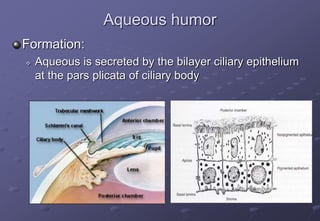
Aqueous humor
Formation:
 Aqueous is secreted by the bilayer ciliary epithelium
at the pars plicata of ciliary body
Aqueous production
Three Mechanism
1. Ultrafiltration
ultrafiltration of plasma through the fenestrated capillaries
into the ciliary stroma
2. Active transport (main mechanism)
Number of solutes are actively transported from
ultrafiltrated across the CE(PE+NPE) into the PC
3. Simple diffusion
Passive transport of H2O to PC facilitated by the Osmotic
gradient created by active transport
Active transport
 Three mechanism:
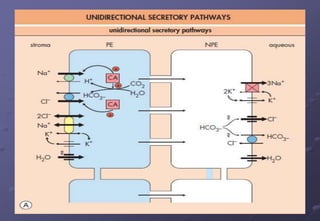
1. Loading of major ions/solutes occurs through the Basolateral
membrane (BLM) of PE
 Na-K-2cl and Na-HCO3 cotransporter / Na/H+ counter exchanger=
uptake of of Na+, K+, CL- from stroma to PE coupled with anti-transport
of H+ and HCO3- by Na/H+ and CL-/HCO3 antiports located in BLM of
PE
2. Active transport of Na+ by Na+,K+ ATPase located at the BLM of
NPE
3. Shifting of fluid and solutes from PE to PC is facilitated by the
concentration gradient
Aqueous dynamics
 Secretion of aqueous balanced with drainage
 Secretion flow rate:2-3 uL/min.
 Aqueous volume(AC+PC)= (200ul+60ul)=260ul
 Maintains IOP of 11-21mmHg (average=16mmHg)
 Diurnal variation – morning rise( 7.mmHg is
considered normal upper limit)
 Asymmetry of IOP >4mmHg is significant
Aqueous flow
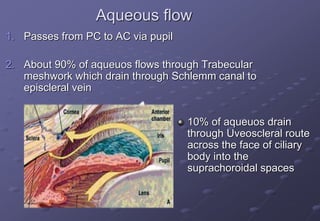
1. Passes from PC to AC via pupil
2. About 90% of aqueuos flows through Trabecular
meshwork which drain through Schlemm canal to
episcleral vein
10% of aqueuos drain
through Uveoscleral route
across the face of ciliary
body into the
suprachoroidal spaces
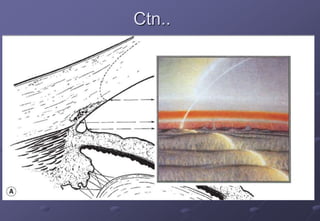
Ctn..
Angle structure
1. Schwalbe line (SL)
2. Trabecular meshwork(TM)
3. Schlemm’s canal(SC)
4. Scleral spur(SS)
5. Anterior border of the ciliary
body(CB)
1. (where its longitudinal fibers insert
into the scleral spur)
6. Iris (I)
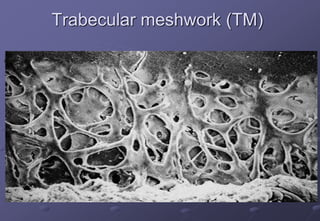
Trabecular meshwork (TM)
TM
 Circular spongework of connective tissue lined by
trabeculocytes
 Triangular in cross section.
 Apex at Schlemm’s canal
 Base formed by the scleral spur and the Ciliary body
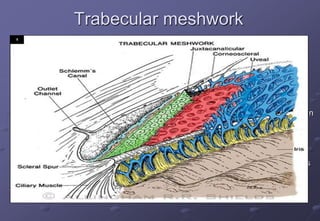
Trabecular meshwork
3 parts:
1. Uveal
 Contains large and circular cordlike trabeculae
 Diameter of pores-70pm in diameter
2. Corneoscleral
 Series of thin, flat, perforated connective tissue sheets arranged in
a laminar pattern
 Pores-35pm in diameter (moderate resistance
3. Juxtacanalicular
 Pericanalicular connective tissue-a multilayered collection of cells
forming a loose network-
 Pores -7pm in diameter (highest resistance to flow)
Glaucoma
Definition:
Glaucoma is a group of acute and chronic, progressive,
multifactorial optic neuropathies in which intraocular pressure
(IOP) and other contributing factors are responsible for a
characteristic, acquired loss of retinal ganglion cell axons leading
to atrophy of the optic nerve with demonstrable visual field defects
The word glaucoma came from the ancient Greek word glaucosis,
meaning clouded or blue-green hue, most likely describing a
patient having corneal edema or rapid evolution of a cataract
precipitated by chronic elevated pressure
Glaucoma
When to suspect?
1. Glaumatous optic neuropathy
2. Characteristic visual field loss
3. Raised IOP
Other clinical signs will depend on the Type of
glaucoma
Glaucoma
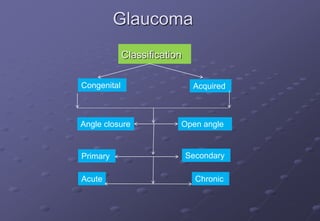
Classification
Congenital Acquired
Angle closure Open angle
Primary Secondary
Acute Chronic
Primary open angle glaucoma
(POAG)
Definition:
 Multifactorial optic neuropathy that is chronic and
progressive with a characteristic acquired visual field
loss in presence of open anterior chamber angle.
Commonly bilateral disease of adult onset
Characteristics:
1. Primary glaucomatous optic neuropathy
2. >IOP 21mmHG at some stage
3. Characteristic visual field loss
4. Absence of secondary cause of glaucoma
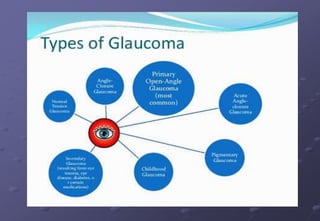
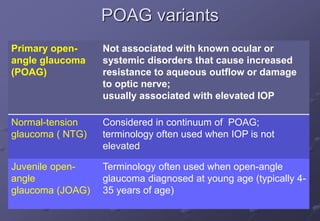
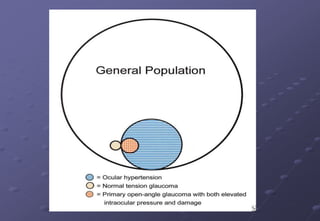
POAG variants
Primary open-
angle glaucoma
(POAG)
Not associated with known ocular or
systemic disorders that cause increased
resistance to aqueous outflow or damage
to optic nerve;
usually associated with elevated IOP
Normal-tension
glaucoma ( NTG)
Considered in continuum of POAG;
terminology often used when IOP is not
elevated
Juvenile open-
angle
glaucoma (JOAG)
Terminology often used when open-angle
glaucoma diagnosed at young age (typically 4-
35 years of age)
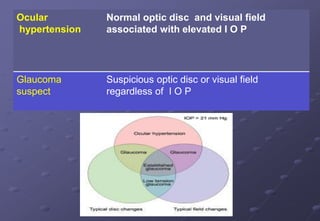
Ocular
hypertension
Normal optic disc and visual field
associated with elevated I O P
Glaucoma
suspect
Suspicious optic disc or visual field
regardless of I O P
POAG
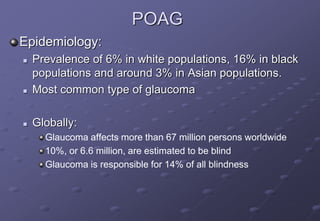
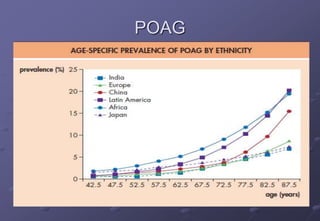
Epidemiology:
 Prevalence of 6% in white populations, 16% in black
populations and around 3% in Asian populations.
 Most common type of glaucoma
 Globally:
Glaucoma affects more than 67 million persons worldwide
10%, or 6.6 million, are estimated to be blind
Glaucoma is responsible for 14% of all blindness
POAG
Risk factors:
 The higher the IOP/Asymmetry of IOP of 4 mmHg or
more
 Older age
 More common in black individuals than in whites
 Genetics
 Steroid usages
 Diabetes mellitus
 Myopia
 Contraceptive pill
 Vascular disease
 Translaminar pressure gradient.
 Large discs
Genetics of POAG
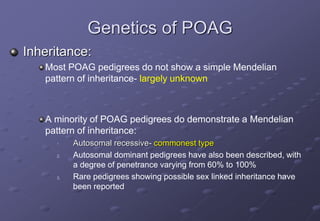
Inheritance:
Most POAG pedigrees do not show a simple Mendelian
pattern of inheritance- largely unknown
A minority of POAG pedigrees do demonstrate a Mendelian
pattern of inheritance:
1. Autosomal recessive- commonest type
2. Autosomal dominant pedigrees have also been described, with
a degree of penetrance varying from 60% to 100%
3. Rare pedigrees showing possible sex linked inheritance have
been reported
Genetics of POAG
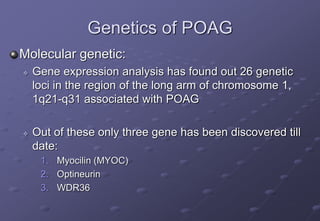
Molecular genetic:
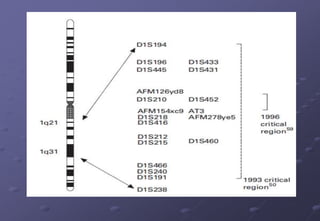
 Gene expression analysis has found out 26 genetic
loci in the region of the long arm of chromosome 1,
1q21-q31 associated with POAG
 Out of these only three gene has been discovered till
date:
1. Myocilin (MYOC)
2. Optineurin
3. WDR36
Ctn..
MYOC(myocilin)-Most studied gene:
Also called TIGR(trabecular meshwork induced glucocorticoid
response protein)
Normally myocilin protein is secreted by TM cells into aqueous
Mutated myocilin protein is not secreted and retained within TM
cells:
 Interferes with TM function
 Causes TM cell death
 Obstruction of aqueous drainage- raised IOP
Ctn…
Optineurin &WDR36:
 It is expressed in a variety of ocular tissues,
including the ciliary body, TM, and retina.
 Itsrole in glaucoma pathogenesis is still unclear
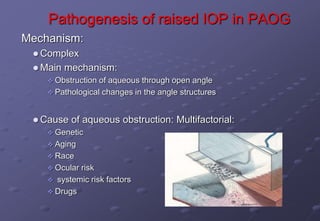
Pathogenesis of raised IOP in PAOG
Mechanism:
 Complex
 Main mechanism:
 Obstruction of aqueous through open angle
 Pathological changes in the angle structures
 Cause of aqueous obstruction: Multifactorial:
 Genetic
 Aging
 Race
 Ocular risk
 systemic risk factors
 Drugs
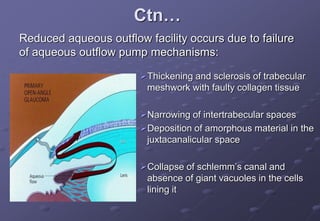
Ctn…
Thickening and sclerosis of trabecular
meshwork with faulty collagen tissue
Narrowing of intertrabecular spaces
Deposition of amorphous material in the
juxtacanalicular space
Collapse of schlemm’s canal and
absence of giant vacuoles in the cells
lining it
Reduced aqueous outflow facility occurs due to failure
of aqueous outflow pump mechanisms:
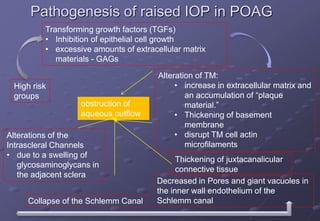
Pathogenesis of raised IOP in POAG
obstruction of
aqueous outflow
High risk
groups
Transforming growth factors (TGFs)
• Inhibition of epithelial cell growth
• excessive amounts of extracellular matrix
materials - GAGs
Alteration of TM:
• increase in extracellular matrix and
an accumulation of “plaque
material.”
• Thickening of basement
membrane
• disrupt TM cell actin
microfilaments
Thickening of juxtacanalicular
connective tissue
Decreased in Pores and giant vacuoles in
the inner wall endothelium of the
Schlemm canal
Collapse of the Schlemm Canal
Alterations of the
Intrascleral Channels
• due to a swelling of
glycosaminoglycans in
the adjacent sclera
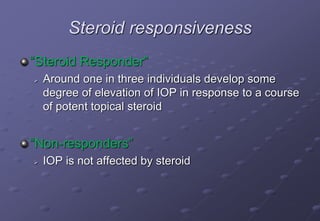
Steroid responsiveness
“Steroid Responder”
 Around one in three individuals develop some
degree of elevation of IOP in response to a course
of potent topical steroid
“Non-responders”
 IOP is not affected by steroid
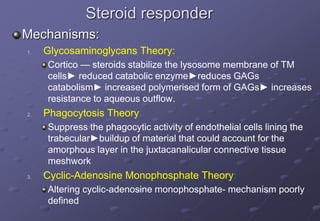
Steroid responder
Mechanisms:
1. Glycosaminoglycans Theory:
Cortico — steroids stabilize the lysosome membrane of TM
cells► reduced catabolic enzyme►reduces GAGs
catabolism► increased polymerised form of GAGs► increases
resistance to aqueous outflow.
2. Phagocytosis Theory:
Suppress the phagocytic activity of endothelial cells lining the
trabecular►buildup of material that could account for the
amorphous layer in the juxtacanalicular connective tissue
meshwork
3. Cyclic-Adenosine Monophosphate Theory:
Altering cyclic-adenosine monophosphate- mechanism poorly
defined
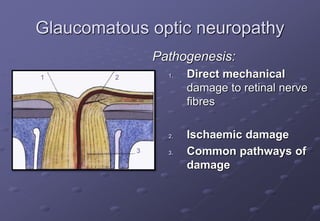
Glaucomatous optic neuropathy
Pathogenesis:
1. Direct mechanical
damage to retinal nerve
fibres
2. Ischaemic damage
3. Common pathways of
damage
1 2
3
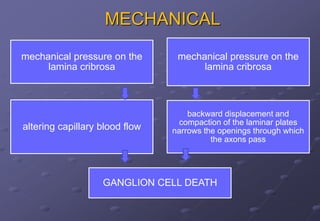
MECHANICAL
mechanical pressure on the
lamina cribrosa
mechanical pressure on the
lamina cribrosa
altering capillary blood flow
backward displacement and
compaction of the laminar plates
narrows the openings through which
the axons pass
GANGLION CELL DEATH
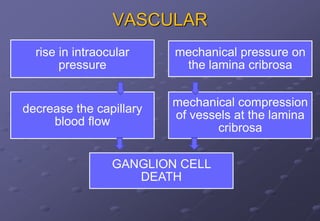
VASCULAR
rise in intraocular
pressure
mechanical pressure on
the lamina cribrosa
decrease the capillary
blood flow
mechanical compression
of vessels at the lamina
cribrosa
GANGLION CELL
DEATH
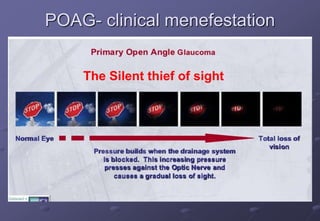
POAG- clinical menefestation
The Silent thief of sight
Clinical features
 Symptoms:
 Insidious and asymptomatic disease
 Gradual painless loss of vision
 Mild headache, eye ache
 Visual field defect(SCOTOMA)
 Frequent change in presbyopic glasses
 Delayed dark adaptation
 Significant loss of vision and blindness
Ctn…
Specific enquiry:
Refractive status(e.g myopia)
Causes of secondary glaucoma
(trauma/surgery/inflammation/tumour)
Family history- glaucoma
Past medical history-Asthma, heart failure/migraine and
Raynaud phenomenon, DM/HTN.
Drugs -Steroids/OCP/beta blockers
Social history- smoking/alcohol/nutrition-diet
Allergies
Examination
Work up:
1. Visual acuity
2. Pupils-
regularity/reaction/asymetry/RAPD/APD
3. Color vision assessment
4. Visual field- confrontation test
5. Slit lamp examination- detail examination of
anterior segment/fundus
Visual field examination
Screening tests …
Confrontational visual field testing
Amsler grid (assesses the central 10° the
visual field ) .
Quantitative measurements using manual or
automated perimetry
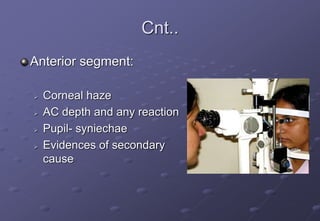
Cnt..
Anterior segment:
 Corneal haze
 AC depth and any reaction
 Pupil- syniechae
 Evidences of secondary
cause
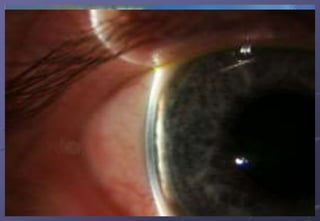
Ctt..
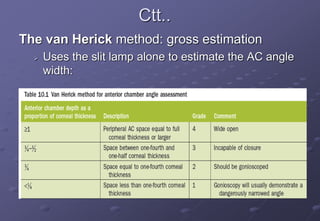
The van Herick method: gross estimation
 Uses the slit lamp alone to estimate the AC angle
width:
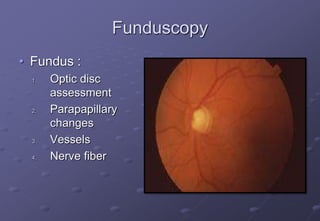
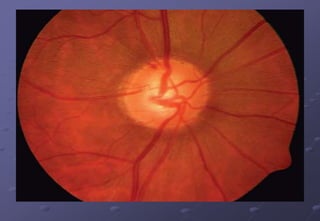
Funduscopy
• Fundus :
1. Optic disc
assessment
2. Parapapillary
changes
3. Vessels
4. Nerve fiber
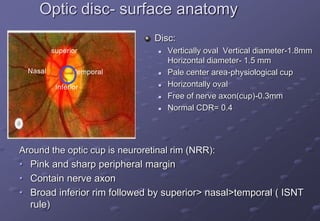
Optic disc- surface anatomy
Around the optic cup is neuroretinal rim (NRR):
• Pink and sharp peripheral margin
• Contain nerve axon
• Broad inferior rim followed by superior> nasal>temporal ( ISNT
rule)
Disc:
 Vertically oval Vertical diameter-1.8mm
Horizontal diameter- 1.5 mm
 Pale center area-physiological cup
 Horizontally oval
 Free of nerve axon(cup)-0.3mm
 Normal CDR= 0.4
Inferior
superior
Nasal temporal
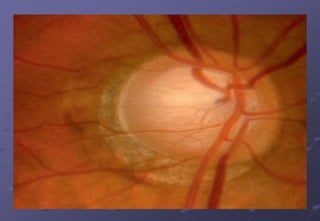
Glaucomatous Optic neuropathy
Glaucomatous damages in three regions:
(a) the optic nerve head
(b) the peripapillary area and
(c) the retinal nerve fibre layer.
There are specific sings and non specific signs
Ctn…
Optic nerve:
Specific signs:
 Focal ischaemic discs
 Myopic disc with glaucoma
 Sclerotic discs
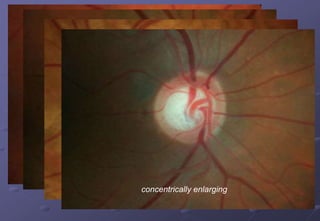
 Concentrically enlarging discs
Focal ischaemic – inferior notch and disc
haemorrhage
myopic;
sclerotic
concentrically enlarging
Glaucomatous ON
Nonspecific signs glaucomatous damages:
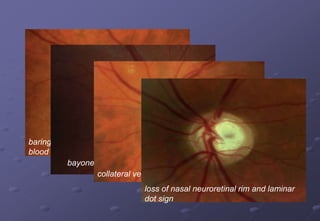
 Disc haemorrhages
 Baring of circumlinear blood vessels
 Bayoneting
 Collaterals
 Loss of nasal NRR
 The laminar dot sign
 ‘Sharpened edge’ or ‘sharpened rim’
baring of inferior circumlinear
blood vessel
bayoneting of blood vessels
collateral vessels
loss of nasal neuroretinal rim and laminar
dot sign
Ctn…
Peripapillary changes
1. Alpha (outer) zone is characterized by
superficial retinal pigment epithelial changes
2. Beta (inner) zone is characterized by
chorioretinal atrophy
Ctn..
Retinal nerve fibre layer
1. Localized wedge-shaped defects and
2. Diffuse defects that are larger and have
indistinct borders
INVESTIGATIONS
1. Tonometry
2. Central corneal thickness(CCT)
3. Diurnal variation test
4. Gonioscopy
5. Perimetry to detect the visual field defects
6. Nerve fibre layer analyzer (NFLA)
7. Provocative tests
Water drinking test
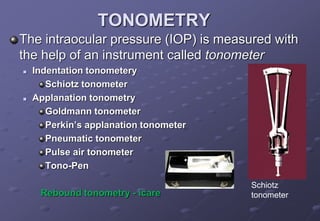
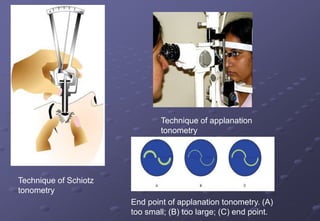
TONOMETRY
The intraocular pressure (IOP) is measured with
the help of an instrument called tonometer
 Indentation tonometery
Schiotz tonometer
 Applanation tonometry
Goldmann tonometer
Perkin’s applanation tonometer
Pneumatic tonometer
Pulse air tonometer
Tono-Pen
Rebound tonometry - icare
Schiotz
tonometer
Technique of Schiotz
tonometry
Technique of applanation
tonometry
End point of applanation tonometry. (A)
too small; (B) too large; (C) end point.
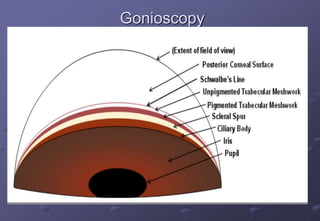
Gonioscopy
The technique of biomicroscopic examination of
the angle of the anterior chamber using a
goniolens.
The angle structures seen from behind forward
are:
1. Root of the iris
2. Ciliary body band
3. Scleral spur
4. Trabecular meshwork
5. Schwalbe’s line
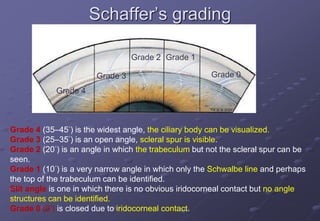
Schaffer’s grading
Grade 0
Grade 1
Grade 2
Grade 3
Grade 4
Grade 4 (35–45°) is the widest angle, the ciliary body can be visualized.
Grade 3 (25–35°) is an open angle, scleral spur is visible.
Grade 2 (20°) is an angle in which the trabeculum but not the scleral spur can be
seen.
Grade 1 (10°) is a very narrow angle in which only the Schwalbe line and perhaps
the top of the trabeculum can be identified.
Slit angle is one in which there is no obvious iridocorneal contact but no angle
structures can be identified.
Grade 0 (0°) is closed due to iridocorneal contact.
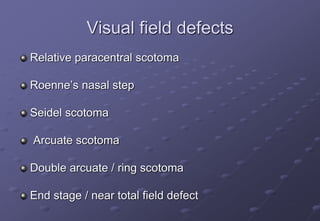
Visual field defects
Relative paracentral scotoma
Roenne’s nasal step
Seidel scotoma
Arcuate scotoma
Double arcuate / ring scotoma
End stage / near total field defect
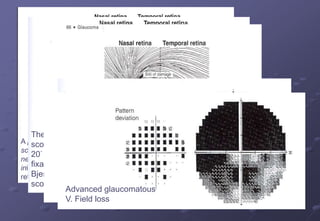
A paracentral
scotoma- loss of
nerve fibers
ininferotemporal
retina
The arcuate
scotoma-10-
20° from
fixation-
Bjerrum
scotoma
Nasal step
Altitudinal defect
Advanced glaucomatous
V. Field loss
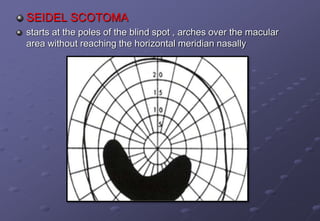
SEIDEL SCOTOMA
starts at the poles of the blind spot , arches over the macular
area without reaching the horizontal meridian nasally
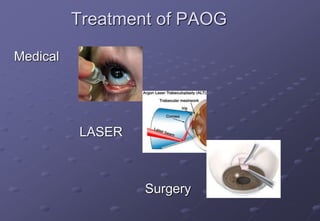
Treatment of PAOG
Medical
LASER
Surgery
Management
Principle:
 Determine TARGET PRESSURE – Reduction of IOP
by at least 30% appears to have the best chance of
preventing optic nerve damage
 Starting drugs-Monocular Therapeutic Trial (MTT)
 Reexamination in 3 to 6 weeks to check for
effectiveness.
 Exception to MMT:
IOP > 40 mm Hg
impending loss of central fixation),
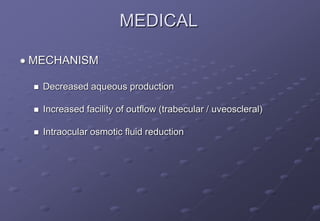
MEDICAL
 MECHANISM
 Decreased aqueous production
 Increased facility of outflow (trabecular / uveoscleral)
 Intraocular osmotic fluid reduction
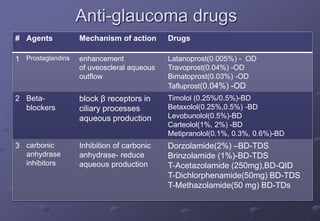
Anti-glaucoma drugs
# Agents Mechanism of action Drugs
1 Prostaglandins enhancement
of uveoscleral aqueous
outflow
Latanoprost(0.005%) - OD
Travoprost(0.04%) -OD
Bimatoprost(0.03%) -OD
Tafluprost(0.04%) -OD
2 Beta-
blockers
block β receptors in
ciliary processes
aqueous production
Timolol (0.25%/0.5%)-BD
Betaxolol(0.25%,0.5%) -BD
Levobunolol(0.5%)-BD
Carteolol(1%, 2%) -BD
Metipranolol(0.1%, 0.3%, 0.6%)-BD
3 carbonic
anhydrase
inhibitors
Inhibition of carbonic
anhydrase- reduce
aqueous production
Dorzolamide(2%) –BD-TDS
Brinzolamide (1%)-BD-TDS
T-Acetazolamide (250mg),BD-QID
T-Dichlorphenamide(50mg) BD-TDS
T-Methazolamide(50 mg) BD-TDs
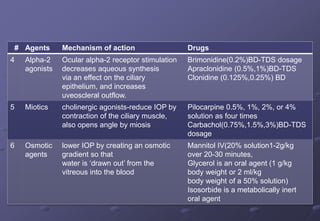
# Agents Mechanism of action Drugs
4 Alpha-2
agonists
Ocular alpha-2 receptor stimulation
decreases aqueous synthesis
via an effect on the ciliary
epithelium, and increases
uveoscleral outflow.
Brimonidine(0.2%)BD-TDS dosage
Apraclonidine (0.5%,1%)BD-TDS
Clonidine (0.125%,0.25%) BD
5 Miotics cholinergic agonists-reduce IOP by
contraction of the ciliary muscle,
also opens angle by miosis
Pilocarpine 0.5%, 1%, 2%, or 4%
solution as four times
Carbachol(0.75%,1.5%,3%)BD-TDS
dosage
6 Osmotic
agents
lower IOP by creating an osmotic
gradient so that
water is ‘drawn out’ from the
vitreous into the blood
Mannitol IV(20% solution1-2g/kg
over 20-30 minutes,
Glycerol is an oral agent (1 g/kg
body weight or 2 ml/kg
body weight of a 50% solution)
Isosorbide is a metabolically inert
oral agent
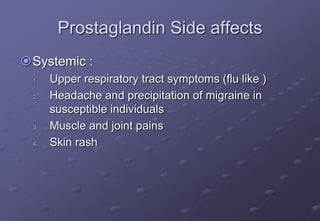
Prostaglandin Side affects
Systemic :
1. Upper respiratory tract symptoms (flu like )
2. Headache and precipitation of migraine in
susceptible individuals
3. Muscle and joint pains
4. Skin rash
Prostaglandin side affects
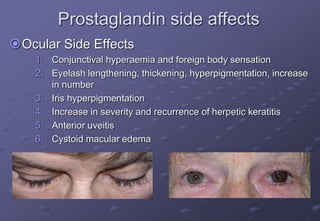
Ocular Side Effects
1. Conjunctival hyperaemia and foreign body sensation
2. Eyelash lengthening, thickening, hyperpigmentation, increase
in number
3. Iris hyperpigmentation
4. Increase in severity and recurrence of herpetic keratitis
5. Anterior uveitis
6. Cystoid macular edema
Beta- blocker side effects
Systemic
1. Cardiovascular effects – bradycardia, arrhythmia,
heart failure, syncope
2. Respiratory reactions – bronchospasm and airway
obstruction, especially in asthmatics
3. CNS effects – depression, anxiety, confusion,
drowsiness, disorientation
4. Others – nausea, diarrhoea, decreased libido, skin
rashes, alopecia
Beta-bockers
Ocular side affects:
 Conjuctival hyperaemia
 Superficial punctate keratopathy
 Corneal anaesthesia
1. Contraindications:
 Bronchial asthma
 Chronic obstructive pulmonary disease
 Heart blocks
 Congestive heart failure
 Cardiomyopathy
Carbonic anhydrase inhibiters
Systemic side affects:
1. Paraesthesias, numbmness, lethargy, depression,
malaise
2. Metabolic acidosis, hypokalemia, increased serum urate
level
3. Urinary frequency
4. Anorexia, cramps, flatulence, weight loss, diarrhoea
5. Sulfonamide related – blood dyscrasias, renal calculi,
steven-Johnson syndrome
Topical agents are less likely to induce systemic side
effects
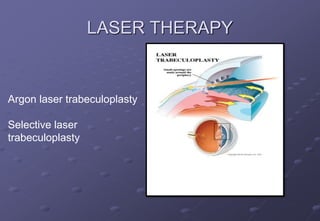
LASER THERAPY
Argon laser trabeculoplasty
Selective laser
trabeculoplasty
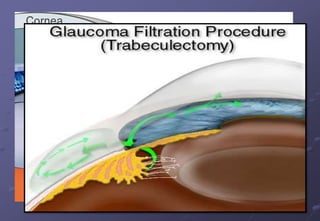
Surgical
TRABECULECTOMY:
Involves creation of fistula between angle of anterior
chamber and sub Tenon’s space
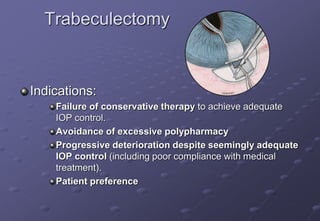
Trabeculectomy
Indications:
Failure of conservative therapy to achieve adequate
IOP control.
Avoidance of excessive polypharmacy
Progressive deterioration despite seemingly adequate
IOP control (including poor compliance with medical
treatment).
Patient preference
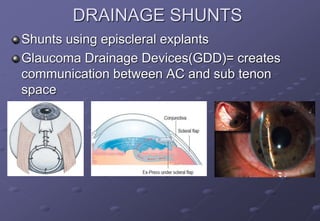
DRAINAGE SHUNTS
Shunts using episcleral explants
Glaucoma Drainage Devices(GDD)= creates
communication between AC and sub tenon
space
THANK YOU

poag-160909121826.pdf

  • 1.
    Topic presentation- POAG Dr.LhachaWangdi R3, JDWNRH/KGUMSB 2016
  • 2.
    Objectives Aqueous formation anddrainage system Glaucoma overview POAG:  Pathophysiology of raised IOP  Glaucomatous optic neuropathy  Clinical manifestation  Investigations and interpretation of the results  Management principles
  • 3.
    Aqueous humor Formation:  Aqueousis secreted by the bilayer ciliary epithelium at the pars plicata of ciliary body
  • 4.
    Aqueous production Three Mechanism 1.Ultrafiltration ultrafiltration of plasma through the fenestrated capillaries into the ciliary stroma 2. Active transport (main mechanism) Number of solutes are actively transported from ultrafiltrated across the CE(PE+NPE) into the PC 3. Simple diffusion Passive transport of H2O to PC facilitated by the Osmotic gradient created by active transport
  • 5.
    Active transport  Threemechanism: 1. Loading of major ions/solutes occurs through the Basolateral membrane (BLM) of PE  Na-K-2cl and Na-HCO3 cotransporter / Na/H+ counter exchanger= uptake of of Na+, K+, CL- from stroma to PE coupled with anti-transport of H+ and HCO3- by Na/H+ and CL-/HCO3 antiports located in BLM of PE 2. Active transport of Na+ by Na+,K+ ATPase located at the BLM of NPE 3. Shifting of fluid and solutes from PE to PC is facilitated by the concentration gradient
  • 7.
    Aqueous dynamics  Secretionof aqueous balanced with drainage  Secretion flow rate:2-3 uL/min.  Aqueous volume(AC+PC)= (200ul+60ul)=260ul  Maintains IOP of 11-21mmHg (average=16mmHg)  Diurnal variation – morning rise( 7.mmHg is considered normal upper limit)  Asymmetry of IOP >4mmHg is significant
  • 8.
    Aqueous flow 1. Passesfrom PC to AC via pupil 2. About 90% of aqueuos flows through Trabecular meshwork which drain through Schlemm canal to episcleral vein 10% of aqueuos drain through Uveoscleral route across the face of ciliary body into the suprachoroidal spaces
  • 9.
    Ctn.. Angle structure 1. Schwalbeline (SL) 2. Trabecular meshwork(TM) 3. Schlemm’s canal(SC) 4. Scleral spur(SS) 5. Anterior border of the ciliary body(CB) 1. (where its longitudinal fibers insert into the scleral spur) 6. Iris (I)
  • 10.
    Trabecular meshwork (TM) TM Circular spongework of connective tissue lined by trabeculocytes  Triangular in cross section.  Apex at Schlemm’s canal  Base formed by the scleral spur and the Ciliary body
  • 11.
    Trabecular meshwork 3 parts: 1.Uveal  Contains large and circular cordlike trabeculae  Diameter of pores-70pm in diameter 2. Corneoscleral  Series of thin, flat, perforated connective tissue sheets arranged in a laminar pattern  Pores-35pm in diameter (moderate resistance 3. Juxtacanalicular  Pericanalicular connective tissue-a multilayered collection of cells forming a loose network-  Pores -7pm in diameter (highest resistance to flow)
  • 12.
    Glaucoma Definition: Glaucoma is agroup of acute and chronic, progressive, multifactorial optic neuropathies in which intraocular pressure (IOP) and other contributing factors are responsible for a characteristic, acquired loss of retinal ganglion cell axons leading to atrophy of the optic nerve with demonstrable visual field defects The word glaucoma came from the ancient Greek word glaucosis, meaning clouded or blue-green hue, most likely describing a patient having corneal edema or rapid evolution of a cataract precipitated by chronic elevated pressure
  • 13.
    Glaucoma When to suspect? 1.Glaumatous optic neuropathy 2. Characteristic visual field loss 3. Raised IOP Other clinical signs will depend on the Type of glaucoma
  • 14.
    Glaucoma Classification Congenital Acquired Angle closureOpen angle Primary Secondary Acute Chronic
  • 16.
    Primary open angleglaucoma (POAG) Definition:  Multifactorial optic neuropathy that is chronic and progressive with a characteristic acquired visual field loss in presence of open anterior chamber angle. Commonly bilateral disease of adult onset Characteristics: 1. Primary glaucomatous optic neuropathy 2. >IOP 21mmHG at some stage 3. Characteristic visual field loss 4. Absence of secondary cause of glaucoma
  • 17.
    POAG variants Primary open- angleglaucoma (POAG) Not associated with known ocular or systemic disorders that cause increased resistance to aqueous outflow or damage to optic nerve; usually associated with elevated IOP Normal-tension glaucoma ( NTG) Considered in continuum of POAG; terminology often used when IOP is not elevated Juvenile open- angle glaucoma (JOAG) Terminology often used when open-angle glaucoma diagnosed at young age (typically 4- 35 years of age)
  • 18.
    Ocular hypertension Normal optic discand visual field associated with elevated I O P Glaucoma suspect Suspicious optic disc or visual field regardless of I O P
  • 20.
    POAG Epidemiology:  Prevalence of6% in white populations, 16% in black populations and around 3% in Asian populations.  Most common type of glaucoma  Globally: Glaucoma affects more than 67 million persons worldwide 10%, or 6.6 million, are estimated to be blind Glaucoma is responsible for 14% of all blindness
  • 21.
    POAG Risk factors:  Thehigher the IOP/Asymmetry of IOP of 4 mmHg or more  Older age  More common in black individuals than in whites  Genetics  Steroid usages  Diabetes mellitus  Myopia  Contraceptive pill  Vascular disease  Translaminar pressure gradient.  Large discs
  • 22.
    Genetics of POAG Inheritance: MostPOAG pedigrees do not show a simple Mendelian pattern of inheritance- largely unknown A minority of POAG pedigrees do demonstrate a Mendelian pattern of inheritance: 1. Autosomal recessive- commonest type 2. Autosomal dominant pedigrees have also been described, with a degree of penetrance varying from 60% to 100% 3. Rare pedigrees showing possible sex linked inheritance have been reported
  • 23.
    Genetics of POAG Moleculargenetic:  Gene expression analysis has found out 26 genetic loci in the region of the long arm of chromosome 1, 1q21-q31 associated with POAG  Out of these only three gene has been discovered till date: 1. Myocilin (MYOC) 2. Optineurin 3. WDR36
  • 25.
    Ctn.. MYOC(myocilin)-Most studied gene: Alsocalled TIGR(trabecular meshwork induced glucocorticoid response protein) Normally myocilin protein is secreted by TM cells into aqueous Mutated myocilin protein is not secreted and retained within TM cells:  Interferes with TM function  Causes TM cell death  Obstruction of aqueous drainage- raised IOP
  • 26.
    Ctn… Optineurin &WDR36:  Itis expressed in a variety of ocular tissues, including the ciliary body, TM, and retina.  Itsrole in glaucoma pathogenesis is still unclear
  • 27.
    Pathogenesis of raisedIOP in PAOG Mechanism:  Complex  Main mechanism:  Obstruction of aqueous through open angle  Pathological changes in the angle structures  Cause of aqueous obstruction: Multifactorial:  Genetic  Aging  Race  Ocular risk  systemic risk factors  Drugs
  • 28.
    Ctn… Thickening and sclerosisof trabecular meshwork with faulty collagen tissue Narrowing of intertrabecular spaces Deposition of amorphous material in the juxtacanalicular space Collapse of schlemm’s canal and absence of giant vacuoles in the cells lining it Reduced aqueous outflow facility occurs due to failure of aqueous outflow pump mechanisms:
  • 29.
    Pathogenesis of raisedIOP in POAG obstruction of aqueous outflow High risk groups Transforming growth factors (TGFs) • Inhibition of epithelial cell growth • excessive amounts of extracellular matrix materials - GAGs Alteration of TM: • increase in extracellular matrix and an accumulation of “plaque material.” • Thickening of basement membrane • disrupt TM cell actin microfilaments Thickening of juxtacanalicular connective tissue Decreased in Pores and giant vacuoles in the inner wall endothelium of the Schlemm canal Collapse of the Schlemm Canal Alterations of the Intrascleral Channels • due to a swelling of glycosaminoglycans in the adjacent sclera
  • 30.
    Steroid responsiveness “Steroid Responder” Around one in three individuals develop some degree of elevation of IOP in response to a course of potent topical steroid “Non-responders”  IOP is not affected by steroid
  • 31.
    Steroid responder Mechanisms: 1. GlycosaminoglycansTheory: Cortico — steroids stabilize the lysosome membrane of TM cells► reduced catabolic enzyme►reduces GAGs catabolism► increased polymerised form of GAGs► increases resistance to aqueous outflow. 2. Phagocytosis Theory: Suppress the phagocytic activity of endothelial cells lining the trabecular►buildup of material that could account for the amorphous layer in the juxtacanalicular connective tissue meshwork 3. Cyclic-Adenosine Monophosphate Theory: Altering cyclic-adenosine monophosphate- mechanism poorly defined
  • 32.
    Glaucomatous optic neuropathy Pathogenesis: 1.Direct mechanical damage to retinal nerve fibres 2. Ischaemic damage 3. Common pathways of damage 1 2 3
  • 33.
    MECHANICAL mechanical pressure onthe lamina cribrosa mechanical pressure on the lamina cribrosa altering capillary blood flow backward displacement and compaction of the laminar plates narrows the openings through which the axons pass GANGLION CELL DEATH
  • 34.
    VASCULAR rise in intraocular pressure mechanicalpressure on the lamina cribrosa decrease the capillary blood flow mechanical compression of vessels at the lamina cribrosa GANGLION CELL DEATH
  • 35.
    POAG- clinical menefestation TheSilent thief of sight
  • 36.
    Clinical features  Symptoms: Insidious and asymptomatic disease  Gradual painless loss of vision  Mild headache, eye ache  Visual field defect(SCOTOMA)  Frequent change in presbyopic glasses  Delayed dark adaptation  Significant loss of vision and blindness
  • 37.
    Ctn… Specific enquiry: Refractive status(e.gmyopia) Causes of secondary glaucoma (trauma/surgery/inflammation/tumour) Family history- glaucoma Past medical history-Asthma, heart failure/migraine and Raynaud phenomenon, DM/HTN. Drugs -Steroids/OCP/beta blockers Social history- smoking/alcohol/nutrition-diet Allergies
  • 38.
    Examination Work up: 1. Visualacuity 2. Pupils- regularity/reaction/asymetry/RAPD/APD 3. Color vision assessment 4. Visual field- confrontation test 5. Slit lamp examination- detail examination of anterior segment/fundus
  • 39.
    Visual field examination Screeningtests … Confrontational visual field testing Amsler grid (assesses the central 10° the visual field ) . Quantitative measurements using manual or automated perimetry
  • 40.
    Cnt.. Anterior segment:  Cornealhaze  AC depth and any reaction  Pupil- syniechae  Evidences of secondary cause
  • 42.
    Ctt.. The van Herickmethod: gross estimation  Uses the slit lamp alone to estimate the AC angle width:
  • 43.
    Funduscopy • Fundus : 1.Optic disc assessment 2. Parapapillary changes 3. Vessels 4. Nerve fiber
  • 44.
    Optic disc- surfaceanatomy Around the optic cup is neuroretinal rim (NRR): • Pink and sharp peripheral margin • Contain nerve axon • Broad inferior rim followed by superior> nasal>temporal ( ISNT rule) Disc:  Vertically oval Vertical diameter-1.8mm Horizontal diameter- 1.5 mm  Pale center area-physiological cup  Horizontally oval  Free of nerve axon(cup)-0.3mm  Normal CDR= 0.4 Inferior superior Nasal temporal
  • 45.
    Glaucomatous Optic neuropathy Glaucomatousdamages in three regions: (a) the optic nerve head (b) the peripapillary area and (c) the retinal nerve fibre layer. There are specific sings and non specific signs
  • 46.
    Ctn… Optic nerve: Specific signs: Focal ischaemic discs  Myopic disc with glaucoma  Sclerotic discs  Concentrically enlarging discs
  • 47.
    Focal ischaemic –inferior notch and disc haemorrhage myopic; sclerotic concentrically enlarging
  • 48.
    Glaucomatous ON Nonspecific signsglaucomatous damages:  Disc haemorrhages  Baring of circumlinear blood vessels  Bayoneting  Collaterals  Loss of nasal NRR  The laminar dot sign  ‘Sharpened edge’ or ‘sharpened rim’
  • 49.
    baring of inferiorcircumlinear blood vessel bayoneting of blood vessels collateral vessels loss of nasal neuroretinal rim and laminar dot sign
  • 50.
    Ctn… Peripapillary changes 1. Alpha(outer) zone is characterized by superficial retinal pigment epithelial changes 2. Beta (inner) zone is characterized by chorioretinal atrophy
  • 51.
    Ctn.. Retinal nerve fibrelayer 1. Localized wedge-shaped defects and 2. Diffuse defects that are larger and have indistinct borders
  • 52.
    INVESTIGATIONS 1. Tonometry 2. Centralcorneal thickness(CCT) 3. Diurnal variation test 4. Gonioscopy 5. Perimetry to detect the visual field defects 6. Nerve fibre layer analyzer (NFLA) 7. Provocative tests Water drinking test
  • 53.
    TONOMETRY The intraocular pressure(IOP) is measured with the help of an instrument called tonometer  Indentation tonometery Schiotz tonometer  Applanation tonometry Goldmann tonometer Perkin’s applanation tonometer Pneumatic tonometer Pulse air tonometer Tono-Pen Rebound tonometry - icare Schiotz tonometer
  • 54.
    Technique of Schiotz tonometry Techniqueof applanation tonometry End point of applanation tonometry. (A) too small; (B) too large; (C) end point.
  • 55.
    Gonioscopy The technique ofbiomicroscopic examination of the angle of the anterior chamber using a goniolens. The angle structures seen from behind forward are: 1. Root of the iris 2. Ciliary body band 3. Scleral spur 4. Trabecular meshwork 5. Schwalbe’s line
  • 56.
    Schaffer’s grading Grade 0 Grade1 Grade 2 Grade 3 Grade 4 Grade 4 (35–45°) is the widest angle, the ciliary body can be visualized. Grade 3 (25–35°) is an open angle, scleral spur is visible. Grade 2 (20°) is an angle in which the trabeculum but not the scleral spur can be seen. Grade 1 (10°) is a very narrow angle in which only the Schwalbe line and perhaps the top of the trabeculum can be identified. Slit angle is one in which there is no obvious iridocorneal contact but no angle structures can be identified. Grade 0 (0°) is closed due to iridocorneal contact.
  • 57.
    Visual field defects Relativeparacentral scotoma Roenne’s nasal step Seidel scotoma Arcuate scotoma Double arcuate / ring scotoma End stage / near total field defect
  • 58.
    A paracentral scotoma- lossof nerve fibers ininferotemporal retina The arcuate scotoma-10- 20° from fixation- Bjerrum scotoma Nasal step Altitudinal defect Advanced glaucomatous V. Field loss
  • 59.
    SEIDEL SCOTOMA starts atthe poles of the blind spot , arches over the macular area without reaching the horizontal meridian nasally
  • 60.
  • 61.
    Management Principle:  Determine TARGETPRESSURE – Reduction of IOP by at least 30% appears to have the best chance of preventing optic nerve damage  Starting drugs-Monocular Therapeutic Trial (MTT)  Reexamination in 3 to 6 weeks to check for effectiveness.  Exception to MMT: IOP > 40 mm Hg impending loss of central fixation),
  • 62.
    MEDICAL  MECHANISM  Decreasedaqueous production  Increased facility of outflow (trabecular / uveoscleral)  Intraocular osmotic fluid reduction
  • 63.
    Anti-glaucoma drugs # AgentsMechanism of action Drugs 1 Prostaglandins enhancement of uveoscleral aqueous outflow Latanoprost(0.005%) - OD Travoprost(0.04%) -OD Bimatoprost(0.03%) -OD Tafluprost(0.04%) -OD 2 Beta- blockers block β receptors in ciliary processes aqueous production Timolol (0.25%/0.5%)-BD Betaxolol(0.25%,0.5%) -BD Levobunolol(0.5%)-BD Carteolol(1%, 2%) -BD Metipranolol(0.1%, 0.3%, 0.6%)-BD 3 carbonic anhydrase inhibitors Inhibition of carbonic anhydrase- reduce aqueous production Dorzolamide(2%) –BD-TDS Brinzolamide (1%)-BD-TDS T-Acetazolamide (250mg),BD-QID T-Dichlorphenamide(50mg) BD-TDS T-Methazolamide(50 mg) BD-TDs
  • 64.
    # Agents Mechanismof action Drugs 4 Alpha-2 agonists Ocular alpha-2 receptor stimulation decreases aqueous synthesis via an effect on the ciliary epithelium, and increases uveoscleral outflow. Brimonidine(0.2%)BD-TDS dosage Apraclonidine (0.5%,1%)BD-TDS Clonidine (0.125%,0.25%) BD 5 Miotics cholinergic agonists-reduce IOP by contraction of the ciliary muscle, also opens angle by miosis Pilocarpine 0.5%, 1%, 2%, or 4% solution as four times Carbachol(0.75%,1.5%,3%)BD-TDS dosage 6 Osmotic agents lower IOP by creating an osmotic gradient so that water is ‘drawn out’ from the vitreous into the blood Mannitol IV(20% solution1-2g/kg over 20-30 minutes, Glycerol is an oral agent (1 g/kg body weight or 2 ml/kg body weight of a 50% solution) Isosorbide is a metabolically inert oral agent
  • 65.
    Prostaglandin Side affects Systemic: 1. Upper respiratory tract symptoms (flu like ) 2. Headache and precipitation of migraine in susceptible individuals 3. Muscle and joint pains 4. Skin rash
  • 66.
    Prostaglandin side affects OcularSide Effects 1. Conjunctival hyperaemia and foreign body sensation 2. Eyelash lengthening, thickening, hyperpigmentation, increase in number 3. Iris hyperpigmentation 4. Increase in severity and recurrence of herpetic keratitis 5. Anterior uveitis 6. Cystoid macular edema
  • 67.
    Beta- blocker sideeffects Systemic 1. Cardiovascular effects – bradycardia, arrhythmia, heart failure, syncope 2. Respiratory reactions – bronchospasm and airway obstruction, especially in asthmatics 3. CNS effects – depression, anxiety, confusion, drowsiness, disorientation 4. Others – nausea, diarrhoea, decreased libido, skin rashes, alopecia
  • 68.
    Beta-bockers Ocular side affects: Conjuctival hyperaemia  Superficial punctate keratopathy  Corneal anaesthesia 1. Contraindications:  Bronchial asthma  Chronic obstructive pulmonary disease  Heart blocks  Congestive heart failure  Cardiomyopathy
  • 69.
    Carbonic anhydrase inhibiters Systemicside affects: 1. Paraesthesias, numbmness, lethargy, depression, malaise 2. Metabolic acidosis, hypokalemia, increased serum urate level 3. Urinary frequency 4. Anorexia, cramps, flatulence, weight loss, diarrhoea 5. Sulfonamide related – blood dyscrasias, renal calculi, steven-Johnson syndrome Topical agents are less likely to induce systemic side effects
  • 70.
    LASER THERAPY Argon lasertrabeculoplasty Selective laser trabeculoplasty
  • 71.
    Surgical TRABECULECTOMY: Involves creation offistula between angle of anterior chamber and sub Tenon’s space
  • 72.
    Trabeculectomy Indications: Failure of conservativetherapy to achieve adequate IOP control. Avoidance of excessive polypharmacy Progressive deterioration despite seemingly adequate IOP control (including poor compliance with medical treatment). Patient preference
  • 73.
    DRAINAGE SHUNTS Shunts usingepiscleral explants Glaucoma Drainage Devices(GDD)= creates communication between AC and sub tenon space
  • 74.